

★★★★½ 4.5/5 — the definitive case that the ability to focus without distraction is the superpower of the modern economy — and a practical system for building it.
Best for: knowledge workers, students, and creatives drowning in distraction who want to produce work that matters · Reading time: ~7 hours (this guide: 16 min) · Difficulty to apply: Moderate — the rules are clear; defending your attention is the challenge
Deep Work in one minute
The ability to focus without distraction on a cognitively demanding task is becoming both increasingly rare and increasingly valuable — which makes it a superpower. Cal Newport draws a sharp line between deep work — focused, undistracted effort that pushes your abilities to their limit and creates hard-to-replicate value — and shallow work — the logistical, low-value email-and-meetings noise that fills most workdays. His hypothesis is that as automation and global competition reshape the economy, the people who thrive will be those who can learn hard things quickly and produce elite-level output, both of which depend on deep work. The problem is that distraction — open offices, constant email, social media — is systematically destroying our capacity to concentrate. The book is one part argument (why deep work matters) and one part manual (four rules and four scheduling philosophies for reclaiming your focus).
Key takeaways
- Deep work is rare and valuable: in a distracted economy, the ability to concentrate deeply is a competitive advantage few people cultivate.
- Two core abilities define winners: quickly mastering hard things, and producing at an elite level — both require sustained focus.
- Shallow work is a trap: logistical, easily replicated tasks feel productive but rarely create lasting value; busyness is not accomplishment.
- Attention residue slows you down: every time you switch tasks, part of your attention stays stuck on the last one, so multitasking makes you worse at everything.
- High-quality work = time spent × intensity of focus: a few truly focused hours beat a full day of distracted effort.
- Choose a deep-work philosophy: monastic, bimodal, rhythmic, or journalistic — match the scheduling style to your life.
- Embrace boredom: if you can never tolerate a moment without stimulation, you cannot train the concentration deep work demands.
- Be a craftsman with your tools: adopt a tool only if its benefits to your core goals clearly outweigh its costs — which usually means quitting most social media.
- Drain the shallows: schedule every minute, quantify how shallow each task is, and ruthlessly cap shallow work. Newport’s scheduling method is the foundation of modern time blocking — we break down the four techniques and a practical five-step setup in our full guide.
- Downtime aids depth: a firm shutdown ritual and real rest restore the attention that deep work burns.
What is Deep Work about?
Deep Work is a productivity book by Cal Newport arguing that focused, distraction-free concentration is a rare and valuable skill in the modern economy. It distinguishes deep work from shallow work and lays out four rules and four scheduling philosophies for training your ability to focus and produce meaningful, high-value output.
About the author
Cal Newport is a computer science professor at Georgetown University and the author of several influential books on work and focus, including So Good They Can’t Ignore You, Digital Minimalism, and A World Without Email. Notably, he has never had a social media account, and he built a career as both a productive academic and a bestselling author largely by practicing what he preaches — protecting long stretches of undistracted concentration. Published in 2016, Deep Work struck a nerve in a culture increasingly aware that its devices were fragmenting its attention, and became a defining text of the modern focus movement. Newport’s tone is analytical rather than motivational; he builds his case with research, history, and the working habits of highly productive people, from Carl Jung’s stone tower to J.K. Rowling checking into a hotel to finish a novel. Explore all Cal Newport book summaries →
Key concepts at a glance
| Concept | What it means | Use it when |
|---|---|---|
| Deep work | Focused, distraction-free, high-value effort | Doing your most important work |
| Shallow work | Low-value tasks done while distracted | Auditing where your time goes |
| Attention residue | Switching leaves focus stuck on the last task | You’re tempted to multitask |
| Deep-work philosophy | A scheduling style for focus | Designing your week |
| Craftsman tool selection | Adopt tools only if benefits beat costs | Deciding on an app or platform |
| Shutdown ritual | A firm end to the workday | You never truly switch off |
Part 1: The deep work hypothesis — focus is rare and valuable
Newport opens with a distinction that anchors the whole book. Deep work is professional activity performed in a state of distraction-free concentration that pushes your cognitive abilities to their limit; it creates new value, improves your skill, and is hard to replicate. Shallow work is the opposite — non-cognitively demanding, logistical tasks, often performed while distracted, that tend not to create much value and are easy to replicate.
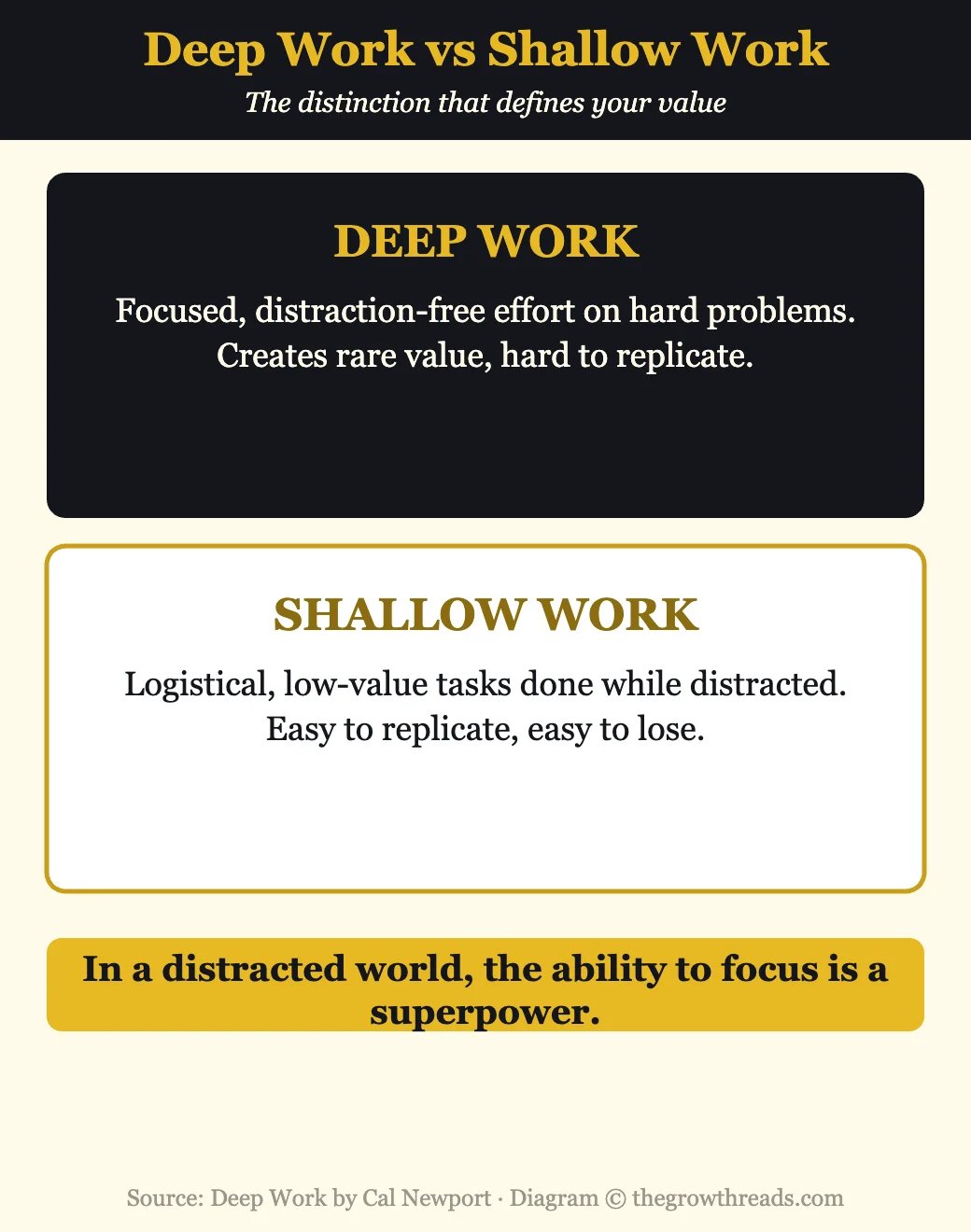
His central claim, the “deep work hypothesis,” is that this ability is becoming increasingly rare at exactly the same time it is becoming increasingly valuable, so the few who cultivate it will thrive. He argues the new economy rewards two core abilities: the ability to quickly master hard things, and the ability to produce at an elite level in terms of both quality and speed. Both depend on deep work, because deliberate practice and high-quality output require intense, uninterrupted focus. The workers who can concentrate deeply will out-learn and out-produce the majority who cannot.
The tragedy, Newport says, is that most modern workplaces are engineered to prevent deep work. Open-plan offices, the expectation of instant email replies, endless meetings, and the constant pull of social media create a state of perpetual distraction. He introduces the concept of attention residue to explain why this is so costly: when you switch from one task to another, a residue of your attention stays stuck on the previous task, so the more you switch, the more of your cognitive capacity leaks away. Constant connectivity does not just interrupt deep work — it slowly erodes your very ability to do it.
Part 2: Deep work is valuable, rare, and meaningful
Before the how-to, Newport spends the first half of the book convincing you that deep work is worth the difficulty, along three lines. First, it is valuable. He connects it to the science of deliberate practice — the finding that expert performance comes from intense, focused practice on specific weaknesses — and offers a simple formula: high-quality work produced equals time spent multiplied by the intensity of focus. Two people can work the same hours, but the one who works with greater intensity of concentration produces far more. This is why a handful of genuinely deep hours can outproduce a whole day of shallow, distracted effort.
Second, deep work is rare, and Newport is fascinated by why organizations tolerate so much shallowness. His answer is the “metric black hole”: the value of deep work and the cost of distraction are hard to measure, so in the absence of clear metrics, people fall back on busyness as a proxy for productivity. Answering email quickly and being visibly active feel productive, even when they crowd out the focused work that actually matters. Because distraction is the path of least resistance, it wins by default unless you deliberately resist it. Third, deep work is meaningful. Drawing on research into flow and the philosophy of craftsmanship, Newport argues that a life spent in deep concentration is not just more productive but more satisfying — that we feel best when fully absorbed in demanding, skillful work, and that a distracted life is a shallow one in more than the technical sense.
TGR Note: Newport’s “time × intensity of focus” is the productivity twin of the single-priority argument in The One Thing and the Quadrant 2 discipline in The 7 Habits of Highly Effective People. All three say the same thing from different angles: your best results come from protecting a small amount of your most important, least urgent work from the tyranny of the shallow and the loud.
Part 3: Rule 1 — work deeply (and pick your philosophy)
The second half of the book delivers four rules. Rule 1, Work Deeply, tackles the reality that willpower is finite: you cannot simply decide to focus more. Instead, you must build routines and rituals that make deep work the default and remove the friction of starting. Newport surveys how highly productive people schedule their focus and distills four philosophies you can choose from.
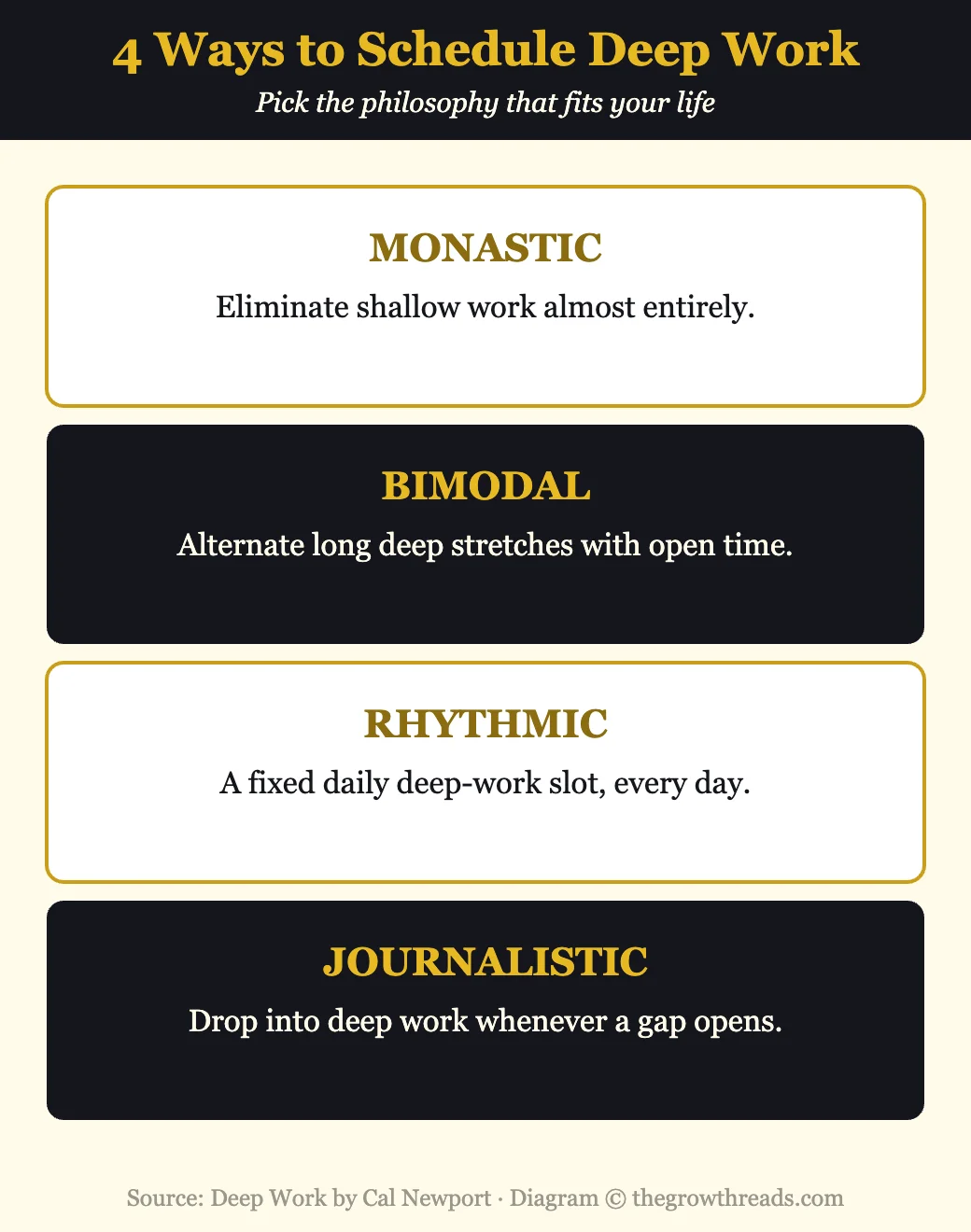
The monastic philosophy eliminates or radically minimizes shallow obligations — suited to people whose value comes from one clearly defined deep pursuit. The bimodal philosophy divides your time, dedicating some long stretches (days or more) entirely to depth while leaving the rest open. The rhythmic philosophy — the most practical for most people — turns deep work into a daily habit by reserving a fixed slot every day, so it never requires a decision. The journalistic philosophy, the hardest to pull off, means dropping into deep work whenever a gap appears in your schedule. Beyond choosing a philosophy, Newport recommends concrete supports: rituals that specify where and how long you will work, occasional “grand gestures” (like Rowling’s hotel) that leverage a big change of environment to spur focus, executing on a small number of “wildly important goals,” and — crucially — a strict shutdown ritual that ends the workday completely, freeing your mind to rest and recover.
Part 4: Rules 2, 3, and 4 — boredom, tools, and the shallows
Rule 2, Embrace Boredom, addresses the muscle behind deep work: attention. If you reach for your phone at the first hint of boredom — in line, at a red light, during a lull — you are training your brain to depend on constant novelty, which makes sustained focus impossible. Newport’s counterintuitive advice is to schedule your distraction rather than your focus: decide in advance when you are allowed to use the internet, and stay off it the rest of the time, so you rebuild your tolerance for undistracted effort. He also suggests exercises like “productive meditation,” using a walk or commute to work through a hard problem entirely in your head.
Rule 3, Quit Social Media, applies what he calls the craftsman approach to tool selection: rather than adopting a tool because it offers any benefit, adopt it only if its benefits to the things you deeply value clearly outweigh its costs to your time and attention. For most people, applied honestly, this means abandoning the majority of social media, whose small benefits rarely justify their large drain on focus. Rule 4, Drain the Shallows, then minimizes what remains: schedule every minute of your workday, quantify the depth of each activity by asking how long it would take to train a smart new graduate to do it, and set a hard cap on shallow work.
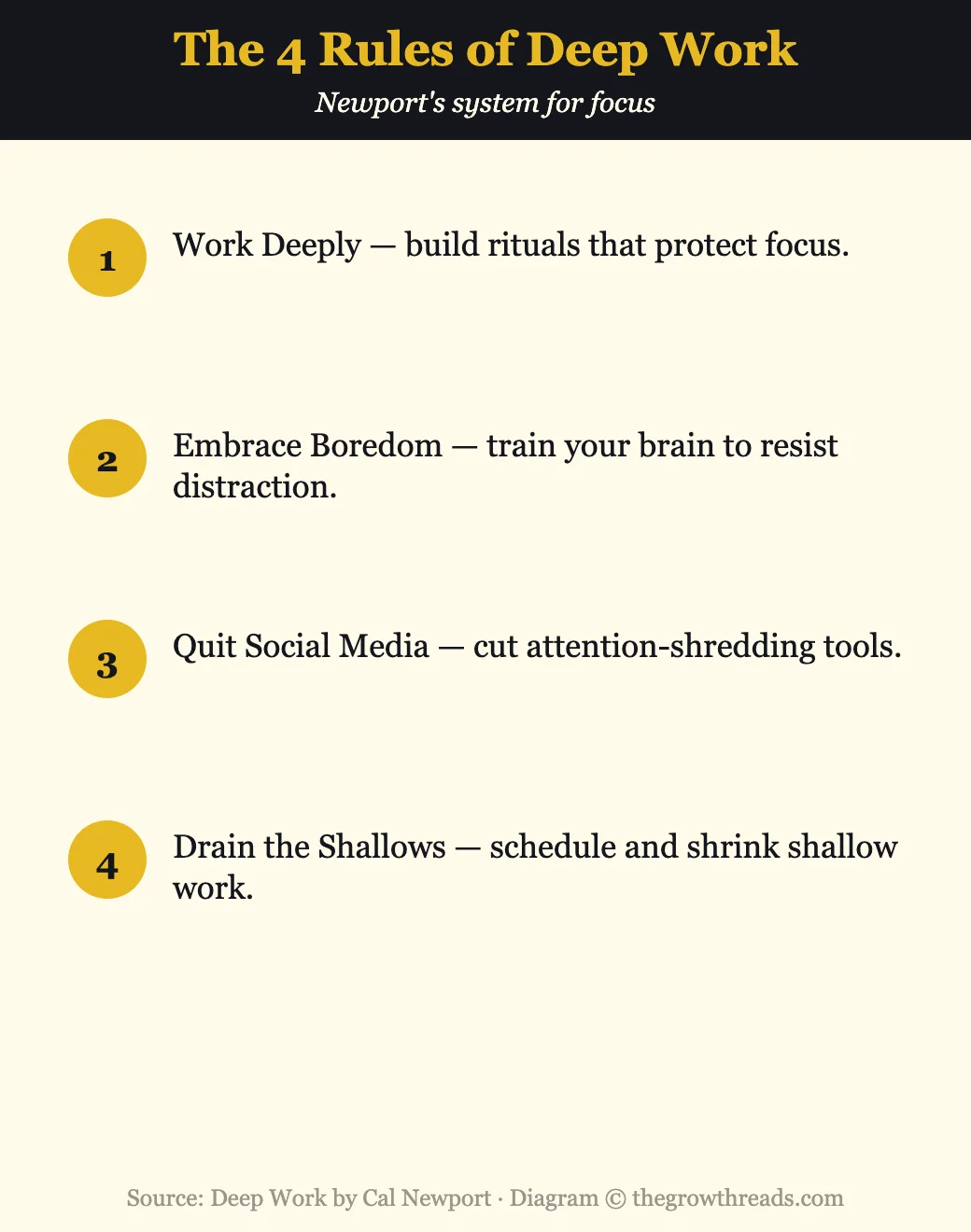
He champions “fixed-schedule productivity” — setting a firm end time to your workday and then working backward, which forces you to be ruthless about protecting deep work and cutting the shallow. Taken together, the four rules form a coherent system: build the routines, train the attention, cut the tools, and defend the calendar. Newport’s promise is that a focused life is not only more productive but genuinely richer.
TGR Note: Newport tells you to build focus rituals but is light on the mechanics of habit formation — the exact gap Atomic Habits fills with cue, craving, response, reward. And once you have carved out deep-work time, Getting Things Done gives you a trusted system for the shallow tasks so they stop invading your focus. Deep Work sets the strategy; those two supply the tactics.
Who is Deep Work best for — and who should read something else first?
This book is ideal for knowledge workers, writers, programmers, researchers, and students — anyone whose output depends on thinking hard and who feels their attention being shredded by distraction. Newport’s analytical, evidence-based style makes the case persuasively. It is not the right book if you want a gentle, motivational read or if your work is largely collaborative and interrupt-driven by necessity, since some advice assumes control over your schedule that not everyone has. If you want the habit mechanics to support deep work, start with Atomic Habits; for the broader philosophy of doing less but better, pair it with Essentialism.
Questions to reflect on
- How many genuinely deep, distraction-free hours did you work last week — and how many shallow ones?
- Which of the four philosophies actually fits the shape of your days?
- What do you reach for the instant you feel bored, and what is it training your brain to expect?
- If you applied the craftsman test honestly, which tools would you keep — and which would you quit?
- What would a firm shutdown ritual look like for you, and what is stopping you from using one?
🔥 Ready to reclaim your focus?
This guide is the map — Newport’s research and case studies are what make the argument impossible to unsee.
How to apply Deep Work (7-day plan)
- Day 1 — Audit your work. Track a day and label each task deep or shallow. Notice the ratio honestly.
- Day 2 — Pick a philosophy. Choose monastic, bimodal, rhythmic, or journalistic for the season you’re in.
- Day 3 — Schedule one deep block. Reserve a fixed 60–90 minute slot, phone in another room, and protect it.
- Day 4 — Embrace boredom. Schedule your internet use; resist the phone in every idle moment today.
- Day 5 — Run the craftsman test. Pick one app and honestly weigh its benefits against its cost to your focus.
- Day 6 — Drain the shallows. Time-block your whole day and set a hard cap on shallow work.
- Day 7 — Build a shutdown ritual. Create a firm end-of-work routine and actually rest afterward.
Frequently asked questions
Is Deep Work worth reading?
Yes, especially for anyone whose work depends on thinking hard. It makes a genuinely persuasive, research-backed case that focus is the defining skill of the modern economy, and it backs the argument with a concrete system of four rules and four scheduling philosophies. Newport’s analytical style means it is more of a well-argued treatise than a motivational pep talk, which many readers prefer. If distraction is eroding your productivity, few books offer a clearer diagnosis and remedy.
What is the main message of Deep Work?
That the ability to focus without distraction on demanding tasks is becoming rare and valuable, making it a competitive and personal advantage. Newport argues the modern economy rewards quickly mastering hard things and producing elite work, both of which require deep concentration — while distraction is systematically destroying our capacity for it. The remedy is to treat focus as a trainable skill and defend it deliberately with routines, boredom tolerance, careful tool choices, and a capped shallow-work schedule.
What is the difference between deep work and shallow work?
Deep work is focused, distraction-free effort on cognitively demanding tasks that create new value, stretch your abilities, and are hard to replicate — writing, coding, analysis, design. Shallow work is logistical, non-demanding tasks often done while distracted, such as most email, routine meetings, and administrative busywork; it is easy to replicate and rarely creates lasting value. Newport argues most people spend far too much time in shallow work and mistake its busyness for real productivity.
What are the four rules of Deep Work?
They are: 1) Work Deeply — build rituals and choose a scheduling philosophy that makes focus your default; 2) Embrace Boredom — train your attention by resisting constant stimulation and scheduling your distraction; 3) Quit Social Media — apply a craftsman’s test and keep only tools whose benefits outweigh their costs; and 4) Drain the Shallows — schedule every minute, quantify the depth of tasks, and cap shallow work. Together they form a system for protecting and strengthening your ability to concentrate.
What are the four philosophies of deep work?
They are four ways to fit deep work into your life. The monastic philosophy eliminates shallow obligations almost entirely. The bimodal philosophy alternates long stretches of pure depth with open time. The rhythmic philosophy — the most practical for most people — reserves a fixed deep-work slot every day so it becomes a habit. The journalistic philosophy means dropping into deep work whenever a gap appears, which is the hardest to sustain. You choose the one that matches your role and schedule.
How long does it take to read Deep Work?
The book is around 300 pages and most readers finish it in about seven hours. It is split into two halves — the argument for deep work and the four rules — so it reads well in sections. Our summary above captures the core ideas in roughly 16 minutes, though Newport’s case studies and research are part of what makes the argument stick.
Does Deep Work really mean you have to quit social media?
Not necessarily quit everything, but Newport asks you to stop adopting tools by default. His craftsman approach says to keep a tool only if its benefits to the things you truly care about clearly outweigh its costs to your time and attention. Applied honestly, that test leads many people to drop most social media, because the modest benefits rarely justify the large drain on focus. The goal is intentional tool use, not blanket abstinence.
Related summaries
- Atomic Habits Summary — the habit mechanics to install your deep-work rituals.
- The One Thing Summary — narrowing to your single highest-value focus.
- Getting Things Done Summary — a trusted system for the shallow tasks.
- Essentialism Summary — doing less, but better.
- Browse all our best productivity books.
How we analyze books: We work from the full book — reconstructing its core arguments in our own words, adding commentary that connects it to related research and other books in our library, and pressure-testing the advice against how it plays out in real life. We never reproduce the text; we synthesize it. Read our full methodology.
Disclosure: The Growth Reads is reader-supported. When you buy through links on our site we may earn an affiliate commission at no extra cost to you. We only recommend books we believe are worth your time, and our summaries and opinions are written independently.
Related Productivity Summaries
Effortless Summary & Review: Make What Matters Most Easier
Make Time Summary & Review: Design Your Day Around What Matters
Slow Productivity Summary & Review: The Case for Doing Fewer Things Better
The Miracle Morning Summary & Review: Wake Up to Your Full Potential
The Power of Habit Summary & Review: Why We Do What We Do