

★★★★☆ 4.3/5 — A tiny-offer playbook for people who already have a skill and keep waiting for permission.
Best for: side-project people, freelancers, and operators who can deliver a result this month.
Reading time: ~5 hours (304 pages) · this guide ~12 min
Difficulty to apply: Medium. Write one offer. Talk to ten humans. Do not build a company costume.
The $100 Startup in one minute
You already have a skill. The scarce move is an offer one person will pay for. Chris Guillebeau wrote The $100 Startup (Crown Business, 2012) after cataloging hundreds of tiny businesses that did not wait for funding, a warehouse, or a five-year plan. The pattern is blunt: passion that lasts, a skill you can already deliver, and usefulness — a result someone will pay for. Where those three overlap, you have a sweet spot. Then you write an offer, talk to humans, and collect a first yes. Overhead stays near zero on purpose. A PDF, a workshop, a consulting hour, a service from a laptop. The $100 is a constraint that kills the funding stall, not a dare to underprice forever.
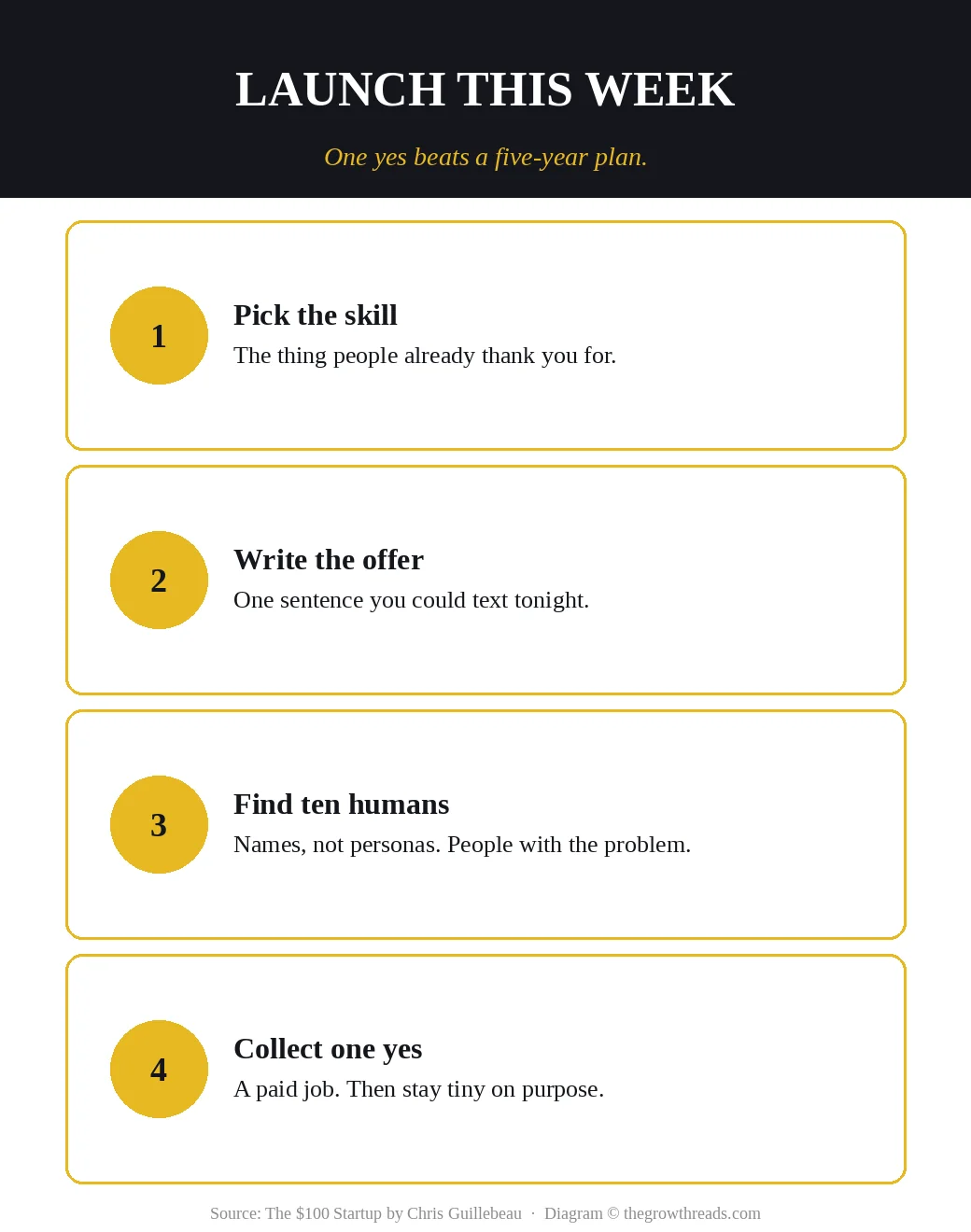
Tonight, name the skill people already thank you for. Write one sentence they could buy. List ten humans. That is the whole entry fee.
Key takeaways
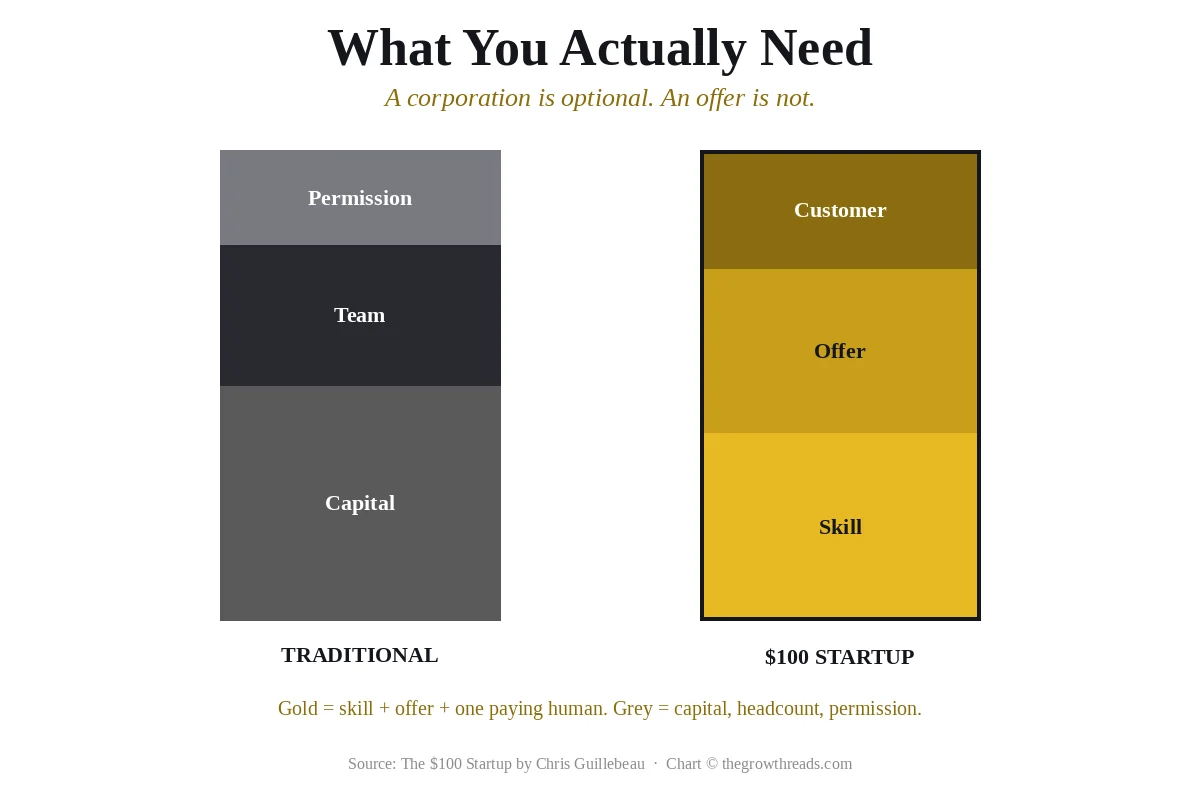
- Permission is not a prerequisite: A skill plus a buyer beats a business plan that never meets a human.
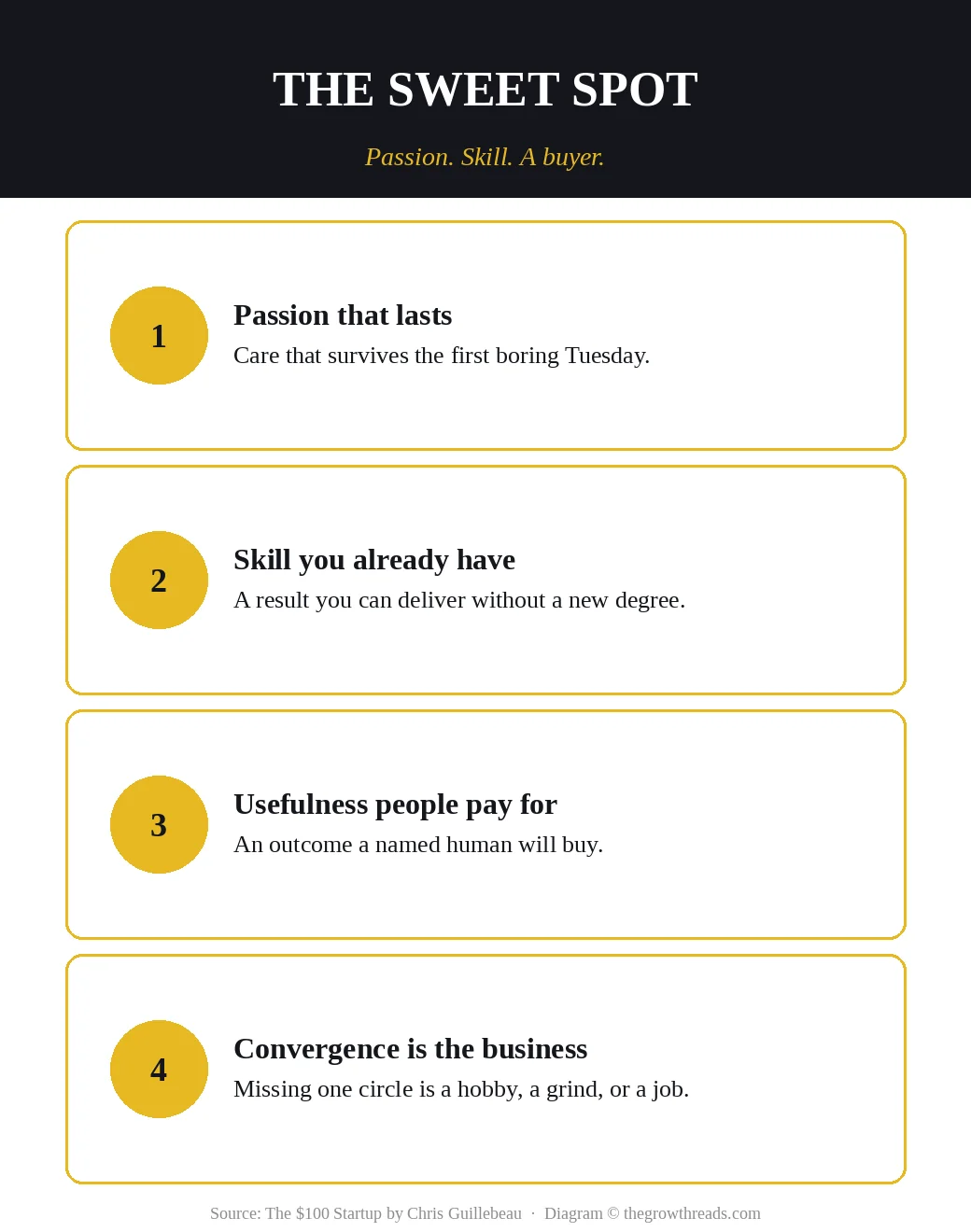
- The sweet spot is three circles: Passion, skill, and usefulness. Missing one is a hobby, a grind, or a job you will resent.
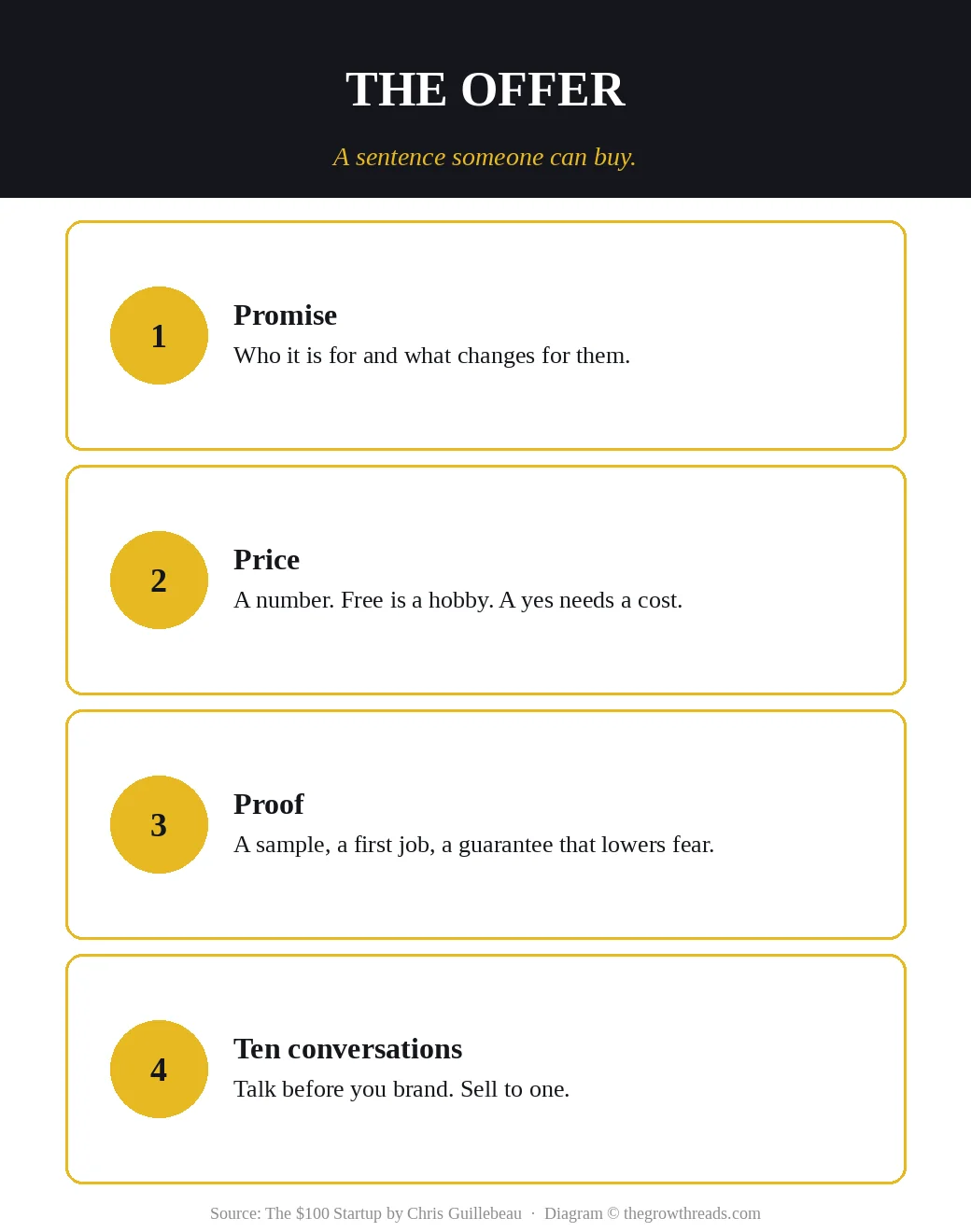
- An offer is a sentence: Who it is for, what result they get, what it costs. If you cannot text it, it is not an offer yet.
- $100 is a constraint: First products should cost almost nothing. If you need a warehouse before a customer, shrink the offer.
- Talk to ten, sell to one: Case studies beat branding. Conversations beat a perfect homepage.
- Price is part of the product: Free advice is a hobby. A number makes the exchange real.
- Hustle, then decide what to systemize: Do the first jobs by hand. The awkward bits are the product spec.
- Stay tiny on purpose: Employees, inventory, and extra offers are optional. Freedom is the point.
- Give more than you take: Help, teach, and be easy to buy from. Reputation is the cheapest distribution.
What is The $100 Startup about?
The $100 Startup is Chris Guillebeau’s playbook for turning a skill you already have into a tiny, paying offer. Merge passion, competence, and a result people will buy. Write the offer as a sentence, talk to real humans, and collect one yes before you build a company. Stay small on purpose.
About the author
Chris Guillebeau is an American writer and entrepreneur known for tiny businesses and long-haul travel. He ran the Art of Non-Conformity blog, visited every country, and hosted the World Domination Summit in Portland — a gathering for people who wanted meaningful work without a traditional script. The $100 Startup (Crown Business, 2012) is the field notebook from hundreds of microbusiness interviews: bakers, consultants, designers, and guides who kept overhead near zero and still paid the rent. He later wrote Side Hustle, Born for This, and Time Anxiety. The voice is practical traveler, not venture capitalist. Read him when you already have a skill and the remaining stall is permission, funding, or a logo. Explore all Chris Guillebeau book summaries →
Key concepts at a glance
| Concept | What it means | Use it when |
|---|---|---|
| Sweet spot | Passion, skill, and usefulness overlap. | You have a hobby, a grind, or a market with no fingerprint. |
| Offer sentence | Who, result, price. Textable in one line. | Your homepage is a mood board. |
| $100 constraint | First version costs almost nothing. | You are waiting on funding or inventory. |
| Follow-your-passion trap | Passion without a buyer is a weekend. | The plan is “do what I love” with no human attached. |
| Hustle, then systems | Do jobs by hand. Then cut the awkward steps. | You are productizing a service you have never delivered. |
| Freedom business | Stay tiny so the calendar stays yours. | Growth starts to look like a second boss. |
| Give first | Help and teach before you pitch. | You are a stranger asking for money. |
| One customer | A yes is the business. A plan is not. | You have slides and zero receipts. |
Part 1: The unexpected surprise — you already have a business
Guillebeau’s opening is not a pep talk about quitting on Monday. It is a catalog. All over the world, people are paying rent from skills that never needed a board meeting: a tour, a tutorial, a repair, a design hour, a tiny product shipped from a kitchen table. The surprise is how ordinary the ingredients are. You do not need an MBA, a warehouse, or employees. You need a result someone already wants, delivered by a person who can already do the work. The renaissance he names is not “everyone becomes a founder.” It is “the company costume is optional.” If The 4-Hour Workweek made lifestyle design famous, this chapter is the smaller door: one offer, one customer, overhead you can list on an envelope.
Desk translation is unromantic. The skill is probably something people already thank you for. The stall is usually costume: the LLC, the logo, the course platform, the “when I have time.” Guillebeau’s travelers and bakers did not wait to feel official. They made a thing a neighbor could buy. If Rework is stay small after you have a shop, this chapter is permission to start without a shop. You are not behind. You are over-equipped and under-offered.
TGR Note: If the remaining leak is a job you want to leave and automate, stay with The 4-Hour Workweek. If the remaining leak is building less and shipping more inside a company you already have, stay with Rework. Come here when there is still no offer a stranger could buy this month.
Part 2: The sweet spot — passion, skill, and a market
The book’s most stolen diagram is three circles. Passion that will last after the novelty dies. Skill you can deliver without a new degree. Usefulness — a result a specific person will pay for. Follow-your-passion as a solo instruction is how people open shops they resent. Skill without care is a grind you will abandon. A market with no fingerprint is a job with extra invoices. The business lives in the overlap. Guillebeau’s case studies keep repeating the same test: can you name the human, the outcome, and the thing you will do on Tuesday? If not, you are still collecting circles. Convergence is the work. A mood board is not a sweet spot.
Steal the test, not a new personality. Write the skill in one line. Write who already asks you for it. Write the outcome they want in their words. If The E-Myth Revisited is systems for a shop that already exists, this chapter is whether a shop should exist. If The Lean Startup is experiment-and-measure for a product that might scale, the sweet spot is the one-person version of “who is this for.” Stay with the overlap until the offer sentence is boringly clear.
TGR Note: If you keep pitching the idea to polite friends, switch to The Mom Test before you price anything. You need their last attempt, not a compliment. If you want a second brain for the research pile, park it in Building a Second Brain — research is not an offer.
Part 3: The offer — make something people will pay for
An offer is not a vibe. It is a promise, a price, and a way to say yes. Guillebeau keeps dragging readers back to a sentence you could text: who it is for, what changes, what it costs. Free is a hobby. A number makes the exchange real. Proof can be a sample, a first client, a before-and-after, a guarantee that reduces fear. The first version should cost almost nothing to make — the $100 constraint again — so you are not protecting inventory. Launch is a conversation, not a campaign. Talk to ten people who already have the problem. Sell to one. The homepage can wait until a human has paid. Hustle here means doing the awkward asks, not posting more.
Steal one sentence this week. If The Mom Test keeps you from leading the witness, this chapter is what you say after you have listened: here is the result, here is the price, do you want it? If The Personal MBA is the map of value creation, this is the smallest value creation that can clear this month. Do not productize a service you have never delivered. Do the job by hand. The awkward steps are the spec.
TGR Note: If the remaining leak is never crossing the last mile of a project that is already on the desk, Finish is the emotional companion. If the remaining leak is a missing deep-work door so the offer never gets written, close it with Deep Work. The offer still needs a room the inbox cannot enter.
Part 4: Launch, hustle, and keep your freedom
The last movement is growth without a second boss. Do the first jobs. Then decide what to repeat, what to drop, and what never to add. Employees, inventory, and extra offers are optional. Many of Guillebeau’s people stayed one-person on purpose because freedom was the point. Hustle is the messy middle of delivery, not a personality. Once a motion repeats, write it down — that is the E-Myth instinct arriving at the right time, after a customer exists. Give more than you take: teach, introduce, be easy to buy from. Reputation is cheaper than ads. When scale starts to look like a job you just invented, shrink. A freedom business that pays the rent beats a company that owns your calendar.
Steal the ending. Finish this week with one yes, or with a clear no and a sharper sentence. If Company of One is stay small as strategy, this chapter is how you earned the right to that strategy. If Profit First is how money leaves the jar later, do not install jars before a customer exists. You do not graduate from the offer sentence. You run it again on a slightly better skill.
TGR Note: If after the first yes you still wait to feel official, stay with this book one more week. If you need identity through a tiny cue instead of an offer, stay with Atomic Habits. The $100 Startup is the offer layer those habit books can hang on when the skill is already there.
Who is The $100 Startup best for — and who should read something else first?
Best for people who can already deliver a result and keep waiting for funding, a logo, or a sabbatical: freelancers, operators, teachers, makers, side-project people. If you want lifestyle design around an existing income engine, go to The 4-Hour Workweek. If you want systems for a shop that already has customers, go to The E-Myth Revisited. If you want to stay one person as a long-term strategy, go to Company of One.
Read something else first if you still cannot start a two-minute task — begin with Mini Habits. If you pitch ideas to polite friends and hear only compliments, start with The Mom Test. If you need a closed door before any offer gets written, start with Deep Work. Come to The $100 Startup when you can already do the work and the remaining failure mode is “I need more money, more time, more permission.”
Questions to reflect on
- What skill do people already thank you for — not the one you wish you had?
- If you had to text an offer in one sentence tonight, what would it say?
- Who are the ten humans, by name, who already have the problem?
- What are you calling “preparation” that is actually a company costume?
- If a customer paid tomorrow, what would you refuse to add this year?
🔥 Ready to make the first offer?
One skill. One sentence. One yes this month.
How to apply The $100 Startup (7-day plan)
- Day 1 — Name the skill. Write the thing people already thank you for. One line. No logo.
- Day 2 — Write the offer sentence. Who it is for, what result they get, what it costs. One sentence you could text.
- Day 3 — List ten humans. Names, not personas. People who already have the problem your skill solves.
- Day 4 — Three conversations. Ask about their last attempt, not your idea. Steal The Mom Test. Take notes.
- Day 5 — Price and ask. Put a number on the offer. Ask one person to buy. A no is data. A yes is a business.
- Day 6 — Deliver the first job. Do the work by hand. Write what was awkward. That list is next week’s product.
- Day 7 — Write what you will not add. No warehouse, no extra offer, no hire. Stay tiny. Name next week’s one customer.
Frequently asked questions
What is The $100 Startup about?
The $100 Startup is Chris Guillebeau’s field guide for building a tiny business from a skill you already have. You do not need venture capital, a warehouse, or a five-year plan. You need a convergence: something you care about, something you can do, and something people will pay for. Then you write an offer, talk to humans, and collect a first yes. The case studies are bakers, consultants, designers, and tour guides who kept overhead near zero. Read it as a shipping manual for a one-person shop, not as a growth-at-all-costs playbook. The scarce move is the offer, not the logo.
How long does it take to read The $100 Startup?
The Crown Business hardcover is about 304 pages. Most readers finish in five hours. This summary is a twelve-minute pass: the microbusiness renaissance, the sweet spot, the offer, and a seven-day plan that aims at one paying customer. If you only have lunch, name the skill people already thank you for, write one sentence they could buy, and list ten humans who might say yes. The travel stories can wait. The World Domination Summit lore can wait. A first conversation cannot. The book is an offer workshop, not a new personality by Friday.
What is the sweet spot in The $100 Startup?
The sweet spot is Guillebeau’s three-circle overlap: passion that will last past the novelty, a skill you can already deliver, and usefulness — a result someone will pay for. Passion without a buyer is a hobby. Skill without care burns you out. A market without your fingerprint is a job you will hate. The business lives where those three meet. Desk translation: write the skill, write who already asks you for it, write the outcome they want. If you cannot name a paying human, you do not have a sweet spot yet. You have a mood board. Stay with the overlap until an offer sentence exists.
Do you really only need $100 to start?
The $100 is a constraint, not a stunt. Guillebeau’s point is that most first offers cost almost nothing: a PDF, a weekend workshop, a consulting hour, a service you can deliver from a laptop. You are buying a domain, a simple page, maybe samples — not a storefront and a payroll. Some of his case studies spent less; some spent a little more. The number is there to kill the ‘I need funding first’ stall. If your plan requires a warehouse before a customer, it is not this book. Make the smallest offer that can collect a yes this month. Then decide what, if anything, is worth buying.
How is The $100 Startup different from The 4-Hour Workweek or The E-Myth?
The 4-Hour Workweek is lifestyle design: escape the office, automate, and buy back time. The E-Myth is how a technician builds systems so the shop does not die when they take a day off. The $100 Startup is earlier than both — how a skill becomes an offer and a first yes without a company costume. Lean Startup is the experiment loop for products that might scale. This book is the one-person version: talk to ten humans, sell one thing, stay tiny. Use 4HWW to leave a job. Use E-Myth when a shop cannot run without you. Use this when you still have no offer.
Who should read something else before The $100 Startup?
If you still freeze on a two-minute start, begin with Mini Habits. If you need a deep-work door before any side offer, start with Deep Work. If you have an idea and keep pitching it to polite friends, start with The Mom Test — you need conversations about their life, not compliments about your concept. If you want to stay one person forever as a strategy, Company of One is the later companion. Come here when you can already start a small project and the remaining leak is ‘I need more money, more time, more permission.’ You do not. You need an offer and one yes.
What should I do on day one with The $100 Startup?
Do not register an LLC. Do not buy inventory. Name the skill people already thank you for — the thing friends ask you to do, explaining, fixing, designing, teaching. Write one sentence: who it is for, what result they get, what it costs. List ten humans who might pay. That is the whole entry fee. The bicycle-on-the-cover energy can wait. A prettier brand can wait. If you cannot name ten humans, you do not have a market yet. You have a hobby. This is not tax, legal, or investing advice. Treat every case study as a pattern for a tiny offer, not a promise of income.
Related summaries
- The 4-Hour Workweek — lifestyle design around time; this book is the tiny offer that can fund it.
- Rework — stay small after you have a shop; Guillebeau is how the shop starts.
- The Mom Test — conversations about their life, not compliments about your idea.
- The E-Myth Revisited — systems once customers exist; do not install them before a yes.
- Best productivity books — the full Productivity silo.
How we analyze books: every book on The Growth Reads is read cover to cover, summarized in thousands of words of original analysis, and rated against our five-criteria rubric (lasting impact, evidence quality, practical application, writing & originality, external consensus). Read our full methodology.