

★★★★½ 4.5/5 — a research-backed recipe for making one idea travel, not a plea to post more.
Best for: Makers, marketers, and managers whose work is good and still dies in the room
Reading time: ~5 hours (256 pages) · this guide ~14 min
Difficulty to apply: Easy to audit one asset — harder to kill the clever line that nobody would retell
Contagious in one minute
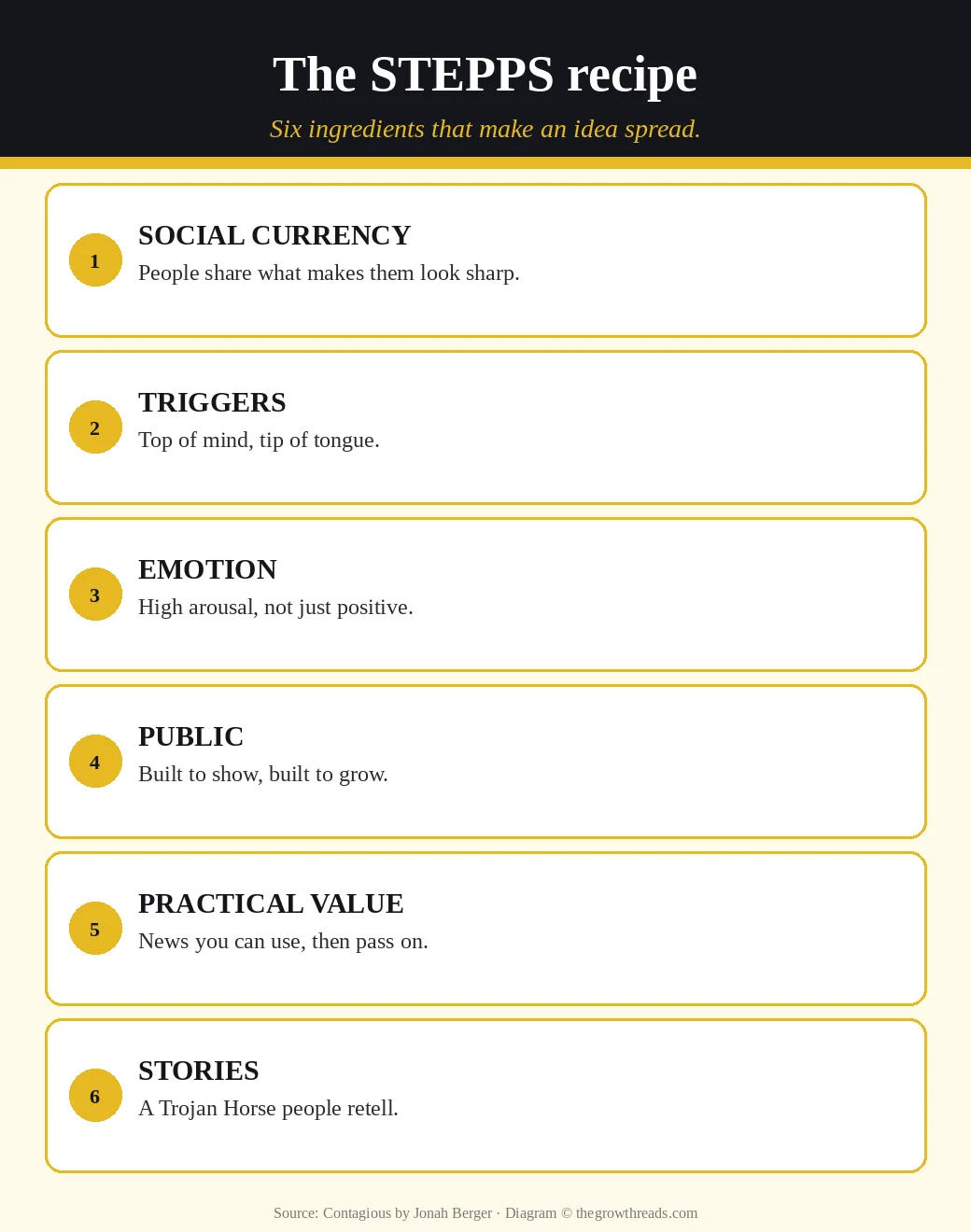
Better is not the same as talked about. Jonah Berger’s claim is blunt: people do not spread your work because it is correct. They spread it because it makes them look good, because something in the environment reminds them, because it spikes the body, because it is easy to copy, because it is useful enough to gift, or because it is wrapped in a story they want to tell. Contagious gives you six levers — STEPPS — so you can design the share on purpose. Read it to fix one asset this week, not to start a content calendar.
Key takeaways
- Word of mouth is the job, not a bonus: Talk is more persuasive and more targeted than a banner people have learned to mute.
- STEPPS is a recipe, not a funnel: Social currency, triggers, emotion, public, practical value, stories — missing one starves the share.
- People share to look good: Inner remarkability, scarcity, and a little game-mechanics status are social currency.
- Top of mind, tip of tongue: Triggers in the environment beat a one-time wow that nobody is cued to remember.
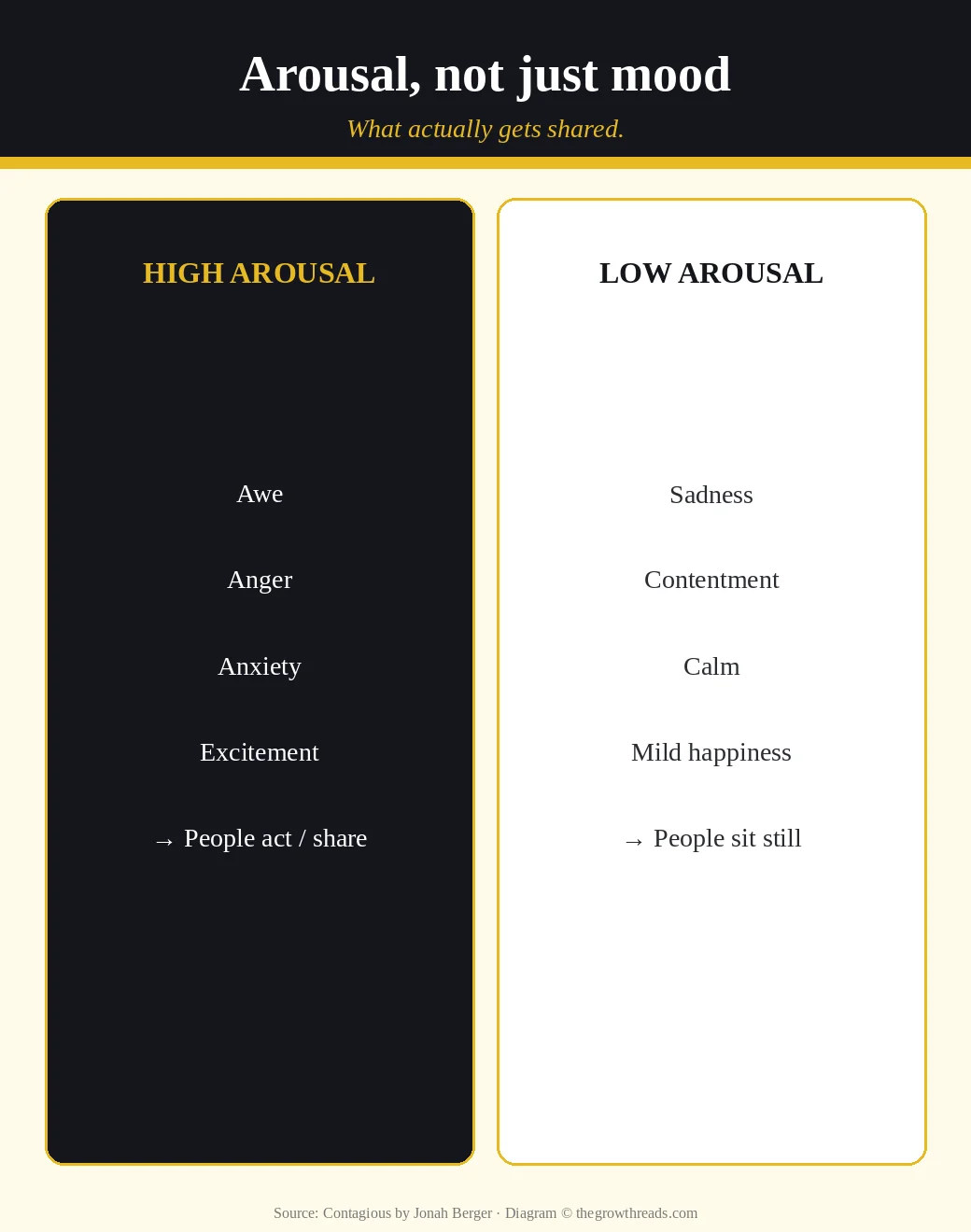
- Arousal, not just mood: Awe, anger, anxiety, and excitement move people. Sadness and contentment mostly do not.
- Built to show, built to grow: Observable behavior is easier to imitate. Leave residue someone can copy without a brief.
- News you can use gets forwarded: Specific, helpful value is a gift — and a reason to pass your name along.
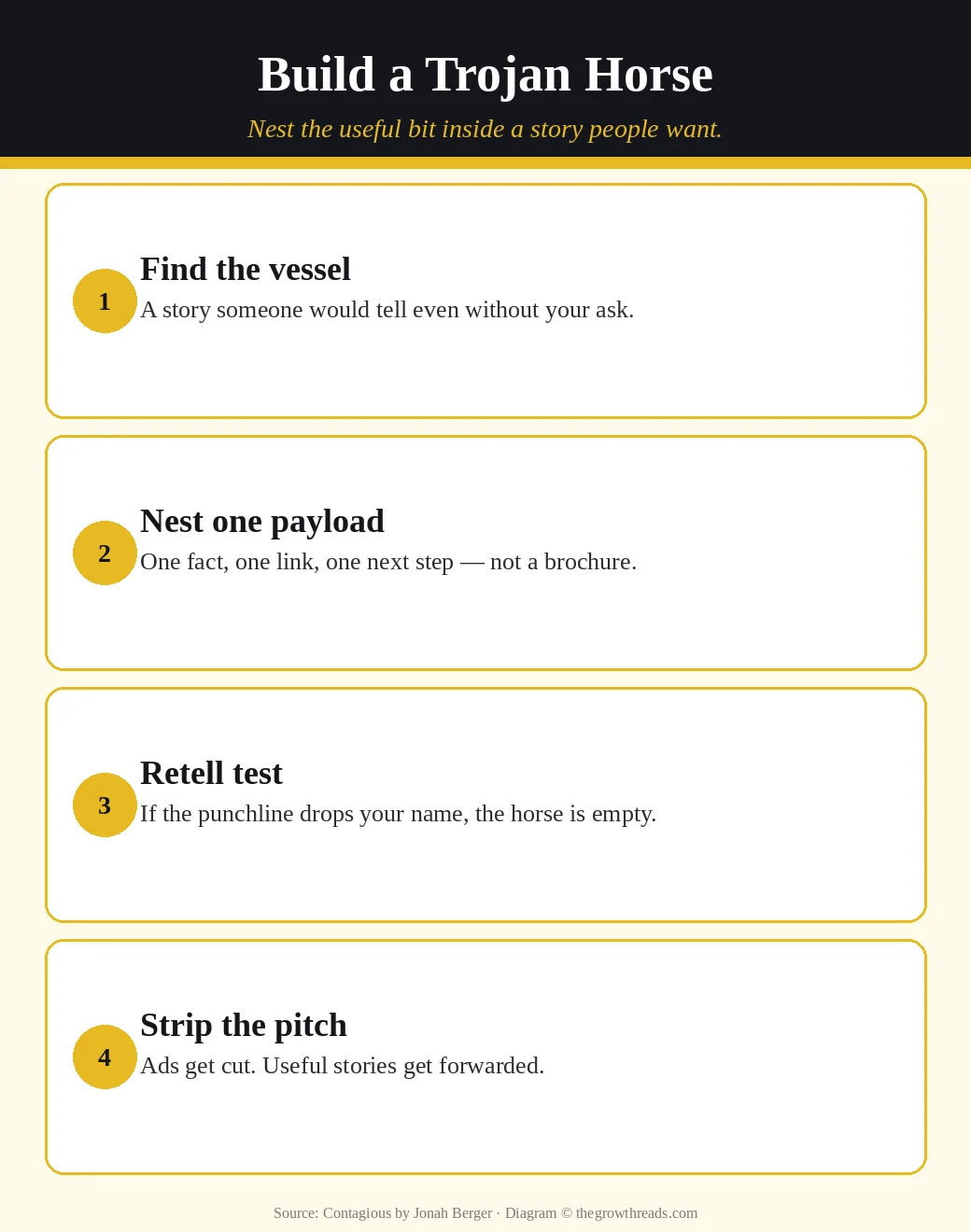
- Stories are Trojan Horses: People retell narratives and drop the brochure. Nest one payload in a vessel they would tell anyway.
- Virality is made: You do not wait for luck. You design the sentence people will actually repeat.
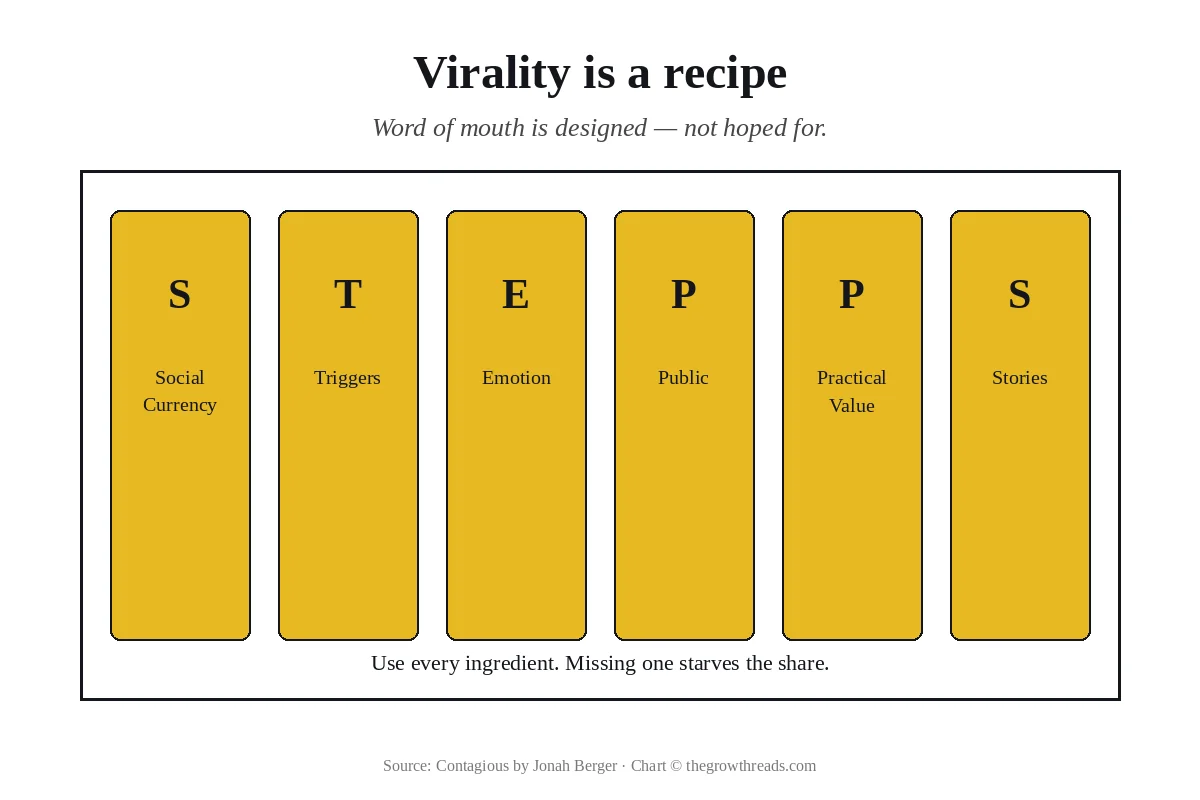

What is Contagious about?
Contagious is Jonah Berger’s 2013 field guide to why products, ideas, and videos spread. He argues word of mouth beats ads, then gives six levers — STEPPS: social currency, triggers, emotion, public, practical value, and stories — so you can design one piece of work that people actually talk about.
About the author
Jonah Berger is a marketing professor at the Wharton School of the University of Pennsylvania. He studies how social influence works — why people talk, what they share, and how little environmental cues change whether an idea travels. Before the book he was already publishing on why New York Times pieces make the most-emailed list. Contagious (2013) is the public version of that lab: Blendtec, a $100 cheesesteak, Hotmail signatures, and a checklist you can run without a research assistant. He later wrote Invisible Influence and The Catalyst. The voice is a teacher who wants you to leave with a recipe, not a vibe. Explore all Jonah Berger book summaries →
Key concepts at a glance
| Concept | What it means | Use it when |
|---|---|---|
| STEPPS | Six ingredients that make an idea travel | Your work is good and still dies in the room |
| Social currency | People share what makes them look sharp or in the know | The asset is correct and boring to mention |
| Inner remarkability | A detail worth repeating even without a brand | You are explaining features instead of a surprise |
| Triggers | Cues that bring you back to mind later | You got a one-time wow and then silence |
| High-arousal emotion | Awe, anger, anxiety, excitement — the body wants to act | The post is “nice” and nobody forwards it |
| Public / residue | If it is visible, it is easier to copy | The habit only happens behind a closed door |
| Practical value | Specific help people can gift to someone else | You are being clever instead of useful |
| Trojan Horse story | A narrative that carries one payload when retold | Your pitch gets stripped and nothing remains |
Part 1: Word of mouth is the work — and Social Currency is the bait
Berger opens by killing a comforting myth: if you build a better product, talk will take care of itself. People skip ads. They trust a person more than a placement. Word of mouth is more persuasive because it comes with a face, and more targeted because you only bother the friend who might care. Treat “people will share this” as a design constraint, not a hope.
Blendtec’s Will It Blend? videos are the proof that boring products can travel. A blender is not a story. A white-haired engineer dropping an iPhone into a jar and turning it to dust is. The product was already good. The share was designed: remarkable enough to mention, public enough to watch, wrapped in a repeating gag. You do not need a viral budget. You need a sentence a colleague would actually say at lunch.
Social Currency is the first lever because sharing is a performance. People talk to look good — in the know, generous, funny, connected to something scarce. Barclay Prime’s $100 cheesesteak is inner remarkability: you mention the price and the lobster, not a sandwich. Please Don’t Tell sold exclusivity you could gift by knowing the phone number. Game mechanics give people a status story they can tell without bragging about themselves. If mentioning this makes the speaker look ordinary, they will not mention it.
TGR Note: If the idea itself is mush, fix memory before you fix travel. Our Made to Stick summary is the Heath brothers’ SUCCESs checklist — simple, unexpected, concrete. Berger assumes you already have a point. Use Made to Stick when people forget. Use Contagious when they remember and still never tell anyone.
Part 2: Triggers and Emotion put you in the room
A remarkable moment that never comes back to mind is a firework. Triggers are the next morning. We talk about what we are reminded of. Rebecca Black’s Friday got a second life every Friday. Kit Kat linked itself to coffee so the kettle became an ad. The environment is a reminder machine. If your idea has no cue in the week, it will not be on anyone’s tongue.
This is why a clever launch week can still go quiet. You bought attention once. You did not install a trigger. Attach the work to something that already happens: a Friday recap, a standup, the walk to the printer. A weaker idea with a daily reminder will out-talk a brilliant idea that lives in a forgotten tab.
Emotion is the other engine, and Berger’s most useful correction is that positive is the wrong axis. With Katherine Milkman he looked at thousands of New York Times articles: awe, anger, and anxiety — high-arousal states — were shared more than sadness. Contentment is pleasant and still. Excitement and a clean surprise make the body want to do something, and sharing is a something. You do not have to manufacture outrage. A “nice” update that lowers the pulse will be liked and never forwarded.
TGR Note: Triggers are cousin to habit cues. If the stall is that nobody remembers to do the thing, not that nobody would praise it, pair this chapter with our Atomic Habits summary. Clear wants a cue, a craving, a response, a reward. Berger wants the same cue to put your name in someone else’s mouth. Park the work next to a kettle, a calendar block, or a Friday ritual so the environment does the reminding.
Part 3: Public and Practical Value make copying easy
If it is built to show, it is built to grow. Private behavior is hard to imitate because nobody sees the script. Hotmail put “Get your free email at Hotmail” under every message — behavioral residue that advertised while you were busy being a person. Apple’s white earbuds turned a private listen into a sidewalk billboard. LiveStrong yellow bands and Movember moustaches made a choice wearable. Berger’s phrase is a design rule: make the desired action observable. Leave a residue. Give people something they can copy by watching, not by reading a wiki.
Inside a company this is not a billboard. It is a habit on a visible board versus a habit in a private doc. If the good way of working is invisible, it will not spread no matter how many all-hands you run. Put the artifact where a passerby can steal it: a named template, a standup demo, a laptop sticker that starts a conversation. Public is not loud. It is copyable.
Practical Value is the generous lever. People share useful specifics because helping is a gift and because it still makes them look competent. The frame of a discount matters more than we admit. Berger’s application is not “be promotional.” It is “pack one usable rule.” A number, a threshold, a “do this on Tuesday” travels farther than a vibe. Shrink the update until it can be gifted in one sentence.
TGR Note: If the real problem is that the work never leaves your desk, Austin Kleon’s Show Your Work is the daily public-practice companion. Kleon wants you to share the process in public. Berger wants the thing you share to have a reason to be passed along. Use Kleon for the cadence. Use STEPPS so the cadence is not just more noise. For one-to-one moving of people rather than broadcasts, To Sell Is Human is the craft book.
Part 4: Stories carry the payload
People do not think in bullet points. They think in narratives, and they retell narratives with the boring bits cut. That is the Trojan Horse: nest the useful fact inside a story someone would tell even if you never asked. Jared’s Subway story carried a weight-loss proof because it was a person, not a macro. A story about landmines can carry a statistic that would die as a slide. Berger’s warning is the one that saves campaigns: if the punchline works with your name removed, you built entertainment, not a vessel. Run the retell test out loud. If a friend can tell the story and never mention the product, the horse is empty.
“Virality isn’t born, it’s made.” That is the whole book in six words. You do not wait for a platform to bless you. You pick one asset. You run STEPPS as six lines on a page. You change the one line that is currently starving the share — usually remarkability or a missing trigger — and you ship. The Dip is what to do when the work is hard and you are deciding whether to quit. Contagious is what to do when the work is fine and still invisible. They are different stalls. Name yours before you buy another tactic.
Put the six letters on the asset, not on a vision poster. If you cannot answer each lever in a clause, that lever is off. Turn one on. Then stop decorating.
Who is Contagious best for — and who should read something else first?
Best for people whose work is already clear and still fails to travel: product people, newsletter writers, internal-tools owners, founders who keep shipping features nobody mentions, managers who want a habit to spread without another all-hands. Also for anyone who has been treating “viral” as luck. Berger gives you a shop checklist.
Read something else first if the idea itself is still mush — start with Made to Stick. If you need a daily practice of putting work in public, Show Your Work. If the stall is one conversation, not a broadcast, To Sell Is Human. If you are in a hard slog and deciding whether to quit, The Dip. Come back to Contagious when you have something worth talking about and nobody is talking.
Questions to reflect on
- Which piece of work from the last month was correct — and still never mentioned in a room you were not in?
- If a colleague repeated your idea at lunch, what sentence would they actually say? Write it. Then look at how far it is from your current headline.
- What already-happening cue in the week could carry your name without a new campaign?
- Does this asset spike arousal, or does it only inform? If you had to pick awe or a usable rule, which one is missing?
- Run the retell test: if your logo falls off the story, what payload is left?
🔥 Ready to stop hoping it catches on?
Get Contagious, then run STEPPS on one asset this week — not a new content calendar.
How to apply Contagious (7-day plan)
- Day 1 — Pick one asset, not a brand. A post, a deck, a feature, a one-pager. Write its current headline at the top of a card.
- Day 2 — Social currency line. What makes the sharer look sharp? Add one inner-remarkable detail. Cut one humble, forgettable clause.
- Day 3 — Trigger. Name a cue that already happens this week. Attach the asset to it (Friday recap, standup, kettle). Do not invent a new ritual.
- Day 4 — Arousal check. Read it out loud. If the pulse does not move, add one surprise or one real stake. Do not add outrage you do not mean.
- Day 5 — Public residue. Make one part copyable by watching: a template name, a demo, a visible board. Hide less.
- Day 6 — Practical value + story. Shrink one giftable rule to a sentence. Nest it in a 30-second story. Run the retell test with one person.
- Day 7 — Ship the one change. Do not rebuild all six. Ship the lever that was starving the share. Put the STEPPS card on the next asset.
Frequently asked questions
What is Contagious about in one paragraph?
Contagious is Jonah Berger’s 2013 field guide to why products, videos, rumors, and workplace ideas spread. He argues that advertising is easy to skip and that word of mouth is more persuasive because it comes from a person, not a banner. The useful part is the recipe: six STEPPS — social currency, triggers, emotion, public, practical value, and stories. Each chapter is a lever you can pull on one piece of work this week. It is a Wharton map of why people talk, written so a maker or a manager can design the share instead of hoping for luck.
What does STEPPS stand for in Contagious?
STEPPS is Berger’s six-ingredient recipe. Social Currency: people share what makes them look sharp, in the know, or generous. Triggers: cues in the environment that bring you back to mind. Emotion: high-arousal feelings (awe, anger, anxiety, excitement) move the body to act. Public: if it is built to show, it is easier to copy. Practical Value: news you can use gets forwarded because helping is a gift. Stories: a Trojan Horse — wrap the useful bit in a narrative people want to retell. Use the list as a checklist on one asset, not as a poster on the wall.
How is Contagious different from Made to Stick?
Chip and Dan Heath’s Made to Stick is about making an idea memorable — simple, unexpected, concrete, credible, emotional, stories (SUCCESs). Berger’s Contagious is about making an idea travel. Memory and transmission overlap (both love stories and emotion) and then they split. Stick asks: will they remember the point on Tuesday? Contagious asks: will they tell someone else before Tuesday? Read Made to Stick when the message is mush. Read Contagious when the message is clear and still dies in the room. They stack. Start with the friction you actually have this week.
Is Contagious a marketing book or a productivity book?
Both, and the useful half for this silo is the work design. Berger is a Wharton marketing professor. The case studies are restaurants, videos, and products. The mechanism is how any idea — a habit you want your team to copy, a doc you want forwarded, a finding you want repeated in a meeting — gets talked about without you standing in the room. If you need a brand campaign, treat it as marketing. If you need one piece of work to travel inside a company or a customer base, treat STEPPS as a production checklist. The 7-day plan in this summary is the second reading.
What is the most useful idea in Contagious to apply this week?
Pick one asset — a post, a deck, a feature, a one-pager — and run a single STEPPS audit. Write six lines. What makes the sharer look good? What cue will remind them later? Does it spike arousal or just inform? Can someone copy it by watching? Is there one practical takeaway? Is there a story that survives if your logo falls off? Then change one line, not six. Inner remarkability (a $100 cheesesteak, a blender eating an iPhone) is usually the cheapest first move. Do not start a content calendar. Start a sentence people would actually repeat.
Is Contagious still worth reading in 2026?
Yes, if you read it as a design book rather than a platforms book. The Blendtec videos are old. Facebook’s feed is not the feed Berger studied. The psychology has not expired: people still share to look good, still need a cue, still forward useful specifics, still retell stories and drop the brochure. Skip it only if you already have a live STEPPS checklist and you are hunting for channel tactics. For everyone else, one designed share beats another week of posting into the void. Pair it with a modern distribution book if you need the current pipes. Use Berger for the payload.
Does word of mouth still matter more than ads?
Berger’s opening claim is still the practical one: people trust a person more than a placement, and talk is targeted at people who might care. He cites research (including McKinsey ranges) that word of mouth drives a large slice of purchasing decisions — not equally in every category. Ads still work when you need reach. Reach without talk is expensive and easy to mute. If your week is full of paid amplification, Contagious is how you stop buying attention for work nobody would mention unprompted. Design the thing people would tell a colleague at the kettle. Then decide whether to boost it.
Related summaries
- Made to Stick — make the idea memorable before you make it travel
- Show Your Work — a daily practice of putting the work in public
- To Sell Is Human — moving one person, not a feed
- The Dip — when the work is hard, not invisible
- Best productivity books — the silo list
How we analyze books: every book on The Growth Reads is read cover to cover, summarized in thousands of words of original analysis, and rated against our five-criteria rubric (lasting impact, evidence quality, practical application, writing & originality, external consensus). Read our full methodology.