

★★★★☆ 4.4/5 — a justice manual for people who already work hard and still cut corners on other people.
Best for: Operators, managers, and sellers who have courage and discipline but keep “winning” in ways that leave a mess
Reading time: ~6 hours (256 pages) · this guide ~12 min
Difficulty to apply: Easy to understand — costly when a shortcut would close the deal
Right Thing, Right Now in one minute
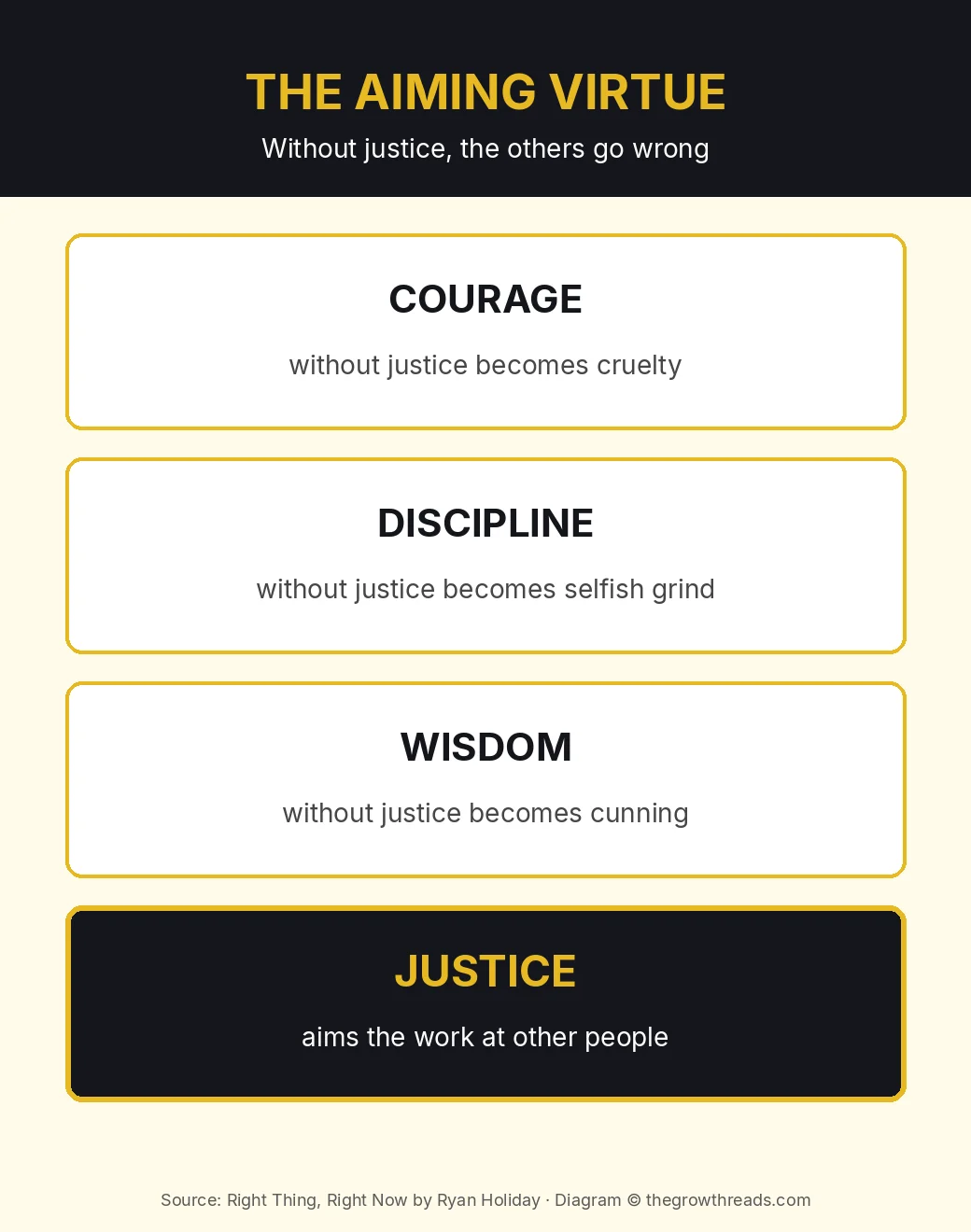
Justice is what aims your courage and your discipline at someone other than you. If Courage Is Calling asked you to act while afraid, and Discipline Is Destiny asked you to command yourself, this 2024 volume asks the missing question: who is this for? Holiday’s case is blunt. Courage without justice is a fight. Discipline without justice is a selfish streak. Wisdom without justice is a hustle. The work is not a speech on fairness. It is the un-scored play — the promise you could drop, the invoice you could pad, the credit you could steal, the stranger you could ignore. Do the right thing while it is in front of you, even when it costs ease, status, or a clean win. Then refuse to keep score.
Key takeaways
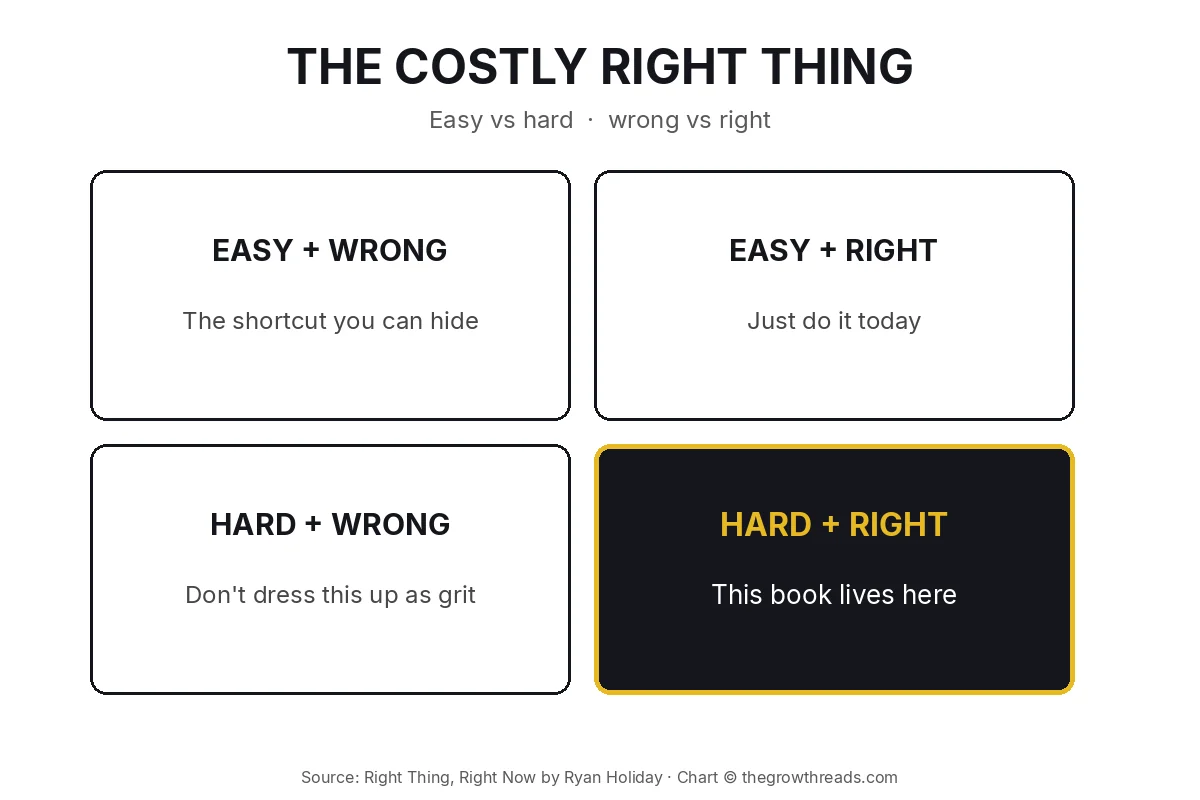
- Justice aims the other virtues: bravery and self-control are not automatically good. They need a target other than your ego.
- Character beats reputation: looking decent on a stage is cheaper than being decent in a thread nobody will screenshot.
- Keep your word: a small broken promise trains you to break a large one. Your handshake is a system, not a mood.
- Honesty is a practice: tell the true size of the delay, the defect, and the cost before the other person has to audit you.
- Justice is active: “don’t steal” is the floor. Give credit, pay fairly, and help when it will not trend.
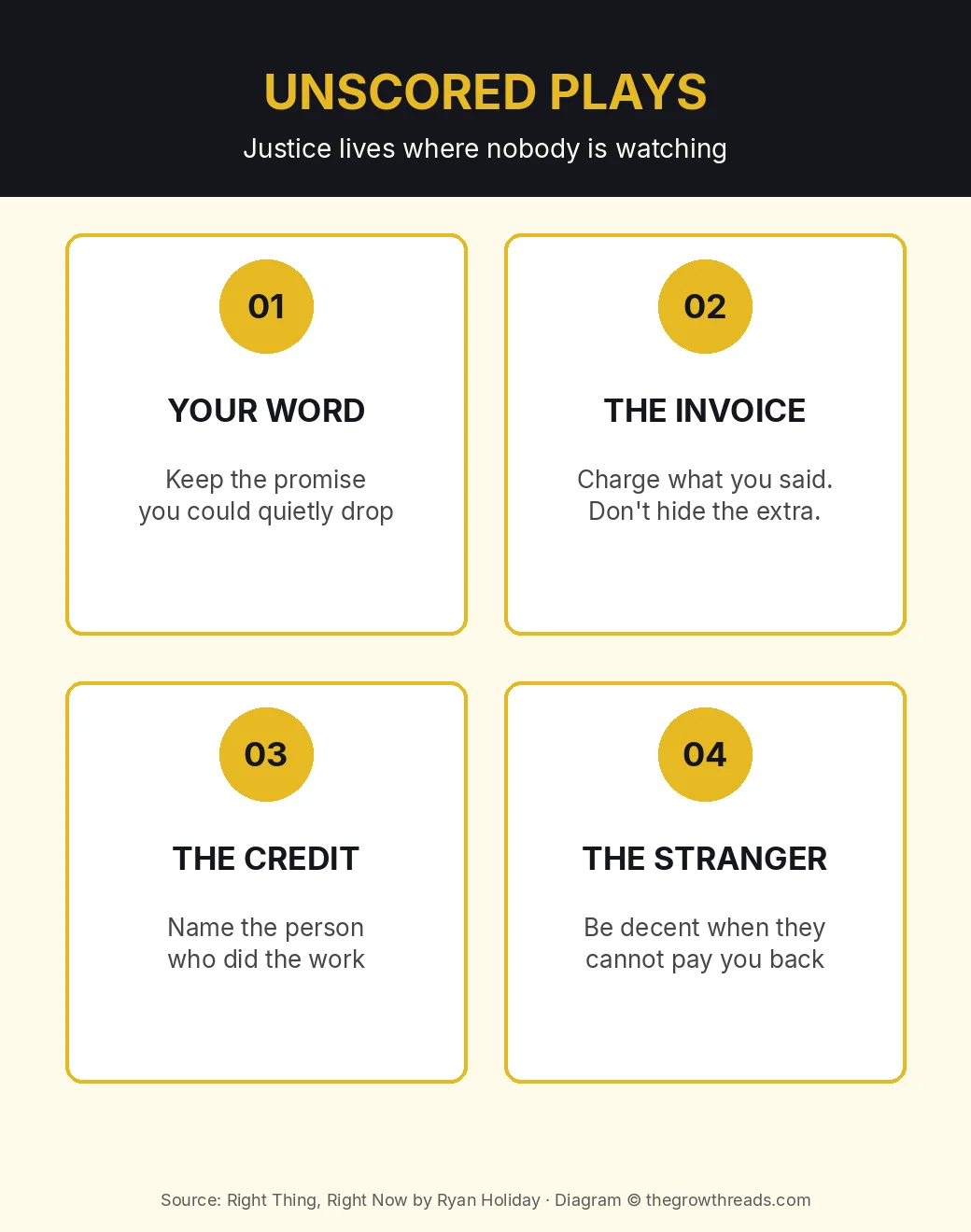
- Un-scored plays decide you: word, invoice, credit, stranger — the four rooms where nobody is watching.
- Hold the line: there is a cost you accept rather than become the kind of person who always finds a workaround.
- You don’t control the outcome: do the right thing because it is right. Applause is not the paycheck.
- Ordinary rooms count: you do not need a courtroom. You need Tuesday’s meeting, and the person who cannot help you back.
What is Right Thing, Right Now about?
Right Thing, Right Now is Ryan Holiday’s justice book in the Stoic Virtues series: a practical argument that good values, good character, and good deeds — done now, especially when they cost you — are how serious people aim their work at other people instead of at applause.
About the author
Ryan Holiday dropped out of college at 19, apprenticed with Robert Greene, and ran marketing for American Apparel before turning Stoic philosophy into a set of working books. The Obstacle Is the Way made perception, action, and will a popular operating system for hard seasons. Ego Is the Enemy and Stillness Is the Key followed. The Stoic Virtues series — Courage Is Calling, Discipline Is Destiny, and this 2024 justice volume — treats the four cardinal virtues as jobs, not posters. He writes the Daily Stoic from Texas and keeps arguing that character is built in ordinary rooms, not in quotes on a wall. Explore all Ryan Holiday book summaries →
Key concepts at a glance
| Concept | What it means | Use it when |
|---|---|---|
| Justice as aiming virtue | Courage and discipline need a target other than you | You are “winning” and leaving a mess |
| Character vs reputation | Being good is not the same as looking good | The room would clap either way |
| Keep your word | Small promises are training, not trivia | You are about to slide a deadline quietly |
| Un-scored plays | Word, invoice, credit, stranger | Nobody will know if you cut the corner |
| Active justice | Not-harming is the floor; help is the work | You hide behind “I didn’t cheat” |
| Hold the line | Accept a cost rather than a workaround | The shortcut would still close the deal |
| Virtue as paycheck | You don’t control whether justice is rewarded | You are waiting for credit before doing it |
| Ordinary rooms | Tuesday counts more than a manifesto | You keep saving goodness for a bigger stage |
Part 1: Justice is the virtue that aims the others
Holiday’s series treats the four cardinal virtues as a set. Courage is the willingness to move. Temperance is the willingness to command yourself. Wisdom is seeing clearly. Justice is the one that is about other people. Without it, the first three become a talented problem. A brave person can still crush someone smaller. A disciplined person can still hoard. A clever person can still design a clever harm. The aiming question is not “did I suffer?” or “did I finish?” It is “who did this serve?”
That is why this book belongs next to the earlier virtues rather than instead of them. If you only train hardness, you get a sharper tool. Tools need a direction. Holiday keeps returning to a Roman insistence that goodness is not an optional extra once you are effective. Effectiveness without justice is just a better way to take. Marcus Aurelius put the homework in one line Holiday loves to put in front of readers: “Waste no more time arguing about what a good man should be. Be one.”
Read that as an operator, not as a poster. Being one happens on a call where you could oversell, in a hire where you could take the cheap option, in a write-up where you could bury the miss. The virtue is not a brand. It is the aim of the work you already know how to do.
TGR Note: If fear is still the bottleneck, start with our Courage Is Calling summary. If the bottleneck is appetite — sleep, phone, ego-spending — use Discipline Is Destiny. Come back here when you can already move and still do not like the trail you leave.
Part 2: Character is what you do on the un-scored plays
Holiday spends a lot of this book away from famous last stands. The interesting test is the play that never hits a highlight reel. You said Thursday. You could send it Monday with a shrug. You quoted a price. You could add a quiet line item. Someone else did the work. You could let the room assume it was you. A stranger needs five decent minutes. You could keep walking. Those are un-scored plays. They train the same muscle as the public ones, and they train it more often.
Character, in this framing, is what you do when reputation is not available as a bribe. Reputation is a lagging indicator. It can be gamed for a quarter. Character is the repeating choice. Holiday’s historical cast — Cato refusing the convenient compromise, Truman eating a decision that would not poll well, ordinary merchants who would not short a weight — is there to show the pattern, not to turn you into a statue. You will not be asked to filibuster. You will be asked not to round the number in your favor.
Keep your word is the boring center. People treat a slipped promise as logistics. Holiday treats it as identity. If your handshake is a mood, your contracts are a mood, and then your culture is a mood. The fix is embarrassingly small: make fewer promises, then keep them at the original size. Do not “manage expectations” after you have already spent the trust.
TGR Note: If the problem is not a missing ethic but a loud self, our Ego Is the Enemy summary is the companion. Ego wants the credit. Justice names the person who did the work. Stillness helps you notice the grab in time — the live path is Stillness Is the Key, in the time-management silo.
Part 3: To, for, and with other people
Justice, Holiday keeps saying, is the social virtue. It is how you sit in a room with workers, customers, family, and people who will never write you a review. “To, for, and with” is the stance: not over them, not around them, not using them as scenery for your grind. A manager who dumps chaos downward and calls it standards is not disciplined. They are insulated. A seller who hides a defect until after the signature is not resourceful. They are extracting.
Active justice is the step past “I didn’t cheat.” You pay on time. You tell the truth about scope. You introduce people without keeping a little tax. You design the process so the next person is not cleaning your shortcuts. Holiday is not asking you to become a charity. He is asking you to stop treating other people’s time as a free input. That is closer to The Go-Giver than it first looks: surplus on their side of the ledger, not a personality transplant.
There is a future-tense version too. The person who is not in the room yet — the customer who will inherit your debt, the teammate who will inherit your undocumented mess, the kid who will inherit the market you strip — still counts. You do not need a manifesto to leave a cleaner handoff than you found. That is justice at the scale of a repo, a shift, a family table.
TGR Note: If you want the research sibling on giving without martyrdom, our Give and Take summary is Adam Grant’s map of givers, takers, and matchers. Use Holiday for the un-scored play. Use Grant when you need to see why otherish giving outperforms doormat giving. Do not stack both as a way to delay the first honest invoice.
Part 4: Hold the line when it costs you
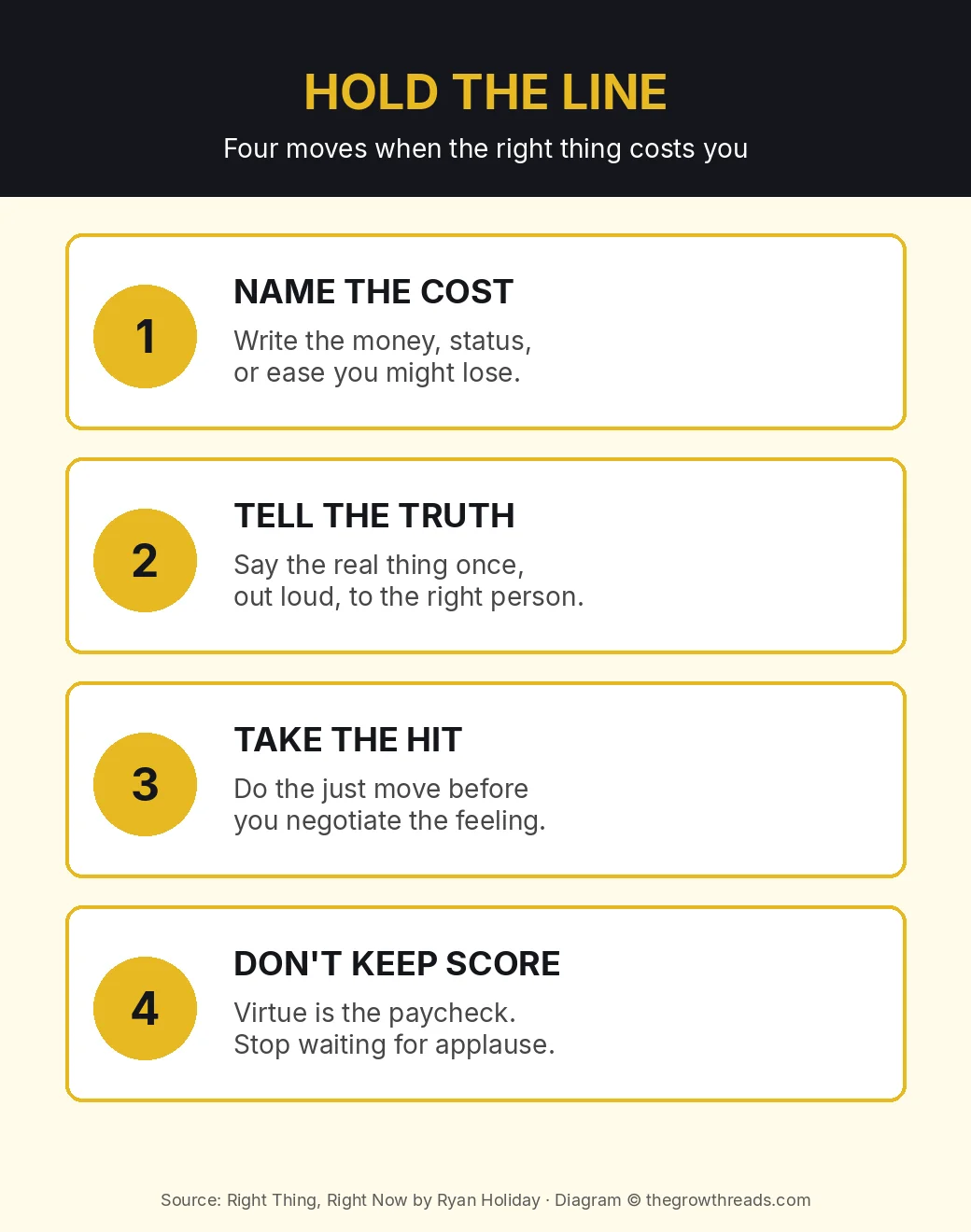
The last move is the one most productivity books skip. Sometimes the right thing loses the deal, the like, the invitation, or the easy quarter. Holiday’s answer is not “and then the universe pays you back on Friday.” Stoicism does not write you a rebate check. You hold the line because you will not become the workaround. Name the cost in advance so it cannot surprise you into a cheat. Tell the truth once, to the right person, without a speech. Take the hit before you negotiate the feeling. Then do not keep score.
This is where Do Hard Things is a useful neighbor. Magness’s toughness is attention under strain. Holiday’s justice is direction under strain. You can suffer well and still aim at the wrong person. Holding the line is not theatrics. It is declining the joke, the padded metric, the quiet betrayal of a colleague who is not in the room. The cost is real. So is the person you would otherwise become.
If you need a close: do the right thing while it is still available. You will not get a perfectly just industry. You will get a Tuesday. Use it.
Who is Right Thing, Right Now best for — and who should read something else first?
Best for people who already execute. If your calendar is full and your trail is messy — missed promises, grabbed credit, “resourceful” invoices — this is the aiming book. Managers who like standards but dump chaos downward will feel seen in a way that is not flattering. That is the point.
Read something else first if you cannot start. Use Atomic Habits to make a small loop, or Courage Is Calling if fear is the freeze. If the problem is a loud self, Ego Is the Enemy. If you need a business parable about surplus instead of a virtue series, The Go-Giver. If you wanted a policy program, this will feel thin on purpose — Holiday is writing character, not legislation.
Questions to reflect on
- Where did I pick easy-wrong this week, and what did it buy me?
- Which promise did I quietly resize after someone had already planned around it?
- Whose name is missing from a win I am currently narrating?
- What would the just version of the email I am about to send actually say?
- What cost am I refusing to pay in order to stay decent — and is that cost real, or just awkward?
🔥 Ready to do the right thing when it costs you?
Get Right Thing, Right Now, then run the 7-day plan on one live un-scored play.
How to apply Right Thing, Right Now (7-day plan)
- Day 1 — List the un-scored plays. Write three places this week where nobody would know if you cut a corner: a promise, a number, a name.
- Day 2 — Keep one promise at the original size. Do not “reset expectations.” Deliver what you actually said, or say you cannot — today, not after the miss.
- Day 3 — Tell one true size. In a meeting or a thread, state the real delay, defect, or cost in one sentence. No speech.
- Day 4 — Give credit in public. Name the person who did the work in the same room where the win is being told.
- Day 5 — Clean one invoice or scope line. Remove a hide, a pad, or a surprise. Charge what you said.
- Day 6 — Fifteen minutes for someone who cannot pay you back. Intro, review, or help. Do not post it.
- Day 7 — Take one costly right action and keep score off. Do it. Close the notebook. Virtue is the paycheck.
Frequently asked questions
What is Right Thing, Right Now about in one paragraph?
Right Thing, Right Now is Ryan Holiday’s 2024 book on justice, the third Stoic virtue after courage and discipline. He argues that being brave and self-controlled is not enough if the work still harms people. The load-bearing idea is simple: do the right thing while it is in front of you, especially when it costs status, money, or ease. This summary turns that stance into daily un-scored plays — your word, your invoice, the credit you give, and the stranger who cannot pay you back — plus a seven-day plan you can run without becoming a monk or a pundit.
Who should read Right Thing, Right Now?
Read it if you already ship work and still notice a trail of people you treated as props. Managers, founders, sellers, and operators who liked Courage Is Calling or Discipline Is Destiny will recognize the voice and get the missing aiming question. Skip it as a first Holiday book if you cannot start — Atomic Habits or Courage Is Calling will help you move. Skip it if you want a policy white paper; this is character in ordinary rooms. If your actual job is moving other people this week, pair it with The Go-Giver instead of collecting another quote about integrity.
How long does it take to read Right Thing, Right Now?
The Portfolio hardcover is a one-sitting-plus book for most busy readers: plan about six hours, or a week of forty-minute evenings. It is shorter than a doorstop history and denser than a parable. This TGR guide is a twelve-minute reconstruction of the argument, not a replacement for the stories. If you only have one evening, read the one-minute section, the key concepts table, and run Day 1 of the plan. Come back for the parts when you hit a real un-scored play — a promise, an invoice, a credit line — rather than rereading the introduction for motivation.
How is this different from The Obstacle Is the Way, Courage Is Calling, or Discipline Is Destiny?
The Obstacle Is the Way is perception, action, and will when life hits you. Courage Is Calling is acting while afraid. Discipline Is Destiny is commanding yourself. Right Thing, Right Now is who the work is for. Holiday’s claim is that courage without justice becomes cruelty, and discipline without justice becomes a selfish grind. You can finish the first three books and still win in a way that leaves a mess. Read this one when the bottleneck is not fear or laziness — it is the shortcut that would still get applause.
Is Right Thing, Right Now a political book?
Holiday writes about justice as a personal virtue, not as a party platform. He uses history — Cato, Truman, Gandhi, Marcus Aurelius — the way he always does: as case studies in character under pressure, not as a voting guide. You will not get a bill, a campaign, or a culture-war scorecard. You will get a demand that you stop treating fairness as something other people should do at scale while you pad a small invoice. If you need institutional analysis, read a different shelf. If you need to keep your word on Tuesday, this is the book.
Can I apply this at work, or is it only for saints?
The useful layer is ordinary and slightly uncomfortable: disclose the defect before the signature, name the person who did the work, keep the promise you could quietly drop, and refuse the joke that punches down in a meeting you want to survive. None of that requires a halo. It does require paying a small cost in the room you are actually in. Holiday’s point is that saints are a distraction. The work is the un-scored play. Run the seven-day plan on one live account, one teammate, and one stranger. Then decide if the book was “impractical” or just expensive.
What is the one idea to steal from Right Thing, Right Now this week?
Steal the un-scored play. Pick one place this week where nobody would know if you cut a corner — a deadline you could slide, a number you could round in your favor, a name you could leave off the slide — and do the just version on purpose. Do not announce it. Do not turn it into a personal brand post. Holiday’s justice is not a speech. It is the aiming of courage and discipline at someone other than you, while the shortcut is still available. If you need a sentence to keep: virtue is the paycheck. Stop waiting for the room to clap.
Related summaries
- Courage Is Calling by Ryan Holiday
- Discipline Is Destiny by Ryan Holiday
- Ego Is the Enemy by Ryan Holiday
- The Go-Giver by Bob Burg and John David Mann
- Best productivity books
How we analyze books: every book on The Growth Reads is read cover to cover, summarized in thousands of words of original analysis, and rated against our five-criteria rubric (lasting impact, evidence quality, practical application, writing & originality, external consensus). Read our full methodology.