

★★★★½ 4.6/5 — A pocket manual for staying in the work after the first spark fades.
Best for: makers who can start a project and then stall when the days turn ordinary.
Reading time: ~4 hours (224 pages) · this guide ~12 min
Difficulty to apply: Easy. The unit is a daily verb, not a new personality.
Keep Going in one minute
The hard part of creative work is not beginning. It is Tuesday. Austin Kleon’s Keep Going is the third book in his trilogy, and it is the one for the middle: after Steal Like an Artist gave you permission to collect, and Show Your Work taught you to share, this one is about remaining a person who still sits down when the good days thin out. Every day is Groundhog Day. Build a bliss station. Forget the noun, do the verb. Make gifts. Look harder. Walk. Tidy. Plant a garden you will not finish this week.
You do not need a cabin or a better mood. You need a loop, a room the feed does not vote in, and a verb small enough to finish before dinner.
Key takeaways
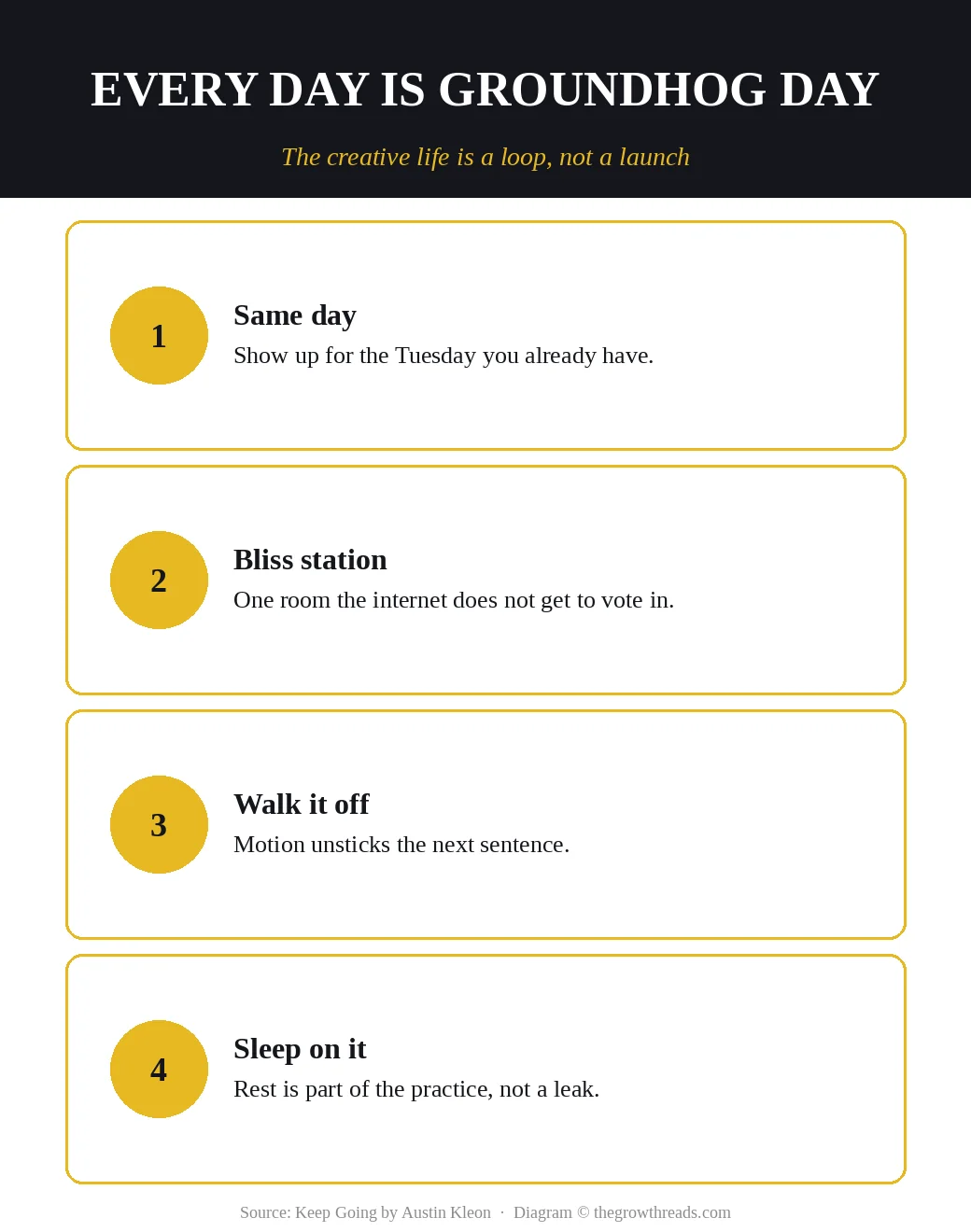
- Groundhog Day is the job: The creative life is a loop, not a launch. Treat today as the same day with a better verb.
- Build a bliss station: One protected pocket of time and space. The phone stays out of the vote.
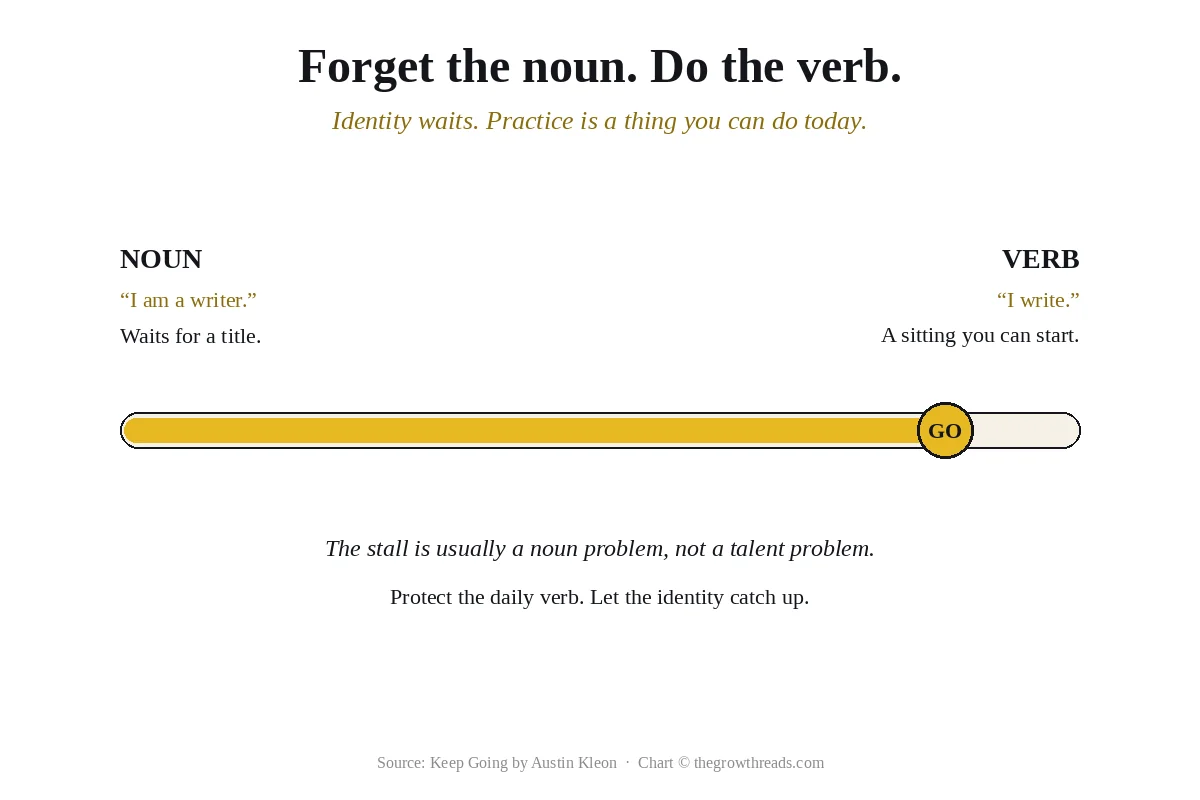
- Forget the noun, do the verb: “Writer” waits. Writing is a thing you can do at 2 p.m.
- Make gifts: Finish something for one real person. Audiences of none keep you stuck in drafts.
- Ordinary plus attention: New work often looks like looking harder at the desk you already have.
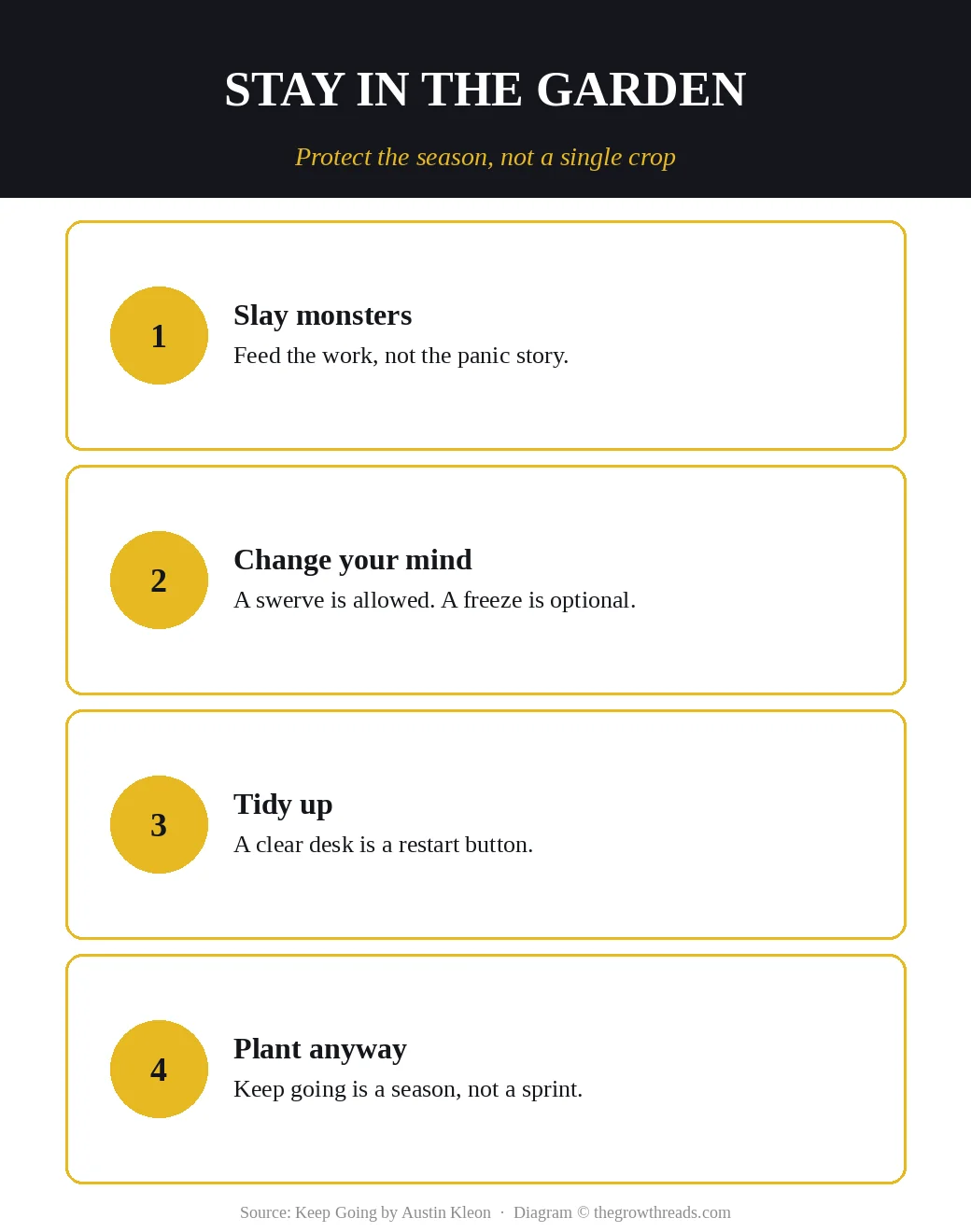
- Slay the art monsters: Feed the sitting, not the panic story about talent or other people’s output.
- You may change your mind: A swerve is allowed. Quitting because identity wobbled is not the same thing.
- Tidy, walk, plant: A clear desk, fresh air, and a long view keep the loop from turning into a crash.
What is Keep Going about?
Keep Going is Austin Kleon’s practical system for staying creative in good times and bad: treat the day as a loop, protect a bliss station, drop the identity, do a small verb, make gifts, and tend a garden you will not harvest this week. It is a stay-in-it manual, not a talent pep talk.
About the author
Austin Kleon is an American writer and artist who turned newspaper blackout poems into a public practice, then into three short books about making things on purpose. Steal Like an Artist (2012) argued that nothing is original so you might as well start. Show Your Work! (2014) argued that sharing the process is part of the work. Keep Going (2019) is the third movement: how to remain a person who still sits down when the spark is gone. He writes from Austin, Texas, in the same plain voice as the drawings — short chapters, lists, permission to be a beginner again tomorrow. The authority is not a laboratory. It is a daily practice that had to survive ordinary weeks. Explore all Austin Kleon book summaries →
Key concepts at a glance
| Concept | What it means | Use it when |
|---|---|---|
| Groundhog Day | The creative life is a repeatable loop, not a launch. | You keep waiting for a special week to “really start.” |
| Bliss station | A protected pocket of time and space the feed cannot vote in. | Every sitting becomes a negotiation with the phone. |
| Noun vs verb | Identity waits; a small action can happen at 2 p.m. | You stall until you feel like a Writer. |
| Make gifts | Finish something for one real person. | Drafts pile up for an audience of none. |
| Extra attention | Ordinary material plus looking harder becomes new. | You think you need a more interesting life first. |
| Art monsters | The panic stories that eat the sitting. | You spend the hour arguing with yourself. |
| Change your mind | A swerve is allowed; freezing is optional. | A wrong turn feels like a fake identity. |
| The garden | A season of planting, not one heroic crop. | You grade the week on a single finished masterpiece. |
Part 1: Groundhog Day and a room of your own
Kleon opens with a movie most people remember as a joke. Phil Connors wakes up, again, in the same town, on the same day. The creative life, he says, looks like that more than it looks like a premiere. You get a Tuesday. Then you get another Tuesday. People who wait for a special week are waiting for the loop to become a launch. It will not. The work is to make the repeat livable: same chair, same first move, same stop time, a slightly better verb than yesterday. That is how a practice survives contact with a calendar.
The second half of the opening is a room. Joseph Campbell called it a bliss station. Kleon treats it as furniture and a clock: a desk, an hour, a door, or at least a phone in another pocket. The station is not a cabin and it is not a mood. It is a pocket the internet does not get to vote in. If you cannot name the pocket, you do not have a practice yet. Steal the structure: After I pour coffee, I sit in this chair and do one verb for twenty-five minutes. The coffee is the taxi. The sitting is the work.
TGR Note: If you want the cue-and-identity architecture under that coffee sentence, Atomic Habits is the cleaner install. Kleon is what you do after the cue has put you in the chair on a boring day. Daily Rituals is the sister catalog of start times; The Creative Habit is the packed box so the first twenty minutes are not a hunt.
Part 2: Forget the noun, do the verb
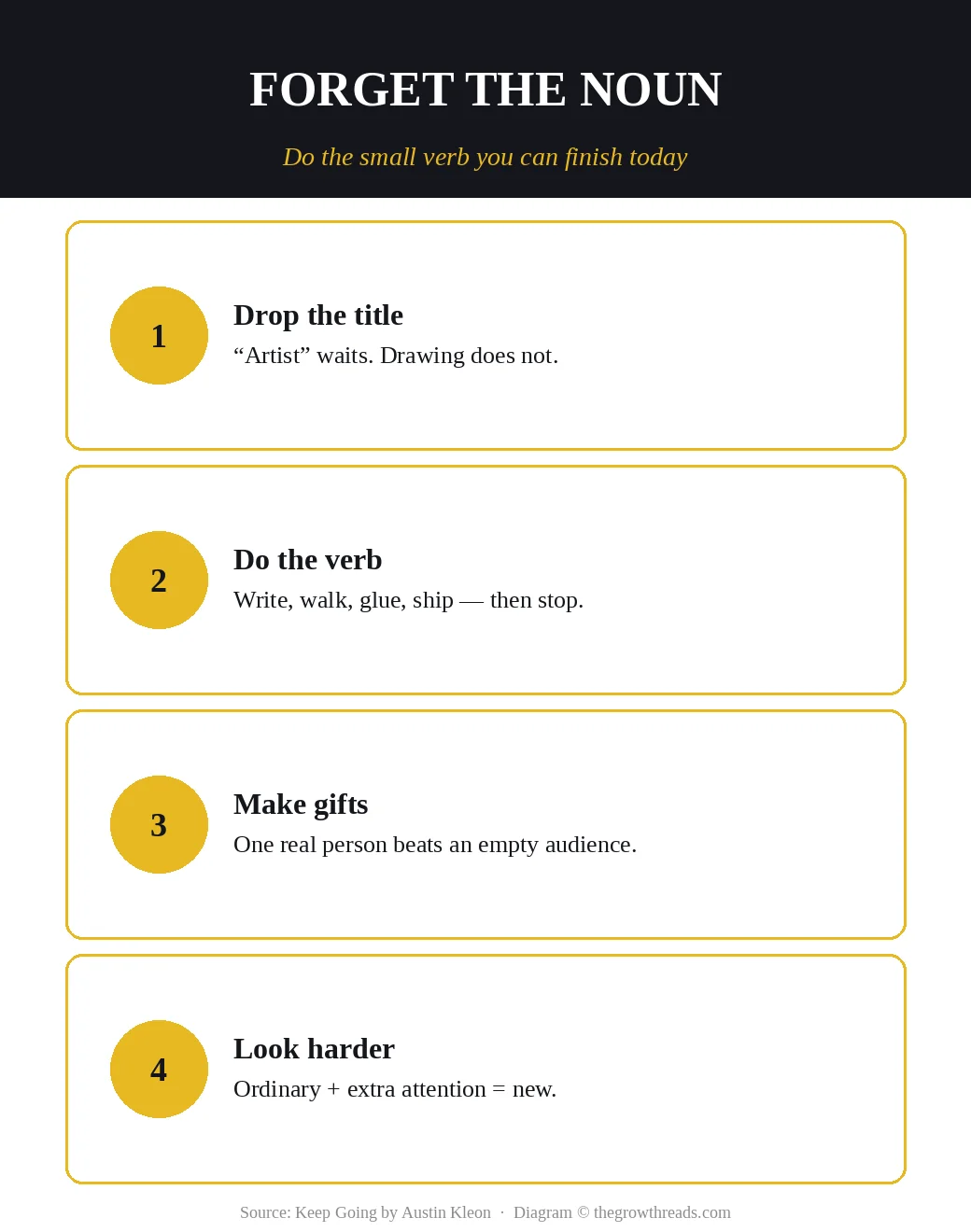
This is the sentence the book is built around: forget the noun, do the verb. A noun is a costume — Artist, Writer, Founder — that you wait to feel before you will sit. A verb is ugly and available: write, draw, glue, walk, send. The stall that looks like a talent problem is often a title problem. You cannot “be a writer” at 2 p.m. You can write for twenty-five minutes. Kleon’s own practice is the evidence. Blackout poems are a verb with a newspaper and a marker, not a personality called Poet. The identity, if it arrives, arrives late, after a pile of verbs.
Two more moves sit next to the verb. Make gifts: finish a small thing for one living person. A gift has a stop condition; an audience of none does not. And look harder: the ordinary desk, the walk, the email you almost sent, plus extra attention, is usually enough material. You do not need a more interesting life first. You need to stop skimming your own. That is how you stay when the calendar is just a calendar.
TGR Note: The permission to collect still lives in Steal Like an Artist. The permission to let people watch lives in Show Your Work. Keep Going is the middle child: stay in the verb when both of those books have already done their job. If the freeze is moral — “people like me don’t make things” — thaw it with Creative Confidence, then come back for the Tuesday loop.
Part 3: Monsters, swerves, and a messy desk
Art monsters are the stories that eat the sitting. You peaked already. Everyone else ships more. This is not real work. Kleon’s move is not to win the argument. It is to starve the story by feeding the verb. The monster wants a noun fight. The sitting wants a timer. You will not think your way into a quiet mind. You will sit anyway, then notice the volume drop because the hands were busy. That is what happens when a panic story loses its audience for twenty-five minutes.
You are also allowed to change your mind. A project that was right in March can be wrong in June without turning you into a fraud. The noun hates a swerve because the noun wanted a brand. The verb can turn. Tidying belongs here too, not as a lifestyle. When the desk is a pile, starting becomes a hunt plus a mood. Ten minutes of closing tabs is a restart button so the next verb has a chair. It is not the work. It is how the work gets a place to land.
TGR Note: If the monster is the force that keeps you from sitting down at all, The War of Art is the Resistance manual. If the job is to show up and ship without waiting to feel ready, Seth Godin’s The Practice is the cousin. Kleon is gentler than both and shorter than both. Use him when you already sit and still want to leave by minute twelve.
Part 4: Fresh air and a garden you will not finish
Demons hate fresh air. So does a sentence that has been sitting in the same chair since breakfast. Kleon’s walk is not a fitness program. It is a way to let the next line arrive while the body is busy. Leave the podcast in the kitchen. Twenty minutes is enough. Sleep belongs in the same family: rest is part of the practice, not a leak. A practice that never sleeps is a crash with better branding. The point of Groundhog Day is that you get another Tuesday. You have to still be a person who can use it.
The last image is a garden. You plant knowing you will not harvest every row this week. Some work is compost. Some work is a tree. The noun wanted a masterpiece by Friday. The garden wants a season of verbs. That is how Kleon closes the trilogy: not a formula for going viral, but a way to remain a maker when the spark is gone. Longevity is a lot of Tuesdays in the same chair. The station gets you through the door. The verb gives the sitting a job. The garden keeps you from grading the year on one crop.
TGR Note: Process versus product is the same fork as The Practicing Mind: stay with the live repeat, drop the dead identity. If the unit of work is still a fantasy novel, Bird by Bird shrinks the bird. Keep Going assumes you already know the bird. It asks whether you will still sit when the bird is ordinary.
Who is Keep Going best for — and who should read something else first?
Best for people who already know how to start and then stall when the days turn ordinary: writers, designers, founders, teachers, anyone with a bliss station that has become a hallway. If you still need permission to collect, go to Steal Like an Artist. If you need to let people watch, go to Show Your Work. If the room is blank and you need a box and a ritual, The Creative Habit is the studio manual.
Read something else first if the freeze is moral — “people like me don’t make things.” Start with Creative Confidence, then come back. If you know the sitting and still will not enter, read The War of Art. If the day has no container, steal a clock time from Daily Rituals. Kleon assumes you can sit. He is here because sitting got boring.
Questions to reflect on
- What noun have you been protecting — Writer, Founder, “creative person” — and what verb could you finish this afternoon without it?
- Where is your bliss station, and what still gets a vote there that should not?
- Who is the one real person you could make a gift for this week instead of posting to no one?
- Which art monster showed up in the last sitting, and what would starving it look like for twenty-five minutes?
- If this week were a garden, which row would you plant even if you will not harvest it by Friday?
🔥 Ready to stay in the work?
Name one verb. Protect a station. Repeat tomorrow.
How to apply Keep Going (7-day plan)
- Day 1 — Name the verb. Write one sentence: the noun you have been protecting (writer, founder, “creative person”) and the verb you will do tomorrow for twenty-five minutes. Put the verb on a sticky note. Do not add a second project. The point is a move you can finish, not a new identity.
- Day 2 — Build a bliss station. Pick a chair, a hour, and one rule the phone does not get to vote on. After I pour coffee, I sit and do yesterday’s verb for twenty-five minutes. Leave the tools out the night before so the start is not a scavenger hunt. The station is a room, not a feeling.
- Day 3 — Make it Groundhog Day. Repeat yesterday’s sitting at the same clock time. Do not upgrade the verb. Same chair, same twenty-five minutes, same stop. If it felt dull, that is data that you showed up, not a verdict on talent. The loop is the job.
- Day 4 — Make one gift. Finish a tiny thing for one real person: a page, a sketch, a voice note, a paragraph that would help a colleague. Send it. Do not post it to an empty square. Gifts train you to finish; audiences of none train you to stall.
- Day 5 — Tidy, then walk. Spend ten minutes clearing the desk and closing extra tabs. Then take a twenty-minute walk with no podcast. Demons hate fresh air; so does a sentence that has been sitting in the same chair all morning. Come back and do one more short verb if you have it, or stop. Rest counts.
- Day 6 — Slay one art monster. Write down the panic story that showed up this week (“this is not real work,” “I peaked already,” “everyone else ships more”). Cross out the noun in it. Replace it with tomorrow’s verb. You do not have to win the argument. You have to sit anyway.
- Day 7 — Plant the next four days. Put four more start times on the coming week. Leave the station set. Grade the week on whether the verb happened, not on whether the piece is good yet. Keep going is a garden: you plant knowing you will not harvest every row this Tuesday.
Frequently asked questions
What is Keep Going about?
Keep Going is Austin Kleon’s 2019 field manual for staying creative after the first spark fades. Steal Like an Artist gave permission to begin; Show Your Work taught you to share; this third book is about the middle — Groundhog Day, a bliss station, and the verb you can do on a dull Tuesday. It is ten short ways to keep a practice alive when the good days stall, not a pep talk about becoming a genius. You do not need a new personality. You need a loop you can repeat this week.
How long does it take to read Keep Going?
The Workman paperback is 224 illustrated pages, about four hours for most readers. This summary is a twelve-minute pass: the daily loop, forget-the-noun, gifts, and the garden. If you only have lunch, read “Every day is Groundhog Day,” name one verb you can finish this afternoon, and put a start time on tomorrow. The rest of the book is fuel for that sitting, not a syllabus to finish first. Come back to the later chapters when the first week of verbs is already on the calendar.
What does Austin Kleon mean by forget the noun, do the verb?
A noun is an identity you wait to feel: writer, artist, founder. A verb is a move you can do at 2 p.m.: write, draw, glue, ship. Kleon’s point is that the stall is usually a title problem, not a talent problem. Drop the job description for one sitting. Do a small verb until the clock runs out. The identity, if it arrives, arrives after the work — the same order Twyla Tharp uses when she walks into a white room cold.
Is Keep Going only for artists?
No. Kleon writes from a studio because that is his laboratory, but the moves are for anyone whose job includes a blank page: writers, designers, founders, teachers, researchers, people who ship a newsletter or a product. Groundhog Day is a Tuesday at a laptop as easily as a sketchbook. If you delay the inventive part of a real job until you “feel like a creative person,” this is the book that names the delay and replaces it with a verb.
How is Keep Going different from Steal Like an Artist or The War of Art?
Steal Like an Artist is the permission slip: nothing is original, so collect and start. Show Your Work is the sharing book. Keep Going is the stay-in-it book for after both of those. Steven Pressfield’s War of Art names Resistance — the force that keeps you from sitting down. Kleon assumes you will sit, then need a way not to quit when the sitting is boring. Read Pressfield when you will not enter. Read Kleon when you enter and still want to leave by minute twelve.
What is a bliss station in Keep Going?
A bliss station is a protected pocket of time and space where the work can happen without a vote from the feed. Joseph Campbell’s phrase, used here as a practical room: a desk, a hour, a door you can close, a phone in another pocket. It is not a mood board and it is not a cabin in the woods. The test is simple. Can you do one verb for twenty-five minutes without negotiating with a notification? If not, the station is still a hallway.
Who should read something else before Keep Going?
If you still think original means unused, start with Steal Like an Artist and get permission to collect. If the freeze is moral — “people like me don’t make things” — start with Creative Confidence, then come back. If you need studio mechanics for a blank room, The Creative Habit is the box-and-ritual manual. Come to Keep Going when you already have a practice and the good days have thinned. Its gift is how to stay, not how to begin. The first sitting can still be twenty-five minutes. The book is there so the second week happens.
Related summaries
- Steal Like an Artist — collect, transform, and start without waiting to be original.
- Show Your Work — share the process so the practice has witnesses.
- The Creative Habit — ritual, box, and a white room you can enter cold.
- The War of Art — name Resistance once you know the sitting.
- Best productivity books — the full Productivity silo.
How we analyze books: every book on The Growth Reads is read cover to cover, summarized in thousands of words of original analysis, and rated against our five-criteria rubric (lasting impact, evidence quality, practical application, writing & originality, external consensus). Read our full methodology.