

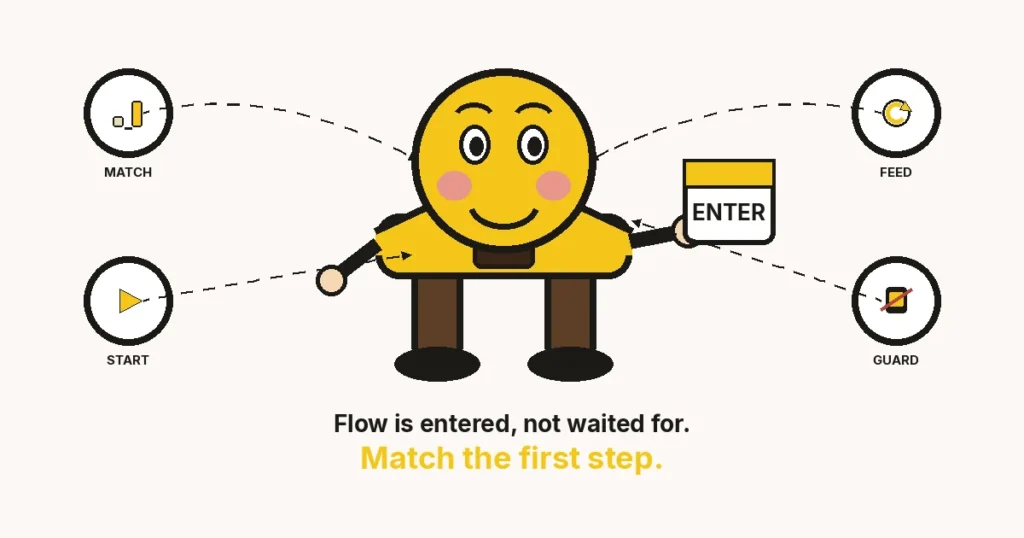
How to enter a flow state is to match the first stretch to today’s skill, name one next move, give the work a signal, and protect the block — then start. It is not a mood you wait for. Shrink the step if you are anxious; raise the demand if you are bored. Sister page flow state owns the channel.
Key takeaways
- Keller and Bless (2008) showed in two experiments that matching task demand to current skill produces flow — the match can be caused, so entering is a setup you change, not a weather system you wait out.
- Nielsen and Cleal (2010) sampled 58 Danish line managers: planning, problem solving and evaluation predicted transient flow at work; the more stable job characteristics in that study did not.
- Swann, Keegan, Piggott and Crust (2012) reviewed 17 elite-sport studies and found flow is reported as controllable to some extent — preparation, an appropriate challenge and feedback keep showing up as the door, not coincidence.
- Peifer, Schulz, Schächinger, Baumann and Antoni (2014) found an inverted-U between flow and sympathetic arousal in 22 men after a stress test: too little charge and too much both miss the channel.
- Daniel Coyle’s The Talent Code names the same edge as a sweet spot of struggle — errors frequent and fixable — which is how skill rises so the same job becomes enterable.
What does it mean to enter a flow state?
To enter a flow state is to cross from setup into a matched stretch — not to wait until you feel locked in, and not to grind the door under a deadline. The channel itself lives on sister page what flow state actually is: high challenge sitting with high skill, a clear next move, a signal, and a protected field of attention. This URL is the method child. It answers the search “how to enter flow state” without turning the page into a how-to schema ladder. The parent in this silo is still how to focus better — the beam that makes any channel possible. Habits-cluster articles on this site still climb to live keystone habits. This page does not mint a new parent. The rest of the library sits at productivity on The Growth Reads.
Entering is a change you can make in the first ten minutes. Johannes Keller and Herbert Bless (2008) built a task whose demand could be held under, at, or over current skill. Compatibility of demand and skill produced flow. That is the honest engine under every “just get in the zone” slogan: you change the first stretch until it needs you and you can still do it. You do not add a soundtrack and wait for a mood the setup has not earned.
Two later distinctions keep this page from copying the sister. First, not every excellent hour is flow. Christian Swann, Lee Crust, Patricia Jackman and colleagues (2017) separated “letting it happen” — a gradual build of confidence that matches the flow description — from “making it happen,” a clutch state of sudden, effortful concentration under pressure. Grinding a Friday deadline is often clutch. It can still ship. It is not the channel this keyword is asking for. Second, the work that opens the door is a certain kind of work. Karina Nielsen and Bryan Cleal (2010) found planning, problem solving and evaluation predicted transient flow in 58 line managers. Meetings and chatter are not a side door. They are how the first minutes get spent on logistics.
How is entering different from waiting, deep work, and clutch?
Waiting is a mood strategy. Deep work is a designed hour. Clutch is effort under pressure. Entering is the first matched stretch of a job you already named.
Waiting treats flow as weather. Keller and Bless could turn the match on in a lab. A playlist is not that match. Deep work, on what deep work actually means, is distraction-free concentration on a cognitively hard task that creates new value. You can run that hour without ever losing the clock. You can also lock in on a puzzle that creates no professional value. Keep the words. Clutch is the other excellent state: Swann’s athletes described a sudden stepping-up of effort when the situation mattered. Useful. Different door. If you only ever “make it happen,” you will think flow is a personality you lack, when you have been using a different gear.
Why do the first minutes decide whether you enter?
The first minutes decide the match, the next move, the signal, and whether a second live task is already in the room — which is the whole door. After that, you are either in a stretch that can hold, or you are narrating about why the mood did not arrive.
Jenova Chen (2007) described how games keep people in the channel by adjusting difficulty in real time. Knowledge work has no designer on your shoulder. You have to do the adjustment by hand: shrink the first step, or raise the bar, before the hour is a pile of open tabs. Abuhamdeh and Csikszentmihalyi (2012) found that for intrinsically motivated, goal-directed activity, enjoyment tracked a higher challenge — inside competence, not past it. The first minutes are when you pick that height. Pick too low and you have relaxation dressed as a block. Pick too high and you leave into anxiety, then into task paralysis, which is a Decisions page about the freeze at start, not a second flow article.
Peter Gollwitzer’s (1999) implementation intentions are the start rule this page borrows without turning into a second how-to: if this cue, then this action. Live implementation intentions owns that sentence. Here it is only the hinge: “After I close Slack, I will write the first sentence of X.” Entering fails most often because the next physical move is still up for debate at minute four. That debate is Self 1 talking. The work cannot talk back until you give it something to answer.
Counter-case. Nielsen and Cleal’s job-characteristic measures — role clarity, influence, cognitive demands — did not predict flow in that sample. That is the finding, not a footnote. Do not read “change your job title and the channel will open.” Change the activity of the next ten minutes. And Peifer’s inverted-U is a small all-male lab after a stress test, not your Tuesday: treat it as a warning against both hype-playlists and total shutdown, not as a cortisol target you can aim at.
The four entry moves
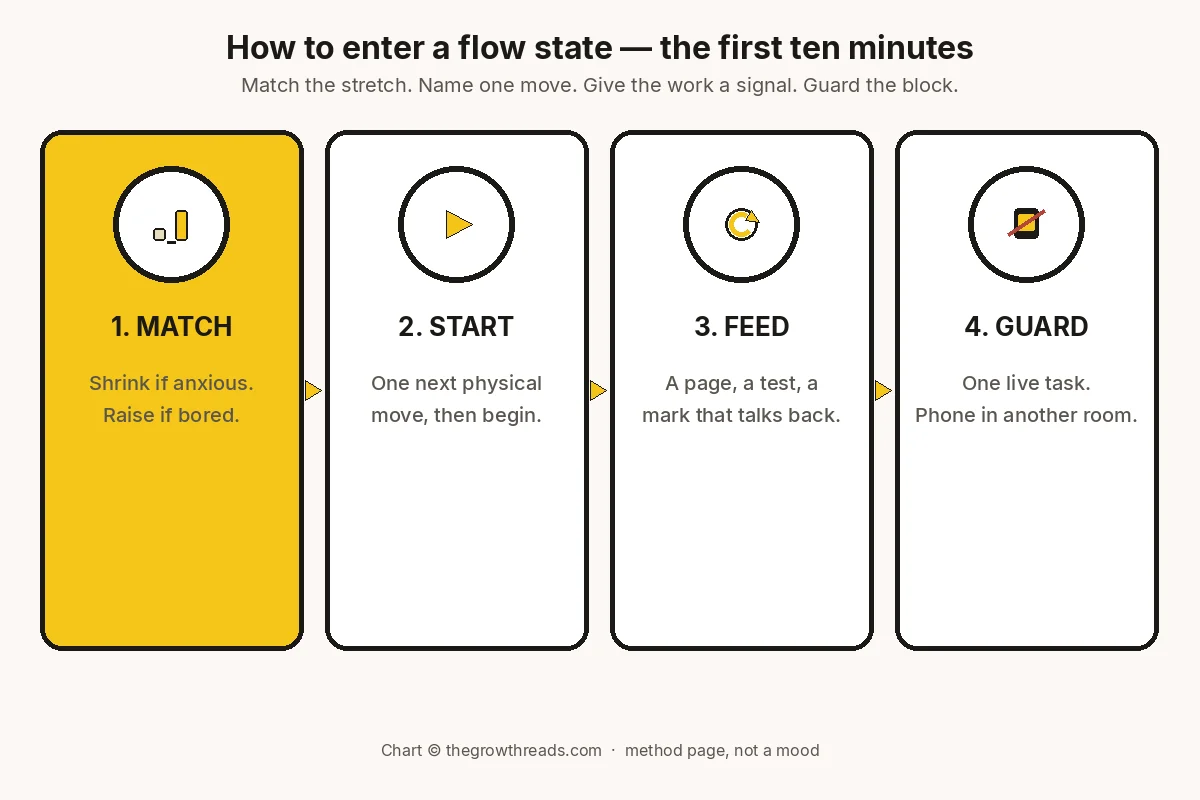
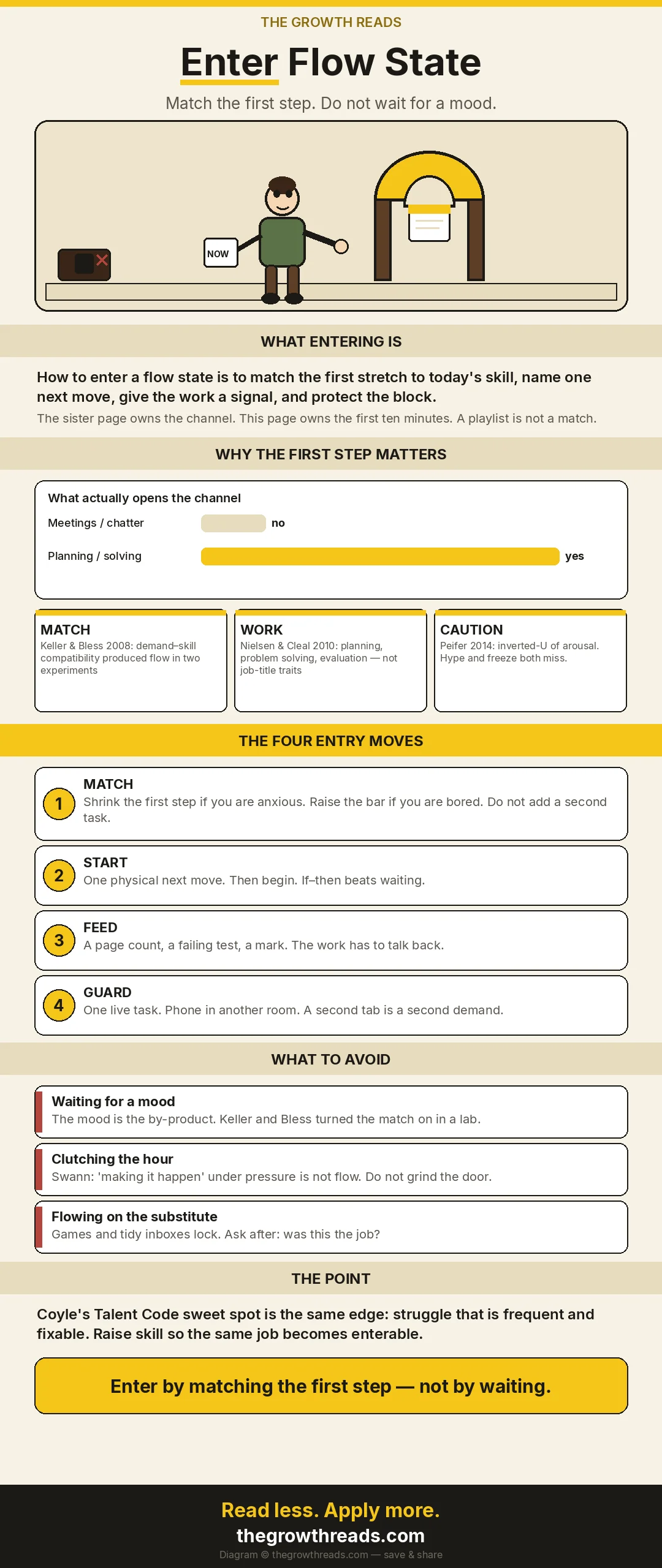
Match the stretch, start one next move, give the work a signal, and guard the block. This spoke drops a numbered how-to ladder and HowTo schema. The moves are still specific. They are the same four conditions the sister page names, written from outside the channel instead of inside it.
| Move | What you change | The tell it is working | The miss |
|---|---|---|---|
| Match | Shrink the first step if you are anxious; raise the quality bar or the clock if you are bored | The next ten minutes need you, and you can still do them | Adding a second task “to make it interesting” |
| Start | One physical next move, then begin — an if–then beats a vibe check | Something is on the page in the first two minutes | Re-ranking the hour instead of touching the file |
| Feed | A page count, a failing test, a sketch you can hold at arm’s length | The work answers the last move without you narrating | Staring at a vague “make progress” with no scoreboard |
| Guard | One live task; phone in another room; a written marker if you have to leave | No second demand is live in the same block | A silent phone on the desk, or a “quick” tab that never closes |
Match is Keller and Bless in desk language. If the job as written is above skill, the first stretch is a smaller version: one paragraph, one function, one slide. That is also the Talent Code edge. Coyle’s sweet spot is where you struggle just enough that errors are frequent and fixable. Deep practice is how the skill axis rises so next week’s first stretch can be the thing that used to be too hard. The book stays on the review; the method on this page is the shrink-or-raise in minute one. If the job as written is below skill, do not add a second live task. Raise the demand on the first one: a tighter bar, a shorter clock, a harder version. A second tab is how you leave into switching, then into attention residue.
Start is the if–then. Name the output in one sentence before you open the file. Then do the first physical move. Single-tasking is the load rule once you are in; this move is how you stop hovering in the doorway. Swann’s 2012 review is useful here without pretending desk work is elite sport: preparation, an appropriate challenge, and a sense that the next action is available keep showing up as antecedents. Controllable to some extent is the honest ceiling. No paper in that review guaranteed the state.
Feed is the unfashionable condition. Unambiguous feedback is how the stretch holds. A word count, a test suite, a sentence that does or does not land. Arnold Bakker’s work on job resources (the sister page uses the 2008 WOLF inventory) keeps putting performance feedback next to absorption. If nothing talks back, you start narrating. Narration is how you leave.
Guard is the parent page’s beam, applied to the first minutes. One live task. Notifications off. Phone in another room — Ward, Duke, Gneezy and Bos (2017) showed a phone merely nearby still taxes working memory, which is a focus finding this method inherits. Notification overload is the volume problem; how to stay on task is the switch protocol once you are inside. This page only asks whether the field is empty enough for a match to hold.
Why failing to enter costs more than it feels like
A morning that never enters does not announce itself as a loss — it just feels like logistics — but the bill is the hard hour you spent arranging instead of stretching. Nielsen and Cleal’s line managers entered more often on planning, problem solving and evaluation. If the first ninety minutes are meetings, inbox, and “just lining things up,” you have spent the stretch on work that does not open the channel, then wondered why the afternoon felt like grit.
The sister page already carries Csikszentmihalyi and LeFevre’s finding that most sampled flow happened at work even though people said they were more motivated in leisure. This page’s cost is more local: you can protect a block and still fail to enter, because the block is a low–low match or a clutch grind. A protected empty hour is not flow. A protected inbox is flow on the substitute. Ask after: was the demand the job?
Swann’s clutch distinction is the other cost. If every important hour is “making it happen,” you will ship, and you will also teach yourself that excellent work only happens under threat. That is a discipline problem for another cluster — live how to build discipline — not a reason to skip the match. Entering is the cheaper gear for the hours that are allowed to be a stretch without a crowd.
Common mistakes
The common mistakes around how to enter a flow state are all versions of treating a setup as a feeling, or using the wrong gear and calling it the channel.
- Waiting for a mood. Keller and Bless produced the state by matching demand to skill. A playlist is not that match.
- Calling clutch “flow.” Swann’s “making it happen” is effortful, sudden, and useful under pressure. It is not the door this keyword is asking for. Do not grind the first ten minutes and then decide you lack a personality.
- Protecting a shallow block. Deep work is the design; flow is the channel. A quiet calendar with a low–low task is relaxation. It will not become flow by lasting longer.
- Adding a second live task to stay interested. That is how you fall into switching. Raise the demand on the first job instead.
- Flowing on the substitute. Games, tidy formatting, and inbox-zero produce the lock. Ask after: was this the job?
- Hype or freeze. Peifer’s inverted-U is the warning: too much sympathetic charge and too little both miss. Start the matched stretch at a moderate pulse, not a pep talk and not a shutdown.
- Skipping the skill axis. If the job is permanently above you, shrinking forever is avoidance. Coyle’s sweet spot is how skill rises. Read the Talent Code review for the practice; come back here for the first ten minutes of tomorrow’s job.
The evidence behind this
The evidence for how to enter a flow state is strongest on changing the match and the activity, mixed on how fully anyone can command the state, and thin as a stopwatch for the first minutes.
| Study | Design and size | Finding | What we used it for |
|---|---|---|---|
| Keller & Bless, 2008 | Two experiments; demand–skill compatibility manipulated during a task | Compatibility produced flow; action-oriented people were most sensitive | Entering is a match you can change, not a mood you wait for |
| Nielsen & Cleal, 2010 | ESM plus questionnaire; 58 Danish line managers in accountancy and elder care | Planning, problem solving and evaluation predicted transient flow; role clarity, influence and cognitive demands did not | Pick the activity of the first minutes; do not wait on a job-title trait |
| Swann, Keegan, Piggott & Crust, 2012 | Systematic review; 17 empirical elite-sport studies, 1992–2011 | Key factors induce or inhibit occurrence; flow reported as controllable to some extent, not merely coincidental | Preparation, challenge and feedback are the door — with an honest ceiling |
| Swann, Crust, Jackman et al., 2017 | Event-focused interviews with athletes across sports; integrated model of flow and clutch | “Letting it happen” (flow) vs “making it happen” (clutch): clutch is sudden, effortful, under pressure | Do not treat a grind as entry, or miss that clutch can still ship |
| Peifer, Schulz, Schächinger, Baumann & Antoni, 2014 | 22 healthy men; modified Trier Social Stress Test, then a 60-minute computer task; cortisol and HRV | Inverted-U of flow with sympathetic arousal and cortisol; parasympathetic indices linearly positive | Hype and freeze both miss; small all-male lab, not a cortisol target |
| Abuhamdeh & Csikszentmihalyi, 2012 | Intrinsically motivated, goal-directed activity; challenge and enjoyment | Enjoyment tracked a higher challenge inside competence | Raise a boring first stretch; do not add a second task |
| Gollwitzer, 1999 | Review of implementation intentions (if–then plans) | A cue-linked action raises follow-through versus a vague goal | The start move: after this cue, the first physical action |
| Coyle, 2009 | Book synthesis on deep practice, ignition and coaching — not a trial | The “sweet spot” is struggle with frequent, fixable errors (myelin as the metaphor) | How the skill axis rises so tomorrow’s job is enterable; named unused review |
Frequently asked questions
How do you enter a flow state?
Match the first stretch to the skill you have today, name one next physical move, give the work a signal that talks back, and protect a block with only one live task — then start. Keller and Bless (2008) showed that matching demand to skill can produce flow in the lab. If the work feels like anxiety, shrink the first step. If it feels like boredom, raise the demand on that same job. Do not add a second tab. Sister page flow state owns the definition of the channel. This page owns those first minutes.
How long does it take to get into a flow state?
There is no honest lab stopwatch for “how many minutes until flow.” Jackson and Marsh built a scale around a just-finished activity, not a countdown. Treat the first ten minutes as setup: match, start, feed, guard. If nothing holds after a protected, matched stretch, change one axis — the size of the step, the signal, or the second live task — rather than sitting in the doorway narrating. Swann’s review is the ceiling: controllable to some extent, never a guarantee. A mood that has not arrived by minute four is usually a missing condition, not a missing trait.
What should I do in the first two minutes?
Write one sentence of “done” for this block. Then do the first physical move: the sentence, the failing test, the sketch. Gollwitzer’s if–then is the hinge — after this cue, that action — and live implementation intentions owns the longer version. Do not re-rank the day. Do not check a silent phone. If the named job is too big, shrink it until the two-minute version is in range. If it is too small, raise the bar on the same job. The Talent Code sweet spot is the same edge: struggle that is frequent and still fixable.
Can you enter a flow state on command?
No, and trying is usually clutch, not flow. Swann, Crust, Jackman and colleagues (2017) split “letting it happen” from “making it happen.” The second is sudden, effortful concentration under pressure. It can ship a Friday. It is not the channel. What you can command is the setup: the match, the next move, the signal, the protected field. Keller and Bless could turn compatibility on in a lab. That is the most honest “on command” the literature has. Set the door. Do not narrate at it.
Why do I enter flow in games but not at my job?
Games adjust the demand in real time and give unambiguous feedback. Chen (2007) described that design as keeping people in the channel. A job with vague goals, delayed signals, and a second live chat does the opposite. Nielsen and Cleal (2010) found planning, problem solving and evaluation — not meetings — predicted transient flow at work. Start the hour on a version of the hard thing that can talk back. Then guard it. If the only lock you get is on a game, the job’s first stretch is probably unmatched, not a verdict about your personality.
Does music help you enter a flow state?
Sometimes as wallpaper, never as the match. Peifer’s inverted-U is the caution: extra sympathetic charge can push you off the channel as easily as boredom can. If music raises the pulse into clutch, it is working against entry. If it is the only way you can start, you still have not named a next move or a signal. Test a silent, matched stretch before you treat a playlist as the method. The parent how-to-focus-better page is the beam; this page is whether the job you just protected is actually in range.
What if the task is too hard to enter flow?
Shrink the first step until it sits at the edge of current skill — errors frequent, still fixable. That is Keller and Bless in one direction, and Coyle’s sweet spot in the other. A permanently oversized job is not a flow problem; it is a skill problem or a scoping problem. Deep practice raises the skill axis so next week’s first stretch can be the thing that used to stall you. If starting itself will not happen even on a two-minute version, that is the task-paralysis page, not this one. Do not add grit on top of a task you cannot yet do.
Is this the same as the flow-state page?
No. What flow state actually is owns the channel: the high–high match, the evidence that it is situational, and the neighbours (deep work, single-tasking, the inner game). How to enter a flow state owns the first minutes: shrink or raise, start, feed, guard. The parent is still how to focus better. The named review on this URL is The Talent Code, because the skill axis has to rise or the same job never becomes enterable. Read the concept page first if you do not yet know what you are trying to enter. Stay here if you already do, and the door is the problem.
Sources
- Keller, J., & Bless, H. (2008). Flow and regulatory compatibility: An experimental approach to the flow model of intrinsic motivation. Personality and Social Psychology Bulletin, 34(2), 196–209. https://doi.org/10.1177/0146167207310026
- Nielsen, K., & Cleal, B. (2010). Predicting flow at work: Investigating the activities and job characteristics that predict flow states at work. Journal of Occupational Health Psychology, 15(2), 180–190. https://doi.org/10.1037/a0018893
- Swann, C., Keegan, R. J., Piggott, D., & Crust, L. (2012). A systematic review of the experience, occurrence, and controllability of flow states in elite sport. Psychology of Sport and Exercise, 13(6), 807–819. https://doi.org/10.1016/j.psychsport.2012.05.006
- Swann, C., Crust, L., Jackman, P., Vella, S. A., Allen, M. S., & Keegan, R. (2017). Psychological states underlying excellent performance in sport: Toward an integrated model of flow and clutch states. Journal of Applied Sport Psychology, 29(4), 375–401. https://doi.org/10.1080/10413200.2016.1272650
- Peifer, C., Schulz, A., Schächinger, H., Baumann, N., & Antoni, C. H. (2014). The relation of flow-experience and physiological arousal under stress — Can u shape it? Journal of Experimental Social Psychology, 53, 62–69. https://doi.org/10.1016/j.jesp.2014.01.009
- Abuhamdeh, S., & Csikszentmihalyi, M. (2012). The importance of challenge for the enjoyment of intrinsically motivated, goal-directed activities. Personality and Social Psychology Bulletin, 38(3), 317–330. https://doi.org/10.1177/0146167211427147
- Gollwitzer, P. M. (1999). Implementation intentions: Strong effects of simple plans. American Psychologist, 54(7), 493–503. https://doi.org/10.1037/0003-066X.54.7.493
- Coyle, D. (2009). The Talent Code: Greatness isn’t born. It’s grown. Here’s how. Bantam. TGR review: The Talent Code summary.
Chen, J. (2007). Flow in games (and everything else). Communications of the ACM, 50(4), 31–34. https://doi.org/10.1145/1232743.1232769 — used as a design analogy for dynamic difficulty, not as a trial of desk work.
Related reading on The Growth Reads
The books this method draws on
- The Talent Code summary & review — the named unused review; the sweet spot of struggle is how the skill axis rises
- Flow summary & review — Csikszentmihalyi’s source map of the channel this page teaches you to enter
Related articles
- How to focus better — the Focus parent; the beam that makes any channel possible
- What flow state actually is — the sister concept page; read it for the channel, stay here for the door
- What deep work actually means — a designed hard hour, which may or may not feel like flow
- Single-tasking — one live job; still not a match on its own
- Attention residue — the leftover Task A that sits on the next hour
- Implementation intentions — the if–then that starts the first two minutes
- How to stay on task — the switch protocol once you are inside the block
- Keystone habits — the Habits cluster anchor; this Focus spoke does not replace it
Go deeper
How this article was researched
The Growth Reads editorial team writes from primary sources: the books themselves and the peer-reviewed literature behind the claims. Keller and Bless (2008), Nielsen and Cleal (2010), Swann, Keegan, Piggott and Crust (2012), Swann, Crust, Jackman et al. (2017), Peifer et al. (2014), Abuhamdeh and Csikszentmihalyi (2012), and Gollwitzer (1999) were checked against the original papers or their published records and are quoted with design and, where the source supports it, sample size. Nielsen and Cleal’s null on job characteristics is named in the body, not buried. Peifer et al. is flagged as n = 22 men after a stress test. Coyle (2009) is a book synthesis, not a trial. Chen (2007) is a design essay. This page does not overwrite live flow-state (the concept) or live how-to-focus-better (the parent), and it does not mint a new habits parent — keystone habits remains that cluster’s live anchor.
This article contains no medical advice and no diagnosis. Nothing above should be read as a claim that missing flow is ADHD, or that a matched stretch treats a clinical attention condition. The work-and-habits version only. This is a spoke: no HowTo schema, no diagnostic type ladder, no “when you are already behind” section.
How we work: every article on The Growth Reads is built from the books in our library plus the research they rest on, and is reviewed and date-stamped when the evidence changes. Read our full methodology.