

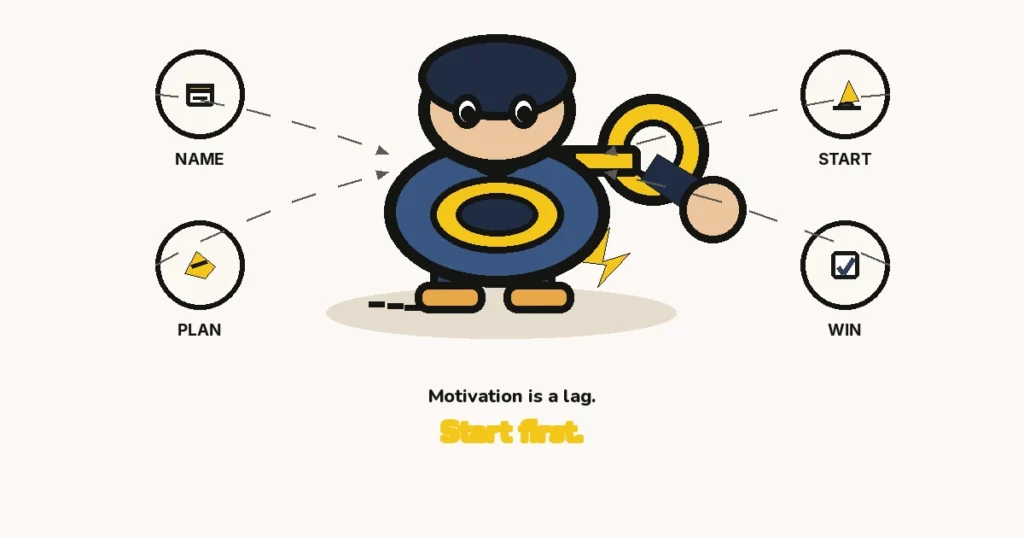
How to get motivated is to name the next physical action, write an if-then cue, start smaller than the mood, and log one visible win — then contrast the obstacle instead of fantasising the finish. Gollwitzer and Sheeran (2006) found if-then plans raise follow-through (d = 0.65); Amabile and Kramer found progress, not pep, moved inner work life.
Key takeaways
- Gollwitzer and Sheeran (2006) meta-analysed 94 tests (N = 8,461) and found implementation intentions — if-then plans — raised goal attainment with a medium-to-large effect (d = 0.65).
- Locke and Latham (2002) summarised 35 years of goal-setting research: specific, difficult goals outperform vague “do your best” goals, which is why the unit here is one physical next action.
- Bandura (1977) ranked performance accomplishments as the strongest source of self-efficacy — a two-minute start you finish beats a speech you believed.
- Amabile and Kramer (2011) read 12,000 diary entries from 238 people on 26 teams and found progress in meaningful work was the dominant inner-work-life mover, not pep.
- Oettingen, Pak and Schnetter (2001) found positive fantasy without contrasting the present obstacle does not bind a goal — rehearsing the finish is not a start.
What getting motivated actually is (and what it isn’t)
How to get motivated, on this page, is a start method: name one physical next action, attach an if-then cue, shrink the first move until it is smaller than the mood, log a win you can see, and contrast the obstacle instead of rehearsing the finish. It is not a personality transplant. It is not a TED talk you wait to feel. It is not a diagnosis. Motivation here is a lagging indicator. The feeling catches the action; it does not grant permission for it.
That job is narrower than “have more drive.” The parent, how to build discipline, owns the system that does not wait on a willpower tank. The sister, what self motivation actually is, owns the engine as a definition. Tony Robbins’s Awaken the Giant Within is the book for the other half of the picture: a change of state as something you do with a decision and a body, not a mood you wait to arrive. Related reading on productivity systems and summaries sits under the same roof. This page ends when the next action has a cue and a logged start.
How is this different from self-motivation, types, or self-control?
This page trains a start; self motivation owns what the engine is; intrinsic vs extrinsic motivation owns the type split; what is intrinsic motivation owns the definition; how to improve self control owns the room change before an urge peaks. Five jobs. Five pages. If the problem is delay despite intending, that is how to beat procrastination — the delay equation, not a missing feeling. If the problem is staying put once you have started, that is mental discipline. This page ends at the first logged move, not at a values speech.
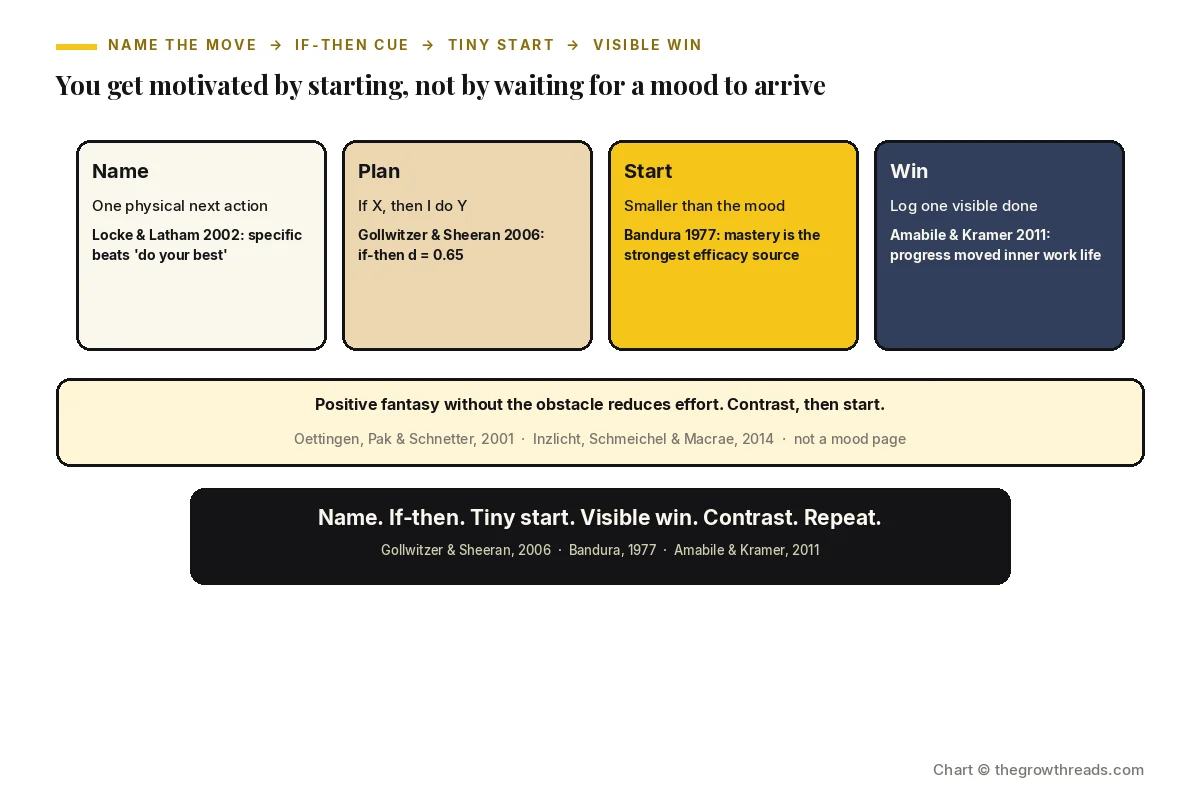
Why the start stalls
The start stalls because the unit is a whole project, readiness is treated as a prerequisite, the finish is fantasised without the obstacle, and the only fuel on offer is a prize for later. Locke and Latham (2002) is the first motor: across 35 years of work, specific and difficult goals beat easy goals and beat “do your best.” “Get motivated about the report” is a do-your-best instruction wearing a feeling. The body has nothing to do.
The second motor is the mood gate. Inzlicht, Schmeichel and Macrae (2014) argued that what looks like a drained willpower tank is often a shift from have-to goals to want-to goals. After a hard block, people prefer something they feel like. Waiting to “feel motivated” is that shift with a slogan on it. The start has to happen while the have-to is still the job, not after a better mood arrives.
The third motor is the fantasy loop. Oettingen, Pak and Schnetter (2001) compared free positive fantasies with mental contrasting — the wished-for future held against the present obstacle. Indulging in the fantasy did not produce binding goals. Contrasting did, and only when expectancy was high. A ten-minute montage of the launched product is not a plan. It is a daydream that can lower the effort you then spend.
The fourth motor is the bribe. Deci, Koestner and Ryan (1999) meta-analysed 128 experiments: engagement-contingent, completion-contingent, and performance-contingent rewards undermined free-choice intrinsic motivation. Unexpected and task-noncontingent rewards did not. A prize for finishing can get a one-off start and then train you to need the prize. This page hooks the start with a near, inherent reward — Woolley and Fishbach (2016) — not a dessert for a finished deck.
The four triggers, in the order you can actually pull them
Pull the named action first, then the if-then, then the shrink, then the logged win — because a pep talk with no next move has nowhere to land. Bandura (1977) is why the shrink comes before the speech: performance accomplishments are the most influential source of efficacy information. Vicarious experience, persuasion, and bodily states trail it. You do not talk yourself into a capable start. You collect a start you already did. Gollwitzer and Sheeran (2006) is why the if-then sits between the name and the shrink: the cue has to be installed before the mood gets a vote.
Why waiting costs more than it feels like
Waiting for a mood costs a hidden tax: the project stays vague, the if-then never installs, and the only evidence you collect is that you still do not feel like it. Locke and Latham (2002) is the cost sheet for vagueness. A “do your best” intention has no difficulty, no specificity, and no feedback loop. Days pass. The feeling you were waiting for had nothing to attach to.
Amabile and Kramer (2011) is the cost sheet for the workday. They analysed roughly 12,000 daily diary entries from 238 professionals on 26 project teams. The single most important factor for inner work life — the mix of emotions, motivation, and perceptions in a given day — was progress in meaningful work, including small wins. Setbacks did the opposite. A morning spent hunting motivation is a morning with no progress event. The diary does not record a TED talk. It records a move.
Gollwitzer and Sheeran (2006) shows the same cost from the other side: 94 independent tests, 8,461 participants, d = 0.65 for if-then plans versus mere goal intention. That is not a guarantee you will love the task. It is a measured lift in doing the thing you already said you would do. Skipping the plan and waiting for a feeling is leaving that lift on the table.
The four stalls — and the fix for each
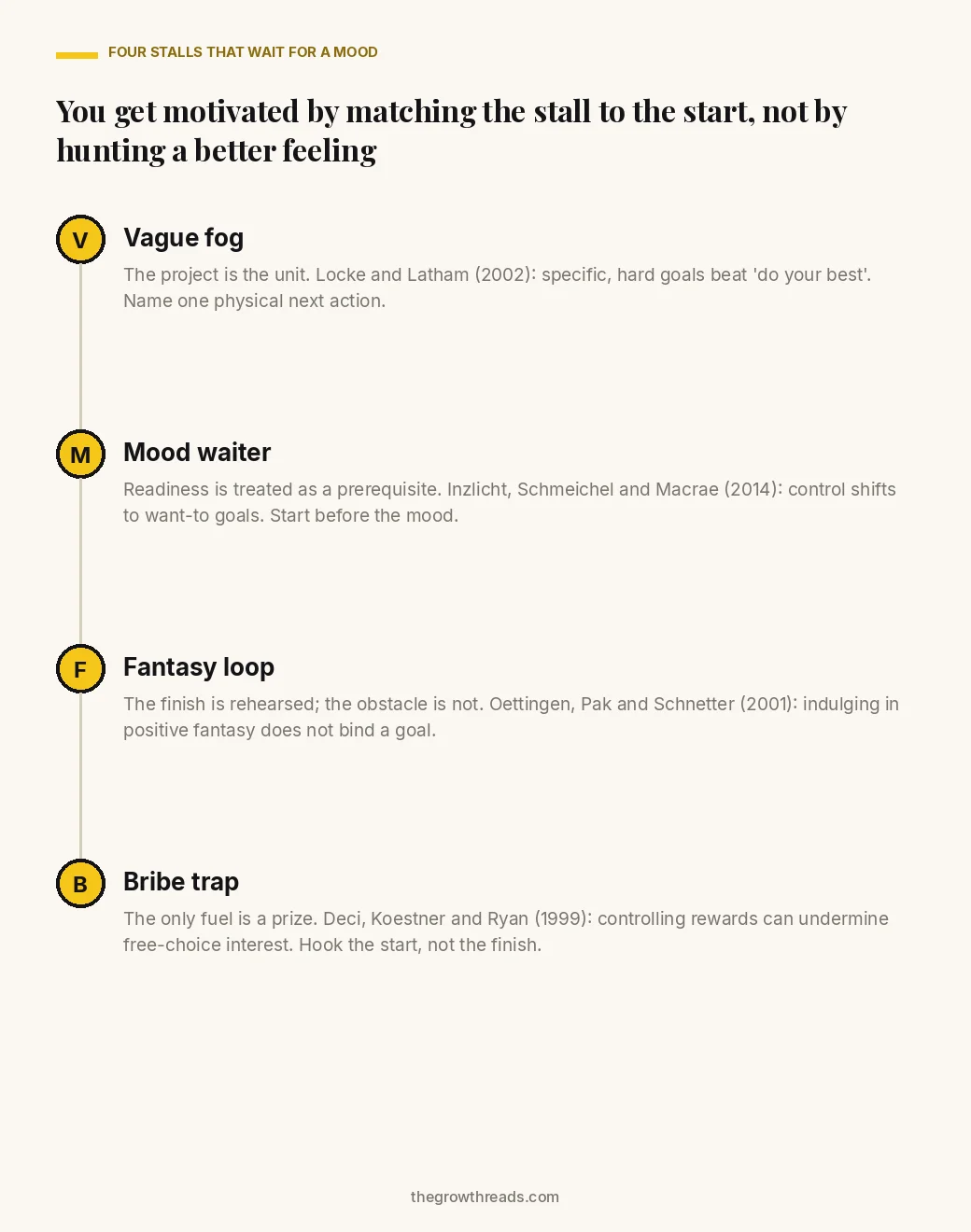
Most “I can’t get motivated” stories are one of four stalls: a vague project, a mood gate, a fantasy of the finish, or a bribe that replaced the work. Name the stall. Pull the matching lever. Do not collect a fifth playlist.
| Stall | What it looks like | The tell | The fix on this page |
|---|---|---|---|
| Vague fog | “I need to get motivated about the project.” No file, no sentence, no first physical move. | You cannot say what the hands do in the next two minutes. Locke and Latham 2002 is this pattern. | Step 1: write one physical next action. Open the file. Not “work on the project.” |
| Mood waiter | Tabs, kettle, a walk around the block to “get in the zone,” then the same chair and no start. | Readiness is treated as a prerequisite. Inzlicht, Schmeichel and Macrae 2014 is the shift underneath. | Steps 2–3: if-then plus a shrink so the start happens before the mood votes. |
| Fantasy loop | Vision boards, highlight reels, a detailed picture of the launched thing, no obstacle named. | The future is vivid; the present friction is not. Oettingen, Pak and Schnetter 2001 named the miss. | Step 6: contrast the wish with the obstacle, then run the cue. Do not add more montage. |
| Bribe trap | “I will start when I can buy X / when the bonus lands / when someone is watching.” | The only fuel is a separable prize. Deci, Koestner and Ryan 1999 is the undermining risk. | Step 4: a near, inherent hook on the start (Woolley and Fishbach 2016), not dessert for finishing. |
If two stalls are running, start with the named action plus the if-then. A visible win with no next action is a trophy for a day that still has no cue tomorrow. A playlist is not a plan.
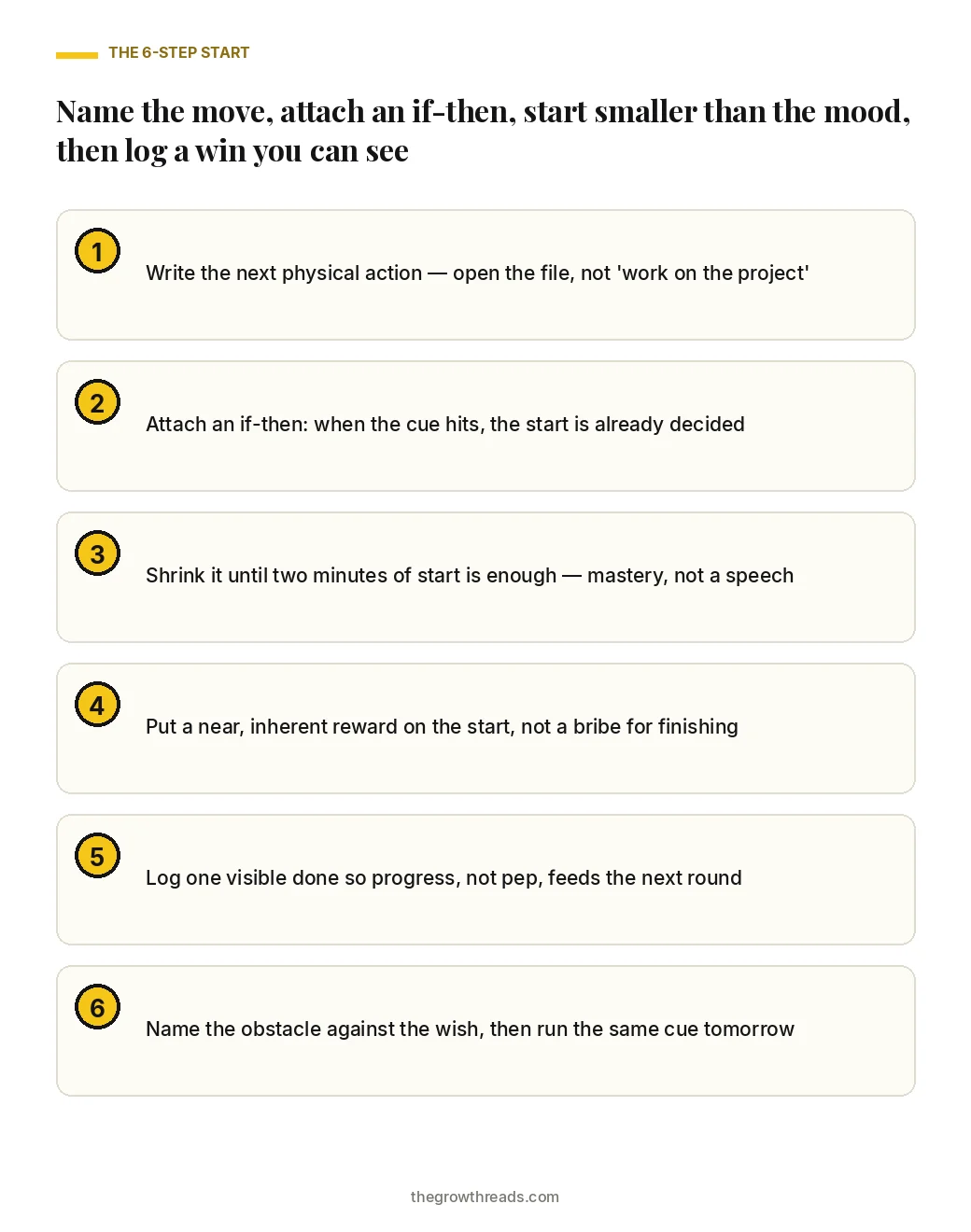
How to get motivated: the 6-step system
The system is a start you can repeat: one named action, one if-then, a shrink below the mood, a near hook on the first minutes, a logged win, and a contrast of the obstacle so the fantasy does not replace the work. It copies Gollwitzer and Sheeran (2006) for the cue, Bandura (1977) for the mastery start, Amabile and Kramer (2011) for the progress log, and Oettingen, Pak and Schnetter (2001) for the contrast. Do not swallow a 5 a.m. identity. Do not install a sticker chart that replaces interest.
Step 1 — Write the next physical action
Write tomorrow’s start as something a camera could film: open the draft, put on the shoes, open the spreadsheet to row 12. Not “work on the project.” Not “get motivated.” Locke and Latham (2002) is why the unit is specific: vague and “do your best” goals underperform specific, difficult ones, and they give you no feedback. If you cannot point at the object your hands will touch, you do not have a start. You have a weather report. Put the object in the sentence.
Step 2 — Attach an if-then cue
Write one line: If it is 9:00 at the desk, then I open the draft to the marked paragraph. Gollwitzer and Sheeran (2006) is the lift: 94 tests, 8,461 people, d = 0.65 for implementation intentions versus a mere goal. The cue has to be a real time or place you already occupy, not a feeling (“if I feel ready”). Feelings do not fire if-thens. Clocks, chairs, and opening a laptop do. One cue. One action. Do not write a branching flowchart.
Step 3 — Shrink it until two minutes of start is enough
Cut the first move until it is smaller than the resistance. Two minutes of the named action, then you may continue. Bandura (1977) is why this is not a trick: performance accomplishments are the strongest efficacy source. A finished two-minute start is evidence. An abandoned heroic hour is also evidence, the other way. You are not lowering the standard of the project. You are collecting a mastery event so the next round has something to stand on. If two minutes still feels theatrical, you named the wrong action in Step 1. Name a smaller object.
Step 4 — Put a near, inherent reward on the start
Attach something enjoyable to the first minutes of the work itself — a playlist you only play while drafting, a coffee that only sits next to the open file — not a prize for finishing. Woolley and Fishbach (2016) found that selecting long-term pursuits for their immediate rewards increased persistence more than selecting them for delayed rewards. Deci, Koestner and Ryan (1999) is the guardrail: controlling, engagement-contingent prizes can undermine free-choice interest. The hook is inside the start. It is not dessert after a finished deck, and it is not a public leaderboard unless the work already has one.
Step 5 — Log one visible done
After the two minutes, write one line you can see: “Opened draft, cut the first limp paragraph.” Amabile and Kramer (2011) is why the log exists. Progress — including small wins — was the dominant inner-work-life mover in that diary set. A start that leaves no trace does not feed tomorrow. The log is not a productivity theatre spreadsheet. It is a sentence. If you cannot write the sentence, the start did not happen, and you go back to Step 1 rather than calling the morning a motivation problem.
Step 6 — Contrast the obstacle, then run the same cue tomorrow
Name the wish in one line. Name the obstacle in one line. Then keep the if-then. Oettingen, Pak and Schnetter (2001) found that holding a positive future against a present negative reality produced expectancy-dependent goal commitment; free positive fantasies did not. The obstacle is usually specific: the phone on the desk, the 9:15 meeting, the fear of a bad first sentence. Write it. Do not add a vision board. Inzlicht, Schmeichel and Macrae (2014) is why you do not wait for a better mood tomorrow: the shift to want-to will show up again. The cue is how you meet it. Run the same if-then. Nudge the named action only if yesterday’s two minutes were stable.
What to do when you already stalled
If the morning already dissolved into tabs, do not hunt a two-hour hero block — name the smallest physical action left, run a two-minute if-then now, and log whatever moved. A day of delay despite intending is how to beat procrastination, not a personality verdict. A missing engine as a definition is self motivation. This page’s job on a blown morning is damage control: no third podcast about drive, no “I will start the program tomorrow,” and no prize for a finish that did not begin. Open the object. Two minutes. One sentence in the log. Resume Step 1 at the next cue you can actually keep.
Night shifts, crises, and days that are not yours to schedule are not this protocol. If the calendar owns the block, protect the next cue you do control. A discipline system still needs a named first move; it is not a substitute for one.
Common mistakes
- Waiting to feel ready. Inzlicht, Schmeichel and Macrae (2014) is the mistake with a mechanism. The want-to shift will arrive. Start before it votes.
- A project as the unit. Locke and Latham (2002) already failed “do your best.” Name an object the hands can touch.
- Rehearsing the finish. Oettingen, Pak and Schnetter (2001) found fantasy without contrast does not bind a goal. Name the obstacle.
- A prize for finishing. Deci, Koestner and Ryan (1999) is why a sticker for the whole job can hollow out interest. Hook the start.
- A bigger speech instead of a smaller start. Bandura (1977) ranked mastery above persuasion. Two minutes you did beats a paragraph you believed.
- Skipping the log. Amabile and Kramer (2011) needed a progress event. If it is not written, tomorrow has nothing to stand on.
- Confusing this with the delay equation. Delay despite intending is the procrastination page. This URL is the missing start, not the four-term formula.
When it is more than a habit
This is a work-and-habits page for a start you can still wind with a named action and a cue — it is not a diagnosis, not a depression page, and not a clinical scale. If nothing holds interest for weeks, if sleep and appetite have fallen apart alongside the stall, or if the only thought that remains is that effort is pointless, stop treating it as a missing if-then and speak to a clinician. Do not self-label anhedonia from a blog. Do not start a stimulant, a crash diet, or a 4 a.m. identity from this URL. A two-minute start is a work habit. It is not treatment.
The evidence behind this system
The method sits on a meta-analysis of if-then plans, a goal-setting review, a self-efficacy theory, a workplace diary of small wins, an immediate-reward persistence set, a process model of self-control, a mental-contrasting experiment, and a rewards meta-analysis that caps what a prize can claim. Observational rows are labelled as such. Small-n trials are labelled as such. Nothing here is causal proof that “getting motivated” raises income or lifespan.
| Study | Design and size | Finding | What we used it for |
|---|---|---|---|
| Gollwitzer and Sheeran, 2006, Advances in Experimental Social Psychology | Meta-analysis; 94 independent tests; N = 8,461 | Implementation intentions raised goal attainment, d = 0.65, versus mere goal intention | Step 2: the if-then cue |
| Locke and Latham, 2002, American Psychologist | Review of 35 years of goal-setting research (hundreds of studies) | Specific, difficult goals outperform vague or “do your best” goals | Step 1: name one physical next action |
| Bandura, 1977, Psychological Review | Theory paper synthesising efficacy experiments | Performance accomplishments are the most influential source of self-efficacy; persuasion trails them | Step 3: shrink the start into a mastery event |
| Amabile and Kramer, 2011, Harvard Business Review | Diary project; ~12,000 entries; 238 professionals; 26 teams | Progress in meaningful work, including small wins, was the dominant inner-work-life mover | Step 5: log one visible done |
| Woolley and Fishbach, 2016, Journal of Consumer Research | Multi-study experimental set on immediate versus delayed rewards | Selecting long-term activities for immediate rewards increased persistence versus delayed-reward framing | Step 4: a near, inherent hook on the start |
| Inzlicht, Schmeichel and Macrae, 2014, Trends in Cognitive Sciences | Process-model review of self-control (not a glucose-tank account) | After have-to work, people shift toward want-to goals; the “empty tank” is often a priority shift | Mood-waiter stall; start before the shift votes |
| Oettingen, Pak and Schnetter, 2001, Journal of Personality and Social Psychology | Experiments on fantasy versus mental contrasting | Positive fantasy alone did not bind goals; contrasting the wish with the obstacle did, when expectancy was high | Step 6: contrast, then run the cue |
| Deci, Koestner and Ryan, 1999, Psychological Bulletin | Meta-analysis; 128 experiments on extrinsic rewards and intrinsic motivation | Engagement-, completion-, and performance-contingent rewards undermined free-choice intrinsic motivation | The counter-case: a prize for finishing can hollow out the work |
Frequently asked questions
How do you get motivated when you do not feel like it?
You name one physical next action, attach an if-then to a cue you already occupy, and run two minutes of that action before the mood gets a vote. Gollwitzer and Sheeran (2006) found if-then plans lift attainment (d = 0.65, 94 tests). Bandura (1977) ranked a performance you already did above a speech you believed. Inzlicht, Schmeichel and Macrae (2014) is why the wait fails: after have-to work, people shift toward want-to. The start has to land first. Log the two minutes so tomorrow has a progress event, which is the Amabile and Kramer (2011) piece.
Is motivation supposed to come before the work?
On this page, no. Motivation is treated as a lagging indicator: the feeling follows a start you can see, it does not grant permission for one. Amabile and Kramer (2011) found progress, including small wins, moved inner work life more than pep in 12,000 diary entries. Locke and Latham (2002) already showed a vague “do your best” intention underperforms a specific goal. Waiting for a mood keeps the unit vague. Name the object. Start. Let the feeling catch up, or not — the log still counts.
Do I need a reward to get motivated?
You need a near hook on the start, not a prize for finishing. Woolley and Fishbach (2016) found immediate rewards attached to the activity increased persistence versus delayed-reward framing. Deci, Koestner and Ryan (1999), across 128 experiments, found controlling, engagement-contingent prizes can undermine free-choice interest. Coffee that only sits next to the open file is a hook. A shopping spree for a finished deck is a bribe. Use the first. Skip the second unless the job already pays that way and you are not trying to grow interest.
Why does imagining success not get me moving?
Because a free positive fantasy does not bind a goal. Oettingen, Pak and Schnetter (2001) had people indulge in the wished-for future or contrast that future with the present obstacle. Only contrasting produced expectancy-dependent commitment. A highlight reel of the launched product can lower the effort you then spend, because the mind has already collected a cheap version of the win. Write the wish. Write the obstacle. Keep the if-then. That is Step 6, not a vision board.
How is this different from beating procrastination?
Procrastination, on the sister page, is delay despite intending — expectancy, value, impulsiveness, and delay. Getting motivated, here, is generating a start when the story is “I do not feel like it,” not “I meant to and did not.” The tools overlap (a next action helps both), but the job is different. If you already intended and still slid, use how to beat procrastination. If you never named a move because you were waiting to feel ready, stay on this URL. Do not mix the four-term formula into a mood hunt.
How is this different from self-motivation or intrinsic motivation?
Self-motivation, on the sister page, is what the engine is: starting from a reason you own. Intrinsic versus extrinsic is the type split. What is intrinsic motivation is the definition. This URL is the method that produces a start on a Tuesday when the engine is quiet. Ryan and Deci’s work lives on those pages; this one borrows only the Deci, Koestner and Ryan (1999) guardrail against controlling prizes. Read what self motivation actually is for the concept. Use this page for the if-then and the two-minute log.
What if two minutes feels pointless?
Then the action is still too big, or the log is missing, or you are grading the two minutes as the whole job. Bandura (1977) is the reframe: the two minutes are a mastery event, not the project. Locke and Latham (2002) still want a specific, difficult goal for the work — after the start exists. Shrink the object (open the file, not write the chapter). Write the sentence in the log. Amabile and Kramer (2011) needed a progress event small enough to count. Pointless is a grade. A logged open is data.
What if I still cannot start after a week of this?
First check whether you actually named a physical action, used a real cue, shrank below two minutes, and wrote the log. If those were sloppy, run the bundle again before you change the story. If they were honest and nothing holds, stop. This is not a diagnosis page. Weeks of interest collapse, with sleep and appetite falling apart, belongs with a clinician, not with another if-then. Match the first hard block to a start you can keep, which is also what the parent how to build discipline argues with a different lever.
Related reading on The Growth Reads
Books. Tony Robbins’s Awaken the Giant Within treats a change of state as a decision plus a body, not a mood you wait for — steal the “change it now” move, not a firewalk.
Articles. The parent and sister are linked above. For the type split, intrinsic vs extrinsic motivation. For the definition, what is intrinsic motivation. For delay despite intending, how to beat procrastination. For staying put after the start, mental discipline.
Hub. All of this sits under productivity and the Discipline parent, not a seventh silo.
Sources
- Gollwitzer, P. M., & Sheeran, P. (2006). Implementation intentions and goal achievement: A meta-analysis of effects and processes. Advances in Experimental Social Psychology, 38, 69–119. https://doi.org/10.1016/S0065-2601(06)38002-1
- Locke, E. A., & Latham, G. P. (2002). Building a practically useful theory of goal setting and task motivation: A 35-year odyssey. American Psychologist, 57(9), 705–717. https://doi.org/10.1037/0003-066X.57.9.705
- Bandura, A. (1977). Self-efficacy: Toward a unifying theory of behavioral change. Psychological Review, 84(2), 191–215. https://doi.org/10.1037/0033-295X.84.2.191
- Amabile, T. M., & Kramer, S. J. (2011). The power of small wins. Harvard Business Review, 89(5), 70–80. https://hbr.org/2011/05/the-power-of-small-wins
- Woolley, K., & Fishbach, A. (2016). For the fun of it: Harnessing immediate rewards to increase persistence in long-term goals. Journal of Consumer Research, 42(6), 952–966. https://doi.org/10.1093/jcr/ucv098
- Inzlicht, M., Schmeichel, B. J., & Macrae, C. N. (2014). Why self-control seems (but may not be) limited. Trends in Cognitive Sciences, 18(3), 127–133. https://doi.org/10.1016/j.tics.2013.12.009
- Oettingen, G., Pak, H., & Schnetter, K. (2001). Self-regulation of goal setting: Turning free fantasies about the future into binding goals. Journal of Personality and Social Psychology, 80(5), 736–753. https://doi.org/10.1037/0022-3514.80.5.736
- Deci, E. L., Koestner, R., & Ryan, R. M. (1999). A meta-analytic review of experiments examining the effects of extrinsic rewards on intrinsic motivation. Psychological Bulletin, 125(6), 627–668. https://doi.org/10.1037/0033-2909.125.6.627
How this article was researched
We read the primary papers listed above, including Gollwitzer and Sheeran (2006) for the if-then effect size, Locke and Latham (2002) for the goal-setting review, Deci, Koestner and Ryan (1999) for the rewards meta-analysis, and Oettingen, Pak and Schnetter (2001) for mental contrasting. Numbers were taken from those papers (sample sizes, d = 0.65, 128 experiments, diary counts) rather than from press releases. We did not treat a diary project as a randomised trial of “getting motivated,” and we did not treat a 1977 theory paper as a 2026 clinical protocol. This page does not diagnose mood disorders or prescribe stimulants.
Method: eight academic sources, one unused review down-link, four required body links (Discipline parent, self-motivation sister, Awaken the Giant Within, productivity hub). Last checked against the live site on 19 September 2026.