

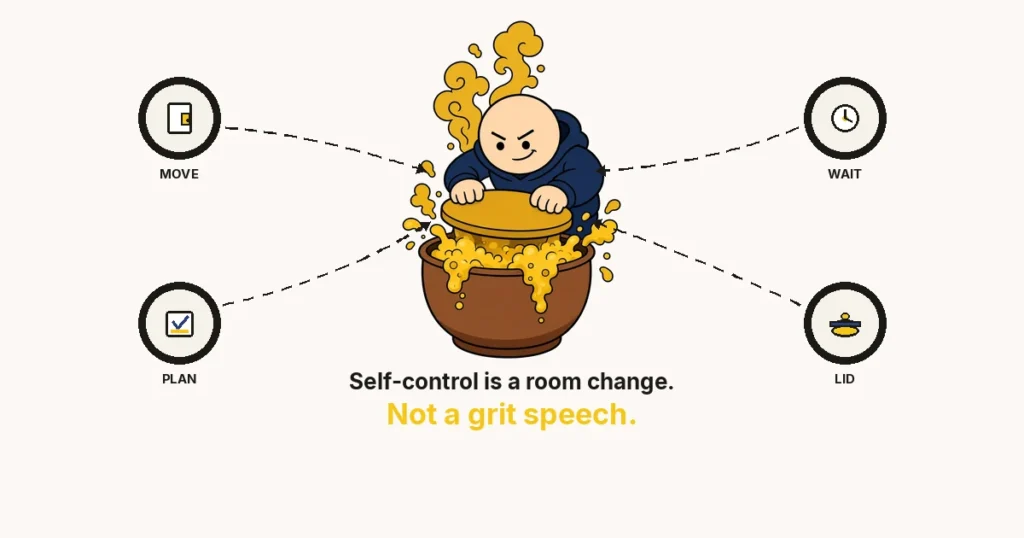
To improve self-control, change the room before the urge peaks — do not wait to feel stronger in the moment. Self-control is choosing a later goal over a smaller now. Impulses grow next to the cue. People who look disciplined often avoid the fight (de Ridder et al., 2012).
Key takeaways
- Situational self-control — leaving the phone in another room, asking the waiter not to bring dessert — lands earlier on the impulse timeline than a grit speech in the doorway, which is why Duckworth, Gendler and Gross (2016) treat the room as the first lever.
- A meta-analysis of 102 studies (N = 32,648) found trait self-control tracks behaviour more tightly when the behaviour is automatic than when it is a controlled, in-the-moment squeeze (de Ridder, Lensvelt-Mulders, Finkenauer, Stok & Baumeister, 2012).
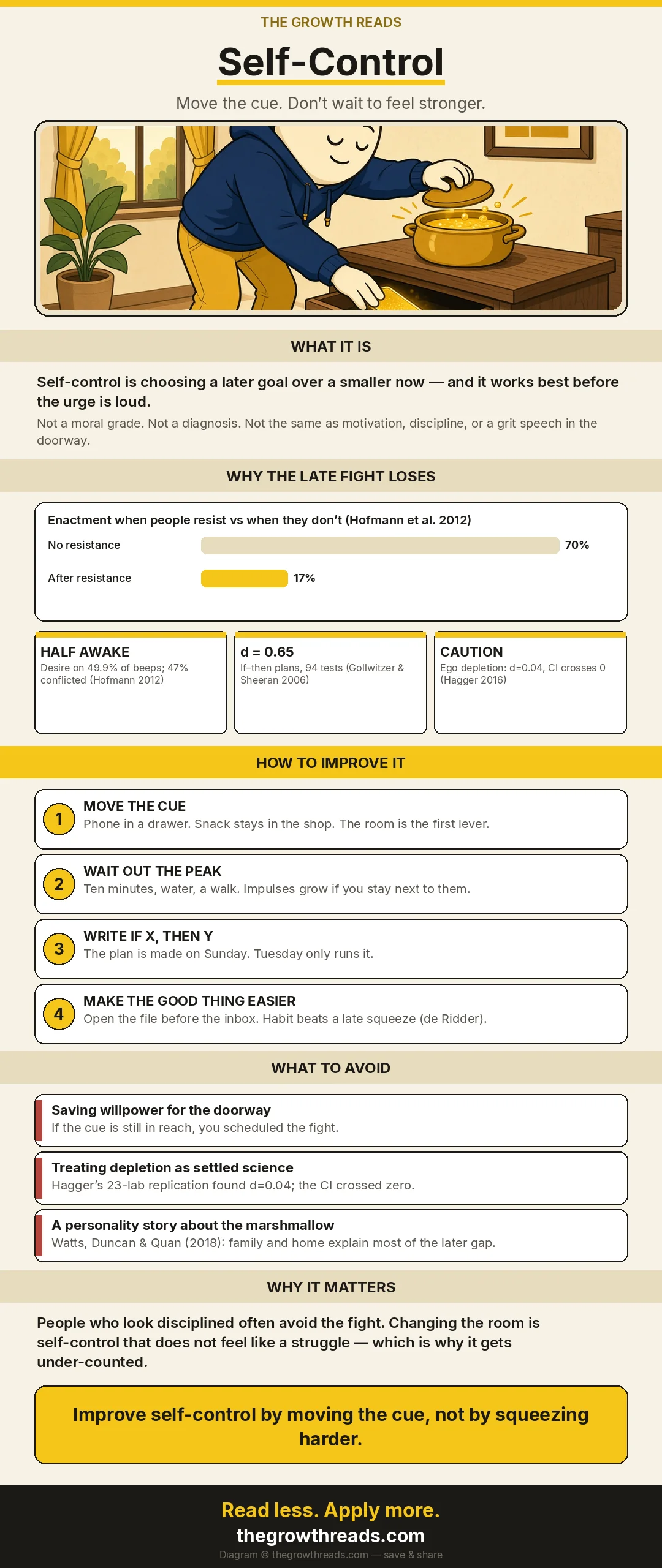
- In everyday life, people report a desire on about half of waking samples; when they resist a desire, enactment falls from 70% to 17% (Hofmann, Baumeister, Förster & Vohs, 2012, 205 adults, 7,827 desire reports).
- A written if–then plan raises follow-through by a medium-to-large amount: d = 0.65 across 94 tests (Gollwitzer & Sheeran, 2006).
- The popular “willpower tank empties after one hard task” story did not survive a 23-lab registered replication (Hagger et al., 2016, N = 2,141, d = 0.04, confidence interval crossing zero), so this page does not treat depletion as a reason to quit early.
What self-control actually is
Self-control is the work of choosing a later, valued goal when a smaller reward is available now. Duckworth, Gendler and Gross (2016) put it as self-initiated regulation of conflicting impulses in the service of enduringly valued goals. The useful part of that sentence is conflicting. Wanting dinner is not a self-control problem. Wanting dinner and also wanting to finish the draft before you eat is.
That is a work-and-habits definition, not a diagnosis. This page does not list clinical symptoms, does not grade your character, and does not treat a hard Tuesday as a disorder. Some people have medical or developmental conditions that change impulse control; those belong with a clinician, not with a productivity article. The rest of us mostly have a room that keeps offering the smaller thing.
Two more boundaries keep the word from swallowing the silo. Self-control is not the same as self motivation — motivation is wanting the later goal in the first place. And it is not the same as mental discipline, which is the practice of staying put after you have already started. Self-control is the earlier fork: the moment the cue appears and you still have a choice about whether the impulse gets a room to grow in.
Is willpower the same thing?
Willpower is the late, effortful version of self-control — useful, and a terrible plan to rely on all day. The folk story says you have a tank, you spend it, and then you fail. That story is tidy. It is also the one that failed to replicate. Hagger and 22 other labs ran a standardised sequential-task protocol in 2016 and found an effect of d = 0.04 whose 95% confidence interval included zero. A single failed replication does not prove the tank never existed. It does mean you should not organise a working day around “I already used my willpower at 9am.”
The more useful contrast is timing. An impulse gets louder the longer you stay next to the cue. Strategies that change the situation — leave the phone in a drawer, sit far from the drinks, open the draft before the inbox — happen before that volume goes up. Strategies that squeeze the already-loud urge happen after. Duckworth, Gendler and Gross argue the early ones are under-counted for a simple reason: when they work, the fight never feels like a fight.
Why the late fight fails
The late fight fails because the impulse has already been fed by the room you left it in. Hofmann, Baumeister, Förster and Vohs asked 205 adults to report their desires for a week. People felt a current desire on 49.9% of the occasions they were beeped. Almost half of those desires (47%) conflicted at least somewhat with another goal. Desire, in other words, is not a rare emergency. It is the background weather of a Tuesday.
When people did not resist, they enacted 70% of those desires. When they did resist, enactment fell to 17%. Resistance works — that is the honest good news. The 17% that still get through is the honest bad news, and it is why “I will just be stronger later” is a weak design. You will resist often. You will not resist perfectly. A room that keeps presenting the cue is a room that schedules the 17%.
Two more details from the same study matter for a work page. The mere presence of other people made enactment less likely. The presence of someone already doing the desired thing made resistance less likely (28% versus 38% when no model was there). Self-control is social before it is heroic. A colleague who “just checks Slack for a second” is an enactment model. So is a phone face-up on the shared table.
The four places an urge grows
- The cue stays in reach. A muted phone on the desk is still a cue. Distance is the cheaper intervention than a silent badge.
- The good action has extra steps. If starting the draft means finding the file, clearing the desktop, and deciding the first sentence, the inbox will win because it is one click.
- The plan is a mood, not a sentence. “I should be better about this” is not an if–then. Gollwitzer and Sheeran’s 94-test meta-analysis (d = 0.65) is about a written link between a situation and a response, not a vibe.
- You treat a personality story as the mechanism. The marshmallow test is famous. Watts, Duncan and Quan (2018) re-ran the later-life claim on a larger, more representative sample and found the bivariate link was about half the original size, then shrank by two-thirds once family background, early cognitive ability and the home environment were in the model. Waiting at age four is not a moral X-ray of the adult you will become.
Why weak self-control costs more than it feels like
A single give-in feels free because it is fast; the bill is the afternoon you never quite enter. Moffitt and colleagues followed about 1,000 children in the Dunedin study to age 32 and found a gradient: lower childhood self-control predicted worse physical health, more money trouble and more criminal convictions, even after they accounted for intelligence and social class. A sibling comparison in a second cohort of about 500 pairs pointed the same way. That is a longitudinal association, not a randomised trial of “try harder.” It is still the clearest population-level reason this topic is not a lifestyle garnish.
de Ridder’s meta-analysis adds the workplace-sized version. Across 102 studies, trait self-control had a small-to-medium link with behaviour, and the link was stronger for automatic behaviour than for controlled behaviour. People who score high on self-control scales are not spending their days in a clenched pose. They have arranged more of the day so the desired action is the default. That is the cost of the opposite arrangement: you pay a late tax, many times, on work that a boring room change would have made cheaper.
What the evidence does not show. Moffitt’s gradient is not a promise that a new drawer will rewrite a life course. Watts’s reanalysis is not a claim that delay of gratification is meaningless — only that the marshmallow-as-destiny story was oversold. And Hagger’s replication is not permission to ignore fatigue; it is a warning not to use a failed tank metaphor as a work policy.
The daily cost is more ordinary than a criminal-conviction gradient. It is the draft you open after the group chat. It is the “quick look” that becomes forty minutes. It is the snack that was sitting on the desk because bringing it home felt like a plan. Each one is small. The room keeps offering them. That is why how to build discipline and this page sit next to each other: discipline is the practice of staying; self-control is the design that makes staying less expensive.
Self-control vs discipline vs willpower vs motivation
These four words get used as synonyms; they are four different jobs. Mixing them is how a person ends up giving a grit speech to a phone that is still on the desk.
| Word | The job it actually does | When it fails | The move that fits |
|---|---|---|---|
| Self-control | Choose the later goal when a smaller now is on offer | The cue stays in reach, so the 17% failure rate gets scheduled | Move the cue; write the if–then before Tuesday |
| Discipline | Stay with the work after the start (see mental discipline) | You keep restarting instead of remaining | Protect the block you already opened |
| Willpower | The late, effortful squeeze once the urge is loud | You treat a contested tank as your only tool | Use it as backup, not as the plan |
| Motivation | Wanting the later goal at all (see intrinsic motivation) | You have no finish you actually care about | Name a finish; do not confuse appetite with a lid |
Robert Greene’s Mastery is the long form of the same split. The apprenticeship chapters are not a pep talk about squeezing harder in week one. They are about arranging years so the later skill stays chosen while the smaller now — novelty, status, a prettier project — keeps knocking. That is why this page’s down-link is Mastery and not a grit memoir: the useful picture is a long lid, not a short speech.
How people actually improve it
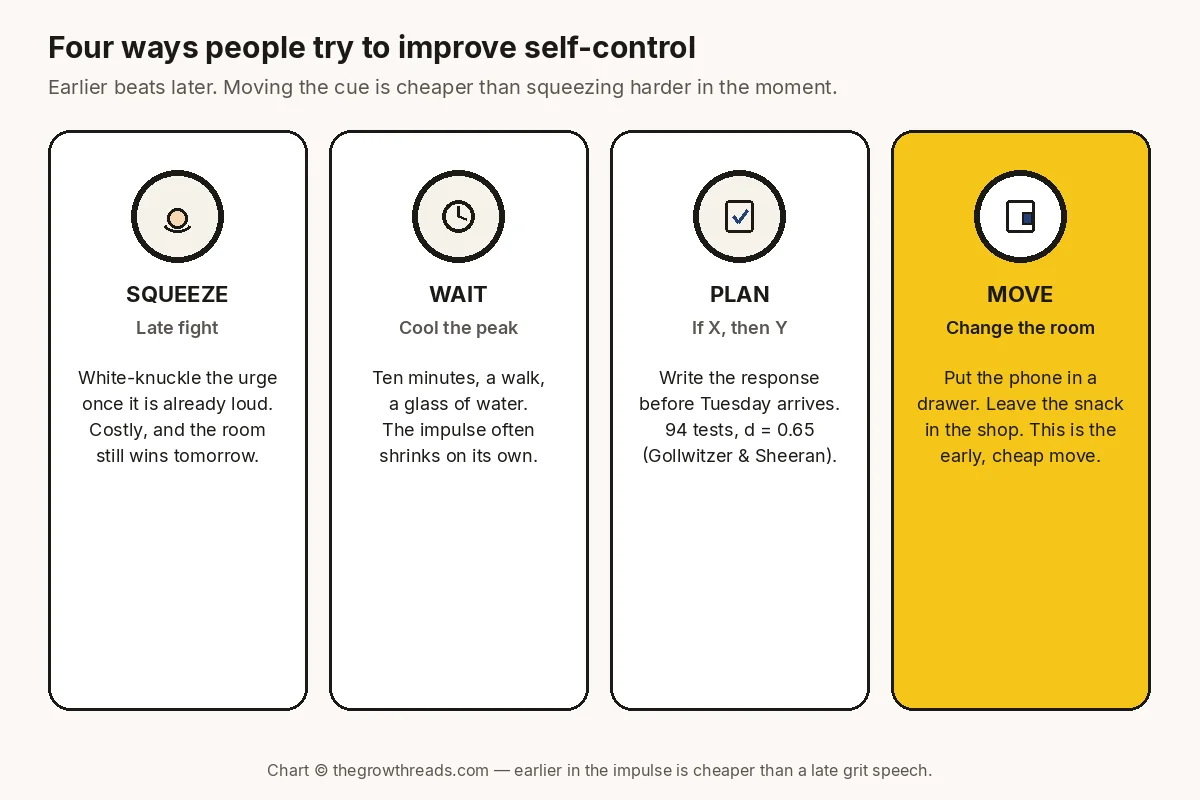
People improve self-control by moving the fight earlier, not by rehearsing a fiercer face in the same room. There is no numbered ladder here, because this is a play-slot page and the mechanism is a handful of designs you can run the same afternoon. Use them in any order. The only rule is not to skip the room and jump to the speech.
Put the cue out of reach. Duckworth, Gendler and Gross’s examples are almost boring on purpose: sit far from the drinks; ask the waiter not to bring the cart; go to the library without the phone. Boring is the point. If the first move still requires you to be a hero, it is not early enough. A phone in a bag on the same desk is a half-move. A phone in another room is the version the focus research keeps pointing at, and it is the same lever here.
Wait out the peak without negotiating. Hofmann’s sample felt desire about half the time they were awake. Most of those desires were not emergencies. Ten minutes, a glass of water, a short walk — none of that is a personality upgrade. It is a delay that lets the hot representation cool. If after ten minutes you still want the thing and it does not wreck the later goal, that is information. If you only wanted it because it was glowing next to the keyboard, that is also information.
Write the response before the cue arrives. Gollwitzer and Sheeran’s if–then plans (“If it is 9:30 and the inbox is open, then I close it and open the draft”) produced d = 0.65 across 94 tests. The plan has to name a situation you will actually meet. “If I feel tempted, then I will be good” is a mood. Pair it with the live method page on implementation intentions if you want the mechanics, not a second pep talk.
Make the wanted action the easy one. de Ridder’s result — stronger links for automatic than controlled behaviour — is permission to stop romanticising the clenched jaw. Open the file before you sit down. Lay out the running shoes. Put the snack on a shelf you have to stand up to reach, and the draft on the desktop you already face. Temptation bundling is the same idea from the other side: attach a pleasure you will not skip to a task you keep skipping, so the wanted action rides along.
Jeff Olson’s Slight Edge is the long, dull version of that last move: the advantage is not a dramatic refusal. It is the boring yes, repeated, until the room no longer bothers to offer the other thing. Steven Pressfield’s War of Art names the opposing weather — Resistance — without turning it into a medical label. The practical reply to Resistance is still a closed drawer, not a personality hearing.
All of this sits inside the broader productivity library for a reason. Self-control is one child of discipline, not a seventh silo. If the later goal is unclear, fix the finish first. If the start never happens, you are on a starting problem, not a squeezing problem.
Common mistakes
- Leaving the cue in sight and calling that a test of character. A test you designed to be hard is not discipline. It is theatre.
- Using the depletion story as a stop rule. Hagger’s 23 labs found d = 0.04. Tired is real. A scientifically failed tank is not a timesheet.
- Writing twenty if–thens for Monday. One situation, one response. A stack of plans is a to-do list wearing a lab coat.
- Confusing motivation with a lid. Wanting the goal harder does not close the drawer. See what self motivation actually is if the want itself is missing.
- Treating the marshmallow as your origin story. Watts, Duncan and Quan cut the later-life claim down to a much smaller, heavily confounded remainder. You are allowed to change a room at 34.
- Copying a public figure’s austerity as the method. Greene’s Mastery is about a long apprenticeship, not a week of performing toughness on the internet.
- Skipping the sister skill of staying. A perfect drawer that you abandon after twelve minutes is a starting win and a staying loss. That is mental discipline, not a new self-control trick.
The evidence behind this
The useful evidence is about timing, defaults and failed metaphors — not about a moral ranking of adults. The table below is the set this page actually used.
| Study | Design and size | Finding | What we used it for |
|---|---|---|---|
| Hofmann, Baumeister, Förster & Vohs (2012) | Experience sampling; 205 adults; 7,827 desire reports over 7 days | Desire on 49.9% of beeps; 47% of desires conflicted; enactment 70% without resistance, 17% with it | Self-control is daily weather, not a rare crisis; resistance works and still leaks |
| de Ridder, Lensvelt-Mulders, Finkenauer, Stok & Baumeister (2012) | Meta-analysis; 102 studies; N = 32,648 | Small-to-medium trait-behaviour link; stronger for automatic than controlled behaviour | People who “have” self-control mostly run better defaults |
| Duckworth, Gendler & Gross (2016) | Theoretical review of the process model of self-control | Situational strategies act earlier on the impulse and are easy to under-count | Move the cue before you squeeze |
| Gollwitzer & Sheeran (2006) | Meta-analysis; 94 tests of implementation intentions | d = 0.65 on goal attainment | Write if X, then Y; do not trust a mood |
| Hagger et al. (2016) | Registered replication; 23 labs; N = 2,141 | Ego-depletion d = 0.04; 95% CI [−0.07, 0.15] | Do not organise the day around a failed tank |
| Moffitt et al. (2011) | Longitudinal; ~1,000 children to age 32; plus ~500 sibling pairs | Childhood self-control gradient on health, money and crime after IQ and class | The topic is not a lifestyle garnish; also not a randomised “try harder” trial |
| Watts, Duncan & Quan (2018) | Conceptual replication of the marshmallow follow-up | Later-achievement link about half the original, then cut by ~two-thirds with family and home controls | Drop the destiny story; keep a modest delay skill |
| Milkman, Minson & Volpp (2014) | Field experiment on temptation bundling at the gym | Bundling a wanted pleasure with a skipped task raised gym visits | Attach a yes you will not skip to a yes you keep skipping |
Frequently asked questions
What is the fastest way to improve self-control this week?
Move one cue out of reach and write one if–then for the hour that usually breaks. A phone in another room plus “If it is 9:30, then I open the draft before the inbox” is a complete experiment. Duckworth, Gendler and Gross put situational moves first because they land before the urge is loud. Gollwitzer and Sheeran’s d = 0.65 is about that written link, not about feeling braver. Run the pair for five workdays and judge the afternoon, not your mood on day one. If nothing is easier, the cue you moved was not the one that was winning.
Is self-control the same as willpower?
No. Willpower is the late, effortful squeeze once the smaller now is already in your hand. Self-control includes that squeeze and, more usefully, the earlier work of keeping the smaller now out of your hand. The tank metaphor that made willpower sound like a daily budget failed a 23-lab replication (Hagger et al., 2016). You can still feel tired after a hard morning. Tired is not evidence that a finite moral fuel ran out at 10:14. Treat willpower as backup. Treat the room as the plan. If you only train the squeeze, you have scheduled a fight for every afternoon the cue is still on the desk.
Can you improve self-control as an adult, or is it a childhood trait?
You can change the room as an adult. Moffitt’s Dunedin gradient shows childhood self-control predicts later health, money and public-safety outcomes, even after IQ and class. That is a reason to take the skill seriously. It is not a life sentence. Watts, Duncan and Quan (2018) also cut the marshmallow-as-destiny story down sharply once family and home were in the model. Trait scores move slowly. Drawer locations move this afternoon. de Ridder’s meta-analysis says the people who look “high in self-control” often have better automatic defaults, which is a design you can copy without pretending you rewrote your temperament over a weekend.
Why do I have self-control in the morning and lose it at night?
The room is usually louder at night, and the later goal is further away. Hofmann’s sample wanted food, sleep, media and leisure more than they wanted “virtue.” Evening is when those desires stack and when someone else is already on the sofa or the phone. Move the cue before the evening starts: charge the phone out of the room, leave the snack in a cupboard, decide the first ten minutes after dinner in the afternoon. A grit speech at 21:40 is the late fight this page asks you not to schedule.
Does ego depletion mean I should stop after one hard task?
No. The sequential-task effect that made “the tank is empty” famous came back at d = 0.04 in Hagger’s registered replication, with a confidence interval that included zero. Stopping after one hard task because a blog said your willpower was spent is a policy built on a result that did not hold. Stopping because the next task is unclear, the room is noisy, or you have not eaten is ordinary work design. Keep those. Drop the tank. Change the next room — walk, water, a closed door — rather than granting a free-for-all on a failed metaphor.
How is self-control different from discipline or motivation?
Motivation is wanting the later goal. Self-control is what you do when a smaller now competes with that want. Discipline is staying with the work after you have started. You can be motivated and still leave the phone on the desk. You can close the drawer and still wander off twelve minutes later, which is a staying problem, not a lid problem. The comparison table above is the short version; the sister pages on self motivation and mental discipline carry the other two jobs. Mixing the three words is how people buy a new app and leave the cue where it was.
Do if-then plans really improve self-control, or is that just planning theatre?
The plans that show up in the meta-analysis are specific. “If situation Y, then I do X.” Gollwitzer and Sheeran pooled 94 tests and got d = 0.65 on goal attainment — a medium-to-large effect, not a miracle and not zero. Theatre is a list of hopes with no situation on them. A working plan names a time or place you will actually meet and a first action small enough to start. Pair one plan with one moved cue. If you write the plan and leave the phone face-up, you documented the fight instead of removing it.
Is a self-control problem the same as procrastination or ADHD?
No. Procrastination is delay of a task you intend to do. Self-control is the fork between a smaller now and a later goal — a snack, a tab, a purchase, or a delay. They overlap; they are not one page. ADHD is a clinical diagnosis this article will not make, treat, or symptom-list. If attention or mood is disrupting life beyond a messy desk, that is a conversation for a qualified professional. The work version here stays in the room: move the cue, write the if–then, make the wanted action easier. That help is real and limited.
Related reading on The Growth Reads
The book this page draws on
- Mastery by Robert Greene — the long lid: years of choosing the later skill while novelty knocks
- The War of Art summary — Resistance as weather, not a diagnosis
- The Slight Edge summary — the boring yes, repeated, until the room stops offering the other thing
Related articles
- How to build discipline — the Discipline parent this page sits under
- Mental discipline — staying put after the start; the sister skill
- What self motivation actually is — wanting the later goal in the first place
- What is intrinsic motivation — when the want itself is the missing piece
- Implementation intentions — the if–then that turns a Sunday sentence into a Tuesday
- Temptation bundling — attach a yes you will not skip to a yes you keep skipping
- Self-discipline examples — what the practice looks like on an ordinary day
Go deeper
How this article was researched
The Growth Reads editorial team writes from primary sources: the books themselves, the authors’ published essays, and the peer-reviewed literature behind the claims. Every study cited above was checked against the original publication or its published abstract, and every figure is quoted with its design, sample and effect so you can judge its weight. Where a finding is a synthesis rather than a single trial, or where later work limits the headline (ego depletion, the marshmallow follow-up), we say so in the body rather than in a footnote.
This is a productivity article about work and habits. It is not a clinical page, not a diagnosis, and not advice about mental health treatment.
How we work: every article on The Growth Reads is built from the books in our library plus the research they rest on, and is reviewed and date-stamped when the evidence changes. Read our full methodology.
Sources
- Duckworth, A. L., Gendler, T. S., & Gross, J. J. (2016). Situational strategies for self-control. Perspectives on Psychological Science, 11(1), 35–55. doi:10.1177/1745691615623247
- de Ridder, D. T. D., Lensvelt-Mulders, G., Finkenauer, C., Stok, F. M., & Baumeister, R. F. (2012). Taking stock of self-control: A meta-analysis of how trait self-control relates to a wide range of behaviors. Personality and Social Psychology Review, 16(1), 76–99. doi:10.1177/1088868311418749
- Hofmann, W., Baumeister, R. F., Förster, G., & Vohs, K. D. (2012). Everyday temptations: An experience sampling study of desire, conflict, and self-control. Journal of Personality and Social Psychology, 102(6), 1318–1335. doi:10.1037/a0026545
- Gollwitzer, P. M., & Sheeran, P. (2006). Implementation intentions and goal achievement: A meta-analysis of effects and processes. Advances in Experimental Social Psychology, 38, 69–119. doi:10.1016/S0065-2601(06)38002-1
- Hagger, M. S., Chatzisarantis, N. L. D., Alberts, H., Anggono, C. O., Batailler, C., Birt, A. R., … Zwienenberg, M. (2016). A multilab preregistered replication of the ego-depletion effect. Perspectives on Psychological Science, 11(4), 546–573. doi:10.1177/1745691616652873
- Moffitt, T. E., Arseneault, L., Belsky, D., Dickson, N., Hancox, R. J., Harrington, H., … Caspi, A. (2011). A gradient of childhood self-control predicts health, wealth, and public safety. Proceedings of the National Academy of Sciences, 108(7), 2693–2698. doi:10.1073/pnas.1010076108
- Watts, T. W., Duncan, G. J., & Quan, H. (2018). Revisiting the marshmallow test: A conceptual replication investigating links between early delay of gratification and later outcomes. Psychological Science, 29(7), 1159–1177. doi:10.1177/0956797618761661
- Milkman, K. L., Minson, J. A., & Volpp, K. G. (2014). Holding the Hunger Games hostage at the gym: An evaluation of temptation bundling. Management Science, 60(2), 283–299. doi:10.1287/mnsc.2013.1784