

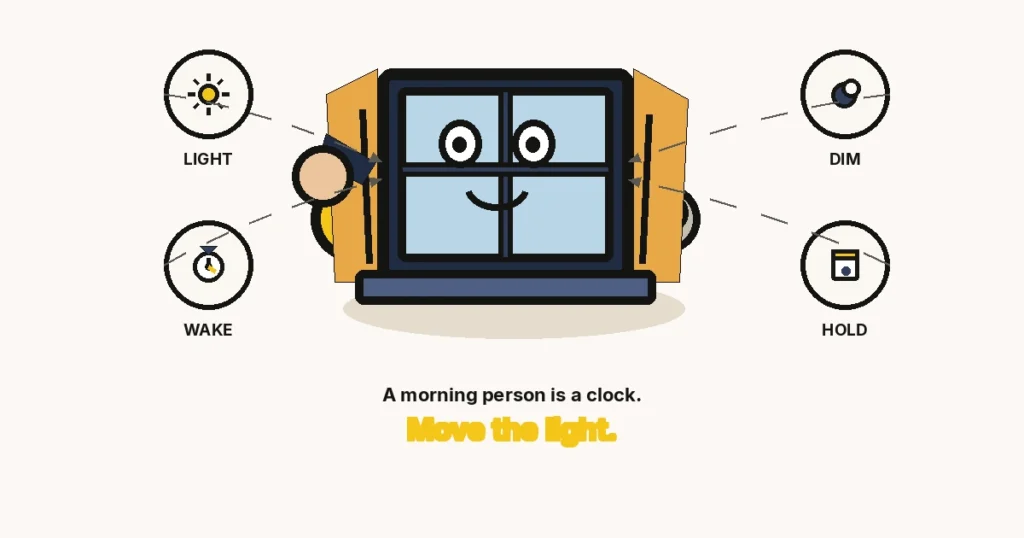
How to become a morning person is to keep one wake time seven days, take outdoor light in the first hour, dim the evening, and shift breakfast earlier — then hold that clock for three weeks. Facer-Childs et al. (2019) advanced extreme night owls about two hours this way, without copying a 5 a.m. speech.
Key takeaways
- Facer-Childs, Middleton, Skene and Bagshaw (2019) shifted extreme night owls about two hours earlier in three weeks with earlier wake times, morning outdoor light, a dimmer evening, and earlier meals — sleep duration did not drop.
- Wright and colleagues (2013) found a week of natural light, with no electric lamps after dusk, advanced melatonin timing by about two hours in eight campers.
- Wittmann, Dinich, Merrow and Roenneberg (2006) named the weekend lie-in social jetlag: the gap between work-day and free-day sleep, not a treat you earn.
- Chang, Aeschbach, Duffy and Czeisler (2015) found five nights of a light-emitting e-reader delayed dim-light melatonin onset by more than 1.5 hours versus print.
- Jones and colleagues (2019) mapped hundreds of genetic loci for morningness in 697,828 people — you can shift the clock; you cannot rewrite the genome in three weeks.
What becoming a morning person actually is (and what it isn’t)
How to become a morning person, on this page, is a light-and-wake method: fix one wake time you can keep all seven days, take outdoor light in the first hour, dim the evening, move breakfast earlier, and hold that clock for three weeks. It is not a personality transplant. It is not a 4:30 a.m. identity. It is not a sleep-medicine protocol and not a mood page. Duffy and Czeisler (2009) already mapped the lever: morning light advances the circadian clock; evening light delays it. This URL trains that lever, not a new character.
That job is narrower than “have a better morning.” The parent, how to build a morning routine, owns the sequence once you are already up. The sister, what makes someone a morning person, owns chronotype as a spectrum. Tim Ferriss’s Tools of Titans is the book for the other half of the picture: a catalogue of morning experiments people actually ran, not a clock you inherit by copying a celebrity hour. Related reading on productivity systems and summaries sits under the same roof. This page ends when the wake, the light, and the week are held.
How is this different from chronotype, the routine, or a sleep-schedule repair?
This page trains a phase advance; morning person owns what chronotype is; how to build a morning routine owns the once-you-are-up sequence; how to fix your sleep schedule owns repairing a week that has already slipped. Four jobs. Four pages. If the problem is one brutal early morning after a late night, that is how to wake up early if you sleep late. If the question is why early hours help at all, that is the benefits of waking up early. If the fight is the first minute of getting vertical, that is why it is so hard to get out of bed. This page ends at the held clock, not at a smoothie recipe.
Why the clock stays late
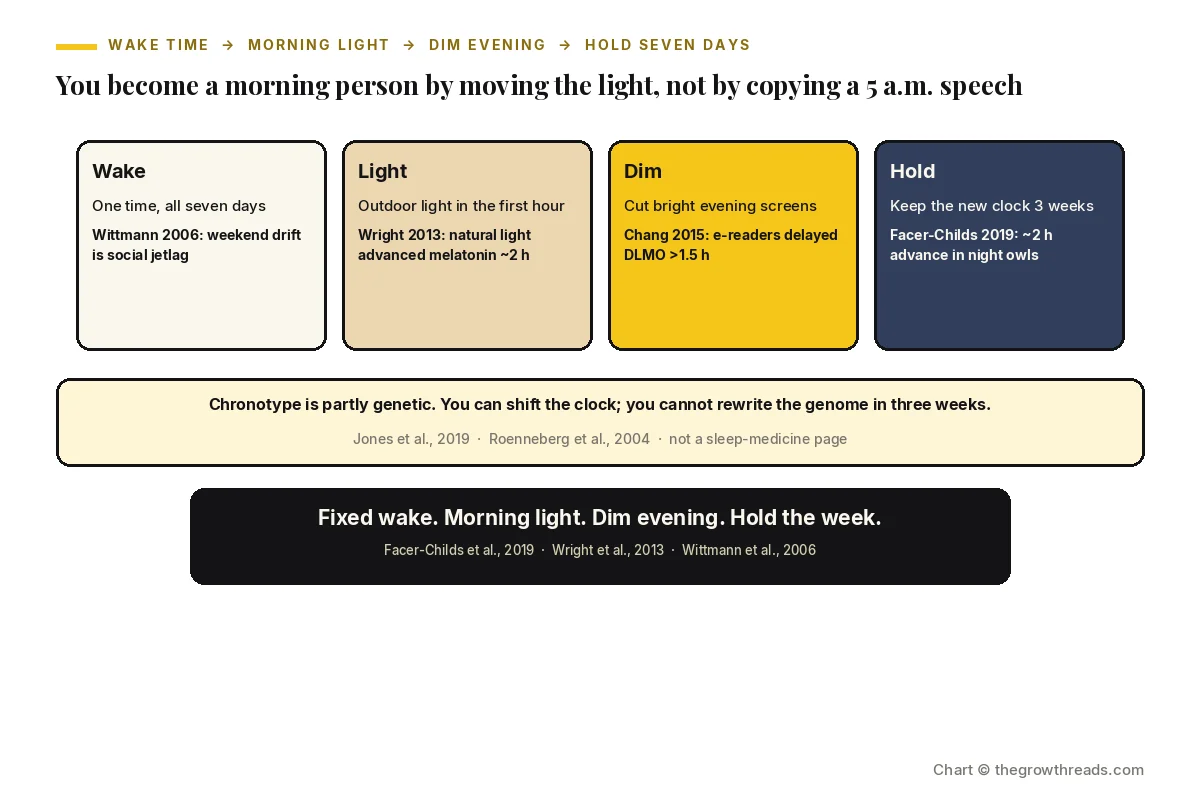
The clock stays late because evening light delays it, weekend lie-ins reopen the delay, indoor mornings starve the advance, and a heroic Monday jump has no light plan behind it. Duffy and Czeisler (2009) is the first motor: the human phase-response curve advances the clock with light in the biological morning and delays it with light in the biological evening. A bright phone after dusk is not entertainment sitting on top of a personality. It is a delay signal.
Chang, Aeschbach, Duffy and Czeisler (2015) made that concrete: twelve healthy young adults, five evenings of a max-brightness e-reader versus print in the same dim room. The e-reader suppressed evening melatonin by about 55 percent and delayed dim-light melatonin onset by more than 1.5 hours (22:31 versus 21:01). Face-down on the pillow is still a lamp.
The second motor is the weekend. Wittmann, Dinich, Merrow and Roenneberg (2006) surveyed 501 people and named the gap between work-day and free-day sleep social jetlag. Late types carried the largest gap. A Saturday 11 a.m. wake is a small weekly westward flight, then a Monday landing.
The third motor is a dark morning. Wright and colleagues (2013) took eight adults camping for a week with sunlight and campfires only. Melatonin onset moved from about two hours after sunset to sunset; later types advanced more. Indoor lamps in the first hour are a weak substitute for a sky.
The fourth motor is the hero jump: a two-hour-earlier alarm with the same 1 a.m. laptop. Facer-Childs, Middleton, Skene and Bagshaw (2019) did not do that. They moved wake, morning outdoor light, bedtime, evening dim, meals, and caffeine together. This page is that bundle, not a slogan.
The four triggers, in the order you can actually pull them
Pull wake first, then morning light, then evening dim, then the weekend hold — because a late wake with a bright night undoes the rest. Roenneberg, Kuehnle, Pramstaller and colleagues (2004) showed chronotype delays through adolescence, peaks around twenty, then slowly advances with age. That curve is real. It is also not an excuse to leave the lamp on until 1 a.m. and call it destiny. Jones and colleagues (2019) found 351 genetic loci for morningness in 697,828 people. Genes set a range. Light, wake, and meals still move you inside it.
Why the delay costs more than it feels like
A late clock costs a hidden Monday tax: social jetlag, a dim-light morning that never advances, and a first work block that starts while the body is still in biological night. Wittmann et al. (2006) is the cost sheet for the weekend. The discrepancy is not “I like nights.” It is a weekly misalignment between social time and biological time, largest in late types, and it tracks stimulant use in that sample. That is correlational — 501 questionnaires, not a trial that proves cigarettes cause lateness — but the gap itself is measurable in hours.
Facer-Childs et al. (2019) is the cost sheet for the workday morning. Twenty-two healthy extreme night owls, mean age 21, were randomised to a three-week field bundle or a control instruction to eat lunch at the same time. The experimental group (n = 12) advanced mid-sleep on free days (MSFsc) by 2.57 ± 0.32 hours and wake by 1.92 ± 0.26 hours, with no drop in sleep duration. Dim-light melatonin onset advanced 1.96 ± 0.63 hours in the sampled subset. Morning reaction time improved in hours night owls usually write off. The trial is small and young. It still moved the morning from unusable to usable.
Wright et al. (2013) shows the same cost from the other side: after camping, sleep timing moved about 1.2 hours earlier and melatonin about two. You can feel fine at 12:30 a.m. and still be delayed relative to the sun you have to work under. Stothard and colleagues (2017) later saw a winter camping weekend still push timing toward sunlight — useful, not a finished shift.
The four delays — and the fix for each
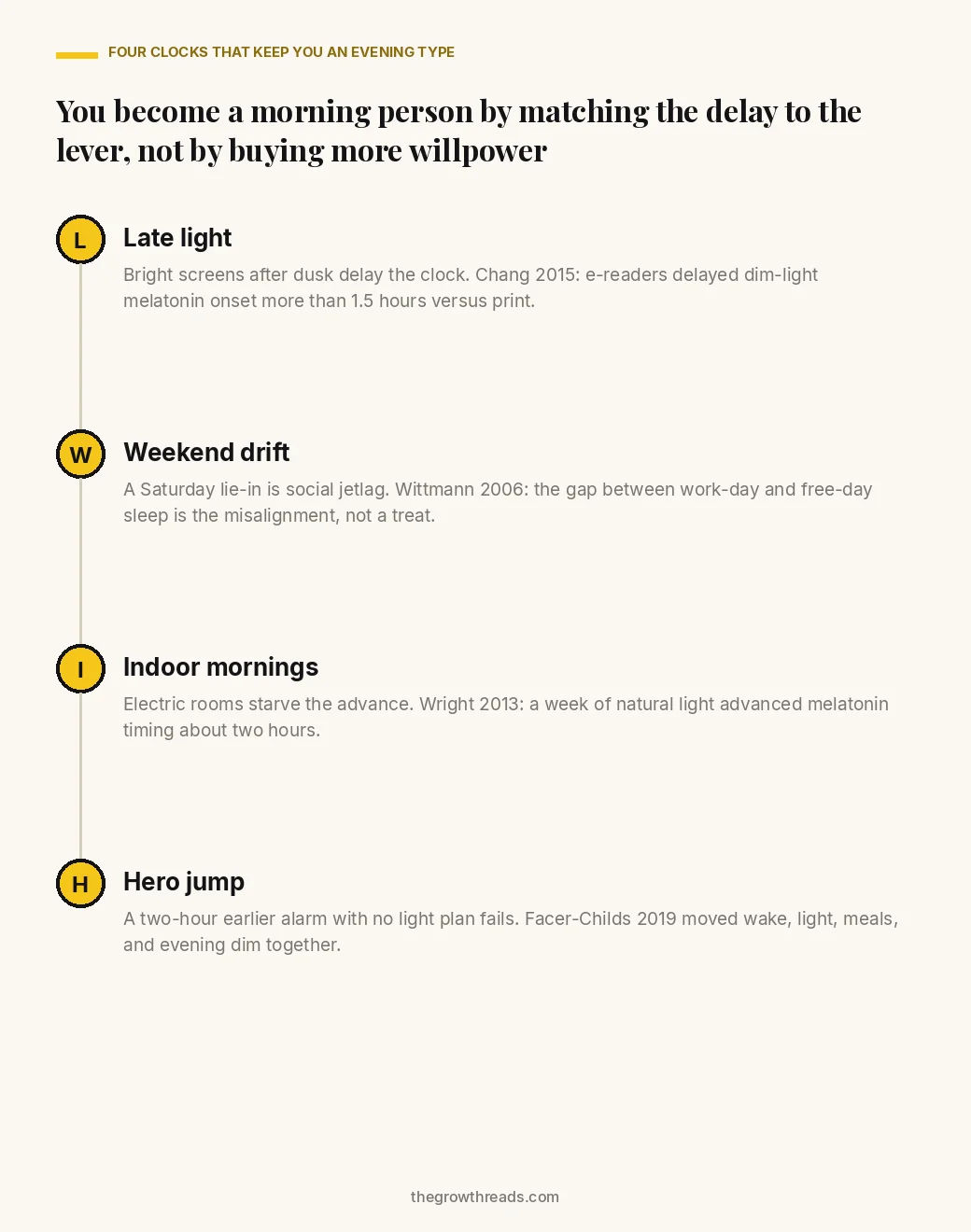
Most “I am not a morning person” stories are one of four delays: late evening light, weekend drift, a dark indoor morning, or a heroic alarm with no bundle behind it. Name the delay. Pull the matching lever. Do not collect a fifth morning playlist.
| Delay | What it looks like | The tell | The fix on this page |
|---|---|---|---|
| Late-light owl | Bright phone or e-reader in bed, “just one more episode,” alert at midnight and foggy at 8. | You are not sleepy until the lamp is on. Chang 2015 is this pattern. | Step 4: print, dim, or another room for screens. Keep wake fixed so the dim has somewhere to land. |
| Weekend drifter | Decent 7 a.m. Tue–Thu, 11 a.m. Saturday, wrecked Monday. | Free-day mid-sleep is hours later than work-day mid-sleep. Wittmann 2006 named it. | Step 1 and Step 6: the same wake, all seven days. Catch-up sleep is a nap, not a late morning. |
| Indoor morning | Alarm, then blackout curtains, then kitchen lights, then a commute in a tunnel of glass. | You “wake” indoors for an hour before you see sky. Wright 2013 is the missing outdoor dose. | Step 2: outdoor light in the first hour. A balcony beats a brighter bulb. |
| Hero jump | Monday alarm two hours earlier, same 1 a.m. laptop, collapsed by Wednesday. | Willpower week, then a crash. Facer-Childs 2019 did not jump without light, meals, and dim. | Steps 1–5 as a bundle, 15–30 minutes at a time, then hold. |
If two delays are running, start with wake plus morning light. Evening dim without a fixed wake just makes a later night feel darker. A checklist is useful after the clock has moved. It is not the clock.
How to become a morning person: the 6-step system
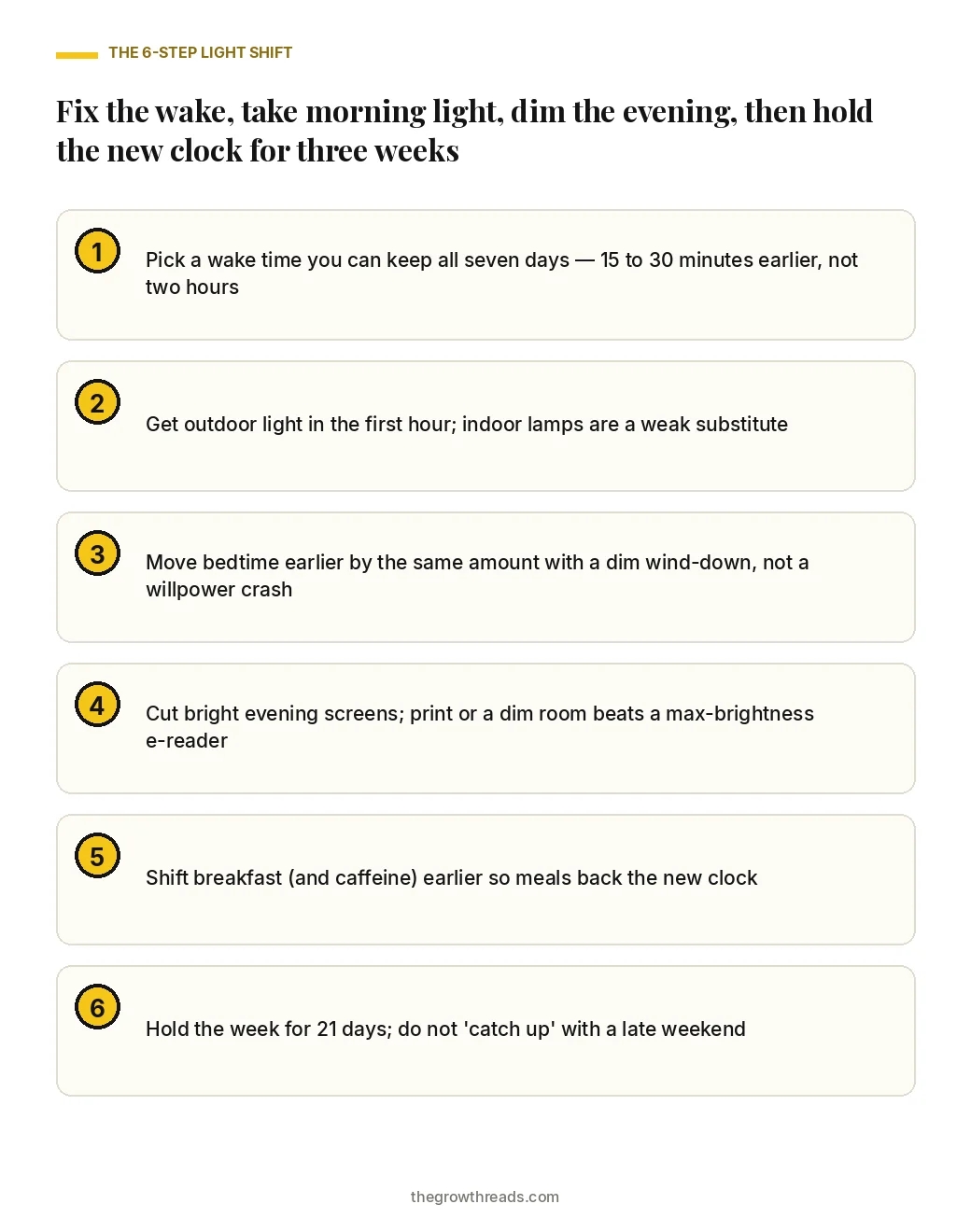
The system is a three-week phase advance: one wake time, morning outdoor light, an earlier dim bedtime, quieter evening screens, earlier breakfast, and a weekend that does not undo the week. It copies the Facer-Childs et al. (2019) field bundle, scaled to a first move of 15–30 minutes rather than a 2–3 hour leap unless you already live at the extreme they studied. Do not swallow melatonin as a personality pill on this page. Do not treat a 5 a.m. influencer hour as the target.
Step 1 — Pick a wake time you can keep all seven days
Write tomorrow’s wake time as a clock you will also keep on Saturday. Make it 15 to 30 minutes earlier than this week’s average, not two hours earlier. Wittmann et al. (2006) is why the weekend is in the sentence: a free-day delay is social jetlag, and late types already carry the largest gap. If you cannot keep Saturday, you did not pick a wake time. You picked a weekday slogan. Put the alarm across the room if you want a body-based cue; the rule is the time, not the gadget.
Step 2 — Get outdoor light in the first hour
Once you are up, take the sky. Ten to thirty minutes outside, even on a cloudy balcony, beats an indoor lamp aimed at a cereal bowl. Wright et al. (2013) advanced melatonin about two hours when people lived in sunlight and campfires for a week; later types advanced more. You are not going camping. You are stealing the part of that protocol that actually fires the phase-response curve Duffy and Czeisler (2009) described: light in the biological morning. Stothard et al. (2017) showed even a winter weekend of natural light still pushed timing toward the sun. A walk to coffee counts. Opening a laptop in a cave does not.
Step 3 — Move bedtime earlier by the same amount
If wake moved 20 minutes, bedtime moves 20 minutes. Do not hunt a heroic lights-out while leaving wake where it was — that only shortens sleep, and Facer-Childs et al. (2019) held duration steady while they advanced the clock. Dim the last 45 minutes. Same chair, same paper, same kitchen light on low. The wind-down is a cue, not a mood you wait to feel. If you are still wide awake at the new bedtime, you moved too far; step back 15 minutes rather than lying in the dark getting angry at the ceiling.
Step 4 — Cut bright evening screens
For the last hour, print, conversation, or a dim room beats a max-brightness e-reader. Chang et al. (2015) is the specific warning: five nights of a light-emitting tablet delayed dim-light melatonin onset more than 1.5 hours versus print, suppressed melatonin by about 55 percent, and left people sleepier the next morning. This is not a dopamine-detox essay and not a screen-time sermon. It is a phase delay you can stop buying. Night mode is weaker than another room. If work forces a screen, drop brightness, raise the device, and stop as early as the job allows.
Step 5 — Shift breakfast and caffeine earlier
Eat breakfast soon after waking, park lunch at a stable hour, and keep caffeine out of the late afternoon. Facer-Childs et al. (2019) asked the experimental group to breakfast as soon as possible, keep lunch regular, avoid dinner after 19:00, and skip caffeine after 15:00. Breakfast time in that group moved about 1.1 hours earlier. Meals are a second zeitgeber, weaker than light, but they travel with the clock. A 10:30 brunch after a 6:30 alarm tells the body the day has not started. Move the plate with the alarm.
Step 6 — Hold the new clock for three weeks
Do not “catch up” with a late weekend. Hold the wake. If you are short on sleep, nap. Facer-Childs et al. (2019) ran three weeks; MSFsc moved 2.57 hours in that window. Jones et al. (2019) is why you stop expecting a new identity at day four: morningness has a genome. You are sliding inside a range. After 21 days, if the new wake is stable, you can nudge another 15 minutes. If it is not stable, you went too fast. The morning routine belongs after this hold, not instead of it.
What to do when you already slept late
If you already woke at 11, do not chase a 6 a.m. hero hour tonight — keep today’s wake from sliding later, take outdoor light now, and dim this evening so tomorrow can move 15 minutes. A one-off late morning is how to wake up early if you sleep late, not a personality verdict. A week that has already torn is how to fix your sleep schedule. This page’s job on a blown morning is damage control: no nap that ends after 15:00, no 2 a.m. “I’ll just start the program tomorrow,” and no extra bright screen as a treat. Get sky. Dim later. Resume Step 1 at the next wake you can actually keep.
Night shifts, newborns, and red-eyes are not this protocol. If the job owns the dark, protect sleep duration first and use this page when you have seven days you control. A billionaire morning routine is theatre if the clock is still late.
Common mistakes
- Jumping two hours on Monday. Facer-Childs et al. (2019) studied extreme night owls and still bundled light, meals, and dim. A raw 5 a.m. alarm with a 1 a.m. laptop is a hero jump. Move 15–30 minutes.
- Treating Saturday as a prize. Wittmann et al. (2006) is the mistake with a name. Keep the wake. Nap if you must.
- More coffee instead of more sky. Caffeine after 15:00 was parked in the Facer-Childs bundle for a reason. It does not advance melatonin onset.
- Copying a 4:30 a.m. influencer hour. Jones et al. (2019) mapped a genome for morningness. Steal the light timing, not the brand.
- A brighter indoor bulb as “morning light.” Wright et al. (2013) needed the sky. Open a door.
- Building the routine before the clock. The parent page is the sequence after you can wake. A journal is a thinking habit, not a zeitgeber.
- Calling it a dopamine detox. This page is phase. Screens here are lamps. The sister screen-time article owns the attention cost; do not mix the jobs.
When it is more than a habit
This is a work-and-habits page for a clock you can still move with light and a fixed wake — it is not a diagnosis, not a depression page, and not sleep medicine. If you cannot stay awake while driving, if a partner reports loud snoring with gasping, or if sleep stays unrefreshing after two or three weeks of a consistent schedule and outdoor mornings, stop treating it as a 5 a.m. identity problem and speak to a clinician. Do not self-label delayed sleep-phase disorder from a blog. Do not start melatonin, prescription hypnotics, or an all-night “reset” from this URL. Roenneberg et al. (2004) already showed adolescence runs late; a 17-year-old struggling at 7 a.m. school is often a clock, not a character flaw — and still not a condition this page will name for you.
The evidence behind this system
The method sits on a small field trial that moved night owls about two hours, a camping study that advanced melatonin with natural light, a social-jetlag survey, an e-reader lab delay, and a genetic map that caps what three weeks can claim. Observational rows are labelled as such. Small-n trials are labelled as such. Nothing here is causal proof that becoming “a morning person” raises income or lifespan.
| Study | Design and size | Finding | What we used it for |
|---|---|---|---|
| Facer-Childs, Middleton, Skene and Bagshaw, 2019, Sleep Medicine | Randomised field trial; 22 healthy extreme night owls (12 intervention, 10 control); three weeks; mean age 21.3 | MSFsc advanced 2.57 ± 0.32 h; actigraphic wake 1.92 ± 0.26 h; DLMO 1.96 ± 0.63 h in the sampled subset; sleep duration unchanged | The 6-step bundle (wake, outdoor morning light, dim evening, meals, caffeine, hold) |
| Wright et al., 2013, Current Biology | Within-subject; 8 adults; one week electrical life vs one week camping, sunlight and campfires only | Melatonin markers ~2 h earlier after natural light; sleep timing ~1.2 h earlier; later types advanced more | Step 2: outdoor morning light as the advance signal |
| Stothard et al., 2017, Current Biology | Field; winter weekend camping (n = 5) and a summer camping week (n = 9) | Natural light still advanced circadian timing toward the sun, including after a winter weekend | You do not need a July expedition; a sky in week one still counts |
| Chang, Aeschbach, Duffy and Czeisler, 2015, PNAS | Inpatient crossover; 12 healthy young adults; five evenings LE-eBook vs print in dim rooms | Melatonin suppressed ~55%; DLMO >1.5 h later (22:31 vs 21:01); sleep latency ~10 min longer; next-morning sleepier | Step 4: evening screens as a delay lamp, not a personality |
| Wittmann, Dinich, Merrow and Roenneberg, 2006, Chronobiology International | Cross-sectional; 501 MCTQ respondents aged 14–94 | Named social jetlag (work-day vs free-day sleep); late types carried the largest gap; associations with stimulant use are correlational | Steps 1 and 6: keep the weekend wake; honest limit on what a survey can prove |
| Roenneberg, Kuehnle, Pramstaller et al., 2004, Current Biology | Large MCTQ sample; chronotype by age | Chronotype delays through adolescence, peaks near 20, then slowly advances | Age is a real shifter; it is not a 1 a.m. laptop excuse |
| Duffy and Czeisler, 2009, Sleep Medicine Clinics | Review of human circadian photoreception and the phase-response curve | Morning light advances; evening light delays | The mechanism under Steps 2 and 4 |
| Jones et al., 2019, Nature Communications | Genome-wide association; 697,828 individuals; 351 loci for morningness | Morningness is substantially genetic | The counter-case: three weeks move a clock, not a genome |
Frequently asked questions
Can a night owl actually become a morning person?
A night owl can become earlier. That is not the same as becoming a lark in the genetic sense. Facer-Childs et al. (2019) advanced extreme night owls about two hours in three weeks with wake, morning outdoor light, a dimmer evening, and earlier meals, without cutting sleep. Jones et al. (2019) mapped 351 loci for morningness in 697,828 people, which is why this page never promises a 5 a.m. personality. Move inside the range you have. Do not wait for a new character to arrive.
How long does it take to become a morning person?
Plan on three weeks for the first stable shift, then decide whether to nudge another 15 minutes. Facer-Childs et al. (2019) used a three-week field bundle and saw mid-sleep on free days move 2.57 hours in extreme night owls. Wright et al. (2013) moved melatonin about two hours in a single week of natural light, which you will not perfectly copy in a city. Stothard et al. (2017) still saw a push from a winter camping weekend. One 5 a.m. Monday is not a conversion. A held wake is.
Should I jump two hours earlier on Monday?
No. Pick 15 to 30 minutes, unless you already live at the extreme Facer-Childs et al. (2019) studied and can also move light, meals, and evening dim the same day. A two-hour alarm with a 1 a.m. laptop is the hero-jump delay in the table above. You shorten sleep, miss the phase-response window Duffy and Czeisler (2009) described, and call the crash proof that you are “not a morning person.” Smaller, bundled, held. That is the method.
Do I need melatonin to become a morning person?
Not on this page. Facer-Childs et al. (2019) used no pharmacology: wake, outdoor morning light, dim evenings, meals, caffeine timing, and exercise timing. Melatonin is a hormone with a clock of its own, and dosing it is a clinical decision this article will not make. If a clinician later uses timed melatonin for a diagnosed circadian disorder, that is their protocol, not a 5 a.m. identity hack. Here the lever is light in the first hour and darkness in the last.
What if my job already starts at 7 a.m.?
Then you may already be waking at a socially early hour while still living a biologically late evening. That is social jetlag with a uniform, not proof the method cannot run. Keep the 7 a.m. wake on Saturday (Wittmann et al., 2006), take outdoor light in the first hour (Wright et al., 2013), and cut the late lamp (Chang et al., 2015). The target is not a new start time. The target is a clock that stops fighting the start time you already have.
Is a weekend lie-in ruining the shift?
Yes, if “lie-in” means a wake hours later than the weekday. Wittmann, Dinich, Merrow and Roenneberg (2006) defined social jetlag as that exact gap, and late types carried the most of it. Sleep debt is real; pay it with an earlier bedtime or a short afternoon nap, not with an 11 a.m. Saturday that reinstalls Monday jet lag. Facer-Childs et al. (2019) told the intervention group to keep sleep and wake fixed on work days and free days. That line is the hold.
How is this different from building a morning routine?
A routine is what you do after you are up. Becoming a morning person, here, is moving the clock that decides whether 7 a.m. is possible. The parent how to build a morning routine owns water, light-as-cue, and the first block of work. This URL owns wake, sky, dim, breakfast, and a three-week hold. Build the checklist after the clock agrees. Copying a billionaire morning routine while melatonin still peaks late is theatre, which that page already argues against.
What if I still cannot wake after three weeks?
First check whether you actually held the weekend, saw sky in hour one, and dimmed the last hour. If those were sloppy, run the bundle again before you change the story. If they were honest and mornings are still impossible, stop. Jones et al. (2019) is a real ceiling, and this is not a diagnosis page. Chronic unrefreshing sleep, gasping snoring, or falling asleep at the wheel belongs with a clinician, not with another 5 a.m. speech. Match the first hard block to the peak you can actually reach, which is also what the sister morning person page argues.
Related reading on The Growth Reads
Books. Tim Ferriss’s Tools of Titans is a catalogue of morning experiments, not a chronotype manual — steal tests, not a celebrity hour.
Articles. The parent and sister are linked above. Repair a torn week with how to fix your sleep schedule. Survive one brutal morning with how to wake up early if you sleep late. For why the hour matters, benefits of waking up early. For the first vertical minute, why it is so hard to get out of bed.
Hub. All of this sits under productivity and the Morning parent, not a seventh silo.
Sources
- Facer-Childs, E. R., Middleton, B., Skene, D. J., & Bagshaw, A. P. (2019). Resetting the late timing of ‘night owls’ has a positive impact on mental health and performance. Sleep Medicine, 60, 236–247. https://doi.org/10.1016/j.sleep.2019.05.001
- Wright, K. P., Jr., McHill, A. W., Birks, B. R., Griffin, B. R., Rusterholz, T., & Chinoy, E. D. (2013). Entrainment of the human circadian clock to the natural light-dark cycle. Current Biology, 23(16), 1554–1558. https://doi.org/10.1016/j.cub.2013.06.039
- Stothard, E. R., McHill, A. W., Depner, C. M., Birks, B. R., Moehlman, T. M., Ritchie, H. K., Guzzetti, J. R., Chinoy, E. D., LeBourgeois, M. K., Axelsson, J., & Wright, K. P., Jr. (2017). Circadian entrainment to the natural light-dark cycle across seasons and the weekend. Current Biology, 27(4), 508–513. https://doi.org/10.1016/j.cub.2017.01.036
- Chang, A.-M., Aeschbach, D., Duffy, J. F., & Czeisler, C. A. (2015). Evening use of light-emitting eReaders negatively affects sleep, circadian timing, and next-morning alertness. Proceedings of the National Academy of Sciences, 112(4), 1232–1237. https://doi.org/10.1073/pnas.1418490112
- Wittmann, M., Dinich, J., Merrow, M., & Roenneberg, T. (2006). Social jetlag: Misalignment of biological and social time. Chronobiology International, 23(1–2), 497–509. https://doi.org/10.1080/07420520500545979
- Roenneberg, T., Kuehnle, T., Pramstaller, P. P., Ricken, J., Havel, M., Guth, A., & Merrow, M. (2004). A marker for the end of adolescence. Current Biology, 14(24), R1038–R1039. https://doi.org/10.1016/j.cub.2004.11.039
- Duffy, J. F., & Czeisler, C. A. (2009). Effect of light on human circadian physiology. Sleep Medicine Clinics, 4(2), 165–177. https://doi.org/10.1016/j.jsmc.2009.01.004
- Jones, S. E., Lane, J. M., Wood, A. R., van Hees, V. T., Tyrrell, J., Beaumont, R. N., Bechtold, D. A., et al. (2019). Genome-wide association analyses of chronotype in 697,828 individuals provides insights into circadian rhythms. Nature Communications, 10, 343. https://doi.org/10.1038/s41467-018-08259-7
How this article was researched
We read the primary papers listed above, including the Facer-Childs et al. (2019) accepted manuscript, Wright et al. (2013), Chang et al. (2015), and the Wittmann et al. (2006) abstract and secondary reports of sample size. Numbers were taken from those papers (sample sizes, hours of advance, melatonin suppression) rather than from press releases. We did not treat a genome-wide association as a three-week self-help guarantee, and we did not treat a 22-person trial of young extreme night owls as proof that every adult can become a 5 a.m. type. This page does not diagnose sleep disorders or prescribe melatonin.
Method: eight academic sources, one unused review down-link, four required body links (Morning parent, chronotype sister, Tools of Titans, productivity hub). Last checked against the live site on 18 September 2026.