

★★★★½ 4.5/5 — Stop borrowing someone else’s habit system. Build one your Tendency can actually keep.
Best for: people who look disciplined at work and unreliable with a private goal — and anyone who manages, teaches, parents, or lives with humans who will not “just do it.”
Reading time: ~6 hours (272 pages) · this guide ~12 min
Difficulty to apply: Easy to start (name the type), medium to keep (redesign the system around it).
The Four Tendencies in one minute
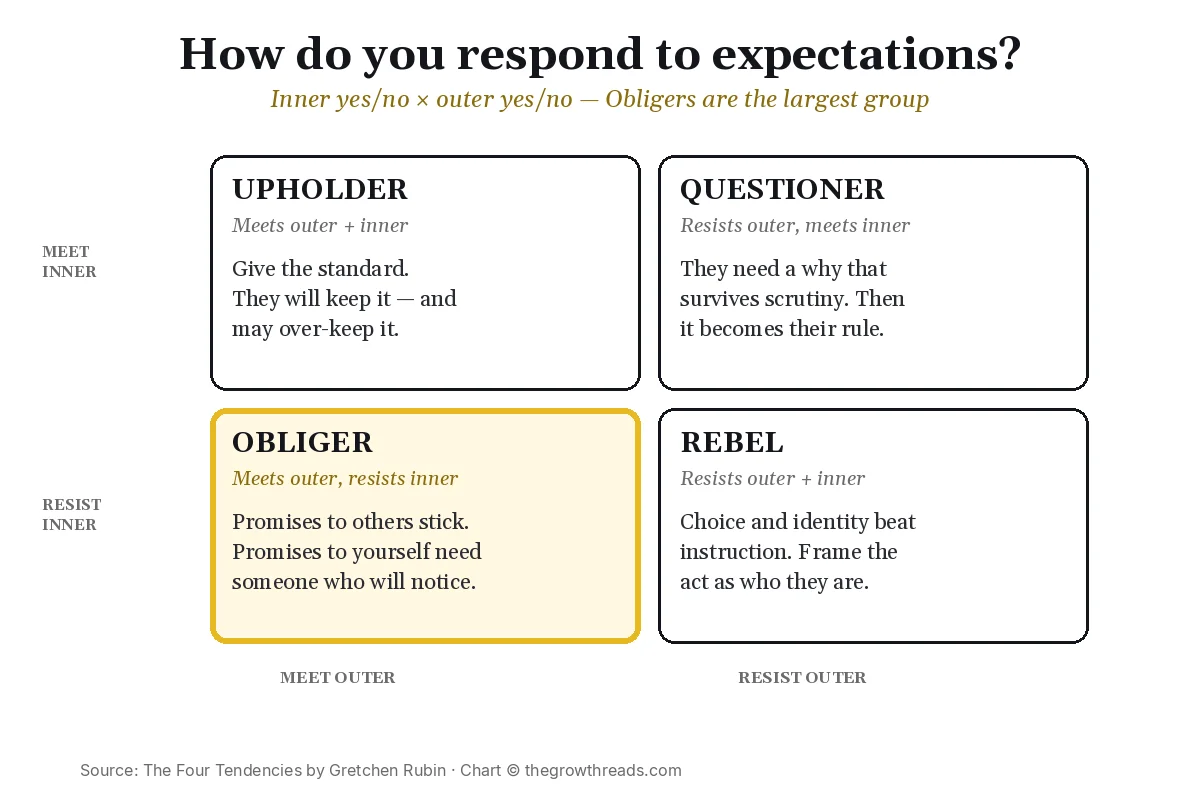
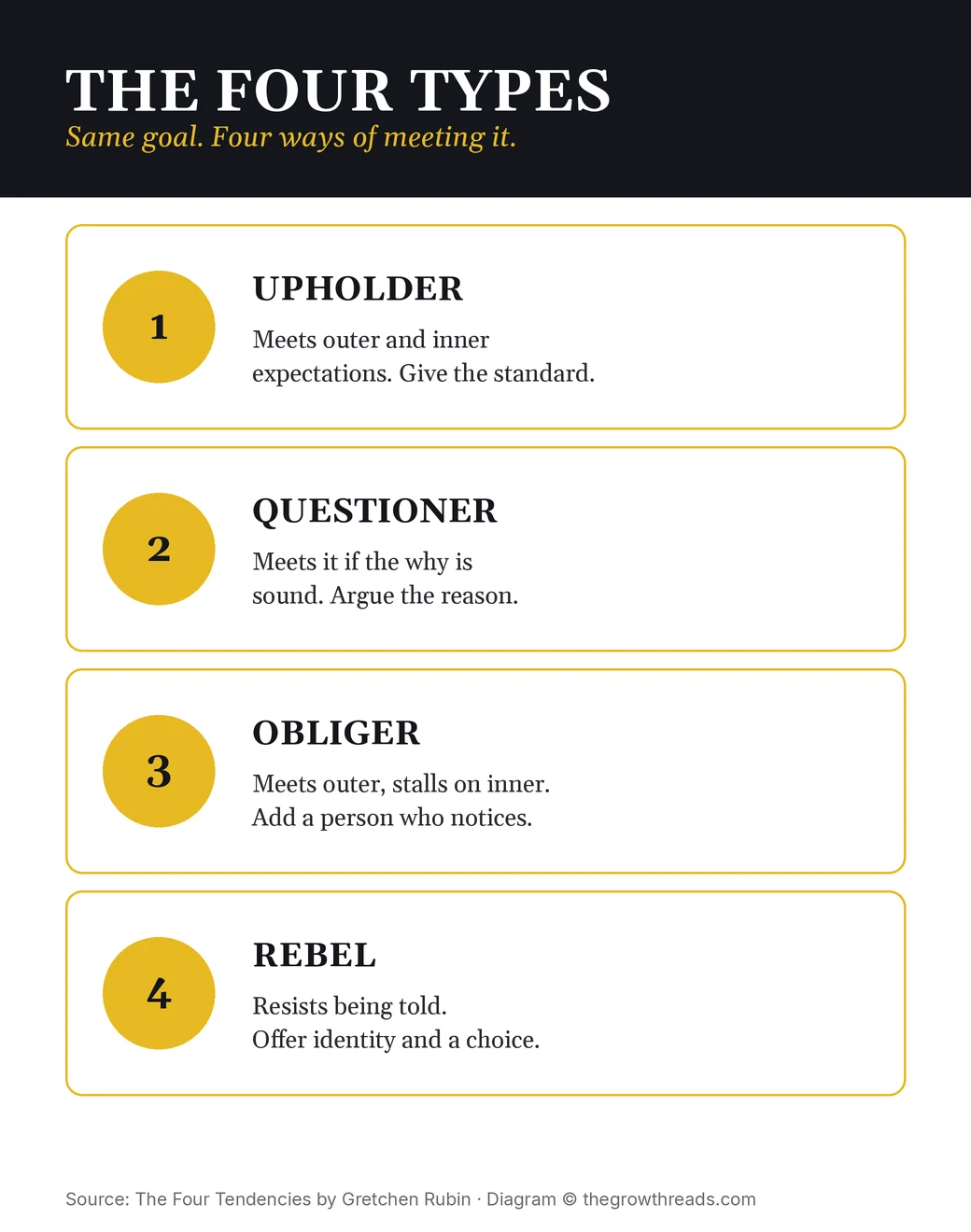
Most habit advice assumes you are one kind of person. Gretchen Rubin’s claim is that you are one of four, and the mismatch is why the same advice looks like character. Ask how you respond to outer expectations — a boss, a family, a deadline — and to inner ones — the run you promised yourself. Upholders meet both. Questioners meet what they have decided is justified. Obligers meet what other people are watching and stall on what nobody will notice. Rebels resist being told, including by themselves. The book is not a personality costume. It is a design manual: change the request, the why, the watcher, or the choice, and the habit often starts moving without a new identity speech. If you only remember one line: when a strategy contradicts your Tendency, you fail — and that is information, not a verdict on your will.
Key takeaways
- One question sorts the room: how do you respond to outer expectations, and to inner ones? The two-by-two is the whole model.
- Upholders keep the rule: they need a clear standard more than a pep talk. Watch for tightness — they can over-keep a dumb rule.
- Questioners need a why: “because I said so” is a stall. Once the reason holds, they often out-discipline everyone else.
- Obligers need a watcher: they are the largest group. Private goals fail until someone else is in the loop. That is design, not a character flaw.
- Rebels need identity and choice: instruction backfires. Freedom plus “the kind of person who…” is the door that opens.
- Your type does not have to change: change the system around it. An Obliger with a class beats an Obliger with a silent app.
- Managing others is translation: the same request lands as a rule, a reason, a check-in, or a choice. Speak the language they can hear.
- Pair this with a universal habit book: Atomic Habits still works. This book tells you which part of that system you will run.
What is The Four Tendencies about?
The Four Tendencies explains why the same habit system works for one person and fails the next: we differ in how we meet outer and inner expectations. Rubin sorts people into Upholders, Questioners, Obligers, and Rebels, then shows how to design habits, requests, and accountability to match the type instead of fighting it.
About the author
Gretchen Rubin trained as a lawyer — Yale College, Yale Law, a clerkship for Justice Sandra Day O’Connor — then left the path to write. The Happiness Project made her a public student of everyday life; Better Than Before turned that work toward habits and first sketched the four types. The Four Tendencies (Harmony, 2017) is the dedicated map: one question, four answers, a lot of office and kitchen examples. She hosts the Happier podcast with her sister Elizabeth Craft. The tone is warm, specific, and a little lawyerly. She is selling a better brief for the person who has to keep the promise. Explore all Gretchen Rubin book summaries →
Key concepts at a glance
| Concept | What it means | Use it when |
|---|---|---|
| Outer expectations | Deadlines, bosses, family, a class — what others ask. | Someone “won’t listen” or you only work when a meeting exists. |
| Inner expectations | The standard you set with nobody watching. | The gym-of-one, the book, the private writing hour keeps slipping. |
| Upholder | Meets outer and inner. Loves a clear rule. | You need someone who will keep the standard without a chase. |
| Questioner | Converts outer into inner once the why is sound. | They stall, ask “why,” then become the most consistent person in the room. |
| Obliger | Meets outer; needs outer accountability for inner goals. | Reliable at work, ghost on the solo plan. Add a watcher. |
| Rebel | Resists being told, including by a past self. | Instruction creates the opposite. Offer choice and identity. |
| Accountability | A person, a class, a stake that notices the miss. | You are an Obliger (or you manage one) and the app is silent. |
| Information vs identity | Questioners move on reasons; Rebels move on who they are. | The same lecture inspires one person and infuriates the other. |
Part 1: The question that sorts everyone
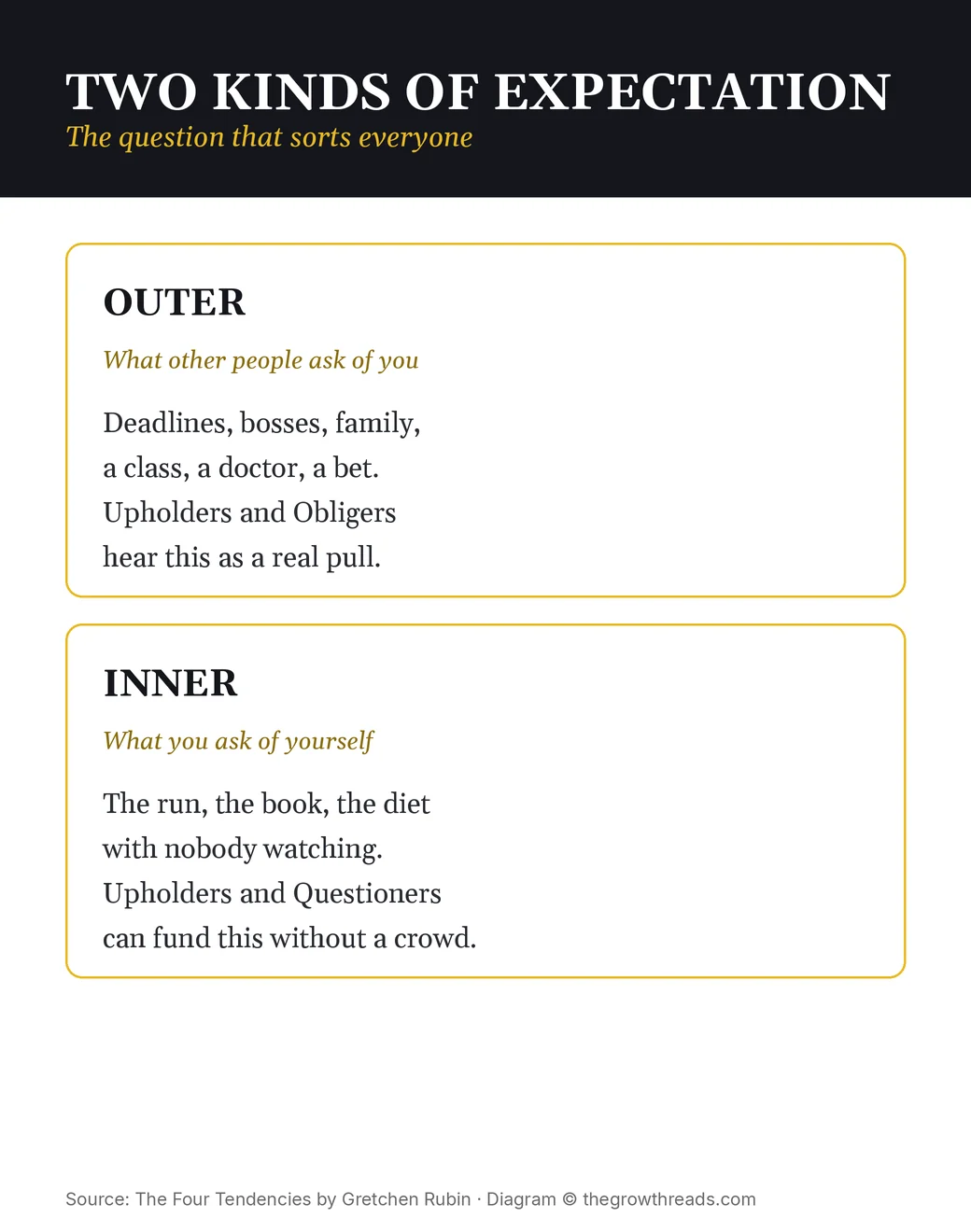
Rubin starts with a dry question that turns out to be a life’s work: how do you respond to expectations? Outer ones come from other people. Inner ones come from you. Cross those two axes and you get four Tendencies — not a spectrum you have to score every Monday. She found the pattern while writing Better Than Before: habit strategies did not fail at random. They failed in clusters. People who never missed a client deadline could not keep a journal. The missing variable was not willpower. It was which kind of expectation had a hook in that person.
The practical move is to stop arguing with the type. An Obliger who buys a prettier tracker still needs a human in the loop. A Questioner told to “just trust the process” will freeze until the process is justified. A Rebel assigned a 5 a.m. club will sleep in on principle. Name the pull. Design toward it.
TGR Note: This framework first showed up as a chapter in Better Than Before — start there if you want the wider habit menu (scheduling, abstaining, pairing). This book is the deep map of the one question that book could not drop. Pair it with Atomic Habits for the universal mechanics; Rubin tells you which mechanic you will actually run.
Part 2: Upholders and Questioners
Upholders meet the deadline and the private standard. They are the people for whom a calendar block is already a contract. Strengths: they are easy to rely on, and they do not need a pep rally to start. Limits: they can over-keep a dumb rule, tighten until others feel policed. Pick better rules, and leave other people more slack than you leave yourself. If you manage one, give a clean standard and then get out of the way. Micromanagement feels like an insult because they were going to do it anyway.
Questioners meet expectations that have passed their inner courtroom. They will research the mattress, the protocol, the meeting length. To an Upholder this looks like stalling. To the Questioner it looks like not wasting a life on a cargo-cult rule. Once they accept the why, they often become more consistent than anyone, because the rule is now theirs. The failure mode is analysis paralysis — more sources instead of a decision — and a reputation for arguing every ticket. The fix is a why that includes a constraint: “we are doing this for 14 days, then we review the metric.” Write the justification once and do not re-open the case before that date.
TGR Note: Questioners who want a tiny, justified start will like Tiny Habits — Fogg’s starter step is a why you can defend. Upholders who over-stack rules can borrow the floor from Mini Habits so the standard stays keepable. Neither book replaces the Tendency test. They give you a smaller unit to hang it on.
Part 3: Obligers and Rebels
Obligers are the heart of the book, and the largest group in Rubin’s quiz data. They keep what other people are counting on. They drop what only they are counting on. From the outside this looks like hypocrisy: the teammate who never misses a standup and never goes for the run they swore they wanted. From the inside it is one mechanism. Outer accountability is already built. Inner accountability is not. The move is almost embarrassingly concrete: put a person, a class, a coach, a charity stake, a photo thread — something with eyes — on the inner goal. Rubin is clear that this is not a moral failing. It is how Obliger follow-through is constructed. Obliger rebellion is the crash: too many outer yeses, no inner recovery, then a blow-up. Prevention is not trying harder alone. Protect a few inner goals with the same outer structure you already use at work.
Rebels resist control, including a past self who made a plan. Tell them what to do and you may have just made the opposite more attractive. Strengths: they can move fast when the action feels like a free expression of who they are. Limits: other people’s systems bounce off, and they can refuse a good plan because it arrived as an order. The design is identity plus choice. “Do you want to be the kind of person who is pushed around by a sluggish afternoon?” plus two ways to move the body. Not “you have to run at 6.” If you live with a Rebel, stop supervising the method. Supervise the outcome they already claimed as theirs.
TGR Note: Obligers who have been told they lack discipline should ignore that sentence and read this next to No Excuses! only if they add a watcher — Tracy’s standards work when someone will notice. Type-as-strategy, not type-as-cage, is the same move as StrengthsFinder 2.0: stop spending the week trying to become a different animal.
Part 4: Using the framework at work, at home, and on yourself
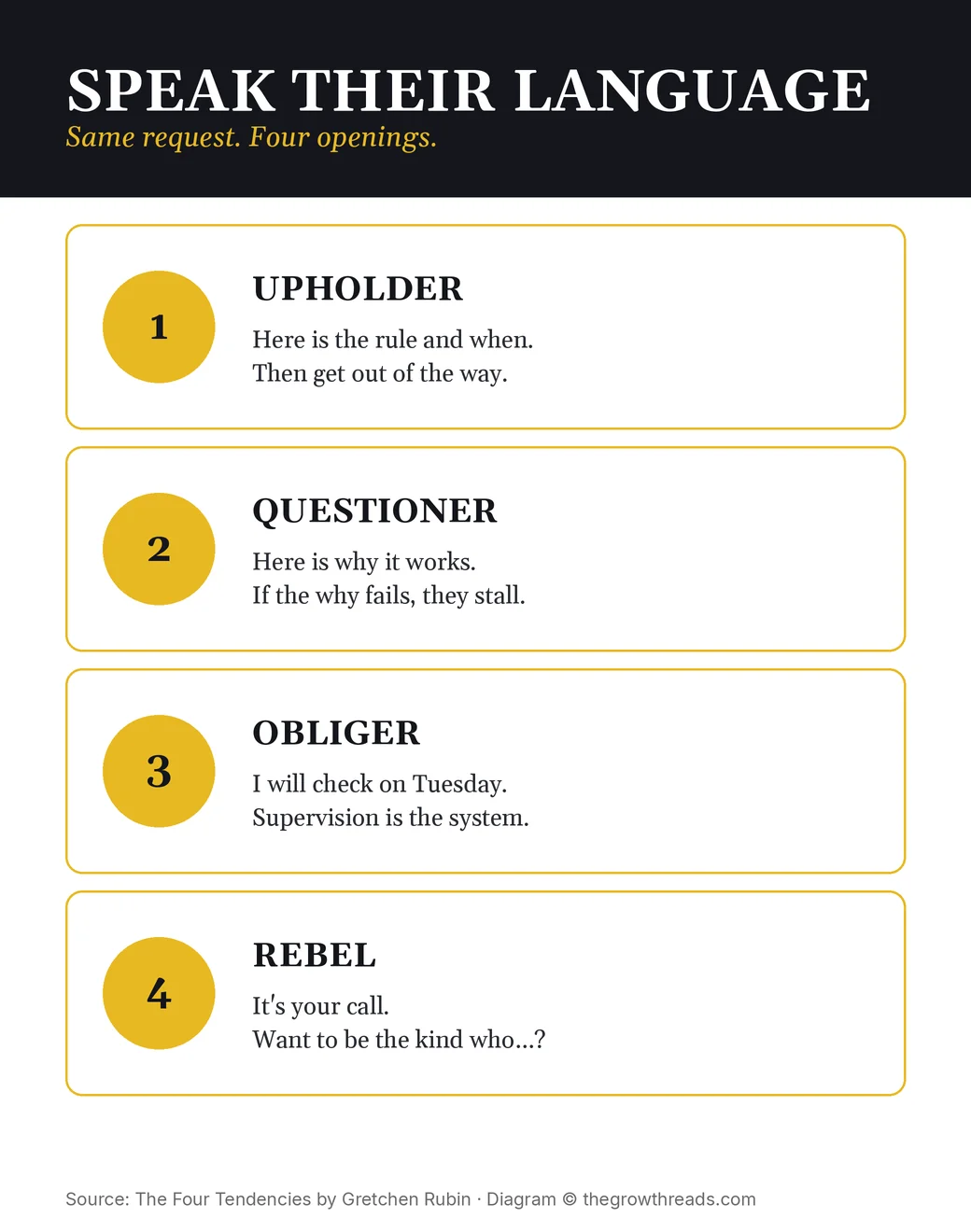
The second half of the book is a translation layer. Same request, four openings. To an Upholder: here is the standard and the date. To a Questioner: here is why it is the least-waste option, with the source. To an Obliger: I will check on Tuesday; want to be my accountability partner in return? To a Rebel: it’s your call — I need X done by Friday, however you want to get there. Managers who only speak Upholder create a culture where Questioners look insubordinate, Obligers drown, and Rebels leave. Parents who only speak Obliger ( nag + watch ) can accidentally train a Questioner child to hide, or a Rebel child to fight the homework as a sport. Couples do a smaller version every Sunday over the calendar.
On yourself, the work is to stop copying the system that worked for your most impressive friend. If they are an Upholder, their 5 a.m. block is a contract. If you are an Obliger, that block is a costume until a person is attached. Rubin’s line is the one to keep: when we try to use a strategy that contradicts our Tendency, we fail. Failure here is a diagnostic. Change the strategy. Keep the goal. Every type gets a design that can actually ship.
TGR Note: If the deeper need is “know thyself, then pick work that uses it,” Managing Oneself is the companion. Rubin tells you how you meet a promise. Drucker tells you which promises are worth your strengths. The Power of Habit is the cue–routine–reward science underneath; use it after you know which kind of cue your type will honor.
Who is The Four Tendencies best for — and who should read something else first?
Read this if generic habit books left you feeling defective, you manage people who will not “just do it,” or you are an Obliger who is excellent for everyone else and thin on your own list. It is also a sharp translator for couples and parents who keep having the same fight in different rooms.
Read something else first if you want one universal recipe — start with Atomic Habits. If you want the science of automaticity, start with The Power of Habit or Tiny Habits. If you already know the four types from Better Than Before and you wanted more tactics than types, stay with that book’s strategy chapters and use this one as the deep reference when a person (including you) will not move.
Questions to reflect on
- When you last dropped a private goal, was anybody else watching — and when you last kept one, were they?
- Which of the four openings (rule, why, check-in, choice) do you over-use on other people because it is the one that works on you?
- If you are an Obliger, who could be the watcher for one inner goal this month without turning into a nag?
- If you are a Questioner, what why would have to be true for the dropped habit to become your rule?
- If you are a Rebel, what identity would make the habit feel like freedom instead of an order?
🔥 Ready to stop using someone else’s habit system?
Name your Tendency. Redesign one stuck habit to match it. Then put the why, the watcher, or the choice on the calendar.
How to apply The Four Tendencies (7-day plan)
- Day 1 — Take Rubin’s free quiz, or skip it and answer two questions in writing: how do I respond when others expect something, and how do I respond when only I expect it? Circle a type.
- Day 2 — List three habits you keep and three you drop. Mark each outer or inner. Do not argue with the pattern.
- Day 3 — Redesign one dropped inner habit for your type: a why (Questioner), a watcher (Obliger), a choice-plus-identity (Rebel), or a named standard (Upholder).
- Day 4 — Tell one person the design. Obligers: that person is the system. Everyone else: saying it out loud still sharpens the rule.
- Day 5 — Rewrite one request you make of someone else in their language, not yours. Lead with why, a check-in, a choice, or a clean standard.
- Day 6 — Run the new habit once in the real week. If you skip, change the design, not the goal.
- Day 7 — Lock a 30-day version of the same design. Put the check-in, the why, or the choice on the calendar so it does not depend on mood.
Frequently asked questions
What is The Four Tendencies about in one paragraph?
The Four Tendencies is Gretchen Rubin’s map of how people respond to outer expectations (what others ask) and inner expectations (what we ask of ourselves). That two-by-two produces Upholders, Questioners, Obligers, and Rebels. The book grew out of Better Than Before, when she noticed habit advice failed in clusters, not at random. It is a field guide: how to design a habit, a request, or a deadline so the other person — or you — can actually meet it. The quiz is famous. The useful part is what you change after you know the type.
What are the four Tendencies?
Upholders meet outer and inner expectations. Questioners meet an expectation once it makes sense — then it becomes their own. Obligers meet outer expectations and struggle to keep promises that only they are watching. Rebels resist both, and move when the action feels like a freely chosen identity. Rubin’s quiz data has long shown Obligers as the largest group. The point is not a personality costume. It is a prediction: which design will this person keep next Tuesday. Use the label to pick a system, not a personality costume.
Which Tendency is most common?
Obligers. In Rubin’s large quiz sample they are the biggest slice — often cited around two in five. That is why so many people look “disciplined” at work and unreliable with a solo gym plan. They are not faking. They are running a system that only fires when someone else is in the loop. Questioners are usually next, then Upholders, with Rebels the smallest group. If a habit app keeps failing you and you never miss a client call, start by assuming Obliger before you assume a character defect.
Can your Tendency change over time?
Rubin treats Tendency as a durable orientation, not a mood. Stress, culture, and a strong partner can change how loudly it shows, but the underlying pull tends to stay put. An Obliger does not become an Upholder by buying a nicer planner. They become a well-designed Obliger: outer accountability aimed at an inner goal. If your type feels mixed, answer the two questions separately — outer, then inner — for the last hard promise you kept and the last one you dropped. The pattern is usually clearer than the label.
How should Obligers build a habit that nobody else cares about?
Put a person in the loop. A class with a roll call, a trainer, a coworker who gets a photo, a charity that charges you if you skip, a partner who asks a specific question on Thursday. Tools and streaks are optional. Supervision is the mechanism. Rubin’s phrase is that Obligers need outer accountability for inner expectations. That is not weakness. It is how their follow-through is already built. Design the habit the way your job already works: someone will notice if you do not show.
How do Questioners and Rebels get themselves to follow through?
Questioners need a why that survives their own cross-examination. Once they accept the reason, they often become more consistent than Upholders, because the rule is now theirs. Give them the research, the constraint, the cost of not doing it — and skip “because I said so.” Rebels need choice and identity. “You have to run” fails. “Want to be the kind of person who doesn’t get pushed around by a sluggish afternoon?” plus two options for how, often works. Information for one. Freedom for the other. Same outcome, different door.
Is this just Myers-Briggs with nicer names?
It is narrower, which is the point. Myers-Briggs tries to describe a whole personality. The Four Tendencies asks one operational question: how do you respond to expectations? That is why it is more useful on a Tuesday than a type that explains your weekend. Some readers will find four boxes too neat; people are messier than a matrix. The practical test is whether a stuck habit starts moving once you match the design to the type. If it does, keep the tool. If it does not, use Atomic Habits or Tiny Habits and ignore the labels.
Related summaries
- Better Than Before — the habit-strategy book that first sketched the four types.
- Atomic Habits — the universal system; this book tells you which parts you will run.
- Tiny Habits — a starter step small enough for any Tendency to attach a design to.
- StrengthsFinder 2.0 — stop spending the week trying to become a different type.
- Best productivity books — the full Productivity pillar.
How we analyze books: every book on The Growth Reads is read cover to cover, summarized in thousands of words of original analysis, and rated against our five-criteria rubric (lasting impact, evidence quality, practical application, writing & originality, external consensus). Read our full methodology.