

★★★★½ 4.6/5 — Your real strategy is the hours you already spent, not the speech about what matters.
Best for: high-achievers whose calendar is winning against the life they say they want — career, family, and a line they do not want to cross.
Reading time: ~6 hours (240 pages) · this guide ~12 min
Difficulty to apply: Medium — you have to move hours, not rewrite a values statement.
How Will You Measure Your Life in one minute
Clayton Christensen taught Harvard MBAs how companies die. Then he asked a ruder question: how will you know your own life worked? The book applies the tools he used on disk drives — hygiene versus motivation, deliberate versus emergent strategy, resource allocation, jobs to be done, and the lie of “just this once” — to career, family, and integrity. Status can stop the misery. It does not create the pride. Strategy is not the slide. It is where time went when nobody was watching. Relationships do not wait in a queue until the promotion lands. If you only remember one sentence: your calendar is the strategy you actually have.
Key takeaways
- Ask the three questions: Will I be happy in my career? Will my closest relationships stay a source of happiness? Will I stay out of trouble — and keep a self I can live with?
- Hygiene is not motivation: pay, title, and perks stop dissatisfaction. Challenge, growth, responsibility, and recognition are what make a job worth the hours.
- Do not wait for the perfect plan: a deliberate career strategy still needs room for unexpected opportunities. Test, then double down.
- Allocation is the tell: what you say you want is a speech. What you fund with hours is the strategy.
- Invest in relationships before you need them: family and friendship do not compound if you only show up in a crisis.
- Hire yourself for the right job: ask what job your partner or child is hiring you to do today — not the job you wish they wanted.
- Kids need hard reps: if you solve every obstacle for them, they never build the processes that later look like character.
- Culture is what you repeat: families have an invisible hand, the same way companies do. It is built in the small, boring reps.
- 100% is easier than 98%: “just this once” is how good people slide. Draw the line when the room is quiet.
- Purpose is a tool, not a poster: a likeness, a commitment, and a metric you can use when the next trade-off shows up.
What is How Will You Measure Your Life about?
How Will You Measure Your Life applies Clayton Christensen’s business theories to career, family, and integrity: find motivating work, fund the people who will still matter, and refuse “just this once.” It grew from his last Harvard class and a 2010 HBR essay, with James Allworth and Karen Dillon.
About the author
Clayton M. Christensen (1952–2020) was the Harvard Business School professor behind The Innovator’s Dilemma. He watched gifted classmates “succeed” into empty lives, got very sick, and decided the last lecture should not be about disk drives. James Allworth was the student who kept pressing the life questions; Karen Dillon, a former HBR editor, helped turn the classroom and the 2010 essay into a short book. He writes as a teacher and a theorist who thought a good theory was a compass. The tone is warm and strict. He is not selling a morning routine. He is selling a way to see the trade you already made. Explore all Clayton Christensen book summaries →
Key concepts at a glance
| Concept | What it means | Use it when |
|---|---|---|
| Hygiene factors | Pay, status, security, conditions — they stop misery when present, but they do not create pride. | You got the raise and still feel empty on Sunday night. |
| Motivation factors | Challenge, recognition, responsibility, growth — the work you stay for. | You are picking a role, a project, or a “better” title. |
| Deliberate vs emergent strategy | The plan you intended versus the opportunities you actually pursued. | Your five-year plan and your last twelve months do not match. |
| Resource allocation | Time, energy, and money are the strategy, not the slide. | You keep saying family is first and your evenings are still a second office. |
| Jobs to be done | People “hire” products — and people — to make progress in a situation. | A relationship feels like you are helping and they still seem unmet. |
| Schools of experience | Capabilities are built in hard, sequenced experiences, not in lectures about values. | You are tempted to clear every obstacle in front of your kids — or your team. |
| Family culture | The invisible hand of “this is how we do things,” trained in small reps. | You only talk values when someone has already blown it. |
| Just this once | Marginal-cost thinking: this exception looks cheap; the full cost is who you become. | A shortcut, a fudge, a silent compromise is on the table. |
| Purpose | A likeness, a commitment, and a way to measure — used at the fork, not on a poster. | The next trade-off has two good-looking options and one that matches who you said you are. |
Part 1: What makes us tick is not the bonus
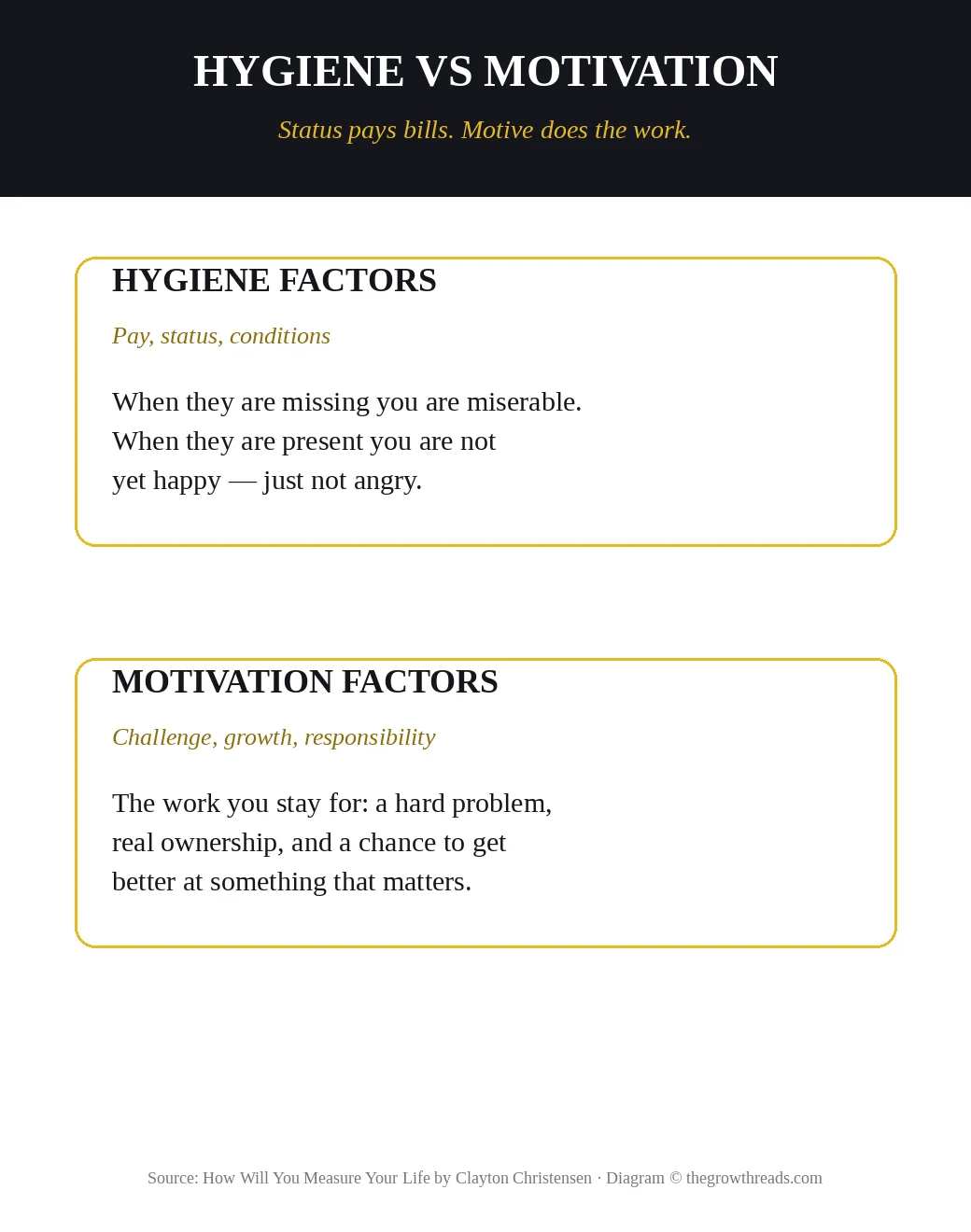
Christensen opens at the job. He borrows Frederick Herzberg’s two-factor theory and refuses to collapse it into “I need to get paid more.” Hygiene factors — pay, status, security, conditions — matter. When they are missing you are miserable. When they are present they mostly buy the absence of complaint. They do not buy the feeling that the work was worth your one life.
Motivation factors sit on a different shelf: a chance to learn, to be recognized for something real, to have responsibility, to see growth. Two people can hold the same title and live in different jobs. Christensen’s classroom was full of people who optimized hygiene with great intelligence and then wondered, a decade later, why the pride never arrived. Before you chase the next title, write what in the current week used your brain, gave you ownership, and left a trace of growth. If that list is empty, a bigger hygiene package will not fill it. It will only make the emptiness more expensive to leave. You still need a floor. You just should not confuse the floor with the point.
TGR Note: If you want the self-knowledge layer under this, start with Managing Oneself — Drucker’s “know your strengths” is the other half of not chasing a hygiene title that uses none of them. The Effective Executive is the time-and-contribution companion. Christensen is the motive test those books assume you already passed.
Part 2: Your strategy is not what you say it is
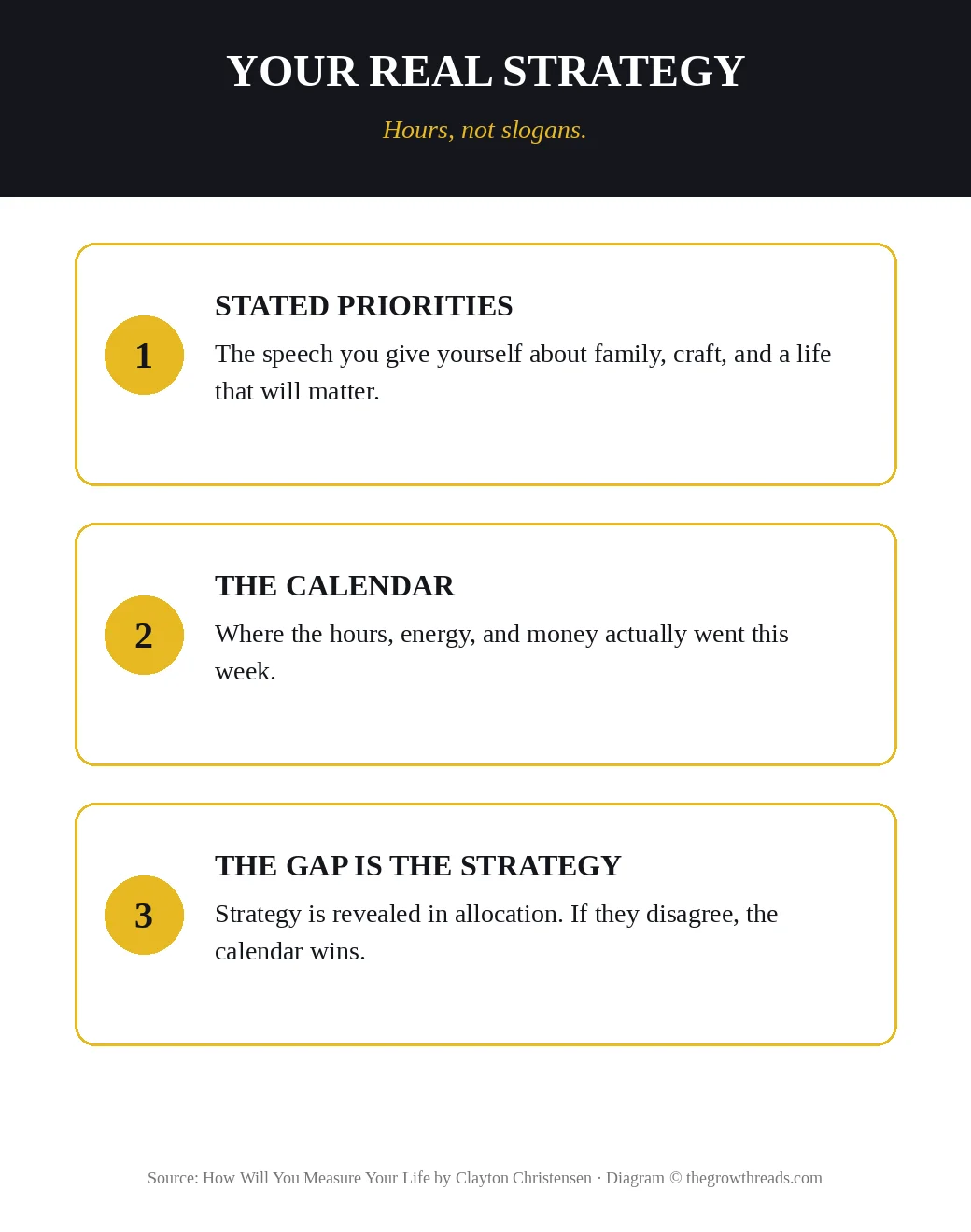
Companies die, in Christensen’s other books, when they allocate resources to the metrics that already work and starve the future. People do a quieter version. You can have a deliberate strategy: the five-year plan, the city, the kind of parent you intend to be. You also have an emergent strategy: the unplanned project that ate the year, the relationship you neglected because the urgent work had a dashboard. Strategy here is not the document. It is the pattern of yeses.
The mechanism is resource allocation. Time, energy, and money are finite. Every evening you spend “just finishing this” is a capital allocation meeting in which career won and the other shareholders were not in the room. His warning is not “never work late.” It is: stop being surprised by the life those late nights compound into. High achievers are good at this self-deception because the career bucket shouts louder than a child’s Tuesday. Hold a direction. Run small tests when an unexpected path uses your motive factors. Do not call leftover hours “family time” and then wonder why the relationship never got funded.
TGR Note: The cut-list version of this argument is Essentialism. The calendar-as-values version is First Things First and the role-balance chapter of The 7 Habits. Christensen’s add-on is the business mechanic: allocation is strategy, whether or not you held a meeting.
Part 3: Relationships are not a later round of funding
Christensen’s claim is blunt: family and close friends will be the strongest source of happiness, and they do not wait until your career is “set.” You cannot crash-invest in a child at sixteen the way you crash-invest in a product launch. Sequence matters. Neglect compounds in the other direction.
He imports jobs to be done: people hire a product — and a person — to make progress in a situation. What job is your partner hiring you to do tonight, not the job you wish they wanted? Listening when you wanted to fix. Presence when you wanted to perform provision. Getting this wrong looks like generosity from the inside and like absence from the other chair. Kids are often hiring you to be a stable person in the room, not a project manager of their résumé.
Capabilities — resources, processes, priorities — explain why doing everything for children backfires. If they never get the sequenced hard experiences, they never build the processes that later get called character. You can give resources. You cannot gift the process of staying with a problem. Families, like companies, also have a culture: not the framed quote, but what actually happens when someone is late, fails, or tells the truth. You build it in the boring reps, years before a crisis.
TGR Note: If you need a design method rather than a theory of trade-offs, Designing Your Life is the prototype-your-way companion. Christensen tells you which investments cannot be deferred. Burnett and Evans tell you how to run cheap tests on the career side so the deferral is less tempting. They stack.
Part 4: “Just this once” is how the story changes
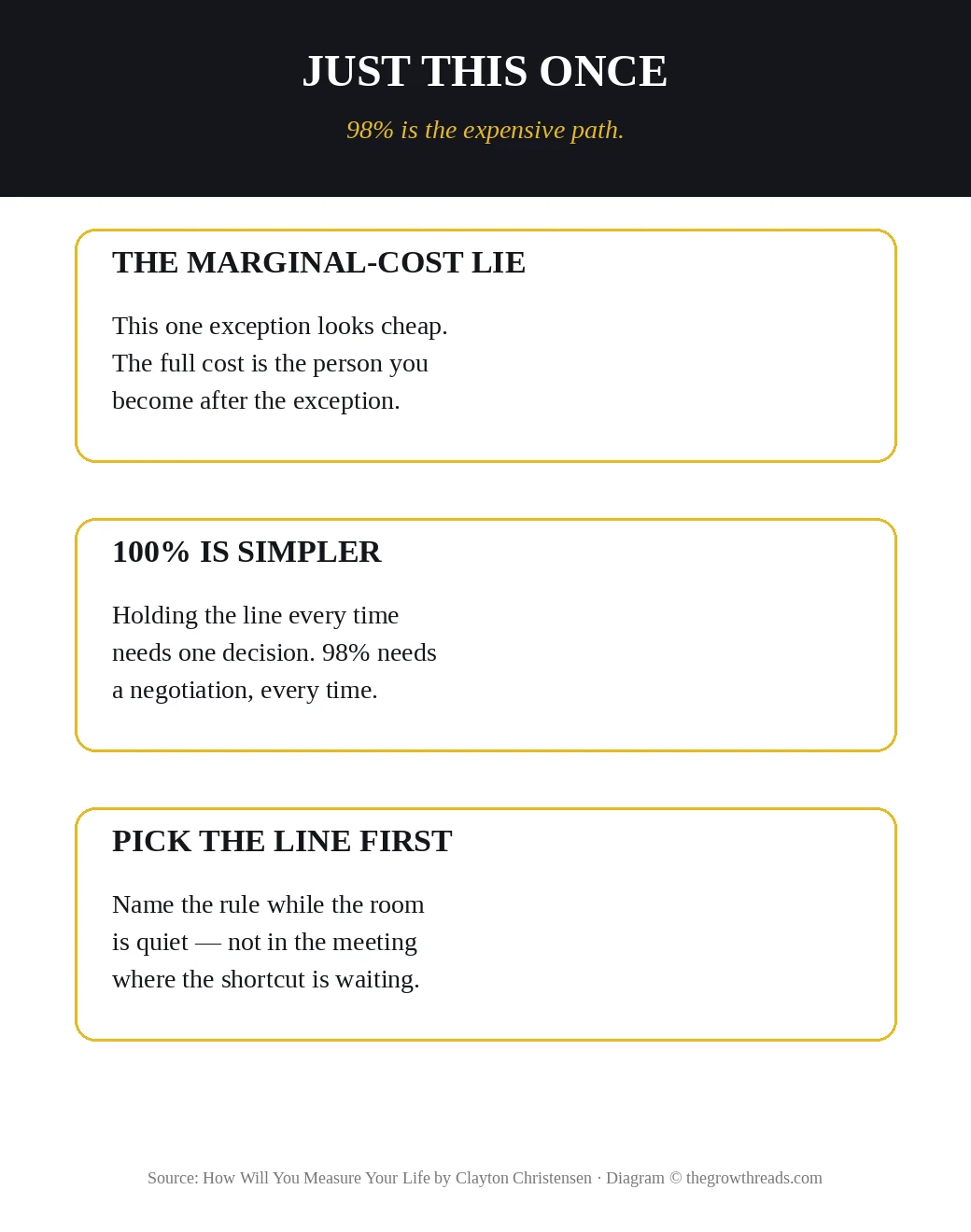
The last movement is the one Christensen taught with a catch in his voice. Classmates did not set out to wreck a life. They made a small exception when the marginal cost looked tiny — this one fudge, this one silence — and the full cost showed up later, as a different person. In a meeting, breaking a rule once looks cheap relative to the deal. Over a life, the cost is the self that now has a precedent. His operational line: it is easier to hold your principles 100 percent of the time than 98 percent. One hundred percent is one decision. Ninety-eight percent is a negotiation, every time, in the room where the shortcut is waiting.
This is not only about crime. It is the smaller slides: the credit you take, the number you round, the promise you miss because a more impressive audience appeared. Draw the line when you are calm. Do not reopen it when the incentive is loud. Purpose is the last tool: a likeness of the person you are trying to become, a commitment, and a way to measure so the next trade-off has a criterion. Without that, hygiene keeps winning, because hygiene always has a number attached. The scoreboard that matters is the one you can still read from a kitchen table — the trail of hours, and whether you can respect the person who spent them.
TGR Note: Same author, different silo: The Innovator’s Dilemma is the company version of allocation-blindness. On the personal-growth side, What Got You Here Won’t Get You There is the behavioral sibling — the habits that keep working until they start costing the people around you.
Who is How Will You Measure Your Life best for — and who should read something else first?
Read this if you already know how to grind and you can feel a split between the life you describe and the hours you spend. It is sharp for the first decade after a prestige job, and for parents who are “providing” so hard they miss the job at home.
Read something else first if a basic week will not stand up — start with Atomic Habits or Mini Habits. If the problem is a bloated yes-list, start with Essentialism. If you need experiments, start with Designing Your Life. If you wanted the disruption book, that is The Innovator’s Dilemma.
Questions to reflect on
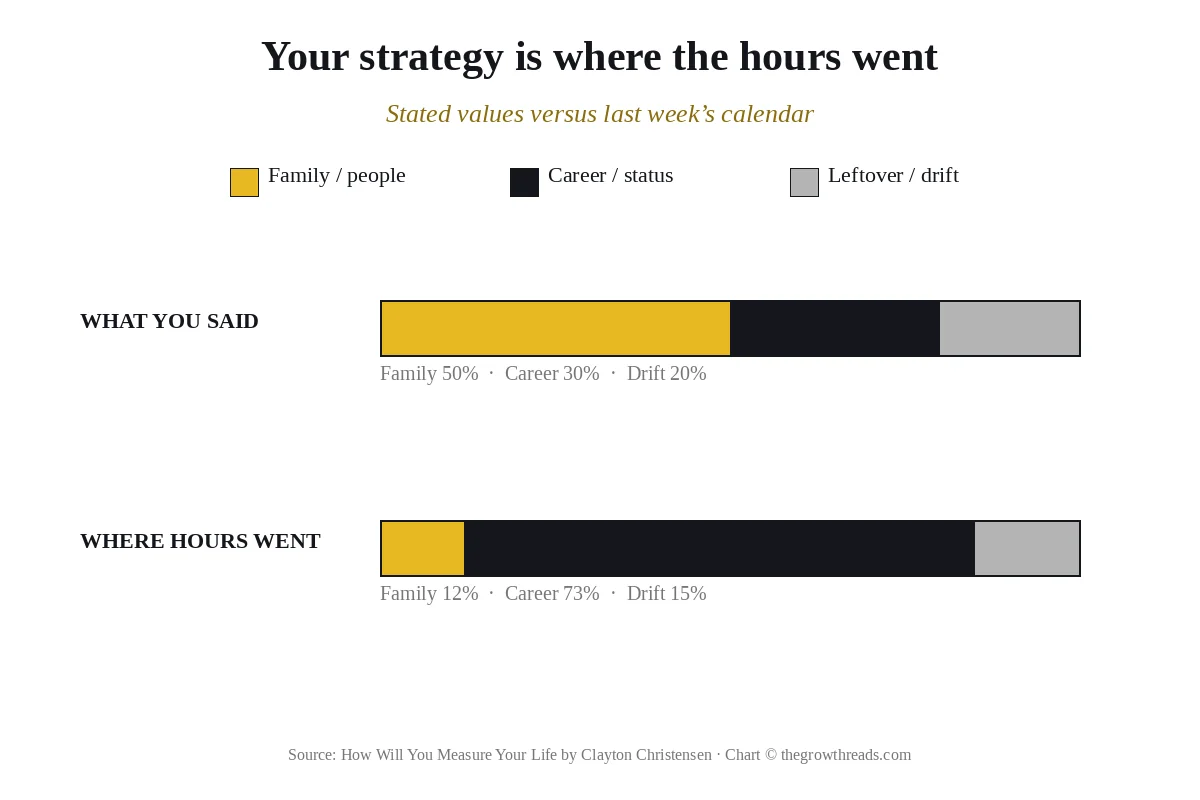
- If a stranger only saw last week’s calendar, what would they say you were optimizing?
- Which parts of your job are hygiene, and which actually use challenge, ownership, and growth?
- What job is the person closest to you hiring you to do this week — and are you doing a different job instead?
- Where are you tempted to say “just this once,” and what would 100% look like as a boring rule?
- If purpose needs a measure, what number or artifact would tell you the life was working in ten years?
🔥 Ready to measure the life you are actually funding?
Audit one week of hours against the speech. Then move one block before the next incentive shows up.
How to apply How Will You Measure Your Life (7-day plan)
- Day 1 — Write Christensen’s three questions at the top of a page. Answer each in two sentences, as you are, not as you wish.
- Day 2 — Split your current role into hygiene versus motivation. Circle one task this week that is only status, and one that is actual growth.
- Day 3 — Color last week’s calendar: career, people, drift. Do not argue with the colors. The colors are the strategy.
- Day 4 — Ask the jobs-to-be-done question about one person: what job were they hiring me to do, and what job did I do instead?
- Day 5 — Move 45 minutes from a hygiene block to a relationship or a motive-factor skill before email. Protect it like a customer meeting.
- Day 6 — Name one “just this once” that is currently in play. Write the 100% rule while the room is quiet. Tell one person.
- Day 7 — Draft a purpose you can use at a fork: likeness, commitment, measure. Block next week’s hours to match it in one visible way — then keep the block.
Frequently asked questions
What is How Will You Measure Your Life about in one paragraph?
How Will You Measure Your Life is Clayton Christensen’s attempt to use the same theories he taught about companies — motivation, strategy, resource allocation, jobs to be done, capabilities, and marginal cost — on a single human life. With James Allworth and Karen Dillon he asks how you will know you were successful in your career, your closest relationships, and your integrity. The practical move is to stop trusting the speech and start reading the calendar. It is a short book with a long aftertaste, written from a classroom and a hospital, not from a productivity-app demo.
What are the three questions in How Will You Measure Your Life?
Christensen asked how you will be sure you found happiness in your career, how your closest relationships will stay a source of happiness, and how you will stay out of jail — meaning you keep a self you can live with. The book follows those three. Career is hygiene versus motivation plus strategy. Relationships are investment, jobs to be done, and culture. Integrity is “just this once.” The questions exist so you do not optimize one bucket until the other two are empty.
What is the difference between hygiene and motivation factors?
Hygiene factors are the job conditions that, when missing, make you miserable: pay, status, security, how you are treated. When they are present they mostly remove pain. They do not create the feeling that the work was worth it. Motivation factors are challenge, recognition, responsibility, and growth — the reasons a hard week can still feel clean. Christensen’s point is that ambitious people over-index hygiene because it is public and countable, then wonder why pride never shows up. Audit the week for both. A raise that buys silence is not the same as a role that uses you.
What does Christensen mean by “just this once”?
He means the exception that looks cheap on the margin. In the meeting, breaking a small rule once seems like nothing next to the deal, the grade, the promotion. The full cost is the person who now has a precedent and a quieter conscience. His operational line is that 100 percent is easier than 98 percent: one decision versus a negotiation every time the incentive is loud. The examples in the book include dramatic falls. The daily version is smaller: a number you round, a credit you take, a promise you miss because a more impressive room appeared. Draw the line when you are calm.
How is this different from The Innovator’s Dilemma?
The Innovator’s Dilemma is the company book: good managers allocate to the metrics that already work and starve the disruption. How Will You Measure Your Life points the same mechanic at a career, a family, and a conscience. You do not need the disruption book first. Read Dilemma if you run a product. Read this if your P&L is a life and the shouting customer is your job. They share an author. They do not share a to-do list. The fingerprint is the same: resources flow to what shouts.
Is this book only for parents and executives?
No. The family chapters come from Christensen’s life as a father, so parents will feel seen. The tools still work if you are single or early-career. Resource allocation does not require children. Jobs to be done works on a partner, a friend, a team. “Just this once” does not require a board seat. If you have hours, incentives, and people you do not want to fail, you are in the audience. Keep the calendar test. That test does not care about your title.
Should I read Designing Your Life or The 7 Habits instead?
Read Designing Your Life if you need prototypes — cheap tests for a career you cannot yet describe. Read The 7 Habits if you need a full character operating system and a weekly role review. Read How Will You Measure Your Life if you can already describe the life and your hours are still funding a different one. They nest: Covey gives the roles, Burnett and Evans give the experiments, Christensen gives the allocation warning and the integrity rule. None of them replace moving a block on next week’s calendar. Start with the book that matches the gap you actually have this month.
Related summaries
- Designing Your Life — prototype a career instead of waiting for a calling.
- Managing Oneself — know the strengths a hygiene title might waste.
- Essentialism — the cut-list for a calendar that has too many yeses.
- First Things First — put the big rocks in before the week fills itself.
- Best productivity books — the full Productivity pillar.
How we analyze books: every book on The Growth Reads is read cover to cover, summarized in thousands of words of original analysis, and rated against our five-criteria rubric (lasting impact, evidence quality, practical application, writing & originality, external consensus). Read our full methodology.