

★★★★☆ 4.4/5 — World-class skill is designed practice, not a personality type you are waiting to discover.
Best for: professionals who already work hard and still plateau, plus managers who confuse “years of experience” with a development plan.
Reading time: ~6 hours (240 pages) · this guide ~12 min
Difficulty to apply: Medium — you have to redesign the next hour, not add more of the same hour.
Talent Is Overrated in one minute
The people we call gifted usually had a different childhood of work — not a different soul. Geoff Colvin, a longtime Fortune editor, takes the Mozart-and-Tiger stories apart and finds hours, coaches, and designed drills where most of us see magic. Experience at the job is not the same thing. Ten years of repeating what you already do well is one year, copied. The engine is deliberate practice: a stretch just beyond current skill, repeated with feedback, aimed at a specific weakness. Passion often shows up after competence, not before. Organizations that treat “high potential” as a hunting license miss the cheaper move: build a practice system. If you only remember one sentence, remember this: stop waiting to be the type. Design Tuesday’s drill.
Key takeaways
- Talent is a poor explanation: great performers look destined only after you ignore the early, intense, coached hours.
- Experience is not practice: years on the job often mean more comfort, not more skill.
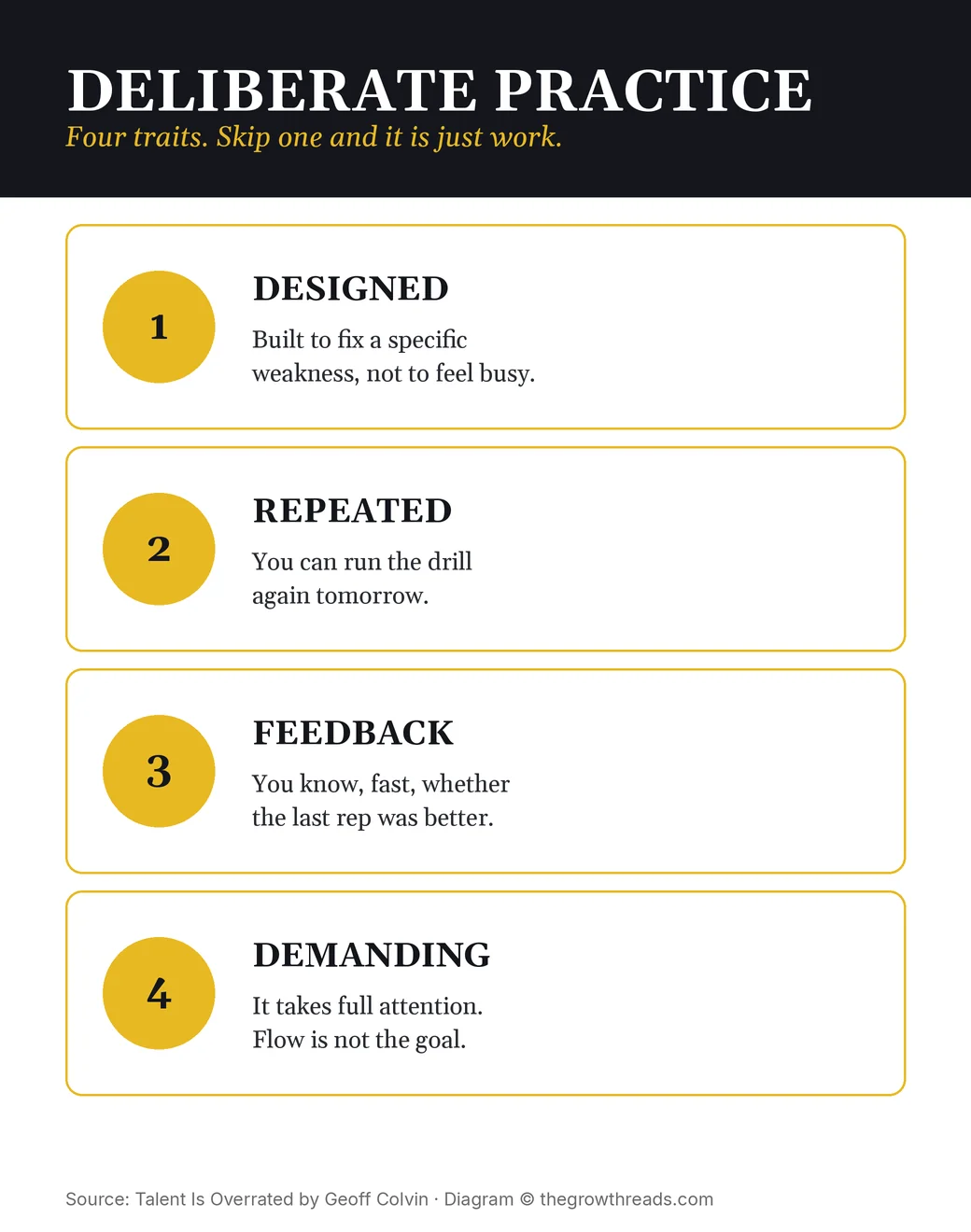
- Deliberate practice is a design: it targets a weakness, can be repeated, and produces a score.
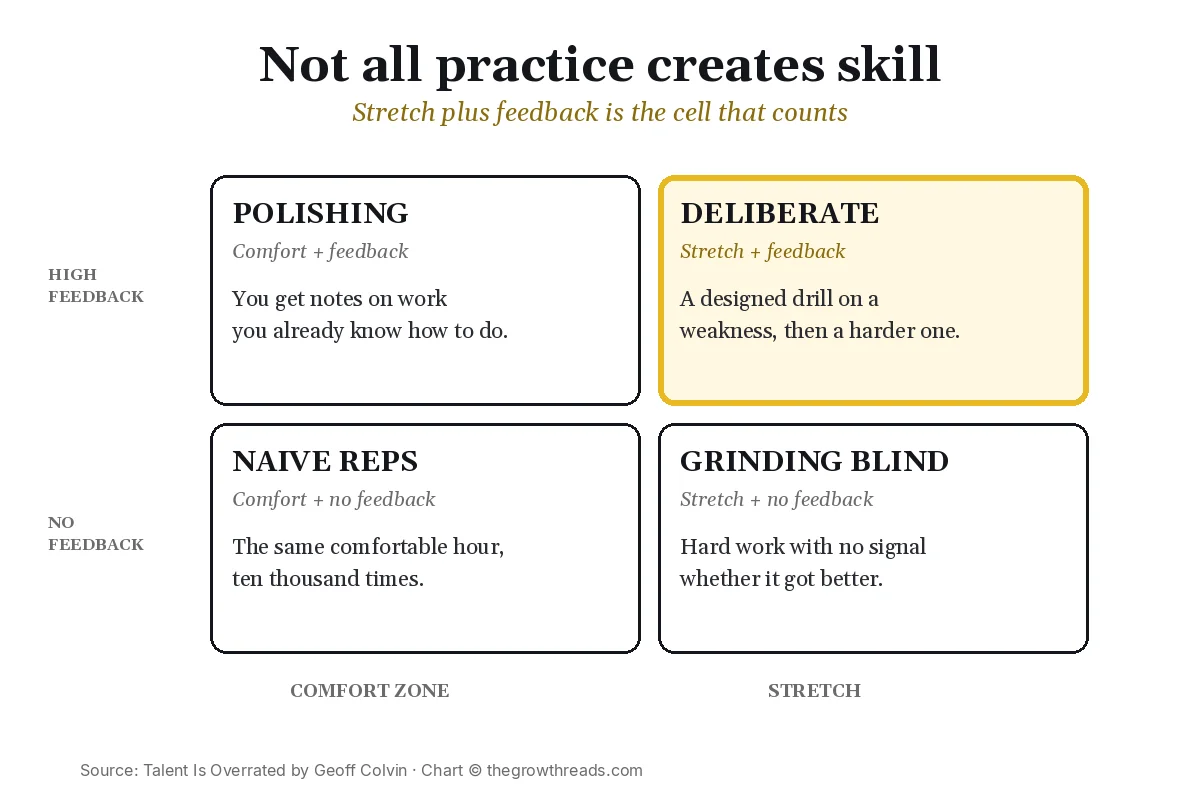
- It is mentally expensive: if it feels like flow and ease, you are probably polishing, not stretching.
- Feedback is the difference: stretch without a signal is just grinding blind.
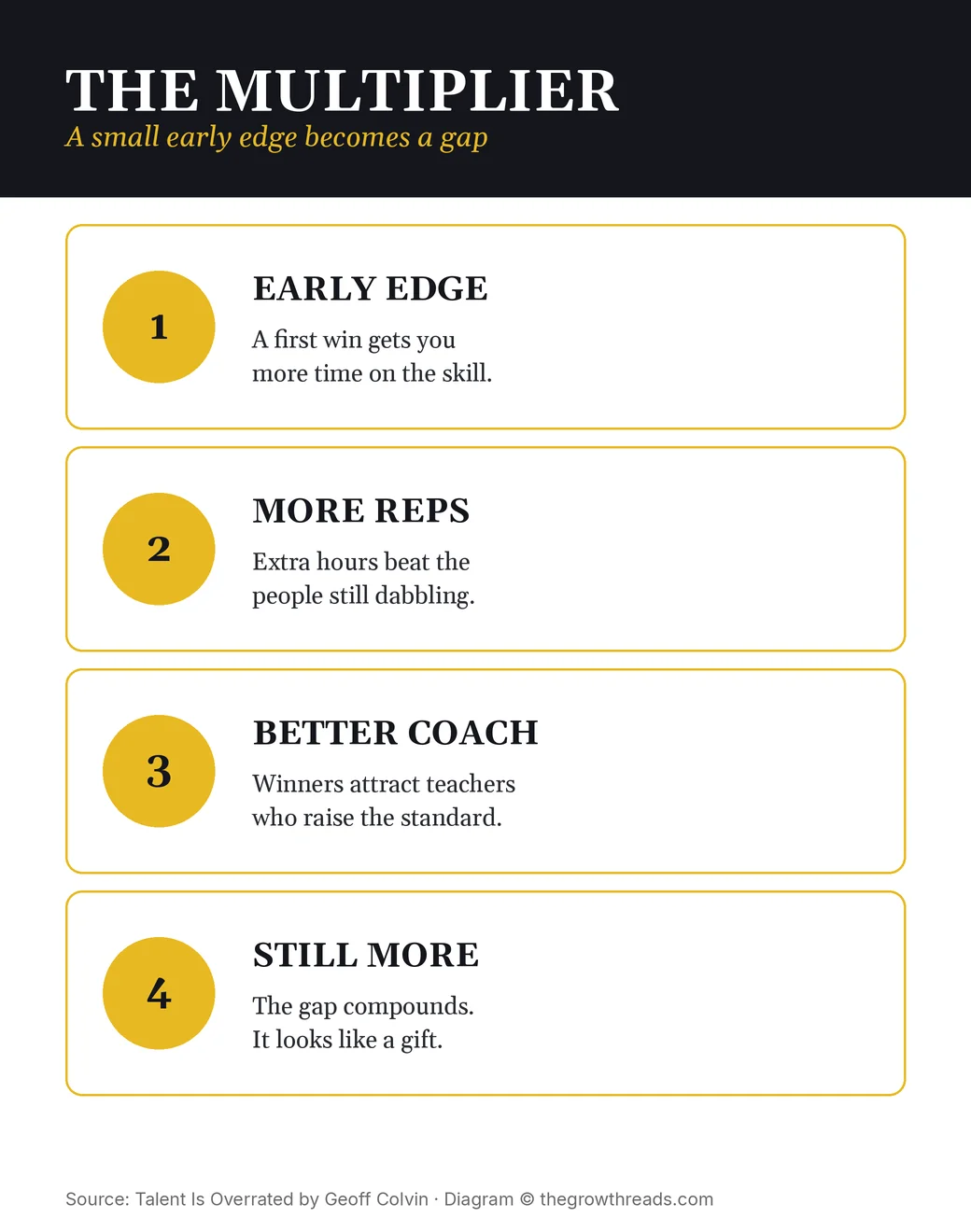
- The multiplier is real: a small early edge attracts better teachers and more reps, which then looks like a gift.
- Passion often follows skill: waiting to “feel called” is a common way to never start the hard hour.
- Innovation is practiced too: new ideas come from deep, practiced knowledge, not from being randomly quirky.
- Companies can install this: stretch assignments, coaching, and honest scoreboards beat slogans about talent.
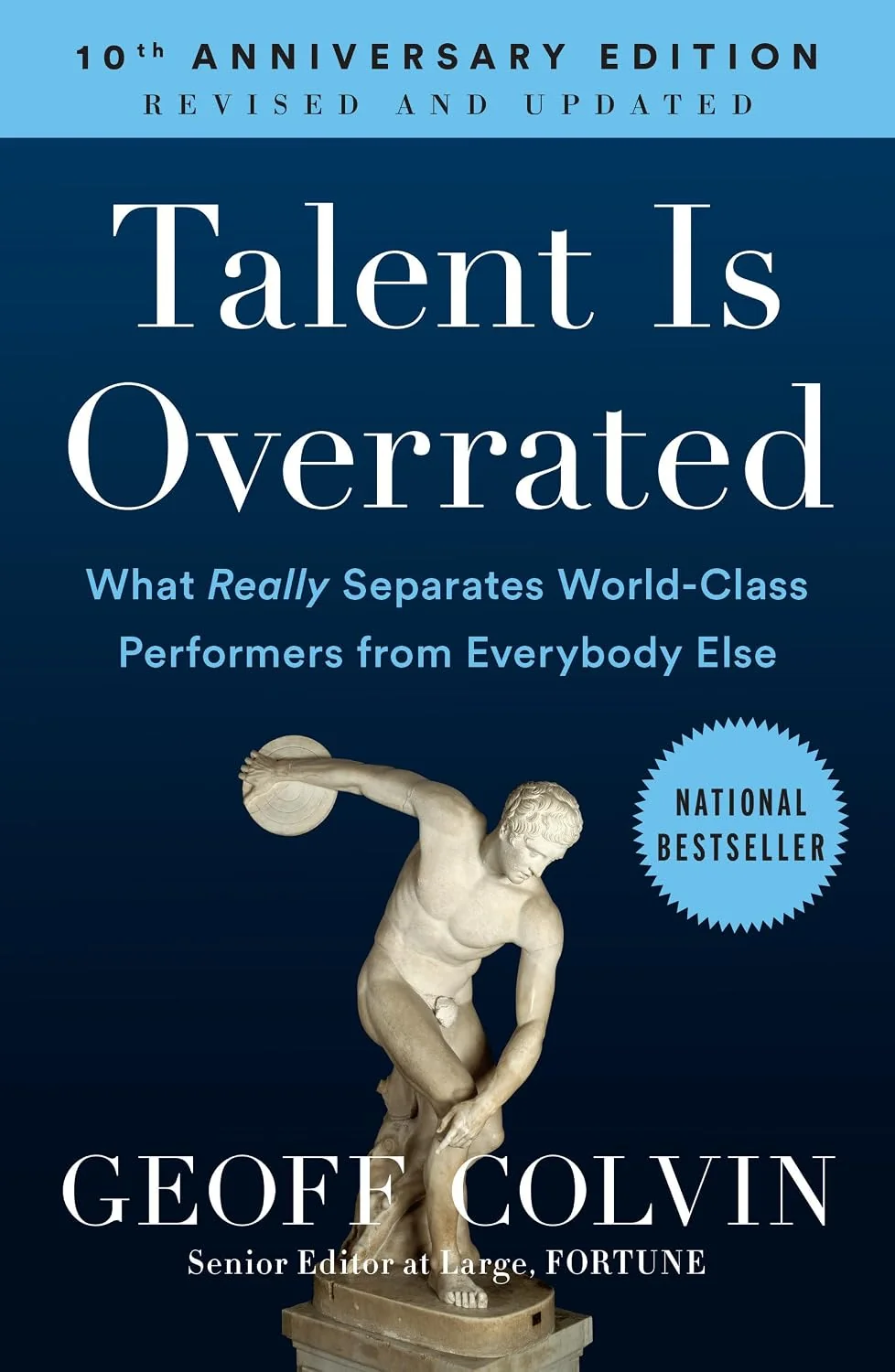
What is Talent Is Overrated about?
Talent Is Overrated argues that extraordinary performance comes from a specific, designed kind of practice — not from an inborn gift you either received or missed. Colvin shows how elite musicians, athletes, comics, and executives built skill, then translates that into how you and your company can stop confusing activity with improvement.
About the author
Geoff Colvin is a senior editor-at-large at Fortune — a daily radio commentator, a Fortune Global Forum regular, and a journalist who spent decades watching which companies built capability and which only advertised it. Talent Is Overrated (Portfolio, 2008; updated paperback 2010) answers a question executives kept asking in plainer language than the labs used: if we can see world-class performance, why can we not copy the process? He is a reporter, not a sports psychologist. That is the book’s strength. He interviews the research, the locker room, and the C-suite, then refuses to leave you with a pep talk about grit. Want the primary science? He points you to Anders Ericsson. Want a better definition of practice by Monday? This is his beat. Explore all Geoff Colvin book summaries →
Key concepts at a glance
| Concept | What it means | Use it when |
|---|---|---|
| Innate-talent story | The claim that greats were simply born different, so practice is a side note. | You catch yourself saying “I’m not a numbers person” as a life sentence. |
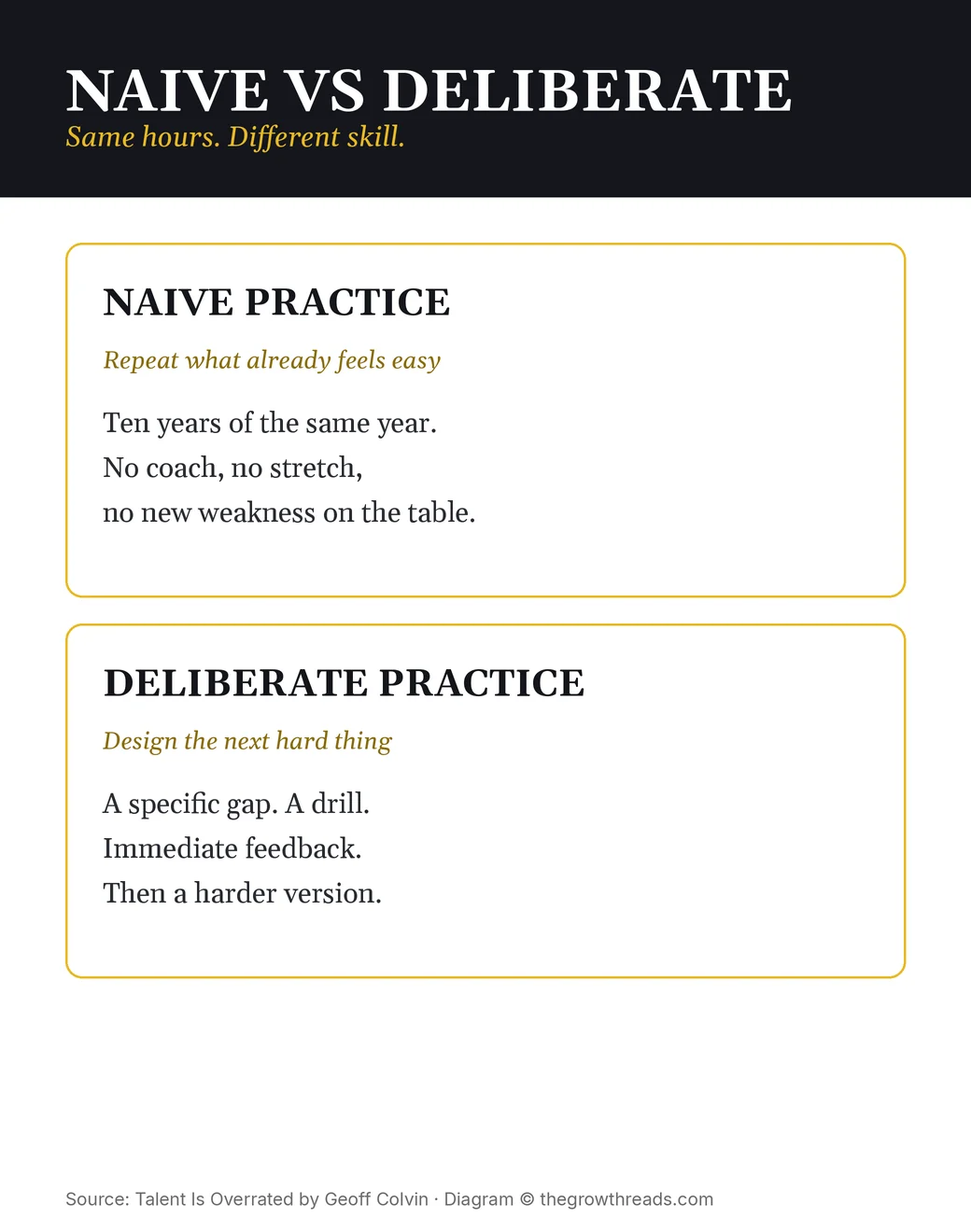
| Naive practice | Repeating what already feels easy, often for years. | Your calendar is full and your skill curve is flat. |
| Deliberate practice | Designed stretch plus feedback on a specific weakness. | You can name the next hard thing and how you will score it. |
| Multiplier effect | Small early advantages attract better coaching and more reps. | You are deciding where your best hours actually go. |
| Mental models | Experts see meaningful patterns where novices see noise. | You are studying cases, films, or past projects — not just doing more volume. |
| Domain memory | Masters remember more in their field, not because of a general super-brain. | You are tempted to chase “brain training” instead of field reps. |
| Passion after skill | Love of the work often grows once you can do it well. | You are waiting to feel called before you start the drill. |
| Organizational practice | Companies can install stretch, coaching, and scoreboards on purpose. | You run a team and “high potential” is your only talent strategy. |
Part 1: The talent story does not survive the evidence
Colvin opens with the story we all already know. A child sits at a piano, or a golf range, and something otherworldly happens. We call it talent because it is easier than counting. Then he does the reporter’s rude thing: he counts. Mozart’s father was a professional pedagogue who started Wolfgang on an extreme training program in early childhood; the compositions we treat as miracles of a toddler are, in Colvin’s reading, the output of years of guided work, including a lot of arranging and imitating before the fully original peaks. Tiger Woods’s story is similar in shape if different in sport: a parent who treated practice as a designed environment, not a weekend hobby, long before the world decided the child was chosen.
The more uncomfortable evidence is about ordinary experience. We assume that ten years in a role produces ten years of growth. Studies of experts — chess players, musicians, doctors, athletes — keep showing a nastier pattern: after a competent threshold, more years often do not predict better performance. The people who keep getting better are not the people who logged the most shifts. They are the people whose hours were structured differently. Effort that stays inside the comfort zone is maintenance. It can be honorable. It is not how world-class skill is grown.
This is why the book lands in a productivity silo even though it never mentions a to-do app. If your week is already full, adding another week of the same motions will not move the curve. The talent myth flatters both sides: if you are “gifted,” you skip the examination; if you are “not gifted,” you skip the start. Colvin’s evidence is an invitation to drop both and look at the hour.
TGR Note: If you want the lab version of this argument, start with our Peak summary — Ericsson is the researcher Colvin is translating. For the coaching-and-myelin narrative, see The Talent Code.
Part 2: Deliberate practice is the real engine
Colvin’s central import from Ericsson is a fussy phrase that earns its fuss: deliberate practice. It is not “practicing a lot.” It is not playing the game. It is not going to the office. It is an activity designed specifically to improve performance, often invented by a teacher, aimed at a skill you cannot yet do cleanly, repeated until it is less ugly, then made harder. You get information about results. You give it full attention. It is not particularly fun in the moment. Colvin is blunt that this is why most people do not do it even when they know the speech.
The famous 10,000-hour figure sits here as a landmark, not a vending machine. In the Berlin violin study, the best students had accumulated on the order of 10,000 hours of serious practice by age twenty; the merely good had thousands fewer; the future music teachers fewer still. Colvin’s use of the number is: volume matters, and the volume that matters is the designed kind. Later popular culture turned 10,000 into a slogan. That is not a reason to throw out the underlying distinction. A salesperson who makes 10,000 unstructured calls is not automatically a rainmaker. A designer who ships 10,000 comfortable screens is not automatically rare. Count the hours that had a weakness, a drill, and a score.
He walks this through fields that feel “gifted” from the cheap seats. Jerry Rice’s off-season work was legendary because it was not game-day athleticism recycled; it was specific conditioning and precision work that most teammates would not copy. Chris Rock’s stage ease is the residue of trying material in small rooms, killing bits, and keeping the ones that survive — a comedy version of deliberate practice. Benjamin Franklin designed writing drills off The Spectator, reconstructing essays from notes, then comparing. None of these stories require you to become Rice. They require you to stop calling unstructured time “training.”
TGR Note: Josh Kaufman’s The First 20 Hours is the other timescale: get usefully good fast. Colvin is about the decade after that. Use Kaufman to start; use Colvin when “good enough” has become a hiding place. Ultralearning is the aggressive self-directed cousin.
Part 3: How designed practice actually works
Why does this kind of hour change the person? Colvin’s answer is less mystic than “they wanted it more.” Experts build richer mental models. They see chunks — chess configurations, surgical patterns, customer tells — where a novice sees a pile of facts. That is also why their memory looks supernatural in the domain and ordinary outside it. The classic chess-memory studies are in here for a reason: masters reconstruct real positions from a glance and collapse on random ones. They did not receive a general genius chip. They received thousands of hours of patterned, feedback-rich looking.
The practical translation is almost insulting in its simplicity. If you cannot name the chunk you are trying to install, you are still in naive practice. If you cannot get a signal within the session — a recording, a checklist, a coach’s note, a metric — you are stretching in the dark. If the session is so pleasant you could do it while half-thinking about inbox zero, you are polishing. A good coach designs the next drill you would not have chosen, then will not let you skip the ugly part.
He also takes a swing at the passion-first story. We love the idea that the greats were pulled by a calling, and the rest of us are still waiting for the tug. In his telling, many high performers got interested after they got competent — after the work started returning identity and status and the pleasure of being able to do a hard thing. Waiting to feel destined is, in this frame, a productivity bug. The application is not “grind joylessly forever.” It is “do not use the absence of a cinematic calling as a veto on the next designed hour.”
TGR Note: Career capital is the same muscle in a different jacket: So Good They Can’t Ignore You and Mastery both argue that rare skill is the asset. Colvin is the practice manual underneath those career books. Grit is the stamina layer — useful once the drill exists.
Part 4: Apply it at your desk and in your company
The second half of the book is Colvin turning the camera on adults with jobs. You probably cannot restart childhood. You can still isolate a skill that would change the next year — a kind of analysis, a kind of writing, a kind of conversation, a kind of craft — and treat it like Rice treated August. That means a weakness list, a drill that is shorter than your ego wants, a feedback source that is not your own mood, and a refusal to count meetings as practice. Innovation gets the same treatment. Colvin’s innovators are not empty-headed rebels; they are people with deep practiced knowledge who can then recombine. “Think different” without a domain is just vibe.
For managers, the talent story is expensive. If you believe stars are born, you hunt, you overpay, and you under-build. If you believe stars are grown, you install stretch assignments, coaching, and honest after-action review as the job, not as a poster. A one-on-one that only reviews status is naive practice for leaders. A one-on-one that picks a skill, a drill, and a score is the organizational version of the book.
One line of Colvin’s is worth keeping on a card: deliberate practice is designed specifically to improve performance. That sentence is a filter. Run last week’s “development” through it. How much of it would still be there if improvement were the only allowed goal? Whatever survives is your real practice. The rest is occupancy.
Who is Talent Is Overrated best for — and who should read something else first?
Read this if you already work hard, you are tired of the gift story, and you can feel a plateau. It is especially sharp for managers who keep hiring for “talent” and then wondering why the team does not get better. It is a good second book after you have a basic habit of showing up.
Read something else first if you cannot get started at all — go to Atomic Habits or Mini Habits. If you need competence this month, not mastery this decade, start with The First 20 Hours. If you want the science unfiltered, start with Peak. If your stall is mood rather than design, No Excuses! is the “anyway” companion. Colvin will not build your calendar for you. He will tell you which hours on that calendar actually count.
Questions to reflect on
- Which skill, if it were rare and real, would change your work in twelve months?
- Of the last ten hours on that skill, how many had a designed stretch and a score?
- What weakness are you avoiding because practicing it would feel like being a beginner again?
- Who could give you feedback this week that is not your own mood?
- If passion is supposed to arrive after competence, what would you practice for 90 days without waiting to feel called?
🔥 Ready to stop waiting on a gift?
Design one stretch drill this week. The feeling of being “talented” is usually the residue.
How to apply Talent Is Overrated (7-day plan)
- Day 1 — Write the one skill and the one-sentence plateau. If you cannot name it, you do not have a practice target yet.
- Day 2 — Audit ten recent hours. Label each naive or deliberate. The ratio is the diagnosis.
- Day 3 — Choose the weakest sub-skill. Write a 25-minute drill that attacks only that gap.
- Day 4 — Attach feedback: record, checklist, or a person. No score, no deliberate practice.
- Day 5 — Run the drill before email. Stop at 25 minutes even if ego wants a heroic session.
- Day 6 — Raise difficulty 10 percent. Remove one crutch you hide in.
- Day 7 — Block four sessions for next week. Write what 90 days of this multiplier would change — then protect the calendar.
Frequently asked questions
What is Talent Is Overrated about in one paragraph?
Talent Is Overrated is Geoff Colvin’s case that world-class performance is not a mysterious gift. Drawing on Anders Ericsson’s research plus stories from music, sport, comedy, and business, he argues that deliberate practice — designed, repeated, feedback-rich, and mentally hard — is what separates the great from the merely experienced. The rest of the book asks how you would redesign Tuesday, and how a company would redesign development, if that were true. It is a practice manual, not a personality test.
Is the 10,000-hour rule the same as this book?
No. Colvin reports Ericsson’s finding that elite violinists had piled up roughly 10,000 hours of serious practice by age twenty, far more than good students. He does not treat 10,000 as a magic receipt. Naive repetition does not buy the same skill as designed stretch. Later debates about the exact number sit here on purpose: the uncontroversial move is still to stop counting years on the job and start designing the next drill. Peak is the lab monograph. This book is the Fortune-journalist translation for people with a calendar.
Does Colvin say innate talent does not exist at all?
He is careful. He is not claiming anyone can be Mozart. He is claiming the popular story — a child is “gifted,” so the rest of us should stop — does not match how great performers spent their years. Mozart and Tiger Woods look like miracles until you count the early, coached hours. The useful conclusion is smaller: you are not waiting for a personality test. You are waiting for a practice design you will actually run this month, on a calendar, with a score.
How is this different from Peak or The Talent Code?
Peak is Ericsson’s own account, with more lab detail. The Talent Code is Daniel Coyle’s myelin-and-coaching story. Colvin sits between them as a business journalist: fewer brain metaphors, more Jerry Rice, Chris Rock, and talent systems. Read Peak for the science source, Talent Code for ignition and coaching, Colvin if you want to walk into Monday and argue that “experience” is not a development plan. The three stack; pick the one that matches the gap you actually have this quarter.
Can I use this if I am starting a skill at 35?
Yes, with an honest scope. Some windows close — elite classical violin is a brutal example — and later starters cannot rewind childhood hours. Adults still improve when practice is designed; many corporate “stars” were made in their thirties by better feedback, not a hidden gene. Do not chase a prodigy fantasy. Pick one skill that would change the next year, isolate the weakest part, and put a coached drill on four days a week. That is the whole application.
What is the multiplier effect?
A small early advantage — extra hour, better teacher, public win — tends to attract still more practice and better coaching. The gap then looks like talent from the outside. Colvin’s point is not that you must have started at age three. Advantages compound, so stop giving your best hours to work that does not stretch you. If you are behind, design a tighter practice than people who are casually putting in time. Multipliers work both ways, including against you.
Should I read Atomic Habits or The First 20 Hours instead?
Read Atomic Habits if the problem is showing up at all. Read The First 20 Hours if you need useful competence fast, not world-class depth. Read Talent Is Overrated if you already show up and still plateau because the hours are comfortable. They nest: Clear gets you in the chair, Kaufman gets you to useful, Colvin tells you why the next decade of that chair time will or will not produce a rare skill. None replace a coach or a scoreboard.
Related summaries
- Peak — Ericsson’s science of expertise, the research Colvin popularizes.
- The Talent Code — coaching, ignition, and how skill gets myelinated.
- The First 20 Hours — the fast path to useful competence, not world-class depth.
- So Good They Can’t Ignore You — career capital from rare skills.
- Best productivity books — the full Productivity pillar.
How we analyze books: every book on The Growth Reads is read cover to cover, summarized in thousands of words of original analysis, and rated against our five-criteria rubric (lasting impact, evidence quality, practical application, writing & originality, external consensus). Read our full methodology.