

★★★★☆ 4.4/5 — a thermostat you can actually raise.
Best for: High performers who stall after a win, stay in excellence work that pays, or sabotage the good week
Reading time: ~5 hours (224 pages) · this guide ~16 min
Difficulty to apply: Medium — naming the cap is easy; leaving excellence when it still pays is the work
The Big Leap in one minute
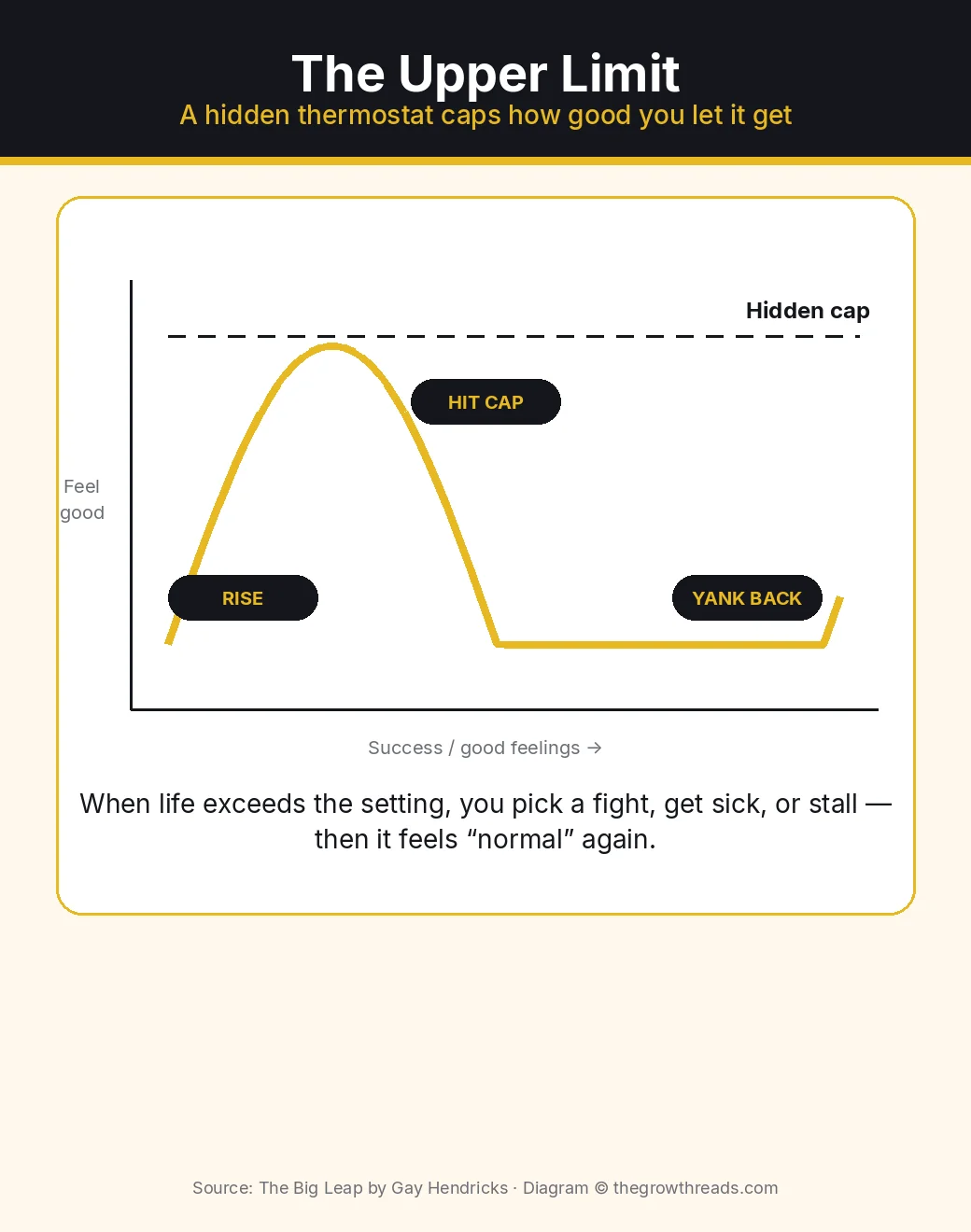
You are not stuck. You are upper-limited. Gay Hendricks’s The Big Leap (2009) argues that each of us runs an inner thermostat for how much love, success, and creativity we will allow. When life exceeds the setting, we pick a fight, stall, or get sick — then it feels “normal” again. The leap is noticing the yank, naming the story that slammed the cap, and moving hours out of excellence into the Zone of Genius. This summary is the application layer: the thermostat, the four barriers, the four zones, Einstein Time, and a 7-day plan around a job.
Key takeaways
- The Upper Limit Problem is a thermostat, not a talent gap: You sabotage good feelings when they exceed an inner setting.
- The yank has a shape: A fight, a fog, a stall, a binge, a sudden “practical” reason to stop. Treat it as data, not fate.
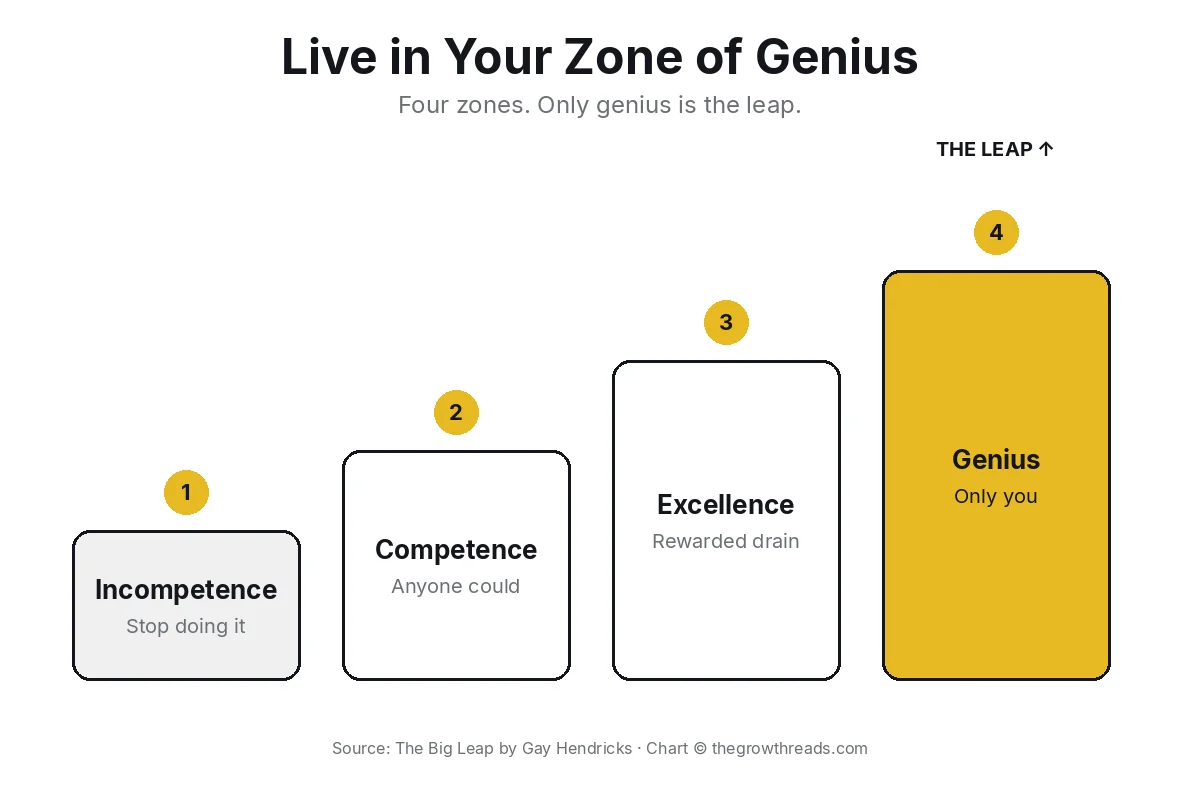
- Four zones of work: Incompetence, Competence, Excellence, Genius. Most careers stall in the third.
- Excellence is the trap: You are rewarded for it. It still quietly drains the hours genius needs.
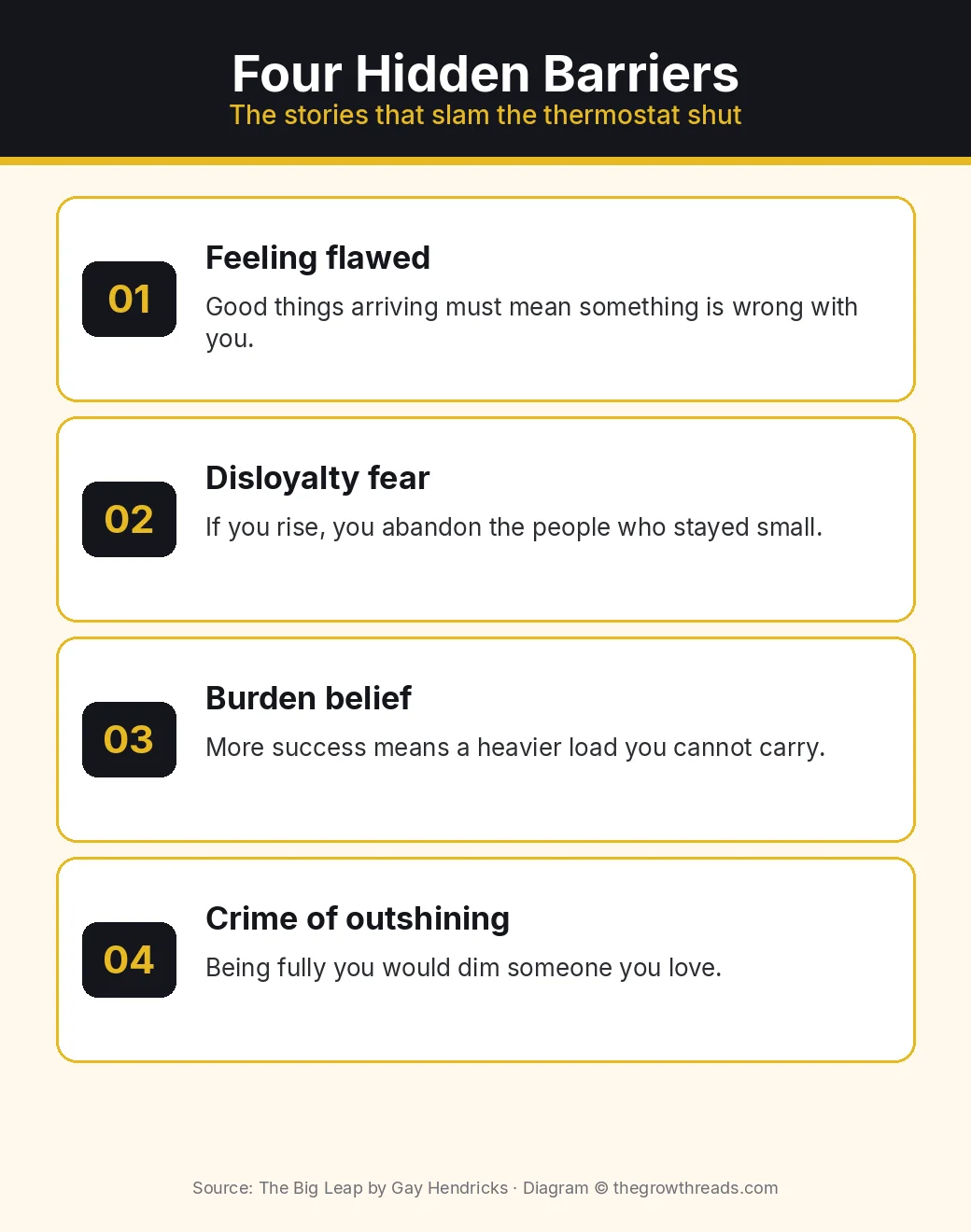
- Four hidden barriers slam the cap: Feeling flawed, fear of disloyalty, the burden story, the crime of outshining.
- Genius is specific: Activities you are uniquely suited to, that you would do even if money were not the question.
- Einstein Time, not Newtonian time: You make time from presence. You do not hunt leftover minutes.
- Wonder is the move: “I wonder how I can expand my genius in this moment?” beats “I don’t have time.”
- Feel it instead of capping it: Let the good wave finish. The thermostat learns from what you are willing to feel.
- The leap is daily: One honest hour in genius beats a personality rebrand you never start.
What is The Big Leap about?
The Big Leap is Gay Hendricks’s 2009 guide to the hidden ceiling on success, love, and creativity. He maps four work zones, four stories that slam the thermostat shut, and Einstein Time — making hours instead of hunting them. The leap is daily genius work, not a personality overhaul.
About the author
Gay Hendricks was born in 1945, earned a Ph.D. in psychology from Stanford in 1974, and spent 21 years at the University of Colorado, becoming a full professor in counseling psychology. With his wife, Kathlyn Hendricks, he founded The Hendricks Institute and has co-authored more than thirty books on relationships, body intelligence, and conscious living, including Conscious Loving and Five Wishes. The Big Leap (HarperOne, 2009) is the book that left the couples workshop and walked into the office: the same upper-limit pattern he saw in marriages, applied to money, creativity, and career. He writes as a practitioner who has hit his own caps — not as a theorist inventing a lab. The point is not to become Gay Hendricks. The point is to catch the yank the next time a good week starts to feel illegally good. Explore all Gay Hendricks book summaries →
Key concepts at a glance
| Concept | What it means | Use it when |
|---|---|---|
| Upper Limit Problem | You sabotage success when it exceeds an inner thermostat | A win is followed by a fight, fog, or stall |
| Zone of Incompetence | Work you are bad at and should stop | You are “being responsible” in someone else’s job |
| Zone of Competence | You can do it; plenty of people could too | Your calendar is full of interchangeable tasks |
| Zone of Excellence | You are rewarded, and it still drains you | The work pays and quietly bores you |
| Zone of Genius | The work only you can do, where time disappears | You keep postponing the thing that feels most like you |
| Four hidden barriers | Flaw, disloyalty, burden, outshining — stories that slam the cap | You can name the yank but not why you yanked |
| Einstein Time | You make time from presence; you do not have leftover minutes | “I don’t have time for genius work” is the sentence |
| Wonder question | Ask how you can expand genius in this moment | Worry is shrinking the hour you already have |
Part 1: The Upper Limit Problem — catch the yank
Hendricks’s signature claim is not that you lack discipline. It is that you have a setting. “Each of us has an inner thermostat setting that determines how much love, success, and creativity we allow ourselves to enjoy.” When the temperature rises past that mark — a deal closes, a streak actually works — an alarm says this much good is not safe. Then you restore the old temperature: a fight from nowhere, a missed easy deadline, a retired habit. Afterwards you call it bad luck. He calls it the Upper Limit Problem.
Treat the yank as a sequence. First the wave of good. Then a thought that this is too much. Then a behavior that brings you down. Fighting only the behavior leaves the thermostat in place. Pause at the thought — “this feels illegally good” — and feel the wave through instead of creating a problem that makes it go away. The setting learns from what you are willing to feel. High performers stall after a win because the win exceeded the setting. Look at the week before the collapse. Often it was the best week. That is the tell.
TGR Note: If your yank is “never enough,” measure from what you already closed. The Gap and the Gain is the cousin. If the story under the yank is a fixed identity, start with Mindset.
Part 2: Four hidden barriers — the stories that slam the cap
The thermostat is not random. Hendricks names four stories that close it. Feeling fundamentally flawed: if something good arrives, it must be a mistake, or it will expose you. Disloyalty and abandonment: if you rise, you leave the people who stayed small, or they leave you. The burden belief: more success means a heavier load you cannot carry. The crime of outshining: being fully yourself would dim someone you love, so you stay dim. You will probably recognize one as home.
These are loyalty oaths, not productivity tips, which is why willpower fails. You are keeping a young promise: I will not be too much. Say it out loud, then write a Tuesday sentence — I can receive this without it meaning I am fake; I can succeed without it becoming a punishment. It will feel false the first week. That is the thermostat arguing. Use it when the yank starts, not as journal decoration. The same cap shows up in money, marriage, and work. If you only apply this at the office, you will still pick a fight at 9 p.m. and call it tired. Watch the whole temperature, not just the KPI.
TGR Note: If the barrier is a thought you can test, Feeling Good is the CBT toolkit. The 7-day plan still starts with which barrier is home, not with a new app.
Part 3: The four zones — excellence is the trap
Once you can see the yank, Hendricks asks where your hours actually go. Zone of Incompetence is what you should stop — staying looks like virtue. Zone of Competence is what plenty of other people could do; it fills a calendar and never makes you. Zone of Excellence is the trap: you are good, the market pays, your identity is built on it, and it still costs the hours genius needs. Zone of Genius is the work you are uniquely suited to — play to you, a miracle to other people, the thing you would still lean toward if money were not the immediate question.
Most readers live in excellence and call it gratitude. The leap is not “quit on Friday.” Take one honest hour from excellence and give it to genius this week. Excellence will argue it is the responsible choice. It is often the well-paid hiding place. If you cannot name genius yet, name the excellent work that leaves you oddly tired. The leftover is a clue. Genius is often the margin work you apologize for. Put it on the calendar as if it were a client. You cannot think your way into genius if competence still owns Thursday. The thermostat will fill the hour with “just one more” paid task. That is the yank in business clothes.
TGR Note: If you cannot say no to excellence work, Essentialism is the cut. If you have not yet built career capital, So Good They Can’t Ignore You is the honest pause. Zone of Genius is a filter for which craft gets the best hours — not a skip.
Part 4: Einstein Time — make the hour, then take the leap
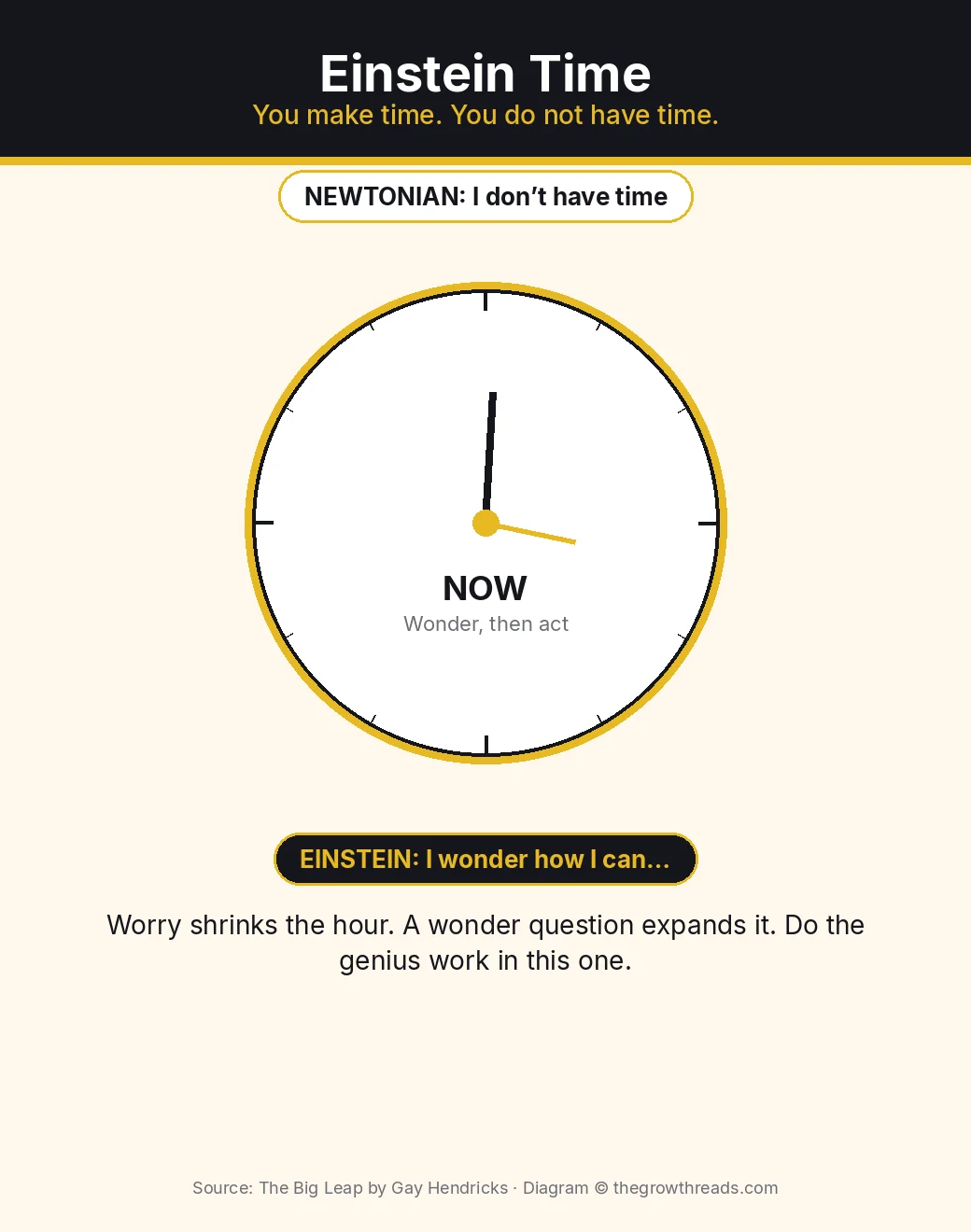
Newtonian time is the scarce-resource story: genius will get whatever is left, and nothing is left. Einstein Time, as Hendricks uses it, is the claim that time is generated by attention. Worry shrinks an hour. A wonder question expands the same hour. “I don’t have time” is often “I am not willing to be in this moment.” The steering sentence is: I wonder how I can expand my genius in this moment. It takes the wheel back from the thermostat, which always promises later — after one more excellence task, after the inbox is quiet. Later does not arrive.
The yank is also a body event: a tightening, a fog, a sudden fatigue. Feel the start of it and do not obey it. Do the next inch of genius work while the commentator is still talking. That is the Tuesday leap: not a resignation letter, an hour you made instead of hunted. Write the commitment on a card: I am willing to feel good all the way through, and I schedule genius as if it were already my job. If the card needs someone else’s permission, you are still in barrier two or four. Write it anyway. Put the hour on the calendar before excellence votes.
TGR Note: If you need a system so the hour happens, Deep Work is the installer and Flow is the research cousin. If the block is fear of starting, The War of Art names Resistance; Hendricks names a thermostat.
Who is The Big Leap best for — and who should read something else first?
Best for people who already have proof they can perform and still cap the good week. Best for experts trapped in excellence work that pays. Best for anyone who can feel the yank after a win and has been calling it coincidence. Run the 7-day plan on one genius hour this week, not as a personality rebrand.
Read something else first if you need a habit installer, not a thermostat: Atomic Habits. If you have not prototyped what “genius” even is, Designing Your Life is the experiment layer. If you need to fight Resistance as an enemy, The War of Art. If you cannot cut excellence work, Essentialism. If you want the research on optimal experience before Hendricks’s anecdotal frame, Flow. This one waits until the block is a cap, a story, or a calendar full of well-paid work that is not yours.
Questions to reflect on
- When was the last time a good week was followed by a fight, a fog, or a stall — and what thought showed up first?
- Which of the four barriers sounds like home: flawed, disloyal, burdened, or outshining?
- What work are you excellent at that leaves you oddly tired, and what do you do in the margins and apologize for?
- Where does “I don’t have time” currently protect an old thermostat setting?
- What one hour this week would count as Zone of Genius if no one else had to vote?
🔥 Ready to raise the cap and take the leap?
Get The Big Leap, then run the 7-day plan on one genius hour this week.
How to apply The Big Leap (7-day plan)
- Day 1 — Catch last week’s yank. Write the last win, the thought that followed, and the behavior that brought you down. Circle the sequence. If you cannot find one, you are not looking at the good week.
- Day 2 — Name the barrier. Flaw, disloyalty, burden, or outshining. Write the old promise in one sentence. Then write the new one. Put it where you will see it when the yank starts, not in a notes app you never open.
- Day 3 — Audit the four zones. List this week’s hours under Incompetence, Competence, Excellence, Genius. Circle one excellence block you will shrink and one genius block you will grow. If genius is empty, the audit already failed.
- Day 4 — Schedule one genius hour. Same as a client. Before the excellence work votes. If it is not on the calendar, it is a wish. Protect it from “just one more” paid task.
- Day 5 — Feel the wave. When something good happens, pause for sixty seconds and let it finish. Do not pick a fight, check a disaster, or shrink the win. The thermostat learns from this, not from a lecture.
- Day 6 — Make time. When “I don’t have time” appears, replace it once with “I wonder how I can expand my genius in this moment.” Then do twenty minutes of the genius work anyway. Worry does not get the hour.
- Day 7 — Review the seating chart. Which yank did you catch? Which zone still owns Thursday? Keep the genius hour next week. Drop one more competence task.
Frequently asked questions
What is The Big Leap about in one paragraph?
Gay Hendricks’s 2009 book is a field guide to the hidden ceiling on success, love, and creativity. When life exceeds an inner thermostat, you sabotage the good until it feels normal again. He maps four zones of work and argues that capable people get stuck in excellence, which pays and still drains genius hours. Four stories slam the cap: feeling flawed, fear of disloyalty, the burden of success, and the crime of outshining. Einstein Time is making hours from presence. This summary is the application layer: catch the yank, move one hour into genius, run a 7-day plan around a job.
What is the Upper Limit Problem in The Big Leap?
The Upper Limit Problem is Hendricks’s name for capping good feelings when they exceed an inner setting. You are not failing at ambition. You are restoring a familiar temperature. The sequence is reliable: a wave of success or ease, a thought that this is too much, then a behavior that brings you down. Fights, fog, missed deadlines, and retired habits are typical yanks. Treating only the behavior leaves the thermostat in place. Notice “this feels illegally good,” feel the wave through, and refuse to create the problem that would make it go away. Day 1 catches last week’s yank as a sequence, not as luck.
What is the Zone of Genius?
The Zone of Genius is the work you are uniquely suited to — play to you, a miracle to other people, the work you would still lean toward if money were not the immediate question. It sits above incompetence (stop), competence (anyone could), and excellence (rewarded and still drained). Most readers need to stop hiding in excellence. Genius is often the margin work you apologize for. The leap is a staffing decision: take an honest hour from excellence and give it to genius this week. If you cannot name it yet, name the excellent work that leaves you tired. Day 4 puts that hour on the calendar.
What are the four hidden barriers in The Big Leap?
Four stories slam the thermostat. Feeling fundamentally flawed: good things arriving must mean something is wrong with you. Disloyalty: if you rise, you leave the people who stayed small, or they leave you. The burden belief: more success means a heavier load you cannot carry. The crime of outshining: being fully you would dim someone you love, so you stay dim. These are loyalty oaths, which is why willpower fails. Say the old promise out loud and write a new one you can use on a Tuesday when the yank starts. You will probably recognize one as home. Day 2 of the plan is naming it.
What is Einstein Time in The Big Leap?
Newtonian time is the scarce-resource story: genius will get whatever is left, and nothing is left. Einstein Time, as Hendricks uses it, is the claim that time is generated by attention. Worry shrinks an hour. A wonder question expands the same hour. “I don’t have time” is often “I am not willing to be in this moment.” Replace it with “I wonder how I can expand my genius in this moment?” Then do the next inch while the commentator is still talking. He is not denying clocks. He is denying leftover minutes that never appear. Day 6 asks you to make twenty minutes, not wait for a quiet inbox.
Who should read The Big Leap — and who should start elsewhere?
Read it if you already have proof you can perform and still cap the good week, or if you are paid well for excellence work that leaves you tired. It is a thermostat book, not a beginner habit book. Start with Atomic Habits if you need an installer for showing up. Start with Designing Your Life if you cannot yet prototype what genius would be. Start with Essentialism if you cannot cut the excellence work that fills Thursday. Start with The War of Art if you need Resistance named as an enemy. Start with Flow for the research on optimal experience.
Is The Big Leap still useful in 2026?
The thermostat aged well. Feeds now offer more ways to yank a good week: a comparison, a doomscroll, a “quick” excellence task that eats the genius hour. Tools can draft excellence work faster, which makes hiding there even easier. Passion-as-brand is louder than in 2009, which makes Zone of Genius easy to fake as a tagline you never schedule. Keep the sequence, the four stories, the four zones, and one honest hour. Ignore advice that says you must quit on Friday or wait to feel ready. Day 1 should still catch last week’s yank. Day 4 should still put genius on the calendar before excellence votes.
Related summaries
- The Gap and the Gain Summary & Review
- Essentialism Summary & Review
- So Good They Can’t Ignore You Summary & Review
- Flow Summary & Review
- Best Productivity Books
How we analyze books: every book on The Growth Reads is read cover to cover, summarized in thousands of words of original analysis, and rated against our five-criteria rubric (lasting impact, evidence quality, practical application, writing & originality, external consensus). Read our full methodology.