

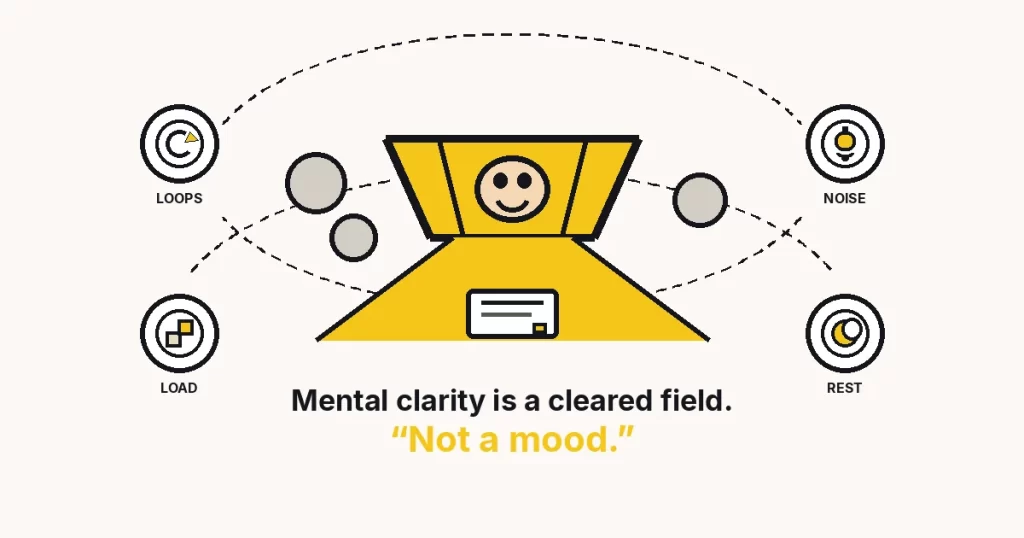
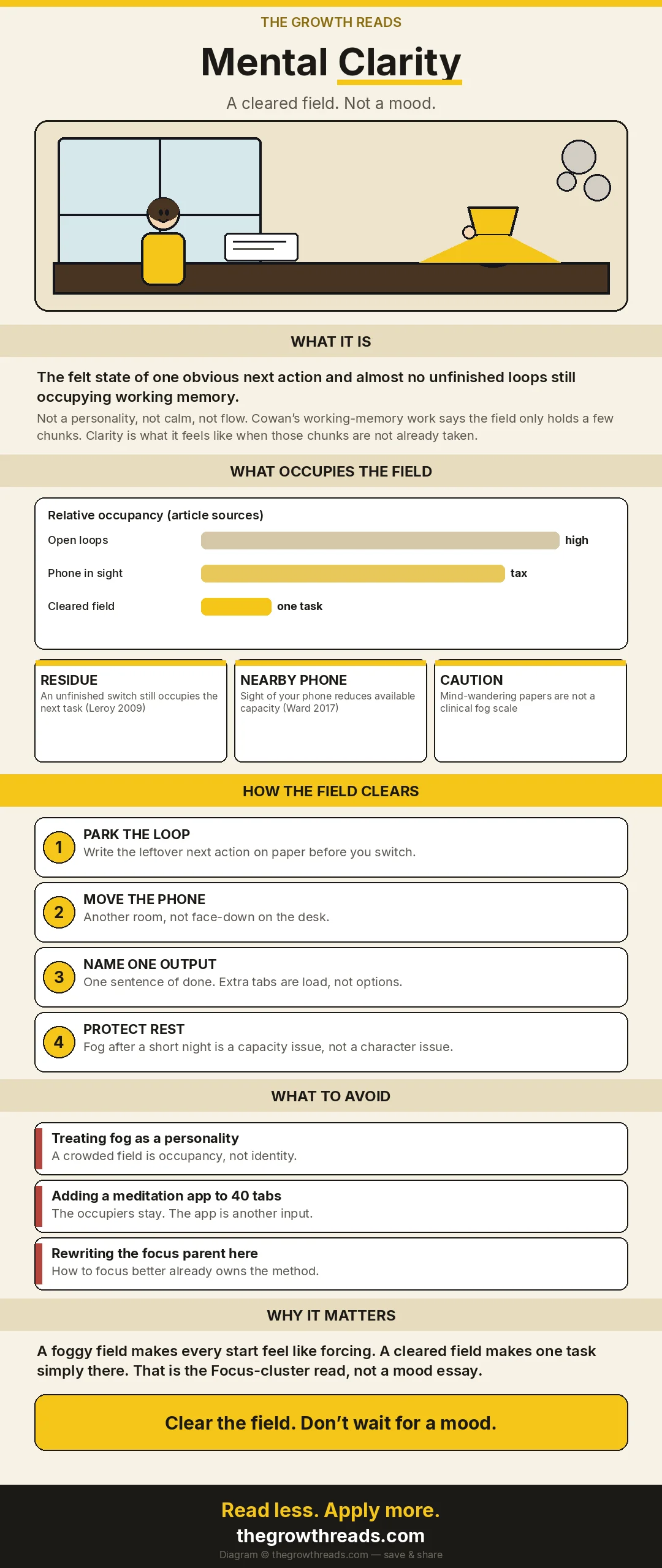
Mental clarity is the felt state of one obvious next action and almost no unfinished loops occupying working memory. It is not a personality or a mood. Attention-residue, phone-presence and cognitive-load research point to a cleared field, not a stronger will. When the field is crowded, focus feels like forcing; when it is empty enough, one task is simply there.
Key takeaways
- Sophie Leroy (2009) showed that switching away from an unfinished task leaves an attention residue that measurably impairs the next task — so a foggy field is often leftover occupancy, not a missing personality trait.
- Ward, Duke, Gneezy and Bos (2017) found that the mere presence of your own smartphone reduced available working memory and fluid intelligence even when the phone stayed silent and unused.
- John Sweller’s 1988 cognitive-load work treats working memory as a narrow channel: extraneous load (extra tabs, extra decisions, extra inputs) occupies the same field the current task needs.
- Nelson Cowan’s 2001 review put typical working-memory capacity nearer four chunks than the folk “seven plus or minus two,” which is why a desk with six open loops already feels full.
- Killingsworth and Gilbert (2010) found people mind-wandered on nearly half of sampled moments, and those moments were rated less happy than moments on-task — a cost that shows up as fog long before it shows up as a missed deadline.
What mental clarity actually is
Mental clarity is what a cleared working-memory field feels like from the inside: one next action is obvious, and almost nothing else is still asking for a turn. The search phrase sounds like a mood or a personality. The productivity read is narrower. A clear field is occupancy, not identity. You can be a careful person and still feel foggy at 11:00 because three unfinished emails, a silent phone on the desk, and an unnamed “real work” block are all still loaded.
Nelson Cowan’s 2001 review of working-memory capacity is the least romantic paper on this page and the most useful. Across a wide literature he argued that the number of items an adult can hold in the focus of attention is typically nearer four chunks than George Miller’s famous seven. That is not a score you should tattoo on a planner. It is a ceiling. If four leftover loops are already in the field, the fifth thing — the thing you sat down to do — has nowhere to sit. Mental clarity is the felt side of that ceiling being empty enough.
This is why the page belongs under Focus, not under a new “mindset” silo. The live parent how to focus better already owns the method for removing switches. This URL owns the name people type when the switch-cost has already been paid and the room still feels thick. The sister page what deep work actually means is the harder, longer version of the same family: hard thinking with no residue. Mental clarity is the lighter, everyday version — enough empty capacity that the next action does not have to fight.
Jay Shetty’s Think Like a Monk is the unused review this row was given, and it earns the slot for a specific reason. Shetty’s still-mind chapters are folk language for a cleared identity loop: stop rehearsing who you are supposed to be long enough to see the next useful act. That is not a lab finding, and we will not dress it as one. It is the library’s closest book-length name for “the field is no longer arguing with itself.” Pair it with the papers, do not replace them.
Mental clarity vs focus vs calm vs flow
Focus is the sustained allocation of attention; mental clarity is the felt emptiness that makes that allocation cheap. You can force focus on a crowded field — that is most of a Tuesday — and it will feel like swimming in clothes. Calm is an affective state. You can be calm and still have twelve open loops. Flow, in Csikszentmihalyi’s sense, is a rarer match of skill and challenge with fast feedback. Mental clarity can exist in a boring admin hour. Flow cannot. If you only chase flow you will miss the ordinary clear field that lets a report get finished.
What steals mental clarity
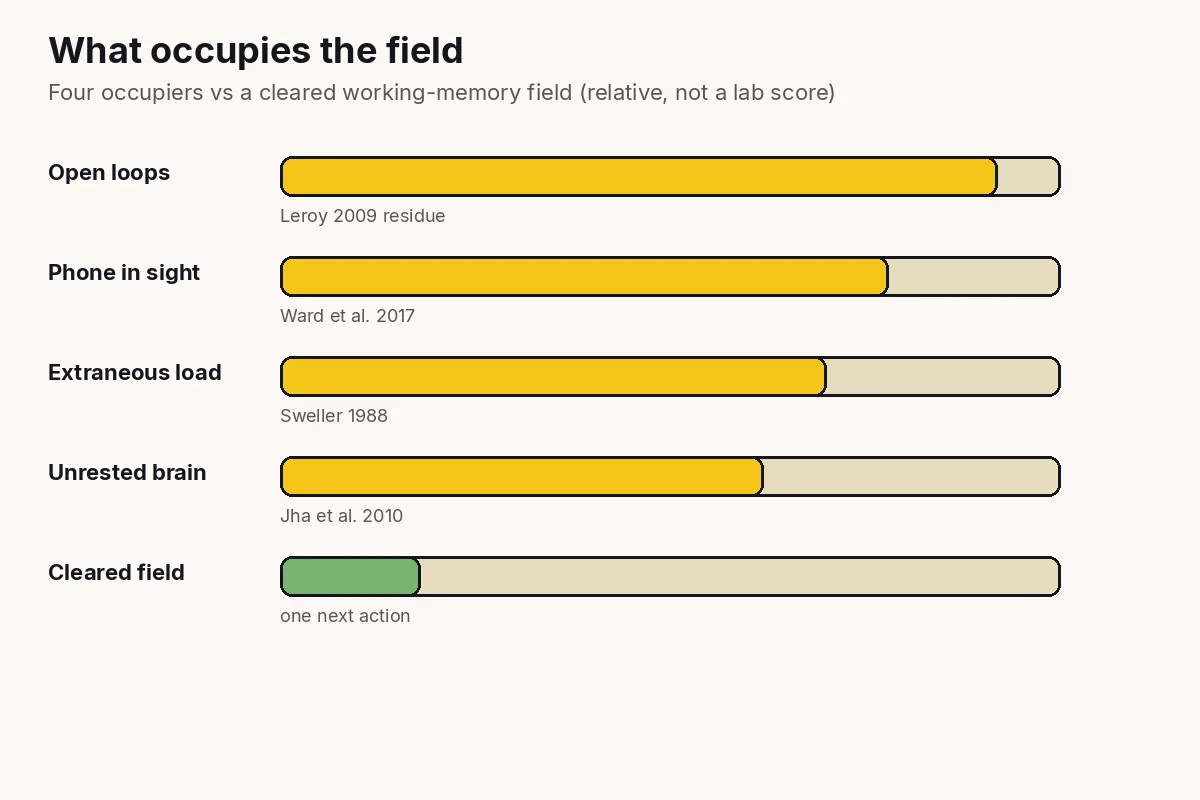
Mental clarity is stolen by occupancy: leftover loops, nearby noise, extraneous load, and an unrested brain. None of those require a diagnosis. All four show up in ordinary knowledge work. The useful move is to name which occupier is actually sitting in the field before you buy another app that promises “clarity” as a mood.
Sophie Leroy’s 2009 attention-residue experiments are the mechanism under leftover loops. When people switched away from Task A before it was finished, part of their attention stayed attached to A and performance on Task B dropped. Finishing A helped, but only when people also disengaged under some time pressure. In a working day that looks like this: you “move on” from an email you did not send, and the unsent sentence keeps nominating itself while you try to outline a report. The fog is not mysterious. The previous task is still loaded.
Ward, Duke, Gneezy and Bos (2017) added a quieter occupier. Across two experiments, people who kept their own smartphone on the desk — even on silent, even unused — showed lower available working-memory capacity and lower fluid intelligence than people whose phone was in another room. Participants did not report thinking about the phone. The tax still showed. Distance beat silence. A face-down phone on the same desk is still in the field.
John Sweller’s 1988 cognitive-load paper is the older architecture. Working memory is a narrow channel. Intrinsic load is the difficulty of the task itself. Extraneous load is everything the environment and the materials add that the task does not need — extra tabs, extra choices, extra half-started notes. Germane load is the useful work of building a schema. Mental clarity, on this page, is what it feels like when extraneous load has been taken off the channel so the intrinsic work can sit. Adding a second system for “clarity” while leaving the tabs open is more extraneous load wearing a helpful name.
The four occupiers
- Open loops. Unfinished switches (Leroy, 2009). The Zeigarnik effect of 1927 is the folk ancestor — incomplete tasks stay more available in memory than completed ones — but it is a historical observation, not a modern randomised trial, and we will not treat it as causal proof. Leroy is the work-day paper.
- Noise in reach. A phone on the desk (Ward et al., 2017) and, by the same logic, any badge that can light up without being touched. Stothart, Mitchum and Yehnert (2015) found that merely receiving a notification disrupted an attention task by roughly the same magnitude as answering it. The signal is the occupier.
- Extraneous load. Extra materials, extra decisions, extra “options” that are really unfinished choices (Sweller, 1988). A 20-tab browser is not a library. It is a set of half-loaded chunks.
- An unrested brain. Jha, Stanley, Kiyonaga, Wong and Gelfand (2010) showed that working-memory capacity degraded under high stress in an untrained military cohort, and that enough daily mindfulness practice protected it. That is a capacity finding, not a sleep-clinic page and not a command to meditate. A short night and a high-stress week occupy the same narrow field. Treating that occupancy as laziness is the mistake.
The productivity library already holds the parent method and the sister pages. This article does not replace them. It names the occupancy so those pages have something specific to act on.
Why a foggy field costs more than it feels like
A foggy field feels free because nothing dramatic happens at the moment of occupancy — the bill arrives as slower starts, more self-interruption, and a day that was busy without being finished. Gloria Mark, Daniela Gudith and Ulrich Klocke (2008) instrumented interrupted knowledge work and found that interrupted people compensated by working faster, finishing in similar time at a hidden cost: higher stress, frustration, time pressure and effort. The work still closed. The person paid. Mental clarity is one name for not running that tax all afternoon.
Joshua Rubinstein, David Meyer and Jeffrey Evans (2001) modelled the switch itself as two executive stages — goal shifting, then rule activation — and showed both take measurable time, more so when the new task is complex. A foggy field is a field that is already mid-switch. You sit down to write and discover you are still loading the rules for the last meeting. The first ten minutes of every block disappear into that reload, which is why the day can be full of “starts” and empty of finishes.
Killingsworth and Gilbert’s 2010 experience-sampling study in Science is the mood half of the same cost, and we will keep it in its box. People reported mind-wandering on 46.9% of sampled moments, and those moments were rated less happy than moments on the current activity — even when the wandering went to pleasant topics. That is not a clinical fog scale. It is not “overthinking disorder.” It is evidence that a field which will not stay on the current chunk extracts a satisfaction tax as well as a time tax. On a productivity page, that matters because people then diagnose the tax as a personality (“I am just not a clear thinker”) and stop touching the occupiers.
Two honest caveats. Ward’s phone-presence effect is a lab capacity finding, not a field study of a whole working week — treat the direction as the claim, not a precise daily IQ loss. Killingsworth and Gilbert sampled experience, not output; a wandering mind can still ship work. And Jha’s mindfulness result is a small field intervention that scaled with practice, not a proof that an app icon creates clarity. Observational and small-n papers get named as such. They still beat an unsourced “studies show.”
The cost that does not need a dramatic number is the identity cost. Once fog is read as character, people start collecting clarity rituals and stop closing loops. The field stays crowded. The rituals become another occupier. That is how a search for mental clarity turns into a new tab.
Nearby ideas that are not this definition
Several neighbouring pages share a word with this one and answer a different question. Keep them linked, not merged. This URL is the definition of a cleared field. It is not a how-to ladder, not a morning-routine rewrite, and not a clinical fog page.
| Idea | What it actually is | What it is not |
|---|---|---|
| What is mental clarity | The felt state of one next action and a working-memory field that is mostly empty | A mood, a talent, or a meditation identity |
| How to focus better | The Focus parent: the method for removing switches | A second definition of clarity |
| What deep work actually means | Hard thinking with no residue — the heavier sister in the same cluster | Everyday admin clarity |
| How to stay on task | Holding one target after the field is already clear enough to start | The feeling before the start |
| Notification overload | Volume of signals as the occupier | The leftover-loop occupier |
| Attention residue | Leroy’s leftover occupancy, named as its own URL | The whole clarity definition |
| How to build a morning routine | A fixed cue-to-action sequence. Already live. Do not rewrite it here | A checklist page, and not this definition |
The live morning-routine how-to and the live morning-routine checklist are different phrases and different jobs. This article does not restage either of them. A clear field can help a morning; a morning stack cannot be substituted for a definition of clarity.
Common mistakes
- Treating fog as a personality. Occupancy is reversible. Identity is a story that keeps the occupiers in place.
- Adding a meditation app to forty tabs. Jha’s result scaled with practice under load, not with an extra icon. The tabs are still extraneous load (Sweller, 1988).
- Leaving the phone on the desk, on silent, as a compromise. Ward’s participants were already not using the phone. Sight was enough.
- Confusing calm with a cleared task field. You can be soothed and still have six open loops. Calm is not the metric this URL owns.
- Restaging the focus parent as a HowTo ladder here. Play slots do not emit that ladder. How to focus better already owns the method.
- Rewriting the morning-routine how-to or the live checklist. Different phrases, already published. A cleared field is not a new dawn stack.
- Reading this as a brain-fog clinic. Persistent, cross-context fog that does not move when the occupiers move is a different conversation than a productivity article. We will not list symptoms.
The evidence behind this
The claim on this page is modest: a felt clear field tracks a less occupied working-memory channel, and the occupiers have names in the literature. The table is the working, not a highlight reel.
| Study | Design and size | Finding | What we used it for |
|---|---|---|---|
| Leroy (2009), OBHDP | Two lab experiments on task switching | Unfinished switches left residue that impaired the next task; completion plus pressure to disengage cleared more of it | Open-loop occupier |
| Ward, Duke, Gneezy & Bos (2017), JACR | Two experiments, own-phone presence vs other room | Silent, unused phone on the desk reduced available working memory and fluid intelligence | Noise-in-reach occupier |
| Sweller (1988), Cognitive Science | Cognitive-load theory paper with problem-solving evidence | Working memory is a narrow channel; extraneous load competes with the task | Extraneous-load occupier |
| Cowan (2001), BBS | Literature review / capacity argument | Focus of attention typically holds about four chunks, not seven | Why a few loops already feel like a full field |
| Killingsworth & Gilbert (2010), Science | Experience sampling, 2,250 adults, ~250,000 samples | Mind-wandering on 46.9% of moments; those moments rated less happy | Satisfaction cost of an unstayed field. Not a clinical scale |
| Rubinstein, Meyer & Evans (2001), JEP:HPP | Four task-switching experiments | Goal shift then rule activation; both cost time, more on complex tasks | Why a mid-switch field makes every start expensive |
| Mark, Gudith & Klocke (2008), CHI | Field study of interrupted knowledge work | Interrupted workers finished faster at higher stress and effort | Hidden cost of running without a clear field |
| Jha et al. (2010), Emotion | Field intervention, military cohorts (n=31 trained, n=17 control) plus civilian comparison | Working memory degraded under stress without training; held with enough practice | Unrested / high-load capacity. Small n; not a meditation prescription |
Frequently asked questions
What is mental clarity?
Mental clarity is the felt state of having one obvious next action and almost no unfinished loops still occupying working memory. It is occupancy, not a personality and not a mood. Cowan’s capacity review says the focus of attention only holds a few chunks; Leroy’s residue work says an unfinished switch keeps one of those chunks busy. When the field is empty enough, the next task does not have to fight. When it is crowded, every start feels like forcing. That is the productivity read of the phrase, and it is the only read this URL will take.
Is mental clarity the same as focus?
No. Focus is the sustained allocation of attention to one target. Mental clarity is the felt emptiness that makes that allocation cheap. You can force focus on a crowded field — most working days do — and it will cost more effort for the same output, which is the pattern Mark, Gudith and Klocke saw when interrupted workers sped up and paid in stress. The Focus parent, how to focus better, owns the method for removing switches. This page owns the name for the field those switches leave behind.
Why do I lose mental clarity in the afternoon?
Usually because the field filled up, not because afternoon-you is a different person. Open loops from the morning are still loaded (Leroy). The phone has been on the desk for hours (Ward). Extraneous tabs and decisions have stacked (Sweller). A short night or a high-stress week can also shrink available capacity (Jha). Name the occupier before you name a character flaw. If the fog is the same in every context and does not move when the occupiers move, that is outside this article — we will not list symptoms or offer a clinic read.
Does meditation create mental clarity?
Sometimes it protects capacity; it does not replace a cleared field. Jha, Stanley, Kiyonaga, Wong and Gelfand (2010) found that enough daily mindfulness practice protected working memory under stress in a small military sample, and the effect scaled with practice, not with enrolment. That is a real lever and a modest one. Adding an app icon while leaving forty tabs and a phone on the desk adds extraneous load. Shetty’s monk chapters are folk language for dropping an identity loop, not a lab protocol, and they sit in the review this page links down to — they do not become a HowTo ladder here.
Is brain fog the same as a lack of mental clarity?
Not on this site. Brain fog is a health-search phrase with medical neighbours we will not take. This page is the work-and-habits version: leftover loops, nearby signals, extra load, and an unrested-but-ordinary week. We will not list clinical symptoms, will not score you, and will not use “fog disorder.” If the problem is persistent, cross-context, and unmoved by closing loops and moving the phone, talk to a qualified professional rather than a productivity URL. The article stays on occupancy.
How is this different from how to focus better?
The parent is the method for removing switches. This page is the definition of the field those switches occupy. Play slots drop the HowTo step ladder and emit no HowTo schema, which is why you will not find a numbered system here. If you already know the field is crowded and want the leaving, go up to how to focus better. If you are still calling the fog a personality, stay here until the four occupiers are named. We will not rewrite the live parent, and we will not restage the live morning-routine how-to or checklist.
Can a phone on silent still steal mental clarity?
Yes, according to Ward, Duke, Gneezy and Bos (2017). People who kept their own phone on the desk — silent, unused, not the object of a conscious thought — still showed lower available working memory and fluid intelligence than people whose phone was in another room. Stothart, Mitchum and Yehnert (2015) add that a notification you do not answer still costs attention. Silence is not distance. Face-down on the same desk is still in the field. The cheaper experiment is another room for one block, not a new willpower speech.
What book is this page pairing with?
Think Like a Monk, in our unused review of Jay Shetty’s still-mind chapters. It is folk language for dropping a rehearsed identity long enough to see the next useful act — a cleared self-loop, not a lab result. We will not pretend Shetty ran Cowan’s capacity studies. The papers above do the occupancy work; the book is the library object this queue row was given because it had zero inbound article links. Daniel Levitin’s The Organized Mind is the neighbouring review if you want the attention-and-environment half in book form. Neither book is a substitute for closing the loop in front of you.
Sources
- Leroy, S. (2009). Why is it so hard to do my work? The challenge of attention residue when switching between work tasks. Organizational Behavior and Human Decision Processes, 109(2), 168–181. doi:10.1016/j.obhdp.2009.04.002
- Ward, A. F., Duke, K., Gneezy, A., & Bos, M. W. (2017). Brain drain: The mere presence of one’s own smartphone reduces available cognitive capacity. Journal of the Association for Consumer Research, 2(2), 140–154. doi:10.1086/691462
- Sweller, J. (1988). Cognitive load during problem solving: Effects on learning. Cognitive Science, 12(2), 257–285. doi:10.1207/s15516709cog1202_4
- Cowan, N. (2001). The magical number 4 in short-term memory: A reconsideration of mental storage capacity. Behavioral and Brain Sciences, 24(1), 87–114. doi:10.1017/S0140525X01003922
- Killingsworth, M. A., & Gilbert, D. T. (2010). A wandering mind is an unhappy mind. Science, 330(6006), 932. doi:10.1126/science.1192439
- Rubinstein, J. S., Meyer, D. E., & Evans, J. E. (2001). Executive control of cognitive processes in task switching. Journal of Experimental Psychology: Human Perception and Performance, 27(4), 763–797. doi:10.1037/0096-1523.27.4.763
- Mark, G., Gudith, D., & Klocke, U. (2008). The cost of interrupted work: more speed and stress. Proceedings of the 26th ACM SIGCHI Conference on Human Factors in Computing Systems, 107–110. doi:10.1145/1357054.1357072
- Jha, A. P., Stanley, E. A., Kiyonaga, A., Wong, L., & Gelfand, L. (2010). Examining the protective effects of mindfulness training on working memory capacity and affective experience. Emotion, 10(1), 54–64. doi:10.1037/a0018438
Related reading on The Growth Reads
The books this definition draws on
- Think Like a Monk summary & review — folk language for a cleared identity loop; the unused down-link this row was given
- The Organized Mind summary & review — attention and environment as design problems, not character
- Peak Mind summary & review — Jha’s attention-training work in book form
Related articles
- How to focus better — Focus parent; the method this play slot will not restage
- What deep work actually means — sister in the same cluster
- How to stay on task — holding the target after the field is clear enough
- Notification overload — the signal occupier, named as its own URL
- Attention residue — Leroy’s leftover occupancy
- Single tasking — refusing the serial switch
Go deeper
How this article was researched
The Growth Reads editorial team writes from primary sources: the books themselves, the authors’ published essays, and the peer-reviewed literature behind the claims. Every study cited above was read in the original publication or its published abstract, and every figure is quoted with its design, sample and effect so you can judge its weight. Where a finding is correlational, small-n, or historical rather than a modern trial, we say so in the body.
This article contains no medical advice. Persistent, cross-context fog that does not move when occupiers move is worth a qualified professional, not a discipline speech. We do not diagnose, treat, or list clinical symptoms.
Method: primary papers and one named unused review. Last checked 14 September 2026. Play slot — no HowTo schema.