

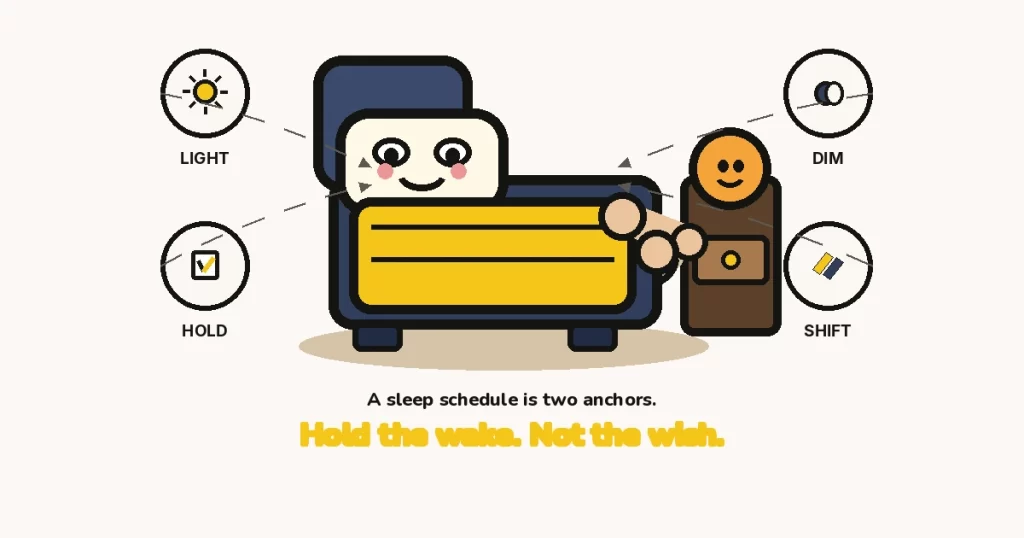
How to fix your sleep schedule: pick a wake time you can keep all seven days, then move toward it in 15-minute steps with morning light and a dimmer evening. Weekend lie-ins are social jetlag (Wittmann et al., 2006). Hold the wake on free days too; do not hunt a heroic bedtime.
Key takeaways
- Wittmann, Dinich, Merrow and Roenneberg (2006) named social jetlag as the gap between weekday timing and free-day timing — a weekend lie-in is a timezone change, not a treat the clock ignores.
- Phillips, Clerx, O’Brien and colleagues (2017) found irregular sleep/wake patterns tracked poorer academic timing in college students; that is correlational, but it is why this page holds one wake for seven days instead of a heroic Friday bedtime.
- Khalsa, Jewett, Cajochen and Czeisler (2003) mapped a human light phase-response curve: bright light in the morning advances the clock, and light in the evening delays it.
- Wright, McHill, Birks, Griffin, Rusterholz and Chinoy (2013) sent eight people camping in natural light and advanced melatonin timing by about two hours — a small study, and still the cleanest demonstration that indoor mornings barely count.
- Chang, Aeschbach, Duffy and Czeisler (2015) found four hours of a light-emitting eReader before bed delayed circadian timing, reduced evening melatonin, and left people less alert the next morning.
What a sleep schedule actually is (and what it isn’t)
A sleep schedule is a pair of anchors you can keep for seven days: a wake time that does not slide on free days, and a wind-down cue that stops you renegotiating bedtime every night. It is not a 4 a.m. identity, a shorter night, or a diagnosis. Roenneberg, Wirz-Justice and Merrow (2003) mapped chronotype as a distribution — a timing trait, not a moral score. This page does not try to turn you into a different chronotype. It tries to stop the week from being two clocks.
That job is narrower than “sleep better.” We will not list clinical signs, dose anything, write children’s screen rules, or treat a late clock as depression. The lever is behaviour you can see on a calendar. If you currently sleep at 2 a.m. and must be up at 7 a.m. tomorrow, that directional shift already has a page: how to wake up early if you sleep late. Use this one when the week itself is the mess — 7 a.m. Monday, 10 a.m. Saturday, and a Monday that feels like a new timezone.
How is this different from an earlier alarm, a morning-person trait, or a morning routine?
This page holds a 7-day wake; the sister page shifts both ends earlier when you currently sleep late; what makes someone a morning person is chronotype, not a system; how to build a morning routine is what you do after you are already up. Four jobs. Four pages. The sister rule still stands: an earlier alarm on the same late bedtime is a sleep cut. Chronotype is why a 5 a.m. target can be the wrong hold. This page ends when the wake is held. The hour after that belongs on the morning routine checklist.
Why the week keeps slipping
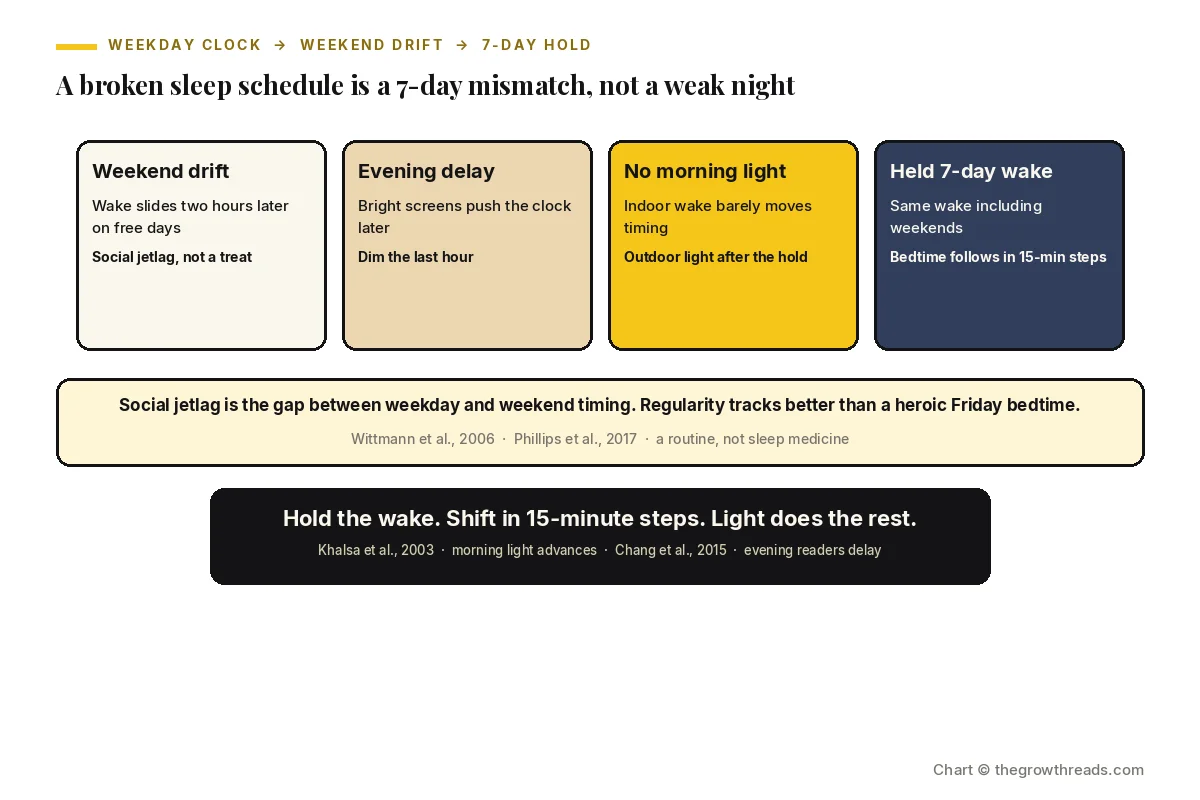
The week slips because free days let the wake drift later, evening light delays the clock, and indoor mornings do not pull it back. Wittmann et al. (2006) called the weekday/free-day gap social jetlag. A Saturday 10 a.m. wake is not rest the pacemaker treats as neutral. It is a small westward flight you reverse every Monday. Phillips et al. (2017) found, in a college sample, that irregular sleep/wake patterns tracked later timing and poorer academic performance. That paper is correlational, not a trial of this habit. It is still why this page refuses “catch-up sleep” that is actually a second timezone.
Light is the other motor. Khalsa, Jewett, Cajochen and Czeisler (2003) plotted a human phase-response curve: morning bright light advances the pacemaker; evening light delays it. Wright et al. (2013) took eight people camping for a week and advanced melatonin timing by about two hours. Small n, and still the cleanest outdoor demonstration that indoor mornings are a weak cue. Chang et al. (2015) closed the evening side: a light-emitting eReader for four hours before bed delayed circadian timing and next-morning alertness versus a printed book. One device class, not a law about every phone minute. On this page it is one lever: dim the last hour. The longer screen habit lives on how to reduce screen time.
The four triggers, in the order you can actually pull them
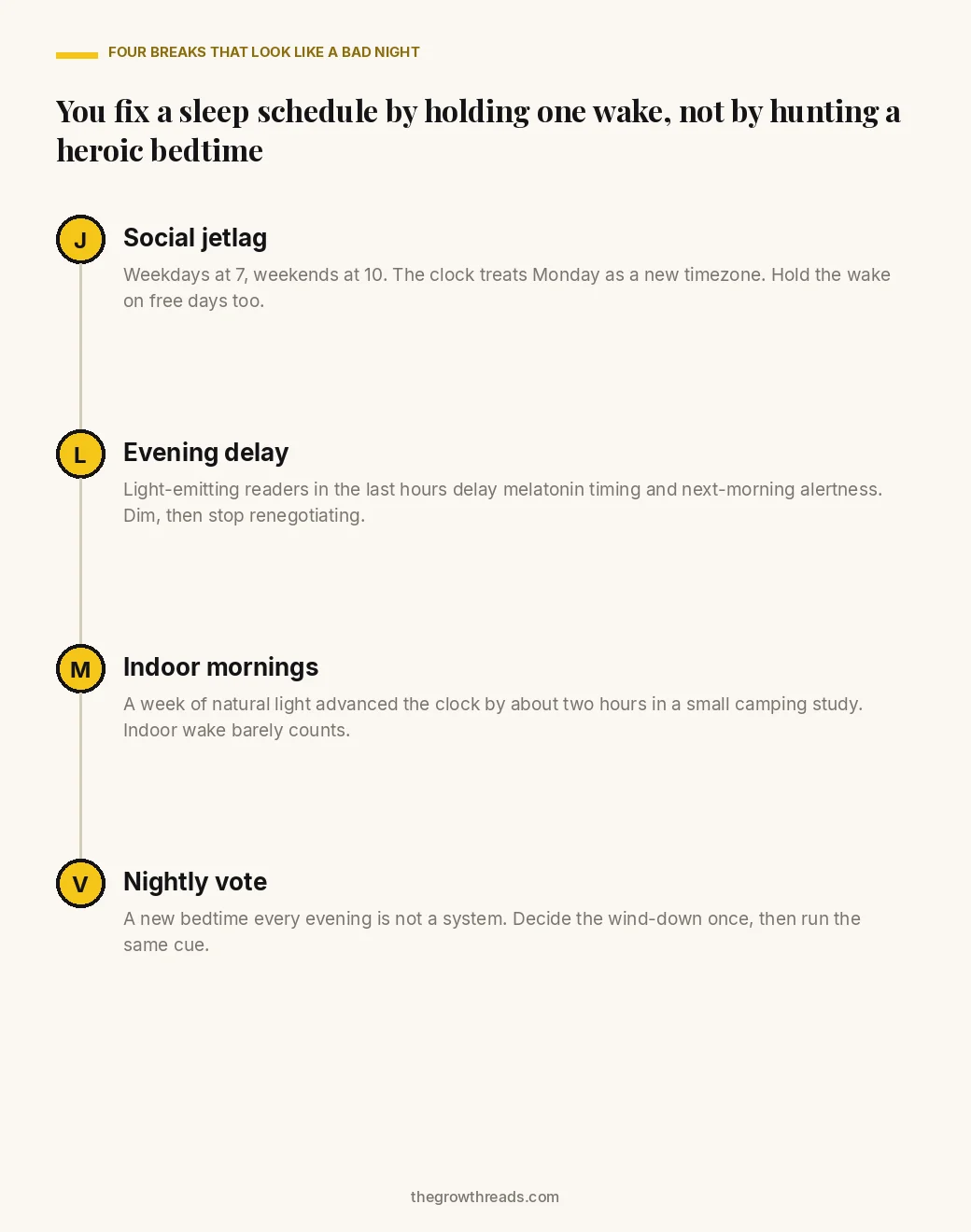
- Two clocks in one week. Weekday 7, weekend 10. Wittmann’s social jetlag. The hold is the wake on free days, not a more virtuous Friday night.
- Evening delay. Khalsa’s PRC plus Chang’s eReader: bright late light pushes the whole window later, so tomorrow’s 7 a.m. is a sleep cut in disguise.
- Indoor mornings. Wright’s camping week is the reminder that a kitchen bulb is not the outdoor cue the pacemaker actually tracks.
- A new bedtime every night. If the wind-down is a vote, you do not have a schedule. You have a nightly negotiation. Kendra Adachi’s The Lazy Genius Way is the book for that failure mode: decide once, then stop using willpower as the nightly planner.
Why the drift costs more than it feels like
The weekend lie-in feels like recovery, and it is often a timezone the Monday alarm has to reverse: Wittmann’s social jetlag is the bill, not the lie-in’s mood. Phillips et al. (2017) is the second bill. In 61 undergraduates wearing wrist monitors for about a month, a higher Sleep Regularity Index tracked better academic performance and earlier timing, separate from duration. College sample. Correlational. Not a trial of “get up at 7 on Sunday.” What it kills is the slogan that hours on Saturday cancel a chaotic week.
Evening light has a similar invoice. Chang et al. (2015) delayed the clock and next-morning alertness with a four-hour eReader versus a printed book: twelve adults, one device. It is not a reason to moralise every text. It is why the last 60 to 90 minutes here are dim on purpose. If you stay up because the show is the reward, that is bedtime procrastination. Use that page for the leisure stall. Use this one when the calendar is two clocks even on nights you meant to be good.
The honest limit: there is no randomised trial of this exact six-step sequence. Wright is eight campers. Phillips is correlational. Khalsa is a lab light-pulse curve. Treat the steps as a well-motivated calendar habit, not a promise you will never sleep late. Related reading on productivity systems and summaries helps because no single cue owns every stall, and energy management vs time management is the cousin page when the issue is fuel, not the alarm.
The four breaks — and the fix for each
Most “just go to bed earlier” speeches fail because they pull the wrong lever. Match the break to the trigger that is winning, then pull that one.
| Pattern | What it looks like | The trigger that is winning | The fix that works |
|---|---|---|---|
| Social jetlag | 7 a.m. weekdays, 10 a.m. free days; Monday is a new timezone | Two clocks in one week — Wittmann et al. (2006) | Hold the same wake on free days (Step 1). Bedtime follows; it is not the first move |
| Evening delay | The last episode, then the last scroll, then a 1 a.m. “I’ll catch up Saturday” | Late bright light — Chang et al. (2015); Khalsa et al. (2003) evening delay | Dim the last 60–90 minutes (Step 5). If the stall is leisure, use bedtime procrastination |
| Indoor mornings | Up at 7, still in dim rooms until the commute, clock never advances | Missing outdoor cue — Wright et al. (2013) camping week | Outdoor or equivalent bright light in the first hour after the held wake (Step 4) |
| Nightly vote | A new bedtime every evening; “just tonight” is the system | No decide-once wind-down — the Lazy Genius failure mode | Write the cue as an if-then and stop renegotiating (Step 6). Log the week first (Step 2) |
How to fix your sleep schedule: the 6-step system
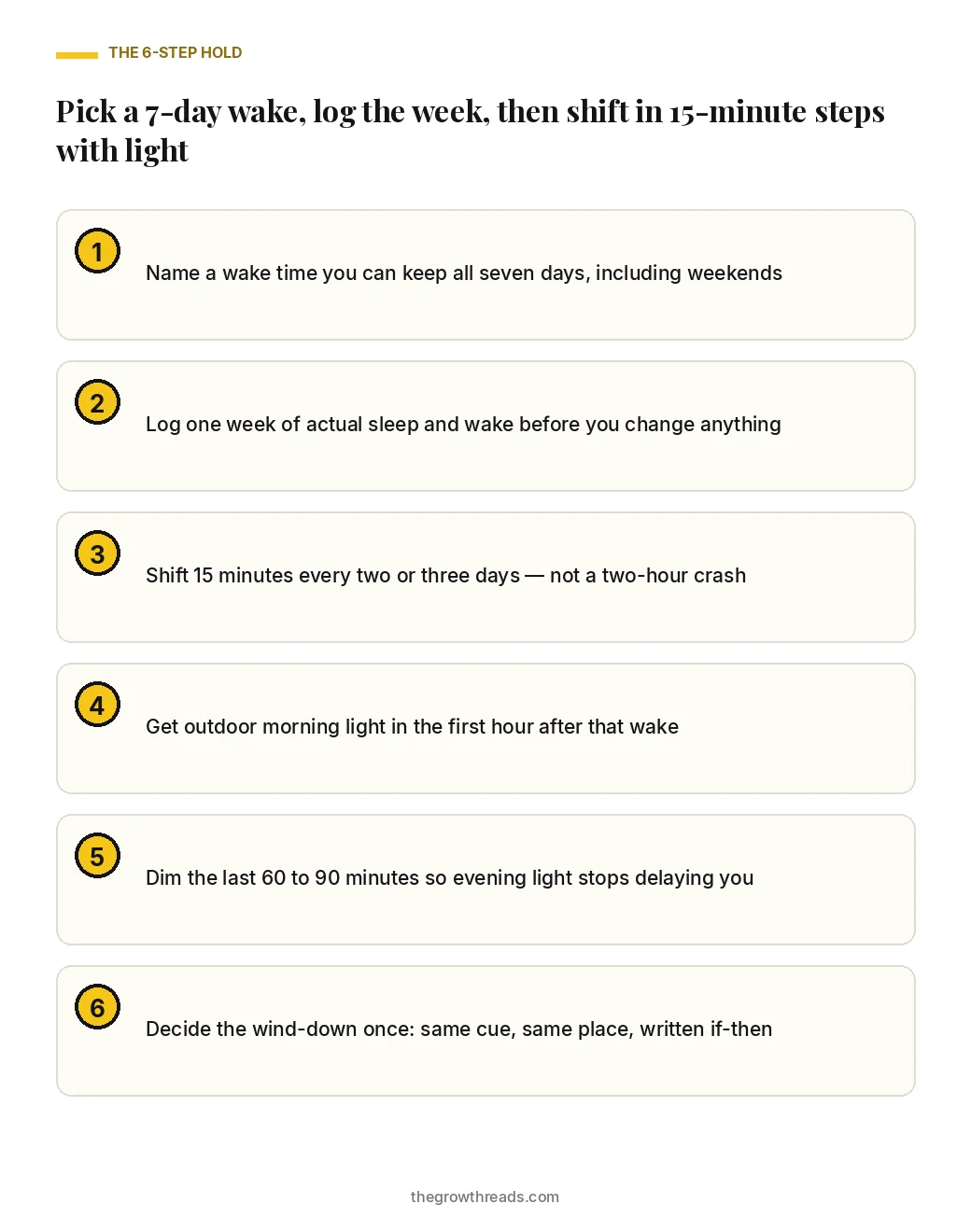
Fix your sleep schedule by naming a wake you can keep seven days, logging one un-fixed week, shifting 15 minutes at a time, taking morning light, dimming the last hour, and deciding the wind-down once. Do not start with a 2-hour earlier Friday. Do not cut the night with a new alarm on the old bedtime — that is the sister page’s sleep-cut warning, and it still applies. Do not borrow a celebrity 4 a.m. from the billionaire morning routine. The target is a wake you can hold, including Saturday.
Step 1 — Name a wake time you can keep all seven days
On paper, write one wake time a stranger could score: “7:30, including Saturday and Sunday,” not “earlier.” If the sentence has no weekend clause, you still have two clocks. Wittmann’s social jetlag is the test. Pick a time you can keep given work, not a moral 5 a.m. The morning-person page is why a later hold can be the honest one. If you currently sleep at 2 a.m. and must be at 7 a.m. this week, do not crash overnight — use how to wake up early if you sleep late to move both ends, then come back here to hold the new pair. One number. Seven days.
Step 2 — Log one week of actual sleep and wake before you change anything
For seven days, write when you got in bed, when you got up, and whether the day was work or free. Do not “be good” this week. The log is the picture. A time audit is the same move for waking hours. Social jetlag only shows up when weekday and weekend sit on the same page. If the log shows a stable pair you can keep, you may not need a shift — you may need to stop pretending 7 a.m. is the hold. The log may change Step 1. It may not become a personality spreadsheet. Seven lines. Then stop measuring.
Step 3 — Shift 15 minutes every two or three days — not a two-hour crash
Move the held wake, and the bedtime window with it, by about 15 minutes every two or three days until you reach the Step 1 number. The sister page already owns “move both ends so the night does not shrink”; we reuse it. A 2-hour Friday crash is a sleep cut plus a new timezone. Khalsa’s curve is why small steps plus light beat a heroic night: the pacemaker shifts in parts of an hour. If you miss a day, repeat the last 15. Do not add a 45-minute punishment jump. If the weekday is already close and the weekend is the mess, start the 15-minute work on Saturday, not on Monday willpower.
Step 4 — Get outdoor morning light in the first hour after that wake
After the held wake, get outside for a chunk of the first hour — a walk, a coffee on the step, the actual sky. Wright et al. (2013) is why this is not decoration: a week of natural light-dark advanced timing by about two hours in eight campers. Khalsa et al. (2003) is why the timing is morning. This is also the first move of the parent morning routine — light as a cue, not a mood. If weather or safety keeps you inside, use the brightest window you have. Do not treat a dim kitchen as a camping substitute, and do not turn the finding into a gadget protocol.
Step 5 — Dim the last 60 to 90 minutes so evening light stops delaying you
Set a clock for the last hour. Screens go down or go dim; overheads go down; the printed page or the conversation is what is left. Chang et al. (2015) found a light-emitting eReader for four hours delayed the clock versus a printed book. You do not need their protocol: protect 60 to 90 minutes. This is not how to reduce screen time — that page is the daily habit. This step is only the last window, so tomorrow’s held wake is not a sleep cut. If the show is the reward, name that stall on bedtime procrastination, then come back to the dim hour.
Step 6 — Decide the wind-down once: same cue, same place, written if-then
On the same scrap as Step 1, write: If it is 60 minutes before bed, then I [one cue, one place]. Lamp off in the kitchen. Book in the chair. Phone on the dresser, not the pillow. Gollwitzer and Sheeran (2006) is why the form is if-then: the situation is named, the action is named, and the nightly vote has nowhere to sit. Kendra Adachi’s The Lazy Genius Way is the practice-facing version: decide once. The cue can be boring. Boring is the point. If you rewrite the wind-down every night, Steps 1–5 will leak. When 23:40 offers “just one more,” read the slip. Do not hold a committee.
What to do when you are already behind
When you slept until 11 after a late night, do not cancel tomorrow’s held wake and do not “catch up” with a 3-hour lie-in: get the morning light you can, keep the next wake close to the hold, and let bedtime flex a little rather than the whole clock. A noon Saturday after a 2 a.m. Friday is how social jetlag gets a second vote. You are allowed to be tired. You are not required to found a new schedule at 11:40.
If you are still up at 2 a.m. and must function at 7 a.m. in a few hours, that is the sister page’s emergency, not a 15-minute plan. Do not invent a 4 a.m. identity from billionaire morning routine theatre. If the late night is leisure delay, name it on bedtime procrastination. This page’s job that morning is only: light, the next held wake, a slightly later bedtime if you need it, and no second timezone.
Common mistakes
- Calling a weekend lie-in “catch-up.” Wittmann et al. (2006) named that gap social jetlag. Recovery sleep that slides the wake by hours is a new clock.
- An earlier alarm on the same late bedtime. That is a sleep cut. The sister page how to wake up early if you sleep late exists so this page does not have to re-derive it.
- A 2-hour Friday crash. Khalsa’s curve and the sister shift rule both say: small steps, both ends, then hold.
- Skipping morning light because you “already woke up.” Wright et al. (2013) is why indoor wake is a weak cue. Step 4 is not a bonus walk.
- Treating every screen minute as the whole problem. Chang et al. (2015) is the last-hours finding. The daily habit is how to reduce screen time. Do not mash them.
- Renegotiating the wind-down every night. That is the nightly vote. Step 6 and Adachi’s decide-once are the fix, not a new playlist.
- Borrowing a 4 a.m. from someone else’s theatre. The hold is a wake you can keep. Chronotype, on morning-person, is allowed to set a later honest number.
When it is more than a habit
A 7-day hold will not fix a clock you do not control, a night that stays wrecked after weeks of a stable routine, or a stall that is standing in for a conversation about the job — those are different problems, and this page is the wrong tool for them. If the wake is a rotating shift you cannot move, protect light and the dim hour inside that shift. If nights stay wrecked after a boring routine, for reasons that are not a missing cue, this is not a diagnosis page and we will not list signs — talk to a clinician rather than adding an eighth step. Leisure until the episode ends is bedtime procrastination. Best work after 22:00 belongs on why am I more productive at night before you declare the schedule broken. This article does not treat a late clock as a mood disorder, dose melatonin, or write rules for children.
The evidence behind this system
There is no randomised trial of this exact six-step sequence. The studies below are the circadian, regularity, and plan literature that makes a 7-day hold a reasonable start — and that also shows where the evidence is thinner than a listicle would like.
| Study | Design & size | Finding | What we used it for |
|---|---|---|---|
| Roenneberg, Wirz-Justice & Merrow (2003), Journal of Biological Rhythms | Munich ChronoType Questionnaire; large survey of daily timing | Chronotype is a distribution of mid-sleep on free days, not a binary morning/evening moral type | The boundary with the morning-person page, and the warning not to hold a 5 a.m. you cannot keep |
| Wittmann, Dinich, Merrow & Roenneberg (2006), Chronobiology International | Questionnaire study of social jetlag (weekday vs free-day timing) | The gap between social and biological time is common and measurable as social jetlag | Step 1’s 7-day wake, the social-jetlag row, and the claim that a weekend lie-in is a timezone |
| Khalsa, Jewett, Cajochen & Czeisler (2003), Journal of Physiology | Laboratory light-pulse phase-response curve in human subjects | Bright light in the biological morning advances the pacemaker; evening light delays it | Steps 4–5, and the light arrows in the diagnostic table |
| Wright, McHill, Birks, Griffin, Rusterholz & Chinoy (2013), Current Biology | Field study: 8 people, one week camping in natural light-dark | Melatonin timing advanced by about two hours versus the electrical-light week | Step 4’s outdoor morning, with the honest limit that n = 8 |
| Chang, Aeschbach, Duffy & Czeisler (2015), Proceedings of the National Academy of Sciences | Within-subjects lab study, 12 healthy adults, eReader vs printed book for 4 hours before bed | The eReader delayed circadian timing, reduced evening melatonin, lengthened sleep onset, and reduced next-morning alertness | Step 5’s dim last hour, not a whole-day screen sermon |
| Phillips, Clerx, O’Brien, Sano, Barger, Picard, Lockley, Klerman & Czeisler (2017), Scientific Reports | 61 undergraduates, wrist monitors ~30 days; Sleep Regularity Index vs duration | Irregular sleep/wake patterns tracked later timing and poorer academic performance, separate from duration | The 7-day hold, and the honest limit that this is correlational in a student sample |
| Stothard, McHill, Depner, Birks, Moehlman, Ritchie, Guzzetti, Chinoy, Smith, Axelsson, Dijk & Wright (2017), Current Biology | Weekend camping / natural light in modern adults; circadian timing across the weekend | Weekend access to a natural light-dark cycle (camping) advanced circadian timing relative to a typical electrical-light weekend | The weekend as a light environment, not only a lie-in, and a second small-n field limit |
| Gollwitzer & Sheeran (2006), Advances in Experimental Social Psychology | Meta-analysis of implementation-intention (if-then) studies | If-then plans raise goal attainment relative to mere intention, with effects that vary by domain | Step 6’s wind-down as an if-then, not a wish |
Frequently asked questions
How do you fix a sleep schedule this week?
Write one wake time you can keep all seven days, including the weekend, and log the week you already had before you change it. Then move the wake and the bedtime window by about 15 minutes every two or three days. Take outdoor light in the first hour after that wake. Dim the last 60 to 90 minutes so evening light stops delaying the clock. Park the wind-down as an if-then so you stop holding a nightly vote. Wittmann et al. named the weekday/weekend gap social jetlag. A heroic Friday bedtime is not a schedule. A held wake is.
Is fixing a sleep schedule the same as waking up early?
No. Waking up early if you sleep late, on our sister page, is a directional shift: bedtime and wake both move earlier so the night does not shrink. An earlier alarm on the same late bedtime is a sleep cut, and that page exists to stop people doing it. Fixing a sleep schedule, on this page, is a 7-day hold. The target can be 7:30. It can be 8:30. Chronotype, on the morning-person page, is allowed to set an honest number. You can have both jobs in one month. You should not mash them into one 4 a.m. ritual.
Should I catch up on sleep at the weekend?
A longer night is not the same as a later wake. Wittmann et al. called the weekday versus free-day gap social jetlag: Monday then behaves like a new timezone. Phillips et al. found irregular patterns tracked poorer academic timing in students, separate from duration, and that study is correlational. If you are exhausted, a slightly later bedtime can hold sleep length without founding a 10 a.m. Saturday clock. A three-hour lie-in is how the hold dies. Rest. Do not open a second timezone.
How much should I shift each day?
About 15 minutes every two or three days, moving bedtime with the wake so the night does not shrink. That is the sister page’s shift rule reused as a hold, not a new law. Khalsa, Jewett, Cajochen and Czeisler’s light curve is why small steps plus morning light beat a two-hour Friday crash: the pacemaker moves in parts of an hour. If you miss a day, repeat the last 15. Do not add a 45-minute punishment jump. A crash is a sleep cut plus social jetlag in one night.
Does morning light really move the clock?
In the lab, yes, on a phase-response curve: Khalsa et al. showed morning bright light advances the pacemaker and evening light delays it. In the field, Wright et al. sent eight people camping for a week and advanced melatonin timing by about two hours versus electrical light. That is a small sample. It is still the cleanest outdoor demonstration we have that a dim kitchen is a weak cue. Sit with the actual sky in the first hour after the held wake. Do not turn the finding into a gadget protocol, and do not skip it because you already stood up.
Will dimming screens at night be enough?
It is one lever, not the whole fix. Chang, Aeschbach, Duffy and Czeisler found a light-emitting eReader for four hours before bed delayed circadian timing and next-morning alertness versus a printed book. That is twelve adults and one device class. Protect 60 to 90 minutes anyway; it is cheap. If the real stall is staying up for the episode, that is bedtime procrastination, a different page. If the real stall is all-day phone time, that is how to reduce screen time. This step only stops the last hour from delaying tomorrow’s hold.
What if I am not a morning person?
Then do not hold a 5 a.m. you will never keep. Roenneberg, Wirz-Justice and Merrow mapped chronotype as a distribution of mid-sleep on free days, not a binary virtue. Our morning-person page owns that trait. This page owns the 7-day pair. Pick a wake that matches work and your clock well enough to keep on Saturday. Late chronotype is a reason to choose 8:00 instead of 5:30. It is not a reason to run 7 a.m. weekdays and 11 a.m. weekends and call the gap rest.
Will this six-step system fix my sleep schedule for good?
No, and the evidence does not say it will. The studies on this page map social jetlag, light, regularity and if-then plans. They are not a trial of this sequence. Wright is eight campers. Phillips is correlational students. Chang is one eReader protocol. A hold is a bout. Next month needs the same wake, or a new number if the job changed. Use it for the next seven days. Do not use it as a promise that you will never sleep late, and do not use it as a medical protocol.
Related reading on The Growth Reads
The book behind the decide-once wind-down
- The Lazy Genius Way summary & review — Kendra Adachi on naming a default so you stop renegotiating a solved problem; the wind-down cousin of a 7-day hold, not a sleep-medicine manual
Related articles
- How to build a morning routine
- How to wake up early if you sleep late
- What makes someone a morning person
- The morning routine checklist
- Bedtime procrastination
- How to reduce screen time
- Why am I more productive at night
- How to run a time audit
Go deeper
How this article was researched
The Growth Reads editorial team writes from primary sources: the books themselves, the authors’ published essays and interviews, and the peer-reviewed literature behind the claims. Every study cited above was read in the original publication or its published abstract, and every figure is quoted with its design, sample and effect so you can judge its weight rather than take ours. Where a finding is limited — a correlational student sample, eight campers, a lab light-pulse curve, or a six-step habit with no trial of its own — we say so directly.
How we work: every article on The Growth Reads is built from the books in our library plus the research they rest on, and is reviewed and date-stamped when the evidence changes. Read our full methodology.
Sources
- Roenneberg, T., Wirz-Justice, A., & Merrow, M. (2003). Life between clocks: Daily temporal patterns of human chronotypes. Journal of Biological Rhythms, 18(1), 80–90. doi:10.1177/0748730402239679
- Wittmann, M., Dinich, J., Merrow, M., & Roenneberg, T. (2006). Social jetlag: Misalignment of biological and social time. Chronobiology International, 23(1–2), 497–509. doi:10.1080/07420520500545979
- Khalsa, S. B. S., Jewett, M. E., Cajochen, C., & Czeisler, C. A. (2003). A phase response curve to single bright light pulses in human subjects. Journal of Physiology, 549(3), 945–952. doi:10.1113/jphysiol.2003.040477
- Wright, K. P., Jr., McHill, A. W., Birks, B. R., Griffin, B. R., Rusterholz, T., & Chinoy, E. D. (2013). Entrainment of the human circadian clock to the natural light-dark cycle. Current Biology, 23(16), 1554–1558. doi:10.1016/j.cub.2013.06.039
- Chang, A.-M., Aeschbach, D., Duffy, J. F., & Czeisler, C. A. (2015). Evening use of light-emitting eReaders negatively affects sleep, circadian timing, and next-morning alertness. Proceedings of the National Academy of Sciences, 112(4), 1232–1237. doi:10.1073/pnas.1418490112
- Phillips, A. J. K., Clerx, W. M., O’Brien, C. S., Sano, A., Barger, L. K., Picard, R. W., Lockley, S. W., Klerman, E. B., & Czeisler, C. A. (2017). Irregular sleep/wake patterns are associated with poorer academic performance and delayed circadian and sleep/wake timing. Scientific Reports, 7, 3216. doi:10.1038/s41598-017-03171-4
- Stothard, E. R., McHill, A. W., Depner, C. M., Birks, B. R., Moehlman, T. M., Ritchie, H. K., Guzzetti, J. R., Chinoy, E. D., Smith, M., Axelsson, J., Dijk, D. J., & Wright, K. P., Jr. (2017). Circadian entrainment to the natural light-dark cycle across seasons and the weekend. Current Biology, 27(4), 508–513. doi:10.1016/j.cub.2016.12.041
- Gollwitzer, P. M., & Sheeran, P. (2006). Implementation intentions and goal achievement: A meta-analysis of effects and processes. Advances in Experimental Social Psychology, 38, 69–119. doi:10.1016/S0065-2601(06)38002-1