

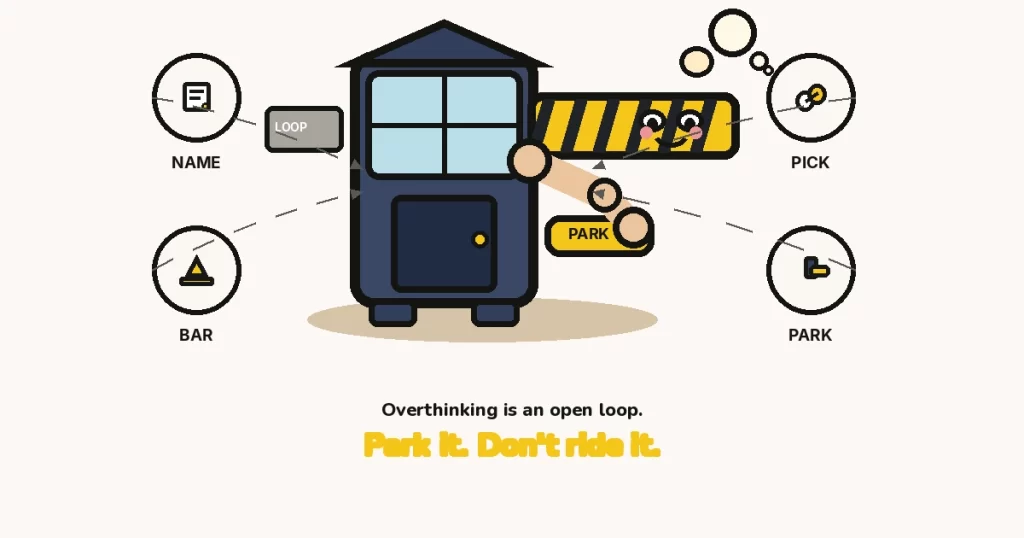
How to stop overthinking: name the one decision still open, set a good-enough bar, and park a next physical action so the loop cannot pretend it is still research. Extra analysis after that bar often worsens the choice (Wilson and Schooler, 1991). A written plan is what parks an unfinished goal.
Key takeaways
- Wilson and Schooler (1991) found that listing reasons for a preference can reduce the quality of the choice, not improve it — so another pass after the bar is met is not automatically diligence.
- Masicampo and Baumeister (2011) showed that making a specific plan reduced the cognitive pull of an unfulfilled goal; the loop quiets when the next action is parked, not when you keep replaying the whole problem.
- Schwartz, Ward, Monterosso, Lyubomirsky, White and Lehman (2002) mapped maximising as a search with no stop: if no option is allowed to be good enough, the comparison never ends.
- Tversky and Shafir (1992) showed that conflict between decent options produces deferral that looks careful and still leaves the decision open.
- Gollwitzer and Sheeran (2006) found if-then plans raise follow-through; the parking slip is that plan in miniature, not a new personality.
What overthinking actually is (and what it isn’t)
Overthinking, on this page, is an unfinished work decision that keeps returning because it has no good-enough bar and no parked next action. You already have enough to name the choice. You keep running another pass anyway: more tabs, another list of pros, a rewrite of a sentence that was already decided. The feeling is “I am still thinking it through.” The behaviour is that nothing closes. Herbert Simon called the useful stop satisficing: take the first option that meets an aspiration level, rather than hunting for a hidden best (Simon, 1955). Overthinking is what happens when that stop never fires.
That is a narrower job than “think less about your life.” Checking a fact that still moves the bar is not the problem. Watkins (2008) is the honest counter-case: some repetitive thought is constructive because it is concrete and it changes the next move. This page is for the other kind — the pass that does not change the next move, and so has to be run again. It is a decision habit. It is not a personality type, and it is not a medical category. We will not list symptoms, and we will not call the loop a disorder.
How is this different from analysis paralysis, a freeze, or a brain dump?
This page parks an already-named decision; analysis paralysis is the choice-overload version with no stopping rule; decision paralysis is the freeze at the moment of commit; a brain dump is capture before you decide. The parent article already uses “stop overthinking every decision” as a subtitle, and it owns a different mechanism: too many options, more research, no clock. Keep using that page when the stall is a pile of flavours and no bar (Iyengar and Lepper, 2000, is the famous jam-study shape of that stall). Use this page when the options are already on the table and the loop is the work. Decision paralysis is the body not moving at commit — you know the choice and cannot press send. Second-guessing, on how to stop second-guessing yourself, is the replay after you already chose. A dump gets the inventory out of your head so a decision can start. Parking is what you do once the inventory is there. Four jobs. Four pages. Do not mash them into one twelve-step ritual that becomes a new loop.
Why the loop keeps returning
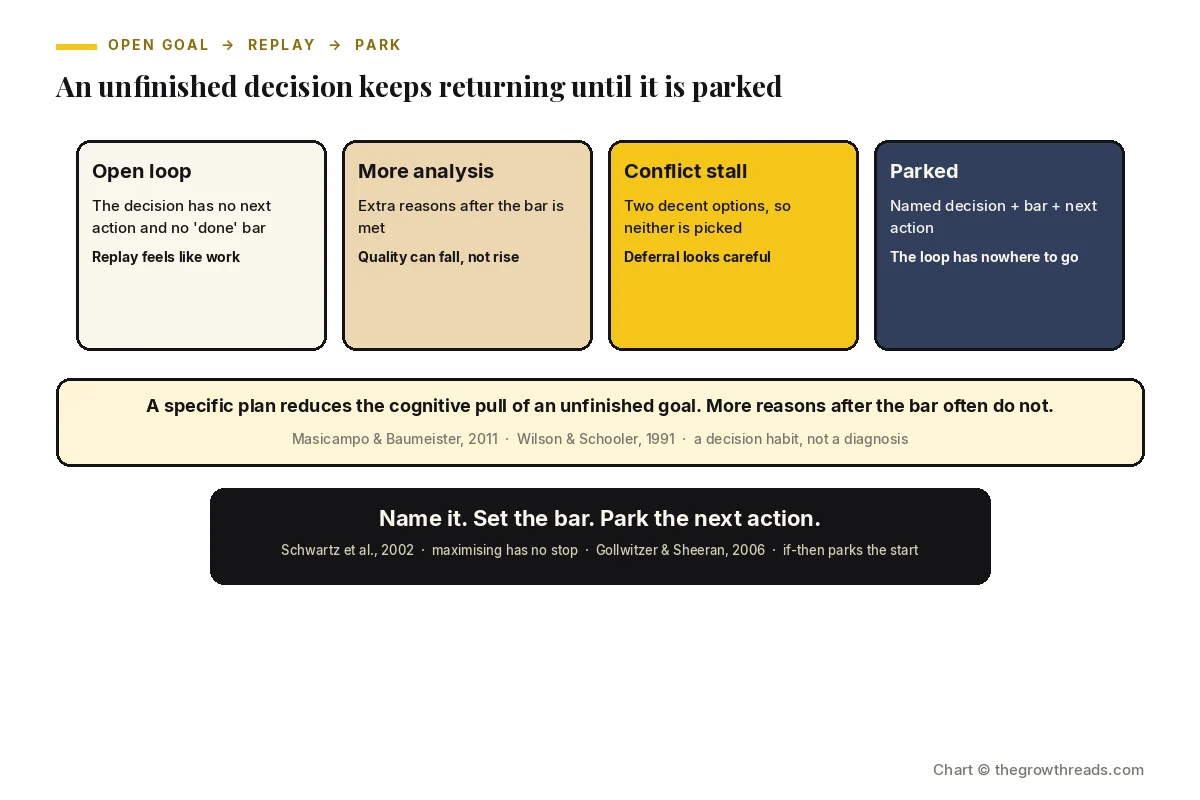
The loop returns because an unfinished goal stays active until a specific plan tells your attention it has a place to go. Masicampo and Baumeister (2011) tested that idea directly: people with an unfulfilled goal showed the usual cognitive intrusion; those who wrote a specific plan did not. The plan did not have to be executed in the lab. It had to exist. That is the mechanism this page is built on. Replaying the whole problem keeps the goal unfinished. Naming the next physical action is what parks it.
Three other forces feed the same loop. Maximising, in Schwartz and colleagues’ 2002 work, is a search with no permitted “good enough,” so comparison has no off switch. Choice overload, on the parent page, is what happens when the menu itself is the stall. Conflict, in Tversky and Shafir (1992), is what happens when two options are both decent, so picking either feels like losing the other — and deferral looks like care. Wilson and Schooler (1991) then showed the extra-pass trap: asking people to list reasons for a jam preference made those preferences line up worse with expert ratings, not better. More reasons are not a quality upgrade by default. They are sometimes a quality tax.
The four triggers, in the order you can actually pull them
- No named decision. “Sort my life” is not a decision. One sentence with an object is. Until that sentence exists, every pass is a new problem.
- No good-enough bar. Simon’s aspiration level is the missing stop. If you cannot say what would count as decided, maximising will keep the search open on purpose.
- Conflict without a clock. Two decent options and no deadline is how Tversky and Shafir’s deferral looks like thoughtfulness.
- No parked next action. Without an if-then, the unfinished goal has nowhere to sit. Gollwitzer and Sheeran’s if-then plans are the parking slip: If it reopens, I read the slip, I do not restart the research.
Why extra passes cost more than they feel like
The extra pass feels like quality control, and it is often the opposite: Wilson and Schooler’s introspection study is the warning that listing more reasons can make the preference worse. In their jam experiment, people who analysed why they liked what they liked ended up with choices that matched expert ratings less well than people who just picked. That is a sharp finding and a limited one. It is one set of studies on preferences, not a law that every spreadsheet is a mistake. What it does kill is the slogan “one more reason always helps.” After the bar is met, more reasons are a gamble. Sometimes they are delay wearing a lab coat.
Maximising has a similar bill. Schwartz et al. (2002) found that people who chronically hunted for the best option reported less satisfaction with outcomes and more comparison. That is correlational, not a trial of this six-step habit. A search with no stop still spends attention on options that will not be taken. When the menu itself is the stall, that cost belongs on the analysis paralysis page. On this page the menu is already short. The cost is the replay.
The honest limit, which this page will not talk past: there is no randomised trial of this exact six-step sequence. Masicampo and Baumeister is a lab demonstration that plans reduce goal intrusion, not a field test of your Tuesday. Watkins is a review of repetitive thought, not a protocol. Gollwitzer and Sheeran’s meta-analysis is about implementation intentions in general, with real effects that vary by domain. Treat the six steps as a well-motivated parking habit, not as a promise that you will never reopen a file. Related reading on productivity systems and summaries is useful here because no single loop owns every stall.
The four loop types — and the fix for each
Most “just stop thinking about it” speeches fail because they pull the wrong lever. Match the loop to the trigger that is winning, then pull that one.
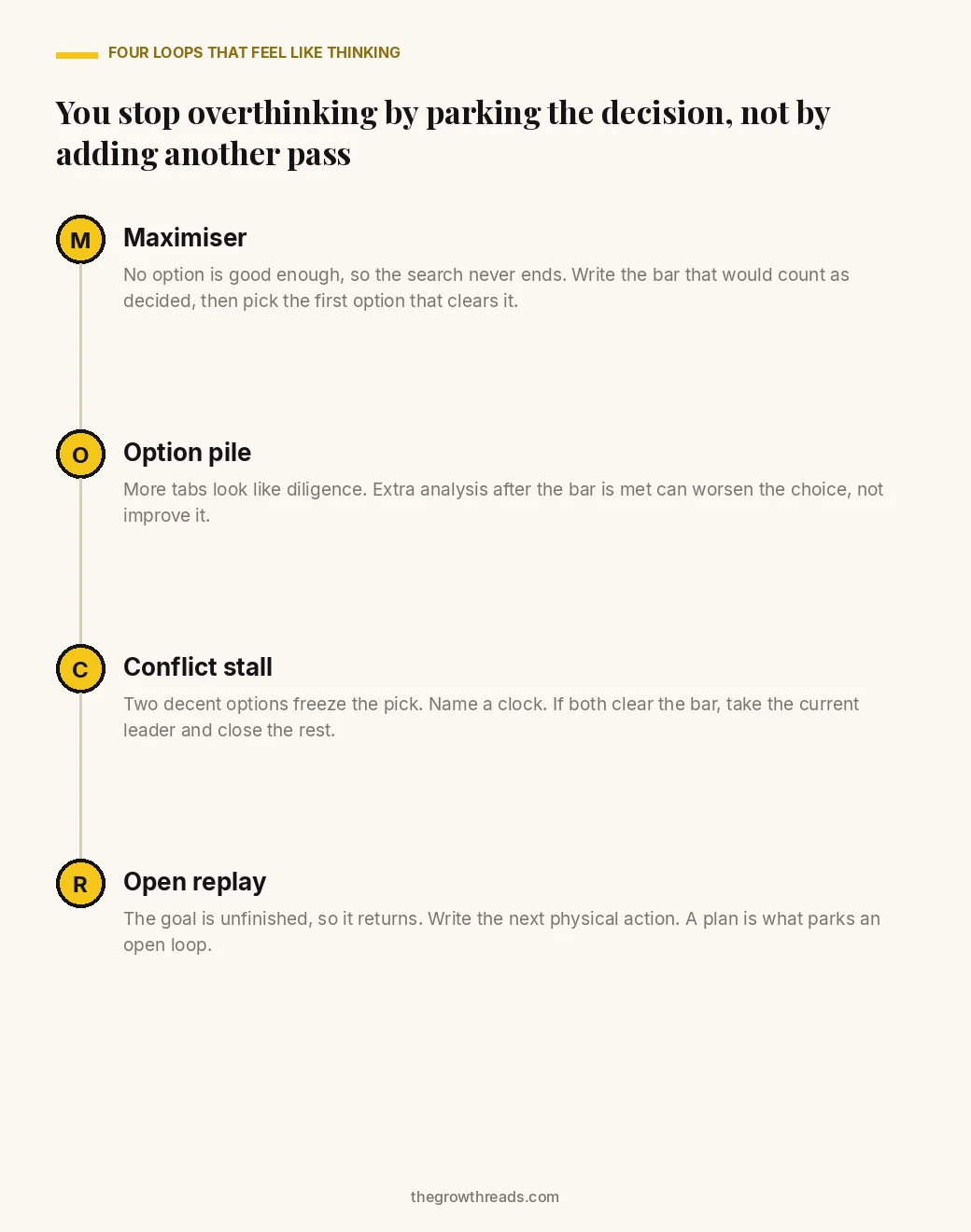
| Pattern | What it looks like | The trigger that is winning | The fix that works |
|---|---|---|---|
| Maximiser | Every option is incomplete; a hidden better one might still exist | No good-enough bar — Schwartz et al. (2002) mapped a search with no stop | Write the bar that would count as decided, then take the first option that clears it (Steps 2–4) |
| Option pile | Another tab, another comparison table, another “just in case” source | Extra analysis after the bar is met — Wilson and Schooler (1991) found more reasons can worsen a preference | Collect only facts that move the bar; then stop collecting (Step 3). If the menu itself is the stall, use the parent page |
| Conflict stall | Two decent options; picking either feels like losing the other | Conflict without a clock — Tversky and Shafir (1992) showed deferral under conflict | Name a clock. If both clear the bar, take the current leader and close the rest (Step 4) |
| Open replay | The same decision returns at 16:00, in the shower, in the next meeting | Unfinished goal with no next action — Masicampo and Baumeister (2011) | Write the next physical action as an if-then, and read that slip when it reopens (Steps 5–6) |
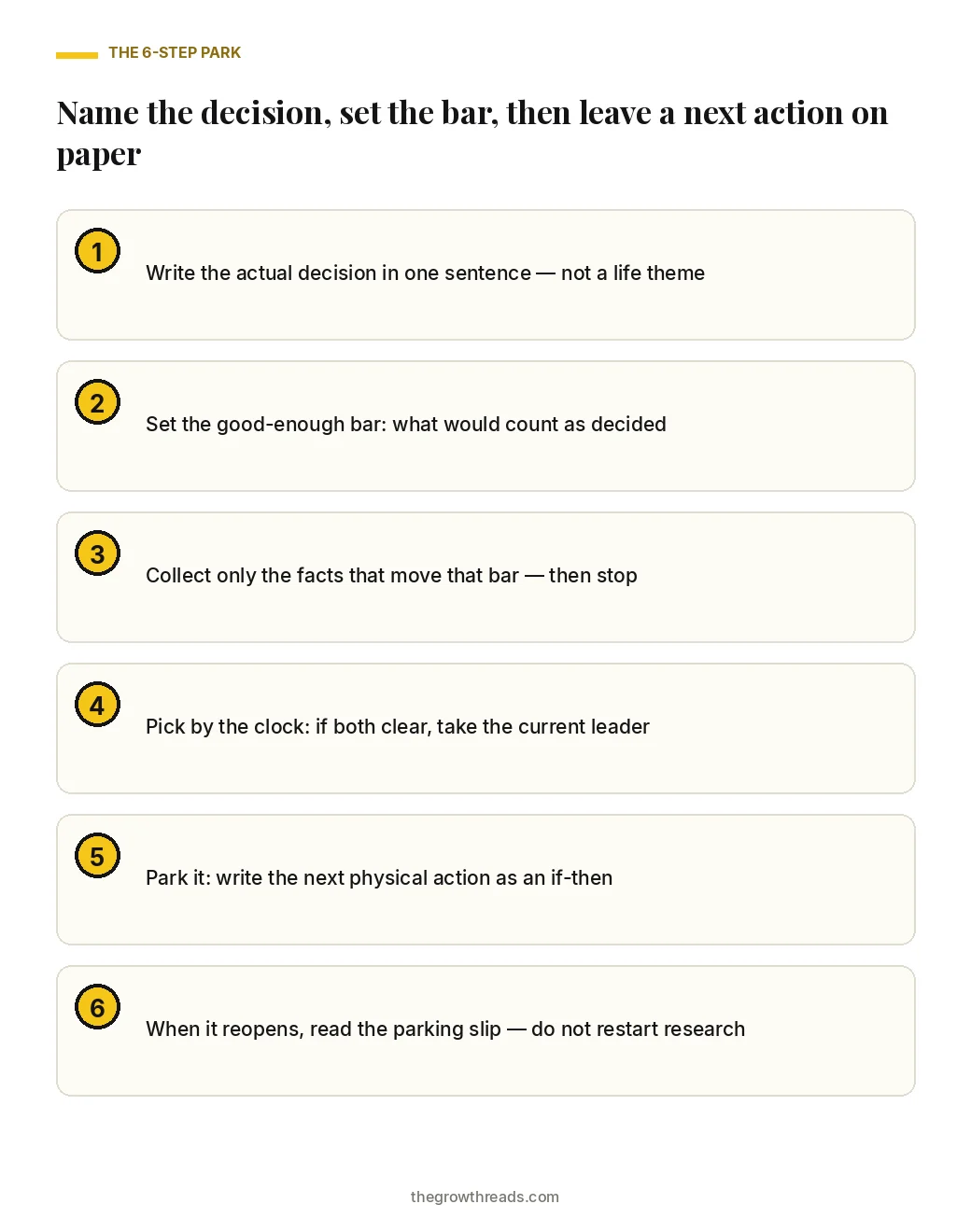
How to stop overthinking: the 6-step system
Stop overthinking by naming the actual decision, setting a good-enough bar, collecting only the facts that move that bar, picking by a clock, parking a next physical action, and reading that parking slip when the loop tries to restart. Do not wait to feel certain. Do not collect a new personality. Do not turn this into a shutdown ritual for the whole evening — that is a different job, for a different page, when that row comes up. This system is for the work decision that keeps not closing.
Step 1 — Write the actual decision in one sentence
On paper, write a sentence a stranger could score: “Choose vendor A or B for the Q4 invoice tool,” not “get my systems in order.” If the sentence has no object, you do not have a decision yet. You have a theme. Themes cannot be parked. They can only be replayed. A brain dump is the right move when the inventory is still a cloud; dump first, then come back to this step with one line. Shane Parrish’s Clear Thinking is useful here for a different reason than rumination blogs use it: ordinary work moments are where defaults either help you close or keep you looping. Name the moment. One sentence. Then stop renaming it.
Step 2 — Set the good-enough bar
Write three to five conditions that would make the choice decided, not perfect. Simon’s 1955 model is the source: you search until an option meets the aspiration level, then you stop. The bar has to be testable. “Feels right” is not a bar. “Ships this week, under the stated budget, and a teammate can run it without me” is a bar. If you cannot write the bar, you are still in Step 1. Maximising will fill the gap with an imaginary better option that has not appeared yet. The bar is what makes that option illegal.
Step 3 — Collect only the facts that move the bar — then stop
For each open question, ask: does the answer change whether an option clears the bar? If no, it is entertainment. Wilson and Schooler’s finding is the brake: extra reasons after a preference is formed can degrade the choice. You are not anti-research. You are anti-research that cannot move a condition you already wrote. Cap the collection. Two sources, or one conversation, or the file you already have. Then you are done collecting, even if a third tab looks virtuous. If the real stall is that there are twenty flavours and no bar, that is the analysis paralysis page, not another pass here.
Step 4 — Pick by the clock
Give the decision an end time you can see on a clock. If both remaining options clear the bar when the time hits, take the current leader and close the rest. Tversky and Shafir showed that conflict produces deferral; a clock is how deferral stops looking like care. The clock is short on purpose. An afternoon is enough for a work pick that already has a bar. A week is how a loop rents your calendar. If the freeze is in the body at the moment of send, use decision paralysis — that page is the commit problem. This step is only the rule that a tied pair does not get a third week.
Step 5 — Park it: write the next physical action as an if-then
On the same scrap as Step 1, write: If this decision reopens, then I will [one verb, one object]. Send the email. Book the slot. Tell the other vendor no. Gollwitzer and Sheeran’s meta-analysis is why the form is if-then rather than a wish: the situation is named, the action is named, and the unfinished goal has a place to sit. Masicampo and Baumeister is why you write it even if you will not execute it in the next ten minutes. The plan is the park. Without it, the goal stays active and the loop has a job again. This is also the cousin of a time audit finding: what you do not park, you will spend again.
Step 6 — When it reopens, read the parking slip — do not restart research
The loop will try to reopen. That is not failure. It is the unfinished-goal mechanism doing what it does. Your only job in that minute is to read the slip from Steps 1, 2 and 5. If the bar is still met and the next action is still the next action, you do not collect a new fact. You do the verb, or you wait until the time you already named. Restarting research is how Step 3 gets undone. If new information actually moves the bar — a price change, a constraint you did not have — you are allowed to reopen on purpose. That is constructive checking, in Watkins’s terms. The test is whether the bar moved. A feeling that you should look again is not a moved bar.
What to do when it is already replaying
When the same decision has already come back three times today, do not start a fresh comparison table: find or write the one-sentence decision, the bar, and the next action, then run only Step 6. Behind-ness here is not a missed deadline. It is a loop that has already spent the afternoon. A new dump, a new matrix, and a new “real” framework are how the option-pile pattern dresses up as recovery. If you never wrote Steps 1, 2 and 5, write them now in ten minutes and stop. If you did write them and you lost the scrap, rewrite the same three lines from memory. Accuracy of the original wording matters less than not opening a fourth tab.
Do not switch to a different decision because this one feels tainted — that is a new loop. Do not promote the replay into a life theme. A theme cannot be parked. A vendor pick can. If the freeze is at the send button, use decision paralysis. If the replay is after a choice you already made, use how to stop second-guessing yourself. This page’s job in that hour is only a parking slip so the unfinished goal stops compounding.
Common mistakes
- Calling another pass “being thorough.” Wilson and Schooler showed extra reasons can worsen a preference. Thorough is facts that move the bar. After that, it is a loop.
- Making the decision a life theme. “Sort my life” cannot satisfy Simon’s aspiration level. Name an object.
- Using a dump as a close. A brain dump is capture. It is not a park. If you only dump, the goal stays unfinished.
- Waiting to feel certain. Certainty is often what happens after the bar is met and the next action is parked, not before. Parrish’s ordinary-moment point is the same shape: the work is the default you run when the feeling has not arrived.
- Letting a tied pair run for a week. That is Tversky and Shafir’s deferral. Step 4 exists so a tie is still a pick.
- Skipping the if-then. Without Step 5, Masicampo and Baumeister’s unfinished goal has no place to sit, so it will return and look like new information.
- Treating this as a medical protocol. It is not. If the loop is not a work decision you can park, this page is the wrong tool. Do not turn a six-step habit into a diagnosis.
When it is more than a habit
A parking habit will not fix a decision you do not control, a role with no finish line, or a loop that is standing in for a conversation you have not had — those are different problems, and this page is the wrong tool for them. If the pick sits with someone else, writing an if-then about their mind is theatre. Ask them, or park your next action (“send the one-line ask by 16:00”), and stop simulating their answer. If every week is already full of other people’s clocks, the bottleneck is the calendar; a time audit is the better next page. If the menu itself is twenty flavours, you are on the wrong article — go back to analysis paralysis. This article does not list clinical signs and does not treat a loop as a disorder. When the work is a named decision you can close, park it. When the work is a stand-in for something you cannot park, stop using a comparison table as a substitute for the real move.
The evidence behind this system
There is no randomised trial of this exact six-step sequence. The studies below are the decision, choice, and plan literature that makes a parking habit a reasonable start — and that also shows where the evidence is thinner than a listicle would like.
| Study | Design & size | Finding | What we used it for |
|---|---|---|---|
| Simon (1955), Quarterly Journal of Economics | Theoretical model of rational choice under limited search | People can stop at the first option that meets an aspiration level (satisficing) rather than hunting a hidden best | Step 2’s good-enough bar, and the claim that a search with no stop is a design choice |
| Wilson & Schooler (1991), Journal of Personality and Social Psychology | Experiments on introspecting about reasons for preferences (including a jam-rating study) | Listing reasons reduced alignment with expert ratings compared with just choosing | Step 3’s stop on extra analysis, and the option-pile row in the diagnostic table |
| Tversky & Shafir (1992), Psychological Science | Experiments on choice under conflict (including a disjunction / deferral design) | When two options conflict, people defer; adding a third, inferior option can change the pick | Step 4’s clock, and the conflict-stall row |
| Iyengar & Lepper (2000), Journal of Personality and Social Psychology | Field and lab choice-overload studies (including a jam tasting table) | More options drew more interest and fewer purchases than a short set | The boundary with the parent article: option pile as menu, not as replay |
| Schwartz, Ward, Monterosso, Lyubomirsky, White & Lehman (2002), Journal of Personality and Social Psychology | Scale development plus correlational studies of maximising versus satisficing | Maximising tracked more comparison and less satisfaction with outcomes | The maximiser row, and the honest limit that this is correlational, not a trial of our steps |
| Gollwitzer & Sheeran (2006), Advances in Experimental Social Psychology | Meta-analysis of implementation-intention (if-then) studies | If-then plans raise goal attainment relative to mere intention, with effects that vary by domain | Step 5’s parking slip as an if-then, not a wish |
| Masicampo & Baumeister (2011), Psychological Science | Lab experiments on unfulfilled goals and the effect of making a plan | A specific plan reduced the cognitive accessibility of an unfinished goal | The mechanism of the loop, Steps 5–6, and the open-replay row |
| Watkins (2008), Psychological Bulletin | Review of constructive versus unconstructive repetitive thought | Some repetitive thought is concrete and useful; some is abstract and does not move the next action | The honest limit: do not “stop thinking.” Stop the pass that cannot change the next move |
Frequently asked questions
How do you stop overthinking a work decision today?
Write the actual decision in one sentence, write the three to five conditions that would count as decided, and collect only the facts that move those conditions. Then set a clock. If two options still both clear the bar, take the current leader. Park the next physical action as an if-then so the unfinished goal has a place to sit. Masicampo and Baumeister showed that a specific plan reduces the pull of an open goal. Wilson and Schooler showed that extra reasons after a preference is formed can make the choice worse. Today’s job is a park, not a new personality.
Is overthinking the same as analysis paralysis?
No. Analysis paralysis, on our parent page, is a menu problem: too many options, no stopping rule, more research that never ends. Iyengar and Lepper’s jam table is that shape. Overthinking, on this page, is a replay problem: the options are already on the table and the loop keeps returning because there is no bar and no parked next action. You can have both in one week. You should not mash them into one ritual. If you cannot even list the options, dump first. If the list is already short and you are still running passes, you are on this page.
Should I think less about every choice?
No, and Watkins’s review is the reason we will not say that. Some repetitive thought is constructive because it is concrete and it changes the next move. Checking a price that moves the bar is not a loop. Listing a tenth reason after the bar is met is. Simon’s satisficing is a stop rule, not a ban on thought. The test is always the same: did this pass change a condition on the bar, or did it only restart the feeling that you should look again? If it did not move the bar, it was not diligence.
What if two options both look good?
That is conflict, not a missing fact. Tversky and Shafir found that conflict produces deferral that looks careful. Name a clock. If both options still clear the bar when the time hits, take the current leader and close the rest. A third week of comparison is how a tied pair rents your attention. If the freeze is in the send — you know the pick and cannot press it — that is decision paralysis, and that page is the better tool. If you already picked and you are replaying the other option, that is second-guessing, which is after the park, not instead of it.
Does a brain dump stop overthinking?
It stops a cloud from pretending to be a decision. It does not park anything. A dump, on our sister page, is capture: get the inventory out so you can see it. Overthinking is what happens after the inventory is visible and still has no bar and no next action. If you only dump, Masicampo and Baumeister’s unfinished goal stays unfinished, and it will return at 16:00 looking like new information. Dump, then write the one-sentence decision, then park. Capture and close are two moves. One of them is not a substitute for the other.
Will an if-then plan really quiet the loop?
It quiets the unfinished-goal pull in the lab, which is a narrower claim than “you will never reopen this.” Masicampo and Baumeister found that making a specific plan reduced the cognitive accessibility of an unfulfilled goal. Gollwitzer and Sheeran’s meta-analysis found if-then plans raise follow-through, with effects that vary by domain. Neither paper is a trial of these six steps on your calendar. Write the if-then anyway. It is cheap, it is specific, and it is the one artefact the loop cannot fake. A vibe of being done is not a plan. A verb plus an object is.
How is this different from waiting until I feel sure?
Certainty is often an output of a parked decision, not a weather system you wait out. Wilson and Schooler showed that digging for more reasons can make a preference worse. Schwartz and colleagues mapped maximising as a search that never grants “good enough,” so the feeling of sure never arrives by design. Parrish’s point is ordinary defaults: you run a close when the moment hits. Set the bar, pick by the clock, and notice whether the feeling follows. Do not use its absence as a reason to reopen the research.
Will this six-step system stop overthinking for good?
No, and the evidence does not say it will. The studies on this page map search, extra analysis, conflict and unfinished goals. They are not a trial of this sequence. Watkins’s review says some repetitive thought is useful, so “never think twice” is the wrong win. A park is a bout. Tomorrow needs the same slip, or a new sentence if the bar actually moved. Use it for the next named choice. Do not use it as a promise that your mind will go quiet forever.
Related reading on The Growth Reads
The book behind the ordinary-moment default
- Clear Thinking summary & review — Shane Parrish on winning the ordinary moment with better defaults; the close-the-loop cousin of a parked next action, not a rumination manual
Related articles
- Analysis paralysis
- Decision paralysis
- How to stop second-guessing yourself
- The brain dump
- How to run a time audit
- How to prioritise tasks
Go deeper
How this article was researched
The Growth Reads editorial team writes from primary sources: the books themselves, the authors’ published essays and interviews, and the peer-reviewed literature behind the claims. Every study cited above was read in the original publication or its published abstract, and every figure is quoted with its design, sample and effect so you can judge its weight rather than take ours. Where a finding is genuinely limited — a correlational scale study, a lab demonstration rather than a field trial, a review paper synthesizing other work, or a six-step habit with no trial of its own — we say so directly, rather than quietly generalizing past what the data supports.
How we work: every article on The Growth Reads is built from the books in our library plus the research they rest on, and is reviewed and date-stamped when the evidence changes. Read our full methodology.
Sources
- Simon, H. A. (1955). A behavioral model of rational choice. Quarterly Journal of Economics, 69(1), 99–118. doi:10.2307/1884852
- Wilson, T. D., & Schooler, J. W. (1991). Thinking too much: Introspection can reduce the quality of preferences and decisions. Journal of Personality and Social Psychology, 60(2), 181–192. doi:10.1037/0022-3514.60.2.181
- Tversky, A., & Shafir, E. (1992). Choice under conflict: The dynamics of deferred decision. Psychological Science, 3(6), 358–361. doi:10.1111/j.1467-9280.1992.tb00026.x
- Iyengar, S. S., & Lepper, M. R. (2000). When choice is demotivating: Can one desire too much of a good thing? Journal of Personality and Social Psychology, 79(6), 995–1006. doi:10.1037/0022-3514.79.6.995
- Schwartz, B., Ward, A., Monterosso, J., Lyubomirsky, S., White, K., & Lehman, D. R. (2002). Maximizing versus satisficing: Happiness is a matter of choice. Journal of Personality and Social Psychology, 83(5), 1178–1197. doi:10.1037/0022-3514.83.5.1178
- Gollwitzer, P. M., & Sheeran, P. (2006). Implementation intentions and goal achievement: A meta-analysis of effects and processes. Advances in Experimental Social Psychology, 38, 69–119. doi:10.1016/S0065-2601(06)38002-1
- Masicampo, E. J., & Baumeister, R. F. (2011). Consider it done! Plan making can eliminate the cognitive effects of unfulfilled goals. Psychological Science, 22(9), 1226–1230. doi:10.1177/0956797610396625
- Watkins, E. R. (2008). Constructive and unconstructive repetitive thought. Psychological Bulletin, 134(2), 163–206. doi:10.1037/0033-2909.134.2.163