

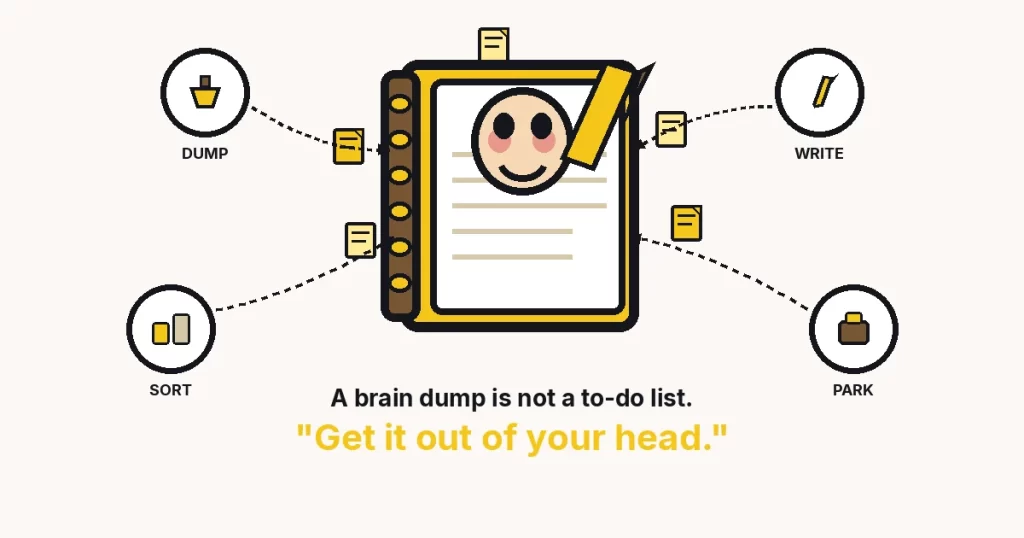
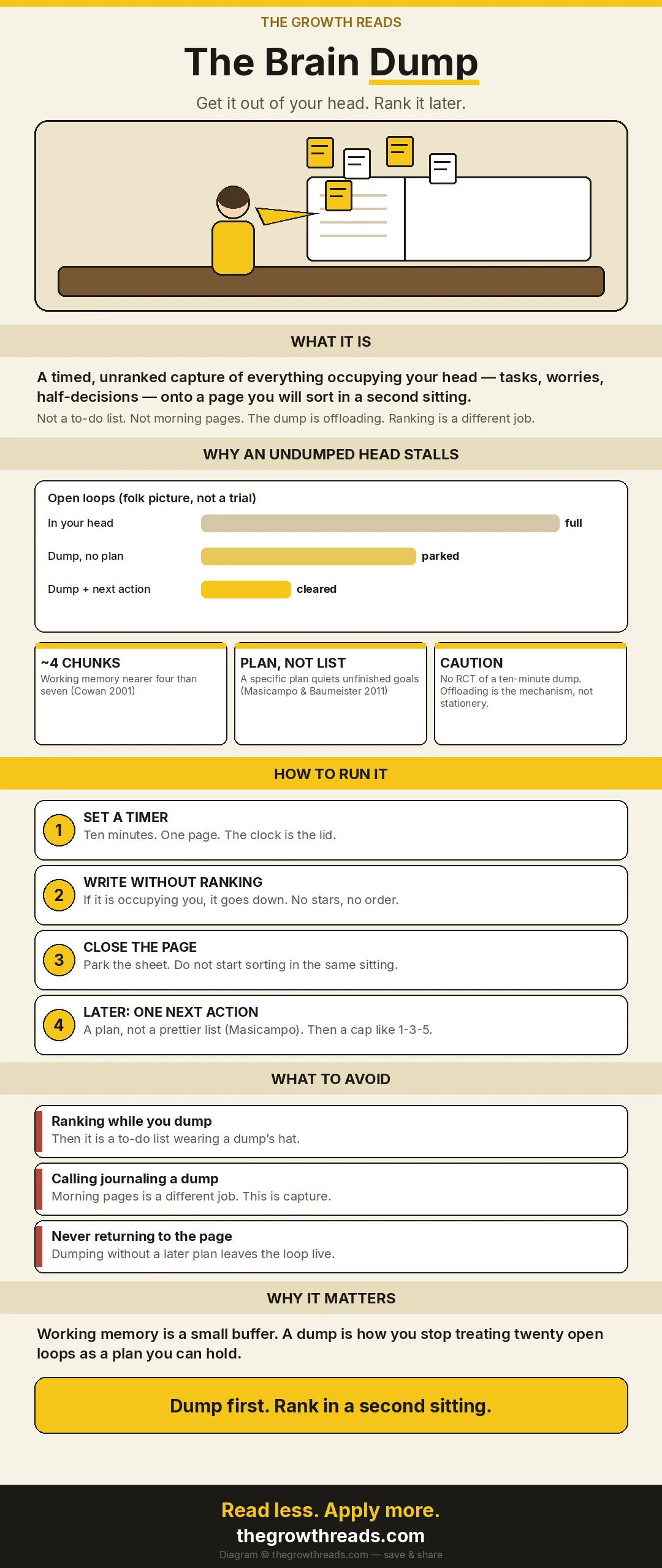
A brain dump is a timed, unranked capture of everything occupying your head — tasks, worries, half-decisions — onto a page you will sort later. Working memory holds about four chunks. An undumped pile of open loops is not a plan. The dump is offloading. Ranking is a second sitting.
Key takeaways
- A brain dump is a timed, unranked capture of open loops onto an external page; it is not a to-do list, not a journal, and not a stationery habit (practitioner method; there is no randomised trial of a ten-minute dump).
- Typical working memory holds nearer four chunks than Miller’s famous seven when rehearsal tricks are stripped, which is why a head full of twenty loops is not a plan you can actually hold (Cowan, 2001).
- Switching away from unfinished work leaves a residue of attention that measurably impairs the next task (Leroy, 2009).
- Making a specific plan for an unfulfilled goal reduces the cognitive intrusion of that goal; dumping without a later plan does not finish the job (Masicampo and Baumeister, 2011).
- Saving information externally can free capacity for new material in lab memory tasks (Storm and Stone, 2015) — an analogy for why the dump is capture, not the day’s ranked list.
What is a brain dump?
A brain dump is a timed capture of everything currently occupying your head — tasks, worries, half-made decisions, nagging half-sentences — onto an external page, without ranking, decorating, or deciding yet. The page can be paper or a blank note. The method is the lid: a clock, one sitting, and a refusal to sort while you write. If you star items as you go, you do not have a dump. You have a to-do list that started early.
This page hangs off analysis paralysis, the Decisions cluster page. An undumped head is a choice set you cannot see. You keep comparing options that only exist as a feeling. The dump is how those options become lines you can later refuse. The sister in this cluster is decision paralysis — the freeze that shows up when too many loops are still inside. A dump does not pick for you. It makes the pile visible so a stopping rule can.
There is no randomised trial that assigned people “write everything for ten minutes, then stop” and measured next-week output. Be honest about that up front. What we do have is a research family on cognitive offloading: using a physical action (writing, saving, setting a reminder) to reduce what working memory has to hold. Evan Risko and Sam Gilbert’s 2016 review in Trends in Cognitive Sciences is the map of that family. Annie Murphy Paul’s The Extended Mind is the named review for the same idea in book form — thinking with the page, the room, and other people, not only with the skull. The book stays on the review. This URL is the method: empty the buffer, then leave.
How is a brain dump different from a to-do list, morning pages, or a second brain?
A to-do list ranks; morning pages journals; a second brain stores for later retrieval; a brain dump only empties, once, without order. Productivity posts mash these together because they all involve writing things down. They are not the same object.
| Practice | What is written | When you sort | What it is not |
|---|---|---|---|
| Brain dump | Everything occupying you right now | A second sitting, after the page is closed | Not a ranked plan, not a journal, not a notebook brand |
| To-do list | Actions you intend to do | While you write, or never | Already a commitment device. A dump that ranks is this |
| Morning pages | Stream-of-consciousness prose | Usually never; the point is the writing | A thinking-and-feeling habit. Live cousin: morning pages |
| Second-brain capture | Notes you may want years from now | Into a system (PARA, folders, tags) | Ongoing storage. A dump is one empty, not a library |
| Weekly review | Open loops you already captured | That is the sitting | Processing. You cannot review a pile that never left your head |
The last two rows matter for later pages. The second brain method is how captured notes become findable over months. A dump is not that library. Morning pages is the live thinking-and-planning journal on this site; how to start journaling is the habit version of the same job. Neither is a dump. If you wrote three pages about how you feel about the work, you journaled. If you wrote “call the landlord, finish the invoice, decide the vendor, buy milk,” you dumped. The productivity library already has those cousins doing their jobs. This URL owns the empty.
Why does an undumped head stall the day?
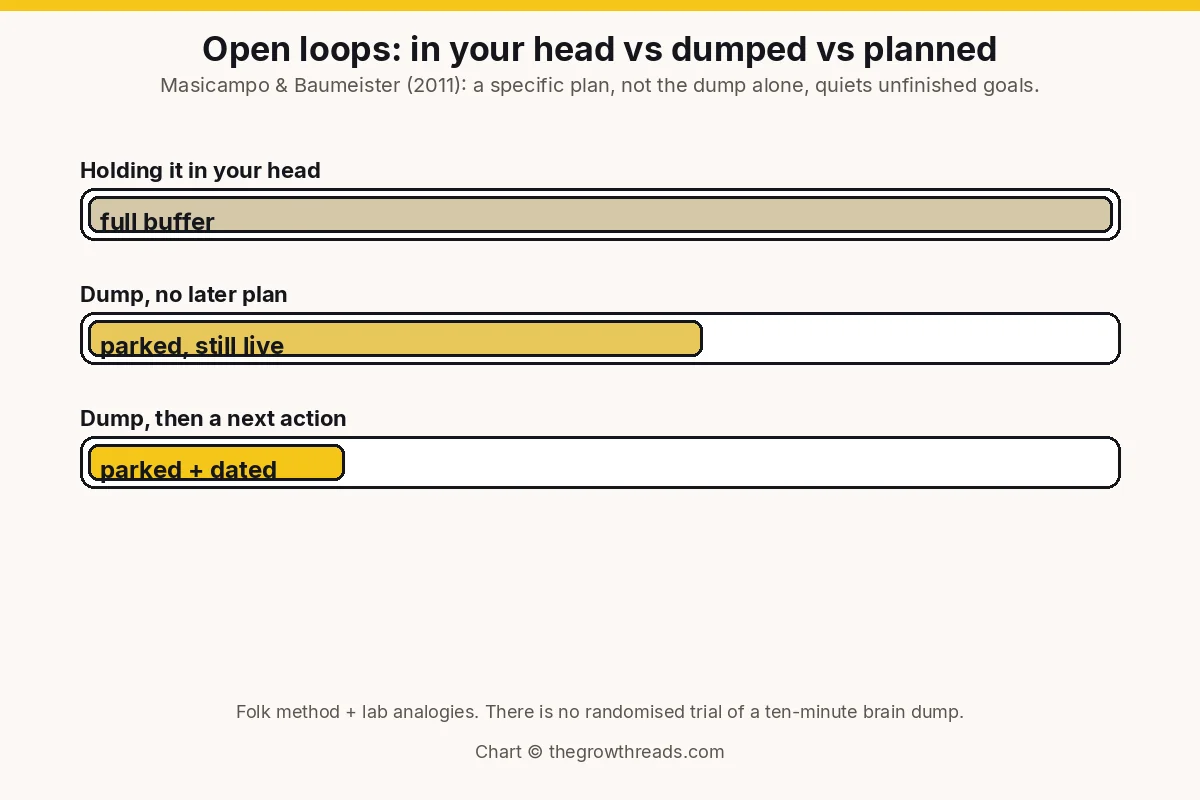
An undumped head stalls because working memory is a small buffer, unfinished loops stay active, and you cannot rank a choice set you cannot see. Nelson Cowan’s 2001 review in Behavioral and Brain Sciences is the capacity finding everyone should quote instead of Miller’s 1956 “magical number seven.” Cowan’s reading of the later evidence puts typical working-memory capacity nearer four chunks, plus or minus one, when you strip rehearsal tricks. Twenty open loops are not twenty extra motivations. They are twenty competitors for a buffer that holds about four. That is why “I’ll just remember it” is not a plan. It is a hope that the buffer will do a list’s job.
Sophie Leroy’s 2009 experiments in Organizational Behavior and Human Decision Processes add the residue. When people switched away from Task A before finishing it, part of their attention stayed attached to A, and that residue measurably dragged Task B. An undumped morning is a machine for unfinished A’s you have not even named. You feel busy because the loops are loud. You are not choosing. Decision paralysis is what that stall looks like from the outside: you hover, you reopen the same three options, you start nothing. The dump is the first move that makes a stopping rule possible. Analysis paralysis is the parent for the comparing; this page is the empty that comes before the cap.
Risko and Gilbert’s 2016 review names the family: cognitive offloading is using a physical action to reduce the processing a task requires of you. Tilting your head to read rotated text is offloading. Writing a reminder is offloading. A brain dump is offloading at the scale of a morning. Sam Gilbert’s 2015 experiments in the Quarterly Journal of Experimental Psychology showed people will park delayed intentions in the external environment — a diary, a reminder — when the internal load would otherwise be high. That is the honest mechanism. It is not “stationery makes you productive.” It is “the page can hold what the buffer cannot.”
The four moves that make it a dump
- Set a timer and one page. Ten minutes is plenty. The clock is the lid. An open-ended dump becomes a journal, then a performance. If you cannot fill ten minutes, you did not have a dump problem. You had one task you were avoiding, which is a different page.
- Write without ranking. If it is occupying you, it goes down. No stars, no colours, no “this is the real one.” Ranking while you dump is how a to-do list sneaks in wearing a dump’s hat. Capture first. How to prioritise tasks is the cluster page for the ranking judgement; it comes after the page is closed.
- Close the page. Park the sheet in a known place — a tray, a note titled “dump,” a pile you will open at 4 p.m. Do not start sorting in the same sitting. The dump’s job is empty. Processing is a different sitting, the way a weekly review is a different sitting from capture.
- Later: one next action, then a cap. E. J. Masicampo and Roy Baumeister’s 2011 paper in the Journal of Personality and Social Psychology is why this fourth move exists. Unfinished goals kept intruding on unrelated tasks until people wrote a specific plan for them; then the intrusion dropped. A dump without a later plan leaves the loop live. “Call the landlord Tuesday 10:00” is a plan. A prettier list of twenty is not. After the plan, a size cap such as the 1-3-5 rule is how the day stays nine slots instead of re-inflating into the dump.
None of those four is a personality. They are a shape you can run on a loud Tuesday. Peter Gollwitzer and Paschal Sheeran’s 2006 meta-analysis (94 tests, d = 0.65) is why the later sitting gets an if–then, not a vibe: “After lunch, before email, I open the dump and write one next action for each line that still matters.” A dump you never reopen is a diary of anxiety. A dump you reopen and rank in the same breath was never a dump.
Why does an undumped head cost more than it feels like?
An undumped head costs you the decision you never quite make, because every unnamed loop is another unfinished A competing for the same four-chunk buffer. Leroy’s residue finding is the bill you do not see: you paid it when you “quickly” thought about the invoice during the draft. Masicampo and Baumeister’s plan-making finding is why writing the loops down is not enough on its own. In their studies, unfinished goals caused intrusive thoughts during reading, higher accessibility of goal-related words, and worse anagram performance — until people made a specific plan, at which point those effects fell. The dump gets the loops onto paper. The plan is what tells the buffer it can stand down.
Benjamin Storm and Sean Stone’s 2015 paper in Psychological Science is the other half of the analogy, and it must be kept in its box. In lab memory tasks, people who saved a file of words later remembered a new file better than people who did not save — saving-enhanced memory. Offloading the old material freed encoding for the new. That is not a ten-minute life dump. It is a file-saving study. Use it to explain why you should not keep the old pile in the same mental workspace as the work in front of you. Do not quote it as proof that a Moleskine will make you smarter.
Andy Clark and David Chalmers’s 1998 essay “The Extended Mind” in Analysis is the philosophical claim underneath Paul’s book: some thinking is already happening in the notebook, the phone, the other person. It is not a productivity RCT. It is the permission to treat the page as part of the work rather than as a confession that your memory failed. Paul’s The Extended Mind review is where that argument lives on this site, with the studies she actually walks. This article borrows the move — put the loops outside — and stops before turning into a stationery review. The productivity hub is the shelf those two URLs sit on.
Two honest caveats. Cowan (2001) is a review of working-memory capacity, not a test of daily planners. Masicampo and Baumeister (2011) tested plan making on activated goals in the lab, not a folk “brain dump” timer. Storm and Stone (2015) is a saving-and-remembering task. Use those papers to explain why offloading plus a later plan can help. Do not quote them as a certificate that ten minutes of messy handwriting is the scientifically correct duration.
How does a brain dump actually run?
Sit down, set ten minutes, write every occupying loop onto one page, close the page, then — in a later sitting — write one next action for the lines that still matter and park the rest. The mistake is treating the dump as a personality you perform with a nice notebook. The method is a container you rebuild when the buffer is loud.
Name the sitting the way you would name a calendar block: “Tuesday 8:40, kitchen table, one page, timer.” If the dump is “be more organised,” you do not have a dump. You have a slogan. Analysis paralysis is the parent for that stall: you are still comparing identities instead of emptying the actual pile. A dump whose first line is a self-help sentence is a mood board.
Protect the empty with the clock, then stop. If a line is a project (“website,” “health,” “Q4”), write it anyway — the dump allows buckets — and in the later sitting split it into a next physical action or drop it. How to prioritise tasks is that later judgement. The 1-3-5 rule is one cap you can put on after the dump so the day does not re-import twenty lines. How to track productivity is a weekly look at whether the loops you dumped actually moved, not a scoreboard of pages filled.
At the later sitting, leftovers get a trial. A loop that has appeared on four dumps and never got a next action is information: you do not mean it, or it is not yours, or it is a worry wearing a task’s hat. Park it on a someday list or drop it. Do not promote the whole dump onto today’s nine. The empty is the method even when the page is ugly. Re-copying the dump in neater handwriting is not progress. It is calligraphy on an open loop.
What are the common mistakes?
- Ranking while you dump. Stars, colours, and “the real one” turn the sitting into a to-do list. Capture first. Rank after the page is closed, on purpose, with a cap.
- Calling journaling a dump. Three pages about how you feel is morning pages. Useful. Different job. A dump is a list of occupying loops, not prose.
- Never returning to the page. Masicampo and Baumeister (2011) is the warning: without a later plan, the goal stays active. A dump you abandon is a diary of the stall.
- Buying a notebook instead of emptying this morning’s buffer. This is a method page, not a stationery review. The cheapest blank page that is already in the room wins.
- Treating the dump as the day’s plan. Twenty captured lines are not nine sized slots. After the dump, use a cap — 1-3-5, Ivy Lee, a single named output — so the day has a lid.
- Treating a loud head as a character verdict. A full buffer is information about load, not a diagnosis. This page is a work-and-habits device under analysis paralysis, not a test of your worth, and not a symptom list.
When is it more than a dump?
If a honest empty still cannot start — a shift you do not control, sleep debt, or a block that is not yours to begin — you are on a different layer than a ten-minute page. The brain dump assumes you can sit and write. It will not open a calendar that is already full of other people’s meetings, a job that forbids a quiet block, or a body that cannot take the bout. Do not turn a folk empty into a verdict. This page is not an evaluation, a symptom list, or a treatment.
A second miss is rumination dressed as capture. Rewriting the same three fears in new handwriting every morning, with no next action and no later sitting, is not offloading. It is rehearsal. Morning pages may be the better tool for that writing; a clinician is the right next step if the loops are not work loops. This article will not diagnose, and it will not list clinical signs. It will say: if the page is never about tasks, vendors, or calendars, you are not on this method.
A third miss is encoding. Students sometimes dump “learn chapter four” and then run a show in the other ear. Sitting down is not the same as being able to recall the chapter tomorrow. Pair the later plan with a should whose success is “the problem set is submitted,” not “I now know the material I never tested.” Learning pages on this site are for the second job.
What does the evidence actually show?
Every figure above traces to a specific published study or essay. Here is the short version of what each one found — and, honestly, what it does not prove. None of them is a randomised test of a ten-minute brain dump.
| Study | Design & size | What it found | Used here for |
|---|---|---|---|
| Cowan (2001), Behavioral and Brain Sciences | Review of short-term / working-memory capacity | Typical capacity nearer 4 chunks than Miller’s 7, when rehearsal tricks are stripped | Why a head full of twenty loops is not a holdable plan |
| Leroy (2009), Organizational Behavior and Human Decision Processes | Lab experiments on switching from unfinished work | Attention residue from Task A impairs Task B; finishing plus time pressure helped clear it | The hidden cost of unnamed open loops |
| Masicampo & Baumeister (2011), Journal of Personality and Social Psychology | Several lab studies; unfulfilled goals, then plan making | Unfinished goals caused intrusion and worse unrelated performance; a specific plan reduced those effects | Why the dump needs a later next-action sitting, not just a list |
| Risko & Gilbert (2016), Trends in Cognitive Sciences | Review of cognitive-offloading research | Physical action (writing, reminders, rotating a page) can reduce internal processing demand | The mechanism family the dump belongs to |
| Gilbert (2015), Quarterly Journal of Experimental Psychology | Experiments on parking delayed intentions externally | People offload intentions into the environment when internal load would otherwise be high | Why “write it down” is a load move, not a personality |
| Storm & Stone (2015), Psychological Science | Lab memory tasks; saving a file of words, then learning a new file | Saving the first file improved memory for the second (saving-enhanced memory) | Analogy only: park the old pile so the next work has room |
| Gollwitzer & Sheeran (2006), Advances in Experimental Social Psychology | Meta-analysis, 94 tests of implementation intentions | Medium-to-large effect on goal achievement (d = 0.65) | Why the later sitting is a written if–then, not a mood |
| Clark & Chalmers (1998), Analysis | Philosophy essay, not a trial | Some thinking already includes the notebook and the environment | Permission to treat the page as part of the work — a claim, not a dataset |
Frequently asked questions
What is a brain dump in simple terms?
A brain dump is a timed, unranked capture of everything occupying your head right now onto an external page. Tasks, worries, and half-decisions all go down. You do not star them. You do not order them. You close the page, then — in a later sitting — write a next action for the lines that still matter. There is no trial of a ten-minute dump. The method is offloading, which sits under analysis paralysis as a way to make a hidden choice set visible. If you ranked while you wrote, you built a to-do list.
Is a brain dump the same as a to-do list?
No. A to-do list is already a commitment device: you are naming what you intend to do. A brain dump is capture without commitment. You empty the buffer so you can see the pile. Ranking, capping, and dating come after, on purpose. If you star items as you go, the dump died in the first three lines. The later cap — nine slots on a 1-3-5 day, or one named output — is how the pile becomes a day. Capture and plan are two sittings. Mixing them is how the stall returns wearing checkboxes.
Is a brain dump the same as morning pages?
No. Morning pages is stream-of-consciousness journaling, usually three pages, and the point is the writing itself. A brain dump is a list of occupying loops: calls, invoices, decisions, errands. One is prose. The other is capture. This site’s morning-pages page and how-to-start-journaling page own the journal job. If you wrote about how you feel, you journaled. If you wrote “email Sam, pick the vendor, buy milk,” you dumped. Both can exist. They are not interchangeable templates, and a pretty notebook does not turn one into the other.
Does a brain dump actually work?
There is no randomised trial of “write everything for ten minutes.” The literature supports offloading and later plan making, not the folk timer. Cowan (2001) puts working memory nearer four chunks. Leroy (2009) showed unfinished work leaves residue. Masicampo and Baumeister (2011) found a specific plan reduces intrusion from unfulfilled goals. Risko and Gilbert (2016) review cognitive offloading. Storm and Stone (2015) is a saving-and-memory analogy. Clark and Chalmers (1998) is philosophy. Run the dump as a device. Do not quote those papers as a certificate that messy handwriting is the correct duration.
How long should a brain dump take?
Ten minutes is a working lid, not a sacred number. The clock exists so the sitting cannot become a journal or a performance. If you are still writing at minute twenty, you are either processing — which is the second sitting — or you are rehearsing the same three fears. Stop, close the page, and schedule the later plan. If you cannot fill five minutes, you did not have a dump problem. You had one avoided task. Name it and start it. The timer is a container, not a personality, and it is not a finding from any of the studies above.
What should I do with the page after I dump?
Park it, then return in a later sitting. For each line that still matters, write one next physical action and, if you can, a time. Masicampo and Baumeister (2011) is why the plan matters: unfinished goals kept intruding until people made a specific plan. Then put a cap on the day so the dump does not become today’s entire list. The 1-3-5 rule is one cap. How to prioritise tasks is the ranking judgement. Lines that have appeared on four dumps with no action get dropped or parked as someday. Do not recopy the page in neater ink and call that progress.
Should I brain-dump every morning?
Only when the buffer is loud. A daily dump as a personality is how the method turns into morning pages with bullet points. If you already have a capture inbox you empty in a weekly review, you may not need a dump at all — you need to process what you already wrote. Use a dump when loops are still in your head and you cannot see the choice set. Skip it when the stall is a single named task you are avoiding. That is not a dump. That is starting. How to track productivity is how you notice, a week later, whether dumps were load or theatre.
What should I read after this page?
Start with analysis paralysis, the Decisions parent this empty sits inside, if the stall is endless comparing. Read decision paralysis if the freeze is the part you recognise. The Extended Mind review is the named book on offloading thought into the page and the room. Then 1-3-5 for a cap after the dump, and how to prioritise tasks for the ranking sitting. Morning pages is the cousin if what you actually needed was journaling. None of those replace writing this morning’s loops down, closing the page, and dating one next action later. The buffer will still try to hold twenty if you let it.
Sources
- Cowan, N. (2001). The magical number 4 in short-term memory: A reconsideration of mental storage capacity. Behavioral and Brain Sciences, 24(1), 87–114. https://doi.org/10.1017/S0140525X01003922
- Leroy, S. (2009). Why is it so hard to do my work? The challenge of attention residue when switching between work tasks. Organizational Behavior and Human Decision Processes, 109(2), 168–181. https://doi.org/10.1016/j.obhdp.2009.04.002
- Masicampo, E. J., & Baumeister, R. F. (2011). Consider it done! Plan making can eliminate the cognitive effects of unfulfilled goals. Journal of Personality and Social Psychology, 101(4), 667–683. https://doi.org/10.1037/a0024192
- Risko, E. F., & Gilbert, S. J. (2016). Cognitive offloading. Trends in Cognitive Sciences, 20(9), 676–688. https://doi.org/10.1016/j.tics.2016.07.002
- Gilbert, S. J. (2015). Strategic offloading of delayed intentions into the external environment. Quarterly Journal of Experimental Psychology, 68(5), 971–988. https://doi.org/10.1080/17470218.2014.972963
- Storm, B. C., & Stone, S. M. (2015). Saving-enhanced memory: The benefits of saving on the learning and remembering of new information. Psychological Science, 26(2), 182–188. https://doi.org/10.1177/0956797614559285
- Gollwitzer, P. M., & Sheeran, P. (2006). Implementation intentions and goal achievement: A meta-analysis of effects and processes. Advances in Experimental Social Psychology, 38, 69–119. https://doi.org/10.1016/S0065-2601(06)38002-1
- Clark, A., & Chalmers, D. (1998). The extended mind. Analysis, 58(1), 7–19. https://doi.org/10.1093/analys/58.1.7
Related reading on The Growth Reads
The books this method draws on
- The Extended Mind summary & review — the named unused review; offloading thought into the page, the room, and other people
Related articles
- Analysis paralysis — the Decisions parent; the stall an empty is built to make visible
- Decision paralysis — the sister; the freeze when too many loops are still inside
- The 1-3-5 rule — a size cap after the dump so the day does not re-import twenty lines
- How to prioritise tasks — the ranking sitting that comes after capture
- Morning pages — the journal cousin; not a dump
- The second brain method — ongoing storage; a dump is one empty, not a library
- How to track productivity — whether dumped loops actually moved
Go deeper
How this article was researched
The Growth Reads editorial team writes from primary sources: the books themselves, the authors’ published essays, and the peer-reviewed literature behind the claims. Every study cited above was read in the original publication or its published abstract, and every figure is quoted with its design and limit so you can judge its weight rather than take ours. Where a finding is a working-memory review, a lab plan-making study, a file-saving memory task, an offloading review, or a 1998 philosophy essay rather than a randomised test of a folk brain dump, we say so in the body rather than in a footnote.
This page is a productivity method, not a book review of any single title, not a stationery guide, and not medical or clinical advice. Persistent inability to start work across contexts belongs with a clinician, not with a ten-minute page. Habits-cluster articles on this site still link up to live keystone habits; this URL is a Decisions child and does not mint a new habits parent.
How we work: every article on The Growth Reads is built from the books in our library plus the research they rest on, and is reviewed and date-stamped when the evidence changes. Read our full methodology.