

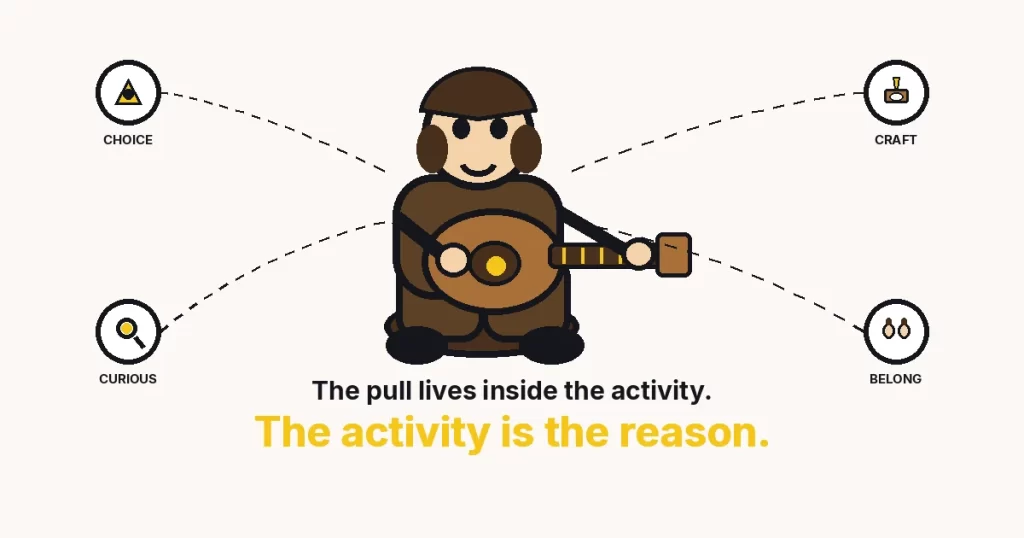
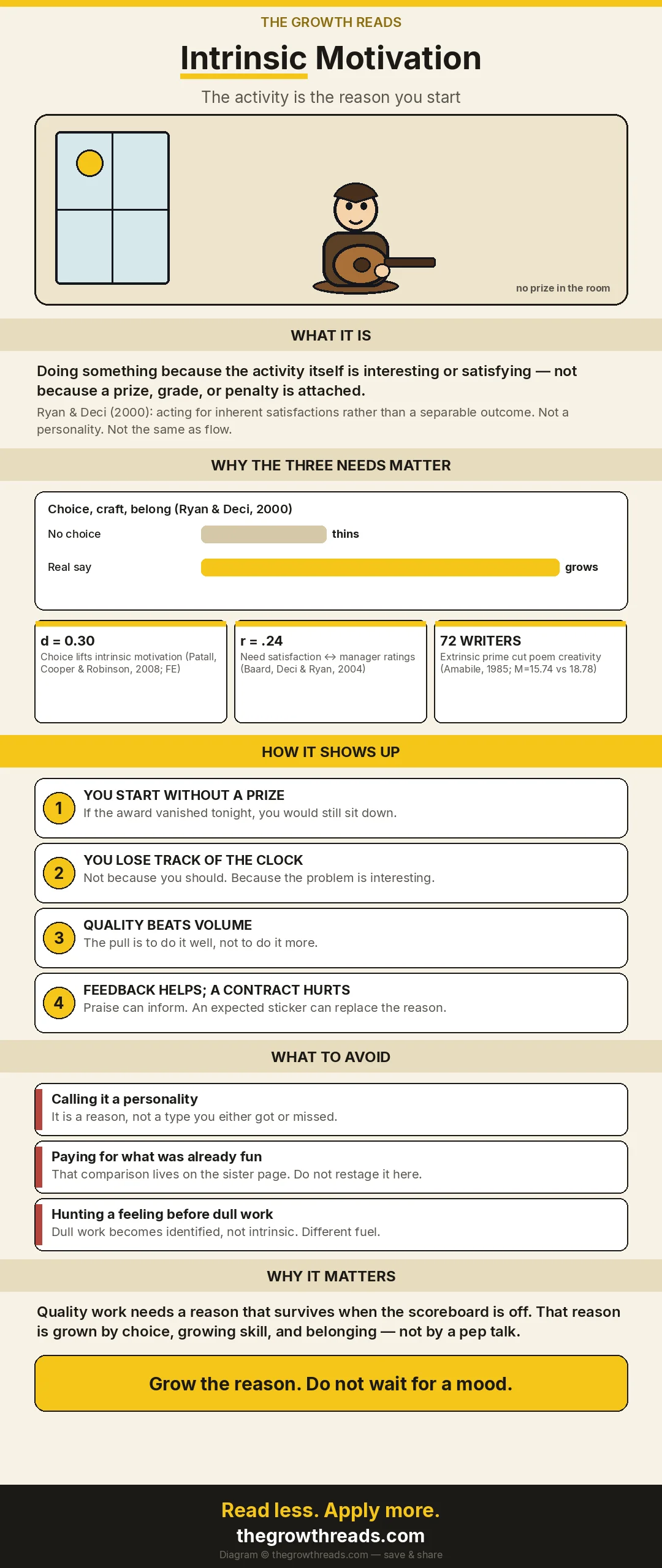
Intrinsic motivation is doing something because the activity itself is interesting or satisfying, not because a prize is attached. Ryan and Deci call it acting for inherent satisfactions rather than a separable outcome. It grows from choice, growing skill, and belonging — and it fades when those three nutrients are missing.
Key takeaways
- Intrinsic motivation is a reason, not a personality: you start because the activity itself is interesting or enjoyable, not because a prize, grade, or penalty is attached (Ryan & Deci, 2000).
- That reason is grown, not wished for. Across 41 studies, giving people a real choice lifted intrinsic motivation at d = 0.30 under a fixed-effect model and d = 0.36 under a random-effect model (Patall, Cooper & Robinson, 2008).
- On a real trading floor, employees whose autonomy, competence, and relatedness were more satisfied were rated better by managers (r = .24) and reported better adjustment (r = .21) in a path model of 528 people (Baard, Deci & Ryan, 2004).
- A brief shift toward extrinsic reasons can thin the work itself: 72 writers primed with payoff-language wrote a second poem scored less creative (M = 15.74) than control writers (M = 18.78) (Amabile, 1985).
- Robert White’s 1959 “effectance” paper is the older root of the competence need: people seek to have an effect on the environment, and that pull is itself a motive, not a consolation prize for missing a bonus.
What intrinsic motivation actually is
Intrinsic motivation is the pull to do an activity because the activity itself is interesting, curious, or satisfying. Richard Ryan and Edward Deci put that in those words in their 2000 American Psychologist paper: people are intrinsically motivated when they act “for inherent satisfactions rather than for some separable consequence.” The test is simple and slightly rude. If the prize, the grade, the title, or the fear of looking lazy vanished tonight, would you still sit down?
That is a reason, not a type. The same person can be intrinsically motivated by a stubborn spreadsheet at 10 a.m. and extrinsically motivated by a status update at 4 p.m. The task does not decide. The reason does. A novel written only for a deadline is extrinsic work in a “creative” costume. A tax return can be intrinsically motivating if the puzzle of the numbers is the point. This page lives under how to build discipline because discipline is what you do after the feeling thins. Intrinsic motivation is why the feeling was there, or was not, in the first place.
The comparison of inner versus outer fuel already has a home: intrinsic vs extrinsic motivation. Do not treat this URL as a second copy of that split. This page answers one question — what the inner reason actually is, and what grows it — then sends the prize-versus-pull fight next door.
What it is not
The opposite of intrinsic motivation is not laziness, and the presence of it is not a moral win. It is not “being a morning person of the soul.” It is not passion-as-identity — the story in which you either found your calling or you did not. It is not flow. Flow is a match between challenge and skill; it often shows up during intrinsically motivated work, and it is still a different claim, which is why what flow state actually is is a separate page.
It is also not a diagnosis. A dead Tuesday on one task is usually a reason problem or a design problem. Months of lifelessness across every context is a different conversation than this article, and this article will not have it.
Where the reason comes from
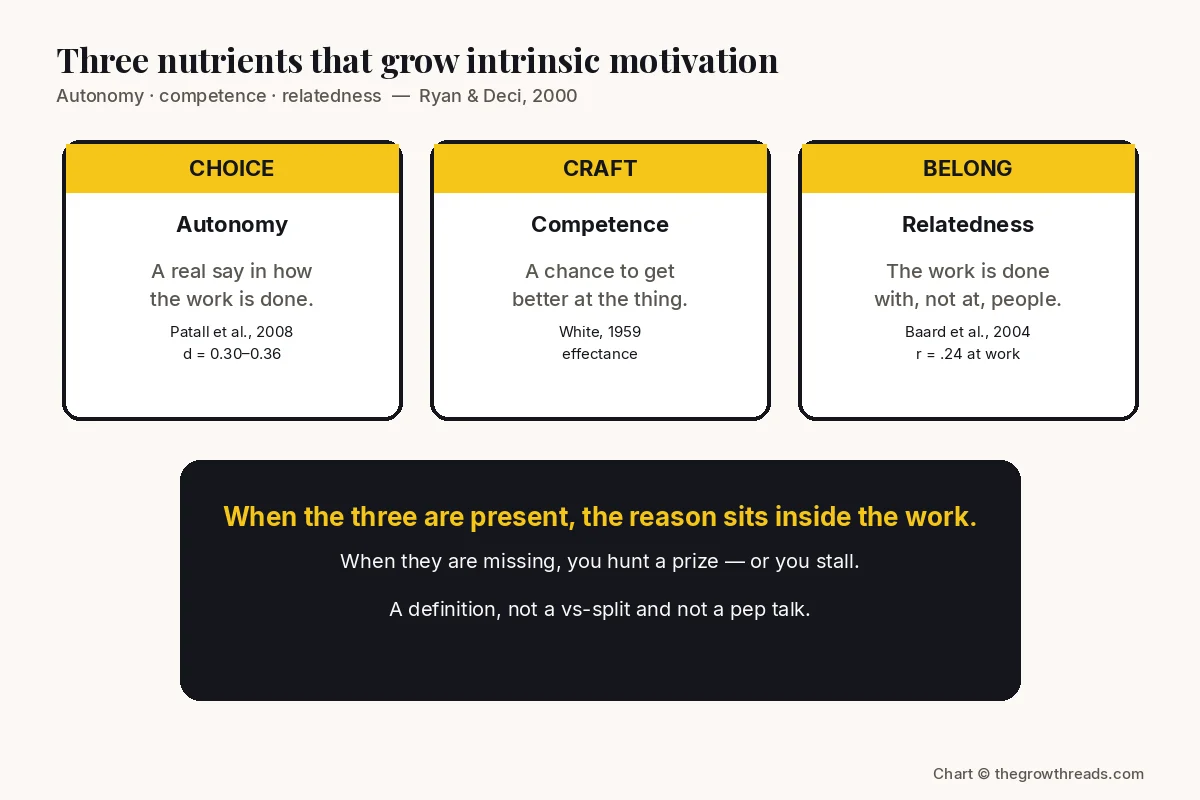
Intrinsic motivation is not a mood you wait for. It is a reason that grows when three psychological needs are fed, and thins when they are not. Ryan and Deci (2000), and the longer 2000 Psychological Inquiry paper with Deci as first author, name those needs as autonomy, competence, and relatedness. They are not branding. They are a claim about what has to be true in the room for the activity to stay interesting on its own.
Autonomy is a real say — not unlimited options, and not “do whatever.” It is the sense that this action is yours. Erika Patall, Harris Cooper and Jorgianne Civey Robinson tested the choice half of that claim in 2008. They meta-analysed 41 studies and 46 samples. Providing choice enhanced intrinsic motivation: the weighted average was d = 0.30 under a fixed-effect model (95% CI 0.25 to 0.35) and d = 0.36 under a random-effect model (95% CI 0.27 to 0.46). The effect was stronger when people made two to four successive choices than when they made one, and it shrank when a reward sat next to the choice. Too many options is not the same kindness as a real say. That is the useful reading for a workday: one or two genuine decisions about how the work is done beat a menu of twenty.
Competence is older than the acronym. In 1959 Robert White argued, in Psychological Review, that people have an “effectance” motive: they want to have an effect on the environment, and getting better at something is itself satisfying. Self-determination theory kept that idea and named it competence. The practical version is unglamorous. You can see the next increment. The task is not so easy that it is a chore and not so hard that it is a wall. When that band is missing, people do not “lose passion.” They lose the feeling that their effort is doing anything, and the inner reason starves.
Relatedness is the one workplaces skip because it sounds soft. Paul Baard, Deci and Ryan (2004) tested the three needs in two organisations. In the larger study they invited 698 associates at an investment bank; the path model used 528 people. Satisfaction of autonomy, competence and relatedness together predicted manager performance ratings (r = .24) and psychological adjustment (r = .21). Relatedness was not a wellness extra sitting beside the work. It sat inside the same model as the ratings. The limit is honest: this is correlational. It does not prove that a warmer team caused the ratings. It does show that the inner reason, measured as need satisfaction, moves with real work outcomes and is not only a classroom story about puzzles.
The three nutrients, in a room
Most “I need to get more motivated” advice fails because it aims at a feeling instead of at the nutrient that is missing.
- Choice. Can you pick the order, the tool, or the first ugly version? If every step is dictated, the reason has nowhere to sit. Patall’s result is the evidence that a real say is not decoration.
- Craft. Can you see yourself getting better this week? If the work is either busywork or a cliff, White’s effectance motive has nothing to bite.
- Belong. Is this done with people, or at them? Baard’s banking sample is why this page sits in the productivity hub and not only in a psychology glossary: the third nutrient showed up next to performance ratings.
Tony Robbins’s Unlimited Power is the unused down-link for this row because it is a popular-language cousin of the same claim, not a second experiment. Robbins argues that the meaning you assign to an action — the “state” you bring to it — changes the energy available for the action. That is not Self-Determination Theory, and this page will not pretend it is. It is the folk version of “the reason lives in how you see the activity.” Use it as a pointer, then come back to the three nutrients, which have papers behind them.
Why a missing reason costs more than it feels like
A missing inner reason feels like a mood problem. The bill shows up in the quality of the work, and in how long you stay with it after the scoreboard is off. Teresa Amabile tested a thin version of that cost in 1985 with 72 young adults who already called themselves writers. Each person wrote two short poems. Before the second poem, one group completed a questionnaire that asked about intrinsic reasons for writing. Another completed a questionnaire about extrinsic reasons — pay, approval, a career. A control group got no questionnaire. First poems did not differ. Second poems did. Extrinsic-orientation poems were scored less creative (M = 15.74) than control (M = 18.78) and intrinsic (M = 19.88) poems, F(2, 69) = 4.66, p < .013. Priming the payoff language did not make people write more. It made the writing thinner.
Two honest limits. Amabile’s intrinsic group did not beat the control group by much — these were already interested writers, so there was little extra interest to add. The study is a laboratory poem, not a quarter of shipping software. Baard’s r = .24 is a medium-small correlation in a specific firm, and the pilot study’s r = .34 sat on a very small set of performance ratings. Neither paper is a law about every bonus. Both are evidence that the reason you start changes the work you produce, not only the story you tell about it.
That is the cost that does not show up on a weekly scorecard. You can still finish the task. You can still hit the number. What leaves first is the part of the work that needed care: the second draft, the extra check, the willingness to stay ten more minutes because the problem is still interesting. Mental discipline is how you stay after that interest thins. This page is why it was there to thin.
The prize-can-empty-the-work mechanism — expected rewards crowding out interest that was already there — is documented on the sister comparison page, including Lepper, Greene and Nisbett’s 1973 drawing study and the 1999 rewards meta-analysis. This page will not restage those numbers. The useful handoff is one sentence: if someone already liked the activity, a visible if-then contract can teach them that the reason they sat down was the prize. For the vs-split, the continuum, and those experiments, read intrinsic vs extrinsic motivation.
Nearby ideas that are not this definition
Several neighbouring pages share a word with this one and answer a different question. Keep them linked, not merged.
| Idea | What it actually is | What it is not |
|---|---|---|
| Intrinsic motivation | The reason you start: the activity itself is interesting or satisfying | A personality, a moral ranking, or a mood you wait for |
| Intrinsic vs extrinsic | The comparison of inner versus outer fuel, plus when a prize empties the work | A second definition of the inner reason |
| How to build discipline | The parent method: cues, reps, return after the feeling thins | A rewrite of this definition |
| Mental discipline | Staying put after interest leaves | A second motivation lecture |
| Is discipline a skill | Trainable, not a trait you either got or missed | A fuel-type test |
| Flow state | Challenge meeting skill — a match, not a mood | The same thing as intrinsic motivation, though they often travel together |
| Personal accountability | Owning the outcome after you chose it | Why you sat down in the first place |
| Self discipline examples | What staying put looks like in a room | A list of passions |
| Temptation bundling | Pairing a wanted activity with a needed one | Paying yourself a bonus for the needed one |
| What is consistency | Repeating the same action until the cue carries it | Feeling inspired every time |
| Burnout vs laziness | Depletion versus a missing reason | A medical page, and not this definition |
If the problem is “I only start when someone is watching the scoreboard,” the comparison page is the closer read. If the problem is “I start, then I leave,” that is mental discipline. If the problem is “I do not know what the inner reason even is,” that is this page.
Common mistakes
- Waiting to feel motivated before starting interesting work. The feeling is a lagging indicator of the three nutrients. Sitting down is often what lets competence and choice show up. Hunting the mood first is how a Tuesday disappears.
- Calling it a personality. “I am just not an intrinsically motivated person” treats a reason as a trait. Ryan and Deci describe conditions, not types. Change the room — a real say, a visible increment, a person the work is for — before you change your story about yourself.
- Confusing flow with the reason. You can be intrinsically motivated on a messy first draft that never quite hits flow. You can hit flow on a game you would not play tomorrow. Flow state is the match. This page is the why.
- Trying to make dull, necessary work “fun.” Tax, rehab, the first dirty draft — these rarely become intrinsic. They can become identified: the outcome is yours even when the activity is not interesting. That is closer to how to take accountability than to a playlist.
- Restaging the prize fight on this URL. Expected rewards and the overjustification effect belong on intrinsic vs extrinsic motivation. Repeating that page here would cannibalise both.
- Copying a public figure’s “I just love the work” story. Visible people narrate the intrinsic years and hide the identified years. Why consistency is important is the quieter half of that story.
- Treating autonomy as no structure. Patall’s strongest choice effects were two to four successive choices, not an infinite menu, and the effect shrank when a reward sat beside the choice. A deadline can be a container. A script for every click cannot.
The evidence behind this
| Study | Design and size | Finding | What we used it for |
|---|---|---|---|
| Ryan & Deci (2000) | Theory review, American Psychologist | Intrinsic motivation = acting for inherent satisfactions, not a separable outcome; three needs named | The definition this page owns |
| Deci & Ryan (2000) | Theory review, Psychological Inquiry | Autonomy, competence, and relatedness as essential nutriments for self-determined behaviour | Why the reason is grown, not wished |
| White (1959) | Theory review, Psychological Review | “Effectance” — competence-seeking is itself a motive | The older root of the craft nutrient |
| Patall, Cooper & Robinson (2008) | Meta-analysis; 41 studies, 46 samples | Choice → intrinsic motivation d = 0.30 (FE) / 0.36 (RE); stronger for 2–4 successive choices | The autonomy nutrient, with a dose limit |
| Baard, Deci & Ryan (2004) | Field; investment bank, path model N = 528 (698 invited) | Need satisfaction ↔ performance r = .24; adjustment r = .21 | Why this is a work page, not only a lab story |
| Amabile (1985) | Lab; 72 self-identified writers, two poems | Extrinsic prime: second-poem creativity M = 15.74 vs control 18.78 | The quality cost when the reason shifts |
| Niemiec & Ryan (2009) | Theory review for classrooms | Autonomy-supportive teaching feeds the same three needs | The school-shaped version of the same claim; not a second experiment |
Frequently asked questions
What is intrinsic motivation?
Intrinsic motivation is doing something because the activity itself is interesting, curious, or satisfying — not because a prize, grade, status, or penalty is attached. Ryan and Deci (2000) define it as acting for inherent satisfactions rather than a separable outcome. It is a reason, not a personality type. The same person can have it for one task on a Tuesday and lack it for the next. The useful test: if the prize vanished tonight, would you still start?
What causes intrinsic motivation?
Self-determination theory says the reason grows when three needs are fed: autonomy (a real say), competence (a chance to get better), and relatedness (the work is done with people, not at them). Patall, Cooper and Robinson (2008) found that providing choice lifted intrinsic motivation at d = 0.30 to 0.36 across 41 studies. Baard, Deci and Ryan (2004) found the same three needs moved with performance ratings in an investment bank. The cause is in the room, not in a pep talk.
Is intrinsic motivation the same as being passionate?
No. Passion-as-identity is a story: you either found the work you were born for, or you did not. Intrinsic motivation is narrower and more useful. It is the reason you start this activity today because the activity is interesting. You can be intrinsically motivated by a spreadsheet and bored by the career that contains it. Waiting to “find your passion” before you will start is how a useful reason gets turned into a personality test.
Is intrinsic motivation the same as flow?
No. Flow is what happens when challenge and skill are matched — a state, often short. Intrinsic motivation is why you sat down: the activity is worth doing for its own sake. They travel together often, which is why people mash the words. You can have the reason without the state, especially on a messy first pass. Flow has its own page on this site. This page stops at the reason.
Can boring work become intrinsically motivating?
Rarely, and it is a mistake to force it. Dull, necessary work — filings, rehab sets, the first dirty draft — usually stays dull. What it can become is identified motivation: you personally value the outcome even though the activity is not fun. Ryan and Deci place that on the self-determined side of extrinsic motivation. That is a feature, not a failure. Use the three nutrients on work that already has a spark. Use ownership, not a playlist, on work that does not.
How is intrinsic motivation different from self-motivation?
Self-motivation is everyday speech for “I can start without being nagged.” That mix can be intrinsic, identified, or just stubborn discipline. Intrinsic motivation is the stricter claim: the activity itself is the reason. Someone can be highly self-motivated by guilt, a public ranking, or a refusal to look weak — and still have no inner interest in the task. If the useful question is “will I start,” look at discipline. If the useful question is “why is this interesting,” you are on this page.
Does autonomy mean no deadlines and no structure?
No. Autonomy is a real say, not an infinite menu. Patall, Cooper and Robinson (2008) found the choice effect was stronger for two to four successive choices than for a single choice or a pile of options, and it shrank when a reward sat next to the choice. A deadline can be a container that lets competence show up. A script for every click is the thing that starves the reason. Structure and autonomy are not opposites unless the structure is there to remove every decision.
Why does intrinsic motivation matter at work?
Because quality work needs a reason that survives when the scoreboard is off. Baard, Deci and Ryan (2004) found need satisfaction moved with manager ratings (r = .24) in a banking sample of hundreds. Amabile (1985) found that shifting writers toward payoff-language thinned the creativity of the next poem. You can still hit a number on extrinsic fuel. What leaves first is care. That is a productivity fact, which is why this page sits under discipline and not in a separate psychology silo.
Sources
- Ryan, R. M., & Deci, E. L. (2000). Self-determination theory and the facilitation of intrinsic motivation, social development, and well-being. American Psychologist, 55(1), 68–78. https://doi.org/10.1037/0003-066X.55.1.68
- Deci, E. L., & Ryan, R. M. (2000). The “what” and “why” of goal pursuits: Human needs and the self-determination of behavior. Psychological Inquiry, 11(4), 227–268. https://doi.org/10.1207/S15327965PLI1104_01
- White, R. W. (1959). Motivation reconsidered: The concept of competence. Psychological Review, 66(5), 297–333. https://doi.org/10.1037/h0040934
- Patall, E. A., Cooper, H., & Robinson, J. C. (2008). The effects of choice on intrinsic motivation and related outcomes: A meta-analysis of research findings. Psychological Bulletin, 134(2), 270–300. https://doi.org/10.1037/0033-2909.134.2.270
- Baard, P. P., Deci, E. L., & Ryan, R. M. (2004). Intrinsic need satisfaction: A motivational basis of performance and well-being in two work settings. Journal of Applied Social Psychology, 34(10), 2045–2068. https://doi.org/10.1111/j.1559-1816.2004.tb02690.x
- Amabile, T. M. (1985). Motivation and creativity: Effects of motivational orientation on creative writers. Journal of Personality and Social Psychology, 48(2), 393–399. https://doi.org/10.1037/0022-3514.48.2.393
- Niemiec, C. P., & Ryan, R. M. (2009). Autonomy, competence, and relatedness in the classroom: Applying self-determination theory to educational practice. Theory and Research in Education, 7(2), 133–144. https://doi.org/10.1177/1477878509104318
Related reading on The Growth Reads
The books behind this
- Unlimited Power summary — Robbins on the meaning you assign to an action. This row’s unused down-link; popular language, not a second SDT paper.
Related articles
- How to build discipline — the Discipline parent
- Intrinsic vs extrinsic motivation — the sister: the split, and when a prize empties the work
- Mental discipline — staying put after the feeling thins
- Is discipline a skill — trainable, not a trait
- What is personal accountability — owning the outcome
- Self discipline examples — what staying put looks like
- Temptation bundling — pairing a wanted activity with a needed one
- What is consistency — the repeat, not the feeling
- What flow state actually is — challenge meeting skill
- Burnout vs laziness — depletion versus a missing reason
Go deeper
How this article was researched
The Growth Reads editorial team read the primary papers behind the definition — Ryan and Deci (2000); Deci and Ryan (2000); White (1959); Patall, Cooper and Robinson (2008); Baard, Deci and Ryan (2004); Amabile (1985); and Niemiec and Ryan (2009) — plus Robbins’s Unlimited Power as the named unused review. Numbers in the takeaways and the evidence table are taken from those papers, not from secondary blog summaries. This is a definition page, not a how-to-get-motivated guide, not a rewrite of the live vs-split, and not a clinical article.
Limits. Baard is correlational and firm-specific. Amabile is a laboratory poem with already-interested writers. Patall’s overall d shrinks under trim-and-fill, which we note as a caution even though the direction stays positive. We did not invent percentages. We did not restage Lepper 1973 or Wrzesniewski 2014 — those belong on the sister comparison page. We did not name books that do not have a Growth Reads review.
Method: primary papers and one named unused review. Last checked 12 September 2026. Play slot — no HowTo schema.