

★★★★☆ 4.3/5 — A practical, science-backed guide to understanding your relationship patterns.
Best for: Anyone who keeps choosing the wrong partners, struggles with relationship anxiety, or wants to understand why some relationships feel effortless and others feel impossible.
Reading time: ~6 hours (this summary: 18 min)
Difficulty to apply: Medium — identifying your style is easy; changing ingrained patterns takes conscious effort over months.
Attached in One Minute
Your attachment style — Secure, Anxious, or Avoidant — shapes every romantic relationship you will ever have. Neuroscience research shows these patterns are hardwired but not permanent. Amir Levine and Rachel Heller translate decades of attachment theory into a practical framework: learn to identify your style, spot your partner’s style early, and use specific communication tools to build the secure bond every human being is designed to need. The central argument is refreshingly direct — needing your partner is not weakness, it is biology.
Key Takeaways
- Attachment is biological, not emotional weakness: Humans are wired to depend on a select few people, and fighting that need creates more anxiety, not less.
- Three styles drive most relationship dynamics: Secure (comfortable with intimacy), Anxious (craves closeness, fears rejection), and Avoidant (equates intimacy with loss of independence).
- Roughly half the population is Secure: About 50% of people can form stable bonds easily; the dating pool skews Anxious and Avoidant because Secure people pair off and stay paired.
- Anxious and Avoidant partners magnetically attract each other: Their opposing needs create an addictive push-pull cycle that both mistake for passion.
- Protest behaviors are distress signals, not character flaws: Calling repeatedly, withdrawing, or keeping score are signs of an activated attachment system, not manipulation.
- Effective communication replaces protest behaviors: Stating your needs directly and early prevents the escalation cycle that destroys relationships.
- The relationship inventory is a diagnostic tool: Tracking how safe, seen, and supported you feel reveals whether a relationship meets your attachment needs.
- Anyone can become more Secure: Exposure to a Secure partner or deliberate practice of Secure behaviors can shift your attachment style over time.
- Dating should include attachment-style screening: Identifying red flags for avoidance early saves years of painful cycling.
- Dependency is a strength in healthy relationships: The “dependency paradox” shows that the more secure your base, the more autonomous and adventurous you become.
What Is Attached About?
Attached explains how adult attachment theory — originally developed for infant-caregiver bonds — applies to romantic relationships. It classifies people into three attachment styles (Secure, Anxious, Avoidant) and provides concrete strategies for identifying your style, choosing compatible partners, and communicating your needs effectively to create lasting intimacy.
About the Author
Amir Levine is a psychiatrist and neuroscientist at Columbia University who has studied the neural basis of attachment for over two decades. His clinical work with couples struggling with intimacy patterns led him to translate academic attachment research into practical advice. Rachel Heller is a psychologist specializing in social cognition and relationships. Together, they combined laboratory science with real-world relationship coaching to produce a book that has helped millions of readers decode their love lives since its publication in 2010. Explore all Amir Levine book summaries →
Key Concepts at a Glance
| Concept | What It Means | Use It When |
|---|---|---|
| Attachment System | A biological mechanism that monitors the accessibility of important people | You feel unexplained anxiety when a partner is distant |
| Secure Base | A reliable partner who gives you confidence to explore the world | You want to understand why some relationships feel freeing |
| Protest Behavior | Actions taken to re-establish contact with an unavailable partner | You notice yourself calling excessively or giving the silent treatment |
| Dependency Paradox | The more effectively you depend on a partner, the more independent you become | Someone tells you that needing a partner is “codependent” |
| Deactivating Strategies | Mental tactics Avoidants use to suppress closeness (idealizing exes, focusing on flaws) | You notice a partner pulling away after moments of connection |
| Activating Strategies | Anxious behaviors that attempt to regain proximity (monitoring, ruminating) | You can’t stop checking your phone after a partner goes quiet |
| Effective Communication | Expressing needs without blame using five specific principles | A conversation keeps escalating instead of resolving |
| Relationship Inventory | A checklist to evaluate whether a partner meets your core attachment needs | You are unsure if a relationship is healthy or just comfortable |
Part 1: The Science of Attachment
Levine opens with a claim that surprises most readers: needing other people is not a sign of weakness — it is one of the most powerful survival mechanisms evolution ever produced. Attachment theory, pioneered by John Bowlby in the 1950s and tested in Mary Ainsworth’s “Strange Situation” experiments, proved that infants form distinct patterns of relating to caregivers. Levine’s contribution is demonstrating, through brain-imaging studies at Columbia, that the same neural circuits govern adult romantic bonds.
The attachment system works like a thermostat: when your partner feels accessible and responsive, the system stays calm and you can focus outward on work, friendships, and goals. When the partner feels distant — physically or emotionally — the system activates, flooding you with anxiety and an urgent need to re-establish contact. This is not neediness; it is neurobiology.
The research identifies three primary attachment styles. Roughly 50 percent of the population is Secure: they find it relatively easy to get close to others and are comfortable with mutual dependence. About 20 percent are Anxious: they crave intimacy but worry constantly that their partner does not love them enough. Around 25 percent are Avoidant: they equate closeness with a loss of independence and use “deactivating strategies” to keep partners at arm’s length. A smaller percentage shows a fourth style (fearful-avoidant), which combines features of both insecure styles.
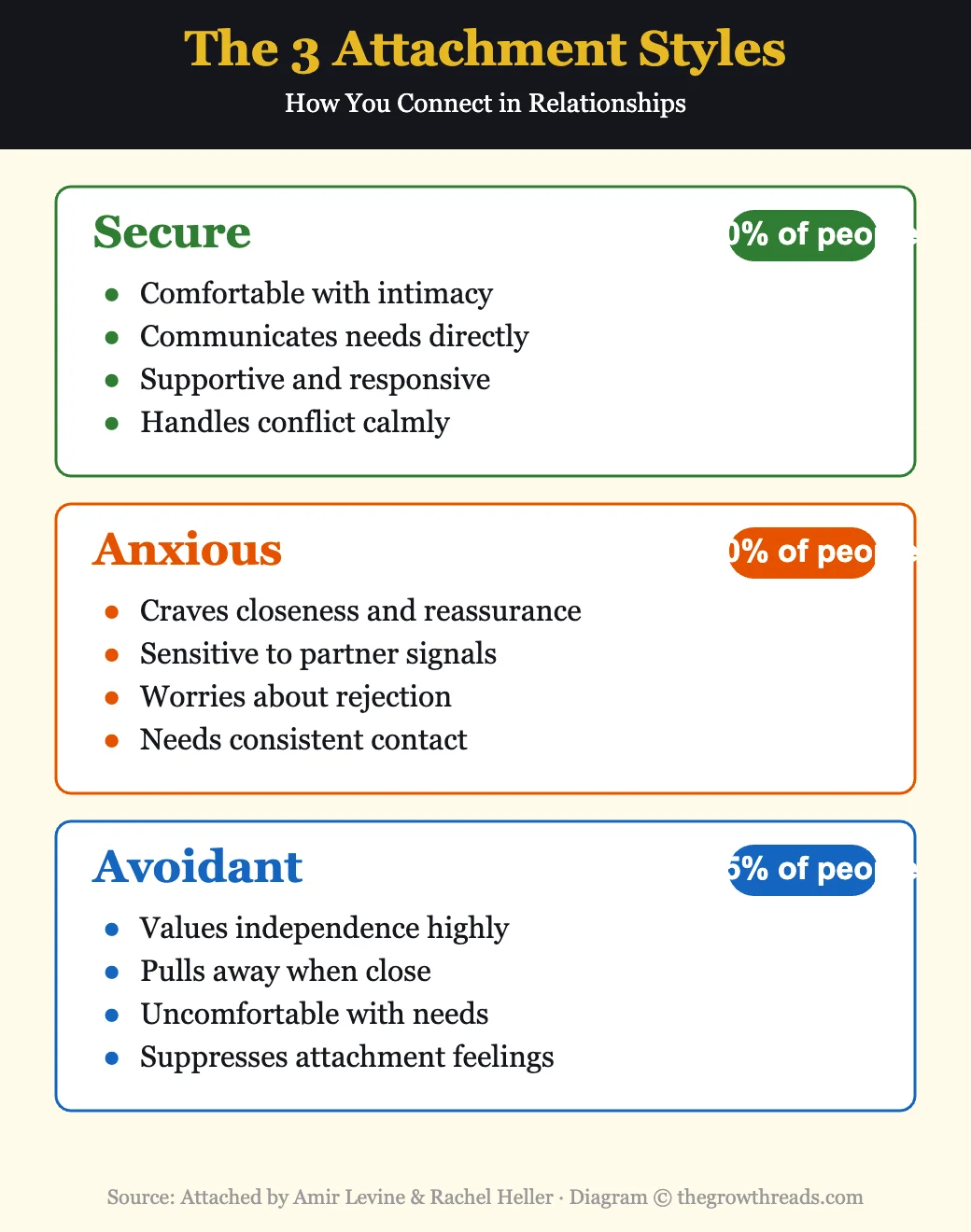
The crucial insight for dating is statistical: since Secure people tend to form long, stable relationships, they leave the dating pool quickly. This means that the pool of available singles is disproportionately Anxious and Avoidant — making the odds of an insecure pairing higher than the population averages suggest. Knowing this reframes the dating experience entirely.
Part 2: The Anxious-Avoidant Trap
Levine and Heller describe what they call the “anxious-avoidant trap” — a self-reinforcing cycle that keeps millions of couples locked in painful push-pull dynamics. An Anxious partner reaches for connection; an Avoidant partner interprets that reach as pressure and pulls away; the Anxious partner escalates with protest behaviors (more texts, emotional outbursts, or threats to leave); the Avoidant uses this escalation as proof that relationships are draining.
The trap is seductive because both partners mistake its intensity for chemistry. The highs (reconciliation after a fight) trigger the same dopamine pathways as a gambling win — unpredictable rewards are more addictive than consistent ones. Levine draws on fMRI studies showing that the uncertainty an Avoidant partner creates literally activates the brain’s reward circuitry in the Anxious partner, producing a craving response indistinguishable from addiction.
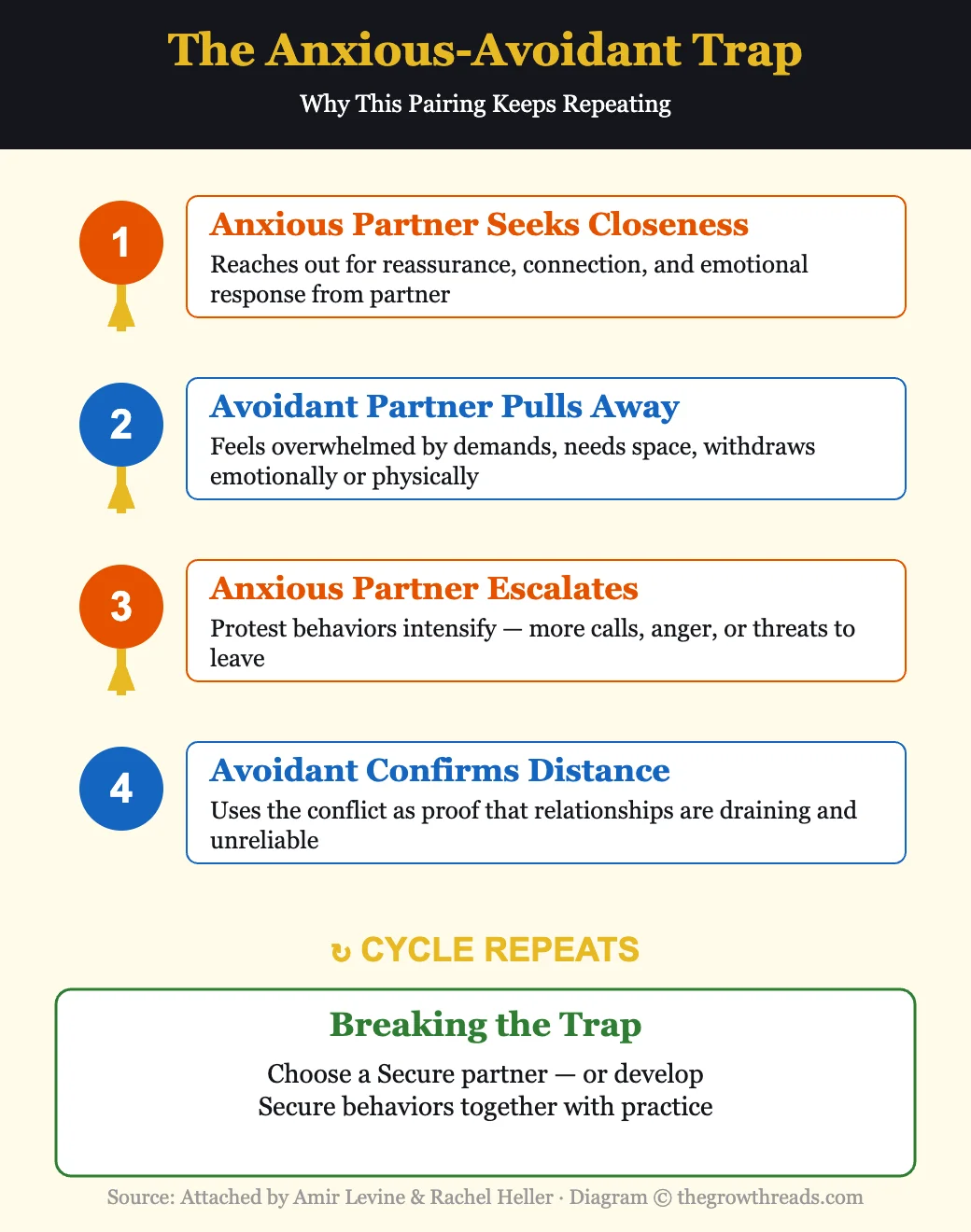
The authors catalogue specific “protest behaviors” that Anxious partners use when activated: excessive calling or texting, keeping score of who reached out last, acting hostile, threatening to leave, or engaging in jealousy-inducing behavior. These are not character flaws — they are distress signals from an overloaded attachment system. Recognizing them as signals rather than manipulation is the first step toward changing the pattern.
On the Avoidant side, Levine identifies “deactivating strategies” — mental techniques used to maintain emotional distance: mentally cataloguing a partner’s flaws, fantasizing about an ideal ex, pulling away after a moment of genuine closeness, or maintaining rigid rules about independence. These strategies protect the Avoidant from vulnerability but also prevent the deep bond their biology still craves.
Part 3: Becoming Secure
The most encouraging section of Attached argues that attachment styles are not permanent. Levine presents what he calls “earned security” — the process of shifting from an insecure style to a Secure one through deliberate practice or through partnering with someone who is already Secure. Longitudinal studies show that roughly 25 percent of people change their attachment classification over a four-year period, usually in the direction of greater security.
The mechanism is elegant: a Secure partner functions as a “buffer” for an insecure partner’s activated attachment system. When an Anxious person voices a need and receives a calm, responsive answer instead of withdrawal, their nervous system gradually recalibrates. Over months, the anxious partner requires less reassurance because their baseline expectation of responsiveness has changed. The same principle works in reverse: an Avoidant partner exposed to consistent, non-demanding warmth slowly learns that closeness does not mean engulfment.
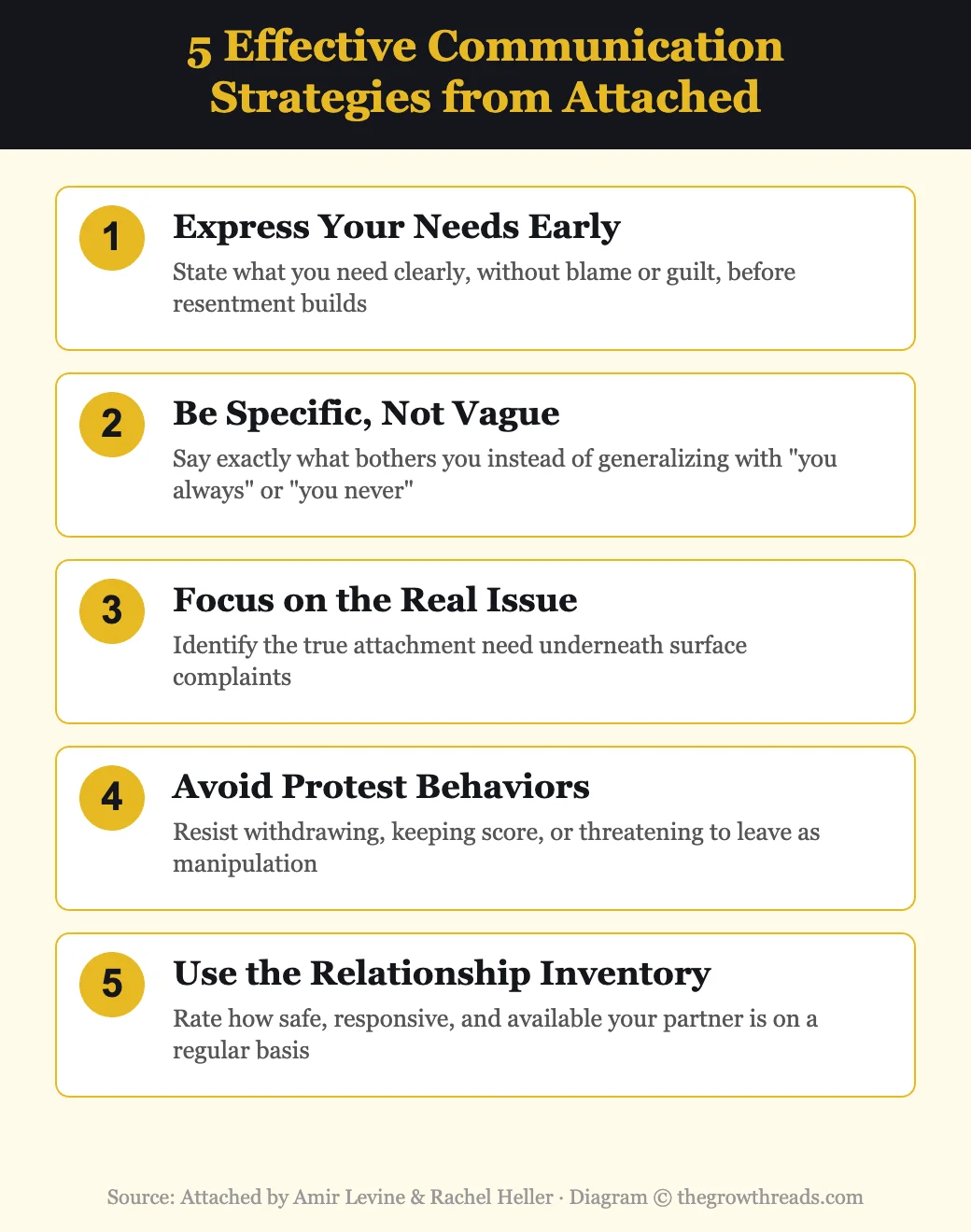
Levine emphasizes five principles of “effective communication” as the core behavioral toolkit for becoming more Secure. First, express your needs early — waiting until frustration peaks guarantees an escalation. Second, be specific rather than vague (“I need us to talk for twenty minutes after dinner” versus “You never pay attention to me”). Third, focus on the real attachment need underneath the surface complaint. Fourth, do not resort to protest behaviors. Fifth, disengage from the conversation if you cannot follow the first four rules and revisit it when calm.
Part 4: Applying Attachment Theory to Dating and Long-Term Relationships
In the final section, Levine and Heller translate the science into concrete dating strategies. They argue that attachment-style awareness should be the first filter, before chemistry, common interests, or physical attraction. They provide a checklist of early dating signals: does the person call when they say they will? Do they introduce you to friends? Do they make plans in advance or keep everything last-minute? Avoidant signals — chronic lateness, vague commitment language, idealization of exes — should be weighted heavily, because they predict the trajectory of the relationship more reliably than the quality of the first few dates.
For those already in relationships, the authors introduce the “relationship inventory” — a structured assessment of whether your core needs for safety, attention, and consistency are being met. Importantly, the inventory is not a one-time exercise; it is meant to be revisited regularly, much like a health check, to catch small erosions before they become serious rifts.
The book closes with a powerful reframe of the word “dependency.” Western culture celebrates independence and stigmatizes emotional need, but Levine’s research shows the opposite: the “dependency paradox” demonstrates that people in secure, interdependent relationships take more risks, pursue bigger goals, and show greater resilience under stress. Healthy dependency is not the enemy of autonomy — it is the foundation of it.
Who Is Attached Best For — and Who Should Read Something Else First?
Attached is ideal for singles who keep falling into the same painful relationship patterns, couples stuck in a pursue-withdraw cycle, or anyone who has been told they are “too needy” or “too distant” and wants to understand why. It is especially useful for people in their 20s and 30s who are actively dating and want a science-backed framework for partner selection.
If your primary challenge is communication within an already-stable relationship rather than attachment anxiety, you might start with The 5 Love Languages. If you are dealing with broader emotional resilience beyond romantic relationships, try The Subtle Art of Not Giving a F*ck for a different lens on emotional boundaries. And if you want the neuroscience of habit change that Levine references, our summary of Atomic Habits explains the reward circuitry in more depth.
Questions to Reflect On
- Which attachment style — Secure, Anxious, or Avoidant — best describes your behavior in your closest relationship? What evidence supports that?
- Think about your last relationship conflict. Was a protest behavior or deactivating strategy at play? Which one?
- When you imagine expressing a need to your partner directly and calmly, what feeling comes up? What does that feeling tell you about your attachment system?
- Has a past partner ever made you feel both intensely drawn in and constantly uncertain? Was that chemistry — or the anxious-avoidant trap?
- What would it look like to apply the dependency paradox this week — to lean into support from someone you trust and notice whether it increases your confidence?
🔥 Ready to decode your relationship patterns?
Attached gives you the science and the practical toolkit to build the secure love you deserve.
How to Apply Attached (7-Day Plan)
- Day 1 — Identify your style: Take the attachment-style quiz in Chapter 3 (or an online equivalent). Write down which descriptions made you think “that is exactly me” and share them with a trusted friend for a reality check.
- Day 2 — Map your protest behaviors: List three specific actions you take when you feel a partner pulling away (e.g., checking their social media, giving the silent treatment, making sarcastic comments). For each, write the attachment need underneath it.
- Day 3 — Spot deactivating strategies: If you lean Avoidant, notice one moment today where you mentally criticized a partner or close friend to create distance. Journal what triggered it and what you were protecting yourself from.
- Day 4 — Practice one effective communication: Choose one unmet need in a current relationship. Express it using the formula: “When [specific situation], I feel [emotion], and I need [specific request].” Say it out loud, even if only to yourself first.
- Day 5 — Run the relationship inventory: Rate your current (or most recent) relationship on three scales from 1–10: safety (can I be vulnerable?), responsiveness (does my partner come through?), and consistency (can I predict their behavior?).
- Day 6 — Audit your dating filter: Write down the top five qualities you look for in a partner. Check how many are attachment-relevant (responsive, reliable, emotionally available) versus surface-level (funny, attractive, successful). Rebalance the list.
- Day 7 — Commit to one Secure behavior: Pick one Secure action to practice for the next month: responding to your partner’s bids for connection within the hour, expressing appreciation daily, or asking “what do you need from me right now?” after a disagreement.
Frequently Asked Questions
What are the three attachment styles in Attached?
The three primary styles are Secure (comfortable with intimacy and independence, about 50% of people), Anxious (craves closeness, fears abandonment, about 20%), and Avoidant (prizes independence, uncomfortable with emotional dependence, about 25%). A smaller group is Fearful-Avoidant, combining anxious and avoidant traits. Your style is shaped by early caregiving experiences but can shift over time with the right partner or deliberate practice.
Can you change your attachment style?
Yes. Research shows about 25% of people shift their attachment classification over a four-year period. The most reliable path is partnering with a Secure person whose consistent responsiveness gradually recalibrates your nervous system. Therapy — particularly emotionally focused therapy (EFT) — also helps. Levine emphasizes that awareness is the first step: once you can name your patterns, you can consciously choose different responses instead of reacting on autopilot.
What is the anxious-avoidant trap?
The anxious-avoidant trap is a self-reinforcing cycle where an Anxious partner seeks closeness, an Avoidant partner withdraws, the Anxious partner escalates with protest behaviors, and the Avoidant uses that escalation to justify further distance. Both partners mistake the intensity of the cycle for passion or chemistry, when it is actually their incompatible attachment systems triggering each other. Breaking the cycle requires either one partner learning Secure behaviors or the Anxious partner choosing a Secure partner instead.
What is the dependency paradox?
The dependency paradox is Levine’s term for a counterintuitive finding: the more effectively you can depend on your partner, the more independent and self-sufficient you become. People in secure relationships take more career risks, pursue challenging goals, and recover faster from setbacks because they have a reliable emotional “home base.” This contradicts the popular belief that needing someone makes you weak — the research shows the opposite.
How long does it take to read Attached?
Attached is 304 pages and takes approximately 5–6 hours to read at an average pace. The writing style is accessible and conversational, mixing neuroscience studies with real relationship anecdotes. Many readers report finishing it in a weekend. The quizzes and exercises in the book add another 1–2 hours if you complete them thoroughly, but they are essential for making the concepts personal and actionable.
Is Attached only for people in romantic relationships?
While the book focuses primarily on romantic partnerships, the attachment framework applies to any close relationship. Levine discusses how attachment styles influence friendships, parent-child dynamics, and even workplace relationships. Singles benefit enormously from the dating strategies and partner-selection criteria. The awareness of your own attachment patterns is valuable whether you are currently partnered, dating, or taking a break from relationships.
What should I read after Attached?
If you want to deepen your understanding of emotional intimacy, try Hold Me Tight by Sue Johnson, which applies attachment theory to couples therapy. For broader emotional intelligence, The 5 Love Languages by Gary Chapman complements Attached by helping you express attachment needs in your partner’s preferred way. If you are interested in the neuroscience behind habits and change, Atomic Habits by James Clear explains the reward circuits that Levine references in his discussion of the anxious-avoidant cycle.
Related Summaries
- The 5 Love Languages Summary — Understand how different people express and receive love
- The Four Agreements Summary — Ancient Toltec wisdom for healthier relationships
- How to Win Friends and Influence People Summary — Build deeper connections with anyone
- Best Relationship Books — Our complete guide to the top books on love, communication, and connection
How we analyze books: We read every book cover to cover, cross-reference key claims with peer-reviewed research, and distill the most actionable ideas into frameworks you can apply immediately. Our infographics are original, and our 7-day plans are designed for real-world implementation. Read our full methodology.
Related Relationships Summaries
Eight Dates Summary & Review: The Research-Backed Conversations That Transform Relationships
How to Know a Person Summary & Review: The Art of Truly Seeing Others
Not Nice Summary & Review: Stop People-Pleasing and Start Being Real
The Dance of Anger Summary & Review: Turn Anger Into Real Change
Untamed Summary & Review: Stop Pleasing and Start Living as Your Truest Self