

★★★★ 4.1/5 — a ruthless, riveting field guide to how power actually works, best read as a decoder ring rather than a rulebook.
Best for: anyone who has ever felt outmaneuvered at work and wants to see the game clearly · Reading time: ~15 hours (this guide: 17 min) · Difficulty to apply: Moderate — the awareness is instant, the restraint takes practice
The 48 Laws of Power in one minute
Power is a social game, and Robert Greene wrote the strategy guide. Drawing on three thousand years of history — from ancient China and Renaissance courts to con artists and modern moguls — Greene distills the dynamics of influence into 48 blunt laws. Some feel cynical; all of them are observations about how people actually behave when status and advantage are on the line. Read as a manual for manipulation, the book is troubling. Read as a decoder ring — a way to recognize the moves being played on you and to act with more awareness and less naivety — it becomes one of the most practically useful books on human behavior ever written. You do not have to like the game to benefit from seeing the board.
Key takeaways
- Power follows patterns: influence is not random or purely moral — it moves in recognizable ways you can learn to read, whether or not you choose to play.
- Never outshine the master (Law 1): make those above you feel effortlessly superior; managing up protects you far more than showing off does.
- Say less than necessary (Law 4): the more you talk, the more ordinary and controllable you appear. Silence unsettles, and it keeps your options open.
- Guard your reputation with your life (Law 5): reputation is the cornerstone of power. Defend it fiercely and use it as leverage.
- Court attention (Law 6): in a crowded world, being talked about beats being ignored. Visibility is a currency you can mint.
- Win through actions, not argument (Law 9): a demonstrated result changes minds that words never will. Show; don’t debate.
- Appeal to self-interest, never to mercy (Law 13): show people what they gain, not what you need. Everyone is tuned to their own frequency.
- Enter action with boldness (Law 28): hesitation invites more danger than boldness. Commit fully and people fall in line.
- Master timing and emotion (Laws 35 & 47): patience and knowing when to stop separate the durable from the reckless.
- Be formless (Law 48): rigid strategies get countered. Stay adaptable and never let anyone fully predict you.
What is The 48 Laws of Power about?
The 48 Laws of Power is a strategy book by Robert Greene that distills how influence, status, and control operate. Using stories from history’s rulers, courtiers, and tricksters, it lays out 48 principles for gaining and defending power — and, just as usefully, for recognizing when those tactics are being used on you.
About the author
Robert Greene worked roughly 80 jobs — from construction to Hollywood — before an editor named Joost Elffers heard his idea for a modern book on power and helped bring it to life in 1998. Greene had studied classical literature and languages, and he poured that scholarship into a book built entirely from historical case studies rather than opinion. The 48 Laws of Power became an underground phenomenon, passed hand to hand in prisons, boardrooms, and recording studios alike, and has sold millions of copies. Greene went on to write The Art of Seduction, Mastery, and The Laws of Human Nature, cementing his reputation as the modern chronicler of how people really behave when something is at stake. His gift is not invention but pattern-recognition: he shows that the same moves recur across centuries. Explore all Robert Greene book summaries →
Key concepts at a glance
| Law | What it means | Use it when |
|---|---|---|
| Never outshine the master | Let superiors feel superior | Working under a boss or client |
| Say less than necessary | Silence is leverage | Negotiating or under pressure |
| Court attention | Visibility is power | Building a reputation or brand |
| Win through actions | Demonstrate, don’t argue | Facing a skeptic |
| Appeal to self-interest | Frame the other person’s gain | Asking for anything |
| Enter with boldness | Commit fully | Making a decisive move |
| Be formless | Stay adaptable | Playing a long game |
Part 1: Power is a game — and pretending otherwise leaves you exposed
Greene’s starting premise is uncomfortable but freeing: power dynamics exist whether or not we acknowledge them, and the people who pretend to be above the game are usually its easiest victims. In the royal courts that supply many of his examples, courtiers had to master the art of appearing to serve while quietly advancing — a world of masks, timing, and indirect maneuvers. Greene argues that the modern office, the modern market, and the modern social scene run on the same hidden currents. The person who insists “I don’t play politics” is not opting out; they are simply playing badly, ceding the board to those who see it clearly.
The book’s method is what makes it credible. Every law is illustrated with historical episodes — the con man Yellow Kid Weil, the diplomat Talleyrand who served every French regime, the showman P.T. Barnum, the strategist Sun Tzu. Greene is not prescribing evil; he is cataloguing what has repeatedly worked, and letting you decide what to do with the knowledge. The most defensible way to read him is defensively: learn the 48 laws the way you would learn the common scams, so that you can spot them coming and keep your footing.
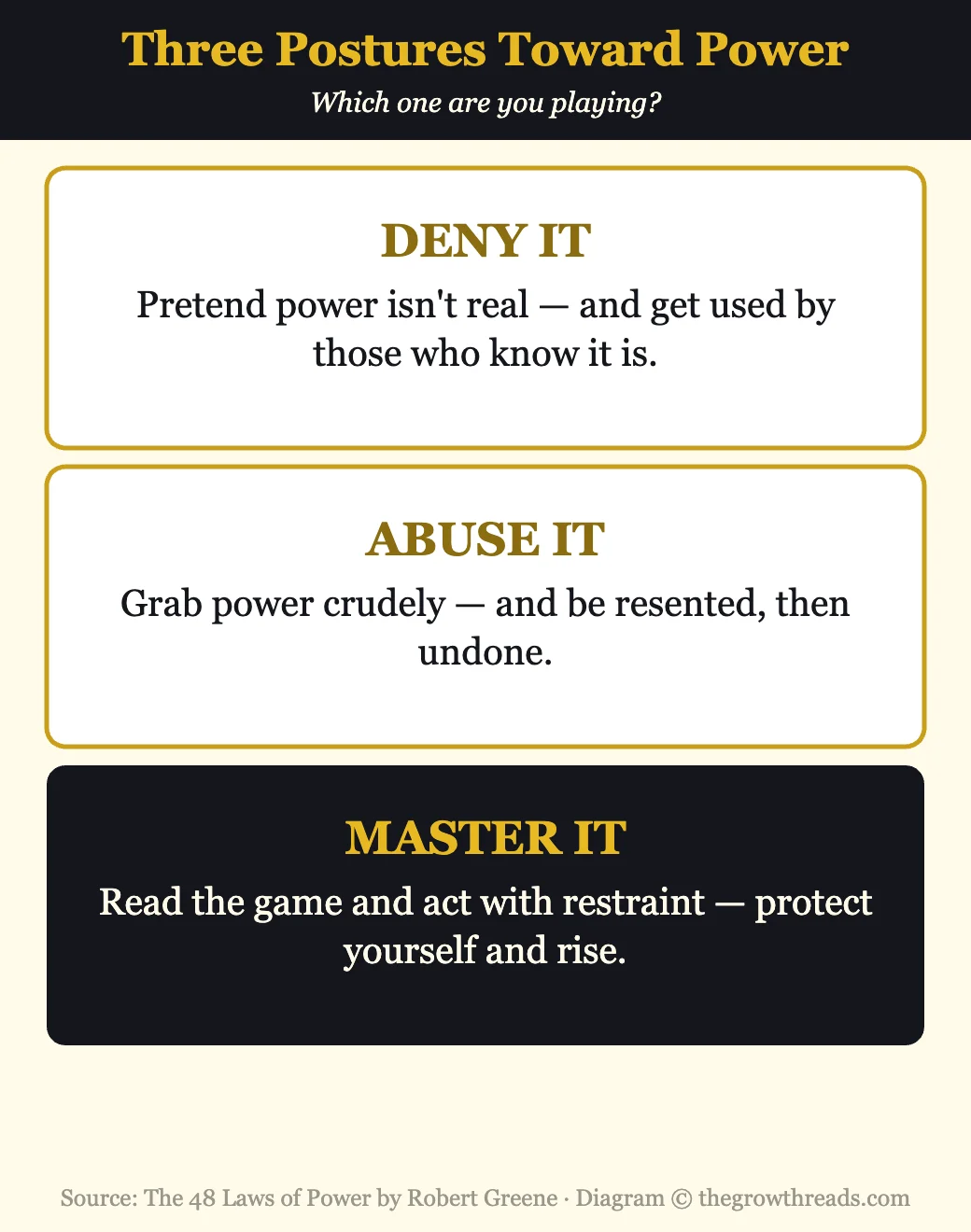
That reframing matters. There are three postures you can take toward power. You can deny it exists — and be quietly used by those who know it does. You can grab it crudely — and be resented until you are toppled. Or you can master it: read the game, act with restraint, and use awareness to protect yourself and rise without making needless enemies. Greene’s laws are the raw material; your character decides how you deploy them.
Part 2: Guard yourself — reputation, emotion, and never outshining the master
A surprising share of the 48 laws are defensive. Law 1 — never outshine the master — is the classic: the astronomer Galileo won patronage not by demanding it but by naming his discoveries after his patrons, letting them feel like the stars. In any workplace, the instinct to prove you are the smartest person in the room is a liability; making your boss look good is how you become indispensable rather than threatening. Law 5 — guard your reputation with your life — treats reputation as your most valuable asset, the thing that lets people trust and fear you before you say a word.
Emotional control runs underneath all of it. Greene repeatedly warns against acting from wounded pride or impatience, because a rattled person is a predictable, manageable one. Law 4 — say less than necessary — is really a discipline of the ego: the urge to fill silence, to explain yourself, to win the small point, is exactly what gives you away. Powerful people, Greene observes, learn to be comfortable saying little, letting others reveal themselves first.
TGR Note: Where Greene teaches you to manage your image, Ego Is the Enemy by Ryan Holiday argues the deeper win is dissolving the need to impress at all. Read together, they map two routes to the same place: Greene keeps your ego from sabotaging you tactically, and Holiday keeps it from sabotaging you spiritually. The overlap — patience, restraint, letting results speak — is where both books quietly agree.
Part 3: Move people — perception, attention, and self-interest
The offensive laws are about shaping how others see and respond to you. Law 6 — court attention at all costs — reflects a truth every marketer knows: obscurity is worse than controversy. Greene tells of figures who understood that being discussed, even unfavorably, kept them in the game while quieter rivals faded. Law 9 — win through actions, not argument — captures why demonstrations persuade where debates entrench: change a person’s mind by proving a point in reality, and they convince themselves.
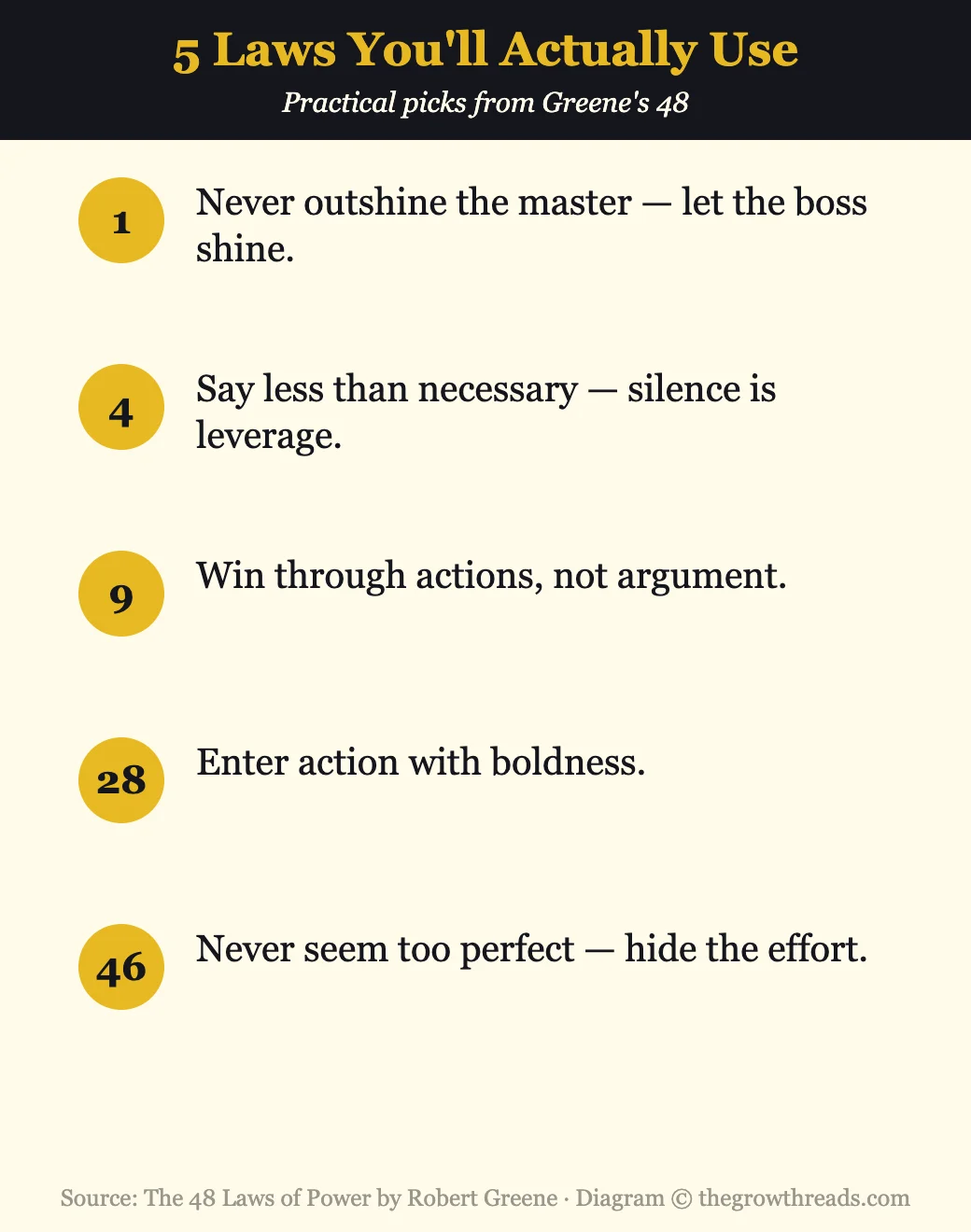
Perhaps the single most useful law for everyday life is Law 13 — appeal to self-interest, never to mercy or gratitude. When you need something, Greene advises, never remind people what you have done for them or plead your need; instead, show them what they stand to gain. It is not that gratitude does not exist, but that self-interest is far more reliable fuel. Pair this with Law 28 — enter action with boldness — and you get a simple operating principle: figure out what the other person wants, offer it plainly, and commit without visible hesitation. Half-measures, Greene insists, create more danger than bold ones, because timidity invites people to push back.
TGR Note: Greene’s influence is the cold, strategic version; How to Win Friends and Influence People is the warm one. Carnegie and Greene actually agree on the mechanics — appeal to the other person’s interests, avoid winning arguments, let people feel important — but differ in spirit. Most readers do best holding both: Carnegie’s sincerity as the default, Greene’s awareness as the armor for when sincerity isn’t being returned.
Part 4: The long game — patience, timing, and formlessness
The final movement of the book is about the discipline that separates lasting power from a lucky streak. Law 35 — master the art of timing — teaches that the same move can succeed or fail depending on when it is made; the powerful are patient, waiting for the moment to ripen rather than forcing it. Law 47 warns against going too far in the moment of victory: knowing when to stop is a rarer skill than knowing how to win, and overreach has undone more powerful people than weakness ever did.
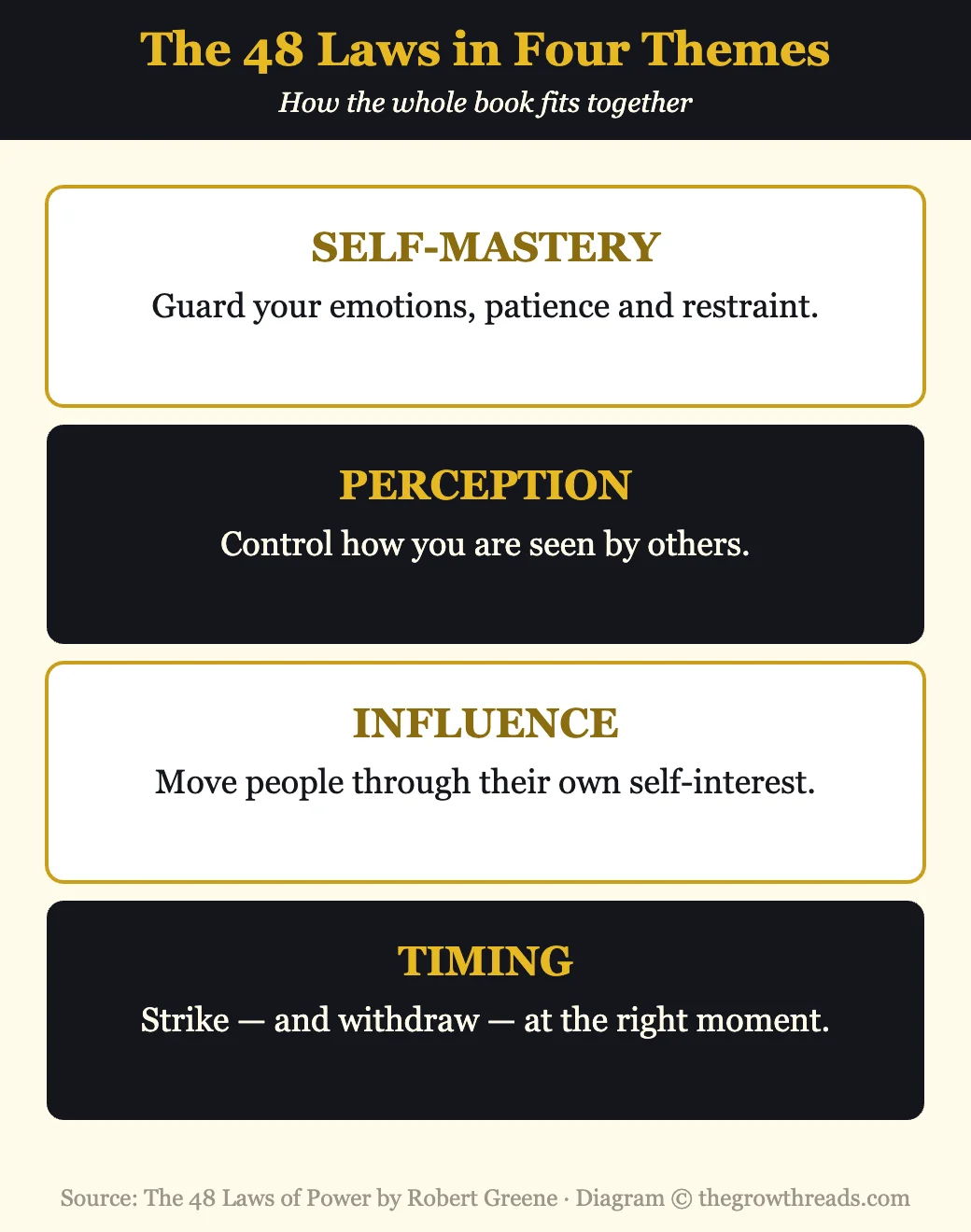
Greene closes the collection with Law 48 — assume formlessness. Rigid plans and fixed reputations become targets; the adaptable person, who never commits to a single predictable shape, is impossible to counter. This is where the book circles back to self-mastery: the ultimate power is not a clever tactic but the flexibility, patience, and emotional control to choose the right tactic for the moment. The laws are tools; the wisdom is in the wielding.
TGR Note: The deepest reading of Greene is not “control others” but “stop being controlled.” That is the same liberation The Courage to Be Disliked and The Subtle Art of Not Giving a F*ck arrive at from the opposite direction — caring less about others’ approval. Power over yourself, it turns out, is the prerequisite for handling power around you.
Who is The 48 Laws of Power best for — and who should read something else first?
This book is ideal for anyone navigating competitive environments — corporate politics, entrepreneurship, negotiation, creative industries — who keeps getting blindsided and wants to understand why. It is also a fascinating history read, since every law is a doorway into a great story. It is not the right first book if what you need is warmth and trust-building; for that, start with How to Win Friends and Influence People. And if you find the tactics leaving a bad taste, balance them with Ego Is the Enemy or 12 Rules for Life, which argue that character, not maneuvering, is the more durable foundation.
Questions to reflect on
- Where in your life are you “not playing politics” — and is that actually protecting you, or just leaving the board to others?
- When did talking too much last cost you? What would saying less have changed?
- Whose self-interest do you need to understand better to get something you want?
- Which of your recent moves came from wounded pride rather than clear strategy?
- Where are you being too rigid and predictable — and what would formlessness look like there?
🔥 Ready to see the whole board?
This guide is the map — Greene’s historical stories are what make the laws impossible to forget.
How to apply The 48 Laws of Power (7-day plan)
- Day 1 — Map the players. Write down who actually holds influence in your workplace or field, regardless of title. Awareness starts with an honest map.
- Day 2 — Practice saying less. In one conversation, resist the urge to over-explain. Notice what the other person reveals when you leave silence.
- Day 3 — Make your boss look good. Find one way to credit or support a superior publicly this week (Law 1).
- Day 4 — Reframe an ask around self-interest. Take something you need and rewrite the request in terms of what the other person gains (Law 13).
- Day 5 — Win with an action. Instead of arguing a point, prove it — send the result, the demo, the number (Law 9).
- Day 6 — Spot a law used on you. Identify one moment this week where someone played a move from the book. Naming it removes its power.
- Day 7 — Choose your restraint. Pick one situation where the powerful move is to wait, not act. Practice timing (Law 35).
Frequently asked questions
Is The 48 Laws of Power worth reading?
Yes, provided you read it as a description of how power works rather than a moral instruction manual. It is one of the most insightful catalogues of human behavior in competitive settings ever written, and its historical stories make the lessons genuinely memorable. Readers who approach it defensively — learning the tactics so they can recognize them — get the most value. It is long (around 450 pages) but built from short, self-contained laws, so it is easy to read in pieces and return to as a reference.
What is the main message of The 48 Laws of Power?
That power is a social game governed by recognizable patterns, and that seeing those patterns clearly protects you whether or not you choose to use them. Greene argues that pretending power dynamics do not exist leaves you vulnerable to people who understand them. The deeper message, easy to miss, is about self-mastery: emotional control, patience, and timing matter more than any single clever tactic.
Is The 48 Laws of Power evil or manipulative?
The book describes manipulative tactics, but describing is not endorsing. Greene catalogues what has historically worked in the pursuit of power, much as a book on persuasion or negotiation would. The ethics live in how a reader applies it. Used to exploit others, the laws are harmful; used to recognize manipulation and protect yourself, they are a form of literacy. Most thoughtful readers treat it as a decoder ring, not a rulebook.
How long does it take to read The 48 Laws of Power?
The book runs about 450 pages and most readers take roughly 15 hours to finish it, though its structure makes that misleading — each law stands alone, so you can read one in a few minutes and dip in and out for months. Many people keep it as a reference rather than reading it cover to cover. Our summary above captures the core ideas in about 17 minutes.
Which laws from The 48 Laws of Power are most useful?
For everyday life, a handful stand out: never outshine the master (managing up), say less than necessary (silence as leverage), win through actions not argument, appeal to self-interest rather than mercy, and enter action with boldness. These are practical, broadly ethical, and immediately applicable at work. The deeper laws about timing, patience, and formlessness reward longer-term strategic thinking.
Should beginners read The 48 Laws of Power?
It is accessible to anyone — the writing is clear and story-driven, requiring no background. That said, beginners to self-development often benefit from pairing it with a warmer book like How to Win Friends and Influence People so the picture is balanced. On its own, the book can feel cynical; alongside a book about trust and character, it becomes a well-rounded education in how people actually behave.
Does The 48 Laws of Power tell you how to use power ethically?
Not directly — Greene deliberately withholds moral commentary and lets the historical cases speak. That neutrality is why the book unsettles some readers. The ethical framework has to come from you. The most constructive approach is to use the laws primarily for awareness and self-protection, and to apply the offensive tactics only in ways you would be comfortable having done to you. Awareness without cruelty is the sweet spot.
Related summaries
- The Subtle Art of Not Giving a F*ck Summary — power over your own attention and values.
- 12 Rules for Life Summary — character and responsibility as a foundation.
- The Courage to Be Disliked Summary — freedom from needing approval.
- Thinking, Fast and Slow Summary — the biases power players exploit.
- Browse all our best psychology books.
How we analyze books: We work from the full book — reconstructing its core arguments in our own words, adding commentary that connects it to related research and other books in our library, and pressure-testing the advice against how it plays out in real life. We never reproduce the text; we synthesize it. Read our full methodology.
Disclosure: The Growth Reads is reader-supported. When you buy through links on our site we may earn an affiliate commission at no extra cost to you. We only recommend books we believe are worth your time, and our summaries and opinions are written independently.
Related Psychology Summaries
Influence Summary & Review: The Psychology of Persuasion
Lost Connections Summary & Review: Depression Isn’t All in Your Head
On the Move Summary & Review: A Neurologist’s Extraordinary Life of Curiosity and Courage
Self-Compassion Summary and Review
The Anxious Generation Summary & Review: How Phones Rewired Childhood