

★★★★★ 4.6/5 — The operating manual that turns a founder’s vision into a business that runs without the founder holding every piece together.
Best for: Founders and leadership teams of small-to-midsize businesses (roughly 10-250 people) who feel like they’re the bottleneck for every decision.
Reading time: ~5 hrs to read the full book · ~25 min for this guide
Difficulty to apply: Moderate to understand, high commitment to run — this is a full operating system, not a single habit
Traction in one minute
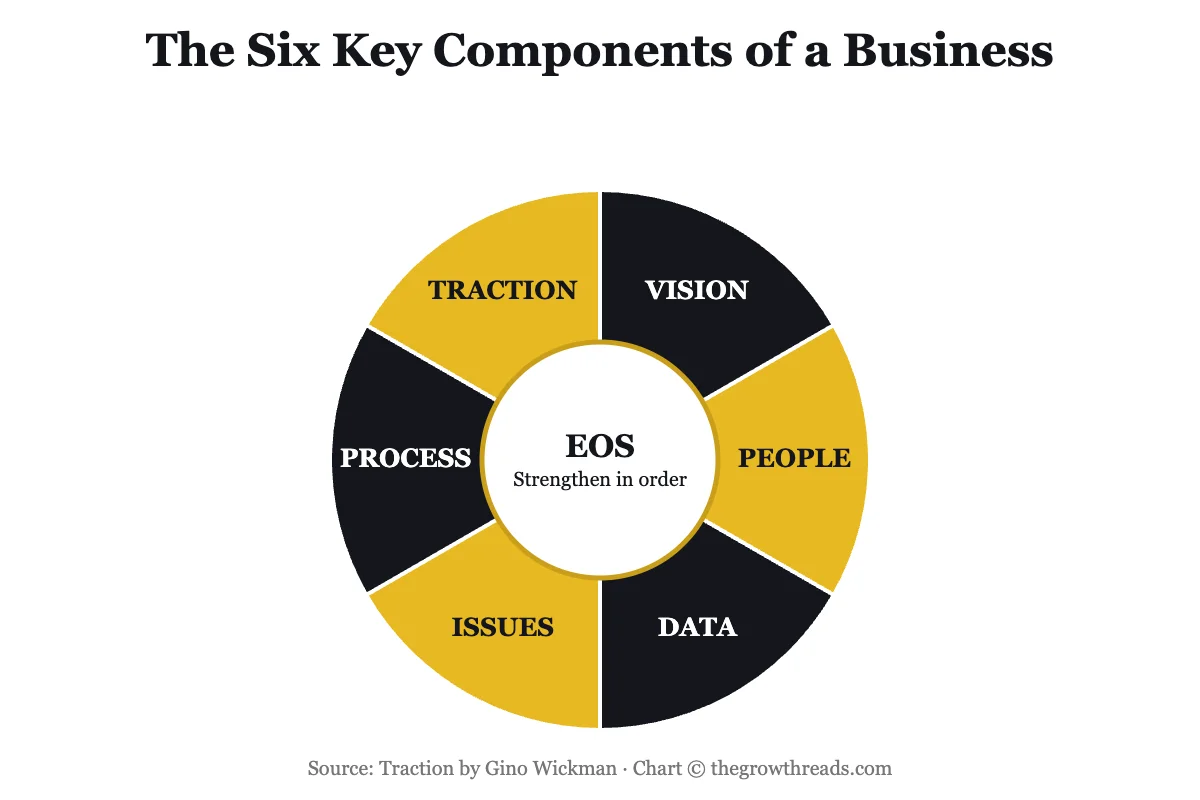
Most businesses don’t have a strategy problem — they have a discipline problem. Gino Wickman spent years coaching entrepreneurial companies and noticed the same six areas breaking down again and again: an unclear vision, the wrong people in the wrong seats, no reliable data, unresolved issues piling up, inconsistent processes, and a lack of follow-through. His answer is the Entrepreneurial Operating System (EOS) — a complete, practical framework built around six components that, strengthened in order, turn a founder’s vision into something the whole team can actually execute. Traction isn’t a collection of leadership philosophy; it’s closer to an installation manual, with named tools (the V/TO, the Accountability Chart, Rocks, the Scorecard, IDS, the Level 10 Meeting) that a leadership team can start using in its very next meeting.
Key takeaways
- Six components, strengthened in order: Vision, People, Data, Issues, Process, and Traction — weakness in any one caps how far the others can take you.
- Vision means everyone can repeat it: If your leadership team can’t recite your core values, target market, and 10-year target the same way, you don’t have a vision — you have an idea in your head.
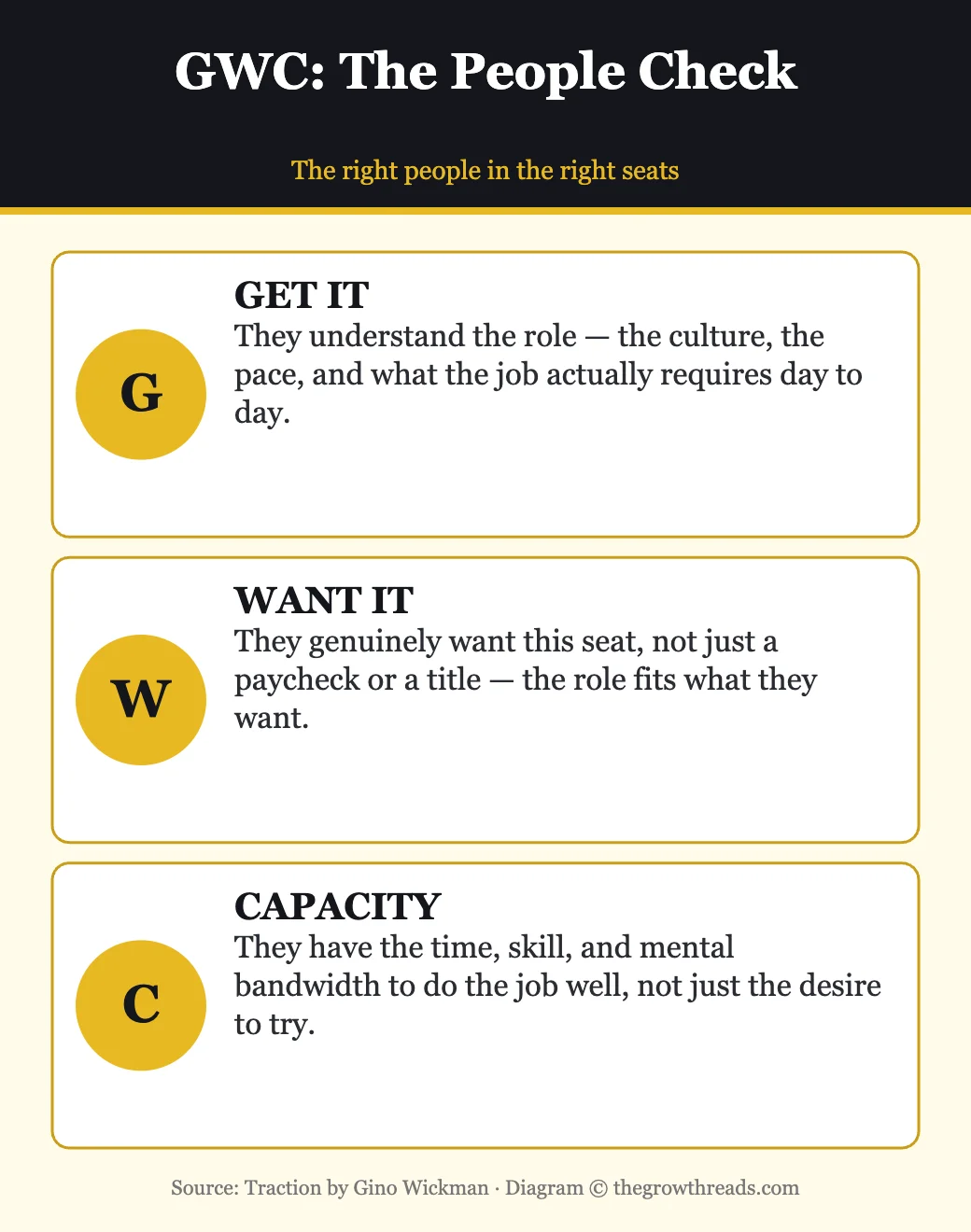
- Right people, right seats: “Right people” fit your culture (measured by core values); “right seat” means they pass the GWC test — they Get it, Want it, and have the Capacity to do it.
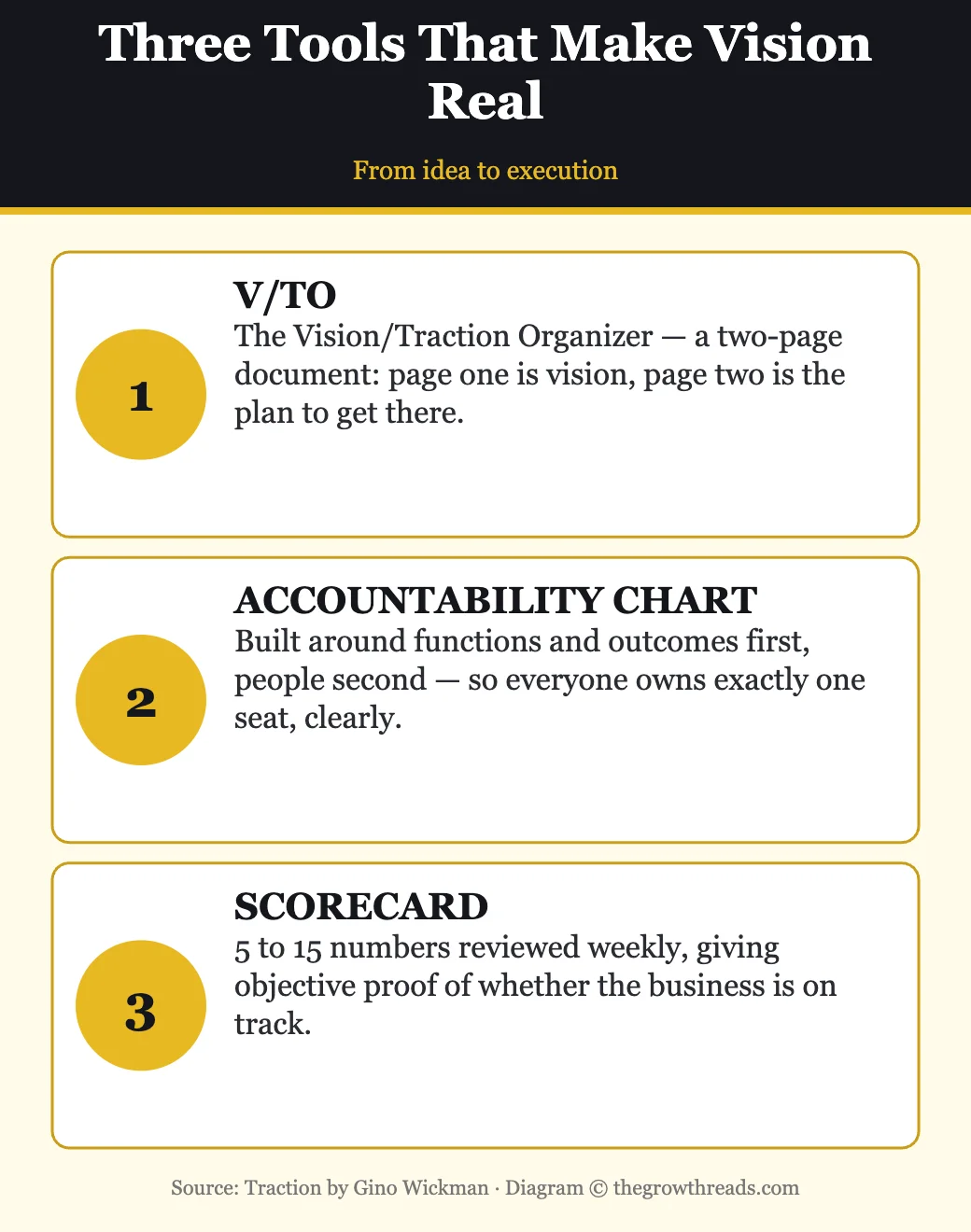
- The Accountability Chart beats the org chart: Define the seats and outcomes a healthy business needs first, then decide which people fill them — not the reverse.
- Rocks are your 90-day translation of the vision: 3 to 7 priorities per person, per quarter, each with one owner — long enough to matter, short enough to stay urgent.
- The Scorecard replaces gut feel with numbers: 5 to 15 weekly metrics give a leadership team an early warning system instead of a monthly surprise.
- IDS is where issues actually die: Identify, Discuss, Solve — a disciplined way to stop the same problem from resurfacing meeting after meeting.
- The Level 10 Meeting is the heartbeat: One structured 90-minute weekly meeting, same agenda every time, is what makes every other tool stick.
- Traction is the proof, not the plan: Vision and tools mean nothing without the discipline to execute — traction is what you get when the other five components hold.
- This is a system, not a single tactic: Wickman is explicit that picking one tool (say, just the Scorecard) without the rest gets partial results — EOS compounds when the components run together.
What is Traction about?
Traction presents the Entrepreneurial Operating System (EOS), a complete framework of six components — Vision, People, Data, Issues, Process, and Traction — that entrepreneurial leadership teams strengthen in order to turn a founder’s vision into a business that executes consistently, instead of depending on the founder to hold everything together personally.
About the author
Gino Wickman started his first business at 21, and at 25 took over his family’s struggling company, which was deeply in debt. After turning it around over seven years and successfully selling it, he distilled what he’d learned into the Entrepreneurial Operating System — a practical method for helping companies clarify their vision and execute on it. He went on to cofound EOS Worldwide, now one of the largest business-coaching organizations of its kind, and has authored or co-authored eight books, including Get a Grip, Rocket Fuel, and The Entrepreneurial Leap. Traction, first published in 2007 and expanded in 2012, has sold more than 2 million copies and become the standard reference for thousands of companies running on EOS. Explore all Gino Wickman book summaries →
Key concepts at a glance
| Concept | What it means | Use it when |
| Six Key Components | Vision, People, Data, Issues, Process, Traction — the framework’s six areas of strength | You’re diagnosing where your business is breaking down |
| V/TO | Vision/Traction Organizer — a two-page document capturing vision and the plan to execute it | Your leadership team can’t agree on where the company is headed |
| GWC | Get it, Want it, Capacity to do it — the test for whether someone is in the right seat | You’re deciding whether someone belongs in their current role |
| Accountability Chart | A chart of functions and outcomes first, people second, unlike a traditional org chart | Roles and ownership feel unclear or overlapping |
| Rocks | The 3-7 most important 90-day priorities for a person or team | Your to-do list has too many “priorities” to actually finish any of them |
| Scorecard | 5-15 weekly metrics that give objective, leading proof of performance | You only find out about problems after they’ve already hurt results |
| IDS | Identify, Discuss, Solve — the method for permanently resolving issues | The same problem keeps coming up meeting after meeting |
| Level 10 Meeting | A fixed 90-minute weekly leadership meeting agenda | Your meetings run long, wander off-topic, or don’t produce decisions |
The Six Key Components
Wickman’s core claim is that every business, regardless of industry, has the same six areas that need strengthening: Vision (does everyone see and agree on where you’re going), People (do you have the right people in the right seats), Data (do you manage with a handful of numbers instead of gut feel), Issues (do problems actually get solved, or just discussed), Process (are your core processes documented and followed the same way by everyone), and Traction (does the team execute with discipline and accountability). He argues these components should be strengthened roughly in that order, because weakness upstream — a fuzzy vision, for instance — makes it much harder to fix the components that depend on it.
The Vision component starts with the V/TO (Vision/Traction Organizer), a two-page document intentionally kept simple: page one captures the vision (core values, core focus, 10-year target, marketing strategy, 3-year picture), page two turns it into a 1-year plan and quarterly Rocks. Wickman is blunt that most leadership teams think they have a shared vision until they try to write it down individually and compare notes — the gaps that surface are usually the real reason strategy conversations go in circles.
Right People, Right Seats
Once vision is clear, Wickman turns to People — and specifically to a distinction he insists most companies get wrong: “right people” and “right seat” are two separate questions. A right person fits your culture, measured against a short list of core values you’ve actually written down and use in hiring and firing decisions. A right seat is a role someone passes the GWC test for: do they Get it (understand what the role really requires), Want it (genuinely desire the responsibility, not just the title or paycheck), and have the Capacity to do it (the time, skill, and mental bandwidth). A great culture fit in the wrong seat is still a problem — and so is a highly skilled person who is a poor culture fit.
To make ownership unambiguous, Wickman recommends building an Accountability Chart before deciding who goes where — the opposite order of a traditional org chart. You first define the functions and outcomes a healthy business of your size needs (sales, marketing, operations, finance), then decide which real people should occupy those seats. This flips a common failure mode where a chart gets built around the people you already have, quietly preserving unclear ownership and duplicated work.
Rocks, the Scorecard, and the V/TO in Practice
With vision and people in place, Wickman moves to Data and the mechanics of execution. Rocks are the 3 to 7 most important priorities a person or team commits to finishing in the next 90 days — short enough to stay urgent, long enough to actually matter, and each with exactly one owner so there’s no ambiguity about who’s accountable. Alongside Rocks sits the Scorecard: 5 to 15 leading numbers reviewed every single week, chosen specifically because they predict problems before they show up in a monthly P&L. Together, the V/TO, Rocks, and Scorecard form a chain from 10-year vision down to this week’s numbers — each tool translating the one above it into something more concrete and closer to today.
Wickman is careful to note that a Scorecard is not the same as a dashboard full of every metric you can measure — the discipline is picking the handful of numbers that actually predict trouble, and reviewing them weekly without fail, not the sophistication of the reporting. Many teams start with a Scorecard that’s too broad, then prune it down after a few weeks once they see which numbers actually change the conversation and which ones nobody ever looks at.
The Level 10 Meeting and IDS
Every tool in EOS ultimately routes through one weekly ritual: the Level 10 Meeting, a fixed 90-minute agenda that Wickman insists should never change once adopted. It runs Segue (a quick personal and business check-in), Scorecard review, Rock review, customer and employee headlines, a to-do list review — and then 60 of the 90 minutes on IDS: Identify, Discuss, Solve. IDS is deliberately the largest block, because most leadership meetings fail not from lack of information but from spending all their time reporting status and none of it actually resolving anything.
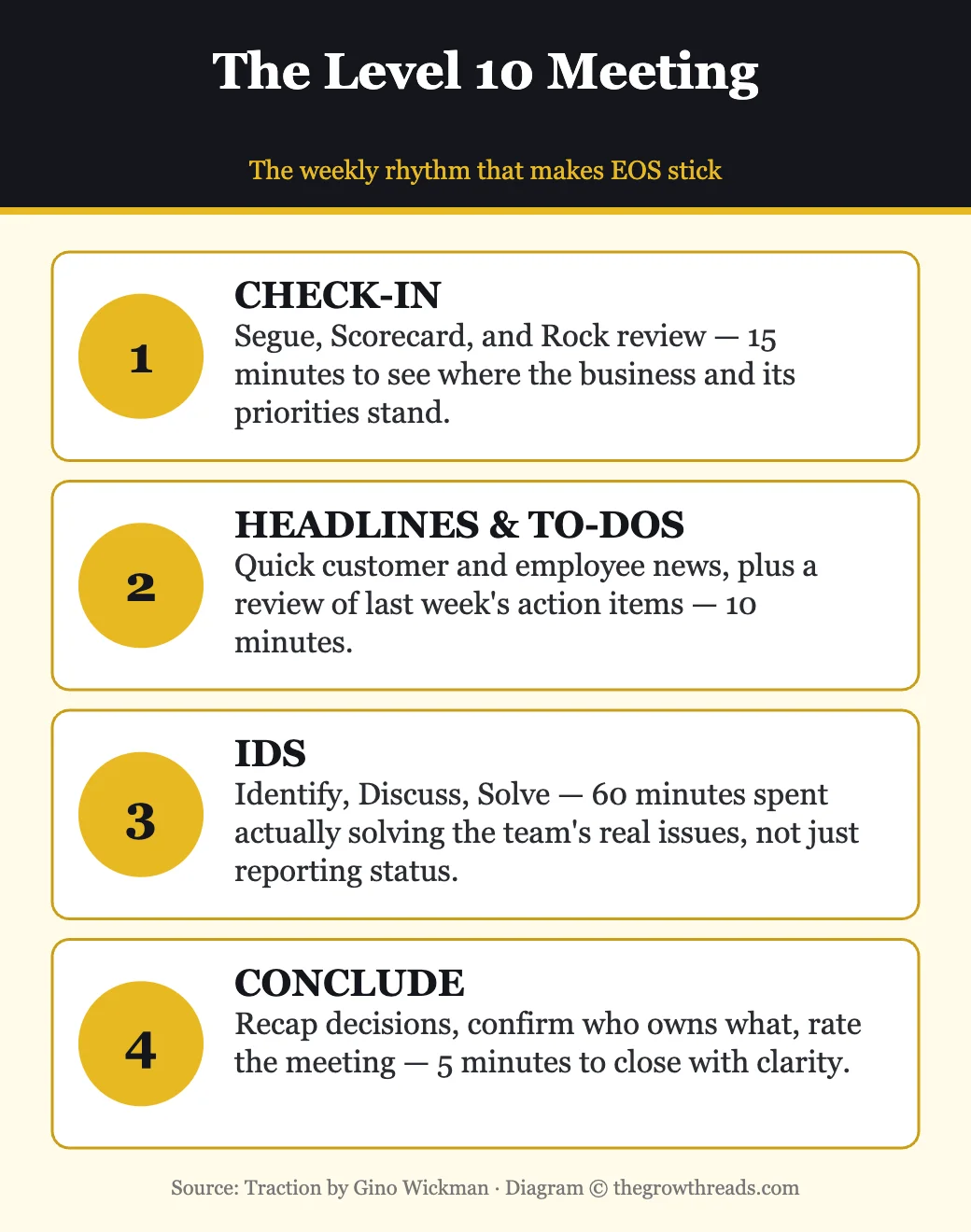
In an IDS conversation, the team first identifies the real, root issue (not just its symptom), then discusses it openly until everyone with something relevant to say has spoken, then commits to a solution with a named owner and a deadline — closing the loop instead of leaving it to resurface next week. Wickman argues this single habit, run consistently, is what separates companies that feel perpetually busy from companies that actually get unstuck. Teams new to IDS often find the hardest part isn’t solving issues — it’s resisting the urge to solve every issue outside the meeting instead of saving it for the dedicated block.
Who is Traction best for — and who should read something else first?
Traction is best for founders and leadership teams of small-to-midsize businesses, roughly 10 to 250 employees, who feel like every decision routes through them personally and want a complete operating system rather than a single technique. It’s especially valuable for the classic “Visionary” founder paired with an “Integrator” operator — EOS gives that pairing a shared vocabulary and a weekly rhythm instead of ad hoc check-ins. It’s less suited to solo founders with no team yet, or to leaders in large enterprises where EOS’s assumptions about a single visionary and integrator don’t map cleanly onto a much larger org chart.
If your core problem is really about team trust and conflict rather than structure, start with The Five Dysfunctions of a Team instead. If you specifically need a hiring framework rather than a full operating system, The Ideal Team Player is a more targeted read.
Questions to reflect on
- If you asked each member of your leadership team to write down your company’s vision separately, how much would their answers actually agree?
- Is there anyone on your team who is a great culture fit but clearly failing the GWC test in their current seat?
- What are the 3-7 things that absolutely must get done in your business in the next 90 days — and does each one have exactly one owner?
- What 5-15 numbers would give you the earliest possible warning that something is going wrong?
- What issue has come up in your team’s last three meetings without ever actually getting solved?
🔥 Ready to get a grip on your business?
Get the full EOS toolkit, templates, and implementation guide in Traction.
How to apply Traction (7-day plan)
- Day 1: Draft your company’s core values and core focus in one page. Don’t overthink it — write what’s actually true today.
- Day 2: Write your 10-year target and 3-year picture in a few sentences each. Share it with one other leader and compare notes.
- Day 3: Build a first-draft Accountability Chart: list the functions and outcomes your business needs, before assigning any names.
- Day 4: Run a GWC check on your own seat and one direct report’s seat. Be honest about gaps.
- Day 5: Set your first 3-7 Rocks for the next 90 days, each with a single owner and a clear finish line.
- Day 6: Pick 5-7 numbers for a first-draft Scorecard — things you could realistically review every week.
- Day 7: Schedule a 90-minute Level 10 Meeting for next week using the fixed agenda, and list the top 3 issues you’ll bring to IDS.
Frequently asked questions
What is Traction by Gino Wickman about?
Traction presents the Entrepreneurial Operating System (EOS), a complete framework of six components — Vision, People, Data, Issues, Process, and Traction — that help entrepreneurial leadership teams turn a founder’s vision into a business that executes with discipline instead of depending entirely on the founder.
What is EOS (the Entrepreneurial Operating System)?
EOS is a practical operating system for running a business, built around six components strengthened in order: a clear Vision everyone shares, the right People in the right seats, objective Data instead of gut feel, a system for solving Issues permanently, documented Process, and disciplined Traction — the follow-through that turns plans into results.
What are Rocks in the Traction / EOS framework?
Rocks are the 3 to 7 most important priorities a person or team commits to completing in the next 90 days. Each Rock has a single, clearly accountable owner, and the 90-day window is chosen to be long enough to matter but short enough to stay urgent and trackable.
What is a Level 10 Meeting?
The Level 10 Meeting is EOS’s fixed 90-minute weekly leadership meeting agenda: a brief check-in, Scorecard and Rock review, customer and employee headlines, a to-do review, and 60 minutes of IDS (Identify, Discuss, Solve) dedicated to actually resolving the team’s real issues rather than just reporting status.
Is Traction only for large companies?
No — EOS is built specifically for small-to-midsize entrepreneurial businesses, generally in the range of roughly 10 to 250 employees. Very early solo-founder companies may find the full system premature, while very large enterprises often need to adapt it, since EOS assumes a single visionary and integrator leadership structure.
Is the EOS system in Traction too rigid for creative or fast-changing companies?
It’s a fair critique that some readers raise — EOS introduces real structure, and organizations that thrive on high flexibility or highly improvisational workflows may find parts of it restrictive. Most teams that stick with it report the tradeoff is worth it: less time in unproductive meetings and clearer ownership, even if it takes deliberate effort to keep the system from feeling bureaucratic.
What is GWC in Traction?
GWC stands for Get it, Want it, Capacity to do it — Wickman’s three-part test for whether someone is in the right seat. They need to understand the role (Get it), genuinely desire the responsibility (Want it), and have the time, skill, and bandwidth to do it well (Capacity) — missing any one of the three usually means it’s the wrong seat, regardless of how well they fit the company’s culture.
Related summaries
If Traction resonated, continue with The Five Dysfunctions of a Team, Measure What Matters, The Ideal Team Player, and Multipliers. For more, browse our full best leadership books list.
How we analyze books: our team reads the full book, cross-checks key studies and claims against original sources where possible, and builds original frameworks — diagrams, application plans, and reflection questions — rather than reproducing the book’s text. Read our full methodology.