

★★★★½ 4.7/5 — Chris Voss turns FBI hostage-negotiation tactics into a practical playbook for salary talks, sales calls, and family arguments alike.
Best for: Anyone who negotiates anything — salaries, prices, deadlines, or hard conversations at home.
Reading time: ~6 hrs for the full book · 12 min for this guide
Difficulty to apply: Easy to start, takes practice to master
Never Split the Difference in one minute
Negotiation isn’t a battle of arguments, it’s a search for information, and the tool for getting it is empathy, not aggression. For 24 years, Chris Voss talked kidnappers into releasing hostages for the FBI. Never Split the Difference distills that experience into a repeatable system: mirror, label, ask calibrated questions, and get your counterpart to say “that’s right” before numbers ever enter the room. Compromise, Voss argues, is often a bad deal dressed up as a fair one, the real win comes from understanding what the other side is actually afraid of losing.
Key takeaways
- Compromise is usually a loss disguised as fairness: “splitting the difference” often gets both sides a deal neither one wanted.
- Tactical empathy wins more than arguments do: demonstrating you understand the other side’s perspective, without agreeing with it, is more persuasive than logic.
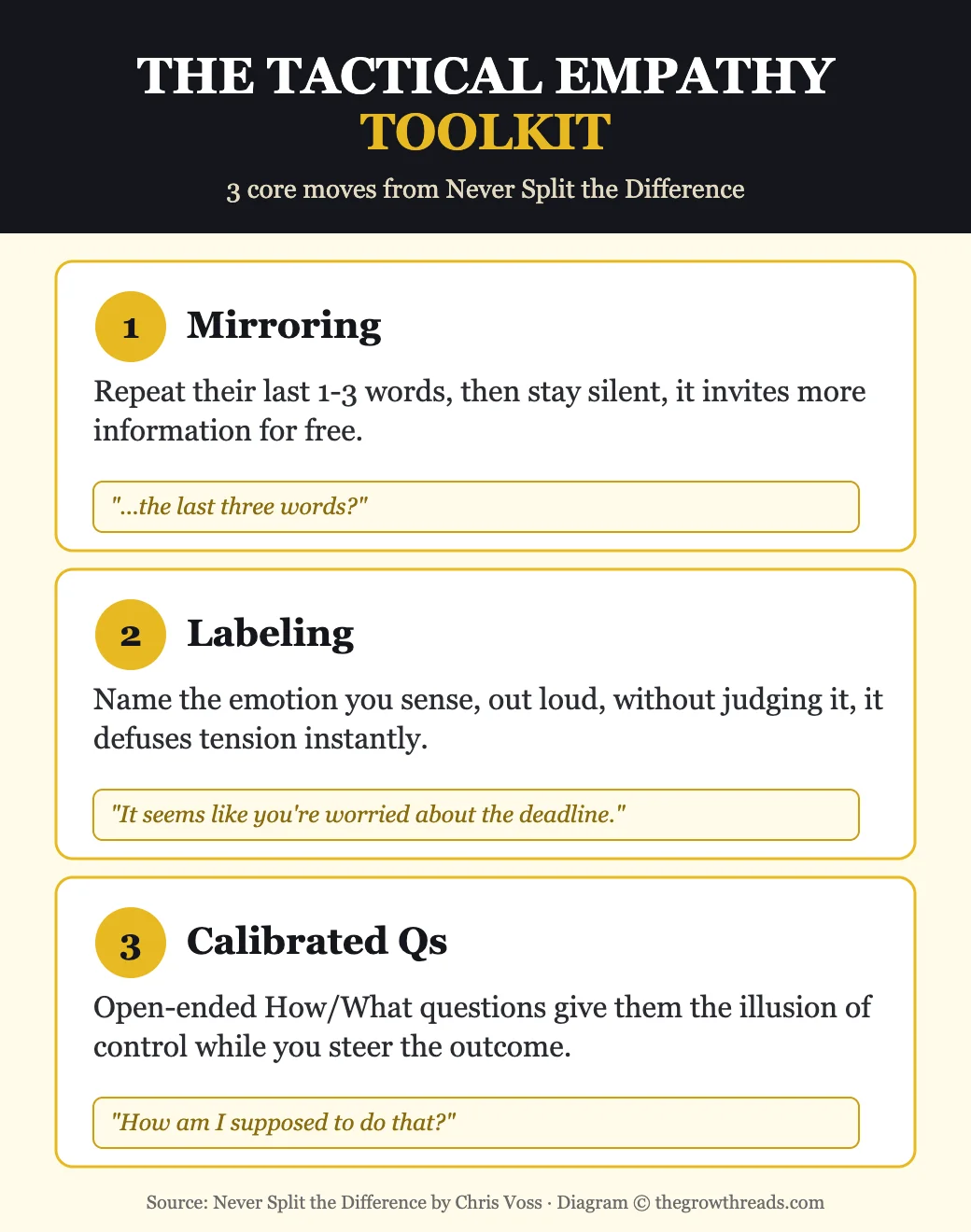
- Mirroring draws out information for free: repeat the last 1-3 words someone says, then stay silent, and they’ll elaborate unprompted.
- Labeling defuses emotion: naming a feeling out loud (“It seems like…”) lowers its grip on the conversation.
- A well-timed “no” protects people: it creates safety and starts real negotiation; pushing for an early “yes” usually backfires.
- Calibrated questions hand over the illusion of control: open “How” and “What” questions get your counterpart to solve your problem for you.
- “That’s right” beats “you’re right”: it’s the signal your counterpart feels truly understood, and that real change is now possible.
- The Rule of Three confirms a deal will hold: get the same agreement three separate ways before you trust it.
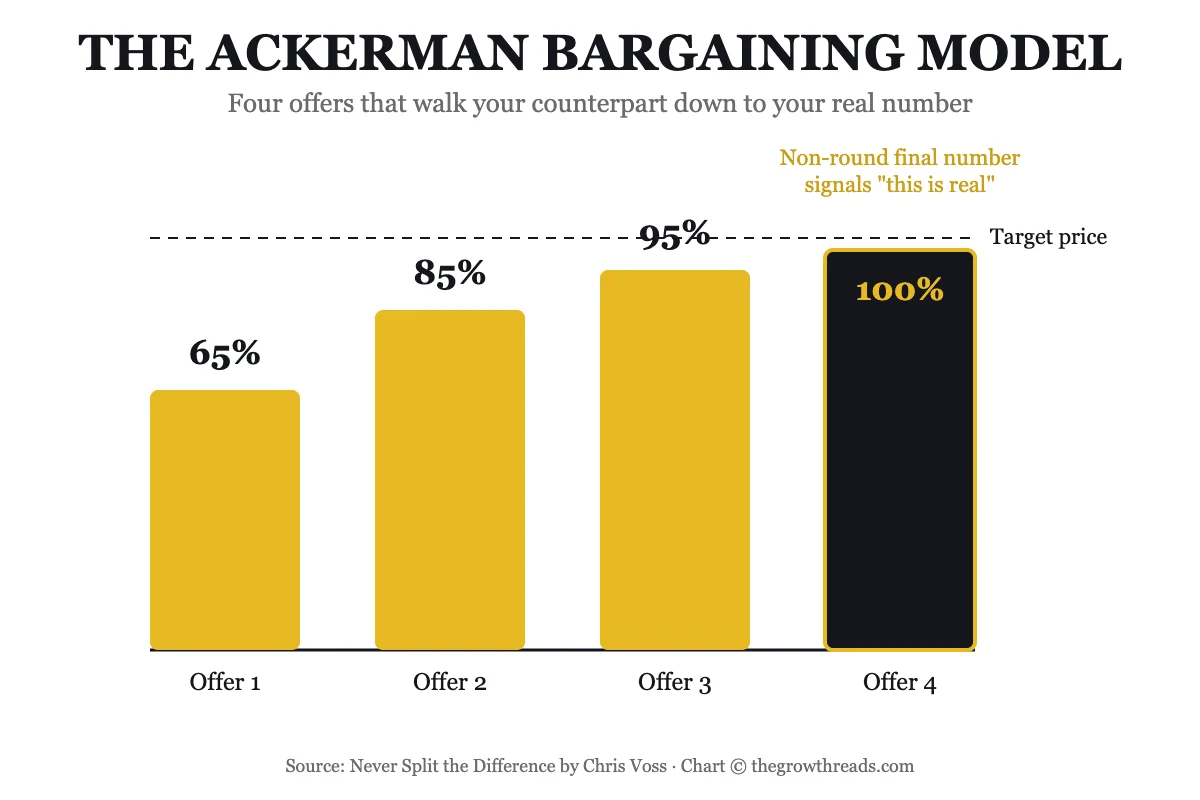
- The Ackerman model anchors price precisely: open extreme, then walk down in four shrinking, non-round steps.
- Every negotiation hides a Black Swan: an unknown piece of information that, once found, can reshape the entire deal.
What is Never Split the Difference about?
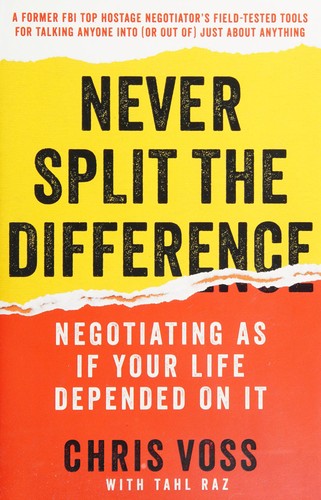
Never Split the Difference is a negotiation guide by former FBI hostage negotiator Chris Voss, written with Tahl Raz. It reframes negotiation as emotional intelligence rather than logic, teaching tactical empathy, mirroring, and calibrated questions to uncover what the other side actually wants, and reach outcomes better than a 50/50 compromise.
About the author
Chris Voss spent 24 years with the FBI, eventually becoming the Bureau’s lead international kidnapping negotiator, before retiring to found The Black Swan Group, which now teaches negotiation to Fortune 500 companies and MBA students at Georgetown, USC, and Harvard. His career carried him through bank robberies, prison uprisings, and hostage standoffs across the Philippines, Haiti, and the Middle East, where he learned that logic and pressure rarely move people, but feeling heard almost always does. Never Split the Difference, co-written with Tahl Raz, is his attempt to translate crisis-negotiation tactics into tools anyone can use at a negotiating table, in a salary review, or across the kitchen table. Explore all Chris Voss book summaries →
Key concepts at a glance
| Concept | What it means | Use it when |
|---|---|---|
| Tactical Empathy | Showing you understand the other side’s emotional state, without agreeing with their position | A negotiation stalls or turns adversarial |
| Mirroring | Repeating the last 1-3 words someone says, then pausing | You need more information without asking a direct question |
| Labeling | Naming an emotion you observe, out loud | Tension or hesitation is blocking progress |
| Calibrated Questions | Open “How” or “What” questions that hand over the illusion of control | You need the other side to solve your problem for you |
| “That’s Right” | The verbal signal that someone feels fully understood | Confirming you’ve reached the real issue, not just a brush-off |
| Ackerman Bargaining | A structured 4-offer anchoring sequence (65-85-95-100%) | Price negotiations with room to move |
| Black Swan | An unknown piece of leverage or information hidden in every deal | Late-stage negotiations that feel stuck |
Part 1: Why Compromise Is a Bad Deal
Chris Voss opens the book by demolishing an idea most of us were taught to admire: splitting the difference is fair. He learned otherwise on the streets, not in a classroom. As an FBI hostage negotiator working bank robberies, prison uprisings, and international kidnappings, Voss watched “textbook” negotiation theory, built around rational compromise, fall apart the moment real fear and emotion entered the room. Hostage-takers weren’t rational actors weighing a fair 50/50 split. They were terrified, cornered people whose decisions were driven almost entirely by emotion.
That observation became the foundation of the book: every negotiation, from a ransom demand to a used-car sale, is an emotional exchange wearing a rational costume. Splitting the difference doesn’t resolve that emotional undercurrent, it just papers over it, leaving both sides with a deal neither one actually wanted. A buyer who “meets in the middle” on price often feels cheated. A manager who compromises on a deadline both sides secretly knew was unrealistic just delays the same conflict. Voss’s alternative is tactical empathy, deliberately demonstrating that you understand the other person’s perspective, feelings, and constraints, without necessarily agreeing with any of it.
Tactical empathy is not soft. It is a deliberate information-gathering tool. When someone feels heard, their guard drops, and a dropped guard is when real information, the kind that actually moves a negotiation, starts to surface. Voss built two techniques to operationalize this: mirroring and labeling.
Mirroring means repeating the last one to three words your counterpart just said, then staying silent. It sounds almost too simple to work, but it triggers something automatic: people instinctively elaborate to fill the silence. A car salesman who mirrors “…thirty-two thousand?” instead of countering with a number invites the buyer to explain, unprompted, exactly why that price feels wrong to them, information a direct question would never have surfaced. Labeling goes a step further: naming the emotion you sense out loud, without judgment, using a soft opener like “It seems like…” or “It sounds like…”. Labeling a fear or frustration takes the air out of it. Once a feeling has been named, it loses some of its grip on the conversation, and the other person is far more likely to engage constructively.
Part 2: Bend Their Reality — Calibrated Questions and the Power of “No”
Most negotiation advice pushes toward “yes” as fast as possible. Voss argues that’s backwards. A premature “yes” is often a fake, a “counterfeit yes” someone gives just to end an uncomfortable conversation, and it rarely survives contact with reality. “No,” by contrast, makes people feel safe. It gives them a sense of control and protects their autonomy, which is exactly what lets them relax enough to actually negotiate. Voss recommends deliberately engineering a “no” early, sometimes by asking a question you know will be rejected, because a “no” is rarely the end of a conversation. It’s the beginning of a real one.
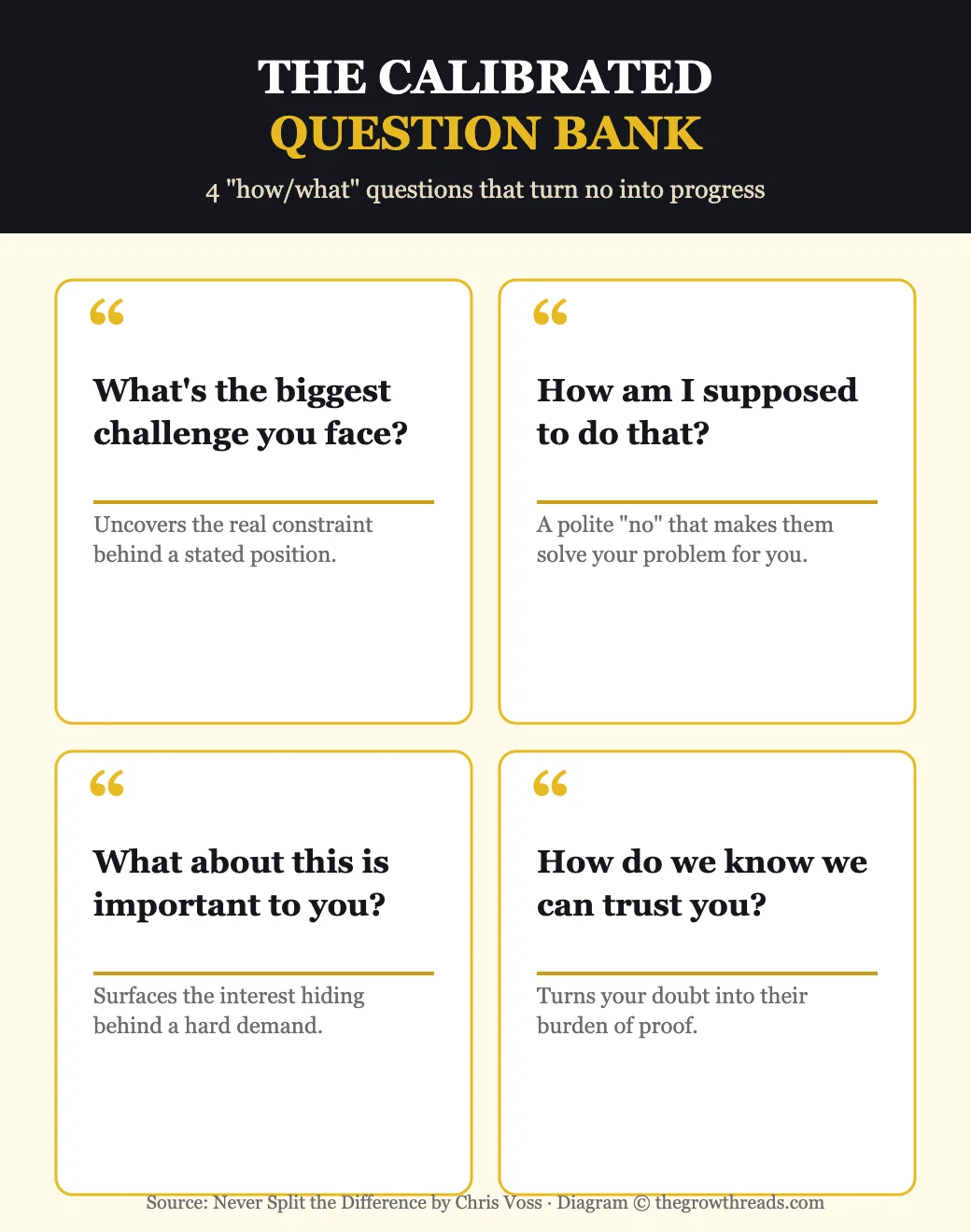
The tool for steering a conversation once someone feels safe is the calibrated question: an open-ended “How” or “What” question that hands your counterpart the illusion of control while you quietly guide them toward solving your problem. “How am I supposed to do that?” is Voss’s signature example. It sounds like a request for help, not a rejection, but it forces the other side to grapple with your constraints as if they were their own. Asked well, a calibrated question gets someone to argue your case for you.
Voss is careful to note what calibrated questions are not: they are not “why” questions, which tend to sound accusatory even when they aren’t meant to. And they are not a script to recite mechanically. The words matter less than the intent behind them, genuine curiosity about the other side’s constraints, paired with a clear sense of your own walk-away point. Used together, an early “no” and a well-placed calibrated question do something compromise never can: they surface the actual obstacle standing between two people and a deal, instead of just averaging two positions and calling it fair.
Part 3: Guarantee Execution — “That’s Right” and the Ackerman Model
Feeling understood and agreeing to act on it are two different things, and Voss devotes a full section to the gap between them. The tell he listens for is a specific phrase: “That’s right.” When someone says “that’s right” after you summarize their situation, it’s a signal that they feel genuinely, fully understood, and people who feel understood are dramatically more willing to change their behavior. “You’re right,” on the other hand, is often a brush-off, a way to end the conversation without actually agreeing to anything. Voss trains negotiators to summarize until they hear “that’s right,” not settle for “you’re right.”
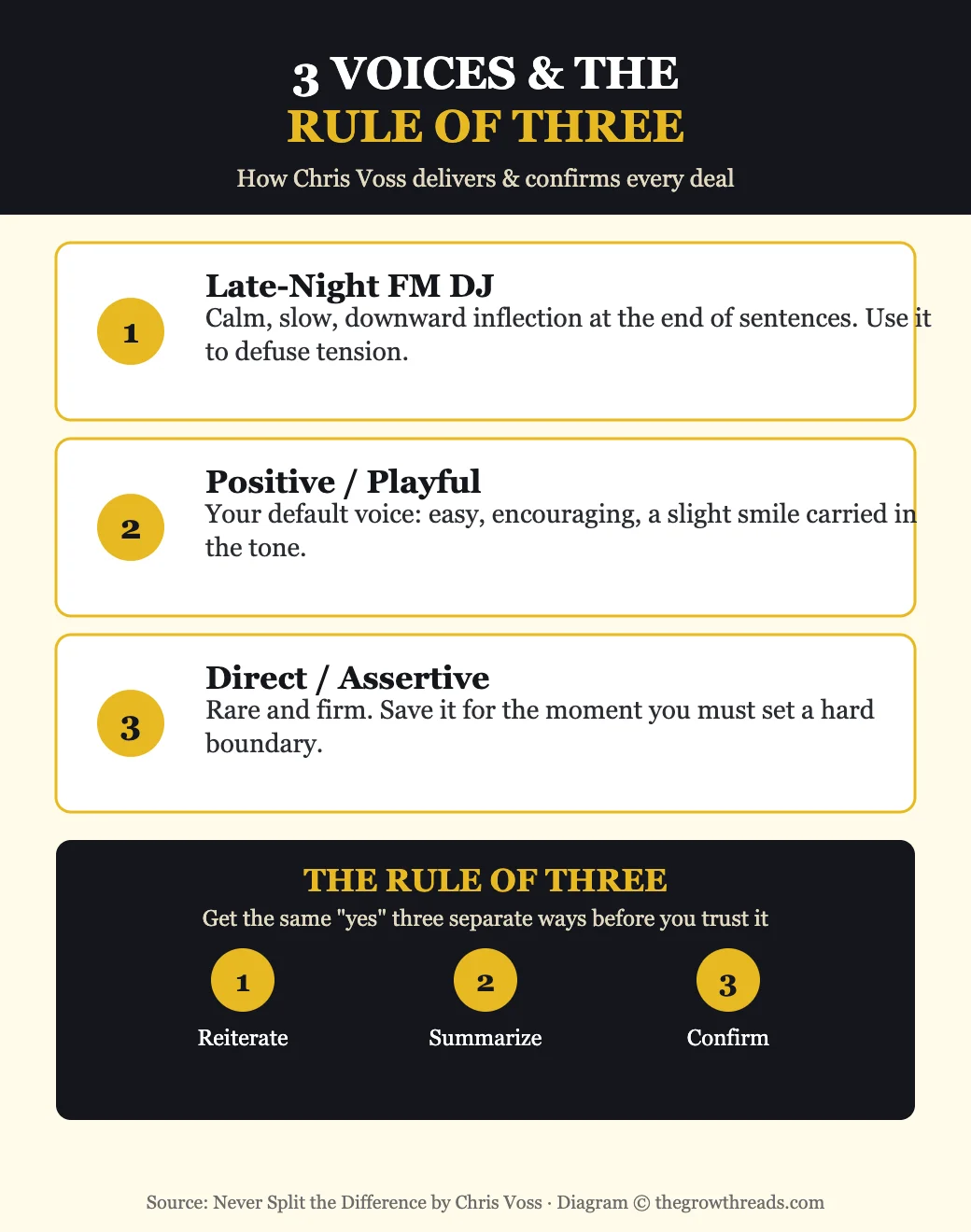
To make an agreement stick, Voss uses what he calls the Rule of Three: get your counterpart to confirm the same thing three separate times, in three different ways, before you trust that the deal will hold. The first confirmation might be a simple agreement, the second a written summary they approve, the third an answer to a calibrated question that would only make sense if they meant it. Liars, Voss notes from his hostage-negotiation days, struggle to stay consistent across three independent confirmations; people telling the truth rarely notice the repetition at all.
For the mechanics of price itself, Voss offers the Ackerman bargaining model, a four-step anchoring sequence he adapted from a former CIA officer. You start by setting your target price, then open extremely, around 65% of it, before making three further offers at 85%, 95%, and finally 100%, each one smaller than the last. The final offer is deliberately a non-round number, like $37,850 instead of $38,000, because odd numbers read as a genuine final calculation rather than an arbitrary stopping point. The shrinking size of each move also signals, without a word of explanation, that you’re running out of room.
Part 4: Know Who You’re Really Negotiating With
Voss closes the book with what he considers the most valuable and most overlooked tool in negotiation: the Black Swan. Borrowed from Nassim Taleb’s term for an unpredictable, high-impact event, Voss’s Black Swans are hidden pieces of information, unknown unknowns, that neither side realizes are on the table until someone finds them. A hostage-taker’s unexpected financial deadline. A buyer’s real reason for needing to close before a specific date. A colleague’s fear of losing face in front of a specific person. Every negotiation, Voss argues, contains at least three Black Swans, and finding even one can reshape the entire deal.
Finding them isn’t about clever questioning alone. It requires close, patient listening for inconsistencies, hesitations, and offhand comments that don’t quite fit the story being told. Voss’s negotiators are trained to notice what’s not said as carefully as what is, because the gap between the two is usually where the real leverage lives.
The final chapters turn outward, applying every tool in the book, tactical empathy, mirroring, labeling, calibrated questions, the Rule of Three, and Ackerman bargaining, to ordinary life: salary negotiations, buying a car, disagreeing with a spouse, negotiating with a teenager. Voss’s larger claim is that negotiation isn’t a specialized skill reserved for lawyers and hostage negotiators. It’s simply what happens whenever two people want different things and have to reach an agreement, which is to say, it’s most of daily life. The same tools that talked a kidnapper into releasing a hostage work, scaled down, on a landlord who won’t fix the heat.
Who is Never Split the Difference best for — and who should read something else first?
This book earns its reputation with anyone who negotiates regularly and dreads it: professionals asking for a raise, freelancers pricing a project, managers mediating a team conflict, or parents negotiating bedtime with a determined seven-year-old. Its biggest strength is how directly the tools translate from page to real conversation, most readers use a calibrated question within a day of finishing a chapter.
If you want a broader theoretical grounding in negotiation before diving into tactics, pair this with Crucial Accountability, which spends more time on the groundwork of holding people to commitments once a deal is struck. If your negotiations are mostly cross-cultural, read The Culture Map alongside this one, since Voss’s tactics were built primarily on American and Western negotiating norms.
Questions to reflect on
- Think of a recent negotiation that ended in a “compromise” you didn’t love, what did each side actually lose by splitting the difference?
- Where in your life could a well-placed “no” open up a conversation instead of shutting it down?
- What’s one calibrated “How” or “What” question you could ask this week instead of pushing for agreement?
- Whose perspective have you not yet labeled out loud in a conversation that feels stuck?
- What’s a “Black Swan,” a piece of information you don’t yet have, that could change your next negotiation?
🔥 Ready to negotiate like an FBI agent?
Get Never Split the Difference and start using tactical empathy this week.
How to apply Never Split the Difference (7-day plan)
- Day 1: Notice your default negotiating style, do you rush to “yes,” or avoid conflict altogether? Write down one recent example.
- Day 2: Practice mirroring in three low-stakes conversations today: repeat the last three words someone says, then pause.
- Day 3: Try labeling once, out loud, in a conversation where you sense tension, “It seems like…”.
- Day 4: Replace one direct request with a calibrated “How” or “What” question and note how the response changes.
- Day 5: Before your next request for agreement, aim for a “no” first, then follow with a calibrated question.
- Day 6: Identify one real, small negotiation this week, a bill, a deadline, a price, and apply the Ackerman model.
- Day 7: Review your notes from the week. Which single tool made the biggest difference, and where will you use it next?
Frequently asked questions
What is the main idea of Never Split the Difference?
The main idea is that negotiation is an emotional process, not a purely rational one, so tools that build trust and surface information, like tactical empathy, mirroring, and labeling, work better than logical arguments or splitting the difference. Chris Voss argues that a fair-sounding compromise usually leaves both sides worse off than a deal built on genuinely understanding what the other party fears losing. The book’s tools are designed to uncover that hidden information quickly, in negotiations as different as hostage crises and salary reviews, using the same underlying psychology.
Is Never Split the Difference based on real FBI negotiations?
Yes. Chris Voss spent 24 years with the FBI, including as the Bureau’s lead international kidnapping negotiator, and the book draws directly on real cases: bank robberies, prison uprisings, and kidnapping negotiations in the Philippines, Haiti, and the Middle East. Names and some details are altered for privacy and security, but the tactics, mirroring, labeling, calibrated questions, and the Ackerman model, are the same ones Voss and his colleagues used and taught inside the Bureau’s Crisis Negotiation Unit before he adapted them for business and everyday negotiations.
What is tactical empathy?
Tactical empathy is deliberately demonstrating that you understand the other side’s perspective, emotions, and constraints, without necessarily agreeing with their position. It differs from ordinary empathy because it’s used strategically to build trust and lower defenses, which makes people more willing to share real information. Voss considers it the foundation the rest of the book’s techniques, mirroring, labeling, and calibrated questions, are built on, since none of them work if the other person doesn’t first feel genuinely heard rather than manipulated.
What is the Ackerman bargaining method?
The Ackerman method is a four-step price-anchoring sequence: set your real target price, then open at roughly 65% of it, and make three further offers at 85%, 95%, and 100%, each increase smaller than the last. The final offer should be a non-round number, such as $37,850 rather than $38,000, since precise figures read as a genuine final calculation instead of an arbitrary stopping point. The shrinking size of each move also signals, without saying so, that you’re approaching your real limit.
Does Never Split the Difference work outside high-stakes situations, like everyday life?
Yes, that’s the core argument of the book’s final chapters. Voss maintains that negotiation is simply what happens whenever two people want different things and must reach an agreement, which describes most of daily life: salary conversations, buying a car, disagreeing with a partner, or negotiating a bedtime with a child. The same core tools, tactical empathy, mirroring, and calibrated questions, scale down from hostage crises to ordinary disagreements without needing any real modification.
How is Never Split the Difference different from other negotiation books like Getting to Yes?
Where classic negotiation theory (like the Harvard-style “principled negotiation” approach) emphasizes rational interests and mutually beneficial trade-offs, Voss argues that approach breaks down under real emotional pressure, exactly the conditions of a hostage crisis. Never Split the Difference instead centers emotion and psychology first: reading feelings, building trust through tactical empathy, and using specific verbal tools like mirroring and labeling before ever discussing terms. It’s less a framework for structuring a deal and more a field manual for reading and influencing the person across the table.
What is a “Black Swan” in negotiation?
A Black Swan is an unknown piece of information or leverage hidden in a negotiation that neither side initially realizes is relevant, borrowed from Nassim Taleb’s term for a rare, high-impact event. Examples include a hidden deadline, an unstated fear of losing face, or a financial pressure the other side hasn’t mentioned. Voss argues every negotiation contains at least three Black Swans, and finding even one, through close listening for inconsistencies and unstated concerns, can reshape the entire deal in your favor.
Related summaries
- Crucial Accountability Summary & Review
- The Culture Map Summary & Review
- The Five Dysfunctions of a Team Summary & Review
- Radical Candor Summary & Review
- Best Leadership Books
How we analyze books: Every TGR summary is built from a full read of the source material, cross-checked against the author’s interviews and published essays, and structured around practical, repeatable actions rather than abstract theory. Read our full methodology.
Related Leadership Summaries
Leadership Is Language Summary & Review: The Power of What You Say
The Coaching Habit Summary & Review: Say Less, Ask More, Lead Better
The Motive Summary & Review: Why You Lead Matters Most
The Score Takes Care of Itself Summary and Review
Tribal Leadership Summary & Review: Upgrade Your Team from Stage 3 to Stage 4