

★★★★★ 4.6/5 — Stress isn’t your enemy. Your beliefs about it are.
Best for: Anyone who feels crushed by stress and wants a science-backed way to turn it into fuel instead of fear.
Reading time: ~9 min summary (book: ~7 hrs)
Difficulty to apply: Easy — the core skill is a 10-second mindset shift you can practice today.
The Upside of Stress in one minute
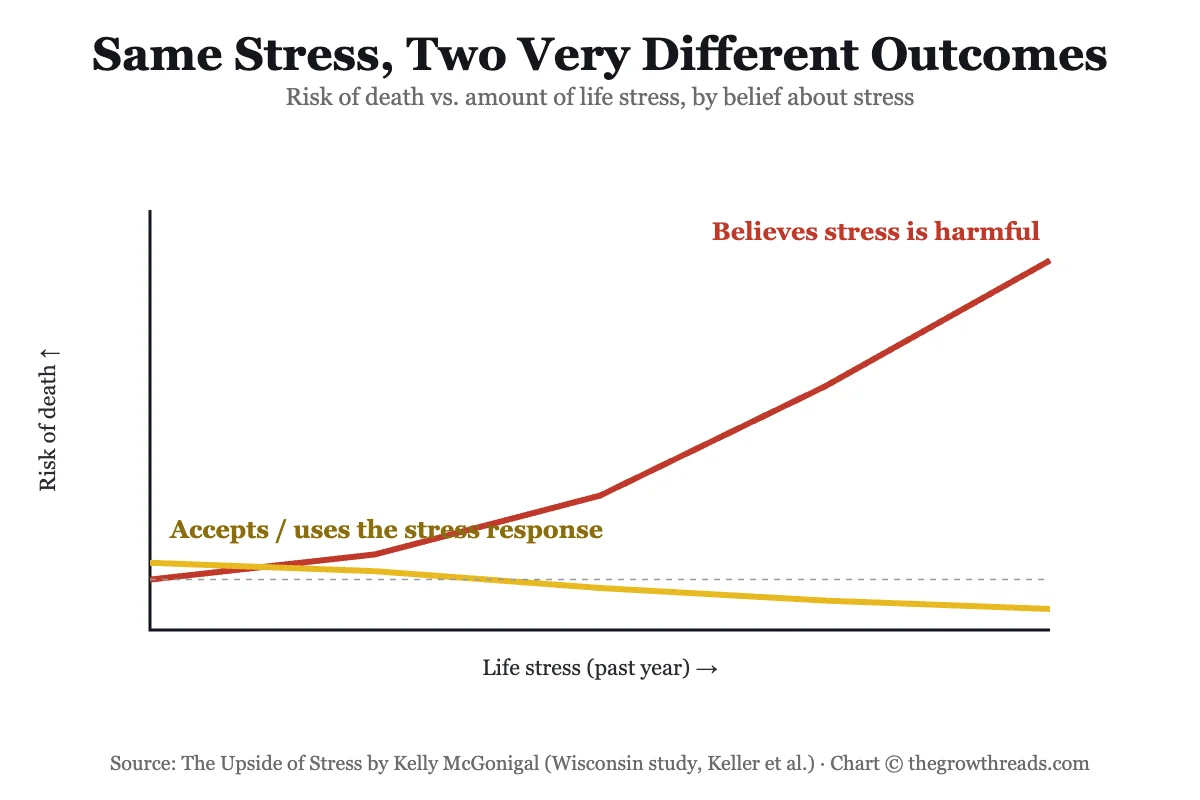
Stress only becomes toxic once you decide it is. Health psychologist Kelly McGonigal spent years teaching Stanford students that stress was the enemy — then a single study made her question everything. People who reported high stress and believed that stress was harmful to their health had a dramatically higher risk of dying. But people who reported equally high stress and did not believe it was harmful had one of the lowest risks of death in the entire study — lower even than people who reported very little stress at all. The stress wasn’t the problem. The belief that stress was dangerous was the problem. The Upside of Stress is McGonigal’s case for a radical reframe: your body’s stress response isn’t a malfunction, it’s a resource — a surge of energy, focus, and connection your body manufactures specifically because something you care about is on the line. Learn to work with it, and it becomes one of the most reliable sources of strength you have.
Key takeaways
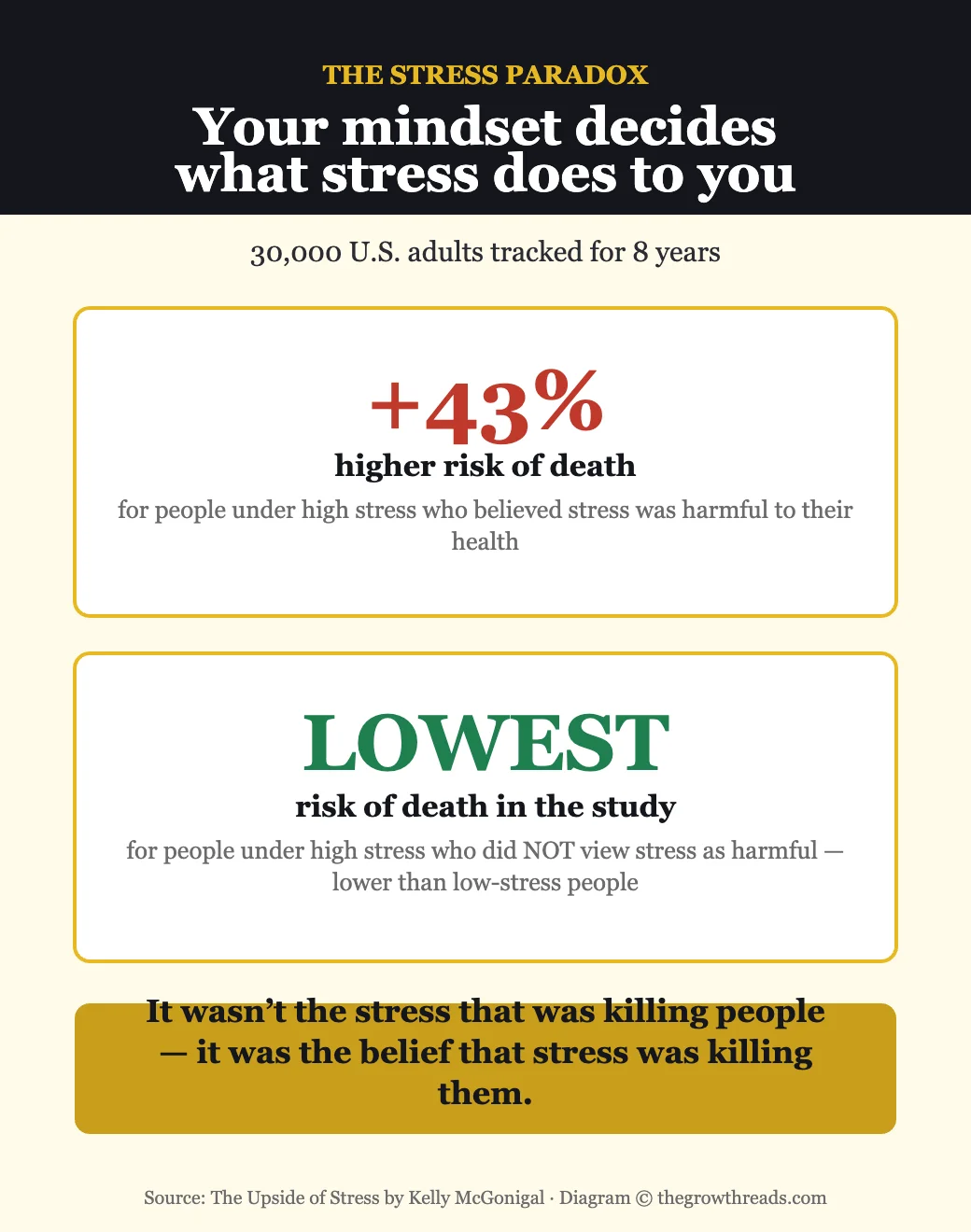
- Believing stress is harmful is what makes it harmful. The Wisconsin study of 30,000 adults found the danger was concentrated almost entirely in people who viewed stress as damaging — not in the stress itself.
- Stress is a sign you care. You don’t get stressed about things you’re indifferent to. Stress and meaning are almost always found together.
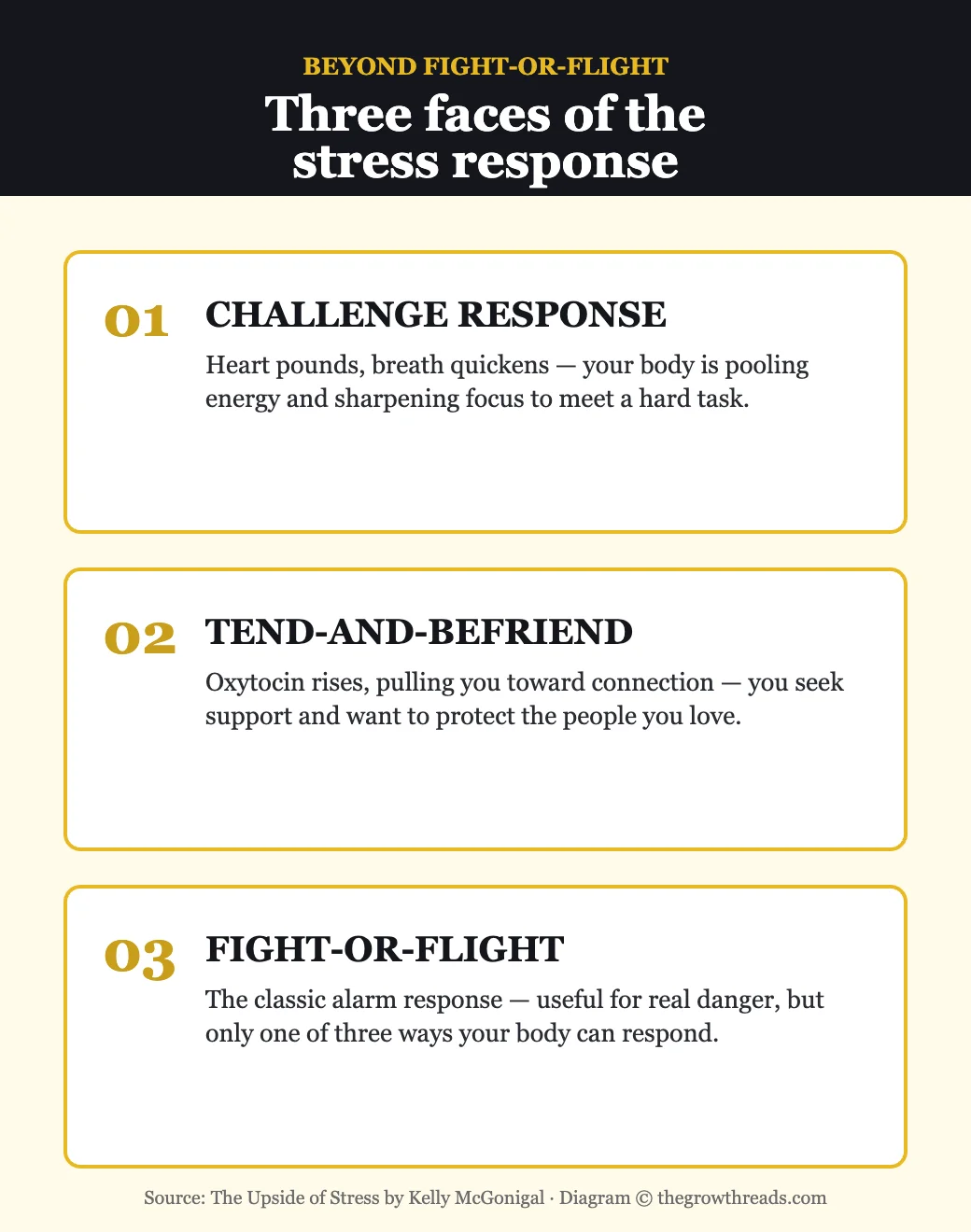
- Your body has three stress responses, not one. Fight-or-flight is the famous one, but the challenge response (energy and focus) and the tend-and-befriend response (connection and care) show up just as often.
- A pounding heart can mean two different things. In lab studies, people told their racing heart was their body “rising to the challenge” performed better and felt less anxious than people told nothing at all.
- Oxytocin is a stress hormone too. Along with adrenaline and cortisol, stress releases oxytocin — pushing you to seek support and to support others, which builds resilience over time.
- Post-traumatic growth is more common than PTSD. Most people who go through major adversity report meaningful positive change afterward — new strength, closer relationships, a clearer sense of priorities.
- Avoiding stress by avoiding meaning backfires. Chasing a stress-free life often means chasing a smaller, less engaged life — and that trade rarely pays off in wellbeing.
- You can “toughen” your stress response like a muscle. Deliberately facing manageable stress (a hard workout, a difficult conversation, a public talk) trains your physiology to recover faster next time.
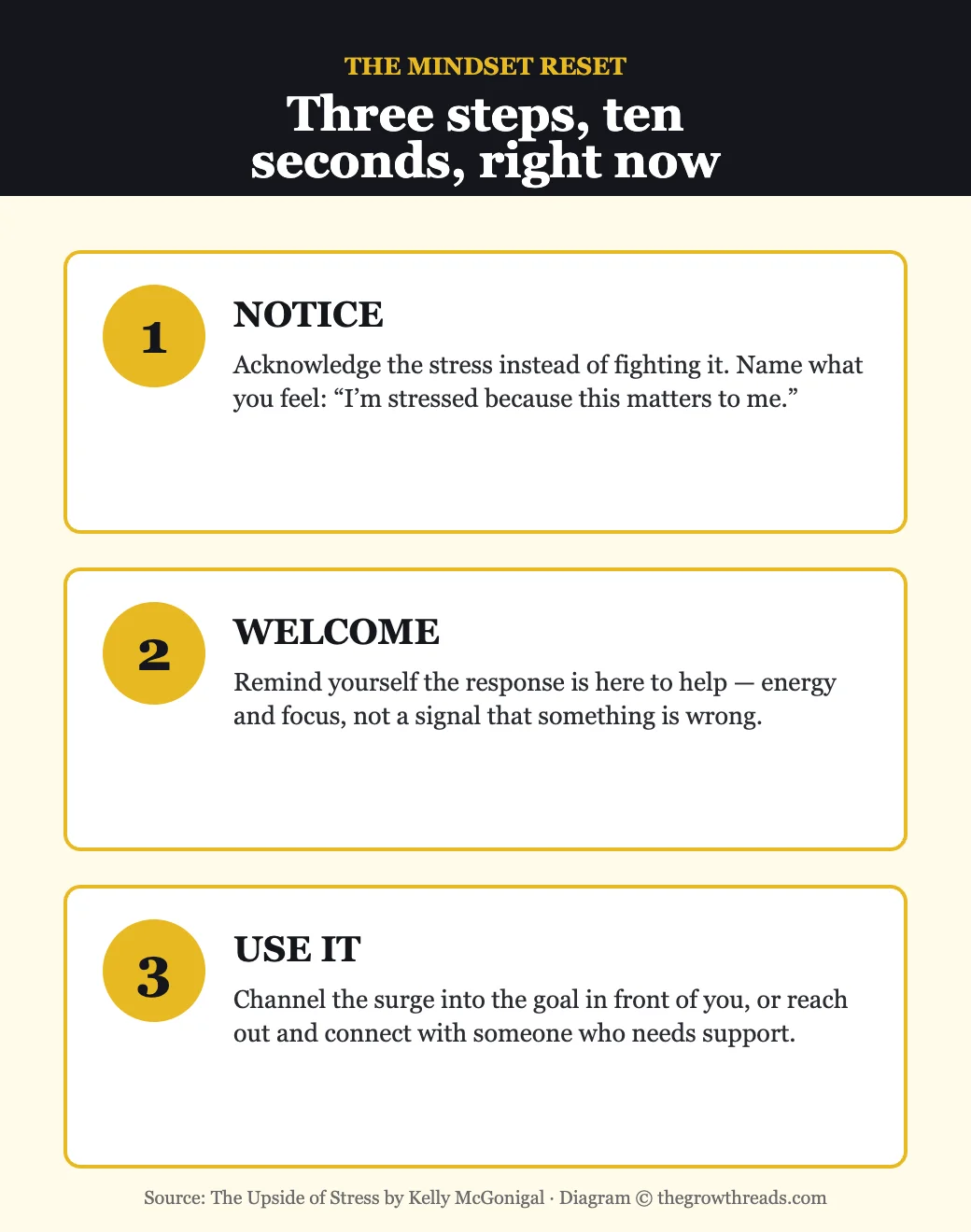
- The mindset reset takes about ten seconds. Notice the response, welcome it as fuel, and connect it to what you’re trying to protect or achieve — then use the energy instead of fighting it.
What is The Upside of Stress about?
The Upside of Stress (2015) is health psychologist Kelly McGonigal’s argument that stress becomes harmful mainly when we believe it is harmful. Drawing on studies of mindset, physiology, and post-traumatic growth, she shows how the stress response — often mislabeled as purely dangerous — actually supplies energy, focus, and social connection that can be consciously redirected toward the things that matter most.
About the author
Kelly McGonigal is an American health psychologist and lecturer at Stanford University, where she has spent nearly two decades teaching the science of mind-body connection. Her earlier book, The Willpower Instinct, reframed self-control as a trainable skill rather than a fixed trait. The Upside of Stress grew out of a similar reversal: after years of teaching a course called “Reduce Stress,” McGonigal encountered research suggesting the goal itself might be misguided, and rebuilt her course — and this book — around helping people work with stress instead of fighting it. She draws on health psychology, neuroscience, and social psychology to translate rigorous research into strategies readers can use immediately. Explore all Kelly McGonigal book summaries →
Key concepts at a glance
| Concept | What it means | Use it when |
|---|---|---|
| Stress mindset | Your belief about whether stress helps or harms you — shown to change its actual physical effects | Before a big test, deadline, or health scare |
| Challenge response | A stress state marked by energy, focus, and confidence rather than fear | Preparing for a performance, presentation, or competition |
| Tend-and-befriend | An oxytocin-driven stress response that pulls you toward connection and caregiving | When you feel the urge to reach out during a hard time — don’t suppress it |
| Post-traumatic growth | Positive psychological change reported by most people after major adversity | Reflecting on past hardship you’ve already moved through |
| Meaning mindset | Recognizing that stress and a meaningful life are almost always found together | When you’re tempted to see stress as proof you’re on the wrong path |
| Physiological toughening | Repeated, manageable stress exposure that trains faster recovery over time | Building resilience deliberately, not just enduring stress passively |
| Self-transcendent goals | Goals oriented toward helping others, shown to buffer the costs of stress | Reframing why a stressful task matters beyond yourself |
| The mindset reset | A three-step, ten-second technique: notice, welcome, use | In the moment, right as stress symptoms appear |
Part 1: The Stress Paradox
McGonigal opens with a study that reshaped her career. Researchers tracked roughly 30,000 U.S. adults for eight years, asking two questions: how much stress had they experienced in the past year, and did they believe that stress was harmful to their health? People who reported a lot of stress and believed it was harmful had a 43% increased risk of death. But people who reported just as much stress and did not believe it was harmful had one of the lowest risks of death in the entire study — even lower than people who reported very little stress. The researchers estimated that it wasn’t high stress that had driven the excess deaths; it was the combination of high stress and the belief that stress is damaging.
That single finding sent McGonigal looking for the mechanism, and she found it in mindset research led by Stanford psychologist Alia Crum. In one experiment, participants watched a short video before a stressful task: one group learned that stress responses (racing heart, quickened breath) are the body helping you perform better; a control group watched a neutral video. The “stress is enhancing” group later reported feeling less anxious, performed better under pressure, and showed a healthier cardiovascular stress response — their blood vessels stayed relaxed even as their heart rate rose, a pattern closer to what happens during joy or courage than fear. The physiology didn’t change because the stressor changed. It changed because the story about the stressor changed.
TGR Note: This is the same mechanism David Burns explores in our Feeling Good summary — the thought about the event, not the event itself, drives the emotional and even physical outcome. McGonigal’s contribution is showing that this isn’t just true for anxiety and depression; it holds up in cardiovascular labs and eight-year mortality studies too.
Part 2: Three Faces of the Stress Response
Fight-or-flight gets all the press, but McGonigal shows it’s only one of three distinct stress responses your body can generate. The challenge response shows up when you’re stressed about something you feel equipped to handle: heart rate rises, but blood vessels stay relaxed, and your body pools energy toward the muscles and brain regions you need. Athletes, performers, and surgeons often describe this state as feeling “locked in” rather than afraid. The tend-and-befriend response, first identified by psychologist Shelley Taylor, releases oxytocin alongside the more familiar stress hormones — pulling you toward the people you love and toward giving or seeking support. This is why a hard day at work can leave you wanting to call a friend rather than run from a tiger: your biology is nudging you toward connection, not just escape.
The classic fight-or-flight response — the one most people mean when they say “stressed” — is real and useful for acute physical danger, but McGonigal’s point is that treating it as the only stress response leaves you fighting your own biology in situations where challenge or tend-and-befriend would serve you better. Learning to recognize which response you’re having, and lean into it, is itself a skill.
TGR Note: McGonigal’s earlier book, covered in our Willpower Instinct summary, treats self-control as a trainable resource you can strengthen with practice. The Upside of Stress applies the same logic to your stress response — it isn’t a fixed reaction, it’s a skill you can shape.
Part 3: Meaning, Connection, and Growth Under Pressure
McGonigal spends real time on a counterintuitive finding: most people who go through serious adversity — illness, loss, disaster, trauma — report meaningful positive change afterward. This “post-traumatic growth” shows up more often in survey data than post-traumatic stress disorder, though it gets far less attention. People commonly describe a clearer sense of what matters, closer relationships, greater personal strength, and a renewed appreciation for life. McGonigal is careful not to romanticize suffering; the point isn’t that trauma is good, but that the human capacity to find meaning and strength through hardship is far more common and reliable than our cultural stories about trauma suggest.
She connects this to the idea of self-transcendent goals — goals oriented around helping people beyond yourself. Students who wrote about how their studies would let them contribute to the world, rather than just benefit themselves, showed more resilience and self-control during stressful academic periods. Stress tied to something bigger than your own comfort seems to be more sustainable than stress tied only to personal achievement, in part because it recruits the tend-and-befriend response rather than pure fight-or-flight.
TGR Note: There’s a striking overlap here with Stoic philosophy — see our Meditations summary. Marcus Aurelius argued that obstacles could be turned into fuel for virtue nearly two thousand years before McGonigal found the mechanism in a cardiology lab.
Part 4: The Mindset Reset in Practice
The most practical chapters focus on what to actually do with all this. McGonigal’s core technique is a three-step, roughly ten-second “mindset reset”: notice the stress response as it happens instead of denying it; welcome it by reminding yourself it’s your body trying to give you energy and focus, not evidence that something is wrong; and use the resulting energy — channel it into the task in front of you, or let it push you toward connecting with someone who needs support. She also describes “physiological toughening”: deliberately choosing manageable stress — hard exercise, difficult conversations, public speaking practice — trains your cardiovascular and hormonal stress response to recover faster, a pattern that appears to transfer across different kinds of stress.
The throughline across all four parts is a shift from stress-avoidance to stress-literacy: understanding what your particular stress response is trying to do for you, and cooperating with it, rather than treating every spike of adrenaline as an emergency.
TGR Note: If the “welcome it” step feels hard in the moment, pair it with the self-kindness practices in our Self-Compassion summary — treating your stressed-out self with the same warmth you’d offer a friend makes the reframe easier to believe.
Who is The Upside of Stress best for — and who should read something else first?
This book is best for people who feel stress is running their life and want a practical, research-backed way to change their relationship with it — students before exams, professionals in high-pressure roles, caregivers, or anyone who’s been told to “just relax” and found that advice useless. If your stress is tied more to unhelpful thought patterns than to genuine overload, start with our Feeling Good summary instead. If what you actually need is a structured way to build self-control before you can even get to the mindset work, The Willpower Instinct is the better starting point.
Questions to reflect on
- Think of a time you felt intensely stressed about something that also mattered deeply to you. What did that stress make possible that indifference wouldn’t have?
- When you notice your heart racing before something important, what story do you usually tell yourself about it — danger, or readiness?
- Can you recall a stressful period that pushed you toward connecting with others rather than withdrawing? What did that tend-and-befriend response look like for you?
- Is there a form of “manageable stress” — a hard workout, a tough conversation, a new challenge — you’ve been avoiding that might actually build your resilience?
- Looking back at your hardest years, what strengths, relationships, or clarity did you gain that you wouldn’t trade away, even if you could undo the hardship itself?
🔥 Ready to change your relationship with stress?
Grab The Upside of Stress and start using pressure as fuel instead of fighting it.
How to apply The Upside of Stress (7-day plan)
- Day 1: Notice one moment of physical stress (racing heart, tight chest) and simply name it out loud: “This is my body giving me energy.”
- Day 2: Before a task you’re dreading, spend 60 seconds writing why it matters to you — connect the stress to something you care about.
- Day 3: Practice the three-step mindset reset (notice, welcome, use) once, in real time, during an actual stressful moment.
- Day 4: When stress hits, instead of isolating, reach out to one person — a text, a call, five minutes of conversation. Notice how it feels.
- Day 5: Choose one “manageable stress” on purpose — a hard workout, a cold shower, a difficult but necessary conversation — and treat it as toughening practice.
- Day 6: Write down a past hardship and one genuine strength, relationship, or insight it left you with.
- Day 7: Reframe your to-do list: next to each stressful item, write who or what it’s ultimately in service of.
Frequently asked questions
What is the main idea of The Upside of Stress?
The main idea is that stress itself isn’t what damages health and performance — the belief that stress is harmful is the bigger driver of negative outcomes. Kelly McGonigal argues that the physical stress response evolved to help you meet challenges, not just to signal danger, and that consciously reframing stress as useful measurably changes both how you feel and how your body responds, including cardiovascular patterns linked to long-term health.
Is The Upside of Stress based on real science?
Yes. McGonigal draws on peer-reviewed research in health psychology, including the widely cited Wisconsin study tracking 30,000 adults over eight years, and mindset intervention experiments led by Stanford psychologist Alia Crum. As with any popular science book, some individual studies have faced replication debates common across social psychology, but the book’s core practical guidance — reframing stress, staying connected, choosing manageable challenges — is broadly uncontroversial and consistent with decades of stress research.
What are the three types of stress response in the book?
McGonigal describes the challenge response (energy and focus for a task you feel equipped to handle), the tend-and-befriend response (an oxytocin-driven pull toward connection and caregiving), and the classic fight-or-flight response (the alarm reaction most people default to associating with all stress). Recognizing which one you’re experiencing helps you work with it more effectively.
How is this different from just “positive thinking”?
The mindset reset isn’t about denying that something is hard or pretending to feel calm. It’s about accurately reinterpreting a real physical response — a racing heart, quickened breath — as your body actively helping you rather than betraying you. The distinction matters: studies show forced calm or suppression tends to backfire, while accurate reframing of the stress response itself changes measurable physiology.
What is post-traumatic growth?
Post-traumatic growth refers to positive psychological change — greater personal strength, closer relationships, clearer priorities, renewed appreciation for life — that many people report after going through serious adversity. McGonigal cites survey data showing it’s reported more often than post-traumatic stress disorder, though it receives far less cultural attention. The book is careful not to suggest trauma is good, only that meaningful growth through hardship is common.
Can you really train your stress response?
McGonigal describes “physiological toughening” — deliberately facing manageable, repeated stress (challenging exercise, difficult conversations, public speaking) — as a way to train faster cardiovascular and hormonal recovery over time. The evidence suggests this kind of practice can improve how efficiently your body handles future stress, similar to how physical training improves fitness.
What’s the single most useful takeaway from this book?
If you take away one thing, make it the mindset reset: when you notice a stress response, notice it, welcome it as your body trying to help, and use the resulting energy toward what you’re trying to accomplish or who you’re trying to support. That ten-second reframe is the most repeatable, evidence-backed tool in the book.
Related summaries
- The Willpower Instinct Summary & Review
- Feeling Good Summary & Review
- Self-Compassion Summary & Review
- Meditations Summary & Review
- Best Psychology Books — Full Reading List
How we analyze books: our team reads the full text, cross-references the author’s cited research and interviews, and builds original diagrams and application plans rather than reproducing the book’s content. Read our full methodology.
Related Psychology Summaries
Meditations Summary & Review: Timeless Stoic Wisdom for Modern Life
Switch Summary & Review: The Rider-Elephant-Path Framework for Real Change
The Happiness Hypothesis Summary & Review: Finding Modern Truth in Ancient Wisdom
The Tipping Point Summary & Review: How Little Things Make a Big Difference
Thinking in Bets Summary & Review: Make Smarter Decisions Under Uncertainty