

⭐⭐⭐⭐ 4.4/5 — A sweeping, meticulously argued case that technological change compounds faster than intuition allows, and essential context for anyone trying to plan more than five years out.
Best for: Futurists, technologists, founders, and long-range thinkers
Reading time: ~9 hrs for the full book · 14 min for this guide
Difficulty to apply: Moderate — a framework for interpreting change, not a step-by-step system
The Singularity Is Near in one minute
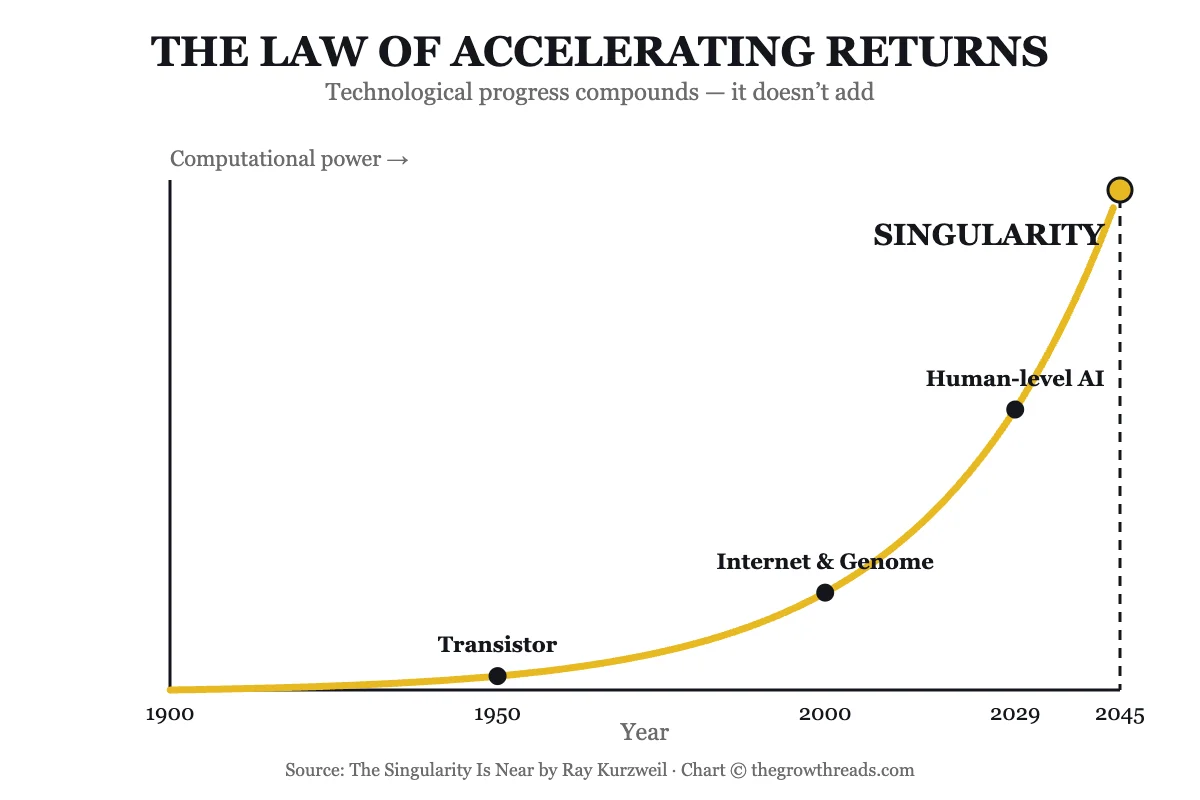
Technology does not improve steadily — it compounds, and most people badly underestimate how fast compounding gets strange. In The Singularity Is Near, inventor and futurist Ray Kurzweil argues that information-based technologies (computing, genetics, nanotechnology) follow a “Law of Accelerating Returns”: each generation of a technology gets better, cheaper, and smaller at an exponential rate, and each new technology becomes the platform the next one builds on. Kurzweil traces this pattern back through six historical epochs and forward to a projected event he calls the Singularity — a point around 2045 when non-biological intelligence, merged with human intelligence, expands our combined capability by roughly a billionfold. The book is part history of technology, part neuroscience primer, part manifesto, and it remains one of the most cited (and most argued-about) books in AI and futurism two decades after publication.
Key takeaways
- The Law of Accelerating Returns: technological progress compounds exponentially over time, not linearly — each advance shortens the time to the next one.
- Six Epochs: evolution moves from physics and chemistry, to biology and DNA, to brains, to technology, to a human-machine merger, and finally to intelligence saturating the universe.
- Paradigm shifts keep the curve alive: when one technology (like silicon transistors) hits a wall, a new paradigm (like 3D molecular computing) takes over — the exponential growth of computing has outlived five earlier paradigms already.
- GNR convergence: genetics, nanotechnology, and robotics/AI are converging revolutions, each amplifying the other’s progress.
- 2029 milestone: Kurzweil expects machines to pass valid tests of human-level intelligence within this timeframe.
- 2045 milestone: the Singularity — the point where non-biological intelligence so exceeds unaided human intelligence that change becomes almost impossible to track from a pre-Singularity vantage point.
- Reverse-engineering the brain is Kurzweil’s proposed path to building non-biological intelligence with human-level nuance and creativity.
- Nanobots could eventually operate inside the bloodstream and brain, repairing tissue and augmenting cognition directly.
- The human/machine line blurs gradually — pacemakers, cochlear implants, and predictive text are early, unremarkable steps on the same continuum Kurzweil describes.
- The real risks are GNR risks: engineered pathogens, self-replicating nanotechnology, and unaligned AI concern Kurzweil far more than any external threat.
What is The Singularity Is Near about?
The Singularity Is Near is Ray Kurzweil’s 2005 case that technological progress is accelerating exponentially, not linearly. He argues that by 2029 machines will reach human-level intelligence, and by 2045 — the Singularity — the convergence of genetics, nanotechnology, and robotics will expand human capability roughly a billionfold.
About the author
Ray Kurzweil is an inventor, computer scientist, and futurist with a track record of technological predictions stretching back to the 1980s. He built the first CCD flat-bed scanner, the first print-to-speech reading machine for the blind, and pioneering text-to-speech and music-synthesis technology, earning a Grammy Award and induction into the National Inventors Hall of Fame. He is the recipient of the U.S. National Medal of Technology and has served as a Principal Researcher and AI Visionary at Google. Kurzweil has written several bestselling books on technology and the future, including The Age of Spiritual Machines, How to Create a Mind, and this book’s 2024 follow-up, The Singularity Is Nearer. Explore all Ray Kurzweil book summaries →
Key concepts at a glance
| Concept | What it means | Use it when |
|---|---|---|
| Law of Accelerating Returns | Technological progress compounds exponentially over time | Forecasting how fast a field you follow will actually change |
| Six Epochs | Kurzweil’s framework for evolution from physics to a fully merged intelligence | Placing today’s AI progress inside a longer historical arc |
| GNR | Genetics, Nanotechnology, Robotics — the three converging revolutions | Thinking about which fields will compound together, not alone |
| Paradigm shift | A new approach replaces an exhausted one, resetting the exponential curve | Explaining why “we’re near the limit” predictions keep being wrong |
| Reverse-engineering the brain | Mapping neural architecture well enough to replicate it computationally | Understanding Kurzweil’s proposed path to human-level AI |
| Non-biological intelligence | Machine intelligence with capability equal to or beyond a human brain | Discussing what happens once AI passes the human baseline |
| The Singularity | The projected 2045 point where change outpaces unaided human comprehension | Framing long-range personal, career, or investment planning |
| Nanobots | Molecular-scale machines Kurzweil expects to operate in the bloodstream and brain | Talking about future health and cognitive-enhancement scenarios |
Part 1: The Law of Accelerating Returns
Kurzweil opens with a claim that sounds modest and turns out to be radical: progress in an information-based technology is exponential, not linear, and human intuition is built for linear thinking. We naturally expect the next ten years to look like the last ten. But if a trend doubles every couple of years, thirty years of “doubling” produces a change so large that the final years dwarf everything before them combined. Kurzweil calls this pattern the Law of Accelerating Returns and argues it governs any process where each improvement becomes a tool for producing the next improvement — which describes computing, genetics sequencing, and communications bandwidth equally well.
The historical evidence he marshals is broad: the time between major paradigm shifts in human technology — agriculture, writing, the printing press, telegraph, computer, internet — has been shrinking for centuries, even as each shift becomes more consequential. Kurzweil is careful to distinguish this from a single technology’s S-curve (invention, adoption, maturity, plateau). His claim is about the meta-pattern: when one S-curve levels off, a new one starts before the old one is exhausted, and the composite of overlapping S-curves is what produces a smooth exponential.
Computing is his central case study. Moore’s Law — the doubling of transistors per chip roughly every two years — is not, in Kurzweil’s telling, a law of silicon. It is the fifth paradigm in a much longer exponential trend in computing power per dollar that began with electromechanical calculators, moved through relays, vacuum tubes, and transistors, and will move past silicon into 3D molecular computing, and eventually quantum and DNA-based computing, once silicon’s limits are reached. Betting against the trend has historically meant betting against the next paradigm shift, not against exponential growth itself — a distinction he returns to throughout the book.
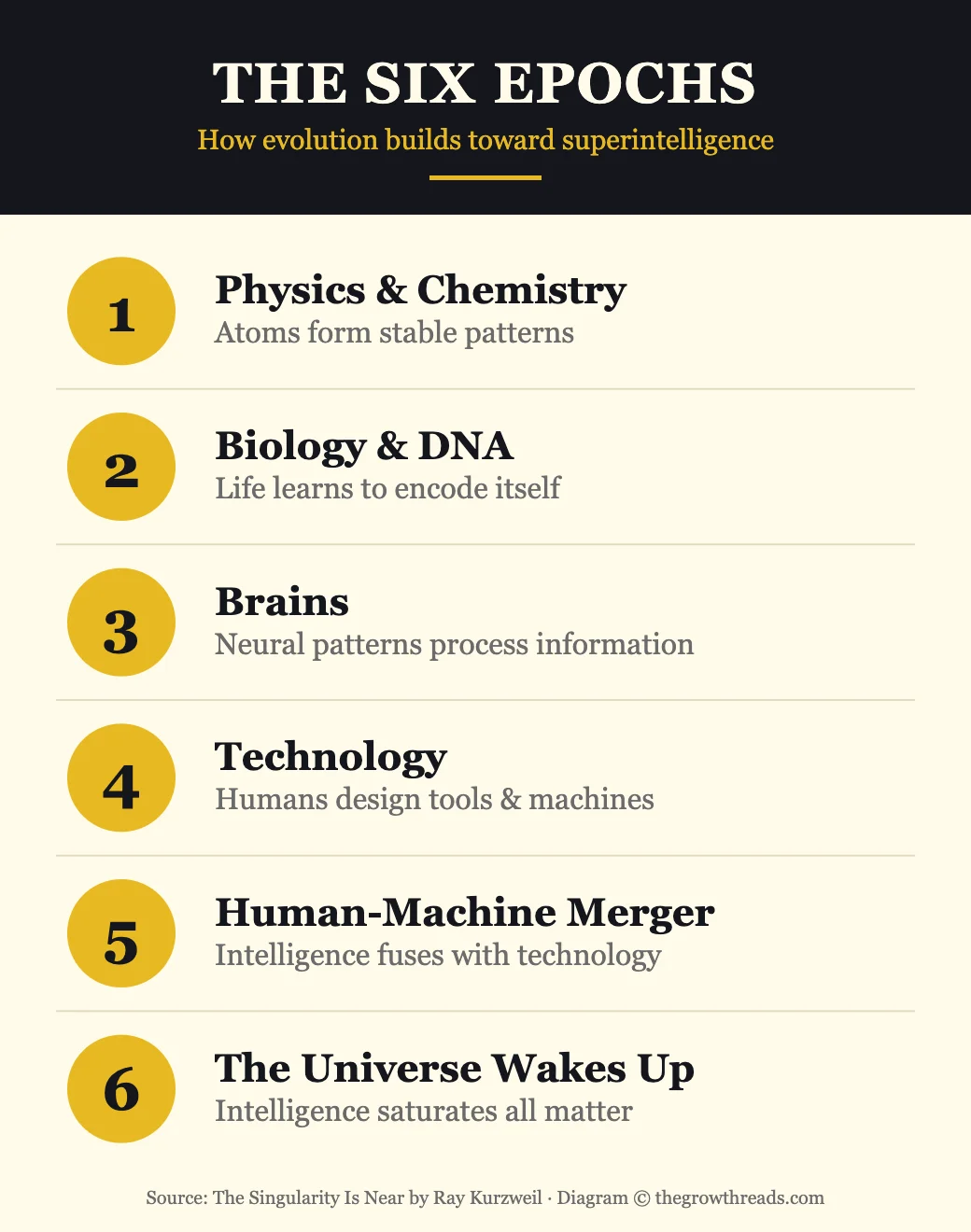
To situate all of this, Kurzweil frames evolution itself as six overlapping epochs, each building the substrate for the next: physics and chemistry (atoms form stable patterns), biology and DNA (life learns to encode and replicate information), brains (neural patterns process information about the world), technology (humans externalize thinking into tools), the merger of human and machine intelligence (the epoch he argues we are entering now), and finally, a speculative sixth epoch where intelligence saturates the matter and energy of the universe itself. The first four epochs, he notes, took billions of years combined; the fifth is expected to take decades.
TGR Note: If the Six Epochs framing interests you, Max Tegmark’s Life 3.0 summary picks up almost exactly where Kurzweil’s fifth epoch begins, walking through concrete scenarios for what a fast or slow intelligence explosion could look like once it starts.
Part 2: The Merger of Human and Machine Intelligence
The book’s most technical stretch covers how Kurzweil thinks non-biological intelligence with human-level nuance actually gets built. His answer is reverse-engineering the brain: neuroscience, brain-scanning resolution, and computing power are all improving on exponential curves of their own, and where they intersect is where we get computational models detailed enough to replicate how a human brain actually produces thought, emotion, and creativity — not just narrow pattern matching.
He is careful to separate this from the “brain as a fixed lookup table” caricature. Kurzweil’s model treats the brain as running relatively simple, repeated algorithms (his prime example is the roughly uniform structure of the neocortex) at massive scale and interconnection, which is why he believes the problem is tractable rather than magical. Once brain-derived algorithms can run on non-biological substrates, he argues, they inherit computing’s exponential cost curve instead of biology’s fixed one — which is the mechanism behind his 2029 milestone for machines passing valid tests of broad human-level intelligence.
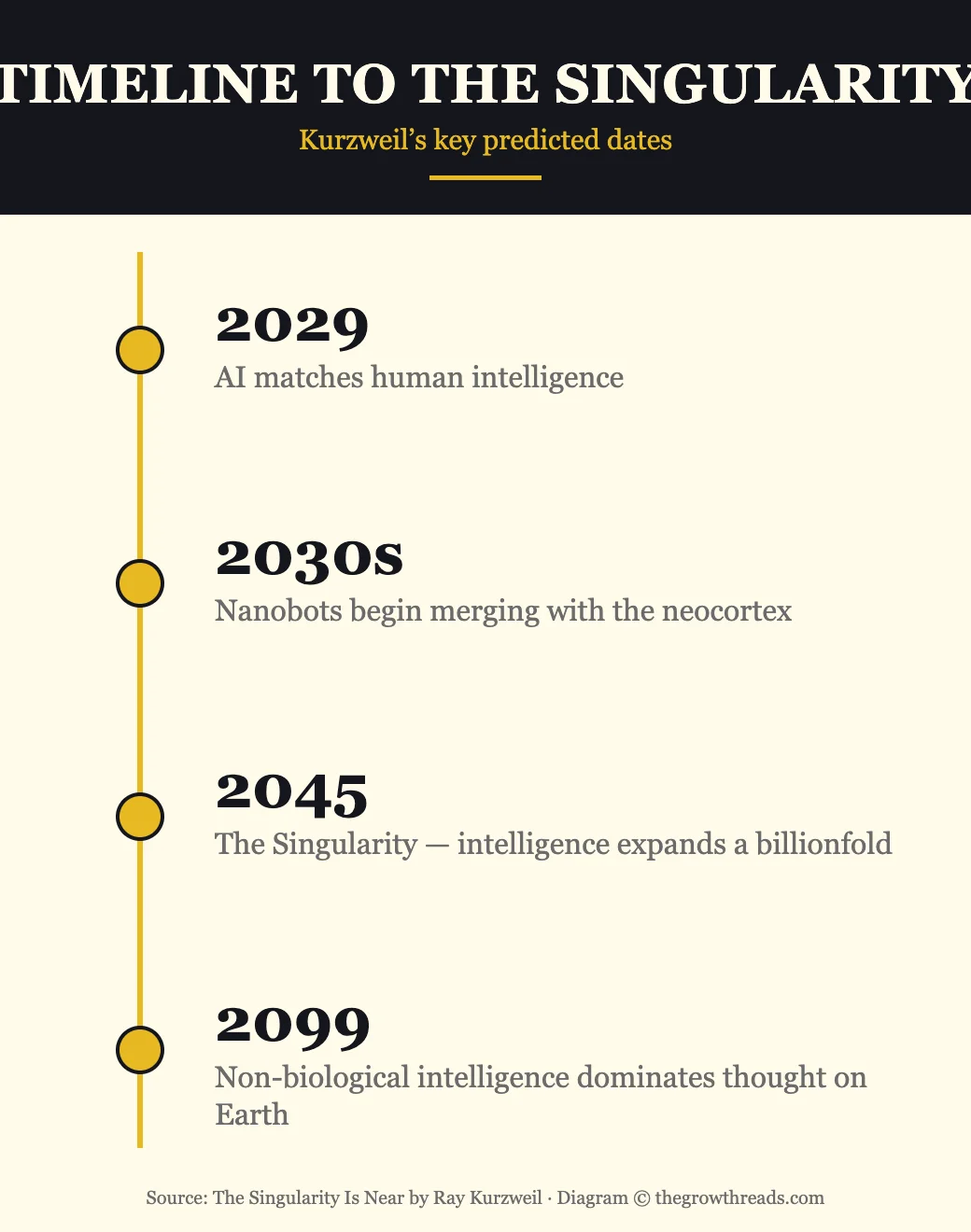
From there, Kurzweil sketches how the merger deepens: brain-computer interfaces evolving from today’s early implants into high-bandwidth, two-way links; nanobots eventually operating inside the bloodstream and brain to monitor health and augment cognition directly; and non-biological portions of our thinking gradually taking on a larger share of the work, the same way calculators, search engines, and now language models already handle cognitive tasks we used to do unaided. By his account, no single dramatic event marks the transition — by the time headlines might declare “the Singularity has arrived,” most of the individual pieces will already feel unremarkable, the way GPS, predictive text, and voice assistants do today.
TGR Note: For the control and safety side of this same merger, pair this section with our Superintelligence summary — Nick Bostrom takes Kurzweil’s timeline seriously but spends his book on the much narrower question of how we keep a system that outthinks us aligned with human goals.
Part 3: GNR — Genetics, Nanotechnology, Robotics
Kurzweil argues that no single technology drives the Singularity — three overlapping revolutions do, and their convergence is what makes the 2040s look so different from the 2000s. Genetics is the first wave, already underway when the book was written: understanding and eventually rewriting the biological code that builds and maintains the body, from gene therapies to synthetic biology. Nanotechnology is the second wave: manufacturing at the molecular scale, building materials and machines atom by atom rather than shaping bulk matter, which Kurzweil expects to eventually produce medical nanobots and radically cheaper, stronger materials. Robotics and strong AI form the third wave, and the one Kurzweil considers most consequential, since sufficiently capable machine intelligence can accelerate progress in the other two.
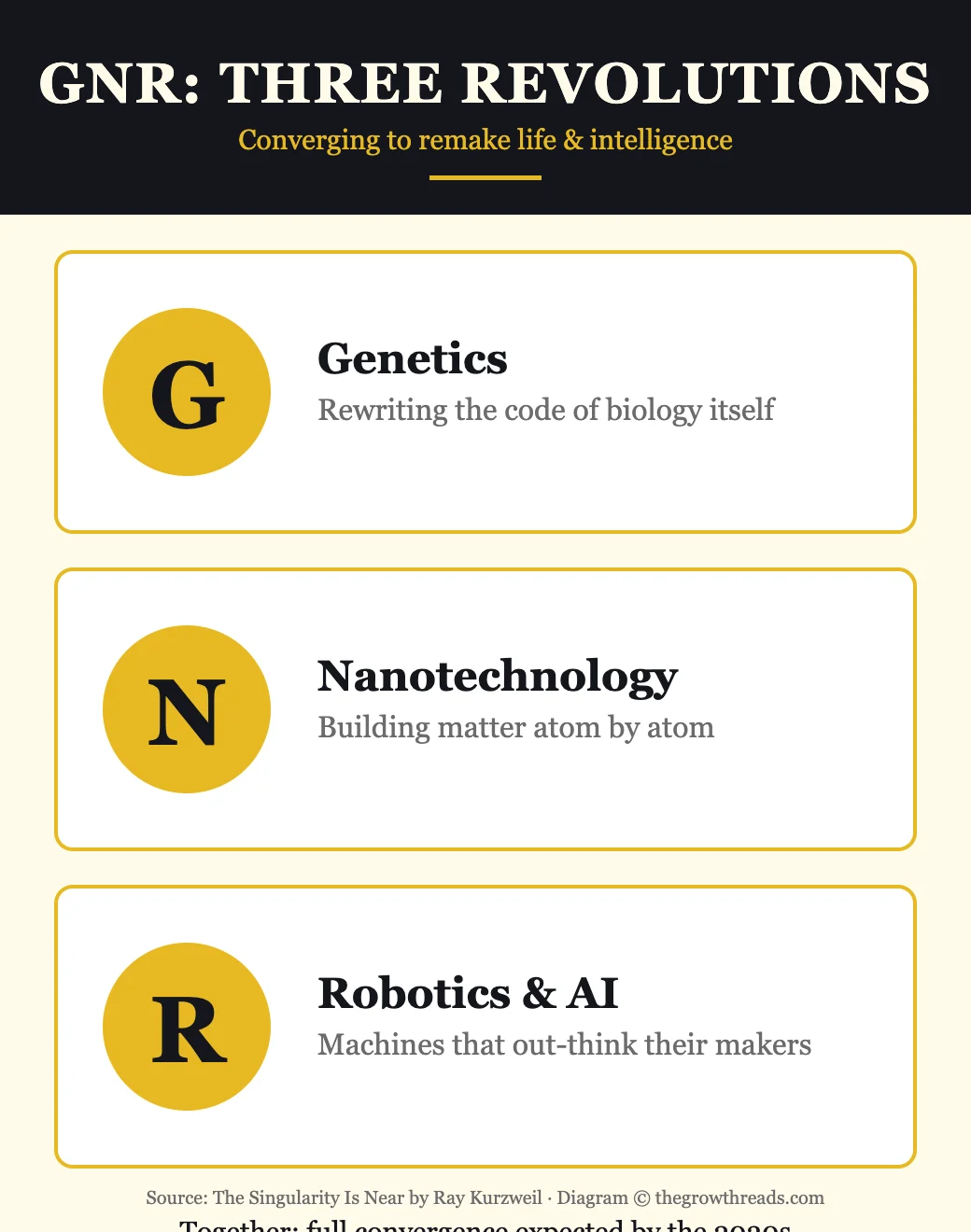
Crucially, the book does not treat GNR as unambiguously safe. Kurzweil devotes real space to what he calls the “downside” of exponential technologies: engineered pathogens made easier to design by biotechnology, self-replicating nanotechnology (the scenario popularly nicknamed “grey goo”), and software-based intelligence pursuing goals misaligned with ours. His argument is not that these risks are small — it’s that abandoning the technologies wholesale is neither realistic nor obviously safer, and that the more productive response is investing heavily in the defensive and alignment side of each revolution rather than trying to halt progress across the board.
TGR Note: Mustafa Suleyman’s The Coming Wave summary is the closest thing on TGR to a 2020s sequel to this section — same GNR-style convergence argument, but written by someone who has shipped frontier AI systems and is noticeably more cautious about the timeline for containment.
Part 4: Living Through the Singularity
The book’s final stretch turns from mechanism to implication. If Kurzweil is even roughly right, the questions stop being purely technical: what happens to work, identity, and mortality when non-biological intelligence and biotechnology both compound this fast? Kurzweil’s own answer leans optimistic — radically extended healthy lifespan through biotechnology and eventually nanomedicine, cognitive capability augmented rather than replaced, and material abundance from technologies that keep getting cheaper as they get better. He is explicit that he is describing a spectrum, not a cliff: individuals and societies will adopt these capabilities at different rates, the same way electricity, cars, and smartphones diffused unevenly.
He also spends time directly answering critics, several of whom argued (both before and after publication) that Kurzweil’s timeline is too aggressive, that intelligence is not as reducible to computation as the brain-reverse-engineering argument assumes, or that “softer” bottlenecks — energy, regulation, social adoption, embodied experience — will slow the curve more than pure computing trends suggest. Kurzweil’s response is consistent throughout: he is not claiming certainty about any individual date, only that the aggregate trend has been remarkably stable across paradigm shifts for a century, and that bets against it have a poor track record. Readers do not have to accept 2045 specifically to take the underlying argument — compounding technological change deserves more weight in personal and institutional planning than linear intuition gives it — seriously.
TGR Note: If Kurzweil’s optimism feels like it needs a counterweight, Stuart Russell’s Human Compatible summary makes the strongest published case for redesigning AI development around provable alignment before capability outpaces control — a useful second opinion on the same underlying trend.
Who is The Singularity Is Near best for — and who should read something else first?
This book rewards readers who like their futurism backed by data tables and citations rather than speculation alone — founders, engineers, investors, and anyone who wants a rigorous mental model for exponential change. If you want the same core argument in a shorter, more current package, Kurzweil’s own The Singularity Is Nearer (2024) revisits these ideas with two more decades of evidence. If you want the AI-safety counterpoint first, start with our Human Compatible summary. And if 672 pages feels like too much commitment before you know whether the topic grips you, our Novacene summary covers similar ground in a fraction of the length.
Questions to reflect on
- Which exponential curve in your own field or industry are you currently underestimating because it still looks linear?
- If machines matched human-level intelligence within your career, what would you want to have already built, learned, or saved?
- Where do you sit on the optimism-to-caution spectrum about GNR technologies, and what evidence would move you?
- What would you do differently today if you expected to remain healthy and capable for another fifty years?
- Which of Kurzweil’s six epochs feels the least certain to you, and what would need to be true for it to happen?
🔥 Ready to see where exponential technology is headed?
Get Kurzweil’s full case for the Singularity — in print, ebook, or audio.
How to apply The Singularity Is Near (7-day plan)
- Day 1: Pick one field you follow closely (health, energy, computing) and map its last twenty years of progress — linear or accelerating?
- Day 2: List three technologies you assumed were “twenty years away” a decade ago, and check how many have already arrived.
- Day 3: Spend thirty minutes reading up on whichever GNR domain — genetics, nanotech, or AI — you know least about.
- Day 4: Audit one health or lifestyle choice through a “next thirty years” lens instead of a “next three years” lens.
- Day 5: Identify the skill in your work most exposed to near-term AI capability gains, and start a small plan to build around it.
- Day 6: Talk to someone outside your field about where they see acceleration happening that you might be missing.
- Day 7: Write a one-page personal view: which of Kurzweil’s predictions do you find most credible, and why?
Frequently asked questions
What is The Singularity Is Near about?
The Singularity Is Near is Ray Kurzweil’s argument that technological progress compounds exponentially rather than growing steadily, and that this compounding is about to become dramatically visible. Drawing on trends in computing, genetics, and nanotechnology, Kurzweil predicts machines will reach human-level intelligence around 2029, and that by 2045 — a moment he calls the Singularity — non-biological intelligence merged with human intelligence will expand our combined capability by roughly a billionfold, transforming health, work, and cognition.
Is Ray Kurzweil’s 2045 Singularity prediction still considered credible?
Opinions remain genuinely split. Supporters point to Kurzweil’s strong track record on earlier computing predictions and note that AI capability has advanced faster than many expected since 2020. Critics argue that intelligence involves embodied, social, and biological factors that resist pure computational scaling, and that regulatory, energy, and social bottlenecks could slow the timeline considerably. Kurzweil himself reaffirmed and refined the 2029 and 2045 dates in his 2024 follow-up, The Singularity Is Nearer, arguing the underlying trends have held up.
What is the Law of Accelerating Returns?
It is Kurzweil’s core claim that any information-based process where improvements feed into future improvements — computing, genetic sequencing, communications bandwidth — grows exponentially rather than linearly. Each generation of the technology becomes cheaper, faster, or smaller, and becomes the platform the next generation builds on. Kurzweil argues this pattern has held for over a century of computing paradigm shifts, from mechanical calculators through transistors, and will likely continue through molecular and quantum computing paradigms.
What are the Six Epochs in Kurzweil’s framework?
Kurzweil frames all of evolution as six overlapping epochs: physics and chemistry (atoms forming stable patterns), biology and DNA (life encoding information), brains (neural information processing), technology (humans externalizing thought into tools), the merger of human and machine intelligence (the epoch he argues we are entering now), and a speculative sixth epoch where intelligence saturates the matter and energy of the universe. Each epoch builds directly on the substrate the previous one created.
What does GNR stand for in the book?
GNR stands for Genetics, Nanotechnology, and Robotics — the three technological revolutions Kurzweil argues are converging to drive the Singularity together, rather than any single field acting alone. Genetics covers understanding and eventually rewriting biology’s code; nanotechnology covers manufacturing at the molecular scale; and robotics, in Kurzweil’s usage, mainly refers to strong AI and machine intelligence broadly, which he considers the most transformative of the three.
Do I need a technical background to understand this book?
No, though patience helps. Kurzweil explains the core arguments — the Law of Accelerating Returns, the Six Epochs, GNR — in accessible prose aimed at general readers, and the central ideas do not require a computing or biology background. Some later chapters go deeper into neuroscience and computing architecture with charts and technical detail; readers mainly interested in the big-picture argument can skim those sections without losing the thread.
How does this book differ from Kurzweil’s later book, The Singularity Is Nearer?
The Singularity Is Nearer (2024) is a shorter, more conversational follow-up that revisits the same core predictions — 2029 for human-level AI, 2045 for the Singularity — with nearly twenty additional years of evidence, including the recent wave of large language models. This original 2005 book remains the more thorough, heavily cited version of the argument, with deeper historical data and a more detailed treatment of the Six Epochs and GNR framework.
Related summaries
- Life 3.0 Summary & Review
- Superintelligence Summary & Review
- The Coming Wave Summary & Review
- Human Compatible Summary & Review
- Best AI Books — Full Pillar Guide
How we analyze books: our team reads the full text, cross-checks key claims against the author’s cited sources and later interviews, and builds original diagrams and application plans rather than summarizing chapter by chapter. Read our full methodology.
Related Technology Summaries
Human Compatible Summary & Review: Building AI That Stays on Our Side
Machine, Platform, Crowd Summary & Review: Three Shifts Reshaping Every Industry
Rebooting AI Summary & Review: Why Deep Learning Alone Won’t Get Us to Trustworthy Machines
Scary Smart Summary & Review: How to Shape What AI Learns From Us
The Age of Spiritual Machines Summary & Review: Kurzweil’s 1999 Blueprint for the AI Age