

★★★★☆ 4.3/5 — The most grounded, evidence-based antidote to AI hype on the market: 29 real deployments, no speculation.
Best for: Managers, product leaders, and anyone who has to make (or defend) a real decision about deploying AI at work.
Reading time: ~7 hours to read cover to cover · ~40 min for this guide
Difficulty to apply: Moderate — the case studies translate directly into a framework you can run against your own AI decisions.
Working with AI in one minute
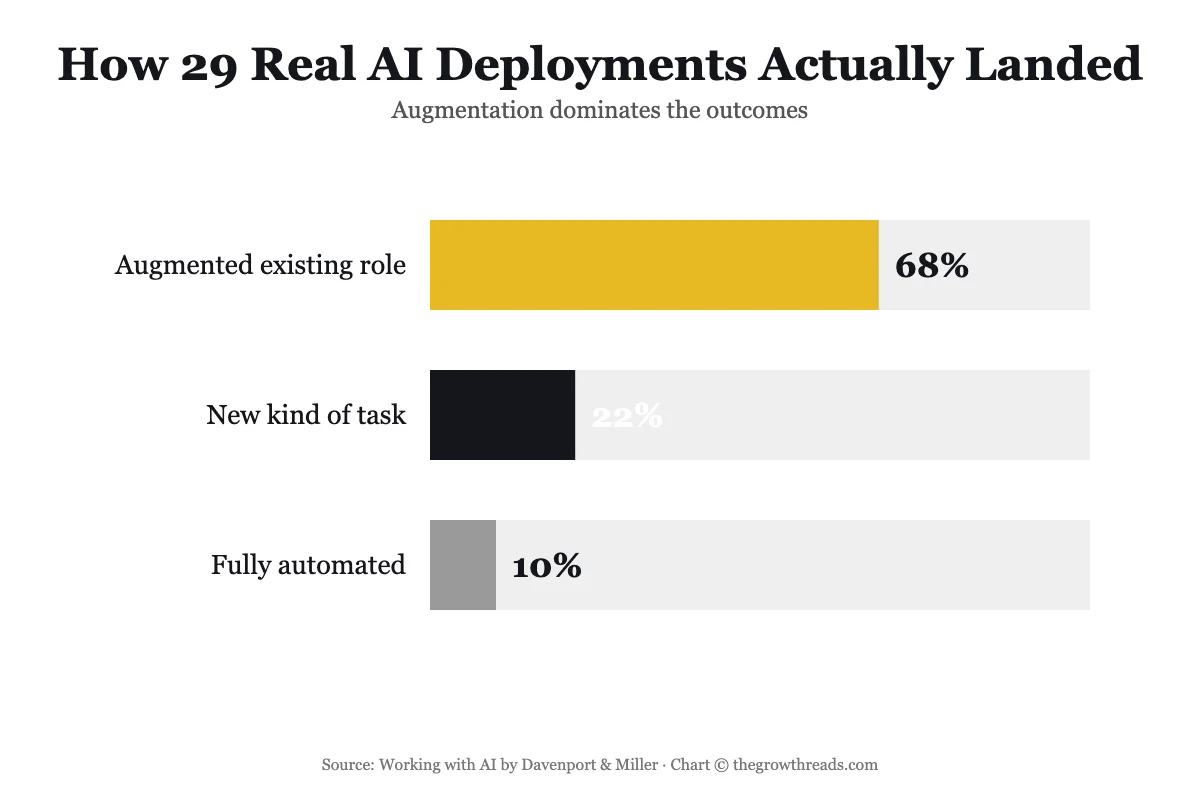
Most AI deployments don’t replace jobs — they change what the job involves. Thomas Davenport and Steven Miller spent years documenting 29 real organizations that put AI into production, across banking, healthcare, manufacturing, agriculture, insurance, and more. Their finding cuts against the automation-panic narrative: the overwhelming majority of successful deployments augmented an existing role rather than eliminating it.
The book is less a theory of AI and more a field guide built from evidence — what actually happened when real companies tried to put AI to work, what made some of those efforts succeed, and what still requires a human in the loop no matter how good the model gets.
Key takeaways
- Augmentation beats automation in practice: across the 29 case studies, most AI deployments changed a job rather than eliminating it.
- AI is best at narrow, well-defined tasks: the biggest wins came from applying AI to specific, bounded problems, not open-ended ones.
- Humans still own the exceptions: every case study kept a person in the loop for edge cases the model wasn’t trained on.
- Trust is built, not assumed: workers adopted AI tools faster when early wins were small, visible, and easy to verify.
- Workflow redesign matters more than the algorithm: organizations that redesigned the surrounding process outperformed those that just bolted AI onto an old workflow.
- Domain expertise doesn’t disappear — it shifts: experts spent less time on routine analysis and more time on judgment calls and exceptions.
- Change management is the real bottleneck: technical deployment was rarely the hardest part; getting people to adopt and trust the tool was.
- ROI came from freed-up time, not headcount cuts: the most successful organizations redeployed saved time toward higher-value work.
- Industry context shapes the right approach: what worked in a bank’s fraud detection team looked very different from what worked on a farm.
- The “job apocalypse” framing misses the real story: the more interesting and more common pattern is jobs quietly getting redefined, not eliminated.
What is Working with AI about?
Working with AI documents 29 real organizations that deployed artificial intelligence in production, showing that most successful deployments augment existing jobs rather than replace them. Drawing on detailed case studies across industries, Davenport and Miller build a practical, evidence-based framework for what makes AI adoption actually succeed at work.
About the authors
Thomas H. Davenport is a Distinguished Professor at Babson College and a Fellow at the MIT Initiative on the Digital Economy, widely known for his earlier work on analytics and “competing on analytics.” He has spent decades studying how organizations actually use data and technology, not just how they claim to. Steven M. Miller is a professor emeritus at Singapore Management University with a background spanning telecommunications, computer science, and organizational studies. Together, they bring both the strategy-and-management lens and the technical-systems lens needed to document how AI actually gets deployed on the ground — which is the throughline of every case study in the book.
| Concept | What it means | Use it when |
|---|---|---|
| Augmentation | AI extends or supports a human role rather than replacing it | Evaluating whether an AI tool should assist or replace a task |
| Automation | AI fully takes over a task with no human step required | The task is narrow, repetitive, and low-judgment |
| Workflow redesign | Rebuilding the process around the AI tool, not just installing it | Planning any new AI deployment |
| Exception handling | The human process for cases the AI model wasn’t trained to handle | Designing the human-in-the-loop safety net |
| Trust building | Early, small, visible wins that get workers to actually use the tool | Rolling out a new AI system to a skeptical team |
| Domain shift | How an expert’s time reallocates once routine analysis is automated | Planning what a role looks like after AI adoption |
Part 1: What 29 real deployments actually looked like
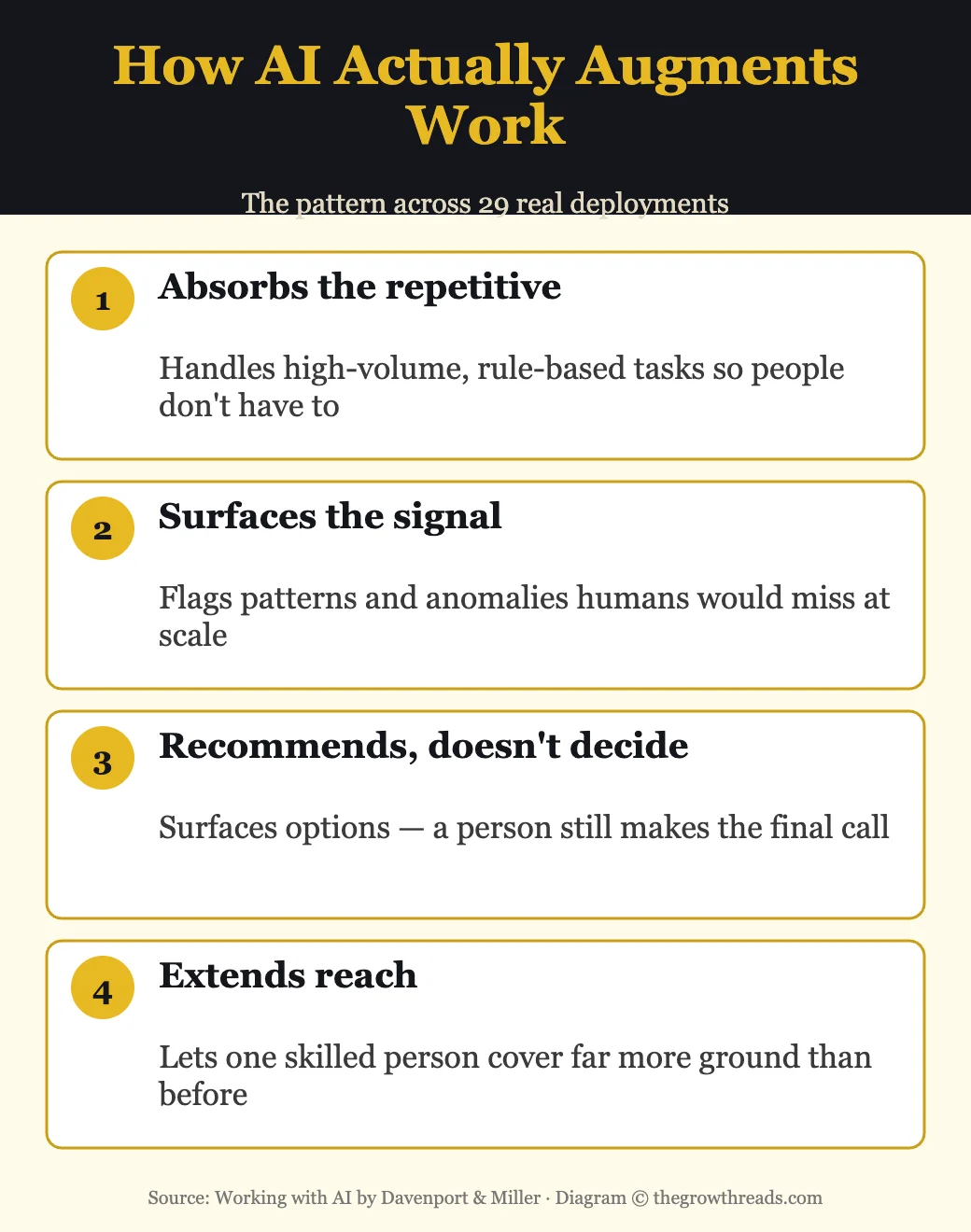
Rather than theorize about AI’s potential, Davenport and Miller went looking for organizations that had already put it to work — and documented what actually happened. Their case studies span a striking range: a bank’s fraud-detection team, a hospital’s radiology department, an agricultural company optimizing crop yields, an insurance firm processing claims, a manufacturer doing predictive maintenance. The pattern across nearly all of them was the same. AI didn’t walk in and replace the department. It took over a specific, bounded slice of the work — the repetitive pattern-matching, the first-pass triage, the anomaly flagging — while a person stayed responsible for judgment calls, unusual cases, and final decisions.
This is the book’s central empirical contribution: not a philosophical argument about whether AI should augment or automate, but a survey of what organizations that already tried actually found worked. The radiologist example is illustrative — AI flags likely areas of concern on a scan, but the radiologist still makes the diagnosis, especially on ambiguous cases. The fraud-detection example is similar — the model scores transactions for risk, but a human analyst reviews the flagged cases before any account gets frozen.
One recurring detail across the case studies is scale of ambition. The organizations that succeeded rarely started with a company-wide AI rollout — they started with a single team, a single well-defined task, and a small enough pilot that failure would be cheap and fast to learn from. Only after that narrow pilot proved out did they expand it to adjacent teams or tasks. This incremental approach also gave workers time to build trust in the tool gradually, rather than having it imposed all at once.
Part 2: Why some deployments succeeded and others stalled
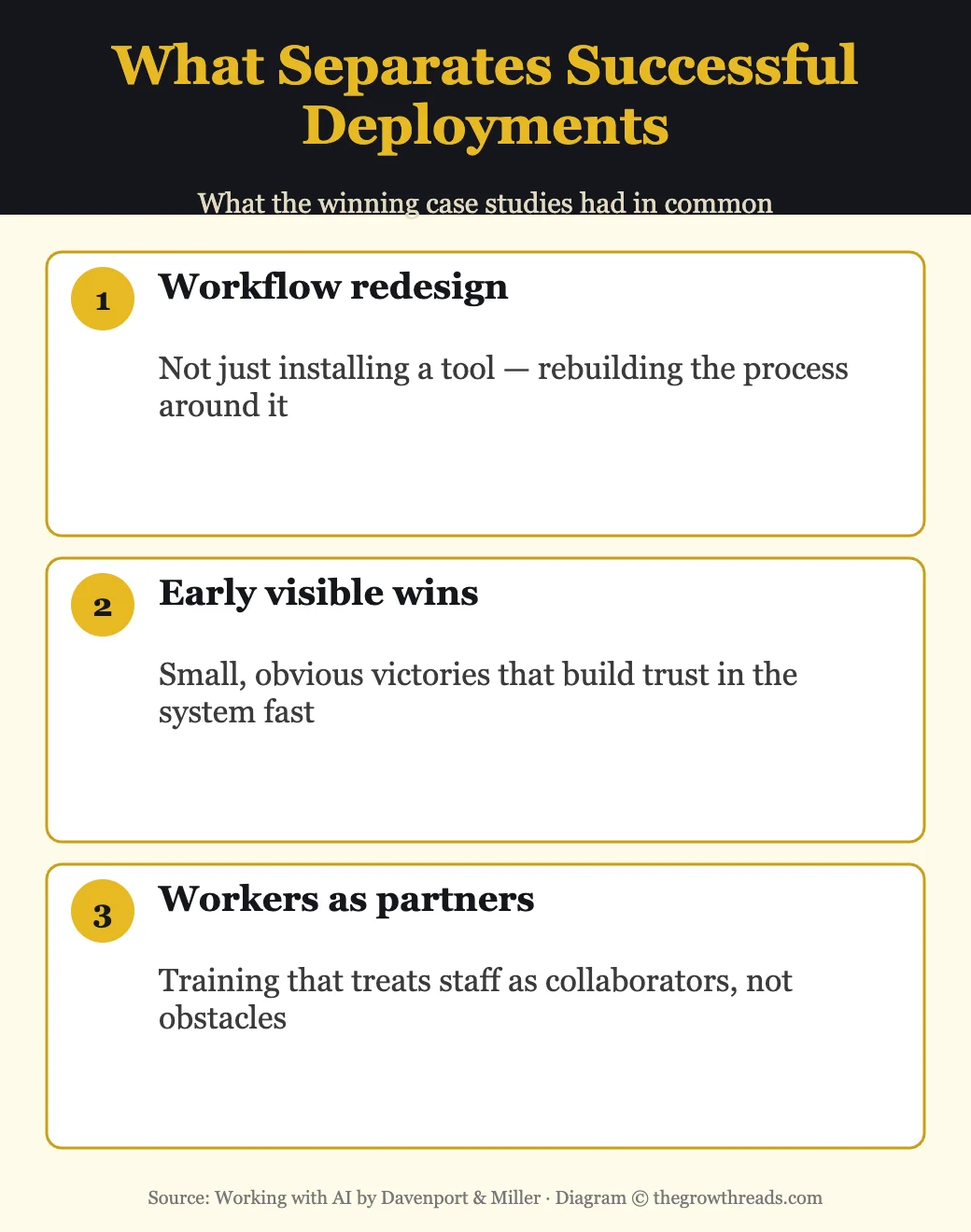
The book’s most practically useful section is its dissection of what separated the case studies that worked from the ones that struggled. The technology itself was rarely the deciding factor — most of the AI models involved were solid, off-the-shelf, well-understood techniques. What actually predicted success was organizational: whether the surrounding workflow got redesigned around the tool, whether early wins were visible enough to build trust, and whether the people using the tool were treated as partners in shaping how it worked rather than subjects it was imposed on.
Davenport and Miller are candid that this is unglamorous work. It involves talking to frontline staff, running pilots small enough to fail safely, and being willing to redesign a process more than once. The organizations that skipped this — that treated AI deployment as a pure IT project — consistently got worse results than the ones that treated it as a change-management project with a technical component.
Part 3: What still requires a human — and why that isn’t changing soon
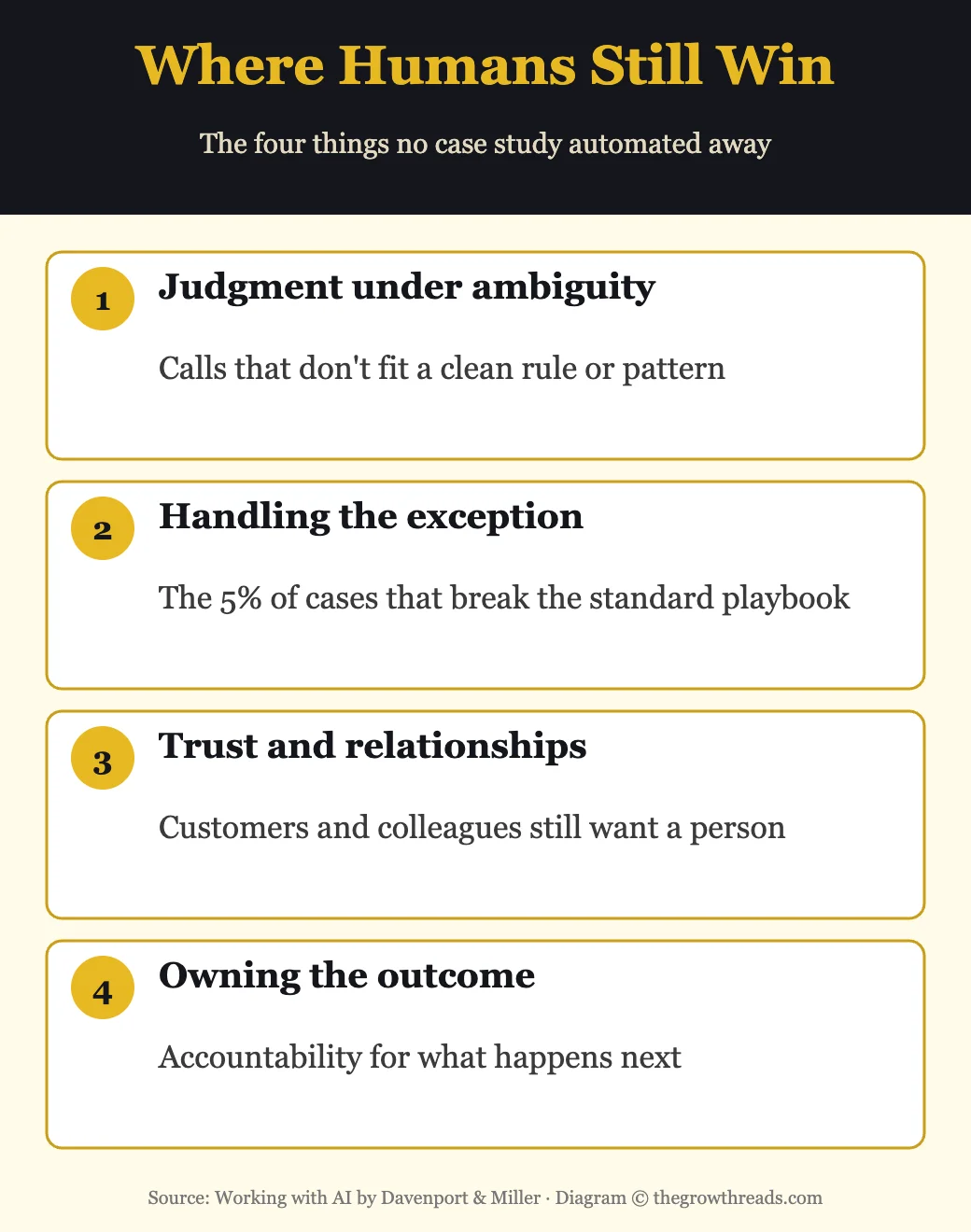
The final section of the book is the most durable, because it isn’t really about the current generation of AI models — it’s about the structural gap between what AI does well and what jobs actually require. Even in the most successful, most automated case studies, four things consistently stayed with a human: judgment calls that don’t reduce to a clean rule, handling the exceptional case that falls outside the training data, building and maintaining trust with customers and colleagues, and owning accountability when something goes wrong.
Davenport and Miller are careful not to frame this as a permanent ceiling on AI capability — models keep improving. But they argue the organizational and human need for these four things is separate from raw model capability. A customer wants to feel heard by a person on a sensitive claim, independent of whether an algorithm could technically process it. A regulator wants an accountable human decision-maker, independent of how good the underlying model is. These are structural, not just technical, constraints — which is why the authors expect the augmentation pattern to persist even as the technology keeps advancing.
The authors also note a subtler shift worth planning for: as routine analysis gets absorbed by AI, the remaining human work tends to concentrate on precisely the hardest, highest-stakes cases — which can be more cognitively demanding, not less. Teams that don’t anticipate this risk burning out their most experienced people, who end up handling nothing but the exceptions. The organizations that planned for this explicitly — by rotating exception-handling duty or building in recovery time — fared better than those that treated the freed-up capacity as a pure efficiency gain.
Who is Working with AI best for — and who should read something else first?
This book is the right choice if you have to make or defend a real decision about deploying AI at work — a manager evaluating a vendor pitch, a product leader planning a rollout, or an executive who wants evidence instead of hype before signing off on a budget. Its case-study format also makes it useful as a reference: you can jump to the industry closest to your own situation rather than reading cover to cover.
If you want the more conceptual, economics-first framing of how AI changes decision-making before diving into case studies, start with Prediction Machines. If your interest is more in the technical limits of current AI than in organizational change management, Rebooting AI is the better starting point.
Questions to reflect on
- Looking at your own team’s workflow, which specific task is repetitive and rule-based enough that AI augmentation could realistically help?
- Who on your team would need to trust a new AI tool for it to actually get used — and what would an early, visible win look like for them?
- Where does your current workflow already rely on a person to catch the exception — and is that role explicit or just assumed?
- If an AI tool freed up two hours a week on your team, what higher-value work would you want that time redirected toward?
- What would “accountability” concretely look like if an AI-assisted decision on your team went wrong?
🔥 Ready to make AI decisions based on evidence instead of hype?
Grab Working with AI and get 29 real case studies you can actually apply to your own team.
How to apply Working with AI (7-day plan)
- Day 1 — Map your candidate tasks. List every repetitive, rule-based task on your team that could realistically be augmented by AI.
- Day 2 — Pick one narrow pilot. Choose the single most bounded, lowest-risk task from your list to pilot first.
- Day 3 — Design the exception path. Before building anything, write down exactly how edge cases will route to a human.
- Day 4 — Plan a visible early win. Identify a small, easily verified result that will build trust in the tool within the first two weeks.
- Day 5 — Talk to the people who’ll use it. Have a real conversation with the frontline staff who will work with the tool, before rollout, not after.
- Day 6 — Redesign the workflow, not just the tool. Sketch how the surrounding process changes, not just what the AI does.
- Day 7 — Define what accountability looks like. Write down who owns the outcome when the AI-assisted decision is wrong.
Frequently asked questions
Is Working with AI written for executives or for technical teams?
Both, but it leans toward business and management readers. The case studies are written in plain, accessible language focused on organizational outcomes rather than technical implementation detail, making it a good fit for managers, product leaders, and executives making deployment decisions.
Does the book argue that AI won’t replace any jobs?
No. The authors are clear that full automation does happen in some cases — about one in ten of their case studies. Their broader point is that augmentation is far more common than the automation-panic narrative suggests, based on the real deployments they documented.
What industries does the book cover?
The 29 case studies span banking and finance, healthcare, insurance, manufacturing, agriculture, retail, and more. The breadth is intentional — it lets readers find a case study close to their own industry and situation.
Is this book still relevant given how fast AI has changed recently?
The specific tools in some case studies have evolved, but the organizational lessons — that adoption depends on workflow redesign, trust-building, and clear exception handling — apply regardless of which specific AI model or vendor a team uses today.
How is this different from other business books about AI?
Most AI business books lead with theory or predictions. This one leads with documented, real-world case studies and builds its framework from what actually happened, which makes its conclusions more grounded and immediately actionable.
Do I need technical AI knowledge to get value from this book?
No. The book focuses on organizational and strategic questions rather than the technical mechanics of how the AI models work, so no machine learning background is required to follow or apply its lessons.
How long does it take to read Working with AI?
Most readers finish it in about seven hours of straight reading. Because it’s structured as independent case studies, it also works well read a chapter or two at a time over one to two weeks.
Related summaries
- Prediction Machines — the economic framework behind why AI changes decisions, not just tasks.
- The Second Machine Age — the macro trend of racing with the machine rather than against it.
- Rebooting AI — the technical case for why humans stay essential in the loop.
- More Technology book summaries
Related Technology Summaries
Machines of Loving Grace Summary & Review: The Hidden Fork Behind Every AI Debate
Our Final Invention Summary & Review: Is Superintelligent AI a Genuine Threat?
Prediction Machines Summary & Review: The Simple Economics of Artificial Intelligence
The Algorithmic Leader Summary & Review
The Book of Why Summary & Review: How to Think in Causes, Not Just Correlations