

★★★★★ 4.6/5 — The clearest map for why good management looks different in every country.
Best for: Managers, founders, and teams working across borders, remote or in person
Reading time: ~18 min to read this guide · ~6 hrs to read the book
Difficulty to apply: Moderate — requires observing yourself and others, not just reading
The Culture Map in one minute
Good management in Boston can look like bad management in Beijing — and neither side is wrong. Erin Meyer, a professor at INSEAD, spent years studying how executives from different cultures work together and clash. She built eight scales — spectrums like direct-versus-indirect feedback or consensual-versus-top-down decisions — that show where a culture typically sits, not as a stereotype of individuals but as a position relative to other cultures. The book’s central insight: culture isn’t good or bad, it’s relative. A “direct” American manager can look brutally blunt to a Japanese colleague and painfully vague to a Dutch one, at the same time, in the same meeting. Once you can name which scale is causing the friction, you can adjust your approach instead of assuming the other side is difficult, incompetent, or rude.
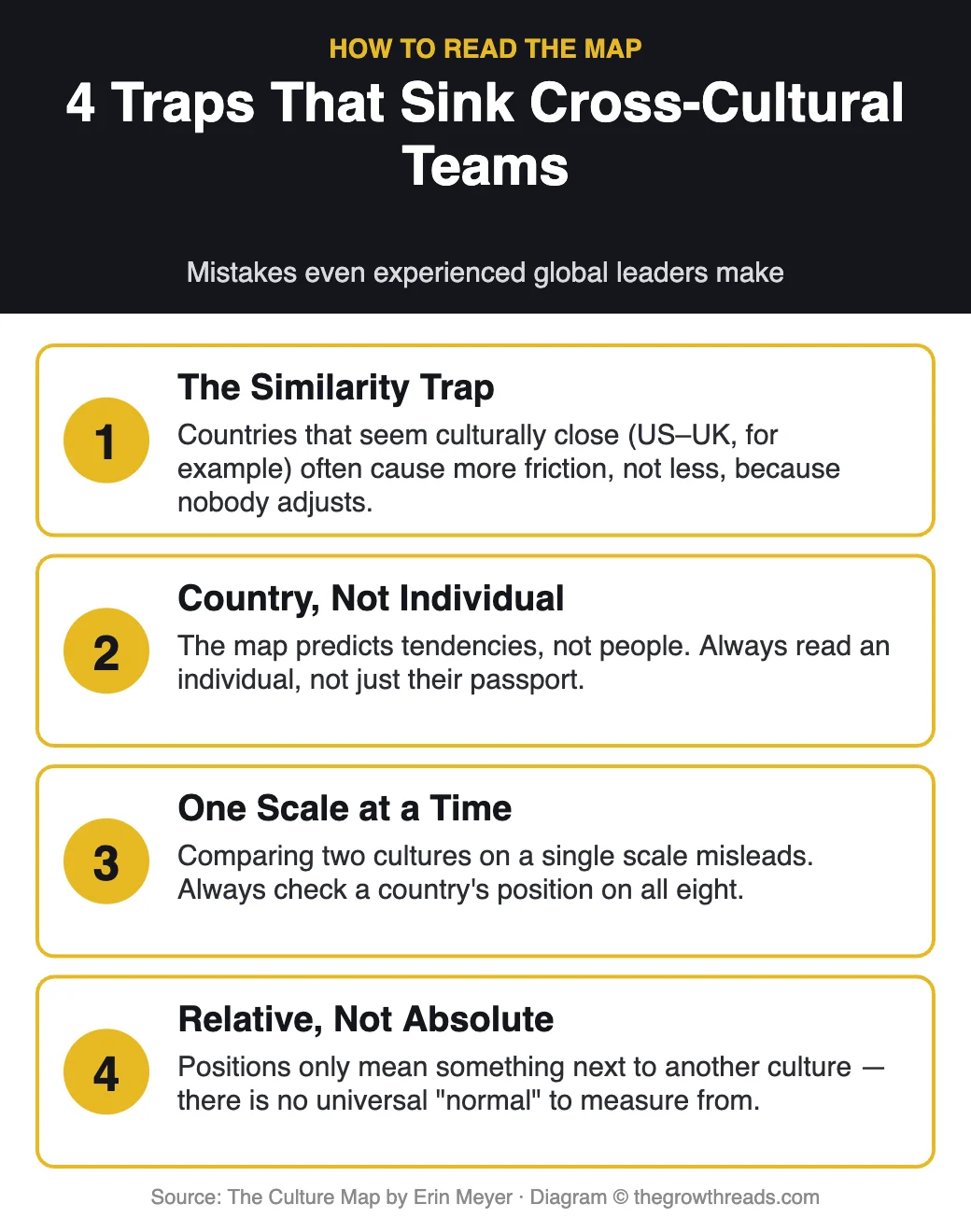
What makes Meyer’s approach different from the pop-culture-quiz version of “cultural differences” is that she never lets a scale stand alone. Two cultures can be close on one dimension and far apart on another — which is exactly why a country can’t be labeled “high-context” or “hierarchical” as a fixed trait. It has to be read scale by scale, relationship by relationship, which is more work than a stereotype but far more accurate.
Key takeaways
- Culture is relative, not absolute: nobody is “very direct” in general — only more or less direct than the specific person they’re talking to.
- Eight scales explain most of the friction: communicating, evaluating, persuading, leading, deciding, trusting, disagreeing, and scheduling cover the vast majority of cross-cultural misunderstandings at work.
- Low-context vs. high-context communication: some cultures say exactly what they mean; others expect you to read between the lines and infer meaning from shared context.
- Direct feedback isn’t universally rude: in some cultures, blunt negative feedback is the most respectful thing a boss can give an employee.
- The similarity trap is real: cultures that look alike on the surface — like the US and UK — often clash more than obviously different ones, because nobody lowers their guard.
- Trust comes in two flavors: task-based trust is earned through good work; relationship-based trust is earned through time and personal connection — and mismatching the two derails partnerships.
- Confrontation isn’t universally healthy or harmful: the same blunt disagreement can build trust in one culture and quietly destroy it in another.
- Hierarchy is about distance, not respect: egalitarian cultures minimize the gap between boss and employee; hierarchical cultures formalize it — neither implies more or less respect.
- Scheduling is about structure, not punctuality: linear-time cultures do one thing at a time; flexible-time cultures run several things in parallel and treat plans as directional.
- The map only works scale-by-scale and culture-by-culture: apply it to individuals cautiously, one dimension at a time, never as a blanket stereotype.
What is The Culture Map about?
The Culture Map by Erin Meyer is a business book that maps how national cultures differ across eight scales — including communicating, feedback, persuasion, leadership, decision-making, trust, disagreement, and scheduling — helping managers decode cross-cultural friction and adapt their leadership style for international teams.
About the author
Erin Meyer is a professor at INSEAD, one of the world’s top international business schools, where she directs the executive program on Management Skills for International Business. Before academia, she spent years living and working across Africa, Europe, and the Americas, including two years with the Peace Corps in Botswana — an experience that put her face-to-face with the cross-cultural misunderstandings she later spent her career studying. Her research has appeared in Harvard Business Review, and she is ranked among Thinkers50’s list of the world’s most influential management thinkers. Beyond The Culture Map (2014), Meyer co-authored No Rules Rules with Netflix co-founder Reed Hastings, examining Netflix’s unconventional, culture-driven management practices. She continues to advise multinational companies on building effective cross-cultural teams, and her INSEAD case studies and executive workshops are used to train managers at organizations ranging from early-stage startups to Fortune 500 leadership teams navigating their first major international expansion. Explore all Erin Meyer book summaries →
Key concepts at a glance
| Concept | What it means | Use it when |
|---|---|---|
| Communicating | Low-context (say exactly what you mean) vs. high-context (read between the lines) | Decoding why the same instructions worked for one report and confused another |
| Evaluating | Direct negative feedback vs. indirect, softened feedback | Giving a performance review to someone from a different feedback culture |
| Persuading | Principles-first reasoning vs. applications-first, lead-with-the-point | Pitching an idea to a room that keeps asking “why” before “what” |
| Leading | Egalitarian (flat) vs. hierarchical (formal distance) | Managing a team that either bristles at or expects top-down direction |
| Deciding | Consensual, group buy-in vs. top-down, fast calls | A decision stalls in one office and races through in another |
| Trusting | Task-based (earned through work) vs. relationship-based (earned over time) | A deal with a new partner isn’t progressing despite a strong proposal |
| Disagreeing | Confrontational, open debate vs. avoids visible conflict | Reading a meeting where silence might mean agreement — or the opposite |
| Scheduling | Linear-time (one thing at a time) vs. flexible-time (fluid, parallel) | A project plan keeps “slipping” in one office and holding firm in another |
Keep this table open as a reference while you read the four parts below — each pair of scales gets its own real-world friction points, plus a specific way to adjust your own default instead of just labeling the other side “difficult.”
Part 1: How to Read the Map — Communicating and Evaluating
Before any of the eight scales are useful, Meyer makes one thing clear: culture is relative, never absolute. Nobody is simply “direct” — they’re direct compared to whoever they’re standing next to. A Dutch manager who reads as refreshingly blunt in Amsterdam can read as needlessly harsh in Tokyo, without changing a single word of what they say. That relativity is the whole engine of the book, and it’s why country-level generalizations only work when you compare two specific cultures, not when you rank a culture as “high” or “low” in isolation.
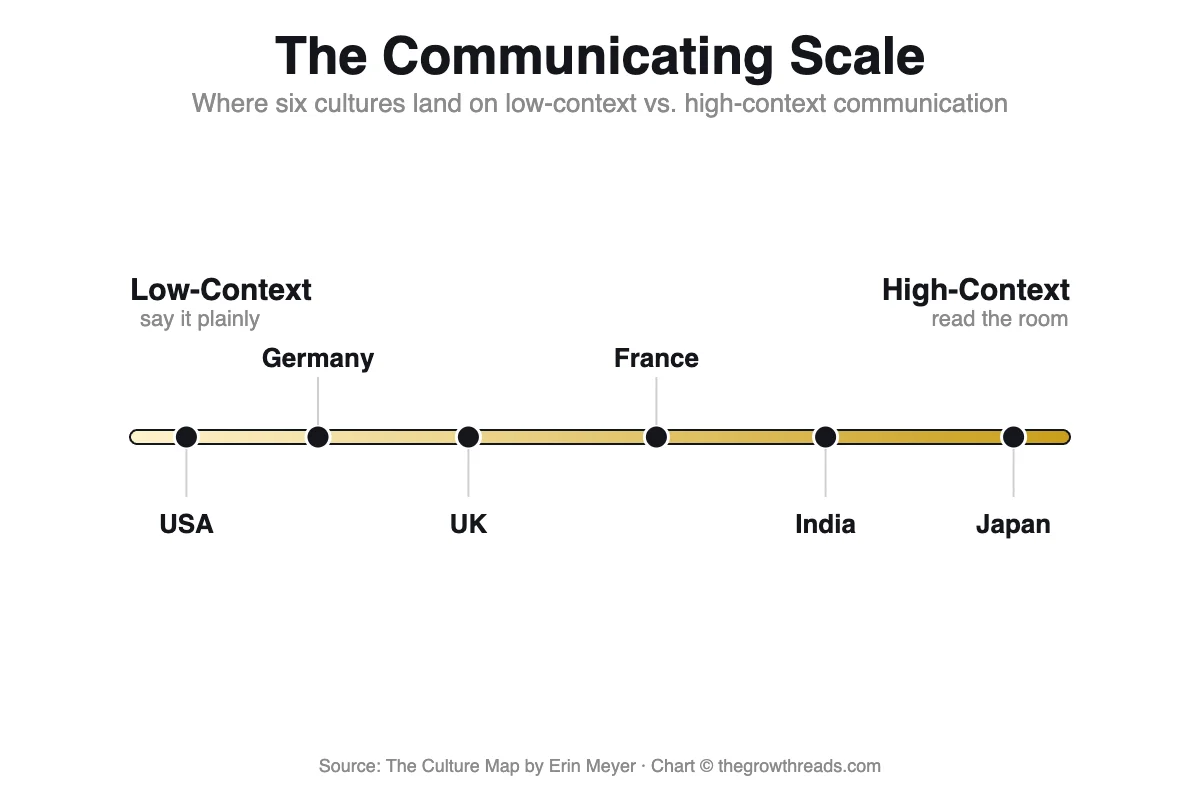
The Communicating scale runs from low-context cultures (the US, the Netherlands, Germany) where messages are meant to be taken literally, to high-context cultures (Japan, China, South Korea) where meaning lives as much in what’s implied as in what’s said. France, India, and Brazil sit in the middle — enough context-reading that a literal American email can land as oddly cold. The Evaluating scale measures something different: how directly negative feedback is delivered. The Netherlands, Israel, and Russia give blunt critique as a form of respect; Japan, Thailand, and — somewhat surprisingly — the UK, wrap criticism in layers of softening language. The surprise matters: the UK is low-context on communicating but indirect on evaluating, which is exactly the kind of scale-by-scale nuance that makes a single “culture score” useless. Each scale has to be read on its own.
In practice, this means treating a colleague’s directness or vagueness as data, not character. If a report from a high-context teammate reads like it’s missing detail, the fix usually isn’t demanding they “be clearer” — it’s asking a specific follow-up question that surfaces the context they assumed you already had. The reverse holds too: a low-context colleague’s blunt one-line email isn’t rudeness, it’s efficiency calibrated to a different default, and reading it as cold says more about your scale than theirs.
TGR Note: If the friction you’re dealing with is specifically about giving direct feedback well, pair this chapter with our Radical Candor summary — it gives you the feedback framework, while Meyer tells you how to calibrate it per culture.
Part 2: Getting Heard — Persuading and Leading
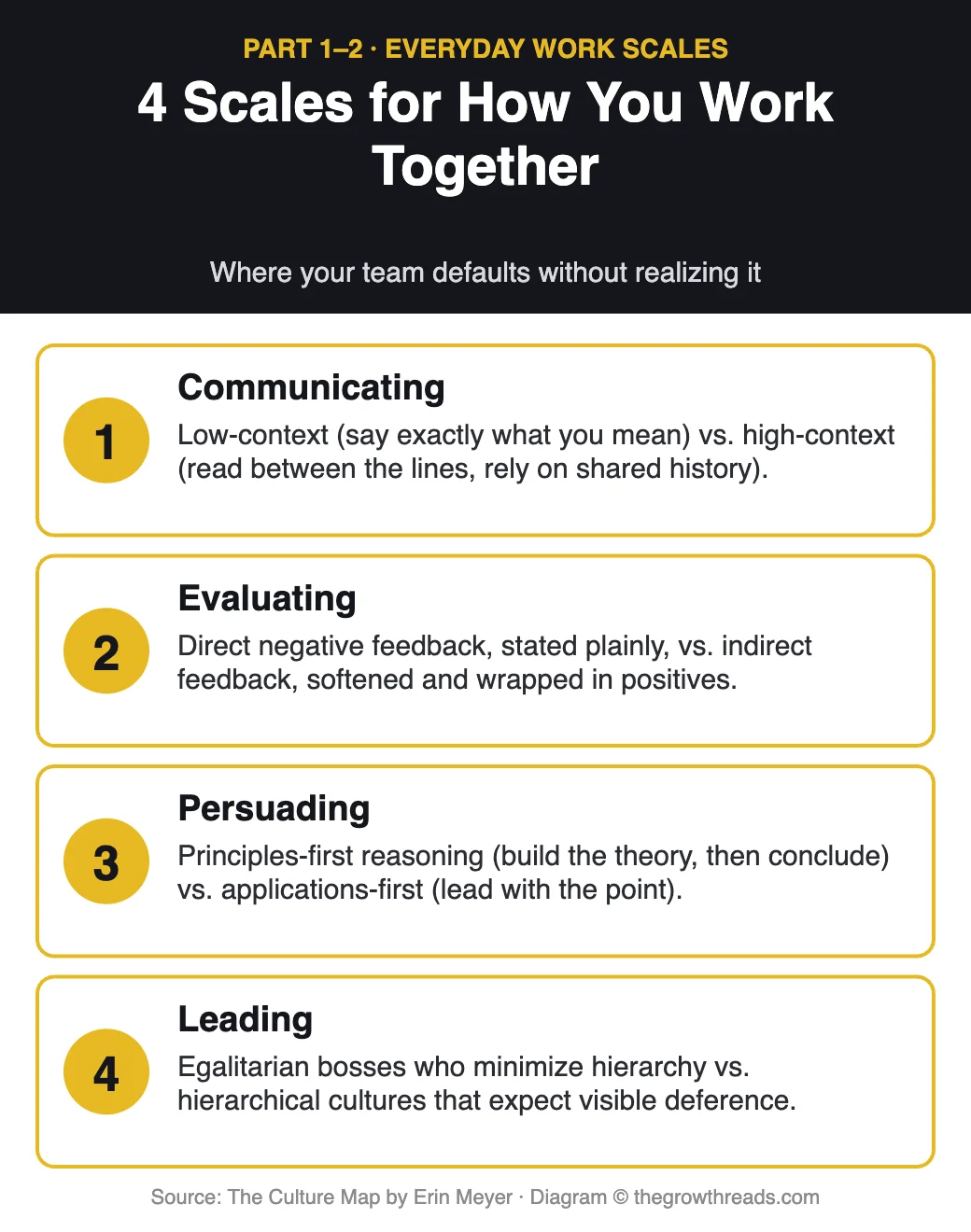
The Persuading scale explains why the exact same pitch lands differently depending on the room. Principles-first cultures (France, Germany, Russia) want the theory and reasoning built up before the conclusion — jumping straight to the recommendation feels presumptuous. Applications-first cultures (the US, UK, Australia) want the bottom line first and the supporting logic only if someone asks. Neither approach is more rigorous; they’re just different orders for the same information, and pitching in the wrong order is a common, invisible reason “great ideas” get politely ignored.
The Leading scale — egalitarian versus hierarchical — measures the formal distance between a boss and their team, and it is easy to conflate with a separate scale, Deciding. Meyer’s sharper insight is that they don’t always move together: Japan is highly hierarchical in how leaders are treated day-to-day, yet famously consensual in how decisions actually get made. France is also hierarchical in leading, but far more top-down in deciding. Assuming that a hierarchical culture automatically makes decisions from the top — or that a flat culture automatically decides by committee — is one of the most common, costly misreads in international business.
A useful test before any high-stakes pitch: read your own slide order out loud. If you open with the ask and only justify it when challenged, you’re applications-first — reorder the deck to lead with context for a principles-first audience instead. And when a hierarchical-leading culture also turns out to be consensual-deciding, as Japan often is, don’t mistake formal deference in the room for agreement; the real decision may still be happening in conversations you’re not part of yet.
TGR Note: Getting your reasoning order right is half the battle of persuasion — our Start with Why summary covers the other half: leading with purpose so people want to follow before you’ve even opened the deck.
Part 3: Deciding and Trusting
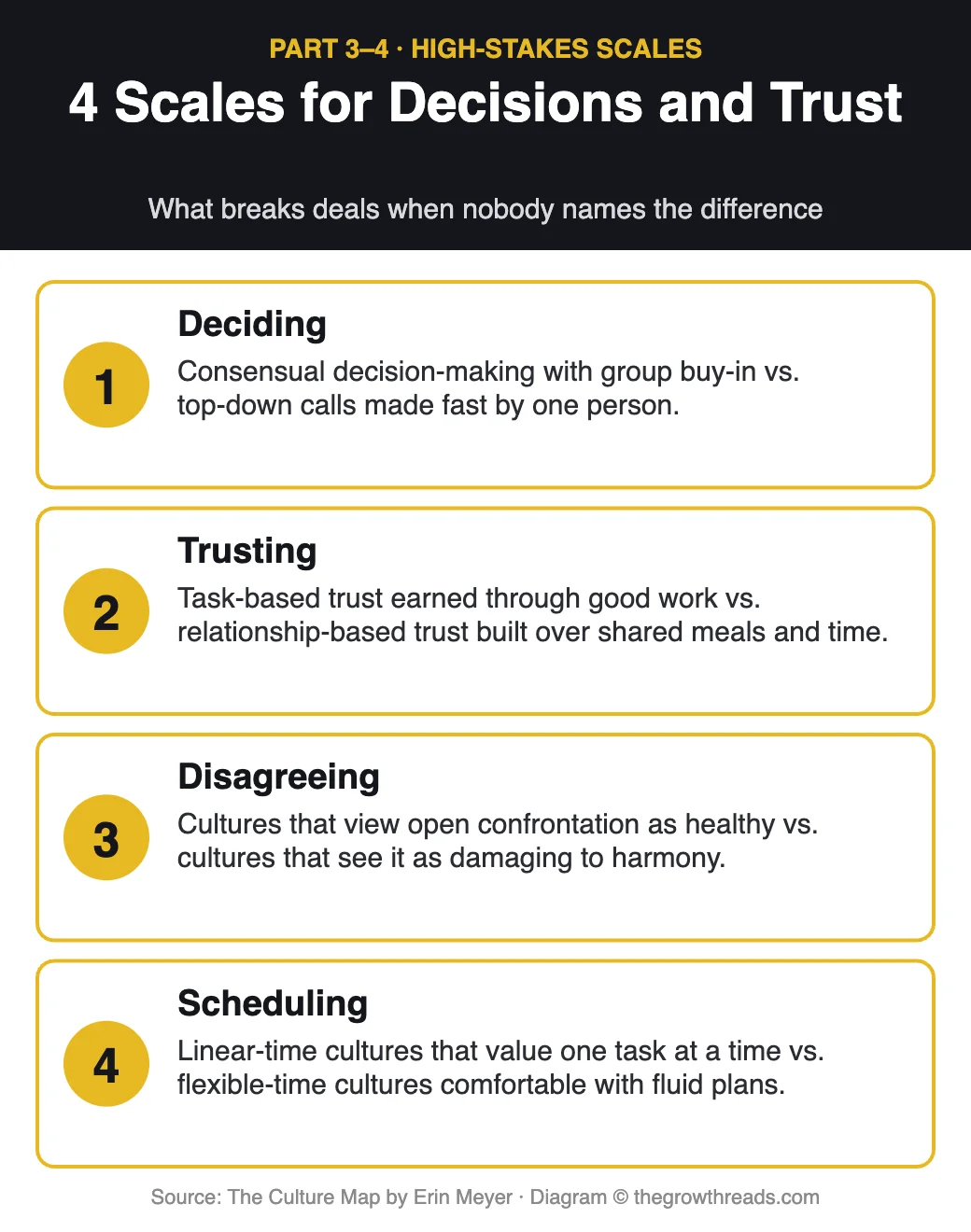
The Deciding scale splits consensual cultures (Japan, Sweden, Germany) from top-down cultures (China, the US, France). Meyer’s useful twist: in consensual cultures, the decision itself takes longer to reach because everyone needs buy-in — but once it’s made, it rarely gets revisited, and execution is fast. In top-down cultures, the call is made quickly by one person, but implementation often gets renegotiated along the way. Neither is “more efficient” — the time is spent either before the decision or after it.
The Trusting scale separates task-based trust (the US, Germany, the Nordics), earned by delivering good work, from relationship-based trust (China, Nigeria, Saudi Arabia, Brazil), earned through shared meals, personal history, and time spent outside the transaction. A task-based negotiator who skips the relationship-building because “the numbers speak for themselves” can stall a deal indefinitely with a relationship-based counterpart — and never understand why.
The practical fix for a stalled top-down/consensual mismatch is patience calibrated to the right stage: push harder for buy-in before a consensual culture decides, and expect more post-decision renegotiation from a top-down one — the total time spent rarely differs, only where it falls. On trust, the fastest way to close a task/relationship mismatch is simple: ask a relationship-based counterpart what they need before they’re ready to talk business, instead of assuming your track record will speak for itself.
TGR Note: Trust-building inside a single team, rather than across borders, is the specific focus of The Culture Code — read it alongside this chapter if the gap you’re solving is safety within a team, not friction between two countries.
Part 4: Disagreeing and Scheduling
The Disagreeing scale runs from confrontational cultures (France, Israel, Russia, Germany), where open debate is treated as sharpening an idea, to conflict-avoidant cultures (Japan, Thailand, Indonesia), where the same directness can read as a threat to group harmony. A team that debates loudly isn’t necessarily dysfunctional, and a team that stays quiet isn’t necessarily aligned — each has to be read against its own cultural baseline before you know which one is true.
The Scheduling scale has nothing to do with punctuality and everything to do with structure. Linear-time cultures (Germany, Switzerland, Japan) finish one task, then the next, and treat a schedule as a firm sequence. Flexible-time cultures (India, Nigeria, much of Latin America) run several threads in parallel and treat a schedule as directional rather than binding. A “delayed” project in one office may simply be running on a different, equally valid, operating system.
If your team avoids confrontation, don’t mistake silence for consensus — build in a structured moment, like a written pre-read or a round-robin, where disagreement has a lower-risk outlet than speaking up live in the room. And when a “delayed” deliverable is coming from a flexible-time culture, ask what’s actually blocking it before assuming it’s slipping — it may simply be running in parallel with three other priorities that are equally real to the person managing them.
TGR Note: When disagreement itself feels risky to raise, our Dare to Lead summary is the natural next stop — it’s built specifically around making hard conversations survivable.
Who is The Culture Map best for — and who should read something else first?
This book is built for global managers, remote and distributed team leads, expats, HR and learning-and-development professionals designing cross-cultural training, and founders hiring or raising money internationally. If your working world crosses a border, a time zone that maps to a different business culture, or a team with more than one nationality on it, the eight scales will pay for themselves in the first misread meeting you catch early.
If your friction is really about giving direct feedback well inside one culture, start with Radical Candor and come back to this for the cultural layer. If it’s about building trust and psychological safety inside a single team rather than across borders, The Culture Code is the better first read. And if the real gap is persuading people to follow your vision at all — before culture even enters the picture — Start with Why builds that foundation first. A useful gut check: if your last three work frustrations involved a colleague, client, or manager based in a different country — a stalled negotiation, a feedback conversation that landed wrong, a decision that seemed to take forever or move suspiciously fast — this book is worth reading this month, not eventually.
Questions to reflect on
- On the Communicating scale, are you naturally low-context or high-context — and does your writing style match how your team actually reads instructions?
- Think of your last cross-cultural misunderstanding at work. Which of the eight scales was really the source of the friction?
- Where do you personally sit on the Disagreeing scale, and has that ever been mistaken for either weakness or hostility?
- Is your team’s trust currently task-based or relationship-based — and would switching approaches with a new international partner change the outcome?
- Which culture do you privately assume is “most like yours” — and could that assumption be creating more friction, not less?
🔥 Ready to stop guessing why your global team keeps misreading you?
Get the full breakdown of Meyer’s eight scales — and a practical way to place any culture on the map before your next cross-border meeting.
How to apply The Culture Map (7-day plan)
- Day 1: Pick one recent cross-cultural friction at work and identify which of the eight scales was actually the source.
- Day 2: Map your own default position on the Communicating scale — low- or high-context — based on how you actually write emails, not how you think you communicate.
- Day 3: Do the same for the Evaluating scale: recall your last piece of feedback and rate honestly how direct it really was.
- Day 4: Before your next presentation or pitch, decide whether your audience needs principles-first or applications-first framing, and reorder your slides accordingly.
- Day 5: In your next 1:1 with a colleague from a different culture, ask one question about how decisions get made on their team, then just listen.
- Day 6: Identify one cross-cultural relationship you’re building and check whether it needs more task-based proof or more relationship-based time before it moves forward.
- Day 7: Sketch your team’s — not just your own — position on all eight scales, and flag the single biggest gap most likely to cause a misunderstanding next quarter.
Frequently asked questions
What are the 8 scales in The Culture Map?
The eight scales are Communicating (low-context vs. high-context), Evaluating (direct vs. indirect feedback), Persuading (principles-first vs. applications-first), Leading (egalitarian vs. hierarchical), Deciding (consensual vs. top-down), Trusting (task-based vs. relationship-based), Disagreeing (confrontational vs. avoids confrontation), and Scheduling (linear-time vs. flexible-time). Each scale positions a culture relative to others rather than assigning it a fixed, absolute score, and cultures often land differently on different scales — a country can be hierarchical in one dimension and consensual in another.
Is The Culture Map based on real research?
Yes. Erin Meyer draws on her research and teaching at INSEAD, along with years of interviews, surveys, and executive workshops with international managers. That said, the scales describe country-level tendencies, not individuals — Meyer herself is careful to note that any single person can fall anywhere on a given scale regardless of their passport, so the book works best as a starting hypothesis to test against the actual people in front of you, not a fixed label. Meyer also draws on decades of prior cross-cultural research, including work by Geert Hofstede and Edward T. Hall, which gives the eight scales an academic foundation beyond her own consulting anecdotes.
How is The Culture Map different from Hofstede’s cultural dimensions?
Meyer builds on earlier cross-cultural research, including Geert Hofstede’s well-known cultural dimensions theory, but narrows the focus specifically to workplace behavior and makes it directly usable by managers. Instead of fixed national scores, she emphasizes relative positioning — comparing two specific cultures against each other — which is closer to how cross-cultural friction actually shows up in a meeting, negotiation, or performance review.
Do I need to work internationally for this book to be useful?
No. Even fully local teams have hidden cultural clashes — someone raised in a direct-feedback household working alongside someone raised in an indirect one, for example. Remote and hybrid teams that span time zones and mix nationalities benefit even more. That said, the highest-value use case is genuinely cross-border teams, international negotiations, or managing an overseas office, where the eight scales explain friction that would otherwise just look like a personality clash.
What is the “similarity trap” and why does it matter?
The similarity trap is Meyer’s term for the friction that shows up between cultures that seem alike on the surface — the US and UK share a language, for instance — but differ sharply on scales like Evaluating or Disagreeing. Because the surface similarity lowers everyone’s guard, nobody adjusts their communication style, and the resulting misunderstandings can be more frequent and more confusing than clashes between obviously different cultures, where people expect friction and prepare for it.
How long does it take to read The Culture Map?
The full book runs about 288 pages, which typically takes around six hours to read at a normal pace, or a bit less as an audiobook. This TGR summary is designed to be read in roughly 18 minutes and covers all eight scales, the book’s key frameworks, and a practical plan for applying them — enough to start using the ideas immediately, though the full book adds many more country-specific examples, worked negotiation scenarios, and a fuller treatment of how the eight scales interact within a single team.
What should I read after The Culture Map?
Erin Meyer’s own follow-up, No Rules Rules, co-written with Netflix’s Reed Hastings, applies a similar cultural lens to Netflix’s unconventional management practices. On thegrowthreads.com, pair this with our The Culture Code summary for team-level trust-building, or Radical Candor for a direct-feedback framework you can calibrate using what you learned here.
Related summaries
- Radical Candor Summary & Review
- The Culture Code Summary & Review
- Start with Why Summary & Review
- Dare to Lead Summary & Review
- Best Leadership Books
How we analyze books: our team reads the full book, cross-references its core claims against other research and expert summaries, and builds original diagrams and application plans rather than reproducing the text. Read our full methodology.
Related Leadership Summaries
Crucial Accountability Summary & Review: How to Hold Anyone Accountable Without a Blowup
High Output Management Summary & Review: Andy Grove’s Playbook for Multiplying Your Impact
Radical Candor Summary & Review: Be a Great Boss Without Losing Your Humanity
The Lean Startup Summary & Review: Build, Measure, Learn
The Motive Summary & Review: Why You Lead Matters Most