

★★★★☆ 4.5/5 — A clear, physiologically grounded case that Type 2 diabetes is a disease of insulin excess, not insulin deficiency, and that it can often be reversed rather than merely managed.
Best for: readers with (or at risk of) Type 2 diabetes who want to understand the disease mechanism, not just track a number · Reading time: ~6 hrs (this guide: ~11 min) · Difficulty to apply: Moderate — the concepts are simple, but real dietary change requires medical supervision if you’re on medication
The Diabetes Code in one minute
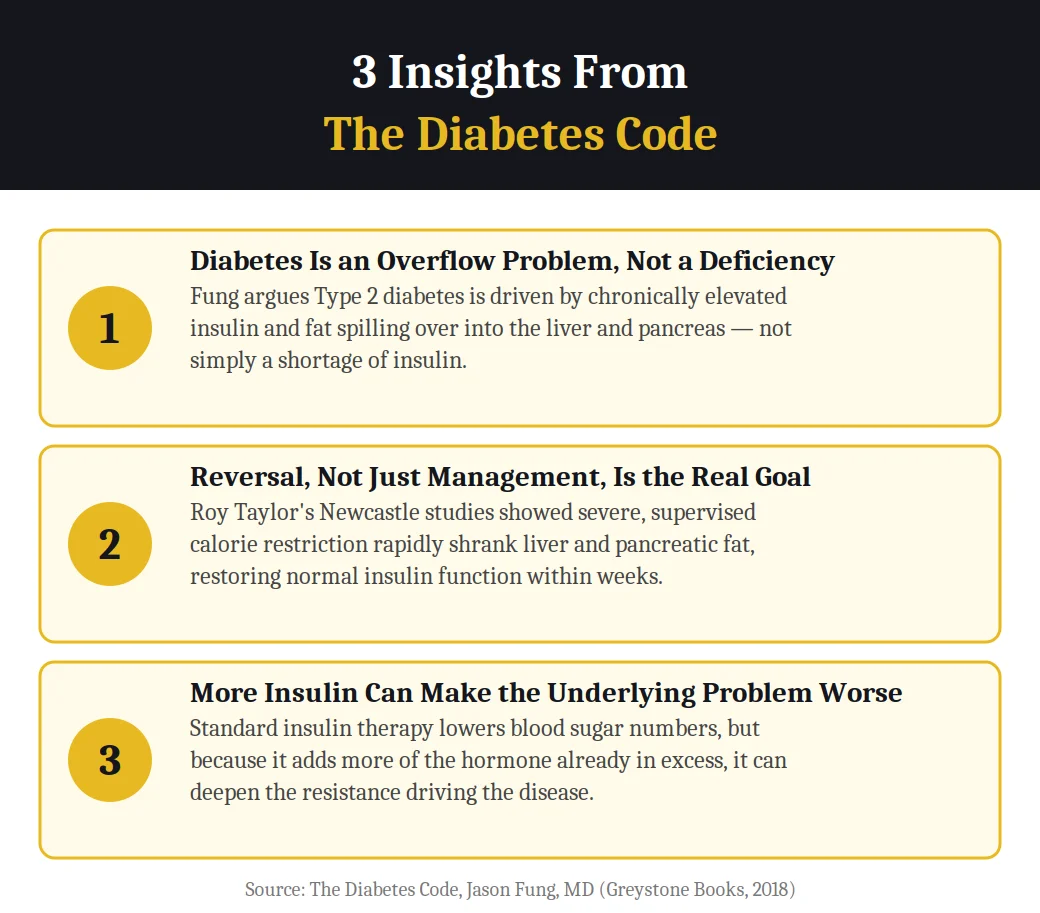
Type 2 diabetes isn’t a disease of too little insulin — Jason Fung, MD, argues it’s a disease of too much, and once you see it that way, reversal becomes a realistic goal, not just management. Fung, a Toronto nephrologist who spent years watching diabetic patients arrive at his kidney clinic with worsening complications despite “well-controlled” blood sugar numbers, builds his case around an overflow, or “bathtub,” model: once the liver and muscles run out of storage space for glycogen, excess glucose converts to fat and spills into organs that were never meant to store it, especially the liver and pancreas. Drawing heavily on the work of Newcastle University’s Roy Taylor, whose supervised very-low-calorie-diet studies reversed Type 2 diabetes in weeks by shrinking organ fat, Fung lays out his “Twin Cycle Hypothesis” and the idea of a “Personal Fat Threshold” — an individual, largely genetic ceiling for safely storing fat, beyond which organ fat and disease follow regardless of a person’s overall size. Published in 2018, the book is also a pointed critique of standard care: insulin and sulfonylurea therapies lower blood glucose readings, Fung argues, but by adding more of the hormone already in excess, they can deepen the resistance driving the disease rather than resolve it.
Key takeaways
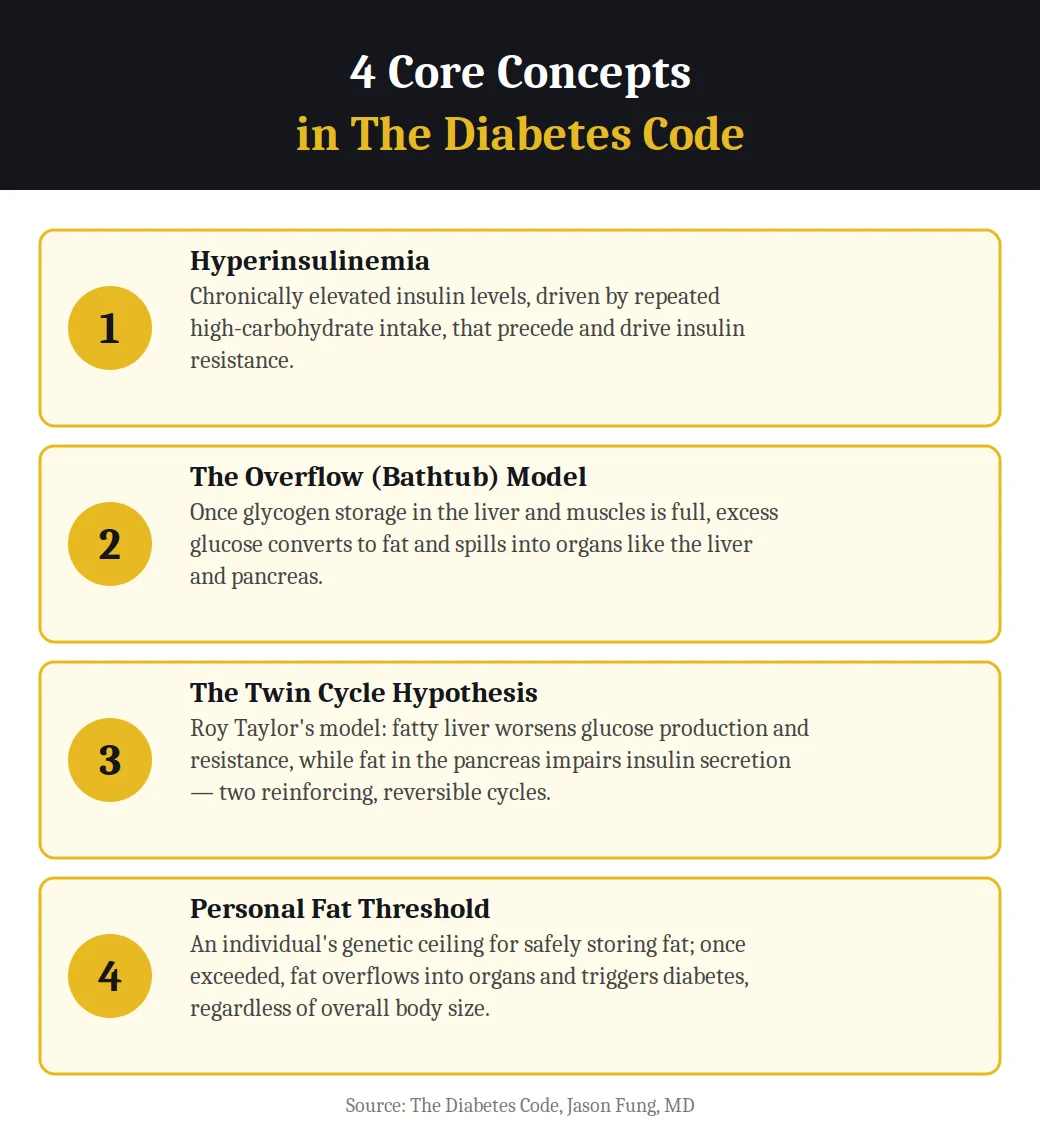
- Type 2 diabetes is a disease of insulin excess, not deficiency: chronically elevated insulin, driven by repeated high-carbohydrate intake, precedes and drives insulin resistance rather than the reverse.
- The overflow (“bathtub”) model explains organ fat: once glycogen storage in the liver and muscles is full, excess glucose converts to fat and spills into organs like the liver and pancreas that aren’t built to hold it.
- The Twin Cycle Hypothesis ties liver and pancreas together: Roy Taylor’s model shows fatty liver worsening glucose production and resistance, while fat in the pancreas impairs insulin secretion — two reinforcing, and reversible, cycles.
- Everyone has a Personal Fat Threshold: an individual’s genetic ceiling for safely storing fat; once exceeded, fat overflows into organs and triggers diabetes regardless of overall body size.
- The Newcastle Diet studies demonstrate rapid reversal: severe, medically supervised calorie restriction shrank liver and pancreatic fat and restored normal insulin function within weeks.
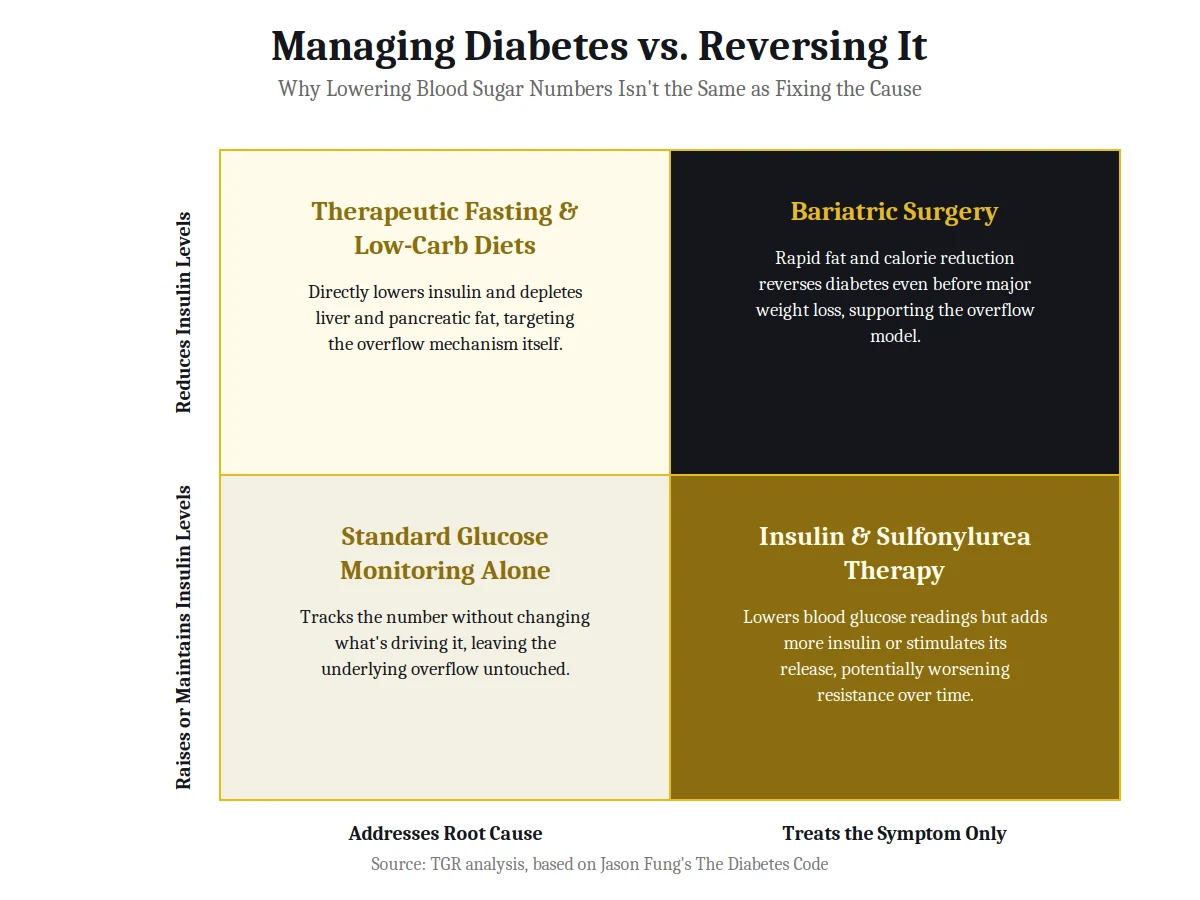
- More insulin can worsen the underlying problem: standard insulin therapy lowers blood sugar numbers, but because it adds more of a hormone already in excess, it can deepen resistance over time.
- Bariatric surgery is proof-of-concept for reversibility: diabetes remission often occurs within days of surgery, before significant weight loss, pointing to organ fat — not body weight alone — as the real driver.
- Therapeutic fasting is Fung’s core clinical tool: at his Intensive Dietary Management clinic, supervised fasting protocols have allowed patients to come off insulin and oral medications entirely.
- Treating the number isn’t the same as treating the disease: glucose monitoring alone tracks the symptom without addressing what’s driving it, leaving the underlying overflow untouched.
What is The Diabetes Code about?
The Diabetes Code is Jason Fung’s case that Type 2 diabetes is fundamentally a disease of insulin excess and organ fat overflow, not a simple shortage of insulin, and that this reframing makes reversal — not just lifelong management — a realistic goal for most patients. Drawing on his clinical experience running Toronto’s Intensive Dietary Management Program and on Roy Taylor’s Newcastle diet studies, Fung explains why standard treatments that focus solely on lowering blood glucose numbers can leave the underlying disease process untouched, or even make it worse. Published in 2018 by Greystone Books, the book combines physiology, clinical case studies, and a critique of conventional diabetes care with a practical framework — built around therapeutic fasting and low-carbohydrate eating — for addressing the root cause rather than the symptom.
About the author
Jason Fung, MD, is a Toronto-based nephrologist (kidney specialist) and one of the world’s leading experts on intermittent fasting and low-carbohydrate diets for the treatment of Type 2 diabetes and obesity. After years of managing dialysis patients whose kidney failure was rooted in unchecked diabetes, Fung became convinced that standard care was treating symptoms rather than the disease itself. In 2010 he founded the Intensive Dietary Management (IDM) Program in Toronto, a clinic dedicated to reversing Type 2 diabetes and obesity through therapeutic fasting and dietary change rather than escalating medication. He is the author of the bestselling The Obesity Code and The Complete Guide to Fasting, and his work has influenced how thousands of clinicians and patients think about insulin, weight, and metabolic disease. Explore all Jason Fung, MD book summaries →
Key concepts at a glance
| Concept | What it means | Use it when |
|---|---|---|
| Hyperinsulinemia | Chronically elevated insulin levels that precede and drive insulin resistance | You’re trying to understand why blood sugar keeps rising despite treatment |
| The Overflow (Bathtub) Model | Excess glucose converts to fat and spills into organs once glycogen storage is full | You want a mental model for why fat accumulates in the liver and pancreas |
| The Twin Cycle Hypothesis | Fatty liver and fatty pancreas reinforce each other in two connected, reversible cycles | You’re evaluating why diabetes can worsen even with stable weight |
| Personal Fat Threshold | An individual’s genetic ceiling for safely storing fat before it overflows into organs | You want to understand why diabetes risk isn’t just about body size |
| Therapeutic Fasting | Supervised periods without food used to lower insulin and deplete organ fat | You’re considering dietary approaches to address the root cause, under medical guidance |
Part 1: Rethinking diabetes as an overflow problem
Fung’s central reframe is that Type 2 diabetes is driven by chronically elevated insulin — hyperinsulinemia — rather than a simple shortage of it. He builds this around an “overflow,” or bathtub, model: once the liver and muscles have filled their glycogen storage capacity, additional glucose has nowhere safe to go, so it converts to fat and spills into organs like the liver and pancreas that were never built to store it in quantity. This overflow, Fung argues, is what actually drives insulin resistance and disease progression, not simply high blood sugar readings in isolation. The implication is significant: if the problem is excess insulin and organ fat overflow, then treatments that add more insulin to the system are addressing the reading on the meter while leaving the underlying flood untouched.
TGR Note: Fung’s overflow model pairs naturally with How Not to Diet‘s emphasis on caloric density and fiber — both point toward what, and how much, ends up stored rather than burned as the real lever on metabolic health.
Part 2: The Twin Cycle Hypothesis and Personal Fat Threshold
Fung draws heavily on Newcastle University researcher Roy Taylor’s work to explain why diabetes progresses and, critically, why it can reverse. The “Twin Cycle Hypothesis” describes two reinforcing cycles: fatty liver worsens glucose production and drives resistance, while fat accumulating in the pancreas impairs its ability to secrete insulin properly — each cycle feeding the other. This connects to the “Personal Fat Threshold,” the idea that every individual has a largely genetic ceiling for how much fat they can safely store before it overflows into organs; someone can develop diabetes at a normal body weight if their threshold is low, while another person can carry significantly more weight without developing the disease if their threshold is higher. Together, these ideas explain both why diabetes onset varies so much between people of similar weight, and why interventions that reduce organ fat — not just body weight broadly — can reverse the disease.
Part 3: Evidence for reversal and the case against standard therapy
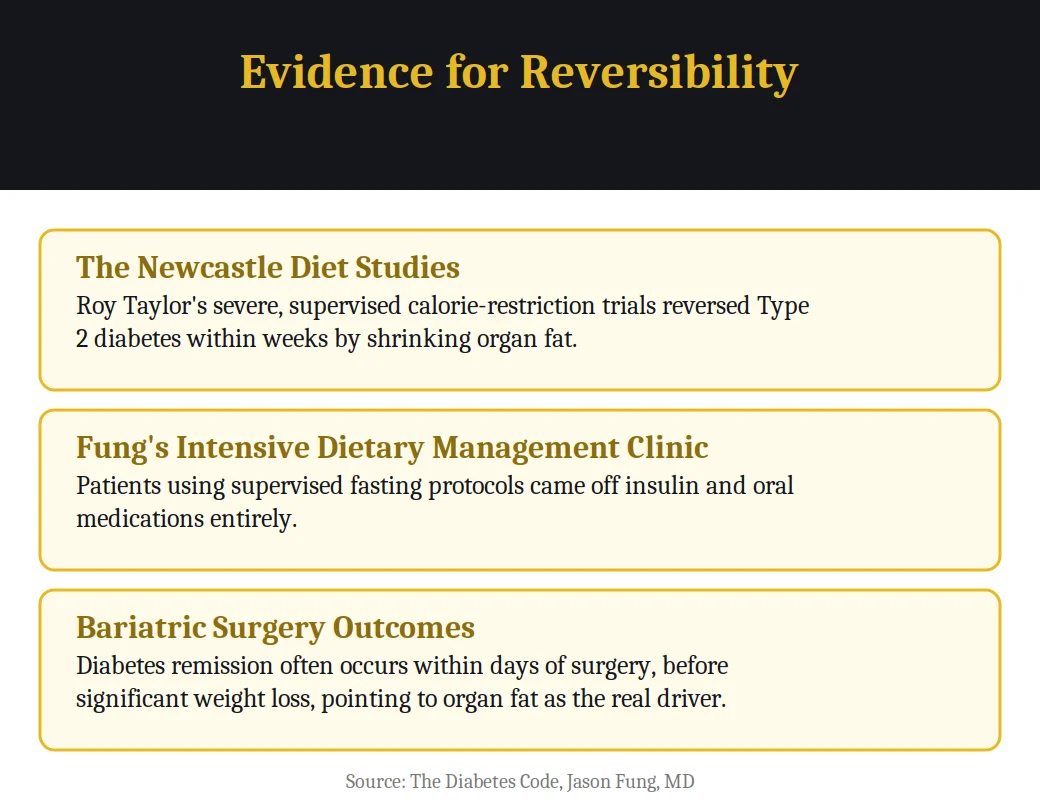
The strongest evidence Fung marshals comes from three directions. Roy Taylor’s Newcastle diet studies used severe, medically supervised calorie restriction to reverse Type 2 diabetes within weeks by rapidly shrinking liver and pancreatic fat. Fung’s own Intensive Dietary Management clinic in Toronto has used supervised therapeutic fasting protocols to help patients come off insulin and oral medications entirely, under close monitoring. And bariatric surgery outcomes offer a striking natural experiment: diabetes remission frequently occurs within days of surgery, well before any significant weight loss has occurred, which Fung reads as strong evidence that organ fat — not overall body weight — is the real driver of the disease. Set against this, he argues that standard insulin and sulfonylurea therapies, while effective at lowering glucose readings, work by increasing the very hormone already in excess, potentially worsening the resistance that underlies the disease over the long run.
Who is The Diabetes Code best for — and who should read something else first?
This book is best for readers who have Type 2 diabetes, prediabetes, or a family history of it and want to understand the disease mechanism well enough to have an informed conversation with their physician about treatment options, including supervised fasting or dietary change. Because it argues for reducing or discontinuing medications in some cases, it’s essential to work with a doctor rather than self-adjusting treatment based on the book alone.
If you want a broader, food-first framework for weight and metabolic health that complements Fung’s insulin-centered lens, How Not to Diet offers a nutrition-science companion built on caloric density and fiber rather than fasting.
Questions to reflect on
- Have you thought about your blood sugar numbers as a symptom rather than the disease itself, and how might that change what you’d want to address?
- Does the idea of a Personal Fat Threshold change how you think about diabetes risk relative to your own body weight?
- If you or someone close to you is on insulin or sulfonylurea therapy, what would a conversation with their doctor about the overflow model look like?
- What would it take, practically and medically, for you to try a supervised period of dietary change aimed at reducing organ fat rather than just glucose readings?
- How does the bariatric surgery evidence change your intuition about what actually reverses Type 2 diabetes?
🔥 Ready to understand diabetes as an overflow problem, not just a number?
This guide covers the core framework — the book gives you Fung’s full clinical case studies, the Newcastle Diet research, and his complete Intensive Dietary Management approach.
How to apply The Diabetes Code (7-day plan)
- Day 1: Write down your most recent fasting insulin and blood glucose numbers, or schedule labs if you don’t have recent ones.
- Day 2: Read up on the overflow model and identify which of your current habits might be contributing to organ fat overflow.
- Day 3: If you take diabetes medication, schedule a conversation with your doctor about the overflow model before changing anything.
- Day 4: Reduce refined carbohydrate intake for one day and notice the effect on how you feel.
- Day 5: Research the Newcastle Diet studies and Fung’s Intensive Dietary Management approach in more depth.
- Day 6: Identify one meal or snack pattern that keeps insulin elevated throughout the day, and plan an alternative.
- Day 7: Under medical guidance, discuss whether a supervised trial of dietary change or fasting could be appropriate for your situation.
Frequently asked questions
Is Type 2 diabetes really caused by too much insulin?
Fung argues yes — chronically elevated insulin, not a shortage, is what drives insulin resistance and disease progression.
What is the overflow (bathtub) model?
Once glycogen storage in the liver and muscles is full, excess glucose converts to fat and spills into organs like the liver and pancreas.
What is the Twin Cycle Hypothesis?
Roy Taylor’s model showing fatty liver and fatty pancreas reinforcing each other in two connected, reversible cycles.
What is a Personal Fat Threshold?
An individual’s genetic ceiling for safely storing fat; once exceeded, fat overflows into organs and triggers diabetes.
Can Type 2 diabetes actually be reversed?
Fung argues yes, citing the Newcastle Diet studies, his own clinic’s outcomes, and bariatric surgery remission data.
Does insulin therapy make diabetes worse?
Fung argues it can worsen underlying resistance over time, even as it lowers blood glucose readings in the short term.
How is this different from How Not to Diet?
How Not to Diet focuses on nutrition science for weight loss broadly; The Diabetes Code focuses specifically on insulin and diabetes reversal.
Related summaries
If The Diabetes Code resonated, these dig further into related territory: How Not to Diet on evidence-based nutrition for weight loss, and other titles in our best health books pillar page.
How we analyze books: We work from the full book — reconstructing its core arguments in our own words, adding commentary that connects it to related research and other books in our library, and pressure-testing the advice in a practical 7-day plan. Ratings weigh usefulness, readability, and evidence quality. Read our full methodology.
Related Health Summaries
Eat Move Sleep Summary and Review
Exercised Summary & Review: Why Something We Never Evolved to Do Is Essential
Glucose Revolution Summary & Review: 10 Simple Hacks to Flatten Your Blood Sugar Curves
The Blue Zones Summary & Review: 9 Lessons From the World’s Longest-Lived People
The End of Alzheimer’s Summary & Review: The First Protocol to Prevent and Reverse Cognitive Decline