

★★★★☆ 4.3/5 — A humanistic, introspective classic that treats leadership as an inward journey of self-discovery rather than a checklist of behaviors.
Best for: readers who want the psychological “why” underneath more tactical leadership books · Reading time: ~7 hrs (this guide: ~13 min) · Difficulty to apply: Moderate — the ideas are simple to grasp, honest self-reflection takes real effort
On Becoming a Leader in one minute
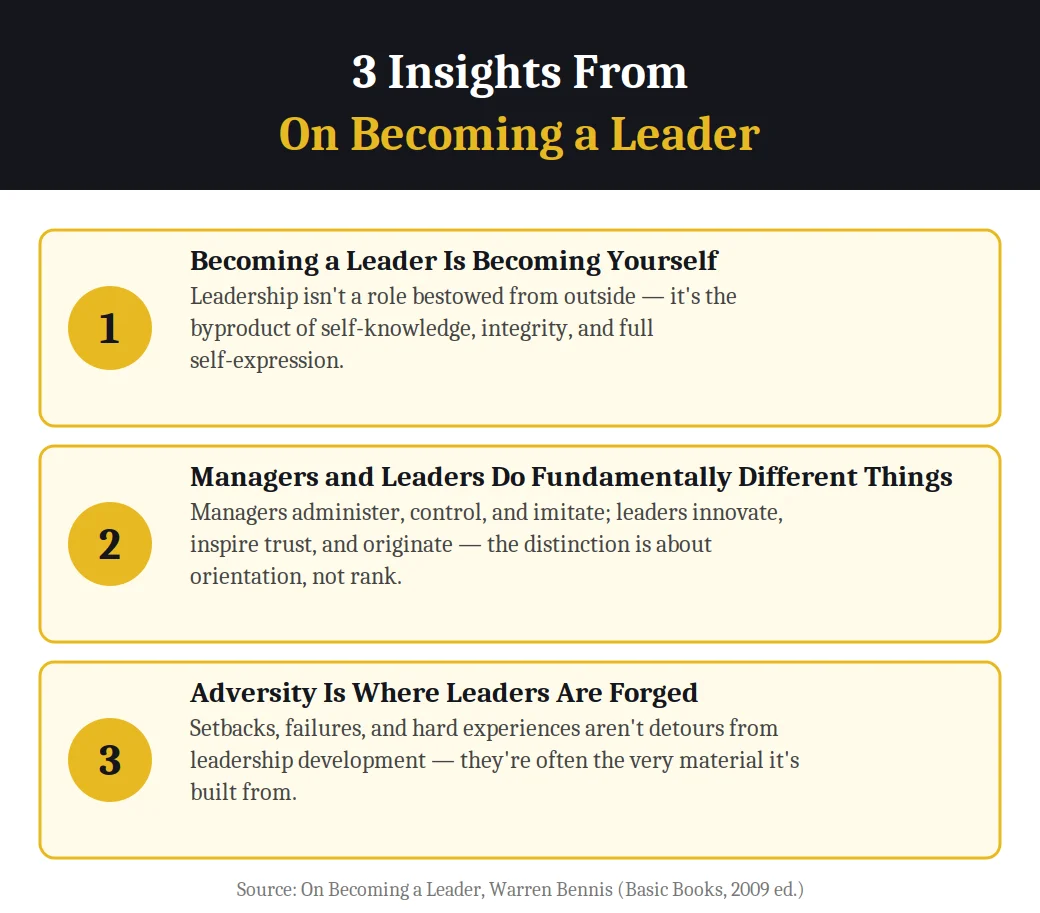
Leaders are made, not born — and made mostly by themselves. Warren Bennis built this book from interviews with dozens of accomplished leaders across business, government, and the arts, searching for what they had in common. What he found wasn’t a formula or a set of tactics, but a shared foundation of self-knowledge, integrity, and full self-expression. His most quoted contribution is a sharp distinction between managers, who administer, control, and imitate, and leaders, who innovate, inspire trust, and originate. First published in 1989 and still in print in a 20th Anniversary edition, the book’s core claim is that becoming a leader is, at bottom, synonymous with becoming yourself — an authentic, integrated person shaped by honestly reflecting on experience rather than merely living through it.
Key takeaways
- Leaders are self-made: leadership develops through internal work — self-knowledge and reflection — more than through external credentials or appointed authority.
- Managers and leaders are not the same job at different levels: they represent different orientations entirely — the manager asks how and when, the leader asks what and why.
- Doing things right isn’t the same as doing the right thing: efficiency and effectiveness are different goals, and Bennis argues leadership is fundamentally about the latter.
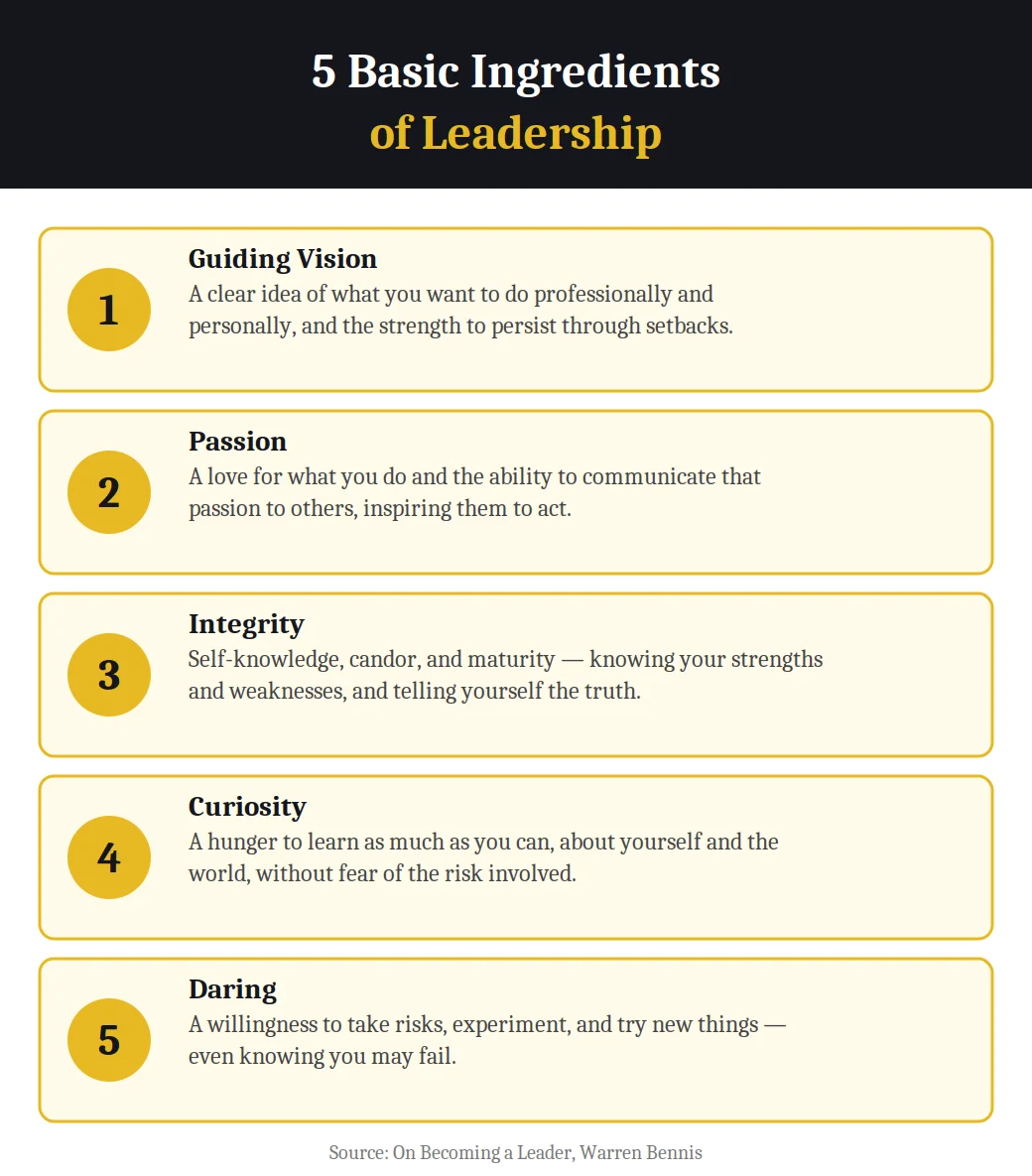
- Five basic ingredients recur across the leaders Bennis studied: guiding vision, passion, integrity, curiosity, and daring.
- Trust is the currency of leadership: built through constancy, congruity, reliability, and integrity — without it, authority is just command.
- There are three modes of learning: maintenance learning preserves what exists, shock learning is forced adaptation to crisis, and innovative learning proactively anticipates change — leaders cultivate the third.
- Adversity is material, not just obstacle: many of the leaders Bennis studied pointed to hardship or disruption as the experience that shaped their leadership most.
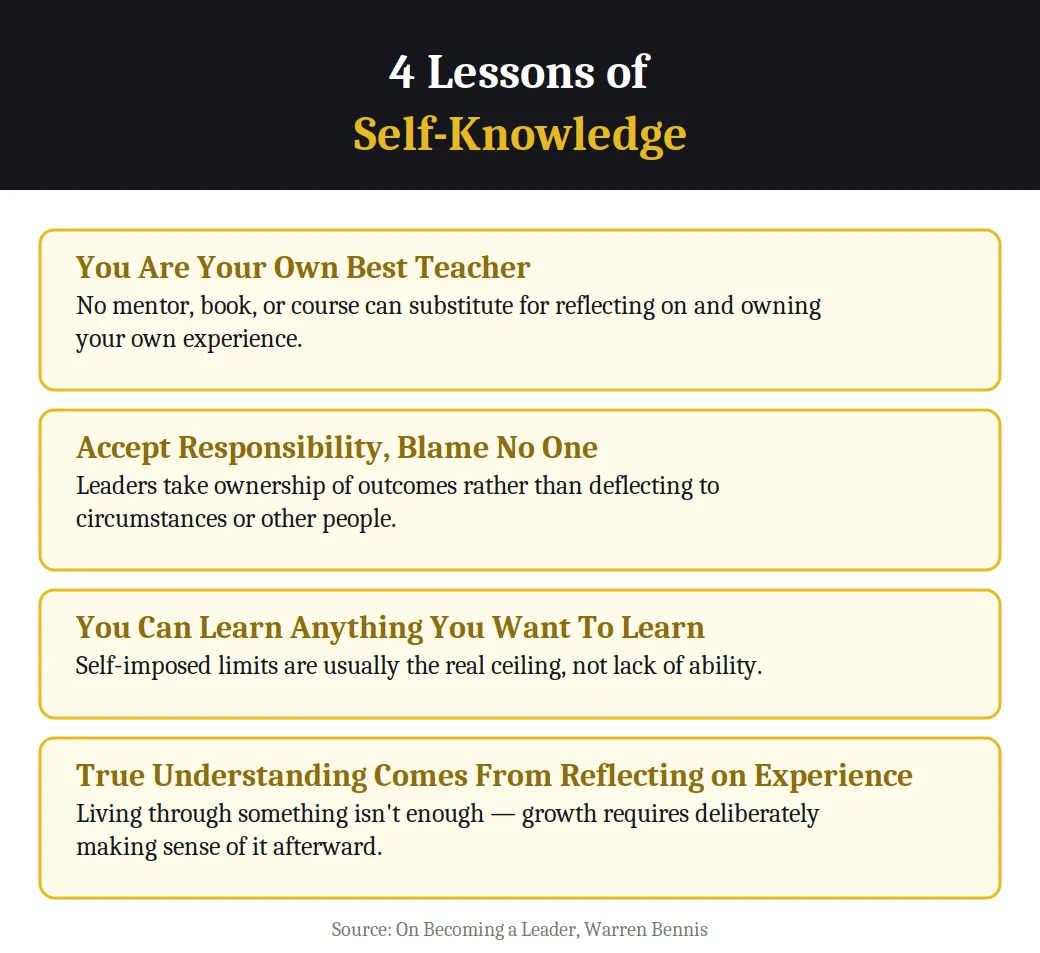
- Self-knowledge has four lessons: you are your own best teacher, accept responsibility and blame no one, you can learn anything you want to learn, and true understanding comes from reflecting on experience.
- Organizations can help or hinder leadership: culture either creates room for leadership to emerge or suppresses it through excessive control.
What is On Becoming a Leader about?
On Becoming a Leader is Warren Bennis’s argument that leadership is fundamentally an inward journey rather than an outward set of techniques. Built from interviews with dozens of leaders across business, government, education, and the arts, the book identifies self-knowledge, integrity, and full self-expression as the true foundation of leadership — and draws a sharp line between managers, who administer and maintain, and leaders, who innovate and originate. First published in 1989 and updated in a 20th Anniversary edition, it remains one of the founding texts of modern leadership studies, treating becoming a leader as essentially synonymous with becoming an authentic, integrated version of yourself.
About the author
Warren G. Bennis (1925–2014) is widely regarded as a founding father of leadership studies as an academic field distinct from general management theory. He earned his PhD from MIT, studying under Douglas McGregor, and went on to chair MIT’s Organizational Studies group, serve as President of the University of Cincinnati (where he founded the Warren Bennis Leadership Institute), and become a University Professor and founding chairman of the Leadership Institute at USC. His 1961 Harvard Business Review article on leadership theory helped carve out leadership as its own field of study, separate from management. Beyond this book, Bennis wrote or co-wrote more than a dozen others, including Leaders (with Burt Nanus), Organizing Genius, Geeks and Geezers (with Robert J. Thomas), and the memoir Still Surprised. Explore all Warren Bennis book summaries →
Key concepts at a glance
| Concept | What it means | Use it when |
|---|---|---|
| Self-Knowledge | Understanding your own strengths, weaknesses, and motivations well enough to act with integrity rather than performance | You suspect your leadership style is more performed than genuine |
| Manager vs. Leader | Bennis’s twelve-point contrast: managers administer, control, and maintain the status quo; leaders innovate, inspire trust, and challenge it | You’re promoted into leadership but keep defaulting to administrative habits |
| Guiding Vision | A clear sense of direction that persists through setbacks — one of the five basic ingredients of leadership | Your team seems busy but directionless |
| Deploying Yourself | Full commitment to a course of action — what Bennis calls “negative capability,” operating amid uncertainty without paralysis | You’re stuck overanalyzing instead of acting on an important decision |
| Innovative Learning | Learning that anticipates change rather than merely reacting to it — one of three learning modes Bennis identifies | Your organization only seems to learn from crises after they hit |
Part 1: Why self-knowledge comes first
Bennis’s central claim is uncomfortable for anyone hoping for a leadership formula: there isn’t one. What he found instead, across interviews with dozens of accomplished leaders, was that each had done the hard work of understanding who they actually were — their genuine strengths, their real limitations, and the values they wouldn’t compromise. He calls this integrity, and treats it as inseparable from candor and maturity. Without it, technique is just performance.
TGR Note: This self-knowledge-first approach is close in spirit to Servant Leadership, where Robert Greenleaf also treats character and self-awareness as the precondition for legitimate authority — not the reward for having it.
Part 2: The manager-leader distinction
Bennis’s most quoted contribution is a set of twelve contrasts between managers and leaders: the manager administers, the leader innovates; the manager is a copy, the leader is an original; the manager relies on control, the leader inspires trust; the manager has his eye on the bottom line, the leader has his eye on the horizon. The line that sums it up best: “It is not enough for a leader to do things right; he must do the right thing.” Five basic ingredients recur in the leaders Bennis studied: guiding vision, passion, integrity, curiosity, and daring — the willingness to take risks and experiment, even knowing you might fail.
TGR Note: This behavioral distinction is echoed and made more actionable in The Leadership Challenge, where Kouzes and Posner translate similar ideas into the Five Practices of Exemplary Leadership — a more teachable, research-validated model built on the same core insight that leadership is about behavior, not title.
Part 3: Trust, chaos, and what organizations owe leaders
Bennis is blunt that leadership without trust is a contradiction in terms — you cannot command genuine effort, only rent it. Trust, in his framework, rests on four pillars: constancy, congruity, reliability, and integrity. People follow leaders they can predict and believe, not merely leaders they’re told to obey. He’s equally direct about organizations: culture can help leadership emerge or actively suppress it. Environments built entirely on control and compliance train people out of the very qualities — curiosity, daring, original thought — that leadership requires.
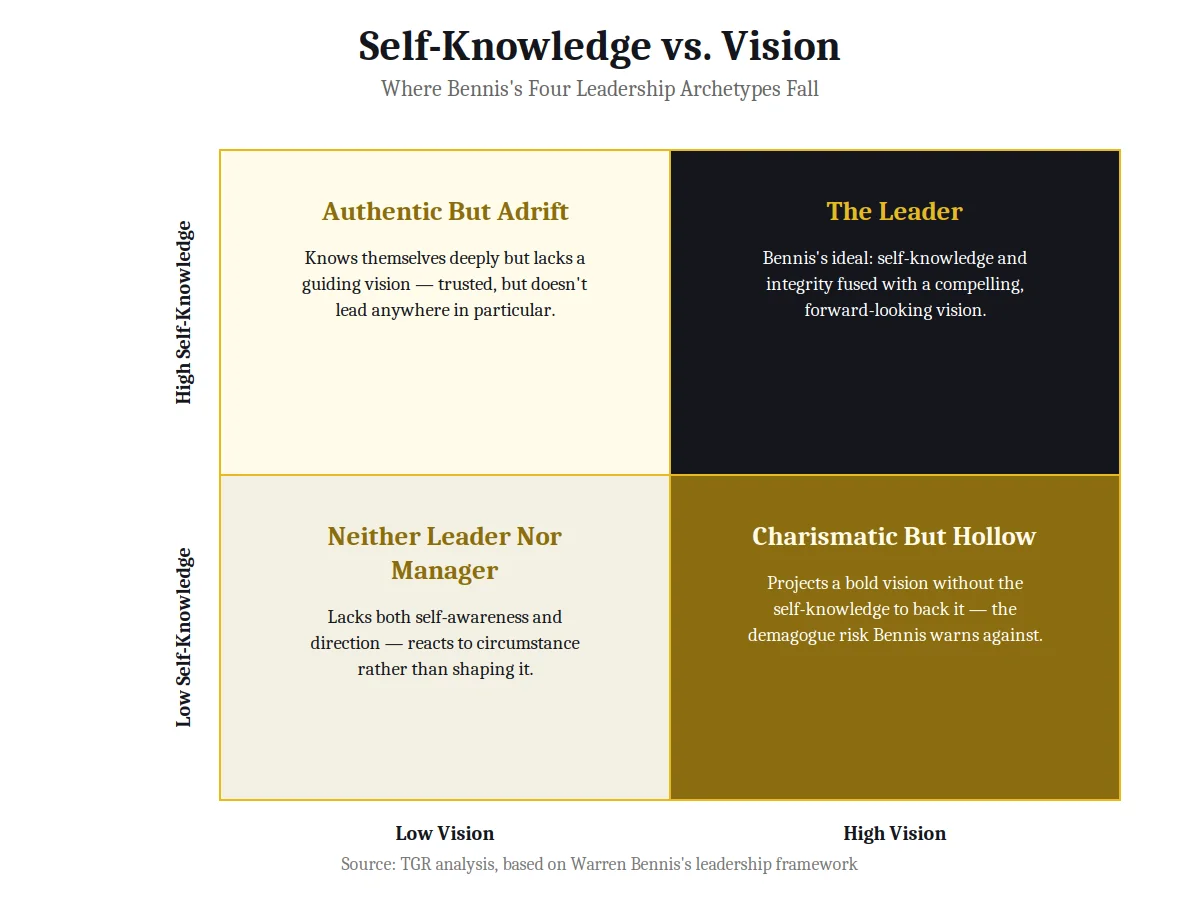
His closing chapter, “Forging the Future,” lists factors like embracing error, encouraging dissent, and sustaining optimism as what organizations must get right if they want leaders to develop inside them rather than despite them.
Who is On Becoming a Leader best for — and who should read something else first?
This book is best for readers who want a psychological, introspective take on leadership rather than a prescriptive playbook — people early or mid-career figuring out their own authentic leadership style, executives revisiting the field’s foundations, and anyone who found more behavior-focused books useful but wants the deeper “why” underneath the practices.
If you want a more teachable, research-validated set of behaviors, The Leadership Challenge translates similar territory into the Five Practices model. If your interest is the ethical foundation of leadership as service, Servant Leadership offers a complementary grounding. And if organizational health, not individual leadership psychology, is your focus, The Advantage applies related thinking at the team and company level.
Questions to reflect on
- Which of the twelve manager-vs-leader contrasts describes your default mode at work right now?
- Of the five basic ingredients (vision, passion, integrity, curiosity, daring), which is your strongest — and which is weakest?
- What’s a piece of adversity or failure in your own history that you haven’t fully reflected on or learned from yet?
- Do the people around you trust you because of constancy and reliability, or because of your position?
- Does your organization’s culture reward innovative learning, or does it mostly demand maintenance and shock learning?
🔥 Ready to become the leader you’re capable of being?
This guide covers the core model — the book gives you Bennis’s full interviews, case studies, and reflections.
How to apply On Becoming a Leader (7-day plan)
- Day 1: Write down your three biggest strengths and three biggest weaknesses as a leader — honestly, not diplomatically.
- Day 2: Go through Bennis’s twelve manager-vs-leader contrasts and mark which side you land on for each.
- Day 3: Write one paragraph on what you’re actually trying to accomplish, professionally, over the next five years.
- Day 4: Pick one significant past setback and write down what it actually taught you — not what you wish it taught you.
- Day 5: Ask a colleague, honestly, whether they’d describe you as constant, congruent, and reliable — and sit with the answer.
- Day 6: Pick one topic outside your expertise you’ve been avoiding, and spend an hour learning about it.
- Day 7: Do one thing this week that involves real risk of failure — an idea you pitch, a conversation you initiate, a decision you own publicly.
Frequently asked questions
What is the main argument of On Becoming a Leader?
That leaders are made, not born, and made mostly by themselves through self-knowledge, integrity, and learning from experience.
What’s the difference between a manager and a leader according to Bennis?
Managers administer, control, and maintain the status quo; leaders innovate, inspire trust, and challenge it. The distinction is about orientation, not organizational rank.
What are the five basic ingredients of leadership in the book?
Guiding vision, passion, integrity, curiosity, and daring.
Does the book use the term “crucible” for formative experiences?
Not directly — that specific term became central in Bennis’s later work, especially the 2002 HBR article “Crucibles of Leadership” and the book Geeks and Geezers. On Becoming a Leader discusses learning from adversity and mentors extensively, but without that exact vocabulary.
Is On Becoming a Leader still relevant today?
Yes, though it’s more foundational than current — many later leadership books, including behavior-focused ones like The Leadership Challenge, build on the self-knowledge-first premise Bennis established.
How is this book different from The Leadership Challenge?
On Becoming a Leader is psychological and introspective, built from interviews and centered on self-knowledge; The Leadership Challenge is empirically derived and behavioral, built around five practices and a validated 360-degree assessment.
Related summaries
If On Becoming a Leader resonated, these dig further into related territory: The Leadership Challenge on the five practices of exemplary leadership, Servant Leadership on leading through service, and The Advantage on building organizational health. For more, see our best leadership books pillar page.
How we analyze books: We work from the full book — reconstructing its core arguments in our own words, adding commentary that connects it to related research and other books in our library, and pressure-testing the advice in a practical 7-day plan. Ratings weigh usefulness, readability, and evidence quality. Read our full methodology.
Related Leadership Summaries
Extreme Ownership Summary & Review: How U.S. Navy SEALs Lead and Win
Good to Great Summary & Review: Why Some Companies Make the Leap
Radical Candor Summary & Review: Be a Great Boss Without Losing Your Humanity
Unreasonable Hospitality Summary & Review: Give People More Than They Expect
Who Moved My Cheese? Summary & Review: Navigate Change Before It Breaks You