

★★★★☆ 4.3/5 — Greenleaf’s foundational case that legitimate power and greatness come from serving others’ growth first, and choosing to lead only as an extension of that service.
Best for: leaders questioning whether authority alone is enough, and organizations wanting a values-based alternative to command-and-control · Reading time: ~9 hrs (this guide: ~15 min) · Difficulty to apply: Moderate — the philosophy is clear, living it consistently under organizational pressure takes real discipline
Servant Leadership in one minute
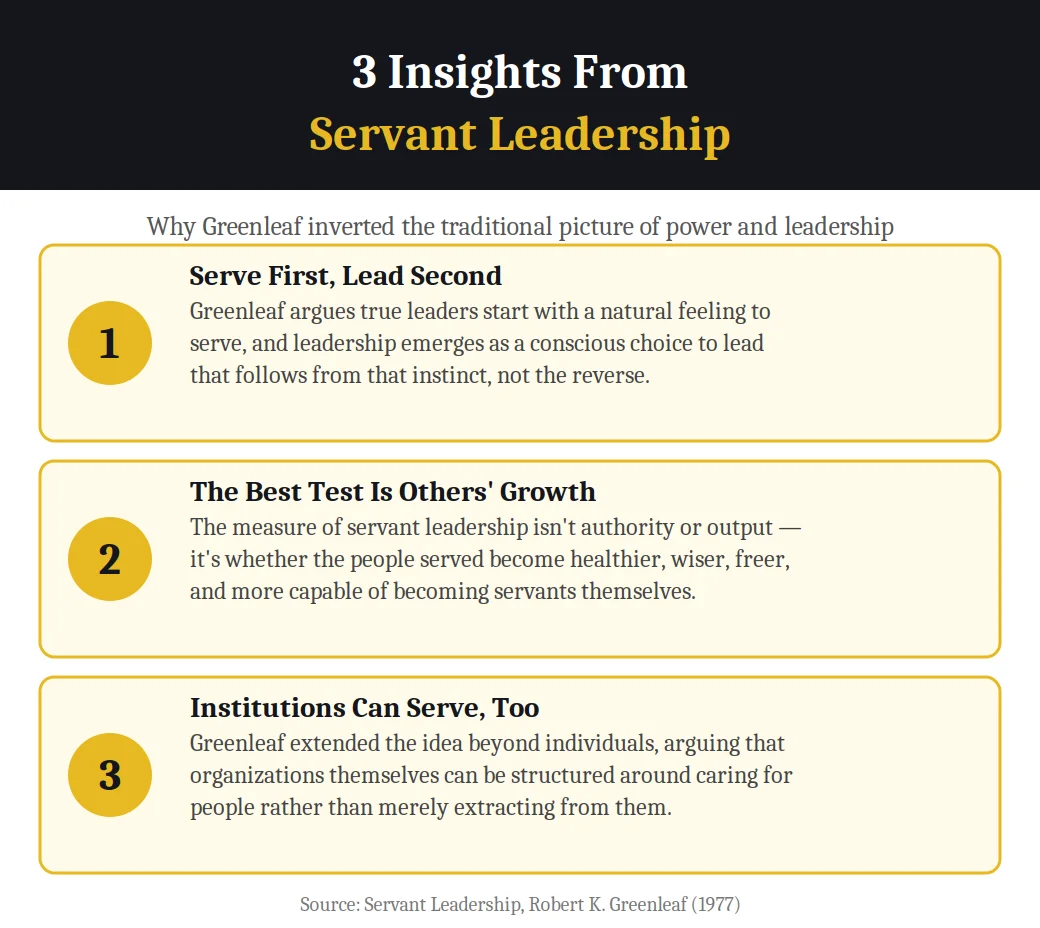
The great leader is seen as servant first — legitimate power and greatness come from serving others, not the other way around. Robert K. Greenleaf, a career AT&T management researcher, introduced the term “servant leadership” in his 1970 essay “The Servant as Leader” and expanded it into this full-length 1977 book. Greenleaf argues that the servant-leader begins with a natural feeling to serve others, and leadership follows as a conscious, deliberate choice made in order to serve better — a reversal of the traditional picture where someone seeks power or position first and perhaps adds service later, if at all. Greenleaf proposes a demanding “best test” for evaluating whether leadership is genuinely servant-first: whether the people being served grow as persons, becoming healthier, wiser, freer, and more autonomous, and whether the least privileged in society benefit or at least aren’t further deprived.
Key takeaways
- Servant leadership reverses the usual sequence: the servant-leader feels a natural desire to serve first, and only then makes a conscious choice to lead, rather than seeking leadership and adding service afterward.
- The best test is others’ growth, not authority: Greenleaf’s central measure asks whether those served become healthier, wiser, freer, and more autonomous — not whether the leader retains power.
- Servant leadership should benefit the least privileged too: Greenleaf extends the test beyond the immediate circle served, asking whether society’s least advantaged benefit or at least aren’t further deprived.
- Institutions, not just individuals, can be servant-led: Greenleaf argues large organizations can be structured around genuinely caring for the people inside and served by them, not merely extracting value.
- Listening is foundational: receiving others’ perspectives without judgment builds the trust that servant leadership depends on.
- Empathy means accepting, not just understanding: Greenleaf’s servant-leader accepts and empathizes with people’s feelings rather than rejecting or minimizing them.
- Foresight lets leaders act before problems fully surface: the ability to anticipate likely outcomes, informed by the past and present, is one of the most distinctive skills of an effective servant-leader.
- Commitment to people’s growth must be genuine and structural: mentoring, coaching, and real autonomy for others, not just verbal encouragement, are what distinguish authentic servant leadership.
- Servant leadership is a stance, not a technique: Greenleaf frames it as a way of being and relating to others, which makes it harder to fake convincingly than more surface-level leadership styles.
What is Servant Leadership about?
Servant Leadership is Robert K. Greenleaf’s foundational argument that the great leader is seen as servant first, meaning legitimate power and genuine greatness come from a natural desire to serve others rather than from seeking authority or position. Expanding on his 1970 essay “The Servant as Leader,” Greenleaf lays out a demanding test for evaluating whether leadership is authentically servant-first: whether the people served grow as persons, becoming healthier, wiser, freer, and more autonomous, and whether the least privileged members of society benefit or at least aren’t further disadvantaged. The book extends this philosophy from individual leaders to entire institutions, arguing that organizations themselves can be structured around genuinely caring for people.
About the author
Robert K. Greenleaf spent nearly four decades in management research, development, and education at AT&T before retiring in 1964 to found the Center for Applied Ethics, later renamed the Robert K. Greenleaf Center for Servant Leadership. In 1970, he published “The Servant as Leader,” introducing the term and the reversal at its core: a leader who begins with a natural desire to serve and only then chooses to lead. His 1977 book expanded that essay into a full framework. Larry C. Spears, who later led the Greenleaf Center, distilled ten characteristics of servant leaders from Greenleaf’s writings, including listening, empathy, and commitment to the growth of people. Explore all Robert K. Greenleaf book summaries →
Key concepts at a glance
| Concept | What it means | Use it when |
|---|---|---|
| Servant first, leader second | A natural desire to serve comes before, and motivates, the conscious choice to lead | You’re evaluating your own motivation for seeking or holding a leadership role |
| The best test | Whether those served grow healthier, wiser, freer, and more autonomous | You want to evaluate whether your leadership is genuinely serving people, not just managing them |
| The least privileged test | Whether the benefits of leadership reach or at least don’t harm society’s least advantaged | You’re assessing the broader impact of an organization’s leadership beyond its immediate circle |
| Institutional servant leadership | Organizations, not just individuals, can be structured to genuinely serve the people in and around them | You’re designing or evaluating organizational culture and structure |
| The ten characteristics | Traits like listening, empathy, foresight, and commitment to growth, distilled by Larry Spears from Greenleaf’s work | You want concrete behaviors to practice as a servant-leader |
Part 1: The servant as leader
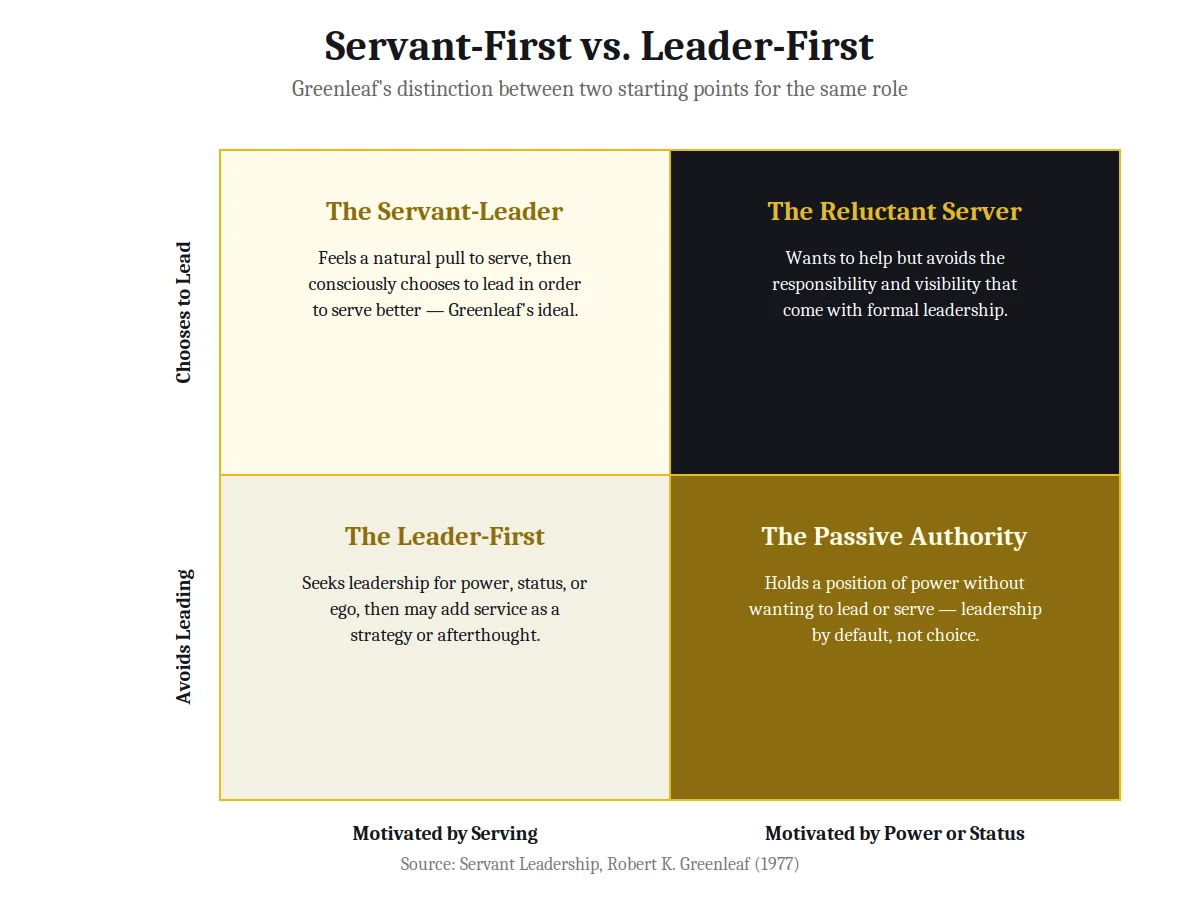
Greenleaf opens with the reversal at the heart of his philosophy: the servant-leader is servant first, someone who begins with a natural, genuine feeling to serve others. Leadership, in this framework, is not the starting point but a conscious choice made afterward, undertaken because it’s the best way to serve more people or serve more effectively. This stands in sharp contrast to what Greenleaf calls the leader-first type, who seeks power or position first and may add an element of service later, often as strategy rather than genuine motivation.
TGR Note: This reversal echoes Start with Why‘s case that a genuine underlying purpose, not the pursuit of authority itself, is what makes leadership durable and trusted over time.
Part 2: The best test
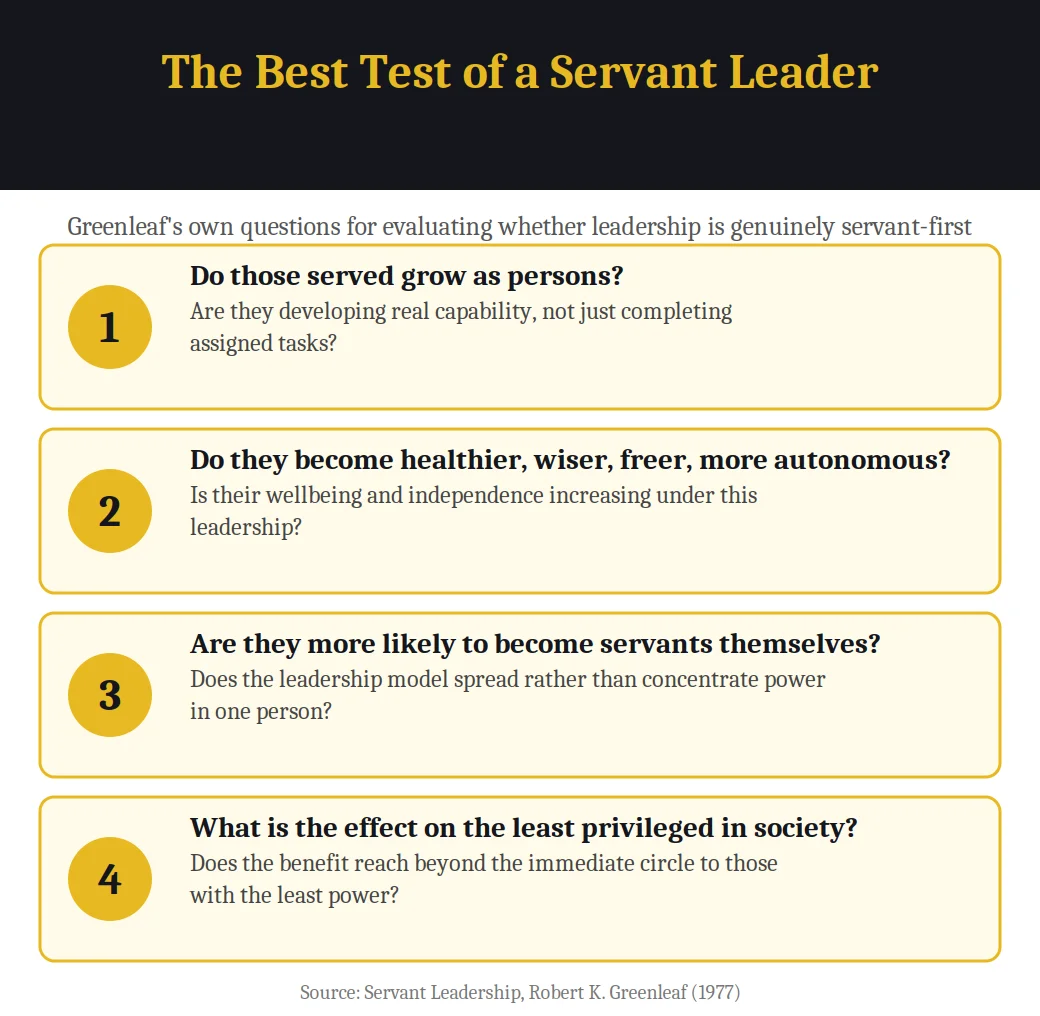
Greenleaf proposes a demanding, difficult-to-administer test for whether leadership is genuinely servant-first: do those served grow as persons? Do they become healthier, wiser, freer, and more autonomous, and are they more likely themselves to become servants? He extends the test one step further, asking what effect the leadership has on the least privileged members of society — whether they benefit, or at minimum aren’t further deprived. This second question pushes the framework beyond an organization’s immediate circle, insisting that genuine servant leadership has to be evaluated against its wider social impact, not just its effect on those directly managed.
TGR Note: The emphasis on people’s growth as the actual measure of leadership success connects to The 5 Levels of Leadership‘s argument that leadership earned through developing people outlasts leadership that relies purely on position or title.
Part 3: The ten characteristics
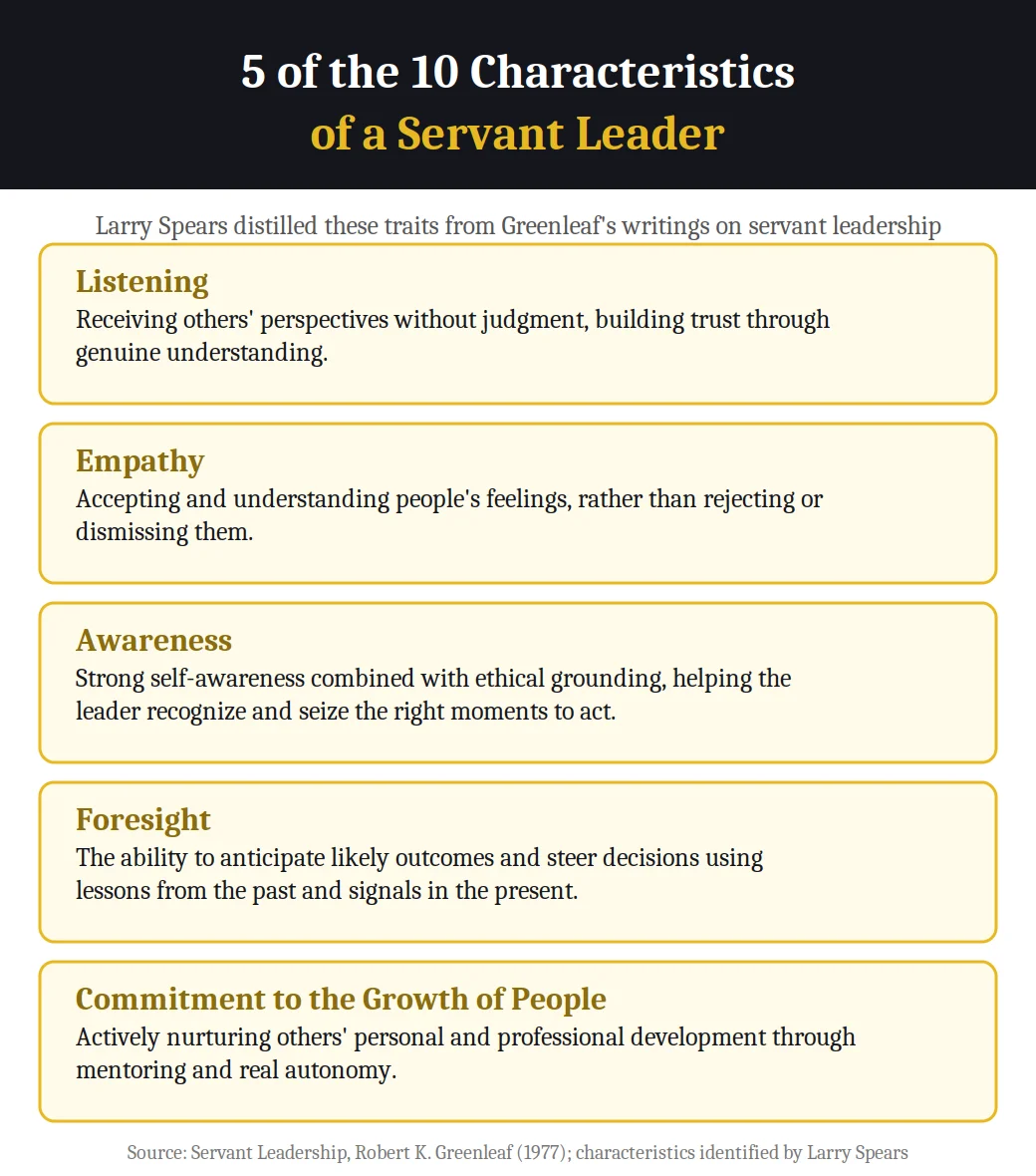
While Greenleaf’s original writing doesn’t present a numbered list, Larry C. Spears, who later led the Greenleaf Center, distilled ten characteristics from across Greenleaf’s essays that have since become the standard practical guide to the philosophy: listening, empathy, healing, awareness, persuasion, conceptualization, foresight, stewardship, commitment to the growth of people, and building community. Listening means receiving others’ perspectives without judgment, which builds the trust the rest of the framework depends on. Empathy means genuinely accepting people’s feelings rather than rejecting or minimizing them. Foresight, one of the more demanding traits, is the ability to anticipate likely outcomes using signals from the present and lessons from the past, letting a servant-leader act before problems fully surface.
Part 4: Institutions as servants
Greenleaf’s most ambitious extension of the framework applies it beyond individual leaders to entire institutions. He argues that large organizations — businesses, universities, hospitals, governments — can themselves be structured around genuinely caring for the people inside them and served by them, rather than treating people as means to organizational ends. This is a significant claim: it means servant leadership isn’t just a personal leadership style some individuals adopt, but a possible design principle for institutions at scale, with real implications for how organizations set policy, structure incentives, and measure their own success.
TGR Note: This institutional framing pairs directly with The Advantage‘s case that organizational health, built through trust and clarity, is what actually determines whether an organization’s stated values translate into how people are genuinely treated.
Who is Servant Leadership best for — and who should read something else first?
This book is best for leaders questioning whether positional authority alone is enough, and for organizations looking for a values-based alternative to pure command-and-control management. It rewards readers willing to engage with reflective, essay-style writing rather than a tightly structured business how-to.
If your interest is more specifically in the practical, story-driven mechanics of building ownership on a team, It’s Your Ship offers a concrete real-world case study of similar principles in action. If you want a clearer framework for how leadership is earned through stages of influence, The 5 Levels of Leadership covers related ground with a more structured model. And if organizational purpose specifically, rather than leadership style, is your focus, Start with Why digs deeper into that adjacent question.
Questions to reflect on
- Did you come to your current leadership role primarily out of a desire to serve, or primarily out of a desire for authority or status?
- Applying Greenleaf’s best test: are the people you lead becoming healthier, wiser, freer, and more autonomous under your leadership?
- What effect does your organization’s leadership have on the least privileged people it touches, even indirectly?
- Which of the ten characteristics — listening, empathy, foresight, or the others — do you practice most naturally, and which do you avoid?
- Is your organization structured to genuinely serve the people inside it, or does it primarily extract value from them?
🔥 Ready to lead by serving first?
This guide covers the core philosophy — the book gives you Greenleaf’s full essays and the depth behind each idea.
How to apply Servant Leadership (7-day plan)
- Day 1: Reflect honestly on whether your motivation for leading is rooted more in a desire to serve or a desire for authority.
- Day 2: Apply Greenleaf’s best test to one person you lead: are they growing healthier, wiser, freer, and more autonomous?
- Day 3: Practice listening without judgment in one conversation today, resisting the urge to immediately respond or advise.
- Day 4: Identify one area where you could show more empathy by accepting someone’s feelings rather than minimizing them.
- Day 5: Practice foresight by anticipating one likely outcome in a current situation and adjusting your approach now.
- Day 6: Identify one concrete way to invest in a colleague’s growth this week — mentoring, delegation, or real autonomy.
- Day 7: Reflect on your organization’s broader impact — does it benefit, or at least not harm, those with the least power or privilege?
Frequently asked questions
What is the main idea of Servant Leadership?
The great leader is seen as servant first — legitimate power and greatness come from a natural desire to serve others, with the choice to lead following from that instinct rather than preceding it.
What is Greenleaf’s “best test” of servant leadership?
Whether those served grow as persons, becoming healthier, wiser, freer, and more autonomous, and whether the least privileged in society benefit or at least aren’t further deprived.
What are the ten characteristics of a servant leader?
Listening, empathy, healing, awareness, persuasion, conceptualization, foresight, stewardship, commitment to the growth of people, and building community, as distilled by Larry C. Spears from Greenleaf’s writings.
Can institutions, not just individuals, practice servant leadership?
Yes — Greenleaf argues organizations themselves can be structured to genuinely serve the people inside and around them, rather than merely extracting value from them.
Who coined the term “servant leadership”?
Robert K. Greenleaf coined the term in his 1970 essay “The Servant as Leader,” later expanded into this 1977 book.
Is servant leadership the same as being a pushover?
No — Greenleaf frames servant leadership as a demanding, deliberate choice to lead in order to serve better, not an avoidance of authority or difficult decisions.
How is Servant Leadership different from The Advantage?
Servant Leadership is a philosophical and ethical framework for individual and institutional leadership, while The Advantage is a practical, sequential framework for building organizational health.
Related summaries
If Servant Leadership resonated, these dig further into related territory: The Advantage on building organizational health, The 5 Levels of Leadership on how leadership is earned over time, and It’s Your Ship on building ownership through practical leadership changes. For more, see our best leadership books pillar page.
How we analyze books: We work from the full book — reconstructing its core arguments in our own words, adding commentary that connects it to related research and other books in our library, and pressure-testing the advice in a practical 7-day plan. Ratings weigh usefulness, readability, and evidence quality. Read our full methodology.
Related Leadership Summaries
It’s Your Ship Summary & Review: Build a Crew That Owns the Outcome
Never Split the Difference Summary & Review: The FBI Negotiator’s Playbook for Getting What You Want
Radical Candor Summary & Review: Be a Great Boss Without Losing Your Humanity
Shoe Dog Summary & Review: The Raw Truth Behind Building Nike
Turn the Ship Around Summary & Review: How to Build Teams That Think for Themselves