
Leadership
Servant Leadership Summary and Review
★★★★☆ 4.3/5 — Greenleaf’s foundational case that legitimate power and greatness come from serving others’ growth first, and choosing to lead only…
Read Summary →"The AT&T executive who argued the great leader is seen as servant first."
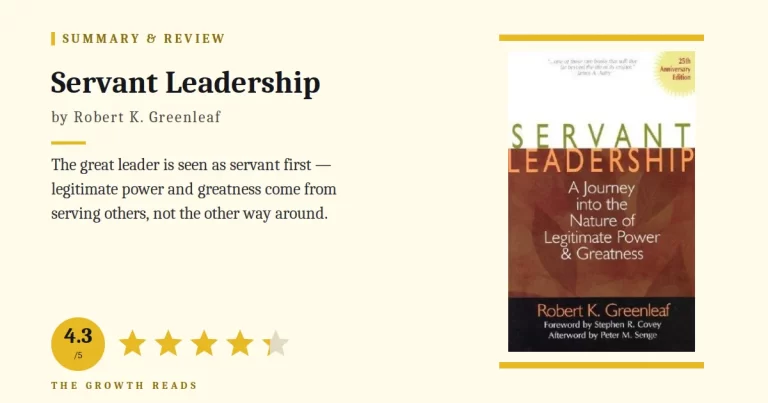
Robert K. Greenleaf spent nearly four decades in management research, development, and education at AT&T before retiring in 1964 to found the Center for Applied Ethics (later renamed the Robert K. Greenleaf Center for Servant Leadership). In 1970, he published the essay "The Servant as Leader," which introduced the term "servant leadership" and argued that the great leader is seen as servant first — someone who begins with a natural desire to serve and only then chooses to lead. His 1977 book, Servant Leadership: A Journey into the Nature of Legitimate Power and Greatness, expanded that essay into a full framework, arguing that legitimate power and greatness come from serving others' growth, not from authority or position. Larry C. Spears, who later led the Greenleaf Center, distilled ten characteristics of servant leaders from Greenleaf's writings, including listening, empathy, and commitment to the growth of people.
Our in-depth summaries and reviews of his work
★★★★☆ 4.3/5 — Greenleaf’s foundational case that legitimate power and greatness come from serving others’ growth first, and choosing to lead only…
Read Summary →In "Servant Leadership," Greenleaf argues true leadership begins with a natural desire to serve, and the choice to lead follows from that instinct rather than preceding it.
"The best test, and difficult to administer, is: Do those served grow as persons? Do they, while being served, become healthier, wiser, freer, more autonomous, more likely themselves to become servants?"— Servant Leadership
★★★★☆ 4.3/5 — Greenleaf’s foundational case that legitimate power and greatness come from serving others’ growth first, and choosing to lead only as an extension of that service. Best for: leaders questioning whether authority alone is enough, and organizations wanting…