

★★★★☆ 4.4/5 — Covey’s deeper dive into time management, arguing the real problem isn’t too little time but a mismatch between the clock and the compass.
Best for: readers who’ve tried urgency-driven to-do lists and still feel like they’re not spending time on what matters · Reading time: ~8 hrs (this guide: ~14 min) · Difficulty to apply: Moderate — requires weekly planning discipline, not just a daily list
First Things First in one minute
Most time-management advice tries to help you do more, faster — First Things First argues that’s the wrong problem entirely. Stephen Covey, with A. Roger Merrill and Rebecca R. Merrill, makes the case that the real issue isn’t a shortage of hours but a mismatch between what you spend time on and what you actually value: living by the clock (schedules, deadlines, hours) instead of the compass (vision, values, direction). Their central tool is the Time Management Matrix, which sorts activities by urgency and importance and shows that the most effective people spend the bulk of their time in Quadrant II — important, non-urgent work like planning, relationship-building, and prevention — rather than constantly firefighting in Quadrant I or getting pulled into Quadrant III’s false urgencies.
Key takeaways
- The real time problem is priorities, not hours: everyone has the same 24 hours; the difference is what people choose to fill them with.
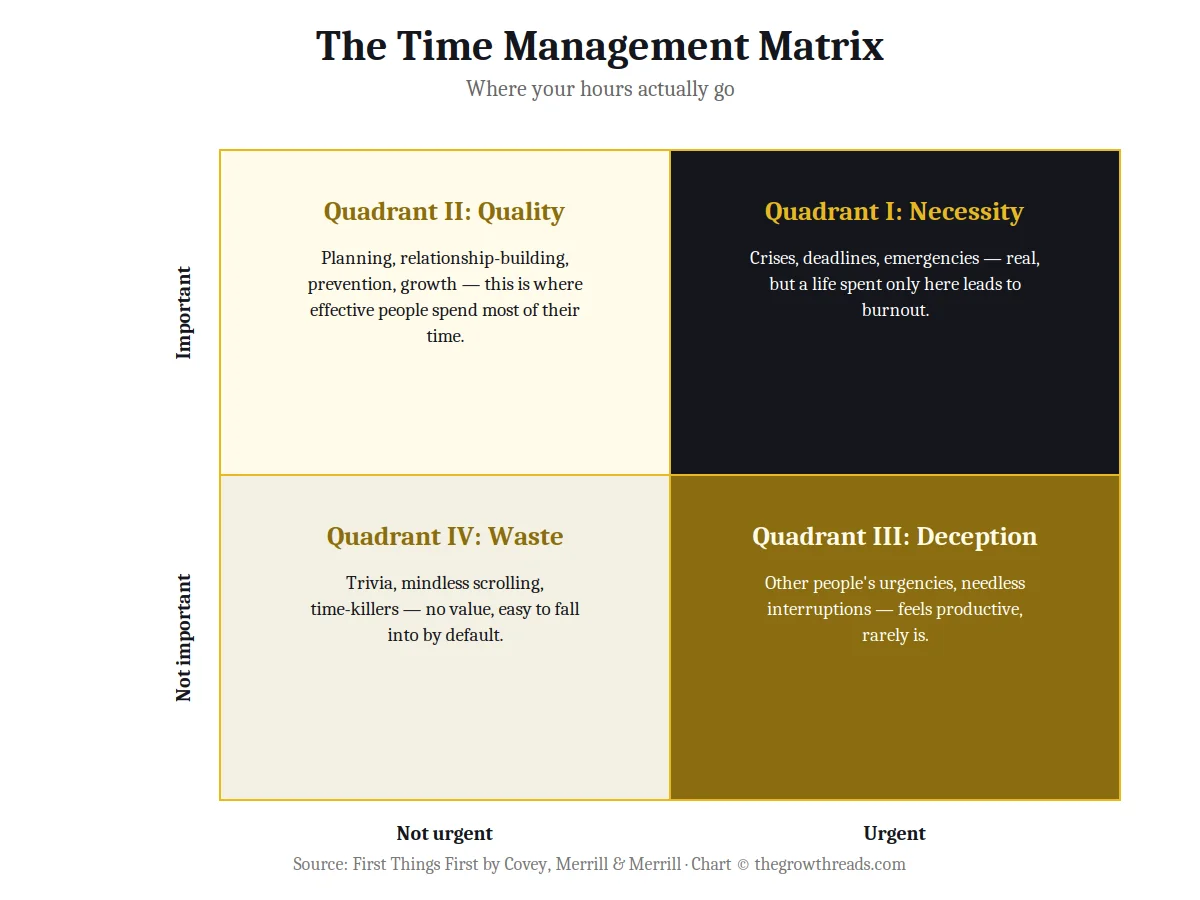
- The Time Management Matrix has four quadrants: Quadrant I (urgent and important), Quadrant II (important, not urgent), Quadrant III (urgent, not important), and Quadrant IV (neither).
- Quadrant II is where effectiveness actually lives: planning, relationship-building, prevention, and personal growth reduce how often you end up firefighting in Quadrant I.
- Quadrant III is deceptive, not harmless: tasks that feel urgent because of someone else’s timeline can consume your day without ever serving your own priorities.
- The clock and the compass are different things: the clock tracks schedules and commitments; the compass represents vision, values, and direction — and most stress comes from a gap between them.
- Weekly planning beats daily planning: starting from your roles and Quadrant II goals for the week, then scheduling them first, keeps priorities from being crowded out by whatever feels urgent each day.
- Everyone plays multiple roles: parent, professional, friend, and more — planning role by role, rather than as one undifferentiated list, keeps any single role from swallowing all your time.
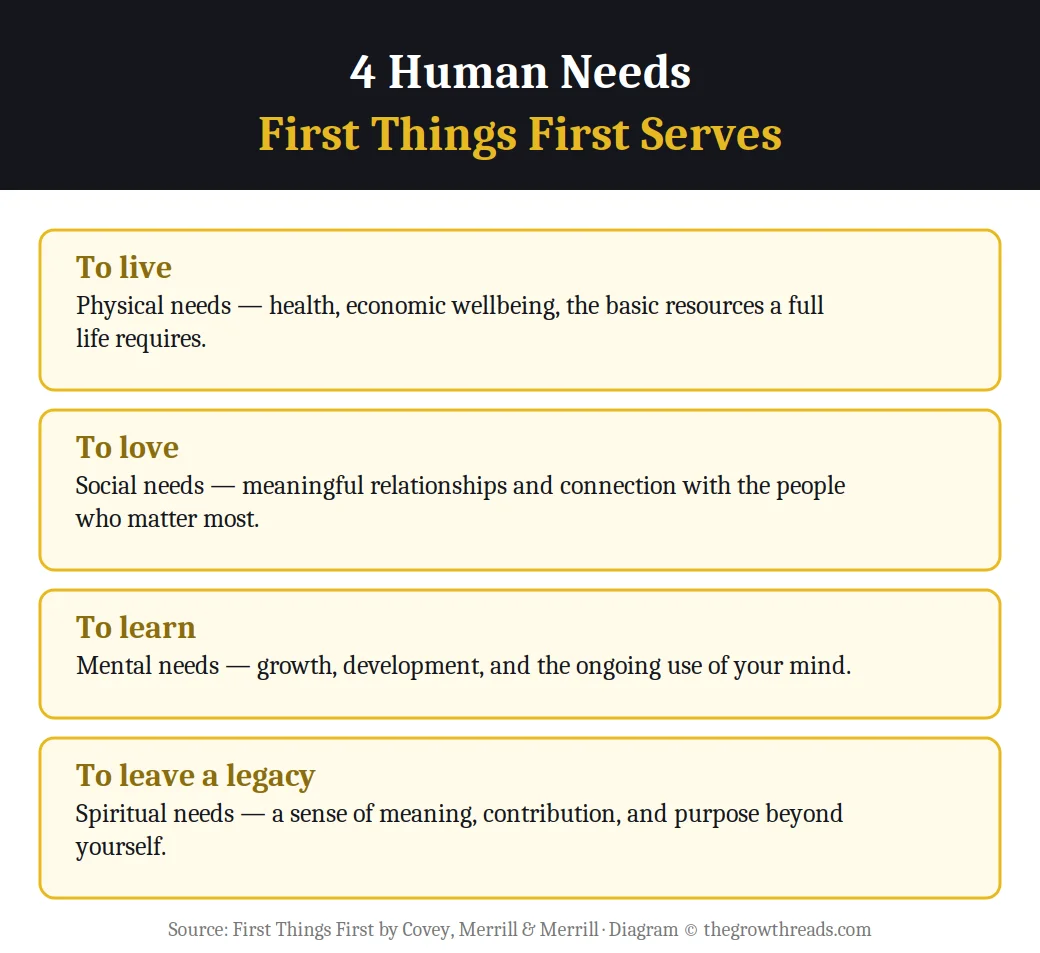
- Four human needs underlie lasting effectiveness: to live, to love, to learn, and to leave a legacy — physical, social, mental, and spiritual needs that a good schedule has to serve.
- Interdependence changes the calculus: because most meaningful work involves other people, effective time management has to account for relationships, not just personal task completion.
What is First Things First about?
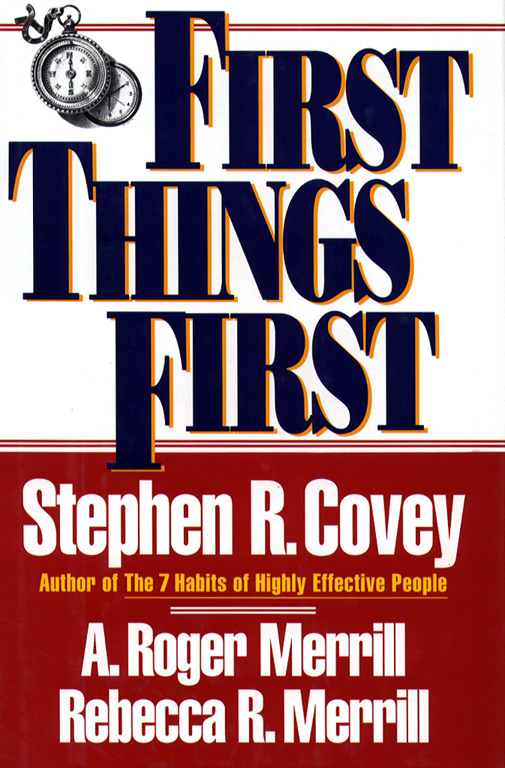
First Things First is Stephen Covey’s follow-up to The 7 Habits of Highly Effective People, co-written with A. Roger Merrill and Rebecca R. Merrill, that narrows in specifically on time management. Rather than treating time management as a problem of efficiency — doing more, faster — the book reframes it as a problem of effectiveness: making sure your time actually goes toward what matters most. Its central contribution is the Time Management Matrix, paired with a weekly planning process built around personal roles and “Quadrant II” priorities, designed to close the gap between how people actually spend their time and what they say they value. This weekly-planning-first approach is the direct ancestor of time blocking — our guide covers the practical setup Covey’s framework inspired.
About the author
Stephen R. Covey was an educator and author best known for The 7 Habits of Highly Effective People, one of the most influential personal-development books of the 20th century. First Things First was co-written with A. Roger Merrill and Rebecca R. Merrill, longtime collaborators of Covey’s at the Covey Leadership Center, which later became FranklinCovey. Where The 7 Habits built a broad framework around character and principle-centered living, First Things First applies that same principle-centered approach specifically to how people plan and spend their time, building directly on the third of the seven habits, “put first things first,” and expanding it into a full system. Explore all Stephen R. Covey, A. Roger Merrill & Rebecca R. Merrill book summaries →
Key concepts at a glance
| Concept | What it means | Use it when |
|---|---|---|
| The Time Management Matrix | Sorting activities into four quadrants by urgency and importance | You want to see clearly where your time is actually going |
| Quadrant II | Important but not urgent work — planning, relationships, prevention, growth | You keep firefighting and want to reduce future emergencies |
| Clock vs. compass | Schedules and hours (clock) versus vision and values (compass) | You’re technically busy but feel disconnected from what matters |
| Weekly role-based planning | Planning around your life roles and Quadrant II goals, scheduled before urgent tasks | Daily to-do lists keep getting crowded out by whatever feels urgent |
| The four human needs | To live, to love, to learn, and to leave a legacy | You want to check whether your schedule serves your whole life, not just work |
Part 1: The Time Management Matrix and why Quadrant II matters most
The book’s central tool sorts all activity into four quadrants based on two dimensions: urgency and importance. Quadrant I holds urgent and important work — real crises, deadlines, and emergencies that demand immediate attention. Quadrant III holds urgent but unimportant work — other people’s priorities and interruptions that feel pressing but don’t actually serve your own goals. Quadrant IV holds neither urgent nor important activity — pure time-wasting. Quadrant II holds important but not urgent work: planning, relationship-building, prevention, and personal development — the category the authors argue is chronically under-invested in because nothing about it screams for attention.
The authors’ key insight is that Quadrant II activity directly reduces how much time you spend in Quadrant I. Planning ahead prevents crises; maintaining relationships prevents them from becoming urgent problems; proactive health habits prevent medical emergencies. Neglecting Quadrant II doesn’t just cost you the benefit of that work — it actively manufactures more of the urgent fires you’ll have to fight later, creating a self-perpetuating cycle that traps people in constant reactivity.
TGR Note: Quadrant II is essentially a more granular version of the third habit from The 7 Habits of Highly Effective People, “put first things first” — this book expands that single habit into a full standalone system with its own tools and weekly process.
Part 2: The clock and the compass
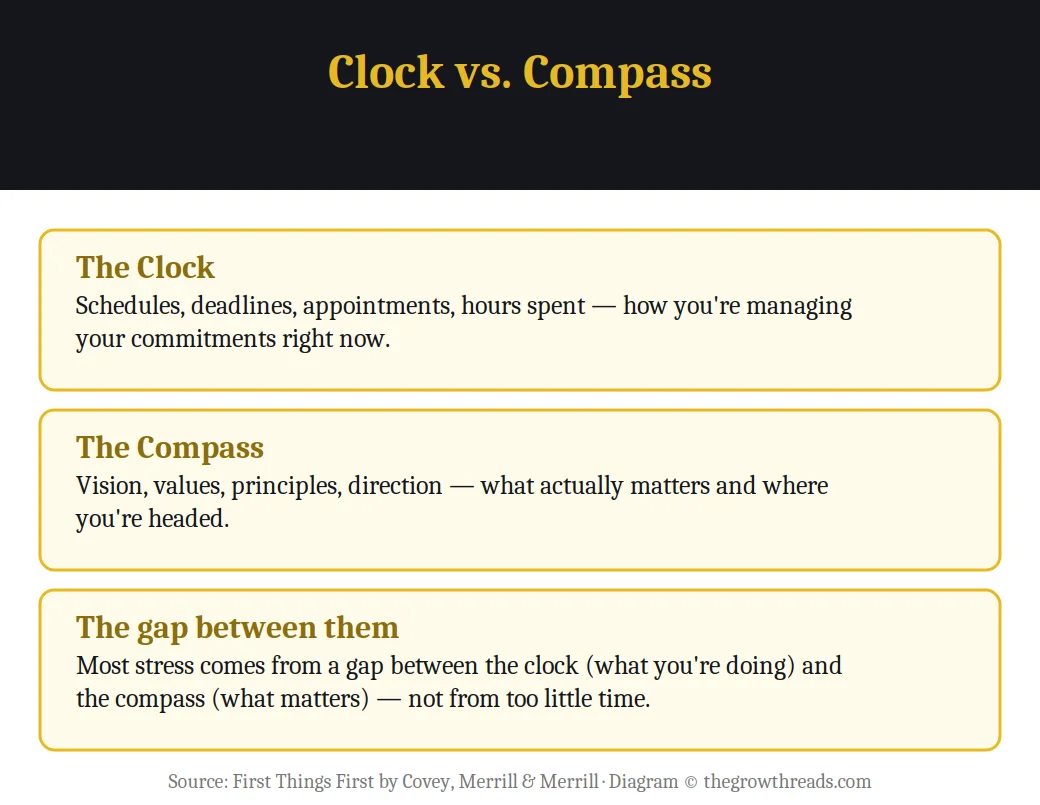
The authors introduce a second, complementary metaphor: the clock represents schedules, deadlines, and appointments — the literal management of hours. The compass represents vision, values, and direction — the sense of what actually matters and where you’re trying to go. Their argument is that most people’s stress doesn’t come from having too few hours; it comes from a persistent gap between what the clock says they’re doing and what the compass says actually matters to them.
Closing that gap, in the authors’ framing, requires an “importance paradigm” — a shift in mindset that automatically weighs decisions against your values and long-term vision rather than against whatever feels most urgent in the moment. This is presented as a deeper shift than a new scheduling technique; it’s a change in how you decide what deserves your attention in the first place.
TGR Note: The clock-versus-compass framing pairs well with Essentialism‘s case for ruthless prioritization — both books argue that busyness measured by the clock is a poor proxy for whether you’re actually living according to what you value.
Part 3: Weekly planning around roles and Quadrant II goals
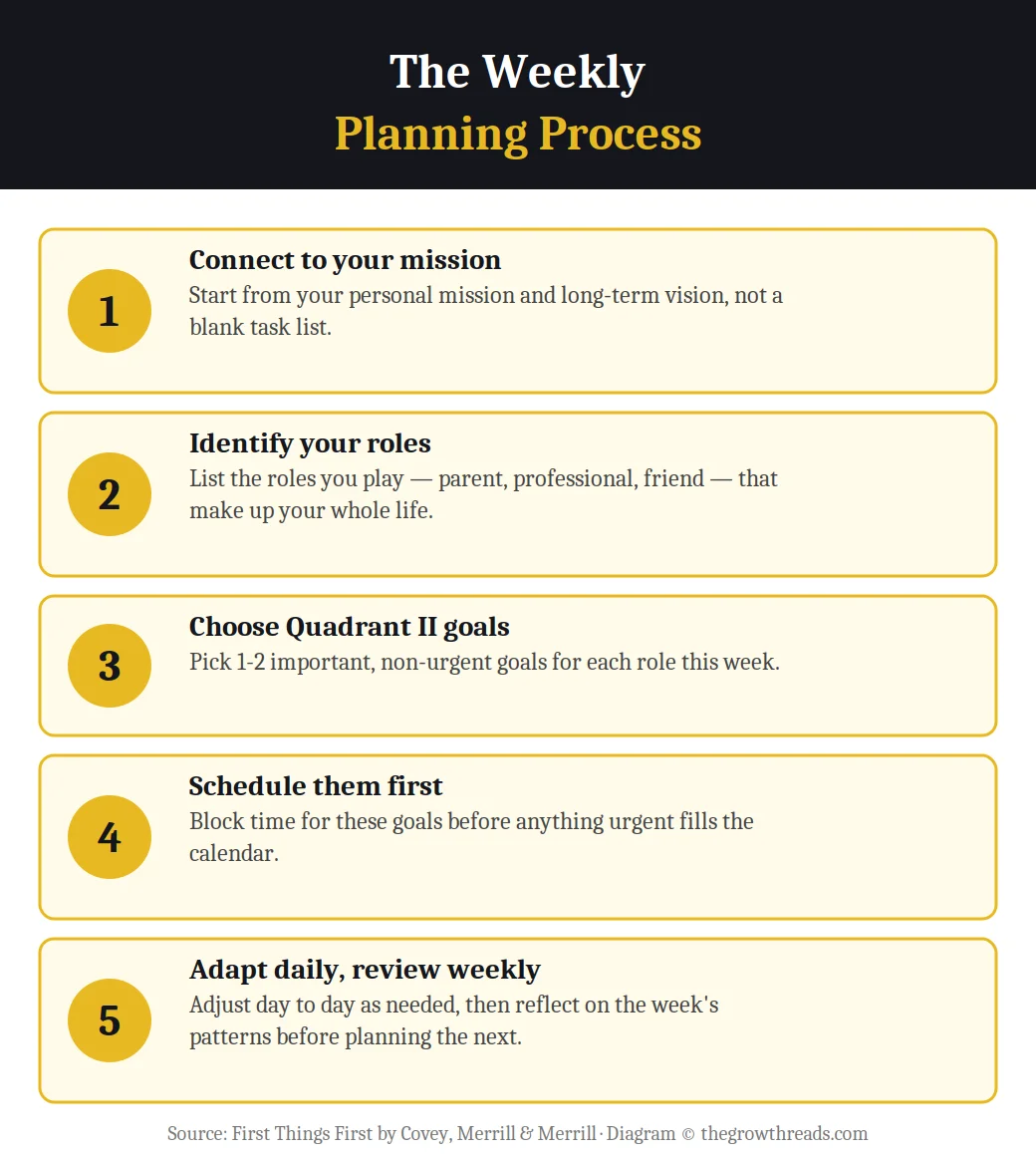
Rather than planning day by day, the authors recommend a weekly process that starts from your personal mission and the various roles you play in life — parent, professional, friend, community member, and others. For each role, you identify one or two Quadrant II goals for the coming week: not urgent tasks, but the important, often-neglected work that actually advances that part of your life. Those goals get scheduled into the week first, before urgent or lower-priority tasks are allowed to fill the remaining time.
This role-based approach directly addresses a common failure mode of single-list planning: without it, whichever role generates the most visible pressure — usually work — tends to absorb all available time, while quieter but equally important roles, like being a parent or maintaining friendships, get chronically shortchanged. Planning role by role forces explicit attention to parts of life that don’t naturally generate their own urgency.
Part 4: The four human needs behind lasting effectiveness
The authors ground the whole system in four basic human needs: to live (physical needs like health and economic security), to love (social needs and meaningful relationships), to learn (mental growth and development), and to leave a legacy (a spiritual sense of meaning and contribution). Their argument is that a schedule optimized for productivity alone, while neglecting one or more of these needs, will eventually fail — not because the scheduling technique was flawed, but because it was solving an incomplete version of the problem.
This is also where the book explicitly departs from pure efficiency thinking: because so much of a meaningful life is interdependent — built through relationships with other people — time management, in the authors’ view, can’t just be a solo optimization problem. Real effectiveness has to account for the people whose lives intersect with your schedule, not just the tasks on your own list.
Who is First Things First best for — and who should read something else first?
This book is best for readers who’ve already tried urgency-driven to-do lists or calendar apps and still feel like their time isn’t going toward what actually matters to them. It particularly rewards readers who want a weekly planning system, not just a daily one.
If you haven’t yet read the broader character-and-principles framework this book builds on, The 7 Habits of Highly Effective People is the natural starting point. If your priority problem is more about ruthlessly cutting non-essential commitments than about a weekly planning system, Essentialism offers a more streamlined approach. And if you’re specifically trying to execute a single, chosen team goal rather than balance multiple personal roles, The 4 Disciplines of Execution addresses that more focused problem.
Questions to reflect on
- Looking honestly at last week, how much of your time actually went to Quadrant II versus Quadrant I, III, or IV?
- Where is the biggest gap right now between your clock (what you’re actually doing) and your compass (what you say matters)?
- What are the 3-4 roles that make up your life, and which one has been chronically shortchanged lately?
- What’s one Quadrant II goal for each of your key roles that you could schedule first this week?
- Which of the four human needs — to live, to love, to learn, to leave a legacy — is currently getting the least attention in your schedule?
🔥 Ready to plan by the compass, not just the clock?
This guide covers the core matrix and planning process — the book gives you the full weekly planning templates and Covey’s complete framework.
How to apply First Things First (7-day plan)
- Day 1: List the roles that make up your life right now — work, family, friendships, health, community, and any others.
- Day 2: For each role, identify one Quadrant II goal — important but not urgent — for this week.
- Day 3: Schedule those Quadrant II goals into your calendar first, before anything else fills the time.
- Day 4: Track how much of today actually fell into each of the four quadrants.
- Day 5: Identify one Quadrant III activity you can decline, delegate, or shorten this week.
- Day 6: Reflect on one gap between your clock (what you did) and your compass (what you value) from this week.
- Day 7: Review the week’s Quadrant II goals honestly, and carry forward whichever ones didn’t get done.
Frequently asked questions
What is the main idea of First Things First?
First Things First argues that the real time-management problem isn’t a shortage of hours but a mismatch between what you spend time on and what you actually value. Stephen Covey, with A. Roger Merrill and Rebecca R. Merrill, introduces the Time Management Matrix and a weekly, role-based planning process built around prioritizing important, non-urgent “Quadrant II” work.
What is the Time Management Matrix?
A framework that sorts activities into four quadrants based on urgency and importance: Quadrant I (urgent and important), Quadrant II (important, not urgent), Quadrant III (urgent, not important), and Quadrant IV (neither urgent nor important).
Why is Quadrant II considered the most important?
Quadrant II activities — planning, relationship-building, prevention, and growth — reduce how often you end up firefighting in Quadrant I. Neglecting Quadrant II tends to manufacture more urgent crises over time, while investing in it prevents many of them.
What’s the difference between the clock and the compass?
The clock represents schedules, deadlines, and hours — how you’re managing your commitments. The compass represents vision, values, and direction — what actually matters to you. The authors argue most stress comes from a gap between the two.
How is the weekly planning process different from a daily to-do list?
Weekly planning starts from your personal roles and mission, sets Quadrant II goals for each role, and schedules those goals before urgent tasks are allowed to fill the time. A daily to-do list, by contrast, tends to be dominated by whatever feels most urgent that day.
What are the four human needs in First Things First?
To live (physical needs), to love (social needs and relationships), to learn (mental growth), and to leave a legacy (a sense of meaning and contribution). The authors argue an effective schedule has to serve all four, not just productivity at work.
How does First Things First relate to The 7 Habits of Highly Effective People?
First Things First expands on the third of Covey’s seven habits, “put first things first,” building it into a full standalone system with the Time Management Matrix and a weekly, role-based planning process, rather than covering it as one habit among seven.
Related summaries
If First Things First resonated, these dig further into related territory: The 7 Habits of Highly Effective People on the broader character-based framework this book builds on, Essentialism on ruthlessly cutting non-essential commitments, and The 4 Disciplines of Execution on executing a single chosen team goal. For more, see our best productivity books pillar page.
How we analyze books: We work from the full book — reconstructing its core arguments in our own words, adding commentary that connects it to related research and other books in our library, and pressure-testing the advice in a practical 7-day plan. Ratings weigh usefulness, readability, and evidence quality. Read our full methodology.
Related Productivity Summaries
Smarter Faster Better Summary & Review: The 8 Drivers of Real Productivity
The 80/20 Principle Summary & Review: Find Your Vital Few
The Compound Effect Summary & Review: Why Small Daily Choices Create Massive Results
The Productivity Project Summary & Review: Manage Your Time, Attention, and Energy
Tiny Habits Summary & Review: The Small Changes That Change Everything