

★★★★☆ 4.4/5 — the small-business classic that explains why being great at the work is not the same as being great at running a business built around it.
Best for: small business owners who feel trapped working in their business instead of running it · Reading time: ~6 hrs (this guide: ~15 min) · Difficulty to apply: Moderate — requires stepping back from daily work to build systems
The E-Myth Revisited in one minute
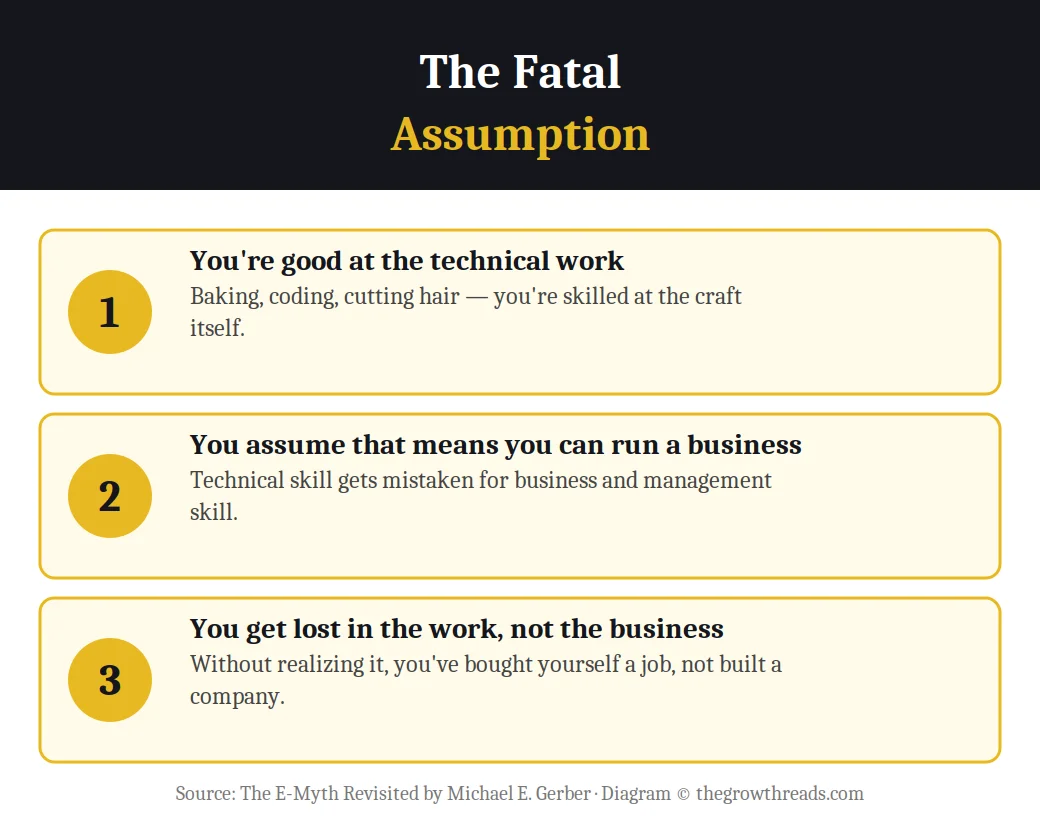
Most small businesses aren’t started by entrepreneurs — they’re started by technicians having what Michael Gerber calls an “entrepreneurial seizure.” A skilled baker, coder, or consultant assumes that because they’re good at the technical work, they must also know how to run a business around it — a mistake Gerber names the Fatal Assumption. The result is an owner who has bought themselves a demanding, poorly paid job rather than built a company. Gerber’s fix is to design the business itself as a product, using a “franchise prototype” model — documented, systemized, and built to deliver a consistent result through ordinary people — whether or not you ever actually franchise it.
Key takeaways
- The Fatal Assumption: being good at the technical work of a business does not mean you understand how to build and run the business that does that work — the two are entirely different skills.
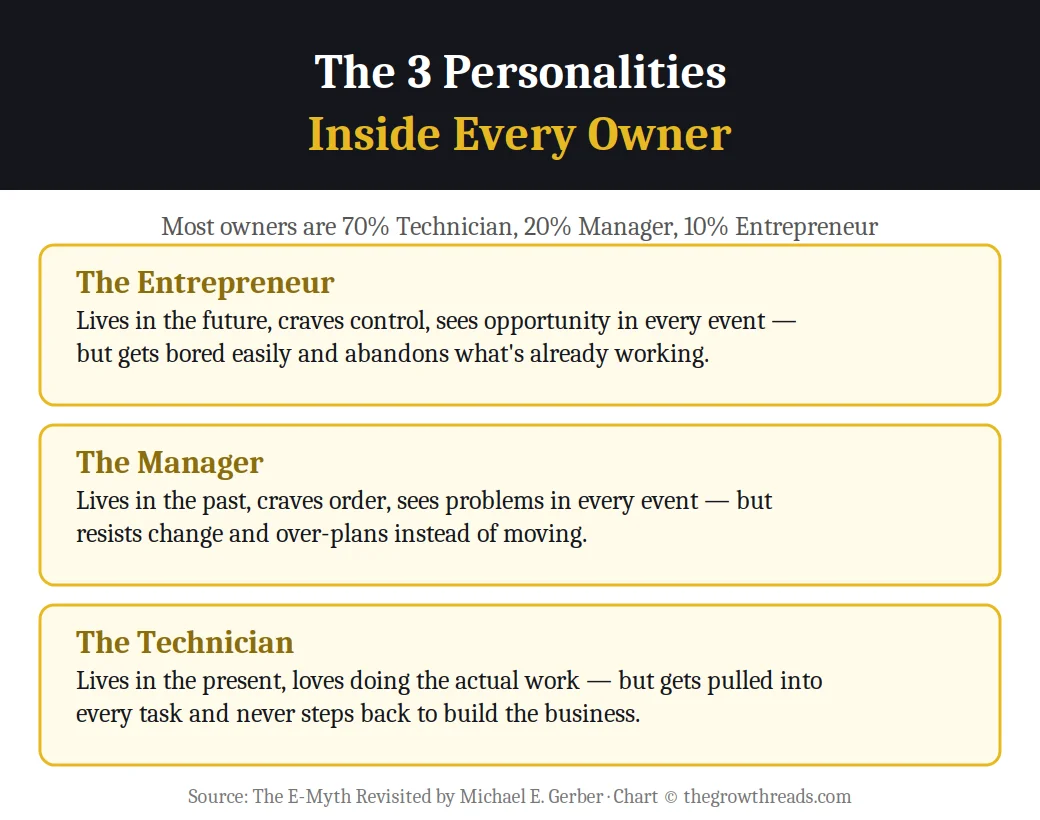
- Three personalities live inside every owner: the Entrepreneur (visionary), the Manager (organizer), and the Technician (doer) — most owners are overwhelmingly Technician, at the expense of the other two.
- Working in your business isn’t the same as working on it: doing the technical work yourself, however well, is different from designing the systems that let the business run without you.
- Build a franchise prototype, even if you’ll never franchise: design your business as a documented, replicable system that delivers consistent value regardless of who’s running it day to day.
- The system runs the business; the people run the system: reliability should come from documented process, not from depending on any one talented individual, including yourself.
- Define your Primary Aim before your business strategy: knowing what you want your life to look like should come first — the business is a vehicle for that life, not the other way around.
- The product is the customer’s experience, not the commodity: what a customer feels about interacting with your business often matters more than the specific good or service they walked in for.
- Hard, soft, and information systems work together: equipment and space (hard), people and process (soft), and data that tells you what’s happening (information) all need to be designed, not left to chance.
- Your business reflects who you are: if the business needs to change, the owner typically has to change first — systems don’t fix themselves without a shift in how the owner operates.
What is The E-Myth Revisited about?
The E-Myth Revisited is Michael Gerber’s explanation for why most small businesses struggle or fail: they’re typically founded by technicians — people skilled at a craft — who mistakenly assume technical skill is enough to run a business, a mistake Gerber calls the Fatal Assumption. Rather than a collection of tactics, the book is built around a single reframe: treat your business itself as the product, designed and systemized like a franchise prototype, so it can deliver a consistent result through ordinary people rather than depending entirely on the owner’s personal effort and talent.
About the author
Michael E. Gerber originated the small business coaching industry in 1975 by founding The Michael Thomas Corporation, later building E-Myth Worldwide and The E-Myth Academy around the ideas that would become The E-Myth Revisited. His central argument grew out of decades spent watching skilled technicians — bakers, consultants, tradespeople — start businesses around their craft and then find themselves trapped in a demanding job rather than owning a company that could run without them. Gerber has authored 29 books in the E-Myth series, the original E-Myth was named the Wall Street Journal’s “#1 business book of all time” in 2011, and his work has reached more than 100,000 small business clients across 145 countries. Explore all Michael E. Gerber book summaries →
Key concepts at a glance
| Concept | What it means | Use it when |
|---|---|---|
| The Fatal Assumption | Mistaking technical skill for business and management skill | You’re great at the work itself but the business around it feels chaotic |
| The 3 personalities | The Entrepreneur, Manager, and Technician that coexist, often in conflict, inside every owner | You want to understand why you keep getting pulled back into daily tasks |
| Working on vs. in the business | Designing systems and vision versus doing the day-to-day technical work yourself | You feel like an employee of your own company, not its owner |
| The franchise prototype | A documented, replicable business model that delivers consistent results through ordinary people | Your business’s quality depends heavily on which specific person is working that day |
| Primary Aim | Defining what you want your life to look like before defining your business strategy | You’re not sure what the business is actually supposed to be building toward |
| Hard, soft, and information systems | Equipment and space, people and process, and the data that shows what’s happening | You’re systemizing one part of the business but ignoring the others |
Part 1: The Fatal Assumption and the entrepreneurial seizure
Gerber opens with a story he calls universal among small business failures: someone skilled at a technical craft — baking, plumbing, writing code — has a moment of inspiration and decides to open a business doing that same work for themselves instead of for an employer. He calls this moment the “entrepreneurial seizure,” and the underlying error the Fatal Assumption: the belief that because you understand the technical work of a business, you therefore understand a business that does that technical work. These are, in Gerber’s framing, two entirely separate disciplines, and conflating them is what quietly dooms so many new businesses before they even notice the mistake.
The consequence of the Fatal Assumption is usually a business that runs entirely on the owner’s personal effort. Since no one else can do the technical work as well as the founder, everything routes back through them, and the business plateaus at the ceiling of one person’s time and energy. What looks, from the outside, like owning a business is often, in practice, closer to owning a particularly demanding and poorly compensated job.
TGR Note: The Fatal Assumption is a small-business-specific version of a broader theme in Zero to One — both books argue that building a company that survives and scales requires a fundamentally different set of skills than being excellent at the underlying product or craft.
Part 2: The three personalities and working on vs. in the business
Gerber argues that every business owner is really three people in conflict: the Entrepreneur, who lives in the future and sees opportunity in every situation but gets bored quickly and abandons what’s already working; the Manager, who lives in the past and craves order but resists change and can over-plan instead of acting; and the Technician, who lives entirely in the present and finds real satisfaction in doing the work, but resists stepping back from it long enough to build anything larger. Most small business owners, in Gerber’s observation, are overwhelmingly Technician, with only small slivers of Manager and Entrepreneur showing up when circumstances force it.
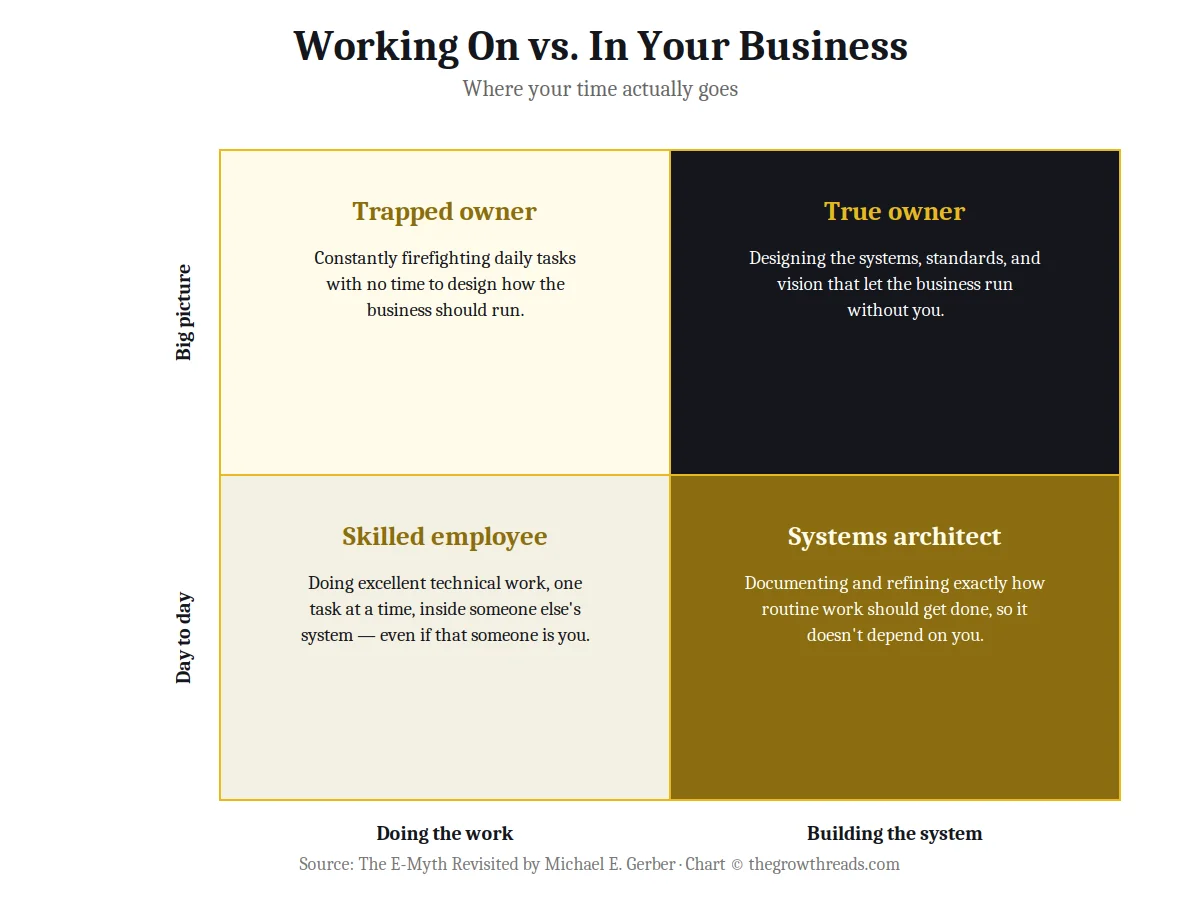
This imbalance is exactly what produces the trap of working in the business rather than on it: an owner dominated by their Technician side keeps doing the actual work — the thing they’re good at and comfortable with — instead of designing the systems, standards, and structure that would let the business function without their constant personal involvement. Gerber’s blunt advice captures the distinction: if you want to work in a business, get a job in someone else’s — don’t spend your life working inside your own without ever stepping back to build it.
TGR Note: This working-on-vs-in distinction closely parallels the redesign practice in Great at Work — both books push owners and employees alike to evaluate whether their effort is producing real structural value, not just visible activity.
Part 3: The franchise prototype model
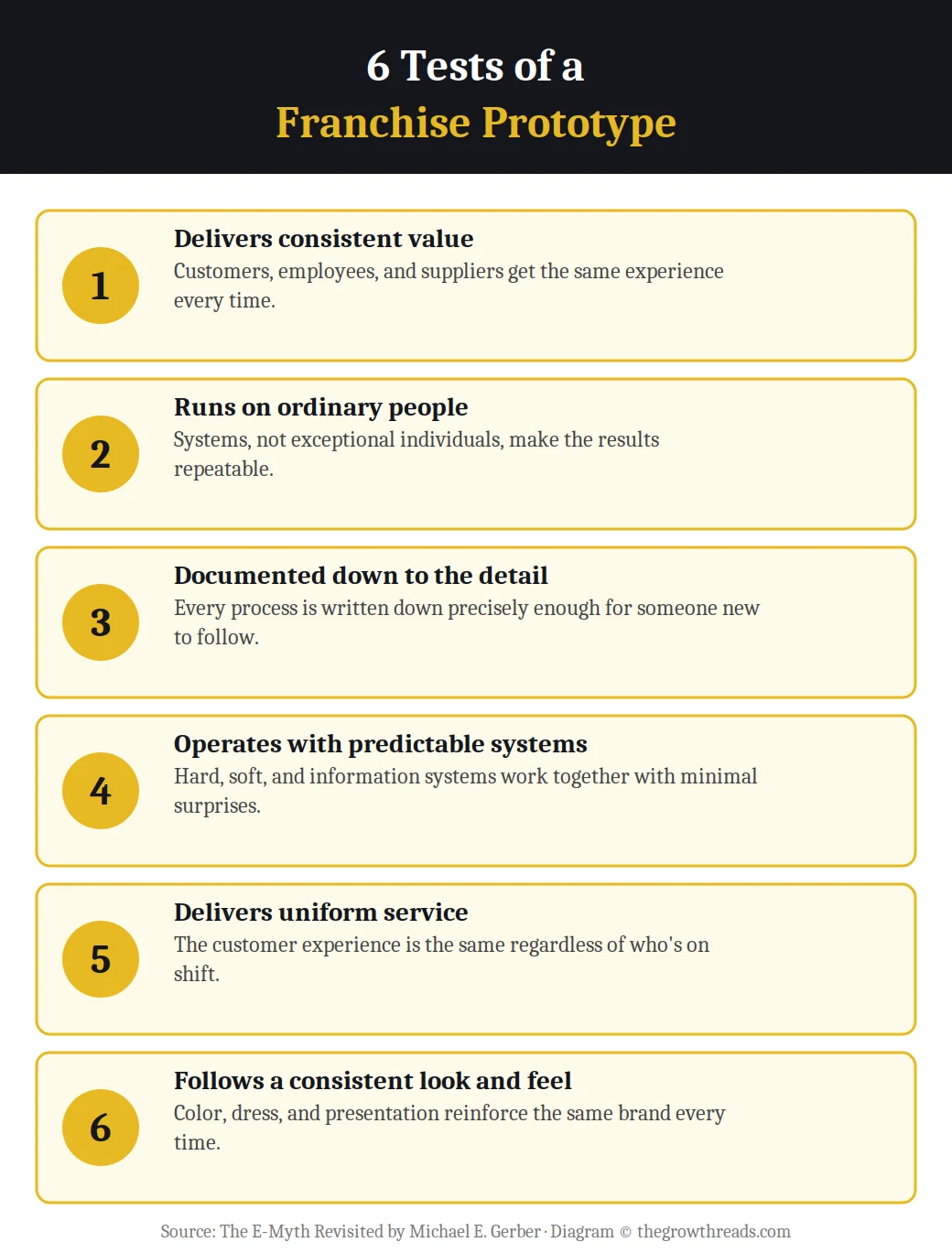
Gerber’s central prescription is to design your business as if you intended to franchise it, whether or not you ever actually do. The franchise prototype has to pass six tests: it delivers consistent value to customers, employees, and suppliers alike; it can be operated by people with the least possible skill and experience the model requires; it stands out for order and predictability rather than relying on individual heroics; every process is documented precisely enough for someone new to follow; it delivers a uniform experience regardless of who’s on shift; and it presents a consistent, deliberately designed look, feel, and brand.
The philosophy underneath the model is captured in one of the book’s most repeated lines: the system runs the business, and the people run the system. Reliability is engineered into documented process rather than dependent on any single talented individual, including the founder — which is precisely what allows a business to grow, scale, or eventually be sold, none of which is possible if quality only exists inside one person’s head and hands.
TGR Note: The franchise prototype’s insistence on documented, repeatable process is close kin to the scoreboard-and-cadence discipline in The 4 Disciplines of Execution — both treat consistency as something engineered through system design, not something you can simply ask people to deliver through effort alone.
Part 4: The fatal assumption’s chain reaction, and defining your Primary Aim
Gerber traces how the Fatal Assumption plays out as a chain reaction: technical skill leads to starting a business, which leads to the owner doing all the technical work personally, which leads to no time or attention left for building management systems, which leads to a business entirely dependent on the owner’s continued presence and effort. Breaking the chain requires recognizing it explicitly, rather than assuming the trapped feeling will resolve itself once things get “less busy” — a moment that, for most owners caught in this pattern, never actually arrives on its own.
Gerber insists this work has to start with a Primary Aim — a clear picture of what you actually want your life to look like — defined before any business strategy. Without it, the business risks becoming an end in itself rather than a vehicle for the life the owner actually wants, and decisions about systems, hiring, and growth lack any real basis for being made one way rather than another.
Who is The E-Myth Revisited best for — and who should read something else first?
This book is best for small business owners and aspiring founders who are, or are at risk of becoming, trapped doing the technical work of their own business rather than building a company around it. It’s particularly valuable for anyone about to start a business based on a craft or skill they’re personally good at.
If you’re specifically focused on team execution once the business is already systemized, The 4 Disciplines of Execution picks up closer to where Gerber’s franchise prototype leaves off. If your interest is in building a company that could become a category-defining, venture-scale business rather than a systemized small business, Zero to One addresses a different, higher-stakes version of the founder problem. And if you want the long-term view of what separates enduring companies from mediocre ones once the founding stage is behind you, Built to Last is a natural next step.
Questions to reflect on
- Are you running your business, or are you the most essential technician inside it?
- Which of the three personalities — Entrepreneur, Manager, Technician — dominates how you actually spend your week?
- If you disappeared for a month, would your business’s quality and consistency hold up, or would it depend entirely on your presence?
- Which single process in your business is currently undocumented and living only in your head?
- What is your Primary Aim — the life you actually want — and does your current business strategy serve it?
🔥 Ready to stop working in your business and start working on it?
This guide covers the core framework — the book gives you Gerber’s full franchise prototype process, worksheets, and detailed case studies.
How to apply The E-Myth Revisited (7-day plan)
- Day 1: Write down your Primary Aim — what you actually want your life to look like, independent of the business.
- Day 2: Identify which of the three personalities — Entrepreneur, Manager, Technician — dominates your typical week.
- Day 3: List every task only you currently know how to do, and pick one to start documenting as a written process.
- Day 4: Evaluate one customer touchpoint against the franchise prototype’s six tests — where does it fall short?
- Day 5: Draft a simple, written procedure for the task you documented on Day 3, precise enough for someone new to follow.
- Day 6: Identify one hard, one soft, and one information system in your business, and note whether each is designed or accidental.
- Day 7: Block time on next week’s calendar explicitly for working on the business, not in it.
Frequently asked questions
What is the main idea of The E-Myth Revisited?
Most small businesses are started by technicians who mistakenly assume that being skilled at the technical work means they can run a business around it — a mistake Michael Gerber calls the Fatal Assumption. His fix is to design the business itself as a product, using a documented, systemized “franchise prototype” model that delivers consistent results through ordinary people.
What is the Fatal Assumption in The E-Myth Revisited?
The Fatal Assumption is the belief that understanding the technical work a business does is the same as understanding how to build and run that business. Gerber argues these are entirely separate skill sets, and conflating them is what traps many technically skilled founders.
What are the three personalities in The E-Myth Revisited?
The Entrepreneur, who is visionary but easily bored; the Manager, who craves order but resists change; and the Technician, who loves doing the work but resists stepping back to build the business. Gerber argues most owners are overwhelmingly Technician.
What is the franchise prototype model?
A framework for designing your business as if you intended to franchise it, whether or not you actually do. It requires the business to deliver consistent value, run on ordinary people, follow documented processes, operate predictably, deliver uniform service, and maintain a consistent brand.
What does “working on your business, not in it” mean?
Working in your business means personally doing the technical work it delivers, like an employee. Working on your business means designing the systems, standards, and structure that let it operate and deliver quality without depending on your constant personal involvement.
Is The E-Myth Revisited only useful for people who want to franchise their business?
No, the franchise prototype is presented as a design discipline, not a literal requirement to franchise. Gerber argues that thinking through your business as if it had to work through ordinary people, following documented systems, improves any small business regardless of whether it’s ever franchised.
What is a Primary Aim in the book?
A Primary Aim is a clear statement of what you want your life to look like, defined before your business strategy. Gerber argues the business should serve this life goal rather than becoming an end in itself with no clear underlying purpose.
Related summaries
If The E-Myth Revisited resonated, these dig further into related territory: The 4 Disciplines of Execution on executing consistently as a team, Zero to One on building a category-defining company, and Built to Last on what separates enduring companies over the long run. For more, see our best productivity books pillar page.
How we analyze books: We work from the full book — reconstructing its core arguments in our own words, adding commentary that connects it to related research and other books in our library, and pressure-testing the advice in a practical 7-day plan. Ratings weigh usefulness, readability, and evidence quality. Read our full methodology.
Related Productivity Summaries
Rework Summary & Review: Build Less, Ship More, Stay Profitable
The Checklist Manifesto Summary & Review: How Simple Lists Prevent Catastrophic Failures
The Effective Executive Summary & Review: Get the Right Things Done
The Now Habit Summary & Review: A Strategic Program for Overcoming Procrastination
The War of Art Summary & Review: How to Defeat Resistance and Do Your Work