

★★★★★ 4.6/5 — the investigative deep-dive that explains, ingredient by ingredient, why processed food is engineered to be nearly impossible to stop eating.
Best for: anyone who shops or cooks for a family, wants to understand why cravings for packaged food feel so hard to control, or is curious how the food industry actually operates behind the label · Reading time: ~10 hrs (this guide: ~17 min) · Difficulty to apply: Moderate — the payoff is a permanent change in how you read a label
Salt Sugar Fat in one minute
Your craving for a specific bag of chips or a specific soda isn’t a personal failing — it was reverse-engineered. Pulitzer Prize-winning investigative journalist Michael Moss spent years inside the food industry — interviewing the scientists, marketers, and even the executives who build these products — to show that salt, sugar, and fat aren’t just ingredients. They’re precision tools, tuned with the same rigor as pharmaceutical research, to hit an exact “bliss point” of craving, mask the taste of cheap ingredients, and make a product feel more indulgent than its nutrition label lets on. Moss’s most damning finding isn’t that this happens by accident: at a 1999 meeting of the industry’s most powerful CEOs, called specifically to discuss the obesity crisis, the industry looked directly at the problem and chose taste and market share instead. This guide reconstructs how that engineering actually works — and what a shopper can do about it once they can see it.
Key takeaways
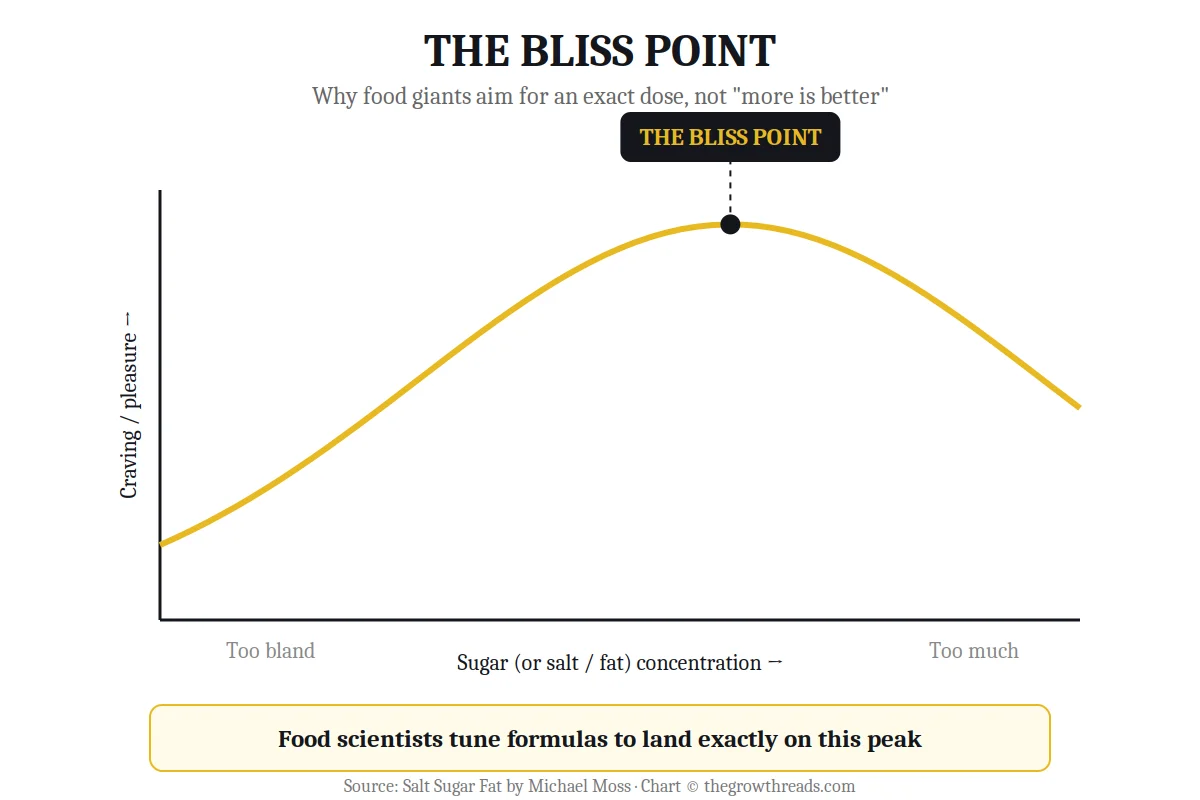
- The bliss point is engineered, not accidental: food scientists systematically test dozens of formulations to find the exact concentration of sugar, salt, or fat that maximizes craving without triggering the point where your brain says “enough.”
- Salt does more than season: it also masks bitter or off notes from cheap ingredients and processing, and extends shelf life — which is a big part of why it’s so hard to simply remove.
- Fat has a “vanishing caloric density” problem: foods engineered to dissolve almost instantly in your mouth trick your brain into undercounting how many calories you’ve actually eaten.
- The industry knew, and discussed it directly: in 1999, the CEOs of the largest food companies in America met to discuss reformulating for health — and the most powerful voice in the room argued for taste and market share over nutrition.
- A small “heavy user” base drives enormous sales: a minority of frequent buyers can account for the majority of a packaged food’s revenue, and products are engineered and marketed to keep them coming back.
- Convenience foods solved a real problem, then optimized the wrong variable: products like Lunchables genuinely answered busy parents’ lack of time, but the underlying engineering optimized for craving and margin, not nutrition.
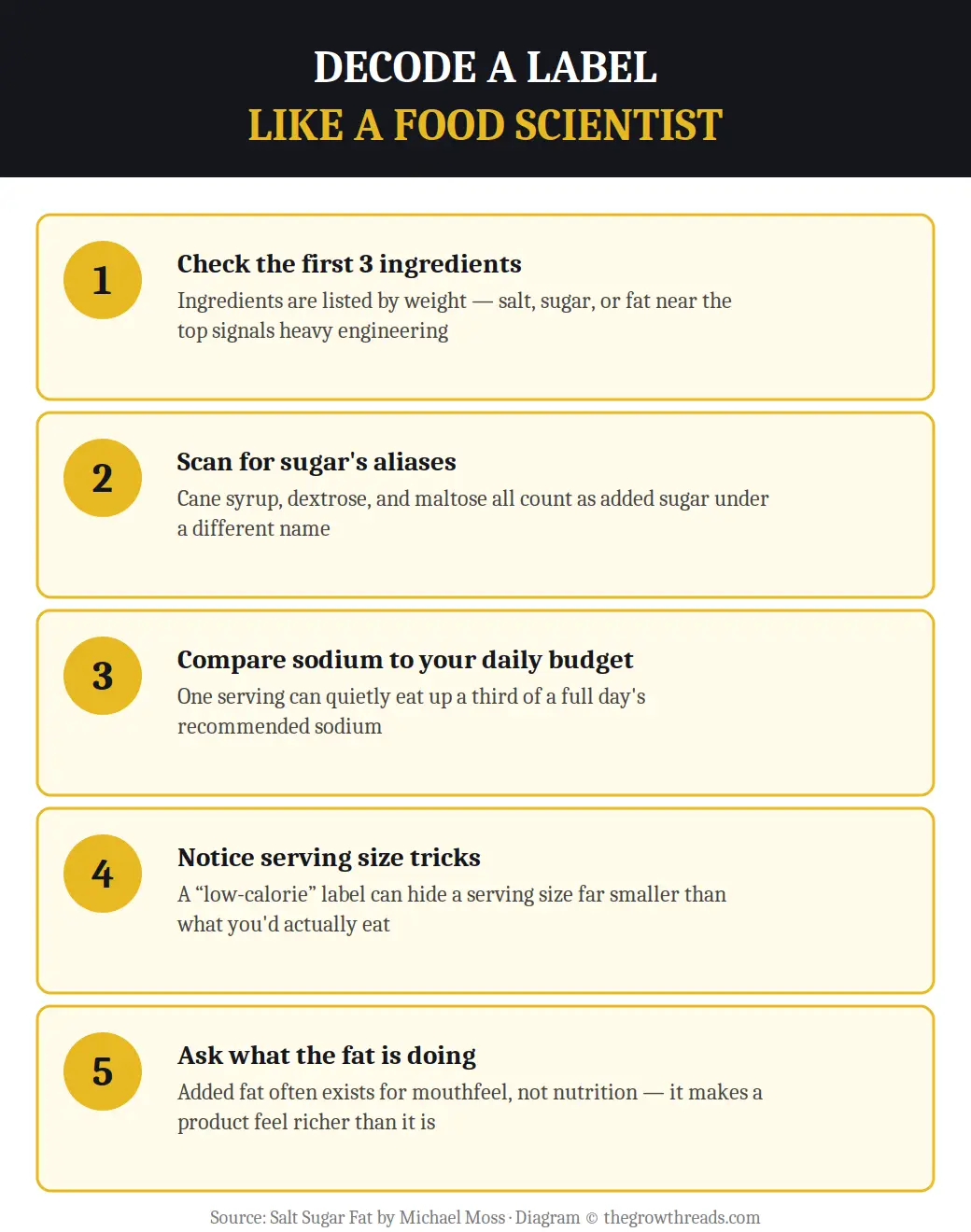
- Sugar hides behind dozens of names on a label: cane syrup, dextrose, and maltose all function as added sugar, just under names that don’t register as “sugar” to most shoppers.
- Marketing to children builds decades of brand loyalty: cereal and snack companies engineer products and ads around kids’ preferences and the “nag factor” — pestering a parent until they give in.
- Reform is possible, but the economics fight back: some companies have made public commitments to cut salt, sugar, or fat, but every reformulation risks losing sales to a competitor who doesn’t follow suit.
What is Salt Sugar Fat about?
Salt Sugar Fat: How the Food Giants Hooked Us is Michael Moss’s investigation into how the packaged food industry deliberately engineers craving into processed food, and how that engineering reshaped the American diet. Drawing on internal industry documents, scientific research, and interviews with the food scientists, marketers, and executives who built the products on your grocery shelves, Moss traces the industry’s decades-long awareness of the health consequences of its formulas — and its repeated choice to protect taste, convenience, and market share over reformulating for health.
About the author
Michael Moss is an investigative journalist who spent much of his career at The New York Times, following earlier work at The Wall Street Journal. In 2010, he and colleagues on the Times staff won the Pulitzer Prize for Explanatory Reporting for a series exposing contaminated ground beef and the regulatory failures that let it reach store shelves — reporting that led to changes in food safety practice. Salt Sugar Fat, published by Random House in February 2013, became a #1 New York Times bestseller and won the James Beard Foundation Award for Writing and Literature in 2014. Moss later expanded on the book’s themes of engineered craving in Hooked: Food, Free Will, and How the Food Giants Exploit Our Addictions (2021), which digs further into the neuroscience of why these products are so hard to put down. Explore all Michael Moss book summaries →
Key concepts at a glance
| Concept | What it means | Use it when |
|---|---|---|
| Bliss point | The precise concentration of sugar, salt, or fat that maximizes craving without tipping into “too much” | You want to understand why a specific product feels impossible to stop eating |
| Sensory-specific satiety | Your brain’s tendency to get bored of one intense flavor, which formulators route around with variety and complexity | You notice you can eat far more of a snack aisle’s worth of flavors than one strong one |
| Vanishing caloric density | A texture engineered to dissolve almost instantly, so your brain undercounts the calories you’ve eaten | A lightweight snack food feels like it doesn’t “count” |
| Heavy user economy | The small share of frequent buyers whose repeat purchases drive a majority of a product’s sales | You want to understand who packaged food marketing is really built for |
| Mouthfeel | The tactile, textural sensation fat and additives create, engineered independent of actual nutrition | A product feels “rich” or “creamy” despite a thin nutritional profile |
| Line extension | Launching many near-identical product variations to occupy more shelf space and consumer attention | You notice a dozen flavors of what is functionally the same snack |
| Nag factor | Marketing engineered to make a child pressure a parent into a purchase | You’re evaluating why a kid fixates on one specific cereal or snack brand |
Part 1: Why the industry engineers craving on purpose
Moss opens with Howard Moskowitz, a Harvard-trained psychophysicist who built a career finding a product’s “bliss point” — the exact level of sweetness, saltiness, or fat that maximizes how much people want it. Working with Dr Pepper in the 1970s, Moskowitz systematically tested dozens of sweetness levels rather than guessing, and later applied the same rigor to Prego spaghetti sauce: instead of searching for one “perfect” recipe, his research found that consumers actually split into distinct clusters of preference, which is how “extra chunky” Prego became a hit variety rather than a compromise nobody wanted. The lesson the industry took from Moskowitz wasn’t subtle — craving can be found empirically, the same way a chemist finds a melting point, and once found, it can be manufactured at scale.
The other half of the science is knowing when to stop pushing. Sensory-specific satiety is the brain’s tendency to get tired of one intense, singular flavor relatively fast — which is why formulators build in complexity and variety rather than simply maximizing sweetness or saltiness in one straight line. A product engineered around the bliss point isn’t trying to overwhelm your palate; it’s trying to sit at the exact point of maximum craving without crossing into “too much,” so you reach for another handful instead of pushing the bag away.
TGR Note: This is the same cue-craving-response-reward loop Atomic Habits maps for ordinary habits — except here, the “craving” step is being deliberately tuned by a lab, not left to form on its own. Recognizing that the loop was engineered, rather than a personal lack of willpower, is often the first shift that makes it easier to interrupt.
Part 2: The three levers — salt, sugar, and fat
Moss devotes a section of the book to each of the title’s three ingredients, and each turns out to be doing more work than its flavor alone suggests.
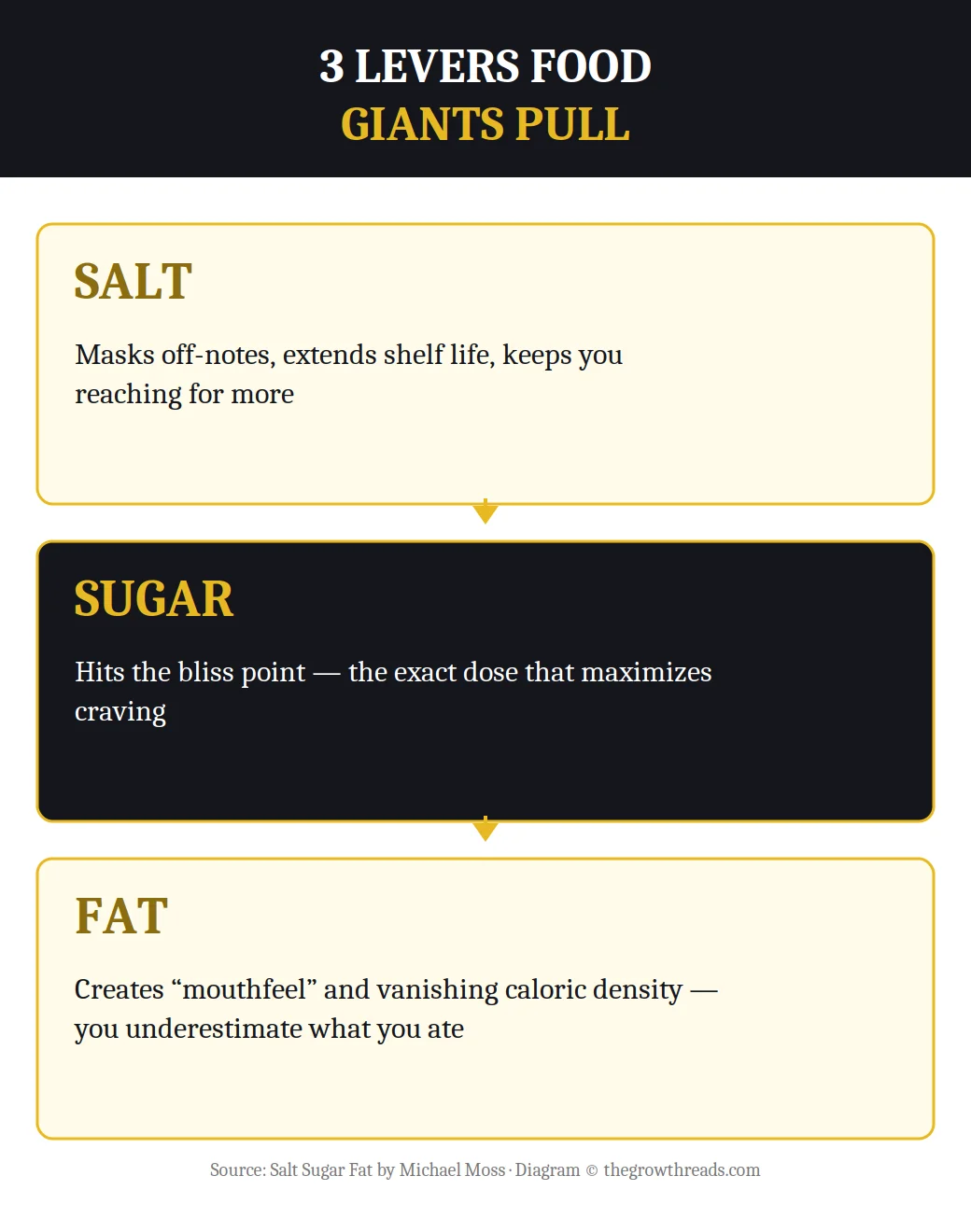
Salt is the hardest of the three to remove, Moss finds, because it isn’t just seasoning — it masks bitter or metallic off-notes from cheap ingredients and heavy processing, and it extends shelf life. When Campbell Soup Company tried reducing sodium in some of its soups, consumer testing showed people could taste the difference and preferred the saltier original, which is part of why industry-wide reduction efforts have moved slowly and inconsistently. Sugar is where the bliss point research is most visible — and Moss traces how, starting in the 1970s, the sugar industry worked to shift public and scientific attention toward dietary fat as the primary villain in heart disease, a framing that arguably delayed scrutiny of sugar’s own role for decades. Fat contributes flavor and satisfaction, but its more insidious trick is texture: food scientist Steven Witherly, quoted in the book, describes Cheetos as engineered so the puff “melts” almost instantly in your mouth — a property Moss calls vanishing caloric density, because your brain registers the fast dissolve as “this must not have many calories,” making it dangerously easy to keep eating long past the point of being full.
TGR Note: The sugar industry’s decades-long push to redirect blame toward fat is a useful case study in motivated reasoning at an institutional scale — worth reading alongside The Scout Mindset on how organizations, not just individuals, can convince themselves of a conclusion that happens to serve their interests.
Part 3: The heavy user economy and the marketing machine
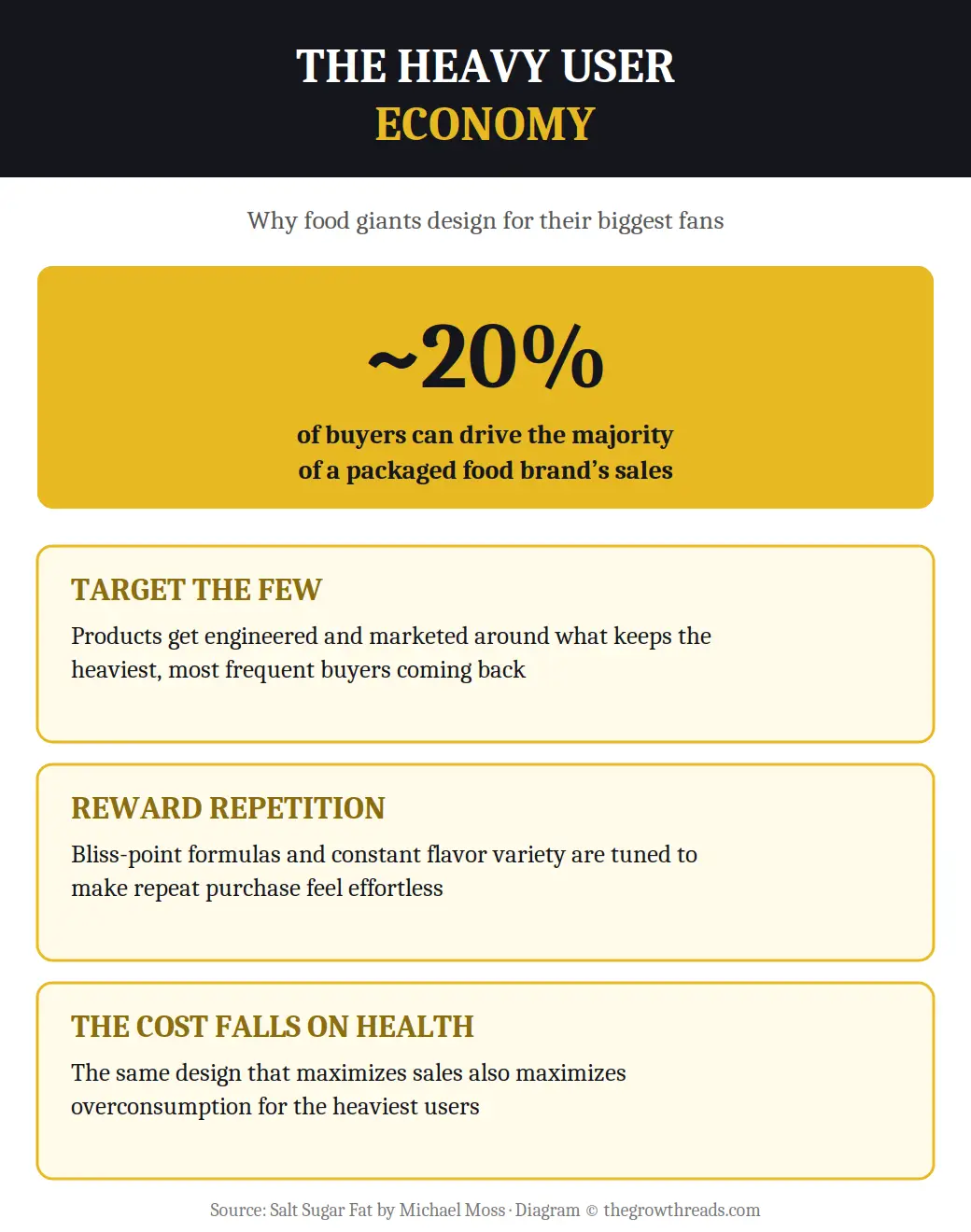
Moss shows that packaged food companies don’t market to the average shopper — they market to their heaviest users, the relatively small group of frequent buyers whose repeat purchases can account for a majority of a product’s sales. Everything from flavor variety to portion size to advertising is tuned around keeping that core group buying, because losing them is far more costly than failing to win over an occasional customer.
Convenience products fit into this same economy. Moss profiles Bob Drane, the Oscar Mayer (a Kraft subsidiary) executive tasked in the 1980s with “modernizing the Oscar Mayer lunch” for busy, two-income households — the project that became Lunchables. Drane genuinely solved a real problem: parents with no time to assemble a lunch got a shelf-stable, kid-approved answer. But the same engineering that made it convenient and craveable optimized for salt, sugar, and fat, not nutrition — a tension Drane himself later spoke about candidly, noting that his own daughter chose not to feed Lunchables to her children. Marketing to children compounds the effect: cereal and snack brands are built and advertised around kids’ taste preferences and the “nag factor” — the well-documented tendency of a child’s in-store pestering to override a parent’s better judgment — cementing brand loyalty that can last a lifetime, long before that child is old enough to evaluate a nutrition label.
TGR Note: The heavy user concept is a sharper, more cynical cousin of the “who is this actually for” question In Defense of Food asks about the industrial food system more broadly — Michael Pollan’s answer (real food doesn’t need this kind of optimization) and Moss’s reporting arrive at the same conclusion from very different angles.
Part 4: Can the industry actually reform — and what you can do right now
The book’s most striking scene is a 1999 meeting at Pillsbury’s Minneapolis headquarters, where a Kraft executive, Michael Mudd, and Pillsbury’s chief technical officer, James Behnke, brought together the CEOs of the country’s largest food companies specifically to discuss the country’s worsening obesity crisis and whether the industry should act. The meeting ended without commitment: Stephen Sanger, then CEO of General Mills, reportedly told the room, “Don’t talk to me about nutrition. Talk to me about taste, and if this stuff tastes better, don’t run around trying to sell stuff that doesn’t taste good.” It’s a scene Moss returns to throughout the book as evidence that the industry’s central problem was never a lack of awareness — it was that reformulating first meant risking sales to a competitor who didn’t.
Some reform has happened since: several major companies have made public commitments over the years to reduce sodium, added sugar, or trans fat in parts of their lineup, and nutrition labeling has become more transparent. But Moss’s reporting is clear that these efforts move slowly and unevenly, because the underlying economics haven’t changed — craving still sells. That leaves label literacy as the most practical tool available to an individual shopper right now.
TGR Note: If Sanger’s “talk to me about taste” line landed for you, it’s worth reading alongside Outlive‘s argument that modern chronic disease is mostly a problem of slow, compounding daily choices rather than single dramatic ones — the food industry’s incentives and the body’s own biology are both, in their own ways, optimized for the short term over the long one.
Who is Salt Sugar Fat best for — and who should read something else first?
Salt Sugar Fat is best for anyone who buys groceries or cooks for a family and wants to understand why certain products feel so hard to moderate — it will permanently change how you read an ingredient list. It also rewards readers interested in investigative journalism and how large industries make decisions, independent of any personal diet goal.
If you’re looking for a structured eating plan rather than an exposé, In Defense of Food gives you Michael Pollan’s practical philosophy in far fewer pages. If your interest is specifically the neuroscience of food cravings and addiction, Moss’s own follow-up, Hooked, goes deeper into that territory than this book does. And if you want the bigger-picture case for why diet matters for long-term health rather than day-to-day craving, Outlive or Brain Food are better starting points. This is a work of investigative journalism, not a nutrition guide or medical advice — for a specific eating plan, talk to a registered dietitian or physician.
Questions to reflect on
- Which packaged food in your own kitchen would you guess was engineered around a bliss point — and what happens when you try to eat “just a little” of it?
- Where in your shopping habits are you likely a food company’s “heavy user” — and does knowing that change how you feel about the product?
- The next time you check a label, which ingredient are you most likely to have overlooked before reading this: an alias for sugar, a sodium number, or a serving size?
- Do you remember a childhood food habit that traces back to marketing rather than an actual preference you formed on your own?
- If reformulating for health means a company risks losing customers to a competitor who doesn’t, what would actually have to change for the industry to move faster?
🔥 Ready to see your grocery list differently?
This guide covers the core mechanics — the book gives you the full reporting: the internal documents, the scientist interviews, and the industry’s own words, product by product.
How to apply Salt Sugar Fat (7-day plan)
- Day 1: Pick one packaged snack you eat regularly and read its full ingredient list out loud, in order — ingredients are listed by weight, so what’s near the top is what you’re really eating most of.
- Day 2: Check that same product’s label for sugar’s aliases (cane syrup, dextrose, maltose, and similar) and add up how many actually count as added sugar.
- Day 3: Compare the sodium content of one packaged meal or soup against your daily recommended sodium budget, and note what share of the day it uses up in one serving.
- Day 4: Check the serving size on a package you’d normally finish in one sitting, and calculate the real calorie count for what you actually eat, not the printed serving.
- Day 5: Notice one food today that “melts” quickly or feels light despite being calorie-dense — that’s vanishing caloric density at work, not your imagination.
- Day 6: Identify one product you buy specifically because of a childhood association or advertising memory, and consider whether you’d choose it on taste and nutrition alone.
- Day 7: Pick one processed staple in your kitchen and find (or make) a lower-engineered swap — not to eliminate the category, but to break one default on autopilot.
Frequently asked questions
What is the main idea of Salt Sugar Fat?
Salt Sugar Fat argues that the American processed food industry deliberately engineers salt, sugar, and fat levels to maximize craving and consumption, using systematic scientific methods rather than guesswork. Michael Moss shows through internal documents and interviews with food scientists, marketers, and executives that the industry has known about the health consequences of this engineering for decades, and that a 1999 meeting of top CEOs specifically confronted and then rejected the case for reformulating around health. The book’s core claim is that overeating processed food is often less a personal failing than the predictable result of deliberate product design.
What is the “bliss point” in Salt Sugar Fat?
The bliss point is the precise concentration of sugar, salt, or fat that maximizes how much a person craves a food, identified through systematic sensory testing rather than intuition. Psychophysicist Howard Moskowitz pioneered this research for products including Dr Pepper and Prego spaghetti sauce, and Moss describes how it became standard practice across the packaged food industry. Formulators pair the bliss point with an understanding of sensory-specific satiety — the tendency to get tired of one intense flavor — to keep products craveable without tipping into “too much.”
Did food company executives really know their products were unhealthy?
Yes — Moss documents a 1999 meeting at Pillsbury’s Minneapolis headquarters, organized by Kraft executive Michael Mudd and Pillsbury’s James Behnke, where the CEOs of the country’s largest food companies were specifically asked to consider reformulating for health as obesity rates climbed. General Mills CEO Stephen Sanger reportedly rejected the proposal, telling the room to focus on taste rather than nutrition. The meeting produced no industry-wide commitment, which Moss uses as evidence that awareness was never the barrier to reform — competitive economics was.
What does “vanishing caloric density” mean?
Vanishing caloric density describes a food texture, most famously Cheetos in Moss’s reporting, engineered to dissolve almost instantly in the mouth. Because the food seems to disappear so quickly, the brain undercounts how many calories it actually contains, making it unusually easy to keep eating well past the point of being full. Food scientist Steven Witherly, quoted in the book, calls it one of the more deliberately engineered properties in snack food design.
Is Salt Sugar Fat still relevant, since it was published in 2013?
The core reporting on bliss point science, industry economics, and marketing strategy has aged well, since the underlying incentives Moss describes haven’t fundamentally changed. Some individual product examples and executives’ roles have shifted since publication, and some companies have made incremental reformulation commitments in the years since. Moss’s 2021 follow-up, Hooked, extends the same investigation into newer neuroscience research on food addiction, and is a natural next read for anyone who wants the more recent science.
Does Salt Sugar Fat offer a diet or eating plan?
No — it’s a work of investigative journalism, not a nutrition guide, and it doesn’t prescribe a specific diet. Its practical value comes from label literacy: once you understand bliss point engineering, sugar’s aliases, and serving-size tricks, reading an ingredient list becomes a genuinely different exercise. Readers looking for a structured eating plan built on similar findings tend to pair this book with something like In Defense of Food or Outlive.
What is the “heavy user economy” the book describes?
The heavy user economy refers to the finding that a relatively small share of frequent buyers can account for the majority of a packaged food product’s sales. Moss shows that companies design flavor variety, packaging, and marketing specifically to keep these heavy users buying, since retaining them matters far more to revenue than attracting occasional customers. It’s one reason marketing for these products can feel so persistent and so specifically targeted.
Related summaries
If Salt Sugar Fat resonated, these dig further into related territory: In Defense of Food on Michael Pollan’s philosophy for eating real food, Brain Food on how diet shapes long-term cognitive health, and Outlive on building a longevity strategy around daily habits. For more, see our best health books pillar page.
How we analyze books: We work from the full book — reconstructing its core arguments in our own words, adding commentary that connects it to related research and other books in our library, and pressure-testing the advice in a practical 7-day plan. Ratings weigh usefulness, readability, and evidence quality. Read our full methodology.
Related Health Summaries
Good Energy Summary & Review: Fix Your Metabolism to Unlock Limitless Health
Intuitive Eating Summary & Review: The Anti-Diet Framework That Actually Works
Keep Sharp Summary & Review: Build a Better Brain at Any Age
The Hungry Brain Summary & Review: Why Your Brain, Not Your Willpower, Decides What You Eat
The Plant Paradox Summary & Review: Are “Healthy” Foods Making You Sick?