

★★★★☆ 4.1/5
One-liner: Being “nice” is not a virtue — it is a cage built from fear of rejection, and breaking free is the path to authentic confidence, real connection, and a life you actually want.
Best for: People-pleasers, chronic avoiders, and anyone who says yes when they mean no — who wants to understand why they do it and how to stop without becoming a jerk.
Reading time: ~7 hours (416 pages)
Difficulty to apply: Moderate to high — the concepts are clear but overcoming deeply ingrained people-pleasing patterns requires sustained courage.
Not Nice in One Minute
You have been trained to be nice — and it is ruining your life. Dr. Aziz Gazipura, a clinical psychologist specializing in social confidence, argues that what most people call “being nice” is actually a fear-driven strategy for avoiding rejection, conflict, and disapproval. Nice people say yes when they mean no, agree when they disagree, suppress their needs, avoid difficult conversations, and construct a carefully managed persona designed to keep everyone comfortable — everyone except themselves. The result is chronic anxiety, simmering resentment, shallow relationships, missed opportunities, and a deep sense of being unseen. Gazipura distinguishes being nice (fear-driven avoidance) from being kind (genuine compassion expressed through honesty) and provides a practical framework for developing bold authenticity — the ability to express your true thoughts, feelings, and needs while still treating others with respect.
Key Takeaways
- Nice is not kind: Niceness is driven by fear of rejection and the need for approval. Kindness is driven by genuine care and expressed through honest, compassionate communication.
- People-pleasing is a survival strategy: Most nice people learned in childhood that suppressing their needs and managing others’ emotions was the safest way to maintain attachment and avoid punishment.
- The nice person’s core belief is “I am not enough”: Underneath the accommodating exterior is a deep conviction that your real self is unacceptable and must be hidden to maintain relationships.
- Saying no is a skill you can learn: Declining requests, expressing disagreement, and setting boundaries are learnable behaviors — uncomfortable at first but increasingly natural with practice.
- Conflict avoidance creates bigger conflicts: Suppressed needs and unexpressed boundaries build into resentment that eventually erupts in ways far more damaging than direct honesty would have been.
- Discomfort is not danger: The anxiety you feel when being honest is a false alarm from an outdated survival system — not evidence that something bad will happen.
- Authentic relationships require authentic people: People cannot love the real you if you never show them the real you. Niceness creates connection to your mask, not to you.
- Bold authenticity is the goal: The alternative to nice is not mean — it is honest, direct, compassionate communication that respects both your needs and others’.
What Is Not Nice About?
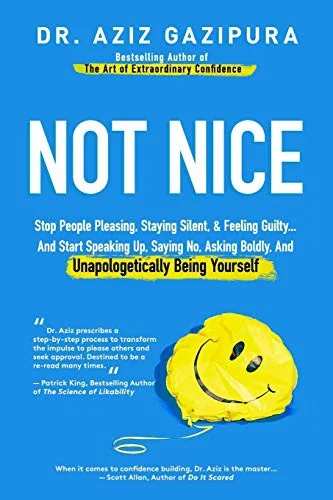
Not Nice reveals that people-pleasing is not a virtue but a fear-based survival strategy that creates anxiety, resentment, and shallow relationships. Dr. Gazipura provides a framework for replacing niceness with bold authenticity — honest, direct communication that builds genuine connection without sacrificing kindness or respect.
About the Author
Dr. Aziz Gazipura is a clinical psychologist, author, and the founder of the Center for Social Confidence in Portland, Oregon. He specializes in helping people overcome social anxiety, excessive niceness, and approval addiction. Gazipura speaks from personal experience — he spent his twenties struggling with intense social anxiety and people-pleasing before developing the clinical approach described in Not Nice. He has worked with thousands of clients and hosts the Shrink for the Shy Guy podcast, which has reached millions of listeners. His approach combines cognitive behavioral therapy with assertiveness training and compassion-based practices. Explore all Aziz Gazipura book summaries →
Key Concepts at a Glance
| Concept | What It Means | Use It When |
|---|---|---|
| The Nice Cage | The pattern of suppressing yourself to manage others’ reactions | You realize you are performing rather than being genuine in relationships |
| Nice vs Kind | Nice is fear-driven avoidance; kind is genuine care with honest expression | You confuse people-pleasing with actual compassion |
| Bold Authenticity | Expressing your true self honestly while maintaining respect for others | You want to be real without being aggressive or hurtful |
| Boundary Setting | Defining and communicating what you will and will not accept | You feel taken advantage of or chronically overwhelmed by others’ demands |
| Discomfort Tolerance | Learning that anxiety from honesty is a false alarm, not real danger | Fear of others’ reactions stops you from speaking your truth |
Part 1: The Nice Prison
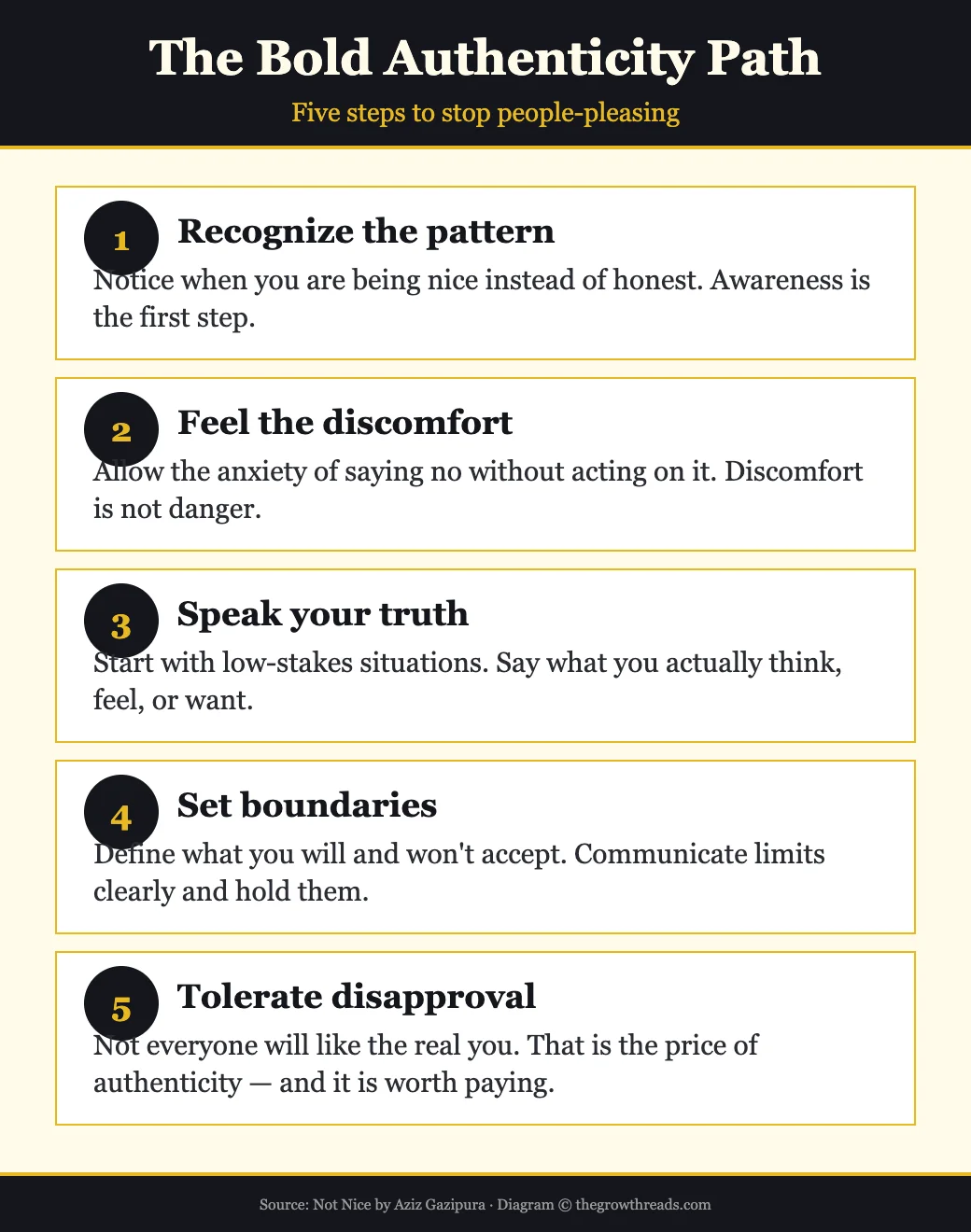
Gazipura opens by describing what he calls the “nice prison” — the invisible cage that nice people build around themselves. The bars are made of rules: do not upset anyone, do not disagree, do not ask for too much, do not take up space, do not be selfish. These rules were usually learned in childhood, where expressing needs or disagreement led to punishment, withdrawal of affection, or conflict between caregivers. The child learned that the safest strategy was to suppress authentic expression and become whatever the environment needed them to be.
In adulthood, this pattern becomes automatic. Nice people scan every social interaction for signs of disapproval. They craft their words carefully to avoid offense. They say yes to requests they want to decline. They swallow anger, hide disappointment, and present a carefully managed version of themselves that is pleasant, accommodating, and thoroughly exhausting to maintain. The irony is devastating: the strategy designed to create connection actually prevents it, because people are connecting with a performance rather than a person.
Part 2: Nice vs Kind — The Essential Distinction
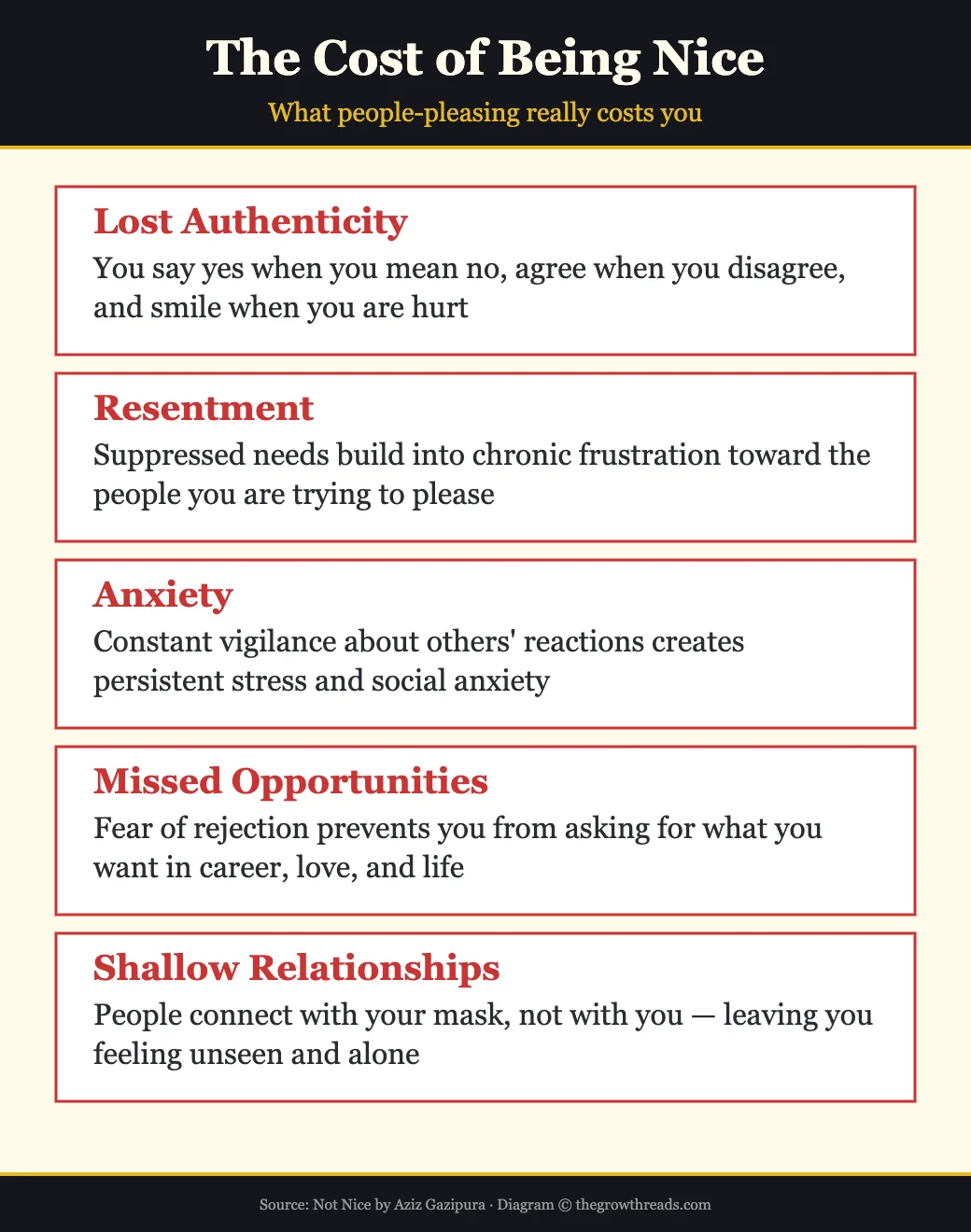
The book’s central insight is the distinction between nice and kind. Niceness is driven by fear: fear of rejection, fear of conflict, fear of being seen as selfish or difficult. It manifests as agreement without conviction, compliance without willingness, and warmth without honesty. Kindness, by contrast, is driven by genuine care for others — but it does not require self-abandonment. A kind person can say no, express disagreement, give honest feedback, and set firm boundaries while still treating the other person with compassion and respect.
Gazipura illustrates this with dozens of examples. A nice person agrees to help a friend move on a day they desperately need for themselves — then resents the friend silently for weeks. A kind person says, “I wish I could help, but I am not available that day. Can I help you find someone else?” The kind response is honest, direct, and compassionate. It may produce momentary disappointment in the friend, but it preserves the relationship’s integrity and the person’s own wellbeing.
He also addresses the common fear that stops nice people from changing: “If I stop being nice, I will become a jerk.” Gazipura calls this a false binary. The spectrum is not nice-to-mean. It is fear-driven to authentic. Bold authenticity — expressing your truth with compassion — is the alternative, and it creates far deeper, more satisfying relationships than niceness ever could.
Part 3: Building Bold Authenticity
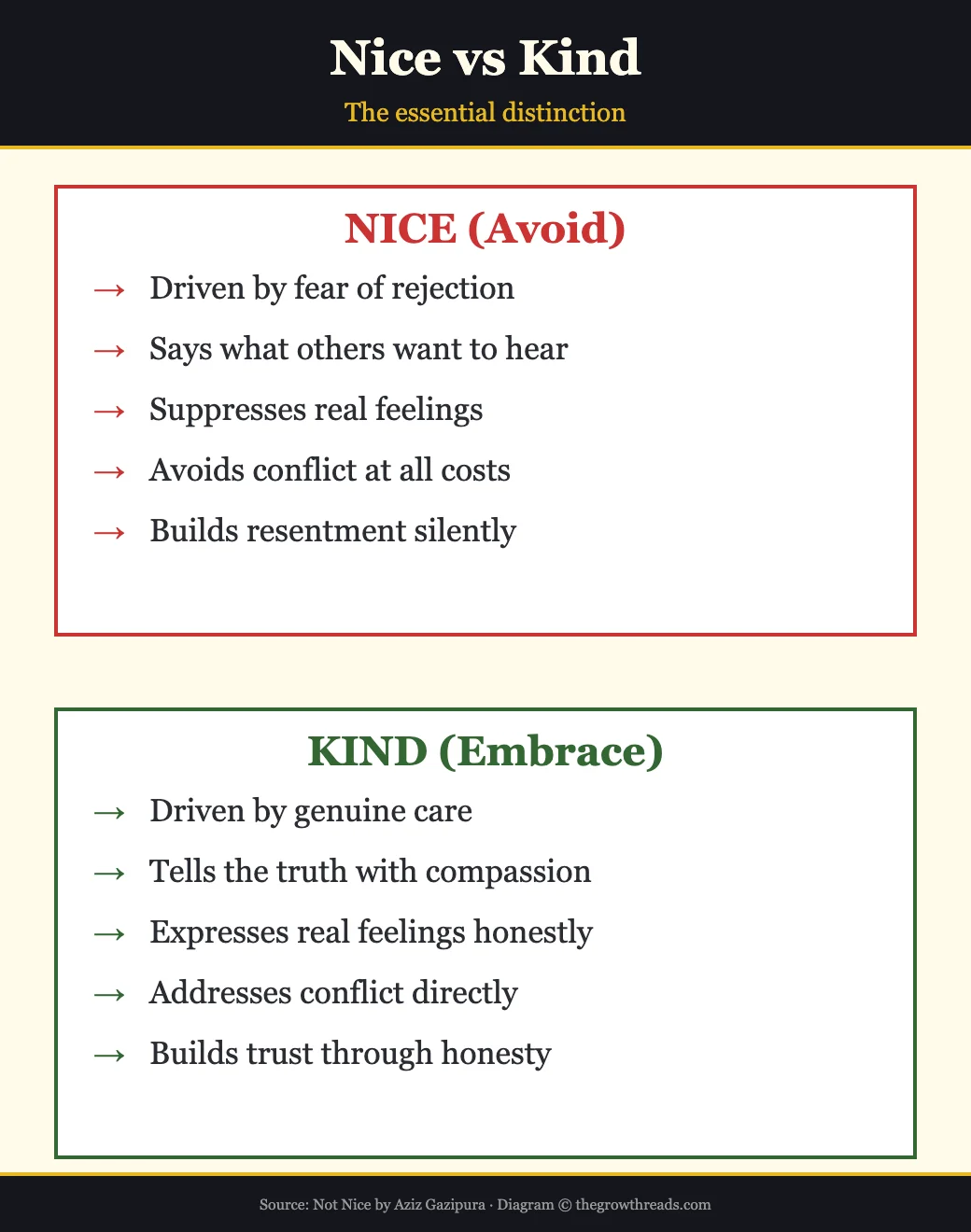
The final section provides the practical toolkit for escaping the nice cage. Gazipura outlines five steps: recognize the pattern (notice when you are being nice rather than genuine), feel the discomfort without acting on it (the anxiety is a false alarm), speak your truth starting with low-stakes situations (build confidence gradually), set boundaries clearly and hold them (define what you will and will not accept), and tolerate disapproval (not everyone will like the real you, and that is acceptable).
Each step includes exercises, scripts, and real-world examples. For boundary-setting, Gazipura provides specific language: “I am not able to do that,” “That does not work for me,” “I need to think about it before I commit.” For expressing disagreement: “I see it differently,” “I have a different perspective,” “That is not my experience.” These phrases are deliberately simple because complexity gives the nice person an excuse to overthink and avoid.
He emphasizes that bold authenticity is a practice, not a destination. There will be days when old patterns resurface, when you say yes when you meant no, when you avoid the conversation you needed to have. The goal is not perfection but a progressive shift from automatic niceness toward conscious authenticity. Over time, the discomfort decreases, the relationships deepen, and the chronic anxiety that defined the nice person’s life begins to lift.
Who Is Not Nice Best For — and Who Should Read Something Else First?
Not Nice is essential reading for chronic people-pleasers, conflict-avoiders, and anyone who recognizes themselves in the description of the “nice person.” It is particularly valuable for people who have read about boundaries but struggle to implement them because the emotional barrier is too high.
If your primary challenge is codependency rather than general people-pleasing, Codependent No More addresses the deeper emotional patterns. If you want a more structured boundary-setting framework, Boundaries provides specific guidance for relationships, work, and family. If your people-pleasing manifests primarily as social anxiety, consider professional support alongside this book.
Questions to Reflect On
- When was the last time you said yes to something you genuinely wanted to say no to — and what stopped you from being honest?
- Do the people closest to you know what you actually think and feel, or do they know the version you present?
- What is the worst thing you believe would happen if you started saying no more often?
- Can you identify the childhood experience that taught you being nice was safer than being real?
- What is one boundary you need to set this week — and what specific words will you use?
🔥 Ready to Stop Being Nice and Start Being Real?
Break free from people-pleasing and discover the bold authenticity that creates genuine confidence and deeper connection.
How to Apply Not Nice (7-Day Plan)
- Day 1 — Catch the nice: Notice every time you suppress your real opinion, agree to avoid conflict, or say yes when you want to say no. Just count — no changes yet.
- Day 2 — Practice one honest opinion: In a low-stakes conversation, share a genuine opinion you would normally suppress — a restaurant preference, a movie critique, a different take on a topic.
- Day 3 — Say no once: Decline one request today. Use simple language: “I am not able to do that” or “That does not work for me.” Notice the anxiety, and notice that nothing terrible happens.
- Day 4 — Express one need: Tell someone what you actually need — help with a task, time alone, a change in plans. State it directly without over-explaining or apologizing.
- Day 5 — Set one boundary: Identify something you have been tolerating and communicate a limit. “I need you to stop doing X” or “Going forward, I will not be available for Y.”
- Day 6 — Tolerate disapproval: If someone reacts negatively to your honesty or boundary, sit with the discomfort. Do not retract, over-apologize, or fix their feelings. Let it be uncomfortable.
- Day 7 — Reflect and commit: Write down what you noticed this week — what was easier than expected, what was harder, and one specific bold authenticity practice you will continue.
Frequently Asked Questions
What is the difference between nice and kind?
Nice is driven by fear — the need to avoid rejection, conflict, or disapproval. It manifests as saying what others want to hear, suppressing genuine feelings, and avoiding honest communication. Kind is driven by genuine care and expressed through honesty with compassion. A kind person can say no, disagree, and set boundaries while still treating others with respect. Nice protects the speaker from discomfort; kind serves the relationship with truth.
Will I become a jerk if I stop being nice?
This is the most common fear — and it is a false binary. The alternative to nice is not mean; it is authentic. Bold authenticity means expressing your truth with compassion and respect. Most people who stop being nice actually become more pleasant to be around because they are present, honest, and no longer radiating the suppressed resentment that makes niceness feel hollow. Authenticity builds trust; niceness builds suspicion.
Why is being nice a survival strategy?
Most people-pleasers learned in childhood that expressing authentic needs or opinions led to negative consequences — punishment, withdrawal of love, parental conflict, or emotional abandonment. The child developed niceness as a strategy for maintaining the attachment bond: if I am always agreeable and never cause problems, I will be safe and loved. In adulthood, this strategy runs automatically, long after the original threat has passed.
How do I start setting boundaries?
Start small and use simple language. Gazipura recommends phrases like “I am not able to do that,” “That does not work for me,” and “I need to think about it.” Begin with low-stakes situations — declining a social invitation, expressing a restaurant preference, saying no to a minor request. Build confidence gradually before tackling high-stakes boundaries with close relationships or at work. The anxiety decreases with practice.
Is Not Nice a therapy book?
Not Nice is a self-help book informed by clinical psychology, not a substitute for therapy. Gazipura uses cognitive behavioral techniques, assertiveness training, and compassion-based practices throughout. For people with deep-seated people-pleasing patterns, reading the book alongside therapy can be particularly effective. If your people-pleasing is connected to trauma, anxiety disorders, or significant relationship dysfunction, professional support is recommended.
How long does it take to change people-pleasing patterns?
Gazipura describes the change as progressive, not instant. Most people notice improvements in self-awareness within days and begin making behavioral changes within weeks. However, deeply ingrained patterns — especially those rooted in childhood attachment experiences — can take months or longer to shift substantially. The key is consistency: each act of authentic expression builds confidence for the next one. Setbacks are normal and expected.
How does Not Nice relate to No More Mr. Nice Guy?
Both books address the problem of chronic niceness and people-pleasing. Robert Glover’s No More Mr. Nice Guy focuses specifically on men and emphasizes how niceness manifests in romantic relationships and sexuality. Gazipura’s Not Nice is gender-neutral, broader in scope (covering social, professional, and family relationships), and more grounded in clinical psychology. If you are a man specifically struggling with the Nice Guy pattern in dating and relationships, Glover’s book may resonate more directly.
Related Summaries
- Boundaries by Henry Cloud — the structured framework for setting and maintaining healthy limits.
- Codependent No More by Melody Beattie — deeper exploration of the emotional patterns behind people-pleasing.
- No More Mr. Nice Guy by Robert Glover — the male-specific version of the niceness trap.
- Best Relationship Books — our complete guide to books on love and connection.
Related Relationships Summaries
Getting to Yes Summary & Review: Negotiate Agreement Without Giving In
Men Are from Mars, Women Are from Venus Summary & Review: Why You Keep Misunderstanding Each Other
Modern Romance Summary & Review: Why Endless Choice Makes Dating Harder
Never Split the Difference Summary & Review: FBI Negotiation Tactics for Everyday Life
The Let Them Theory Summary & Review: Mel Robbins on the Power of Letting Go