

★★★★★ 4.5 / 5
One-liner: The most practical, immediately usable guide to emotional validation ever written — a skill that transforms every relationship you have.
Best for: Anyone who has ever been told they are a bad listener, partners who want to stop fixing and start connecting, and people who struggle to understand why others get upset.
Reading time: ~2 hours (134 pages)
Difficulty to apply: Moderate — the concept is simple but overriding the instinct to fix or advise takes practice.
I Hear You in one minute
The most powerful thing you can say to another person is not advice — it is acknowledgment. Michael Sorensen argues that emotional validation — the act of recognising and affirming someone else’s feelings — is the single most important relationship skill most people were never taught. The book breaks validation down into a simple, repeatable four-step process: listen empathically, validate the emotion, offer advice only if asked, and validate again. Sorensen shows why our natural instinct to jump in with solutions or silver linings actually makes people feel worse, and provides dozens of real-world scripts for conversations with partners, friends, children, and coworkers. At just 134 pages, it is one of the most efficient self-improvement reads you will find.
Key takeaways
- Validation is not agreement: You can validate someone’s feelings without agreeing with their perspective. Saying “I understand why you feel that way” does not mean “you are right.”
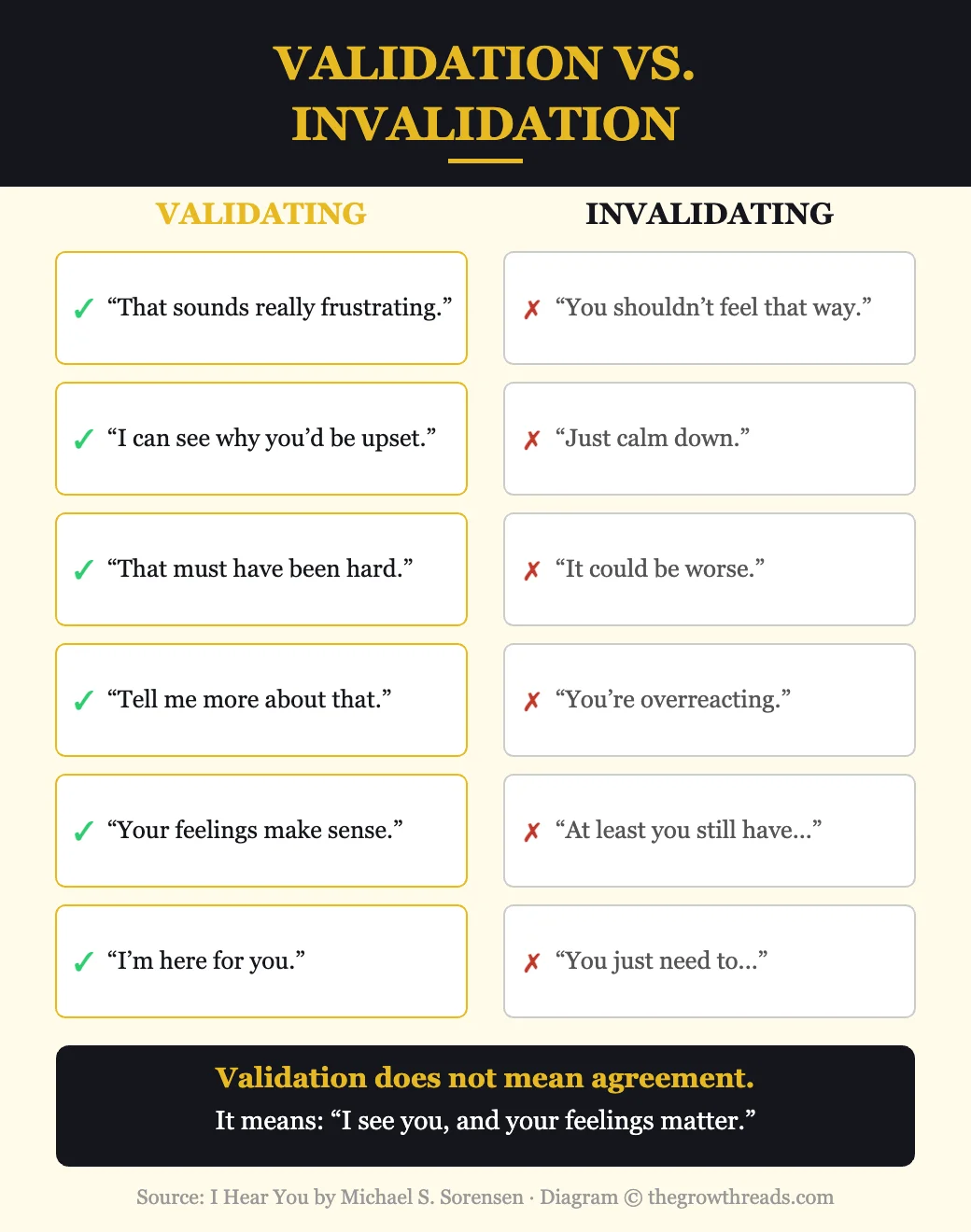
- Most people default to invalidation: Common responses like “just calm down,” “it could be worse,” or “you shouldn’t feel that way” dismiss emotions and damage trust — even when well-intentioned.
- Validation before advice — always: People cannot hear solutions until they feel heard. Offering advice before validating emotions makes the listener feel dismissed, no matter how good the advice is.
- Empathic listening means full presence: Put away your phone, make eye contact, and resist the urge to formulate your response while the other person is speaking.
- The four-step process is learnable: Listen, validate, offer (only if asked), validate again. It sounds mechanical at first, but with practice it becomes natural.
- Self-validation is the foundation: You cannot consistently validate others if you do not validate your own emotions. Acknowledging your own feelings without judgment is step zero.
- Validation works in every relationship type: The same principles apply to romantic partners, friends, parents, children, colleagues, and even strangers.
- Micro-validations add up: Small moments of acknowledgment (“that makes sense” or “I’d feel the same way”) build emotional trust over time far more than grand gestures.
- Feedback is easier after validation: If you need to deliver difficult feedback, validating first creates psychological safety that makes the other person far more receptive.
- The skill compounds: As you practise validation, people open up more, conflicts de-escalate faster, and your relationships deepen across every area of life.
What is I Hear You about?
I Hear You is a practical guide to emotional validation — the skill of recognising, understanding, and affirming another person’s emotional experience. Sorensen presents a simple four-step framework that helps readers become better listeners, reduce conflict, and build deeper connections in romantic, family, professional, and social relationships.
About the author
Michael S. Sorensen is a writer and communication coach based in the United States. He became interested in validation after noticing that his own relationships improved dramatically once he learned to stop offering unsolicited advice and start acknowledging emotions instead. Frustrated by the lack of accessible, practical books on the topic, he wrote I Hear You to fill the gap. The book, originally self-published in 2017, found a massive audience through word of mouth and consistently ranks as one of the highest-rated relationship books on Amazon. Sorensen’s approach is grounded in research from clinical psychology and attachment theory but delivered in plain, jargon-free language. Explore all Michael S. Sorensen book summaries →
Key concepts at a glance
| Concept | What it means | Use it when |
|---|---|---|
| Emotional Validation | Acknowledging and affirming another person’s emotional experience without judgment | Someone shares a feeling with you |
| Invalidation | Dismissing, minimising, or correcting someone’s emotional experience | You catch yourself saying “just calm down” or “it could be worse” |
| The Four Steps | Listen empathically → validate the emotion → offer advice (if asked) → validate again | Any conversation where emotions are present |
| Empathic Listening | Full-presence listening without planning your response or multitasking | Someone needs to be heard, not solved |
| Self-Validation | Accepting your own emotional experiences without judgment before trying to manage them | You feel overwhelmed, anxious, or upset and want to respond skillfully |
| Micro-Validation | Brief acknowledgments (“that makes sense,” “I’d feel the same”) that build trust incrementally | Everyday conversations where full validation feels too formal |
| Feedback Sandwich | Validating before and after delivering constructive criticism to create psychological safety | You need to give difficult feedback at work or at home |
Part 1: Why validation matters — the cost of being unheard
Sorensen opens with a truth that most people recognise but few can articulate: the feeling of being truly heard is one of the most powerful emotional experiences a human can have. And its opposite — the feeling of being dismissed or misunderstood — is one of the most damaging.
He argues that most interpersonal conflict does not stem from genuine disagreement. It stems from one or both people feeling invalidated. When someone shares a frustration, a worry, or an excitement and the listener responds with advice, correction, or minimisation, the speaker does not feel helped — they feel alone. The content of the advice is irrelevant. What matters is that the listener skipped the emotional layer entirely.
Sorensen backs this up with research from clinical psychology and couple therapy, showing that invalidation is one of the strongest predictors of relationship breakdown. John Gottman’s research on marriage, for example, demonstrates that couples who consistently fail to acknowledge each other’s emotions are far more likely to divorce than couples who fight frequently but validate each other in the process.
The good news: validation is a learnable skill. It does not require you to be naturally empathetic or emotionally intuitive. It requires a framework and practice.
Part 2: The four-step validation framework
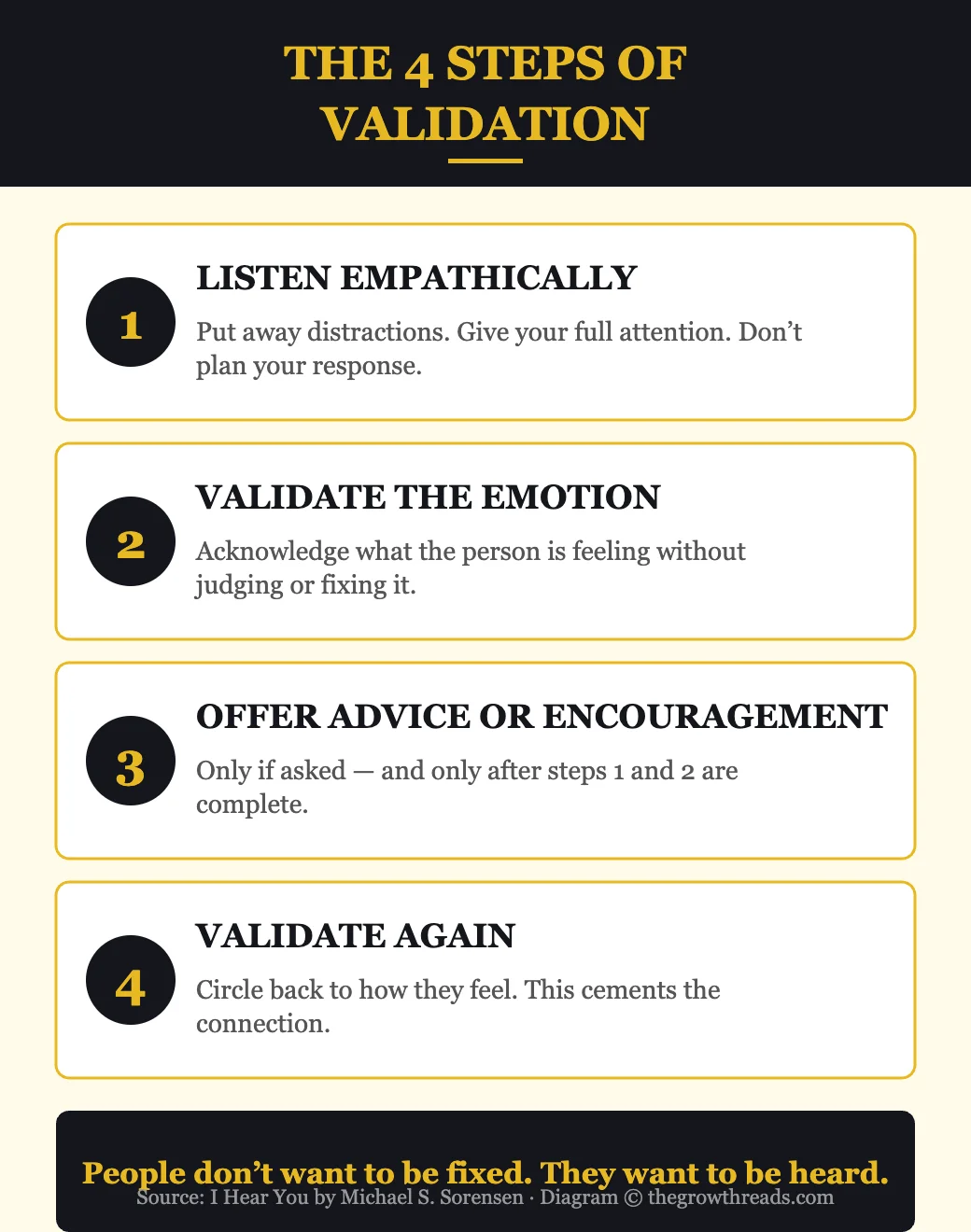
The core of the book is Sorensen’s four-step process, designed to be simple enough to remember in the heat of a conversation.
Step 1: Listen empathically. This means giving your full attention — no phone, no mental multitasking, no planning your response. Sorensen stresses that most people listen to respond rather than to understand. Empathic listening requires you to focus entirely on what the other person is saying and feeling, not on what you are going to say next.
Step 2: Validate the emotion. This is the step most people skip. Before offering any opinion, solution, or perspective, explicitly acknowledge what the person is feeling. Use phrases like “That sounds really frustrating,” “I can see why that upset you,” or “That must have been hard.” The goal is not to agree with their interpretation of events — it is to confirm that their emotional response is understandable and legitimate.
Step 3: Offer advice or encouragement — only if asked. After validation, the person may want advice. Or they may simply want acknowledgment. Sorensen is emphatic: do not offer solutions unless the person explicitly asks for them. If you are unsure, ask: “Do you want me to help you think through this, or do you just need to vent?”
Step 4: Validate again. After any advice or discussion, circle back to the emotional layer. Reaffirm that their feelings make sense, that you are glad they shared, and that you are there for them. This final validation cements the connection and prevents the conversation from ending on a clinical or transactional note.
Part 3: Common mistakes and self-validation
Sorensen devotes a substantial section to the ways people accidentally invalidate others — often with the best intentions. The most common patterns include offering solutions too quickly (“have you tried…”), comparing suffering (“at least you still have…”), correcting emotions (“you shouldn’t feel that way”), and toxic positivity (“just look on the bright side!”). Each of these responses tells the speaker, implicitly, that their feelings are wrong or excessive.
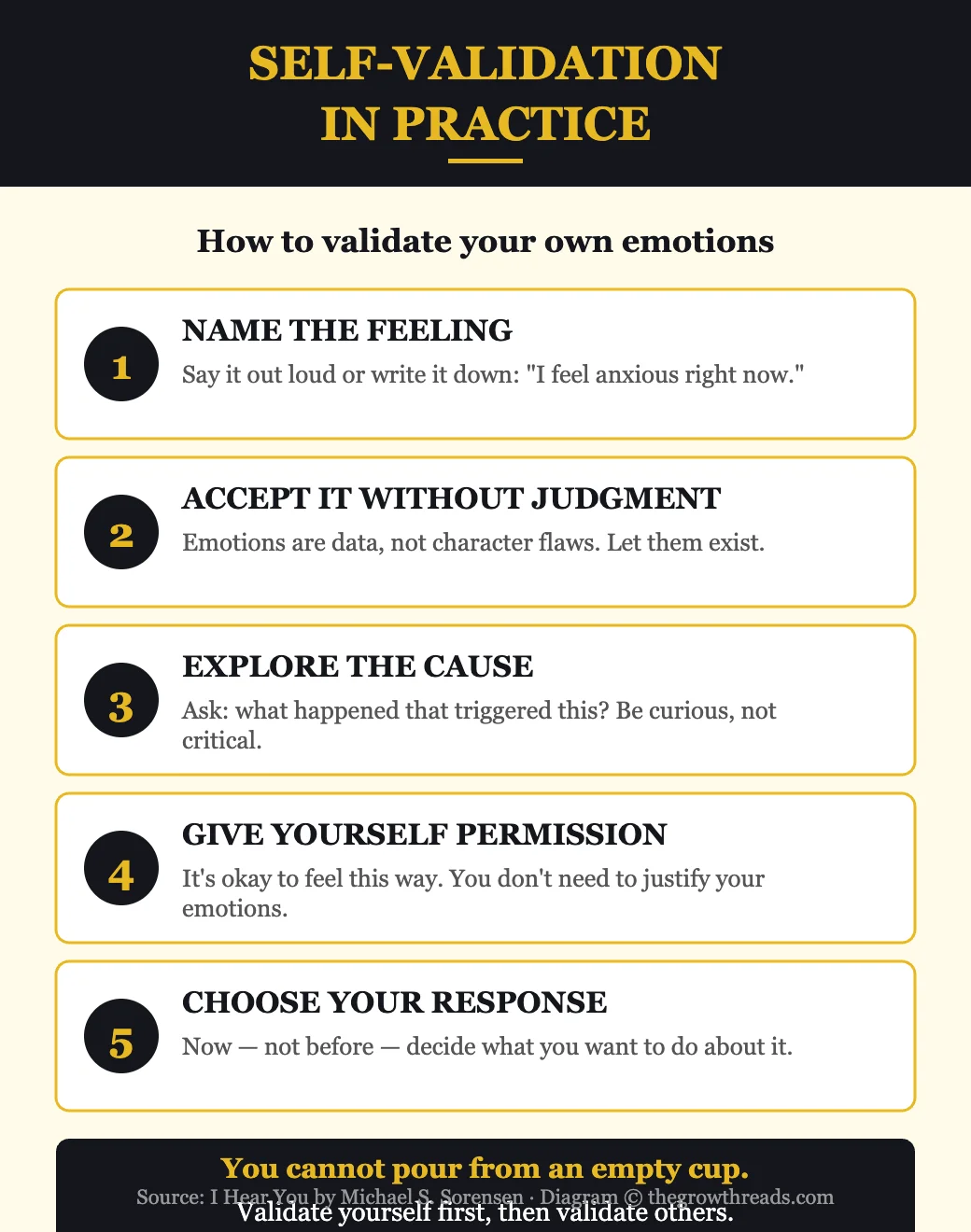
He also introduces the concept of self-validation, arguing that you cannot consistently validate others if you are in the habit of dismissing your own emotions. Self-validation means acknowledging your feelings without judgment — saying “I feel anxious and that is okay” rather than “I shouldn’t be anxious, this is stupid.”
Sorensen provides a five-step self-validation practice: name the feeling, accept it without judgment, explore its cause with curiosity rather than criticism, give yourself permission to feel it, and then — only then — choose how to respond. This sequence prevents the common trap of trying to problem-solve emotions before fully experiencing them.
The book closes with practical scripts for common difficult conversations: validating a partner after a bad day, responding to a child’s frustration, handling a colleague’s complaint, and giving feedback without triggering defensiveness. These scripts make the abstract framework concrete and immediately applicable.
Who is I Hear You best for — and who should read something else first?
This book is ideal for anyone who has been told they are a bad listener, couples who default to arguing about facts when the real issue is feelings, parents who want to connect more deeply with their children, and managers who want to build trust on their teams. It is also an excellent starting point for anyone new to emotional intelligence — the concepts are clear and the book is short enough to finish in a single sitting.
If you want a deeper dive into the research behind validation and attachment, consider The Relationship Cure by John Gottman. If your challenges are more about receiving feedback than giving validation, Thanks for the Feedback is the stronger pick. And if you are specifically looking for help with difficult or high-stakes conversations, Difficult Conversations by Douglas Stone covers that territory more comprehensively.
Questions to reflect on
- When someone close to you shares a problem, is your first instinct to fix it or to acknowledge how they feel?
- Think of the last argument you had — did either person feel unheard? What would have changed if you had validated their feelings before responding?
- How do you respond to your own difficult emotions — do you allow them or immediately try to talk yourself out of them?
- Is there someone in your life who consistently makes you feel heard? What specifically do they do that creates that effect?
- What would change in your closest relationship if you validated before advising for the next 30 days?
🔥 Ready to transform how you listen?
Get the book that turns a two-hour read into a lifetime of better conversations and deeper connections.
How to apply I Hear You (7-day plan)
- Day 1: In your next conversation where someone shares a frustration, resist the urge to offer advice. Instead, say: “That sounds really frustrating.” Notice how the other person responds.
- Day 2: Practise empathic listening with one person today. Put your phone away, make eye contact, and focus entirely on what they are saying without planning your reply.
- Day 3: Catch yourself invalidating. Notice if you say things like “at least…” or “you just need to…” and replace them with “I can see why that would bother you.”
- Day 4: Try the full four-step process in a real conversation: listen, validate, ask if they want advice, then validate again at the end.
- Day 5: Practise self-validation. When you notice a difficult emotion, name it, accept it without judgment, and sit with it for two minutes before deciding what to do.
- Day 6: Ask someone close to you: “Do you want me to help you think through this, or do you just need to vent?” before offering any opinion. Notice the difference it makes.
- Day 7: Reflect on the week. Which conversations felt different? Write down one specific moment where validation changed the dynamic.
Frequently asked questions
What is emotional validation?
Emotional validation is the act of recognising, understanding, and affirming another person’s emotional experience. It does not mean you agree with their perspective or approve of their behaviour. It simply means you acknowledge that their feelings are real, understandable, and legitimate given their experience. Validation sounds like “That makes sense” or “I can see why you feel that way” — it tells the other person they are not crazy for feeling what they feel.
Is I Hear You only about romantic relationships?
Not at all. While many examples involve partners, Sorensen explicitly applies validation to friendships, parent-child relationships, workplace dynamics, and even brief interactions with acquaintances. The four-step framework works in any context where emotions are present — which, in practice, means virtually every meaningful conversation you have.
Does validation mean I can never give advice?
No. Sorensen’s framework includes a step for offering advice — but only after you have validated the person’s emotions and only if they have asked for it. The issue is not advice itself; it is premature advice that skips the emotional acknowledgment. When people feel heard first, they become dramatically more receptive to suggestions and solutions.
How long does it take to read I Hear You?
The book is approximately 134 pages with clear, conversational writing and plenty of examples. Most readers finish it in a single sitting of about two hours. Despite its brevity, the content is dense with practical scripts and frameworks — it is the kind of book where you highlight something on nearly every page.
What is the difference between validation and empathy?
Empathy is feeling or understanding what another person feels. Validation is the act of communicating that understanding back to them. You can feel empathy internally and still fail to validate if you do not express it. Sorensen’s framework focuses on the communication side — making sure the other person knows you understand, not just that you feel for them privately.
What is self-validation and why does it matter?
Self-validation is the practice of acknowledging your own emotions without judgment — saying “I feel anxious and that is okay” rather than “I shouldn’t be anxious.” Sorensen argues that people who habitually dismiss their own feelings tend to dismiss other people’s feelings too. Practising self-validation builds the emotional muscle you need to validate others consistently.
How does I Hear You compare to other communication books?
Compared to Difficult Conversations by Douglas Stone, I Hear You is narrower in scope but more immediately practical — it gives you one skill and drills it deeply. Compared to Nonviolent Communication by Marshall Rosenberg, Sorensen’s approach is less structured and more intuitive. Compared to Supercommunicators by Charles Duhigg, I Hear You is more focused on the emotional layer specifically. Its greatest strength is brevity and actionability — you can read it in a morning and start applying it by afternoon.
Related summaries
- The Seven Principles for Making Marriage Work Summary — Gottman’s research on what makes relationships last
- Thanks for the Feedback Summary — The art of receiving criticism without defensiveness
- Difficult Conversations Summary — Navigating high-stakes talks with clarity and empathy
- 📚 Best Relationship Books — The Full List
Related Relationships Summaries
Big Friendship Summary and Review
Codependent No More Summary & Review: How to Stop Losing Yourself in Others
Love Sense Summary & Review: The Revolutionary Science of Romantic Love
Men Are from Mars, Women Are from Venus Summary & Review: Why You Keep Misunderstanding Each Other
The Four Agreements Summary & Review: A Simple Code for Personal Freedom