

★★★★☆ 4.2 / 5 — A powerful sequel to Extreme Ownership that reveals the hardest truth about leadership: every principle taken to its extreme becomes destructive.
Best for: Leaders and managers who have internalised Extreme Ownership and now need to master the nuances — the when and how much of every leadership decision.
Reading time: ~6 hours (320 pages)
Difficulty to apply: Moderate — the principles are clear but require constant situational judgment; there is no formula, only calibration.
The Dichotomy of Leadership in one minute
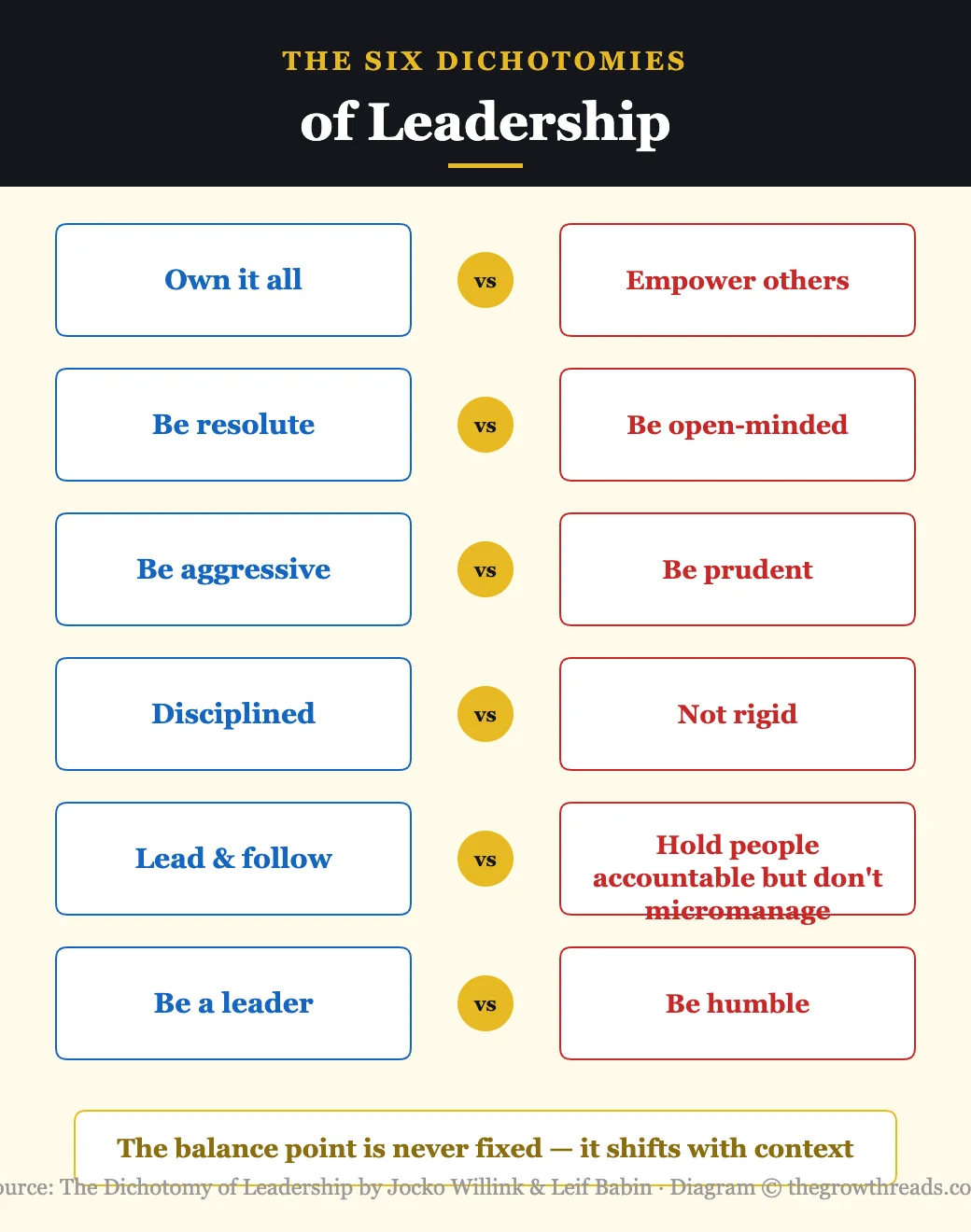
Leadership is not about choosing one side — it is about finding the balance between two opposing forces, every single day. Jocko Willink and Leif Babin wrote Extreme Ownership to argue that leaders must take total responsibility. In The Dichotomy of Leadership, they reveal the necessary sequel: every leadership principle, pushed too far, becomes a liability. A leader who owns everything becomes a micromanager. A leader who empowers everyone becomes absent. A leader who is bold becomes reckless. The book presents six core dichotomies that every leader must navigate — not by picking a side, but by constantly recalibrating the balance based on the mission, the team, and the situation.
Key takeaways
- Every leadership strength has a shadow side: Confidence becomes arrogance. Decisiveness becomes recklessness. Humility becomes passivity. The best leaders recognise when a virtue has tipped into a vice.
- Own everything, but empower others: Take ultimate responsibility for outcomes while giving subordinate leaders the authority and autonomy to execute. This is decentralised command in action.
- Be resolute, but not inflexible: Hold firm on the strategic vision while remaining open to new information that might require tactical adaptation.
- Be aggressive, but not reckless: Default to action, but calculate risk. Aggression without prudence gets people killed; prudence without aggression means missed opportunities.
- Discipline creates freedom: Structure and standards liberate teams by reducing decision fatigue and creating predictability — but discipline taken too far becomes rigidity that prevents adaptation.
- Lead and follow simultaneously: A good leader knows when to step forward and when to step back and let a subordinate leader take charge.
- Hold people accountable without micromanaging: Set clear standards and enforce them, but trust your people to figure out how to meet those standards.
- Be a leader and be humble: Confidence is essential for making tough calls, but humility is essential for learning, adapting, and earning trust.
- Plan, but do not over-plan: Detailed planning prevents chaos, but over-planning creates rigidity. The plan should be simple enough that everyone understands and can adapt it.
- The balance point is never fixed: Context determines where the equilibrium sits. Yesterday’s correct calibration might be wrong today. Leadership is continuous recalibration.
What is The Dichotomy of Leadership about?
The Dichotomy of Leadership is the sequel to Extreme Ownership that explores the paradoxes every leader must balance. Willink and Babin present six core dichotomies — own everything but empower others, be resolute but open-minded, be aggressive but prudent — and show through combat stories and business case studies how finding the balance between opposing forces is the essence of mature leadership.
About the author
Jocko Willink is a retired U.S. Navy SEAL officer who commanded SEAL Team Three’s Task Unit Bruiser during the Battle of Ramadi in 2006 — the most highly decorated special operations unit of the Iraq War. Leif Babin served alongside Willink as a SEAL platoon commander during the same campaign. After leaving the military, they co-founded Echelon Front, a leadership consulting firm that has trained thousands of leaders across Fortune 500 companies, startups, and government agencies. Their first book, Extreme Ownership, became a #1 New York Times bestseller and reshaped how an entire generation of business leaders thinks about accountability. Explore all Jocko Willink book summaries →
Key concepts at a glance
| Concept | What it means | Use it when |
|---|---|---|
| Own It All vs Empower | Take responsibility for everything while empowering subordinates to lead | You are either micromanaging or being too hands-off |
| Resolute vs Open-Minded | Commit to the mission while adapting to new information | Deciding whether to stay the course or pivot |
| Aggressive vs Prudent | Default to action while calculating risk | Evaluating whether boldness or caution serves the mission |
| Disciplined vs Flexible | Maintain standards while allowing room for adaptation | Processes are either too loose or too rigid |
| Lead and Follow | Know when to step forward and when to step back | A subordinate leader needs space to grow |
| Humble and Confident | Strong enough to decide, open enough to learn | Balancing decisiveness with receptiveness to feedback |
| Decentralised Command | Pushing decision-making authority to the frontline | The team is waiting for your approval on every decision |
| Commander’s Intent | Communicating the why so people can adapt the how | Plans need to survive contact with reality |
Part 1: The ultimate dichotomy — own it all, but empower others
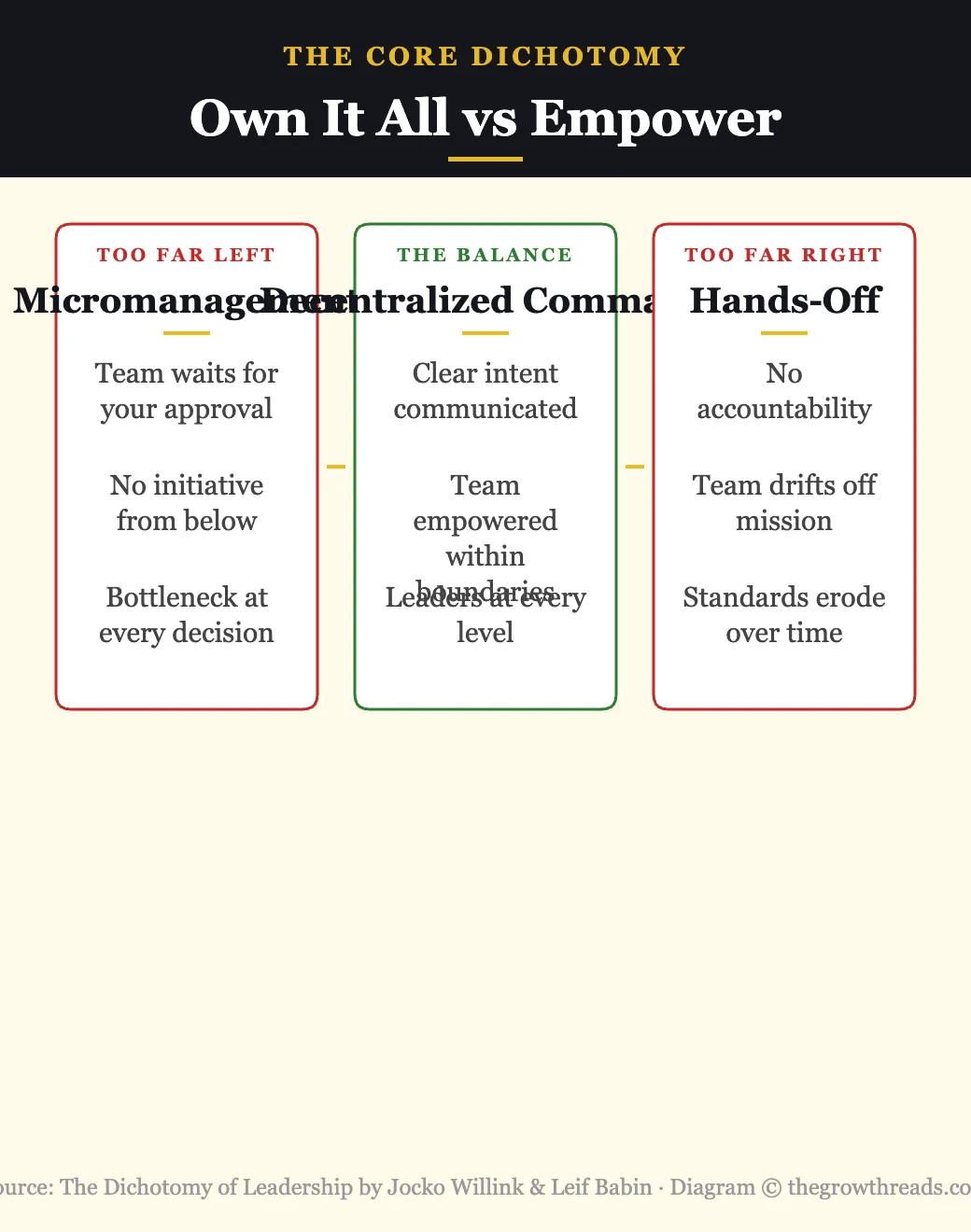
Willink and Babin open with what they call the most fundamental dichotomy of leadership. In Extreme Ownership, they argued that leaders must take total responsibility for everything that happens in their world. But taken to its extreme, total ownership becomes micromanagement — a leader who controls every decision, approves every action, and inserts themselves into every process. The result is a team that cannot function without the leader present, a bottleneck at every decision point, and subordinate leaders who never develop because they are never given the chance to lead.
The counterbalance is decentralised command — pushing decision-making authority down to the lowest capable level. This requires two things: clear commander’s intent (the team must understand not just what to do but why, so they can adapt when conditions change) and trust (built through training, shared experience, and a track record of competence). Willink describes situations in Ramadi where his SEAL operators had to make split-second decisions without consulting him — and how the only way that worked was because they deeply understood the mission’s intent and had been trained to exercise judgment within boundaries.
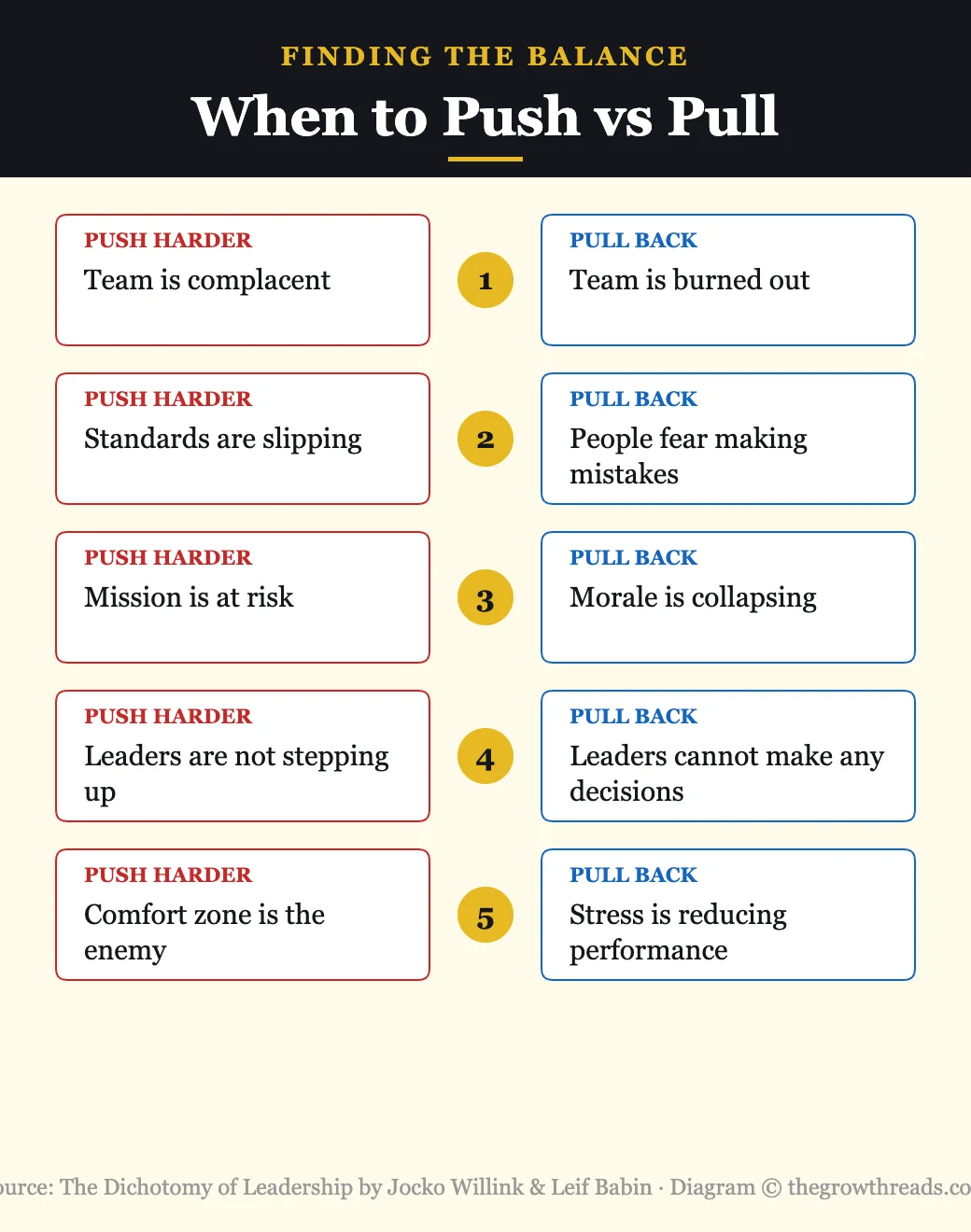
The practical signal that a leader has drifted too far toward ownership: the team waits for permission before acting. The signal they have drifted too far toward empowerment: standards are slipping and no one is being held accountable. The balance point requires constant attention — it is not a setting you configure once.
Part 2: Be resolute, but be open-minded — and be aggressive, but be prudent
The second pair of dichotomies addresses decision-making under uncertainty. A resolute leader who never changes course becomes dogmatic — clinging to a failing plan because admitting error feels like weakness. An open-minded leader who changes course with every new piece of information becomes indecisive — whipsawing the team with constant pivots that destroy momentum and trust. The balance is to hold firm on the strategic objective while adapting tactics as the situation evolves.
Willink describes a mission in Ramadi where the original plan became unworkable due to unexpected enemy positions. Rather than abandoning the mission or stubbornly executing the original plan, the team adapted their route and approach while maintaining the same objective. The lesson: the mission (the why) is non-negotiable; the plan (the how) must be flexible.
The aggression-prudence dichotomy is illustrated through the concept of “default aggressive” — the idea that in ambiguous situations, a bias toward action is usually superior to a bias toward analysis. But aggression without calculation is recklessness. Willink distinguishes between being aggressive (seizing initiative, moving quickly, creating momentum) and being reckless (ignoring risks, failing to plan, rushing without information). The difference is not speed — both move fast. The difference is that the aggressive leader has done enough planning to understand the risks and has decided they are acceptable. The reckless leader has not bothered to ask.
Part 3: Discipline and humility — the leader’s inner dichotomies
The final dichotomies are internal — how a leader manages themselves. Discipline creates freedom, Willink argues (echoing his earlier book by the same title), because structure and standards reduce the number of decisions a team must make, freeing mental energy for the decisions that actually matter. A team with clear SOPs, consistent training rhythms, and enforced standards does not waste energy on chaos — they operate within a reliable framework. But discipline taken too far becomes rigidity: a team so bound by process that it cannot adapt when the situation demands deviation from the plan.
The humility-confidence dichotomy is perhaps the most personally challenging. A leader must be confident enough to make tough calls, stand by unpopular decisions, and project certainty when the team needs direction. But a leader must also be humble enough to admit mistakes, accept feedback, listen to subordinates who see things differently, and continuously learn. Willink admits to moments when his own ego prevented him from seeing a better path — and argues that the willingness to say “I was wrong” is not a sign of weakness but the ultimate expression of ownership.
The practical test: when was the last time you changed your mind based on input from someone below you in the hierarchy? If the answer is “never” or “rarely,” the confidence dial is turned too high. When was the last time you made a decisive call under pressure without excessive deliberation? If that is rare too, the humility dial may have tipped into indecisiveness.
Who is The Dichotomy of Leadership best for — and who should read something else first?
This book is best for leaders who have already internalised the principles of Extreme Ownership and are ready for the advanced course. It is especially valuable for experienced managers who sense that something in their leadership approach is out of balance but cannot quite diagnose what. If you are a new leader, read Extreme Ownership first — the dichotomies make far more sense once you understand the foundations.
If you want a framework for building team trust specifically, start with The Five Dysfunctions of a Team. If you want the research behind what makes leaders effective at scale, Good to Great provides the complementary data-driven perspective.
Questions to reflect on
- Which of the six dichotomies is most out of balance in your leadership right now — and which direction are you leaning too far?
- When was the last time you changed your mind based on feedback from someone below you in the hierarchy?
- Is your team waiting for your permission before acting? Or are standards slipping because you are too hands-off?
- Do you default to aggression or caution? What has that cost you recently?
- Where in your leadership has discipline become rigidity — processes that once served the mission but now slow it down?
🔥 Ready to master the paradoxes that define great leadership?
The essential sequel to Extreme Ownership — because every strength, pushed too far, becomes a weakness.
How to apply The Dichotomy of Leadership (7-day plan)
- Day 1 — Self-assess the six dichotomies. Rate yourself on each of the six balances. Where are you leaning too far in one direction? Ask a trusted colleague for their honest assessment.
- Day 2 — Check your ownership level. Review your current projects. Where are you the bottleneck? Identify one decision you can delegate to a subordinate leader today with clear commander’s intent.
- Day 3 — Test your flexibility. Revisit one plan or process that has not been questioned in a while. Ask: is this still serving the mission, or has it become rigid habit?
- Day 4 — Default aggressive. Identify one decision you have been putting off. Gather the essential information (not all information), assess the risk, and make the call today.
- Day 5 — Practice humility. In your next meeting, ask your team: “What am I not seeing?” Listen without defending. Change one thing based on what you hear.
- Day 6 — Calibrate accountability. Review how you are holding your team accountable. Are you micromanaging or too hands-off? Adjust: set the standard clearly, then step back and let them execute.
- Day 7 — Brief and debrief. At the end of the week, run a personal after-action review: what went well, what did not, and what will you adjust next week? This is the continuous recalibration loop.
Frequently asked questions
What is The Dichotomy of Leadership about?
The Dichotomy of Leadership explores the paradoxes every leader must navigate. It argues that every leadership principle — ownership, aggression, discipline, confidence — has an opposing force that is equally important, and that taking any principle to its extreme creates dysfunction. The book presents six core dichotomies and teaches leaders how to find the constantly shifting balance point between them using examples from Navy SEAL combat operations and Fortune 500 business consulting.
Do I need to read Extreme Ownership first?
It is strongly recommended. The Dichotomy of Leadership is explicitly positioned as the sequel and advanced course to Extreme Ownership. The dichotomies make much more sense once you understand the foundational principles they are balancing. Extreme Ownership establishes that leaders must take total responsibility; Dichotomy explains why and how that responsibility must be calibrated. Reading Dichotomy first would be like taking an advanced course without the prerequisite.
What are the six dichotomies?
The six dichotomies are: (1) Own it all vs. empower others, (2) Be resolute vs. be open-minded, (3) Be aggressive vs. be prudent, (4) Disciplined vs. not rigid, (5) Lead and follow, and (6) Be a leader but be humble. Each represents a tension between two opposing forces that must be balanced rather than resolved. The authors argue that the balance point is never fixed — it shifts constantly based on the mission, the team, and the situation.
What is decentralised command?
Decentralised command is the practice of pushing decision-making authority down to the lowest capable level in an organisation. It requires two prerequisites: clear commander’s intent (every team member understands the mission’s purpose well enough to adapt when plans change) and trust (built through training, shared experience, and demonstrated competence). When decentralised command works, teams can operate effectively without waiting for top-down instructions. When it fails, it is usually because intent was unclear or trust had not been established.
How is this book different from other leadership books?
Most leadership books present principles as absolutes: be decisive, be bold, be humble, take ownership. The Dichotomy of Leadership is unusual because it argues that every one of these principles, taken too far, becomes destructive — and that mature leadership requires holding opposing principles in tension simultaneously. The combat-to-business format also gives it a visceral immediacy: the consequences of getting the balance wrong in Ramadi were life and death, which makes the business applications feel more urgent and less theoretical.
How long does it take to read The Dichotomy of Leadership?
The Dichotomy of Leadership is 320 pages and takes approximately 6 hours to read. The book alternates between combat stories from Ramadi and business case studies from the authors’ consulting work, which keeps the pace engaging. The audiobook runs about 8 hours and is narrated by Willink and Babin themselves, which adds authenticity to the combat narratives. Most readers finish in 2–3 sittings.
What is the most important dichotomy?
Willink and Babin identify “own it all but empower others” as the ultimate dichotomy — the tension between total responsibility and decentralised command. A leader who owns everything but never empowers anyone becomes a bottleneck. A leader who empowers everyone but takes no ownership allows standards to erode. The balance between these two forces is the fundamental challenge of leadership at every level, and all the other dichotomies flow from it.
Related summaries
- Extreme Ownership by Jocko Willink & Leif Babin — The foundational book that The Dichotomy of Leadership builds upon.
- Good to Great by Jim Collins — Data-driven research on what separates great companies from merely good ones.
- Multipliers by Liz Wiseman — How the best leaders amplify the intelligence of everyone around them.
- The Five Dysfunctions of a Team by Patrick Lencioni — A framework for building team trust and productive conflict.
📚 See all leadership book summaries
Related Leadership Summaries
It’s Your Ship Summary & Review: Build a Crew That Owns the Outcome
Multipliers Summary & Review: How the Best Leaders Make Everyone Smarter
Primal Leadership Summary & Review: Lead With Emotional Intelligence
The 5 Levels of Leadership Summary & Review: Build Real Influence, Not Just Authority
Turn the Ship Around Summary & Review: How to Build Teams That Think for Themselves