

★★★★☆ 4.5 / 5
One-liner: A behavioural scientist’s playbook for overcoming the psychological traps that keep smart, successful people single.
Best for: Anyone who is single and wants to be in a relationship — especially overthinkers, perfectionists, and people who keep repeating the same dating patterns.
Reading time: ~5 hours (320 pages)
Difficulty to apply: Medium — the insights are immediately useful, but changing deep dating patterns takes sustained self-awareness.
How to Not Die Alone in one minute
Finding love is not about luck — it is about making better decisions. Logan Ury, a behavioural scientist and director of relationship science at Hinge, argues that most single people are not unlucky in love — they are making predictable, systematic errors rooted in cognitive biases. She identifies three dating tendencies — the Romanticizer, the Maximizer, and the Hesitator — that explain why smart people stay single, and provides a research-backed framework for overcoming them. Her central insight: stop waiting for “the spark” and start choosing partners who are genuinely compatible with your values, because long-term relationship success is predicted by slow-burn connection, not instant chemistry.
Key takeaways
- You have a dating tendency: Most people fall into one of three categories — Romanticizer (overvalues chemistry), Maximizer (always wonders if someone better exists), or Hesitator (waits until they are “ready”) — and each one sabotages love differently.
- The spark is overrated: Initial chemistry often correlates with anxiety, not compatibility. Research shows that “slow burn” relationships — where attraction grows over time — are more likely to succeed long-term.
- Stop waiting to be ready: Hesitators use self-improvement as a shield against vulnerability. You will never feel fully ready; the readiness comes from engaging, not from preparing.
- Ditch your checklist: Long lists of must-haves (height, job title, college) filter out great partners. Focus on values and character traits — kindness, emotional intelligence, growth mindset — instead.
- Decide, don’t slide: The biggest relationship mistakes happen when people drift into commitments (moving in, getting engaged) without making conscious choices. Intentionality is everything.
- Give second dates a chance: First-date impressions are unreliable. Ury recommends going on at least three dates before deciding, unless there are clear dealbreakers.
- Your attachment style shapes everything: Understanding whether you are anxious, avoidant, or secure transforms how you interpret your own reactions and choose better partners.
- Love is a verb, not a feeling: Long-term relationships thrive on daily choices — gratitude, repair, attention — not on sustained romantic intensity.
- The “good enough” partner is not settling: Satisficing (choosing someone who meets your core criteria) leads to more happiness than maximising (endlessly searching for the “best”). This is decision science, not romantic pessimism.
- Your dating life is a funnel, not a lottery: Treat finding love as a skill you can improve — with better strategy, self-awareness, and decision-making — not as random chance.
What is How to Not Die Alone about?
How to Not Die Alone applies behavioural science and decision-making research to modern dating. Logan Ury identifies three psychological tendencies that keep people single, debunks the myth of “the spark,” and provides a practical framework for making better romantic decisions — from choosing who to date to deciding when to commit.
About the author
Logan Ury is a behavioural scientist, dating coach, and the director of relationship science at Hinge, the dating app designed to be deleted. She studied behavioural economics at Harvard under Dan Ariely, one of the world’s leading researchers on irrational decision-making. Before joining Hinge, she worked at Google’s behavioural economics team (the “Irrational Lab”), applying decision science to product design. Her unique combination of academic research, real-world coaching (she has worked with hundreds of clients), and dating app data gives her an unusually comprehensive view of modern romance. Explore all Logan Ury book summaries →
Key concepts at a glance
| Concept | What it means | Use it when |
|---|---|---|
| Dating tendencies | Three patterns (Romanticizer, Maximizer, Hesitator) that sabotage love | You keep ending up single despite wanting a relationship |
| The spark | Instant chemistry that often predicts passion but not compatibility | You dismiss people after one date for “no spark” |
| Slow burn | Attraction that develops over time through real connection | You want a partner for life, not just an exciting first month |
| Decide, don’t slide | Make conscious relationship choices instead of drifting | You are about to move in together, get engaged, or break up |
| The partner list | Values-based criteria vs. a specifications checklist | You are defining what you actually need in a partner |
| Satisficing vs. maximizing | Choosing “good enough” vs. endlessly searching for “the best” | You wonder whether to commit or keep looking |
| Attachment style | Anxious, avoidant, or secure patterns in relationships | You want to understand your own reactions to intimacy |
Part 1 — Why you are still single (and it is not what you think)
Ury opens by demolishing the most common explanation single people give for their status: “I just have not met the right person.” Drawing on her work as a dating coach and her research at Hinge, she argues that most chronically single people are not unlucky — they are making systematic decision-making errors that they repeat on every date, with every app, in every relationship.
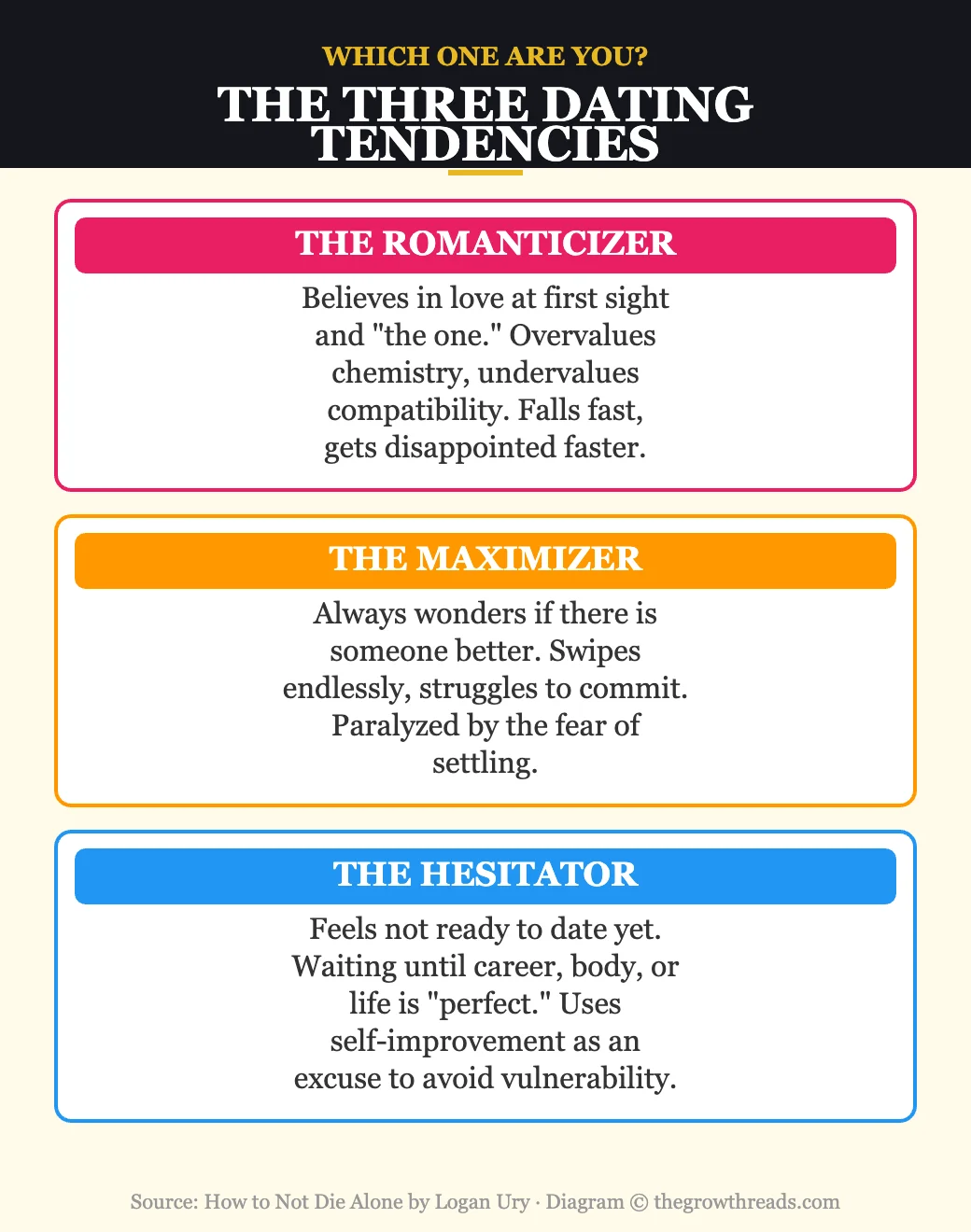
She introduces the three dating tendencies. The Romanticizer believes in love at first sight, soulmates, and the idea that “when you know, you know.” They over-index on chemistry and excitement, dismiss perfectly good partners for lacking “the spark,” and tend to fall hard and fast only to be disappointed when the intensity fades. The Maximizer treats dating like an optimisation problem — always swiping, always wondering if the next person might be better, unable to commit because commitment means giving up optionality. The Hesitator avoids dating entirely by telling themselves they are not ready — they need to lose weight first, get the promotion first, sort out their life first. The self-improvement never ends because its real purpose is to avoid the vulnerability of putting yourself out there.
Ury is clear that most people have a primary tendency with shades of the others, and that all three are driven by the same underlying fear: making the wrong choice. The irony is that by trying to avoid the wrong choice, all three tendencies prevent you from making any choice at all.
Part 2 — Why “the spark” is leading you astray
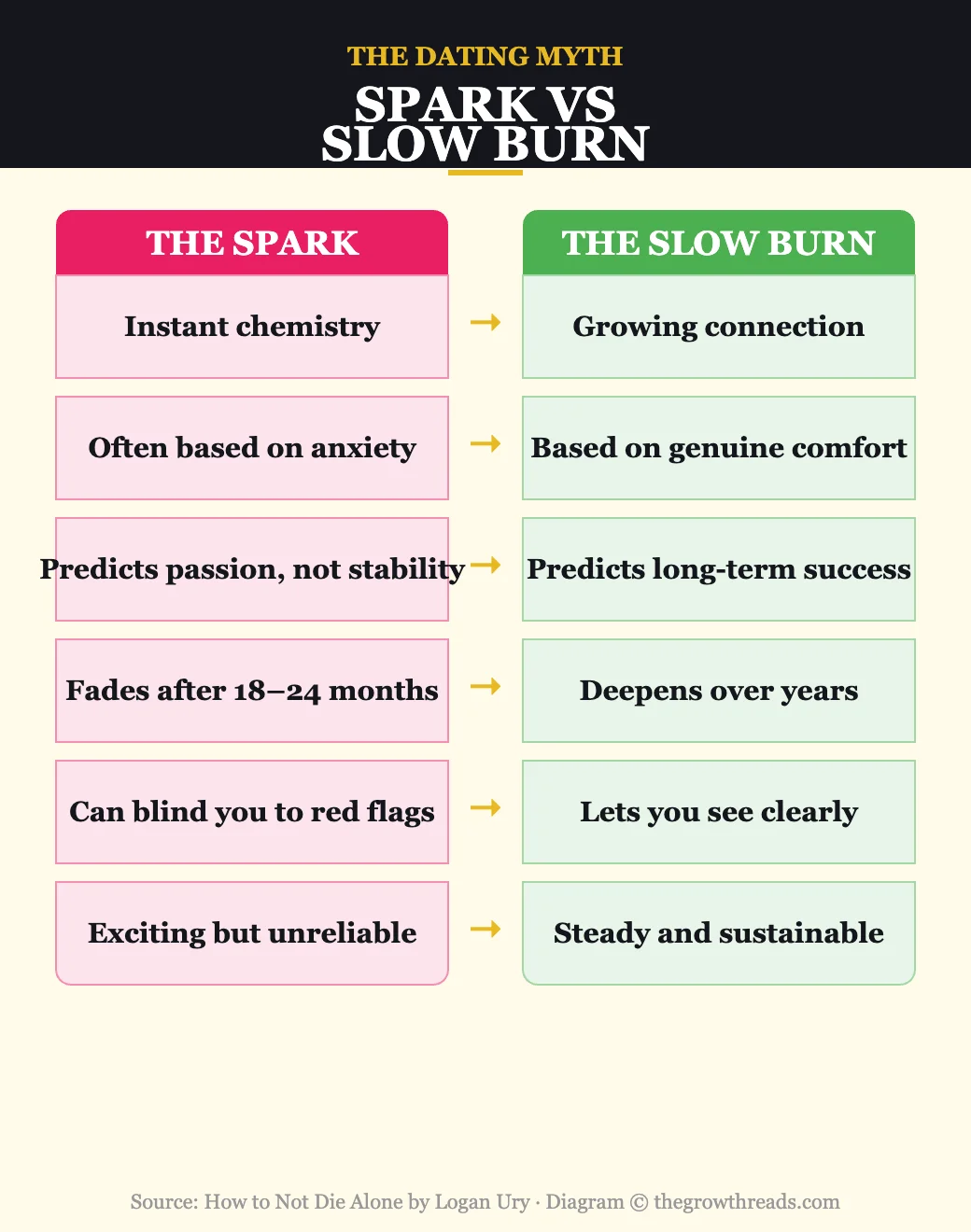
The most provocative chapter in the book challenges the cultural obsession with instant chemistry. Ury cites research showing that the feeling people call “the spark” on a first date often correlates not with genuine compatibility but with anxiety — specifically, the activation of the attachment system. People with anxious attachment styles feel the strongest “sparks” with avoidant partners, because the push-pull dynamic triggers neurochemical arousal that gets mislabelled as attraction.
Conversely, meeting someone who is genuinely secure and compatible often feels… calm. Unremarkable. Even boring. And because we have been culturally programmed to equate love with intensity, we dismiss these people. Ury calls this the “spark bias” — the systematic tendency to over-weight initial excitement and under-weight the qualities that actually predict relationship success: emotional stability, kindness, reliability, and shared values.
She advocates instead for the “slow burn” — giving people time to grow on you. Attraction, she argues, is not fixed at first sight. It develops as you discover someone’s sense of humour, watch them handle stress, see how they treat a waiter. The partners who make the best long-term matches are often the ones who did not light up the room on date one but who revealed their depth over dates two, three, and four.
Part 3 — How to date intentionally and decide well
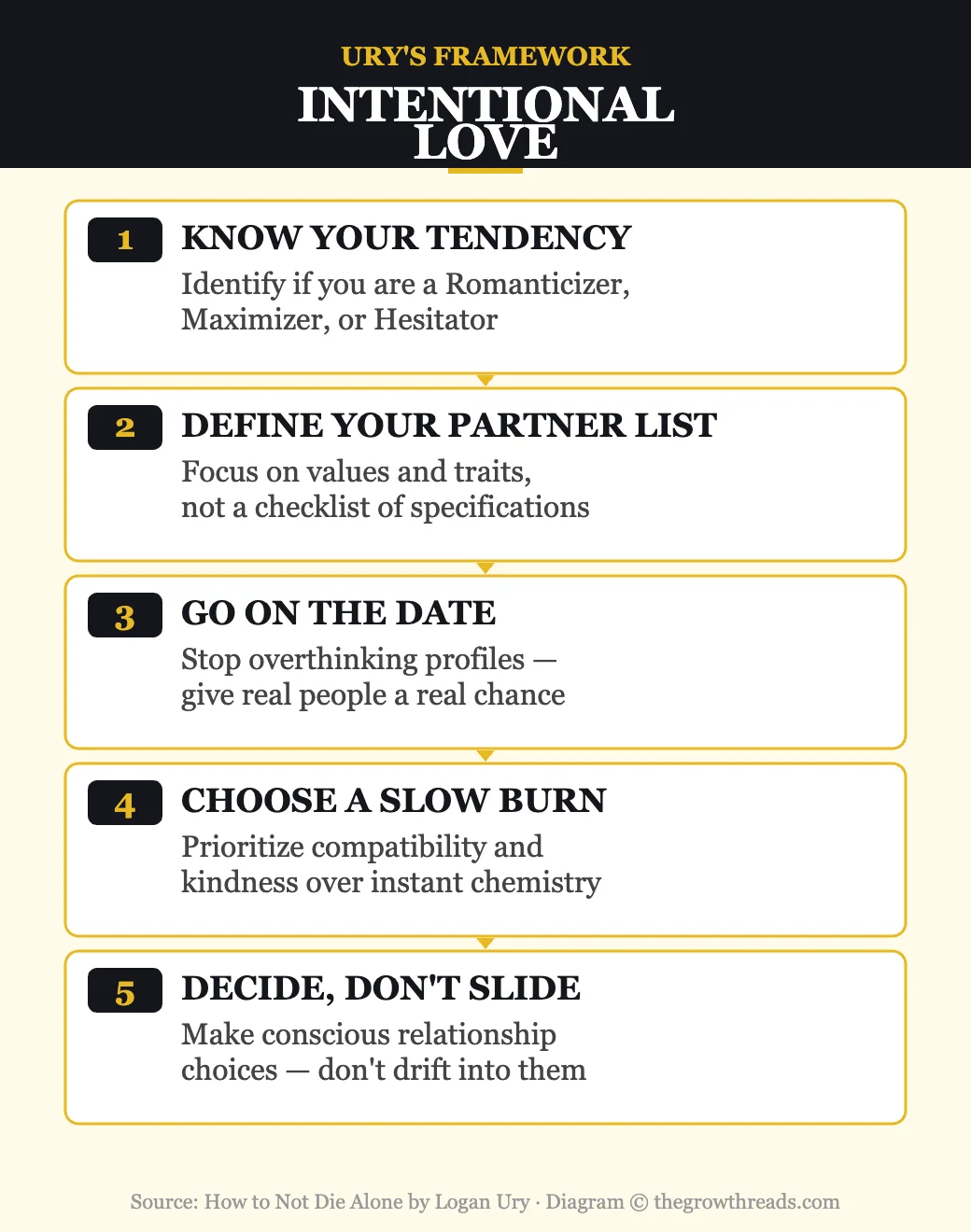
The final section provides Ury’s practical framework for better romantic decision-making. It starts with the partner list — but not the kind most people write. Instead of a specifications checklist (tall, Ivy League, good with dogs), Ury asks readers to define the values and qualities that matter for long-term compatibility: How do they handle conflict? Are they emotionally available? Do they have a growth mindset? Are they kind to people who can do nothing for them?
She then introduces the “decide, don’t slide” principle — a concept from relationship researcher Scott Stanley. Most people do not consciously choose their major relationship milestones. They slide into exclusivity because it is easier than having the conversation, slide into living together because the lease was up, slide into engagement because it has been long enough. Ury argues that every transition should be a deliberate decision made with open eyes.
The book closes with advice for people already in relationships: practise gratitude rituals, fight well (repair quickly, avoid contempt), and remember that love is maintained through daily choices, not through sustained passion. She cites John Gottman’s research showing that stable couples have a 5:1 ratio of positive to negative interactions, and that the ability to repair after conflict is more important than the absence of conflict.
Who is How to Not Die Alone best for — and who should read something else first?
This book is ideal for single people who want to be in a relationship but keep repeating the same patterns, overthinkers who analyse their dating life to death, people recovering from a breakup who want to approach the next relationship differently, and anyone who suspects that their approach to finding love might be the problem.
If you are already in a committed relationship and want to strengthen it, start with The Seven Principles for Making Marriage Work by John Gottman. If you want to understand attachment theory in depth before dating again, Attached by Amir Levine is the foundational text.
Questions to reflect on
- Which dating tendency — Romanticizer, Maximizer, or Hesitator — describes you most? How has it played out in your last three dating experiences?
- Have you ever dismissed a genuinely good person because you did not feel “the spark” — and looking back, was that the right call?
- What is on your current partner checklist that is actually a specification (height, career) rather than a value (kindness, emotional availability)?
- Think of a major relationship milestone you “slid into” rather than consciously decided — what would you do differently knowing the decide-don’t-slide principle?
- If you are a Hesitator: what specific milestone are you waiting to reach before dating — and is that milestone genuinely necessary, or is it a shield?
🔥 Ready to find love on purpose?
Get the behavioural science playbook for making better romantic decisions.
How to apply How to Not Die Alone (7-day plan)
- Day 1 — Identify your tendency: Take Ury’s quiz (available on her website) or self-assess: are you a Romanticizer, Maximizer, or Hesitator? Write down three specific ways this tendency has shown up in your dating life.
- Day 2 — Rewrite your partner list: Replace your specifications checklist with a values-based list of 5–7 qualities that predict long-term compatibility: emotional availability, kindness, growth mindset, communication style, shared life vision.
- Day 3 — Give a second date: Think of someone you recently dismissed after one date (or one profile). If there were no dealbreakers, reach out for a second chance. Practice the slow-burn mindset.
- Day 4 — Examine your spark bias: Recall the three people you felt the strongest “sparks” with. How did those relationships end? Now recall the steadiest, most reliable person you have dated. What made that different?
- Day 5 — Address your tendency: If Romanticizer: go on a date with someone who seems kind but does not make your heart race. If Maximizer: delete one dating app and commit to one platform. If Hesitator: send three messages today without waiting to feel ready.
- Day 6 — Practice deciding, not sliding: Review one area of your current dating life (or relationship) where you are “sliding.” Make a conscious decision about what you actually want and communicate it.
- Day 7 — Set a relationship intention: Write a one-paragraph statement of what you want your love life to look like in one year and the specific actions you will take to get there. Put it somewhere visible.
Frequently asked questions
What are the three dating tendencies in How to Not Die Alone?
The three tendencies are the Romanticizer (believes in love at first sight and “the one,” overvalues chemistry, gets disappointed when intensity fades), the Maximizer (always wonders if someone better exists, treats dating like an optimisation problem, struggles to commit), and the Hesitator (feels not ready to date, uses self-improvement as a shield against vulnerability, waits for conditions to be perfect). Most people have a primary tendency that explains their recurring dating patterns.
Why does Logan Ury say “the spark” is overrated?
Ury cites research showing that the feeling of instant chemistry often correlates with anxiety activation rather than genuine compatibility. People with anxious attachment styles feel the strongest “sparks” with avoidant partners, creating intense but unstable relationships. Meanwhile, meeting a genuinely secure, compatible person often feels calm or even underwhelming. The spark predicts passion but not relationship stability — and it typically fades after 18–24 months regardless, leaving compatibility as the only foundation.
What does “decide, don’t slide” mean?
This principle, drawn from relationship researcher Scott Stanley, means making conscious, deliberate choices at every relationship milestone rather than drifting into them by default. Most people slide into exclusivity (it just happened), living together (the lease was up), and even marriage (it seemed like the next step). Ury argues that each transition should involve an explicit conversation and a conscious decision made with clear eyes, because sliding creates relationships built on inertia rather than intention.
Is this book only for people using dating apps?
No. While Ury draws on data from Hinge and discusses app-specific strategies, the core framework — understanding your dating tendency, overcoming the spark bias, making intentional decisions — applies regardless of how you meet people. The behavioural science insights are about human psychology, not technology. The book is equally useful for people who meet partners through friends, work, hobbies, or any other context.
Is choosing a “good enough” partner the same as settling?
Ury explicitly addresses this concern. She draws on Herbert Simon’s concept of “satisficing” — choosing the option that meets your core criteria rather than exhaustively searching for the theoretically optimal one. Decision science consistently shows that satisficers are happier than maximizers in every domain, including relationships. Choosing a partner who is kind, emotionally available, and shares your values is not settling — it is making a wise decision. “Settling” would be staying with someone who does not meet your genuine needs; satisficing means recognising that no partner will score 10/10 on every dimension.
How does attachment style affect dating according to this book?
Ury integrates attachment theory throughout the book, showing that your attachment style (anxious, avoidant, or secure) shapes who you are attracted to and how you behave in relationships. Anxious daters feel the strongest “sparks” with avoidant partners — creating an addictive push-pull dynamic that feels like love but produces instability. Secure partners may feel less exciting initially but provide the stable foundation for lasting love. Understanding your style helps you recognise unhealthy patterns and make more conscious partner choices.
Does this book work for people who have never been in a relationship?
Yes — in some ways it is especially useful for people starting from scratch, because they have not yet developed ingrained patterns. Ury’s framework provides a clear structure: identify your tendency, define what actually matters in a partner (values, not specifications), overcome the barriers keeping you from putting yourself out there, and make intentional decisions as the relationship progresses. The book normalises the fact that finding love is a skill that can be learned, not an innate talent you either have or lack.
Related summaries
- Attached by Amir Levine — The foundational text on attachment styles in adult relationships.
- The Seven Principles for Making Marriage Work by John Gottman — The research-backed guide to sustaining the relationship once you have found it.
- The Paradox of Choice by Barry Schwartz — The decision science behind why maximizers struggle in dating and every other domain.
- Mating in Captivity by Esther Perel — The companion for navigating desire and intimacy within committed relationships.
📚 Explore more: Best Relationship Books
Related Relationships Summaries
Crucial Conversations Summary & Review: Master High-Stakes Dialogue
Eight Dates Summary & Review: The Research-Backed Conversations That Transform Relationships
Getting to Yes Summary & Review: Negotiate Agreement Without Giving In
Men Are from Mars, Women Are from Venus Summary & Review: Why You Keep Misunderstanding Each Other
Thanks for the Feedback Summary & Review: Master the Art of Receiving