

⭐⭐⭐⭐
4.4 / 5 — A brilliantly practical playbook for solving big problems and testing ideas in just five days.
Best for: Product teams, startup founders, designers, and anyone who needs to move from idea to validated prototype without months of planning.
Reading time: ~5 hours (288 pages)
Difficulty to apply: Medium — the method is step-by-step, but it requires blocking a full week and getting the right people in the room.
Sprint in one minute
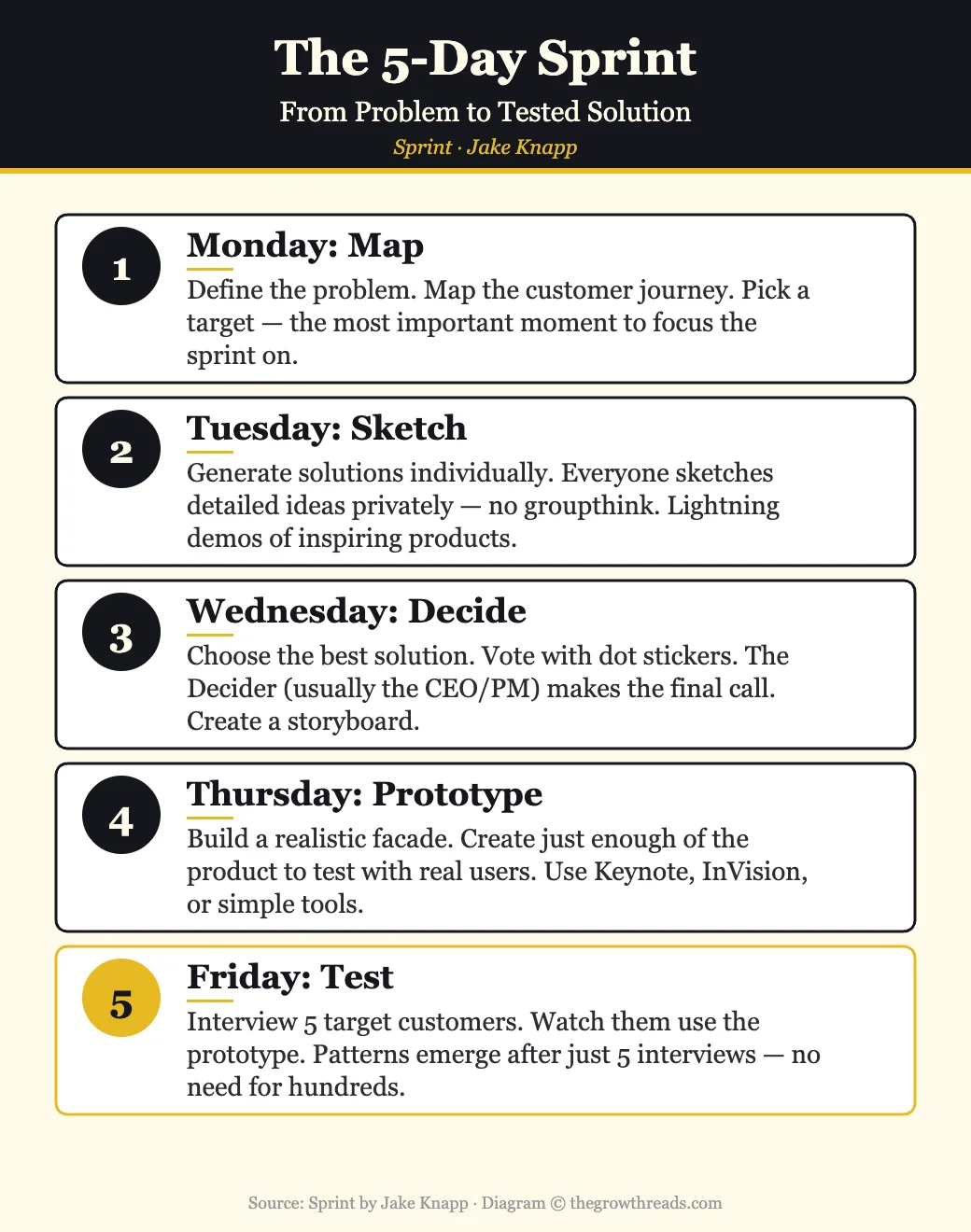
You can test almost any idea in just five days — and the answer you get will be more reliable than months of debate. Jake Knapp developed the design sprint at Google Ventures after watching hundreds of startups struggle with the same problem: they spent months building products nobody wanted. The sprint compresses months of work into one week: Monday you map the problem, Tuesday you sketch solutions, Wednesday you decide, Thursday you prototype, and Friday you test with real customers. The method has been used over 150 times at GV-backed startups, and at companies from Slack to the New York Times to LEGO. Five interviews on Friday reveal patterns that thousands of survey responses never would.
Key takeaways
- Five days replaces months of debate: Instead of arguing about ideas in meetings, build a realistic prototype and test it with real customers. You’ll learn more in one Friday than in three months of planning.
- Start with the end in mind: Monday’s mapping exercise defines the long-term goal and sprint questions — what you need to learn by Friday. Everything flows backward from the test.
- Sketch alone, decide together: Individual sketching (Tuesday) produces better ideas than group brainstorming. The Crazy 8s exercise generates eight distinct solutions in eight minutes, preventing groupthink.
- The Decider breaks ties: Every sprint needs one person with authority to make the final call on Wednesday. Democracy produces compromise; a clear Decider produces bold choices.
- Prototype anything in one day: You can fake almost any product experience with Keynote, a website builder, or even paper. The prototype doesn’t need to work — it needs to look real enough to generate honest reactions.
- Five interviews is enough: Jakob Nielsen’s research shows that five user tests reveal 85% of usability problems. More interviews produce diminishing returns. Patterns become obvious after the third or fourth session.
- No devices in the sprint room: Phones, laptops, and tablets kill sprint energy. The only exception is the facilitator’s timer. Real thinking requires sustained attention.
- Time pressure is a feature, not a bug: The tight deadline forces decisions and prevents perfectionism. Constraints breed creativity. A week is enough time to be thoughtful but not enough time to overthink.
What is Sprint about?
Sprint presents a five-day process for answering critical business questions through design, prototyping, and testing with real customers. Developed by Jake Knapp at Google Ventures, the method provides a step-by-step playbook for teams to go from a big challenge to a tested solution in one week, eliminating months of debate, failed launches, and wasted development time.
About the author
Jake Knapp is a designer and bestselling author who created the design sprint process while working at Google, where he spent over ten years. He later brought the method to Google Ventures (now GV), running sprints with startups including Slack, Nest, 23andMe, and Blue Bottle Coffee. Before Google, Knapp worked on products at Microsoft. He co-authored Sprint with John Zeratsky and Braden Kowitz, both former GV design partners. Knapp also wrote Make Time, a guide to daily productivity. He has run over 150 design sprints and trained teams at organizations from LEGO to the United Nations. Explore all Jake Knapp book summaries →
Key concepts at a glance
| Concept | What it means | Use it when |
|---|---|---|
| Design Sprint | 5-day process: Map → Sketch → Decide → Prototype → Test | Launching a new product, feature, or service |
| Sprint Questions | The specific unknowns you need to answer by Friday | Starting any sprint to define what success looks like |
| Map | End-to-end customer journey with key moments identified | Aligning the team on the problem before jumping to solutions |
| Crazy 8s | 8 sketches in 8 minutes to generate diverse solutions | You need creative ideas without groupthink |
| The Decider | One person with authority to make the final call | The team is stuck debating between options |
| Storyboard | Step-by-step blueprint for Thursday’s prototype | Translating the chosen idea into a buildable plan |
| Goldilocks Prototype | Realistic enough to test, rough enough to build in a day | You need to test an idea without building the real product |
| Five-Act Interview | Structured customer interview with prototype walkthrough | Friday testing to generate actionable feedback |
Part 1: Monday — Map the problem
The sprint begins with the end in mind. Monday morning, the team defines a long-term goal — where they want to be in six months, a year, or five years. Then they list sprint questions: the assumptions and risks that could derail the whole effort. These questions become the tests for Friday. The team also creates a customer journey map — a simple diagram showing how customers move through the experience from discovery to key action.
The afternoon features “Ask the Experts” — short interviews with team members and external stakeholders who have relevant knowledge. The marketing lead knows why customers churn. The support manager knows what people complain about. The CEO knows the strategic constraints. Each expert presents for 15–20 minutes while the team captures “How Might We” notes on sticky notes. These notes are clustered, voted on, and placed on the map, identifying the most promising area to focus the sprint.
Monday ends with the most important decision of the week: choosing the target. The Decider selects one customer and one moment in the journey to focus on. This constraint is essential — sprints fail when teams try to solve everything at once. One target, one customer, one moment. The entire rest of the week flows from this choice.
Part 2: Tuesday and Wednesday — Sketch and decide
Tuesday is about generating solutions, and Knapp’s approach deliberately avoids traditional brainstorming. Research consistently shows that group brainstorming produces fewer and lower-quality ideas than individuals working alone. Instead, the sprint uses “Lightning Demos” — each team member presents inspiring solutions from other products (15 minutes total) — followed by individual sketching time.
The centerpiece is the “Crazy 8s” exercise: fold a sheet of paper into eight panels and sketch eight distinct solution ideas in eight minutes, one per minute. Speed prevents self-editing and forces divergent thinking. After Crazy 8s, each person creates a detailed “Solution Sketch” — a three-panel storyboard of their best idea, detailed enough that someone else could build it. Critically, solution sketches are anonymous and self-explanatory — no presenter pitching their idea. The work speaks for itself.
Wednesday is decision day. The team does a silent “Art Museum” walkthrough of all sketches, placing dot stickers on the ideas (or parts of ideas) they find most promising. Then the Decider reviews the heat map of dots and makes the final call. This isn’t democratic — the Decider has ultimate authority because they have the most context on business constraints. The chosen solution gets turned into a storyboard: a step-by-step blueprint showing exactly what Thursday’s prototype will look and feel like.
Part 3: Thursday — Prototype
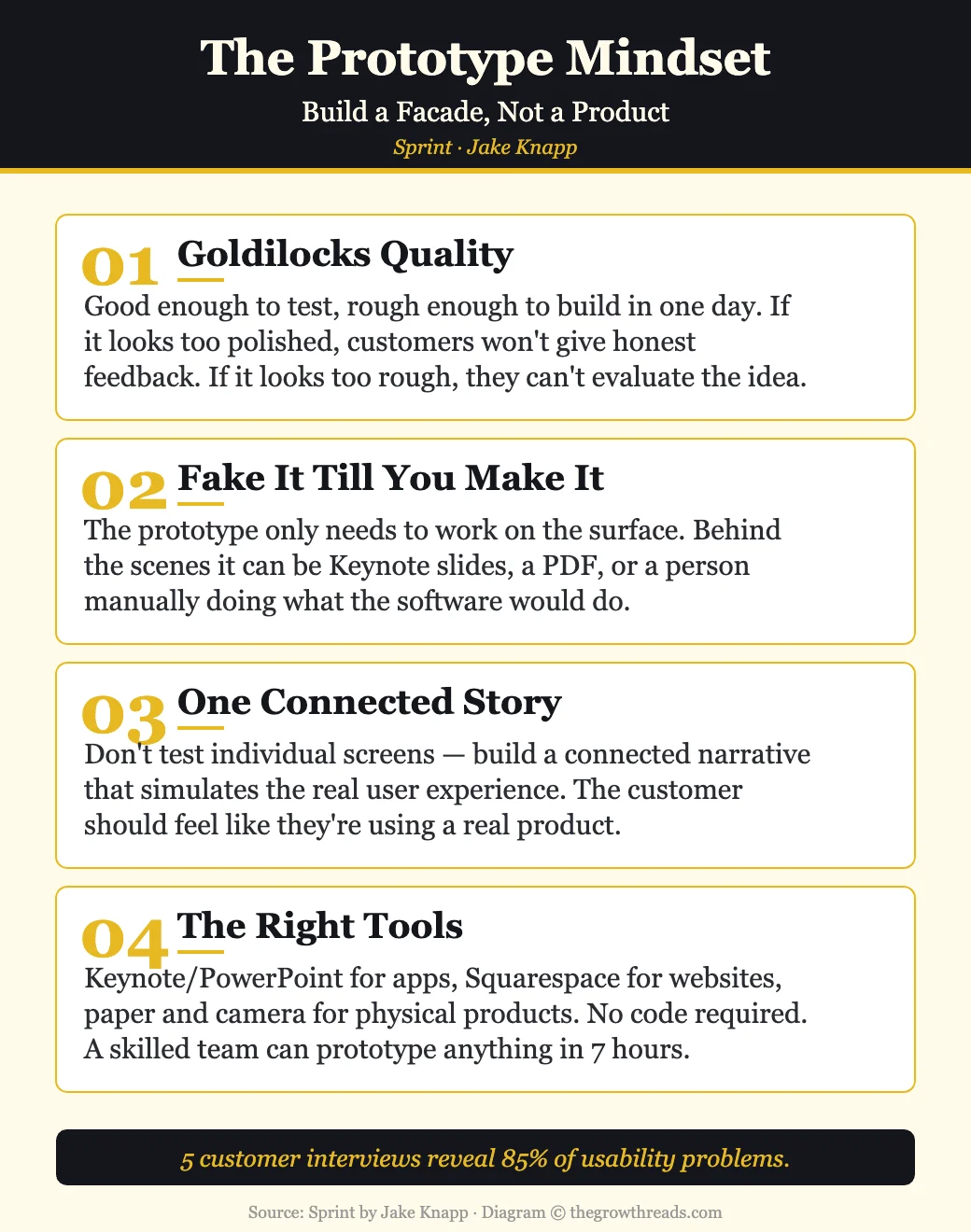
Thursday is about building a “Goldilocks prototype” — realistic enough that customers can react to it honestly, but rough enough to build in a single day. Knapp is emphatic: you can prototype anything. Apps use Keynote or InVision with linked screens. Websites use Squarespace or WordPress with stock content. Physical products use modified existing objects or 3D prints. Services use role-playing with scripted interactions. Hardware uses cardboard and paper overlays.
The team divides into Makers (who build the prototype), a Writer (who creates realistic content — not lorem ipsum), an Asset Collector (who gathers images, icons, and reference materials), and a Stitcher (who assembles everything into a cohesive flow). The Interviewer spends Thursday reviewing the storyboard and preparing Friday’s interview script. This division of labor is critical — seven people can build in one day what would take one person a week.
Knapp introduces the concept of the “facade” — the prototype only needs to work on the surface. Behind every clickable screen can be a static image. Behind every “search result” can be a hand-curated list. The customer doesn’t know the difference. What matters is that the experience feels real enough to generate genuine emotional reactions and honest feedback. If customers treat the prototype like a real product, the test results are valid.
Part 4: Friday — Test and learn
Friday is test day. Five target customers arrive one at a time for 60-minute sessions. The Interviewer follows a five-act structure: friendly welcome and warm-up, context questions about the customer’s life and relevant habits, introduction to the prototype, detailed tasks where the customer uses the prototype while thinking aloud, and a debrief asking for overall reactions. The rest of the team watches from another room via video feed, taking notes on a shared board.
Five interviews is not arbitrary — it’s based on Jakob Nielsen’s research showing that five usability tests uncover 85% of problems. After the third interview, patterns start emerging. By the fifth, the team has high confidence about what works and what doesn’t. More interviews produce diminishing returns. The team records reactions on a grid: green for positive, red for negative, organized by sprint question. By 5pm Friday, the answers are clear.
Not every sprint produces a winning solution. Knapp estimates that about two-thirds of sprints reveal significant flaws in the tested idea — which is exactly the point. Discovering a fatal problem on a Friday afternoon, after investing one week, is infinitely better than discovering it after six months and a million dollars of development. A “failed” sprint is actually the highest-value outcome because it prevents catastrophic waste. The team walks out with clear knowledge of what doesn’t work, why, and what to try next.
Who is Sprint best for — and who should read something else first?
Sprint is essential for product managers, startup founders, and design teams who need to validate ideas before investing months of development time. It’s equally valuable for corporate innovation teams struggling to move fast inside slow organizations, and for consultants who facilitate client workshops. The step-by-step format means you can literally follow the book as a recipe during your first sprint.
If you need broader product strategy rather than a specific five-day process, try our The Lean Startup summary. For personal productivity rather than team processes, our Make Time summary (co-authored by Knapp himself) is the natural companion. And if your challenge is less about speed and more about choosing the right problem to solve, our Essentialism summary will help you focus before you sprint.
Questions to reflect on
- What is the biggest decision your team has been debating for weeks or months that could be tested in five days?
- If you had to pick one customer and one moment in their journey to focus a sprint on, what would you choose?
- When was the last time you tested an idea with real customers before building it? What happened?
- Who would be your Decider, and would they actually commit to being in the room for a full week?
- What assumptions about your product or service have you never actually validated?
🔥 Ready to solve your biggest problem in five days?
Learn the exact process that Google Ventures uses to test ideas with real customers — before writing a single line of code.
How to apply Sprint (7-day plan)
- Day 1 — Choose your challenge: Identify the biggest unresolved question facing your team right now. It should be important enough to dedicate a week to, and specific enough to prototype.
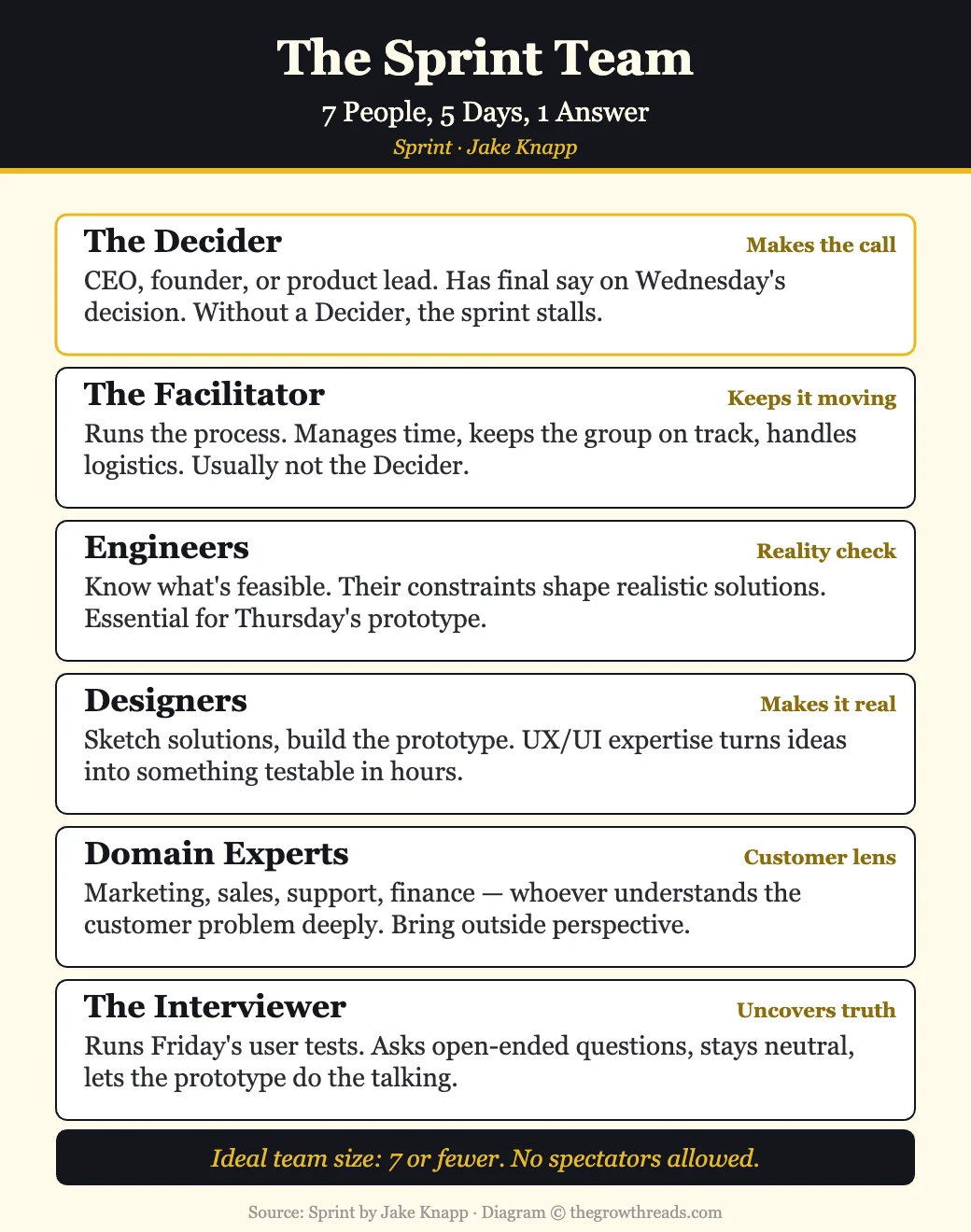
- Day 2 — Assemble your sprint team: Recruit 4–7 people: a Decider, a Facilitator, engineers, designers, and at least one domain expert. Send the calendar invite for a full Monday–Friday block.
- Day 3 — Prepare the sprint room: Book a room with wall space (or use large whiteboards), buy sticky notes, Sharpies, dot stickers, and a Time Timer. Remove all chairs with wheels — you want people standing and engaged.
- Day 4 — Recruit your test customers: Find 5 target customers for Friday interviews. Use Craigslist, social media, your existing customer base, or a recruiting firm. Offer a gift card for their time. Schedule one-hour sessions, 30 minutes apart.
- Day 5 — Run your first sprint (Monday): Follow the book’s Monday recipe: define the long-term goal, list sprint questions, map the customer journey, do expert interviews, and choose your target.
- Day 6 — Sprint Tuesday through Thursday: Sketch individually (Crazy 8s + Solution Sketches), decide with dot voting and the Decider, then build your prototype using Keynote, a website builder, or whatever gets you to “Goldilocks quality.”
- Day 7 — Test on Friday: Run the five customer interviews. Watch from the observation room. Record reactions on a green/red grid organized by sprint question. Debrief as a team. You now have data, not opinions.
Frequently asked questions
What is the Sprint method by Jake Knapp?
The Sprint method is a five-day process for solving big problems and testing new ideas. Developed at Google Ventures, it compresses months of work into one week: Monday (map the problem), Tuesday (sketch solutions), Wednesday (decide on one), Thursday (build a prototype), Friday (test with 5 real customers). Over 150 companies have used it to validate product ideas before committing to full development.
How many people do you need for a design sprint?
The ideal sprint team has 4 to 7 people. You need a Decider (someone with authority to make the final call), a Facilitator (who runs the process), and 2–5 additional team members covering engineering, design, marketing, or domain expertise. Fewer than 4 limits the diversity of ideas; more than 7 slows decision-making and makes logistics unwieldy. No spectators — everyone participates.
Why only 5 customer interviews on Friday?
Jakob Nielsen’s research demonstrates that 5 usability tests reveal approximately 85% of usability problems. After the third interview, strong patterns emerge. By the fifth, the team has high confidence about what works and what doesn’t. Running 20 interviews would take four times longer but only uncover 15% more issues. The sprint prioritizes speed of learning over statistical comprehensiveness.
Can you run a sprint remotely?
Yes, though it requires adaptation. Remote sprints use video conferencing, shared digital whiteboards (Miro, FigJam, or MURAL), and collaborative tools for sketching and voting. Jake Knapp has published a remote sprint guide that adjusts the schedule and techniques for distributed teams. The core principles stay the same — individual work before group discussion, clear Decider authority, and structured time blocks.
What if the sprint prototype fails on Friday?
A “failed” prototype is actually one of the best possible sprint outcomes. Discovering that an idea doesn’t work after investing one week is infinitely cheaper than discovering it after months of development. Knapp estimates roughly two-thirds of sprints reveal significant problems with the tested idea. The team leaves with clear knowledge of what doesn’t work and why — which directly informs what to try next.
How is Sprint different from Agile or Scrum sprints?
Despite sharing the word “sprint,” the two are fundamentally different. Agile/Scrum sprints are 1–4 week development cycles for building working software incrementally. The design sprint is a one-time, five-day workshop for testing ideas before development begins. A design sprint typically happens before Agile sprints start — it answers “should we build this?” while Agile answers “how do we build this?”
What problems are best suited for a design sprint?
Sprints work best for high-stakes decisions where the cost of being wrong is significant, where the team has been debating without resolution, or where you need to test a new direction before committing resources. Examples include launching a new product, redesigning a critical user flow, entering a new market, or choosing between competing strategies. Sprints are less useful for small UI tweaks or problems that can be solved with A/B testing.
Related summaries
- The Lean Startup Summary — Eric Ries’s Build-Measure-Learn loop for product development and startup strategy.
- Make Time Summary — Jake Knapp’s personal productivity system for designing your ideal day.
- Thinking in Systems Summary — Donella Meadows’ foundational guide to how structure shapes behavior.
- Essentialism Summary — Greg McKeown’s case for doing fewer things better — the mindset behind sprint focus.
📚 Explore More Productivity Books
This summary is part of our Best Productivity Books collection — 43 expert-reviewed guides to help you work smarter, build faster, and ship with confidence. Browse the full list →
Related Productivity Summaries
Do Nothing Summary & Review: How to Break Away From Overworking
Limitless Summary & Review: Unlock Your Brain’s Full Potential
Mastery Summary & Review: The Path to Extraordinary Skill
The 12 Week Year Summary & Review: Get More Done in Less Time
The E-Myth Revisited Summary & Review: Why Most Small Businesses Don’t Work