

⭐⭐⭐⭐✬ 4.5 / 5
A provocative, contrarian guide to building companies that create entirely new things rather than competing in existing markets.
Best for: Founders, aspiring entrepreneurs, and anyone who wants to think differently about innovation and competition.
Reading time: ~4 hours (224 pages)
Difficulty to apply: Moderate — the thinking frameworks are immediately useful; the monopoly-building strategies require ambition and execution.
Zero to One in one minute
Every moment in business happens only once. Peter Thiel — co-founder of PayPal and Palantir, and one of Silicon Valley’s most influential investors — argues that true progress means going from zero to one: creating something entirely new. Going from one to N is merely copying what already works. The most valuable companies in the world — Google, Apple, Facebook — all achieved monopoly status by doing something no one else could. Thiel lays out a framework for identifying and building these kinds of businesses, centered on the idea that competition is destructive and monopoly is the goal. Based on notes from a Stanford course by Blake Masters, the book is dense with contrarian ideas: that competition is for losers, that secrets still exist, and that definite optimism — believing you can shape the future — is the only productive worldview for founders.
Key takeaways
- Zero to one is creation; one to N is copying: Real innovation means building something new, not iterating on what exists. Globalization without technology is unsustainable.
- Competition is for losers: Competing in crowded markets destroys profits for everyone. The goal is to build a monopoly by creating something so good that no one else can offer a close substitute.
- Monopolies lie, and competitors lie: Monopolists downplay their dominance to avoid regulation. Competitors exaggerate their uniqueness to attract investment. Both distort your view of reality.
- Start small and monopolize: Dominate a small market first, then expand. Amazon started with books. Facebook started at Harvard. Trying to capture 1% of a huge market is a losing strategy.
- Secrets still exist: There are important truths about the world that most people do not know or believe. Great companies are built on secrets — insights that are not obvious but are discoverable.
- Last mover advantage: Being first is overrated. What matters is generating cash flows in the future. Build something durable, not just early.
- The power law governs everything: A small number of investments, decisions, and markets will dramatically outperform all others. Focus relentlessly on the few things that matter most.
- Technology is not automatic: Progress requires human agency and definite plans, not vague optimism or incremental improvement.
- Distribution matters as much as product: Even a great product will fail without a plan to sell it. Most founders underestimate the importance of sales and distribution.
- Founders are essential and strange: Great companies need visionary founders who think differently — but those same qualities can become destructive without the right team and structure.
What is Zero to One about?
Zero to One is a book about startups and innovation that argues the most valuable businesses are monopolies built on unique technology. Peter Thiel presents a framework for identifying untapped opportunities, building companies that create new markets, and thinking about the future with definite optimism rather than incremental improvement.
About the author
Peter Thiel co-founded PayPal in 1998 and served as its CEO through the company’s IPO and acquisition by eBay. He was the first outside investor in Facebook, writing a check for half a million dollars in 2004 that would eventually be worth over a billion. He co-founded Palantir Technologies and the Founders Fund, one of Silicon Valley’s most successful venture capital firms. Blake Masters was a Stanford Law student who took detailed notes during Thiel’s CS183 course on startups; those notes went viral and became the foundation for this book. Thiel is one of the most polarizing figures in technology — celebrated for his investing track record and contrarian thinking, and criticized for his political positions. Explore all Blake Masters book summaries →
Key concepts at a glance
| Concept | What it means | Use it when |
|---|---|---|
| Zero to one | Creating something entirely new — vertical progress through technology | You are deciding whether to build or imitate |
| Definite optimism | Believing you can plan and shape a specific, better future | You are setting strategy or vision for a company |
| Monopoly | Being so good at something that no competitor can offer a close substitute | You are choosing your market and positioning |
| The power law | A tiny number of outcomes produce the vast majority of results | You are allocating time, money, or effort across projects |
| Secrets | Important truths that most people do not know or believe | You are looking for a startup idea or competitive edge |
| Last mover advantage | Long-term value matters more than being first to market | You feel pressure to rush a launch to beat competitors |
| Distribution | The plan to sell your product is as important as the product itself | You are building something great but have no go-to-market plan |
| The 7 questions | Engineering, timing, monopoly, people, distribution, durability, secret | You want to stress-test a business idea before committing |
Part 1 — The challenge of the future: zero to one thinking
Thiel opens with his famous interview question: “What important truth do very few people agree with you on?” It is designed to identify contrarian thinkers — people who can see beyond conventional wisdom. His own answer sets the tone for the book: most people think the future will be defined by globalization (taking things that work in one place and copying them everywhere), but Thiel believes it will be defined by technology (doing entirely new things).
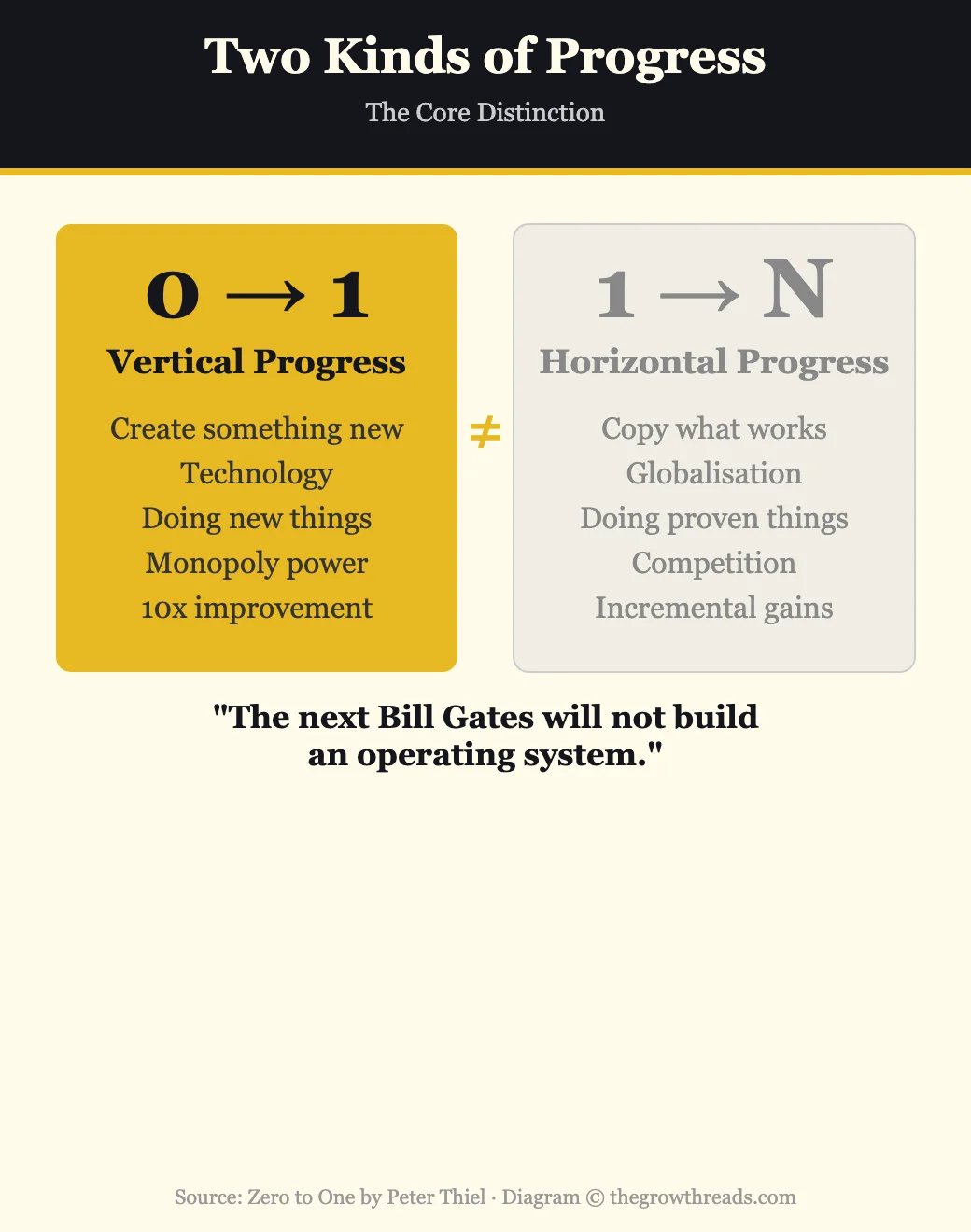
The distinction between horizontal progress (one to N) and vertical progress (zero to one) is the book’s organizing framework. Horizontal progress is globalization — China copying Western manufacturing, a new restaurant opening in a proven format. Vertical progress is technology — the first personal computer, the first search engine, the first social network. Thiel argues that only vertical progress creates lasting value, because horizontal progress without new technology eventually hits resource limits.
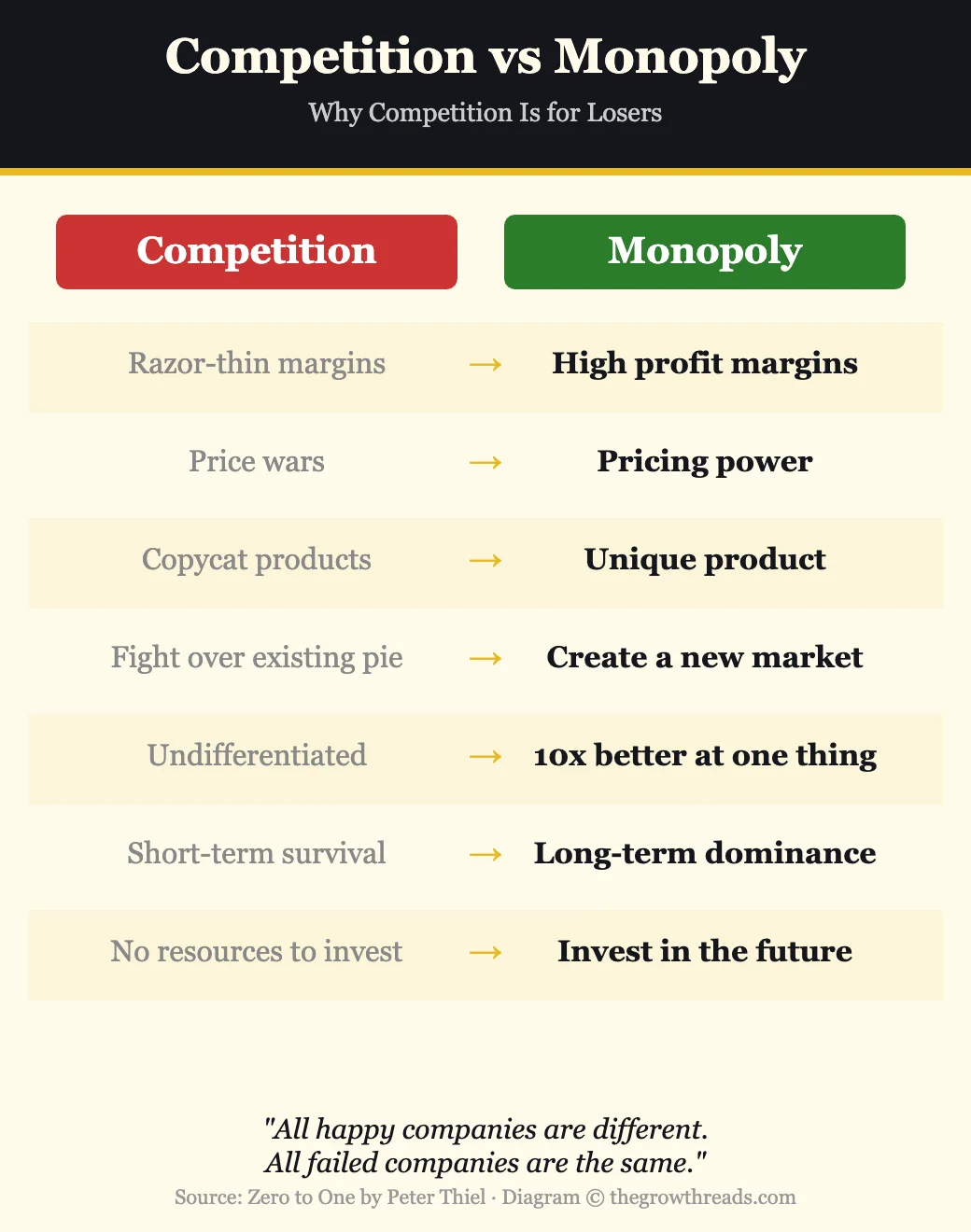
He then delivers one of his most controversial claims: competition is destructive. In economics class, competition is presented as the ideal market structure. Thiel inverts this. In a perfectly competitive market, no company makes economic profit — they just survive. Monopolies, by contrast, can invest in innovation, treat employees well, and think long-term because they are not fighting for survival. Google, he argues, is a monopoly that pretends to be in fierce competition (by defining its market as “technology” rather than “search”), while restaurants are perfect competitors that pretend to be unique.
Part 2 — Building a monopoly: secrets, the power law, and starting small
The practical core of Zero to One is Thiel’s framework for building monopoly businesses. It starts with finding a “secret” — an important truth that most people do not see. Secrets come in two forms: secrets about nature (undiscovered scientific truths) and secrets about people (things people hide or do not know about themselves). Airbnb’s secret was that many people would be willing to rent out their homes to strangers — something most people in 2008 would have dismissed as absurd.
Once you have a secret, Thiel prescribes starting with a small market you can dominate completely. The mistake most founders make is targeting a huge market and hoping to capture a tiny percentage. Instead, be the definitive player in a niche — then expand into adjacent markets from a position of strength. PayPal started by dominating payments for eBay power sellers, a tiny market of about 20,000 people. Once they owned that niche, they expanded outward.
The power law chapter is one of the most consequential in the book. In venture capital, returns follow a power law: one company in a portfolio will outperform all others combined. This is not just a VC insight — it applies to careers, decisions, and strategy. If the power law governs outcomes, then you should concentrate your effort on the few things that have exponential upside rather than diversifying across many modest bets.
Thiel also distinguishes between four views of the future: definite optimism (you have a specific plan to make a better future), indefinite optimism (you believe the future will be better but have no plan), definite pessimism (you expect decline and plan accordingly), and indefinite pessimism (you expect the worst and have no plan). He argues that the United States has drifted from the definite optimism that built the interstate highway system and sent astronauts to the moon into an era of indefinite optimism — where finance replaces engineering and nobody builds anything concrete. Founders need to return to definite optimism.
Part 3 — Foundations, distribution, and the 7 questions
Thiel devotes a chapter to distribution — the art of selling — that many technical founders skip. He identifies four distribution channels ranked by customer lifetime value: complex sales (multimillion-dollar deals requiring personal relationships), personal sales (mid-range products sold by a dedicated team), marketing and advertising (consumer products), and viral distribution (products that spread through use). The critical insight is that most businesses need exactly one of these channels to work. Trying to use all four is a recipe for failure.
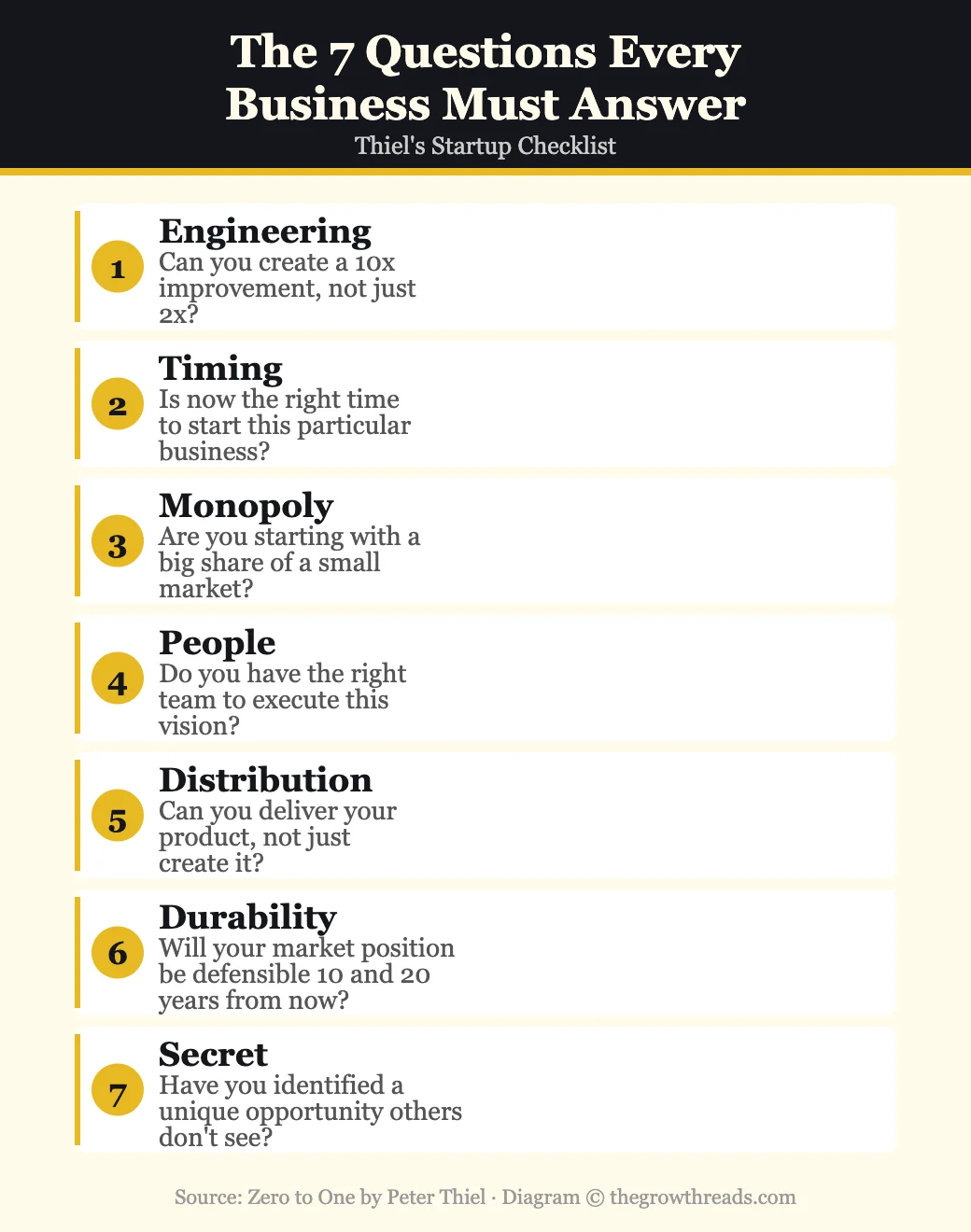
The “seven questions” chapter provides the book’s practical stress test. Every great business must have a convincing answer to all seven: the engineering question (can you create a 10x improvement?), the timing question (is now the right moment?), the monopoly question (are you starting with a big share of a small market?), the people question (do you have the right team?), the distribution question (can you deliver?), the durability question (will you still dominate in 10 to 20 years?), and the secret question (have you identified an opportunity others don’t see?). Thiel uses the cleantech bubble of the 2000s as a case study — most failed cleantech companies could not answer even one of these questions convincingly.
The final chapters explore the role of founders. Great founders, Thiel argues, are extreme personalities — visionaries whose strengths border on madness. Steve Jobs, Elon Musk, and Howard Hughes all exemplify this. Companies need these founders for direction and inspiration, but the founder mythology can become destructive if it replaces the systems and teams needed to execute. The tension between individual genius and institutional stability is never fully resolved — and Thiel is honest that it cannot be.
Who is Zero to One best for — and who should read something else first?
Zero to One is essential reading for founders and aspiring entrepreneurs who want to build technology companies. It is also valuable for anyone in venture capital, corporate strategy, or product development who needs a framework for evaluating whether an idea has monopoly potential. If you are tired of incremental-improvement thinking, this book will challenge you to think bigger.
If you are looking for practical startup operations advice — hiring, firing, managing — this is not that book. Try The Hard Thing About Hard Things or The Making of a Manager instead. If you want the lean, iterative approach to building products, The Lean Startup is the counterpoint worth reading alongside Zero to One.
Questions to reflect on
- What important truth do very few people agree with you on — and could that truth be the basis for something you build?
- Is your current business or career in a competitive market where everyone fights over scraps, or are you building something with monopoly potential?
- If you applied the power law to your current projects, which one has the most disproportionate upside — and are you spending most of your time on it?
- What is your distribution plan? If you cannot describe how your product reaches customers in one sentence, you may not have one.
- Are you being a definite optimist — building toward a specific vision of the future — or are you hedging, diversifying, and waiting for things to work out on their own?
🔥 Ready to build something the world has never seen?
Zero to One will transform how you think about competition, innovation, and what it takes to build a company that creates real value.
How to apply Zero to One (7-day plan)
- Day 1 — Find your contrarian truth: Write down one belief you hold that most people in your industry would disagree with. Test it: is it truly contrarian, or just unpopular?
- Day 2 — Audit your competition: List every competitor in your market. If you have more than three real ones, you may not have enough differentiation. Brainstorm what would make you the only option.
- Day 3 — Apply the 7 questions: Take your current business idea or project and answer each of Thiel’s seven questions honestly. Note where your answers are weak.
- Day 4 — Identify your small market: Define the smallest possible audience that would love your product. Write a one-sentence description of that niche.
- Day 5 — Map your distribution: Choose one distribution channel and sketch out how your product gets from you to the customer. Eliminate any channel you cannot execute.
- Day 6 — Look for secrets: Spend 30 minutes asking: what do I know about my industry that most insiders take for granted but is actually wrong? Write down any secrets you find.
- Day 7 — Commit to definite optimism: Write a one-page vision of where your business will be in 10 years — not a vague aspiration, but a specific, concrete plan.
Frequently asked questions
Is Zero to One only for tech founders?
The examples are tech-heavy — PayPal, Facebook, SpaceX — but the framework applies to any business. The core question is universal: are you creating genuine value or just competing for a share of an existing market? Restaurant owners, consultants, and nonprofit leaders can all benefit from thinking about monopoly positioning, secrets, and the power law in their own contexts.
Does Thiel really think monopolies are good?
Thiel distinguishes between creative monopolies (companies that are so good at something new that no one can compete) and coercive monopolies (companies that use political power to block competition). He celebrates the first kind — Google, Apple, early Microsoft — while acknowledging the risks of the second. His argument is economic: creative monopolies drive innovation because they can invest profits in the future, while perfectly competitive markets squeeze out all profit and all capacity for long-term thinking.
How is Zero to One different from The Lean Startup?
They represent opposite philosophies. The Lean Startup says: build a minimum viable product, test with customers, iterate based on feedback. Zero to One says: have a bold vision, build something 10x better, and dominate a market. Eric Ries focuses on reducing risk through experimentation. Thiel focuses on concentrating effort on one big bet. Both are useful — Lean for early product validation, Zero to One for strategic ambition — and many successful founders use both approaches at different stages.
What does Thiel mean by “secrets”?
A secret is an important truth about the world that most people do not know or believe. Not a trivial fact — something fundamental that, if true, would change how you build a business. Uber’s secret was that people would get into a stranger’s car ordered by an app — obvious now, absurd-sounding in 2009. Thiel argues that many people have stopped looking for secrets because they assume everything worth knowing is already known. Founders who still look for secrets have a massive advantage.
Is the book too short to be useful?
At 224 pages with short chapters, Zero to One is dense rather than thin. Every chapter contains an idea that could fill a book on its own — the power law, secrets, definite optimism, distribution channels. The brevity is a strength: it forces Thiel to make every sentence count. Most readers find they return to it multiple times, discovering new layers with each read.
What should I read after Zero to One?
If you want the operational counterpart — how to actually run the startup once you have the vision — read The Hard Thing About Hard Things. For the iterative approach that complements Thiel’s big-bet philosophy, try The Lean Startup. For more on innovation frameworks, The Innovator’s Dilemma is the classic.
Is Zero to One still relevant in 2026?
More than ever. The rise of generative AI is the most significant zero-to-one moment since the internet. Thiel’s framework — find a secret, build a monopoly, aim for 10x improvement — is exactly how the most valuable AI companies are thinking. The book’s warnings about indefinite optimism and incremental thinking are especially urgent in an era when many companies are simply adding AI features to existing products rather than reimagining what is possible.
Related summaries
- The Lean Startup Summary — Eric Ries on validated learning and iterative development — the complementary philosophy.
- The Hard Thing About Hard Things Summary — Ben Horowitz on the operational reality of running a startup.
- The Innovator’s Dilemma Summary — Clayton Christensen on why great companies fail to innovate.
- Good to Great Summary — Jim Collins on what separates enduring companies from mediocre ones.
📚 Explore the full Leadership collection
This summary is part of our best leadership books series — 39 in-depth reviews to help you lead, build, and innovate with confidence.
Related Leadership Summaries
The Leadership Challenge Summary and Review
The Score Takes Care of Itself Summary and Review
Think Again Summary & Review: Master the Art of Rethinking
Who Moved My Cheese? Summary & Review: Navigate Change Before It Breaks You
Wooden on Leadership Summary & Review: The Pyramid of Success Framework