

★★★★★½ 4.7/5 — A leadership philosophy built from the ground up, not the scoreboard down.
Best for: Coaches, managers, and anyone who wants to build a team culture on character instead of shortcuts.
Reading time: ~6 hrs to read the full book · ~12 min for this guide.
Difficulty to apply: Moderate — it rewards patience and daily repetition, not a quick fix.
Wooden on Leadership in one minute
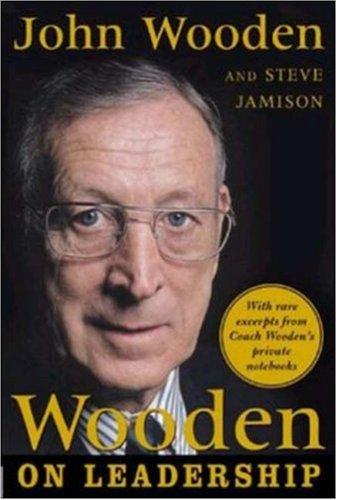
John Wooden never talked about winning. In twelve seasons at UCLA he won ten national championships — a record no coach in any major sport has come close to touching — yet he told his players before every game to walk off the court knowing they had given their best effort, whatever the scoreboard said. Wooden on Leadership is his attempt, written late in life with sportswriter Steve Jamison, to hand that philosophy to people who will never coach a basketball team: executives, teachers, parents, anyone responsible for getting a group of people to become better than they thought they could be. The core tool is the Pyramid of Success, a framework of fifteen character traits stacked from the ground up — industriousness and enthusiasm at the base, competitive greatness at the peak. The book is less about strategy and more about the discipline of teaching fundamentals so well they become instinct.
Key takeaways
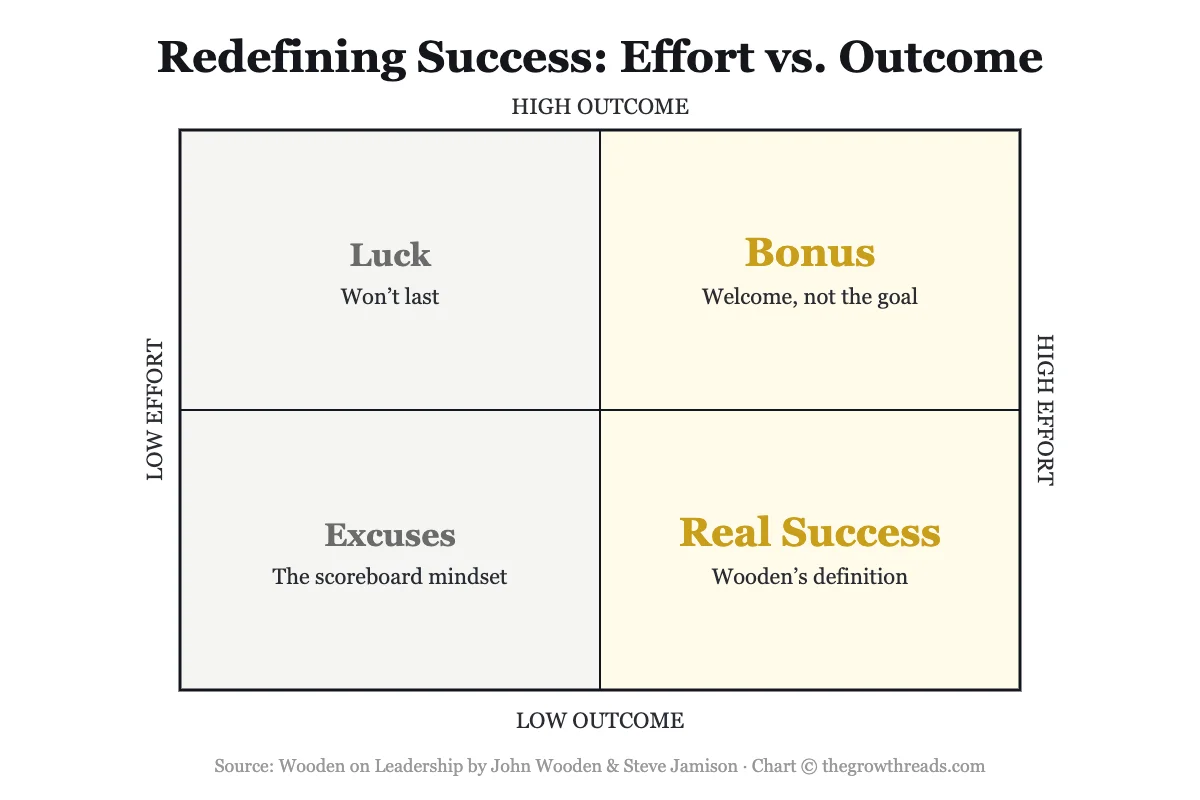
- Success is not the scoreboard: it is the peace of mind that comes from knowing you made the effort to become the best you are capable of becoming.
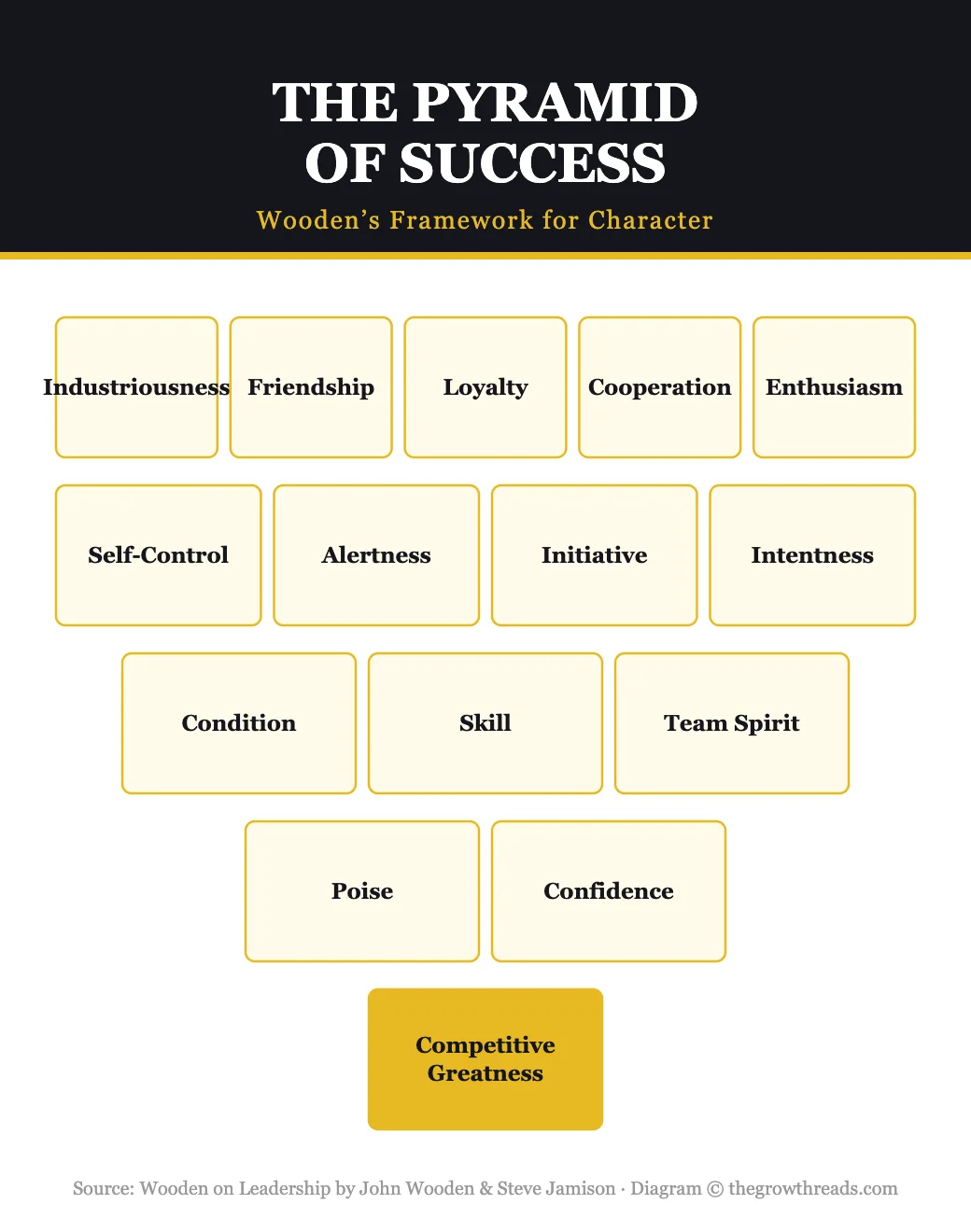
- The Pyramid of Success stacks fifteen blocks: character traits are built in order, from the foundation up, not picked at random.
- Character comes before skill: industriousness and enthusiasm are the base blocks everything else rests on.
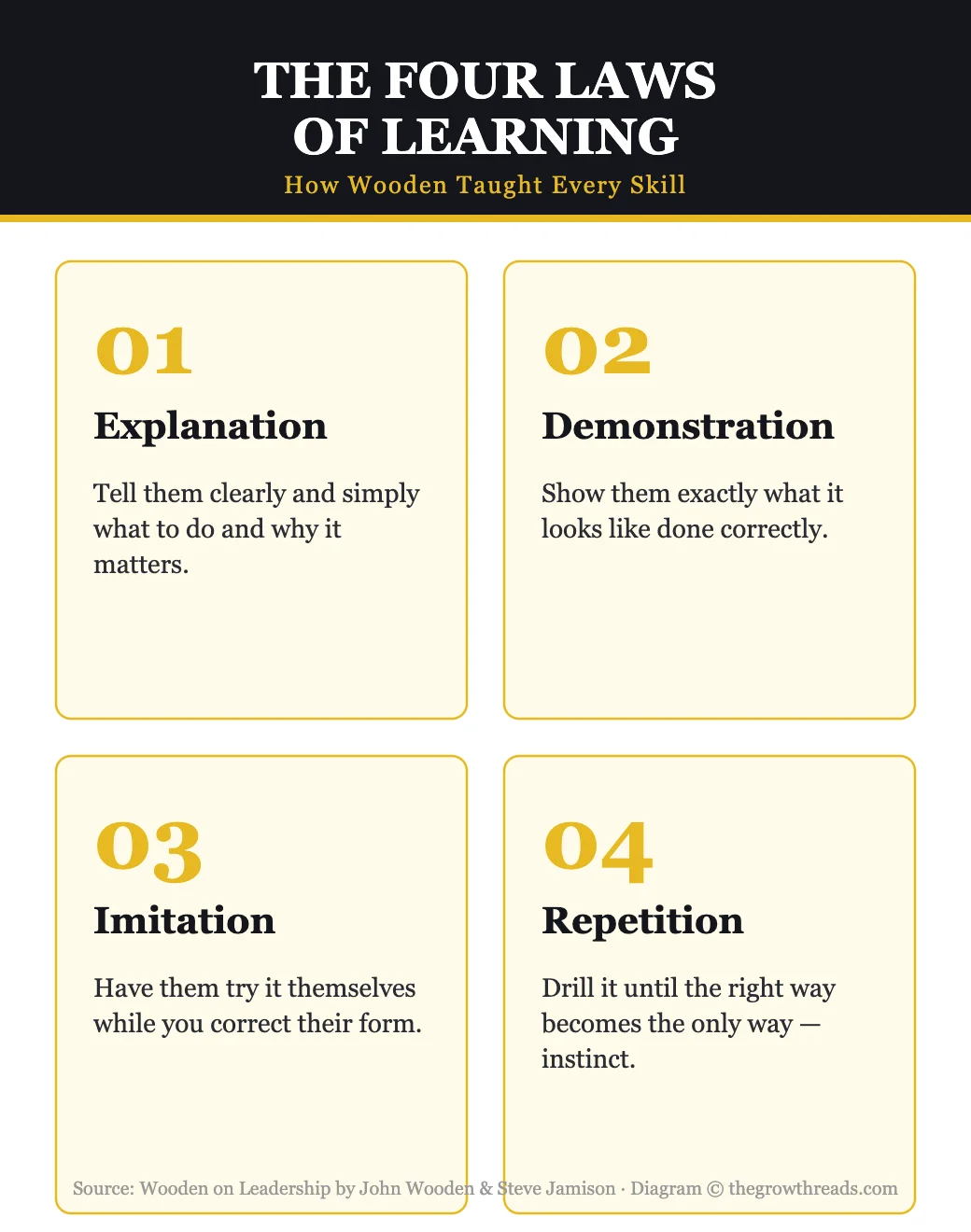
- Teaching follows Four Laws: explanation, demonstration, imitation, and repetition — in that order, every time.
- Self-control is the leader’s first job: you cannot lead others’ emotions under pressure if you cannot lead your own.
- Teams win on condition, skill, and team spirit — not on talent alone, and not on any one star player.
- Poise means being yourself — no pretense, no panic — especially when things go wrong.
- Competitive greatness is showing up at your best when your best is required, not just when it’s easy.
- Adversity reveals character, it doesn’t build it — the building happens in the daily repetitions nobody sees.
- Leadership is teaching, endlessly: the same fundamentals, explained patiently, one player and one day at a time.
What is Wooden on Leadership about?
Wooden on Leadership is UCLA basketball coach John Wooden’s framework for building character-driven teams, centered on his Pyramid of Success — fifteen traits stacked from industriousness at the base to competitive greatness at the peak, taught through relentless attention to fundamentals rather than talent or tactics.
About the author
John Wooden (1910–2010) coached basketball at UCLA for twenty-seven years, winning ten NCAA championships in a twelve-season stretch — including seven in a row — a record that remains untouched in major American sports. Long before UCLA, he taught high school English in Indiana, and that teacher’s instinct never left him; he described himself first as a teacher who happened to coach basketball. In his sixties he began distilling his approach into the Pyramid of Success, a framework he’d spent decades refining on index cards. After retiring in 1975, he spent his final three decades speaking and writing for audiences far beyond sports — coaches, CEOs, teachers, and parents — most of it channeled through Wooden on Leadership and its companion books, co-written with sportswriter Steve Jamison. Explore all John Wooden book summaries →
Key concepts at a glance
| Concept | What it means | Use it when |
|---|---|---|
| Pyramid of Success | Fifteen character blocks stacked bottom-up into a complete framework | Building a long-term leadership philosophy |
| Four Laws of Learning | Explanation, demonstration, imitation, repetition — the fixed teaching sequence | Teaching any new skill or habit |
| Industriousness | Hard, purposeful work — the foundation block everything else rests on | Starting any new initiative |
| Self-Control | Keeping your emotions and actions in check under pressure | High-stakes, high-pressure moments |
| Team Spirit | Sacrificing personal recognition for the group’s success | Building genuine collaboration, not just cooperation |
| Poise | Being yourself, without pretense, when things go wrong | Handling criticism, mistakes, or crisis |
| Competitive Greatness | Performing your best when your best is genuinely required | The moments that actually decide outcomes |
Part 1: The Foundation — Character Before Skill
Wooden built the Pyramid of Success from the ground up on purpose. The base row holds five blocks — industriousness, friendship, loyalty, cooperation, and enthusiasm — and none of them are about basketball skill at all. They’re about who a person is before they ever touch a ball. Wooden believed you could not build anything durable on top of a team that lacked these basics, no matter how talented the players were. Industriousness meant there was no substitute for hard, honest work; he distrusted shortcuts and quick fixes because he’d watched too many talented teams collapse the moment adversity showed up. Enthusiasm, to Wooden, wasn’t cheerleading — it was the energy that made hard work sustainable, the thing that let a player run the same drill for the thousandth time without resentment.
Friendship, loyalty, and cooperation round out the base because Wooden had learned, the hard way, that talent alone doesn’t produce a team — it produces a collection of individuals who happen to wear the same uniform. He required his players to genuinely know and support each other before he’d let strategy matter at all. The lesson generalizes cleanly outside of sports: a manager who skips straight to strategy and incentive design, without first building trust and shared purpose among the team, is building on sand.
TGR Note: This is the same diagnosis Patrick Lencioni reaches from a different angle in The Five Dysfunctions of a Team — an absence of trust is the root dysfunction everything else sits on top of. Wooden just got there fifty years earlier, from a gym in Westwood instead of a consulting practice.
Part 2: The Middle Blocks — Discipline and Alertness
The second row up — self-control, alertness, initiative, and intentness — is where Wooden’s philosophy turns from character to discipline. Self-control gets the most attention in the book, and for good reason: Wooden was famous for never raising his voice at officials or players during a game, not because he lacked intensity but because he believed a leader who loses composure has already lost the ability to think clearly, and a team takes its emotional cues from whoever is supposedly in charge. He didn’t demand this because it looked good; he demanded it because panic is contagious and so is calm, and only one of those wins close games.
Alertness and initiative are paired deliberately: alertness without initiative just notices problems without solving them, and initiative without alertness solves the wrong problems energetically. Intentness — Wooden’s word for sustained focus on a goal despite obstacles and setbacks — is what keeps a person from abandoning a plan the moment it gets difficult, which he considered the single most common way ordinary teams fail.
This is also where the book lays out its most practical, reusable tool: the Four Laws of Learning. Wooden taught every single skill — a chest pass, a defensive stance, a free throw — the same fixed way, every time: explain it clearly, demonstrate it correctly, have the player imitate it while you correct their form, then repeat it until the correct version is the only version that comes out under pressure. He resisted the temptation to skip steps even with players who seemed to already get it, because instinct under game pressure only comes from repetition, never from a single good explanation.
TGR Note: The Four Laws are a plainer, older cousin of the deliberate-practice research popularized decades later — explain, demonstrate, imitate, repeat is just a coach’s version of “practice with feedback, then repeat until it’s automatic.” If you want the science behind why repetition works this way, it pairs well with anything on habit formation in our productivity library.
Part 3: Team Building — Condition, Skill, and Team Spirit
The third row — condition, skill, and team spirit — is where Wooden addresses the part most leadership books skip: the unglamorous logistics of actually being good at the thing you do. Condition, to him, meant moral, mental, and physical readiness together; he refused to separate a player’s discipline off the court from their conditioning on it, because he’d seen plenty of physically fit players who fell apart under pressure they hadn’t mentally prepared for. Skill is exactly what it sounds like — the technical ability to execute — but Wooden placed it deliberately in the middle of the pyramid, not the base, because he believed skill without the character blocks below it was fragile and skill-first teams collapsed the moment things got hard.
Team spirit is the block Wooden wrote about with the most feeling. He distinguished it sharply from mere cooperation: cooperation is willingness to work alongside others, team spirit is willingness to sacrifice personal recognition for the group’s success. He famously discouraged his star players from celebrating their own baskets, insisting they instead acknowledge whoever passed them the ball — a small habit meant to make selflessness visible and rewarded, not just preached. Teams that talk about culture but keep individual-glory incentives in place, he argued, are lying to themselves about what they actually value.
TGR Note: Wooden’s insistence on rewarding the assist over the basket is a real-world version of the incentive-design problem Jocko Willink and Leif Babin describe from the battlefield in Extreme Ownership — teams follow what gets rewarded, not what gets said in the locker room.
Part 4: The Apex — Poise, Confidence, and Competitive Greatness
At the top of the pyramid sit poise, confidence, and — at the very peak — competitive greatness, and Wooden is careful to explain why they come last, not first. Confidence built before the lower blocks are in place is just bravado, and it shatters the first time it’s tested. Poise, which he defined simply as being yourself, without pretense or embarrassment, under any circumstance, is what keeps confidence from curdling into panic or arrogance when a game — or a quarter, or a launch — goes badly. He wanted players who looked the same on the bench up thirty points as they did down two with a minute left, because the version of you that only shows up when things are going well isn’t dependable.
Competitive greatness, the capstone, is Wooden’s definition of clutch: performing at your best when your best is genuinely required. It’s easy to misread this as “winning,” but Wooden is explicit that it isn’t — a team can play with competitive greatness and lose to a better opponent, and a team can win while playing well below its capability. The whole point of the pyramid is that the outcome you can’t control (the score) is separated cleanly from the standard you can control (your effort), and only the second one is where self-respect actually lives.
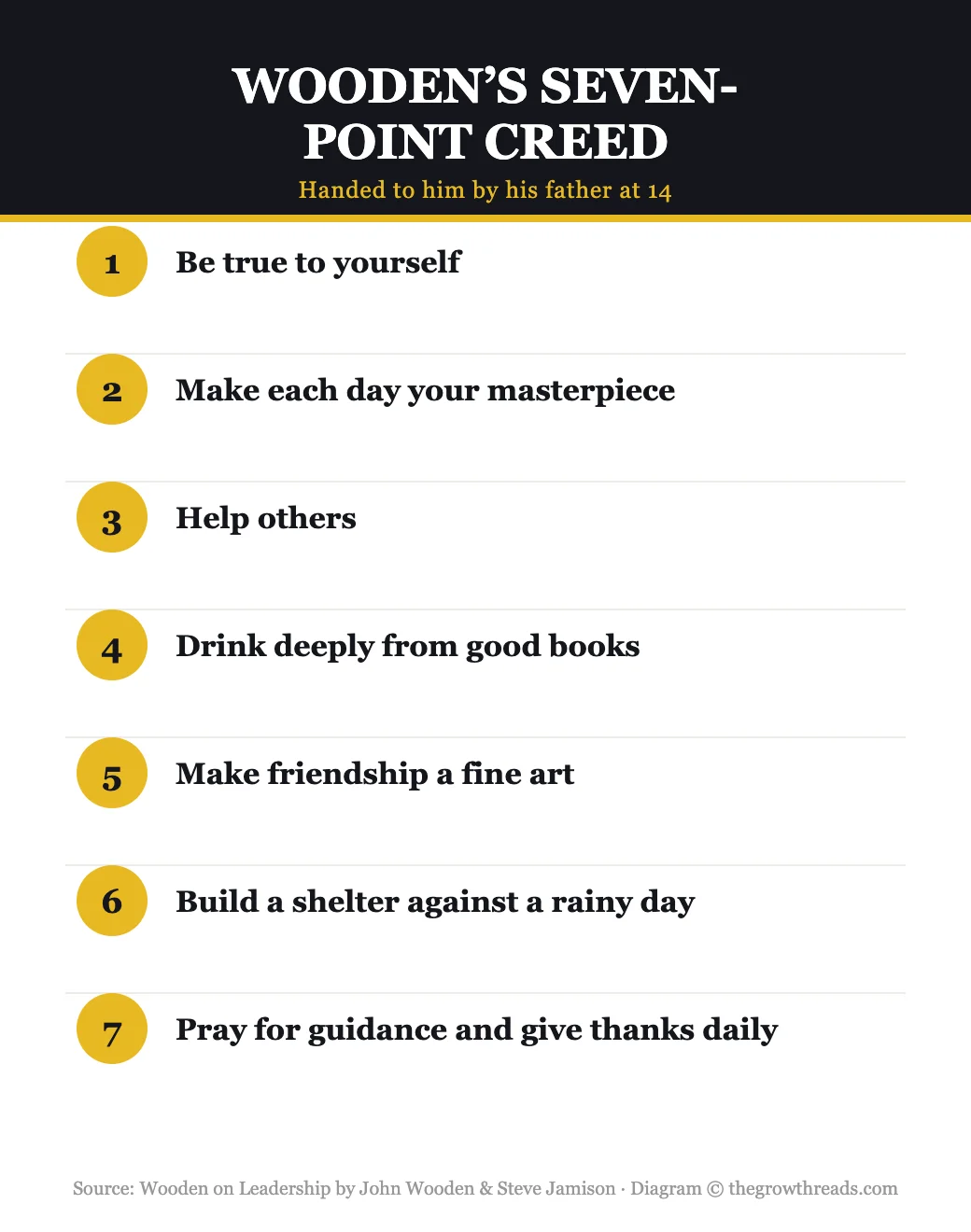
Wooden traces much of this back to a creed his father, Joshua, handed him on a small card the day he graduated eighth grade — seven simple lines about being true to yourself, helping others, and giving thanks daily, that he says he carried, literally, for the rest of his life. It’s a reminder that the Pyramid wasn’t built in a UCLA film room; it was built over decades, starting long before he ever coached a single game.
TGR Note: Separating effort from outcome is also the load-bearing idea in Good to Great‘s “Stockdale Paradox” — hold onto realism about results while never wavering on the standard of effort. Different books, same hinge.
Who is Wooden on Leadership best for — and who should read something else first?
This book is best for coaches, managers, teachers, and parents who are building — or rebuilding — a team culture from scratch, and who are willing to play a long game measured in years, not quarters. If you want a tactical playbook for a specific crisis (a toxic team, a failing project, a single hard conversation), start with Extreme Ownership instead. If you want the diagnostic version of “why is my team dysfunctional,” The Five Dysfunctions of a Team is the faster read. Wooden’s book rewards people who are willing to think in decades.
Questions to reflect on
- Which base-level block — industriousness, friendship, loyalty, cooperation, or enthusiasm — is genuinely weakest on your team right now, underneath the strategy conversations?
- When you teach a new skill or process, do you actually follow all four steps (explain, demonstrate, imitate, repeat), or do you skip straight to “just do it”?
- Think of your last high-pressure moment: did your self-control set the emotional tone for the people around you, or did theirs set yours?
- Does your team’s reward system actually recognize the assist, or only the basket?
- If you separated “the outcome” from “the effort” this quarter, which one would you actually be proud of?
🔥 Ready to build your own Pyramid of Success?
Get the full book for the complete block-by-block breakdown, stories from Wooden’s UCLA years, and his personal rules for handling adversity.
How to apply Wooden on Leadership (7-day plan)
- Day 1: Write down your team’s base-level blocks — industriousness, friendship, loyalty, cooperation, enthusiasm. Rate each honestly, 1–5.
- Day 2: Pick your lowest-rated block and identify one concrete, visible action you can take this week to strengthen it.
- Day 3: Choose one skill or process you teach often. Rebuild how you teach it using the Four Laws: explain, demonstrate, imitate, repeat.
- Day 4: Notice one high-pressure moment. Practice staying visibly calm — poise — and observe how it changes the room.
- Day 5: Publicly recognize someone’s “assist” rather than their “basket” — the setup work, not just the finish.
- Day 6: Write your own short creed — five to seven lines you actually believe — the way Wooden’s father did for him.
- Day 7: Separate one recent outcome from the effort behind it. Score the effort honestly, independent of how it turned out.
Frequently asked questions
What is the Pyramid of Success in Wooden on Leadership?
The Pyramid of Success is John Wooden’s framework of fifteen character traits, arranged in five rows and stacked from the ground up. The base row (industriousness, friendship, loyalty, cooperation, enthusiasm) supports the middle rows (self-control, alertness, initiative, intentness, then condition, skill, team spirit), which in turn support the top blocks (poise, confidence) and the capstone, competitive greatness. Wooden spent decades refining it and taught it explicitly to every team he coached.
Is Wooden on Leadership only useful for sports coaches?
No. While Wooden draws every example from basketball, the book was written specifically for a general leadership audience — Steve Jamison co-wrote it after years of executives and managers asking Wooden to translate his coaching philosophy for the business world. The principles (character before skill, structured teaching, effort over outcome) apply directly to any team, in any field.
What are the Four Laws of Learning?
Explanation, demonstration, imitation, and repetition. Wooden taught every skill — no matter how simple it seemed — in this exact order: explain it clearly, demonstrate it correctly, have the learner imitate it while receiving correction, then repeat it until it becomes instinctive under pressure. He believed skipping steps, even with talented people, produced skills that broke down the moment the stakes rose.
How is Wooden on Leadership different from Extreme Ownership?
Extreme Ownership is built around a small number of hard operating principles drawn from combat, aimed at fixing accountability failures quickly. Wooden on Leadership is a slower, more foundational philosophy about building character and teaching fundamentals over years. They’re complementary rather than competing — Wooden for the long-term culture, Willink and Babin for the sharper tactical edges.
What does Wooden mean by “success is peace of mind”?
Wooden defined success as “peace of mind attained only through self-satisfaction in knowing you made the effort to become the best you are capable of becoming.” It deliberately excludes the scoreboard — you can meet this standard and still lose, or fail this standard and still win, and only the first one, he argued, is something you can control and be proud of.
Does the book include Wooden’s actual rules and quotes from his UCLA years?
Yes. The book is full of first-person stories from Wooden’s twenty-seven years at UCLA, his rules for practice and conduct, and direct quotes he used with players — including his well-known instructions on tying your shoes properly and never criticizing a teammate. Steve Jamison structures these around the Pyramid framework rather than presenting them as a straight memoir.
Is Wooden on Leadership backed by research, or is it just Wooden’s personal philosophy?
It’s primarily Wooden’s personal philosophy, built from decades of coaching experience rather than academic research — this is worth knowing going in. That said, later research on deliberate practice, psychological safety, and intrinsic motivation lines up closely with several of his core ideas, particularly the Four Laws of Learning and his emphasis on effort over outcome.
Related summaries
- Extreme Ownership Summary & Review
- The Five Dysfunctions of a Team Summary & Review
- The Dichotomy of Leadership Summary & Review
- Good to Great Summary & Review
- See all Best Leadership Books
How we analyze books: we read the full text, cross-reference the author’s other work and interviews, and test every framework against real-world application before writing a summary. Read our full methodology.
Related Leadership Summaries
Leaders Eat Last Summary & Review: Build a Team That Has Your Back
Start With Why Summary & Review: How Great Leaders Inspire Action
The Art of War Summary & Review: Timeless Strategy for Modern Leaders
The Coaching Habit Summary & Review: Say Less, Ask More, Lead Better
The Hard Thing About Hard Things Summary & Review: A CEO Survival Manual for the Hardest Decisions