

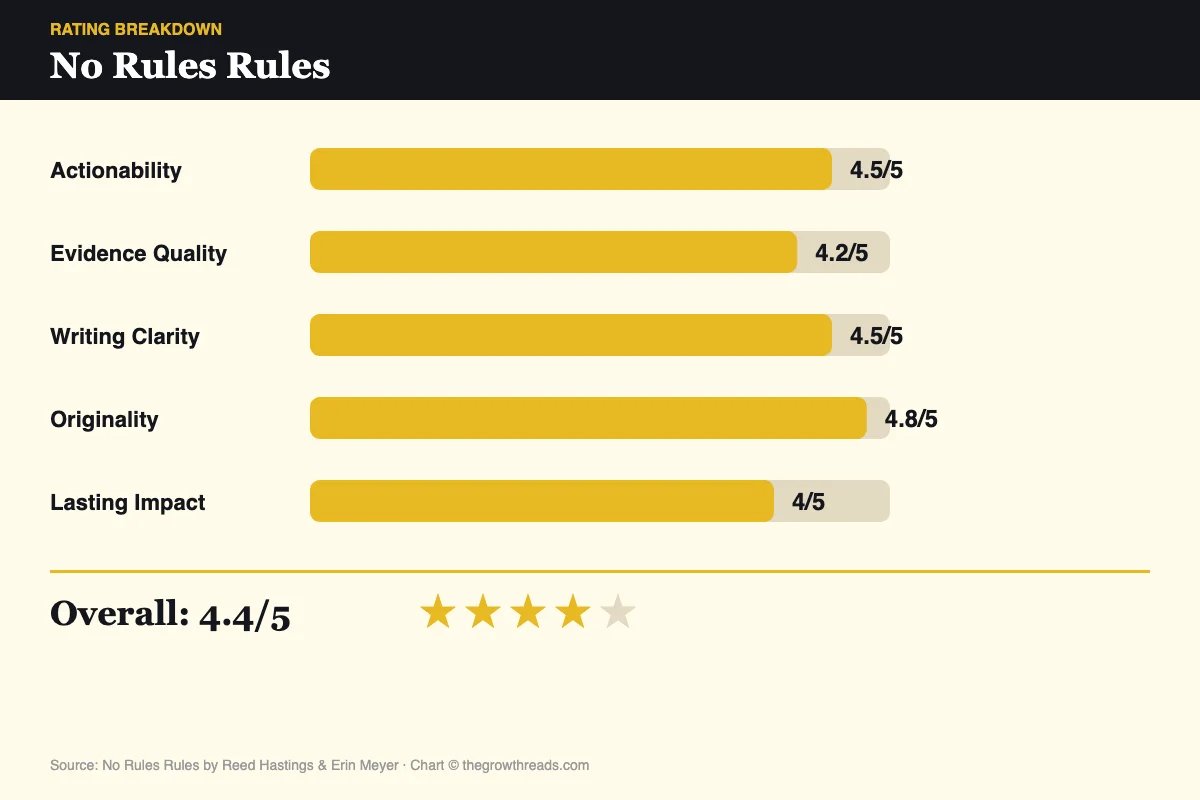
⭐⭐⭐⭐ 4.4/5 — A fascinating inside look at how Netflix built the most radically free corporate culture on the planet — and the counterintuitive logic that makes it work.
Actionability: 4.5/5 · Evidence Quality: 4.2/5 · Writing Clarity: 4.5/5 · Originality: 4.8/5 · Lasting Impact: 4.0/5
Best for: Founders, managers, and HR leaders who want to build high-performance teams by removing bureaucracy instead of adding it.
Reading time: ~7 hours (320 pages)
Difficulty to apply: High — the Netflix model requires exceptional talent density as a prerequisite. Removing controls without it creates chaos, not freedom.
No Rules Rules in one minute
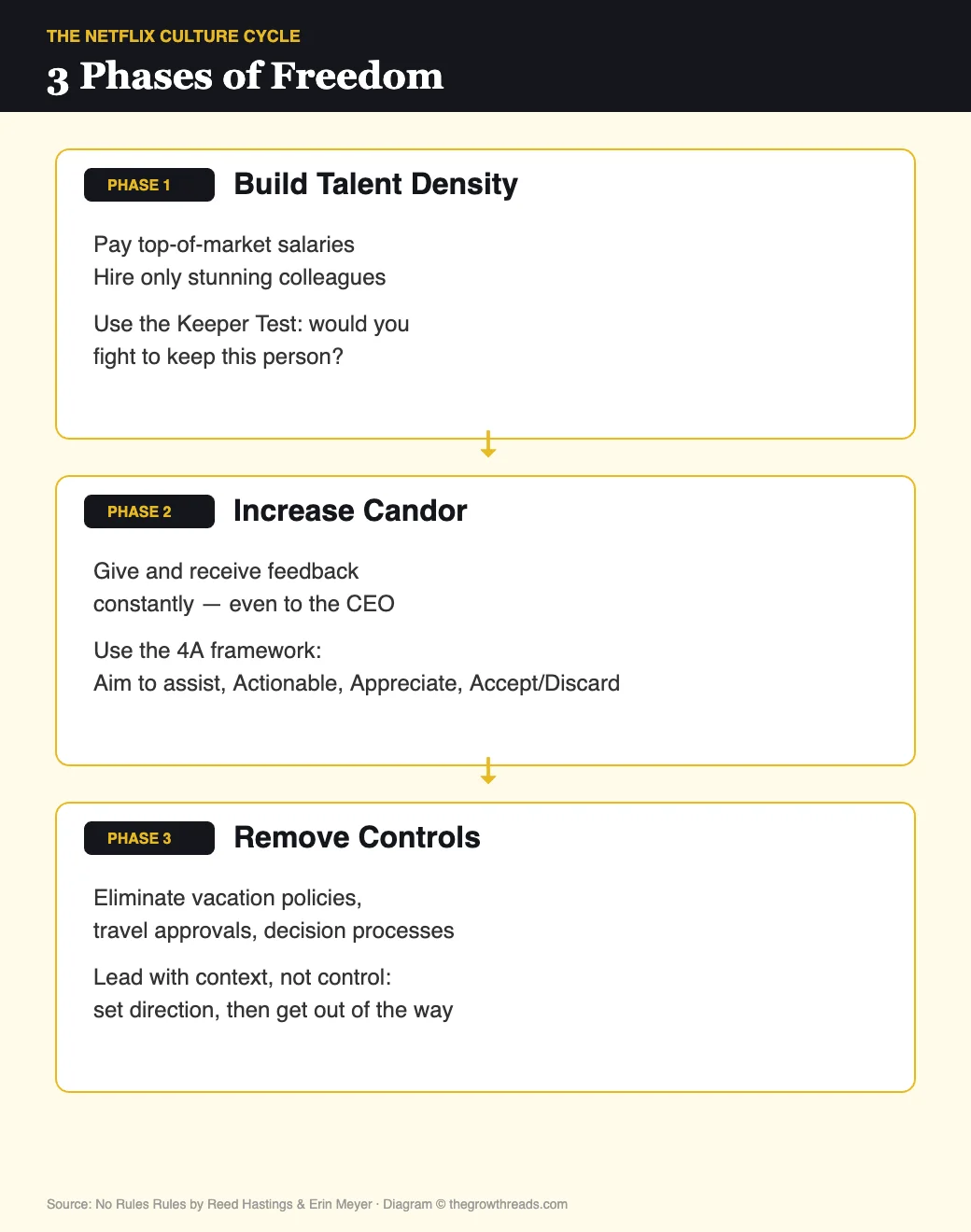
Netflix does not have vacation policies, expense approvals, or decision-making committees — and that is precisely why it dominates. Reed Hastings and INSEAD professor Erin Meyer reveal how Netflix built the most unconventional corporate culture in the world by following a counterintuitive three-phase cycle: first, increase talent density by hiring only exceptional people and paying top of market; second, increase candor by normalizing radical honesty through the 4A feedback framework; third, remove controls — eliminate policies, approvals, and processes that exist only because companies do not trust their employees. The result is a culture where talented people make better decisions faster than any bureaucracy could, and where freedom and responsibility are two sides of the same coin.
Key takeaways
- Talent density is the foundation: One outstanding employee is worth ten adequate ones in creative work. Netflix pays top-of-market salaries and uses the Keeper Test — “Would I fight to keep this person?” — to maintain density.
- Adequate performance gets a generous severance: Being “good enough” at Netflix means you are taking a slot that a stunning colleague could fill. The company pays substantial severance packages rather than managing people out slowly.
- Radical candor is a cultural muscle: Netflix expects employees at every level to give honest feedback — up, down, and sideways — using the 4A framework: Aim to assist, Actionable, Appreciate, Accept or discard.
- Remove controls as density and candor increase: Vacation policies, travel approvals, and decision committees exist because companies do not trust employees. When you have the right people and radical transparency, those controls become drag, not safety nets.
- Lead with context, not control: Instead of telling people what to do, provide the strategic context — the vision, metrics, and constraints — and let informed people make decisions. This produces faster, better outcomes than top-down directives.
- The “sunshine test” for expenses: Before spending company money, ask: “Would I be comfortable if this expense were published in a newspaper?” If yes, proceed without asking permission.
- Disagree, then commit — or escalate: If you disagree with a direction, you have an obligation to voice it. But once a decision is made (even one you oppose), commit fully — or escalate, never sabotage.
- Cultural adaptation matters globally: Meyer, an expert on cross-cultural management, adds a crucial dimension: Netflix’s feedback culture had to be adapted for Japan, Brazil, and other markets where direct confrontation violates deep cultural norms.
- Innovation requires risk tolerance: Netflix expects managers to “bet” on projects and accepts that some will fail. The key metric is batting average over time, not whether any single swing misses.
- Freedom is not the same as anarchy: Netflix’s system works because freedom is paired with extreme transparency. Everyone knows the company’s strategy, finances, and priorities — information asymmetry is the enemy.
What is No Rules Rules about?
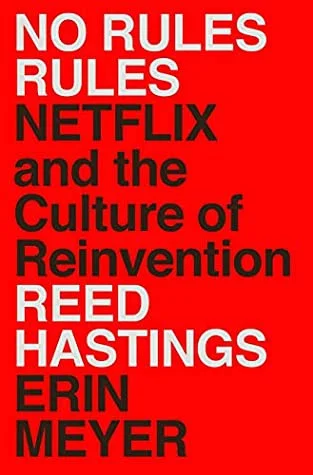
No Rules Rules explains how Netflix built an extraordinarily high-performing culture by eliminating traditional corporate controls — vacation policies, expense approvals, top-down decisions — and replacing them with three reinforcing principles: exceptional talent density, radical candor, and maximum employee freedom paired with full context and transparency.
About the authors
Reed Hastings co-founded Netflix in 1997 after selling his first company, Pure Software, and spent over two decades as CEO building the streaming giant from a DVD-by-mail service into a $150+ billion global entertainment company. Erin Meyer is a professor at INSEAD and the author of The Culture Map, one of the most influential books on cross-cultural business communication. Their collaboration is what makes No Rules Rules work: Hastings provides the insider perspective of a founder who built the culture, while Meyer provides the outside analytical lens of a researcher who can identify what is transferable and what is Netflix-specific. Meyer also conducted over 200 interviews with current and former Netflix employees across multiple countries.
Key concepts at a glance
| Concept | What it means | Use it when |
|---|---|---|
| Talent Density | A team of top performers outperforms a larger team of average ones | You are hiring, restructuring, or deciding whether to invest in training vs. upgrading |
| The Keeper Test | “Would I fight to keep this person?” — if no, offer generous severance | Reviewing team performance or making retention decisions |
| 4A Feedback | Aim to assist, Actionable, Appreciate, Accept or discard | Giving or receiving difficult feedback at any level |
| The Sunshine Test | Would you be comfortable if this expense were published publicly? | Making spending decisions without approval processes |
| Context over Control | Provide strategy and constraints; let people decide how to execute | Delegating decisions and building autonomous teams |
| Informed Captain | One person owns each decision — not a committee | Resolving disagreements and avoiding decision paralysis |
| The Innovation Cycle | Bet → Some fail → Learn → Bet again → Batting average rises | Evaluating risk tolerance and encouraging experimentation |
Part 1: Build talent density first
Hastings learned the lesson that would define Netflix’s culture during a layoff. In 2001, after the dot-com crash, Netflix laid off a third of its workforce — keeping only the strongest performers. What Hastings expected was a demoralized, overworked team. What he got was the opposite: the remaining team moved faster, produced better work, and was measurably happier. The weak performers had not just been doing less — they had been dragging everyone else down through meetings that went nowhere, code that needed rewriting, and decisions that required consensus because no one trusted the person making them.
This observation became the founding principle of Netflix’s culture: talent density is the prerequisite for everything else. In creative and knowledge work, the gap between a great employee and an adequate one is not 2x — research by Ernest O’Boyle Jr. and Herman Aguinis (published in Personnel Psychology, 2012) suggests it can be 10x or more. Netflix’s strategy is to pay top-of-market for fewer, better people rather than market-average for more people. Hastings calls this “rock star pay”: paying one person what two or three adequate performers would cost, because the one person will produce more, collaborate better, and raise the performance of everyone around them.
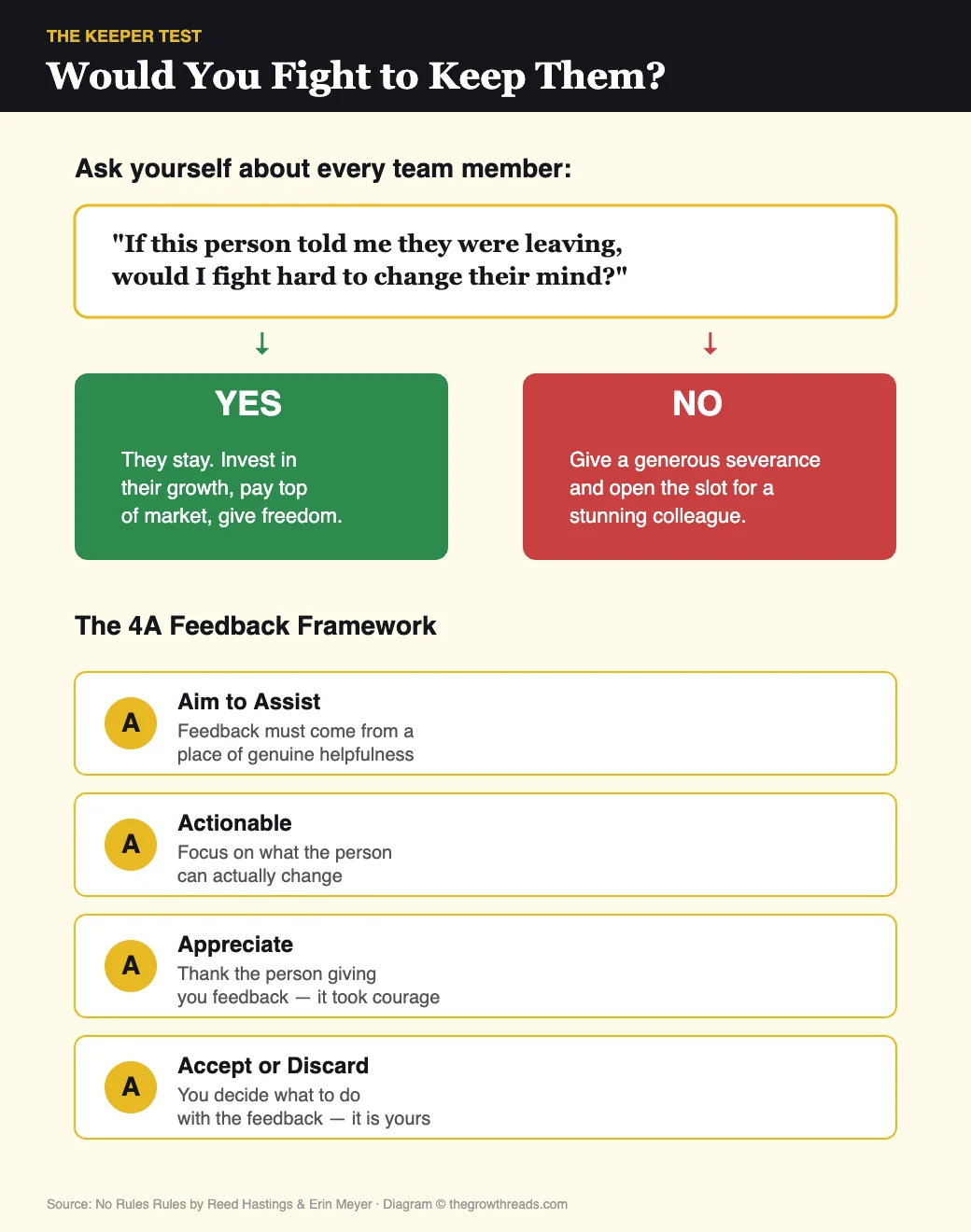
The enforcement mechanism is the Keeper Test. Every manager is expected to regularly ask: “If this person told me they were leaving for a competitor, would I fight hard to change their mind?” If the honest answer is no, the employee receives a generous severance package — typically four to nine months of salary — and the slot opens for someone who would elicit a yes. This is not performance management through fear; Netflix frames it as building a professional sports team, not a family. On a great team, everyone plays their position at an elite level, and there is no shame in being traded — only in being kept on the roster out of loyalty when someone better is available.
Part 2: Increase candor with the 4A framework
With high talent density established, Hastings introduces the second phase: radical candor. Netflix expects every employee — from intern to executive — to give and receive feedback constantly, without waiting for annual reviews or formal channels. The cultural expectation is that withholding feedback is a form of disloyalty: if you see something that could be improved and you do not say it, you are failing your colleagues.
To make this work without turning the company into a war zone, Meyer codifies the 4A feedback framework. First, Aim to assist — feedback must come from a genuine desire to help, not to score points or vent frustration. Second, make it Actionable — focus on specific behaviors the person can change, not personality traits. Third, when receiving feedback, Appreciate — thank the person for the courage it took to speak up, even if you disagree with the content. Fourth, Accept or discard — the recipient decides what to do with the feedback. You are not obligated to act on every piece of input, but you are obligated to consider it seriously.
The most counterintuitive aspect is feedback flowing upward. Netflix employees are expected to tell their bosses — including Hastings himself — when they think a decision is wrong. Hastings shares examples of being publicly corrected by junior employees in meetings, and describes it as the most important feedback he receives. Meyer notes that this upward feedback loop is almost impossible to create through policy alone — it requires the CEO to model vulnerability consistently for years until the behavior normalizes. In her interviews, employees who had been at Netflix for less than a year still found upward feedback terrifying; those who had been there for three or more years described it as liberating.
Part 3: Remove controls and lead with context
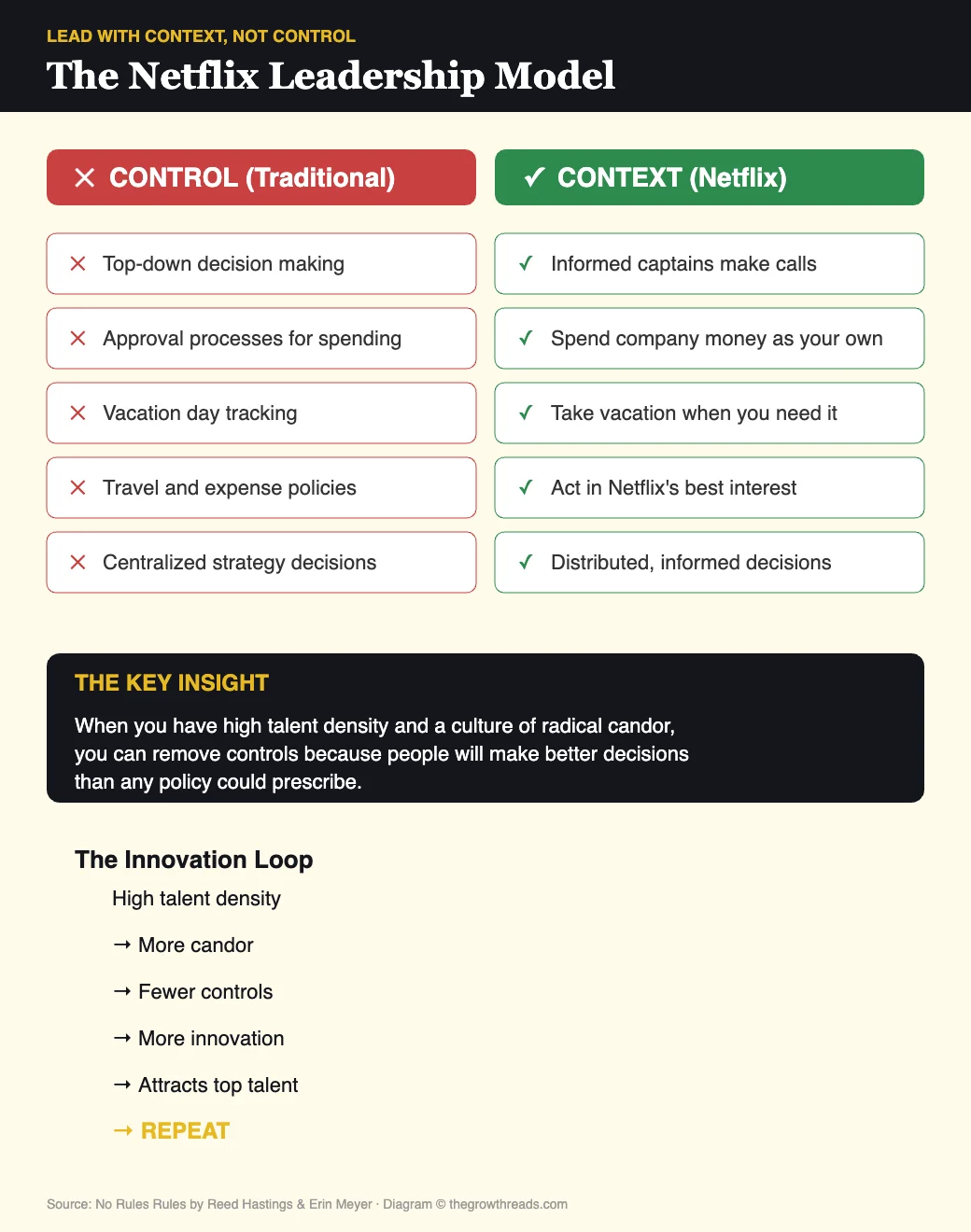
The payoff of talent density plus radical candor is the freedom to eliminate controls. Netflix has no vacation policy — employees take what they need. There are no travel or expense approval processes — employees spend company money using the sunshine test (“Would I be comfortable if this were published?”). There are no decision-making committees — an “informed captain” owns each decision, seeks input, makes the call, and is accountable for the outcome.
Hastings explains the logic through what he calls “leading with context, not control.” Traditional management provides control: here is a process, follow it. Netflix provides context: here is our strategy, our constraints, our financial position, and what success looks like — now use your judgment. This only works because of the first two phases: people with high talent density make better unguided decisions than policies can prescribe, and radical candor ensures mistakes surface quickly enough to correct them.
The most compelling section covers Netflix’s approach to innovation and failure. Hastings tells managers to think of their decisions as bets: some will pay off, some will not. The key is batting average over time, not whether any single project succeeds. When a bet fails, the expectation is to “sunshine” it — share what happened openly so others can learn — not to hide it or assign blame. This risk tolerance is what enabled Netflix to pivot from DVD to streaming, invest billions in original content when no one believed it would work, and expand globally into 190+ countries in seven years.
Part 4: The global challenge and cultural adaptation
Meyer’s contribution becomes most valuable in the final section, where she analyzes how Netflix’s culture — built on American directness — translates across cultures. In the Netherlands and Israel, radical candor landed naturally because those cultures already value blunt feedback. In Japan and Singapore, it required significant adaptation: Meyer explains that in high-context cultures, the same feedback delivered the same way can be received as disrespectful rather than helpful. Netflix learned to adjust the delivery while preserving the principle: the content of feedback stays honest, but the channel shifts from public to private, and the directness is calibrated to local norms.
This section also addresses the most common criticism of the Netflix model: that it creates a culture of fear. Meyer’s interviews reveal a nuanced picture. Employees consistently report that the Keeper Test creates anxiety in the first year, but that anxiety gives way to a sense of playing on a genuinely elite team — a feeling most described as exhilarating rather than stressful. The generous severance also matters: departing employees frequently said they felt respected rather than discarded, because the financial cushion gave them time and space to find a better fit. Hastings acknowledges the model is not for everyone — people who need predictability, gradual progression, or tenure-based security will be happier elsewhere — but argues it is the optimal structure for creative, fast-moving industries where innovation is the primary competitive advantage.
Who is No Rules Rules best for — and who should read something else first?
This book is ideal for founders building company culture from scratch, managers frustrated by bureaucracy, and HR leaders questioning whether policies are protecting the company or slowing it down. It is particularly valuable for leaders in creative, technology, and knowledge-work industries where output quality varies dramatically between individuals. The dual-author format — insider founder plus outside researcher — makes it more credible than most corporate culture books.
If you manage a single team rather than an organization, Radical Candor by Kim Scott is more immediately actionable. If you want a broader framework for organizational design, Principles by Ray Dalio covers similar territory with a more systematic approach. And if you are interested in how other legendary companies built their cultures, Creativity, Inc. by Ed Catmull offers Pixar’s very different — but equally effective — model of creative excellence.
Questions to reflect on
- If you applied the Keeper Test to your current team, how many people would you fight to keep — and what does that number tell you about your talent density?
- When was the last time someone junior gave you candid feedback about a decision you made — and did your reaction make it more or less likely they will do it again?
- Which policies and approval processes in your organization exist because of genuine risk, and which exist because someone once abused a freedom that could simply have been addressed individually?
- If you eliminated your vacation tracking tomorrow, what would actually happen — and what does your honest answer reveal about your trust in your team?
- Are you leading with context (providing strategy, information, and trust) or control (providing rules, processes, and approvals) — and what would it take to shift?
🔥 Ready to rethink everything you know about managing people?
Hastings and Meyer’s playbook could transform how you build teams, give feedback, and make decisions.
How to apply No Rules Rules (7-day plan)
- Day 1 — Run the Keeper Test mentally: Go through your team list. For each person, honestly answer: “Would I fight to keep them?” Write down the results privately. Note which names gave you pause and why. This is your baseline talent density score.
- Day 2 — Give one piece of 4A feedback: Choose one colleague and deliver one piece of constructive feedback using the 4A framework: state that you aim to assist, make it actionable, and offer it in private. Notice how the framework changes the conversation compared to unstructured criticism.
- Day 3 — Ask for upward feedback: In your next one-on-one or team meeting, explicitly ask: “What is one thing I could do differently that would make your work better?” Do not defend, explain, or justify. Just listen, thank them, and write it down. This is the hardest day.
- Day 4 — Identify one control to remove: Review your team’s approval processes. Find one that exists “because we have always done it that way” rather than because it prevents genuine risk. Propose removing it on a 30-day trial basis. Monitor what happens.
- Day 5 — Practice context over control: The next time someone asks for your approval, instead of saying yes or no, provide context: share the strategic goal, the budget constraints, and the relevant information — then say “You decide.” Observe how they respond.
- Day 6 — Sunshine a failure: Share a recent mistake or failed bet with your team — not as a confession, but as a learning exercise. Describe what you expected, what happened, and what you learned. Model the behavior you want to normalize.
- Day 7 — Design your culture roadmap: Map your team’s current position on the Netflix cycle: Where is your talent density (are you settling for adequate?), candor (does honest feedback flow freely?), and freedom (are controls proportionate to risk?). Write one action item for each area for the coming month.
Frequently asked questions
What is the main idea of No Rules Rules?
The central argument is that traditional corporate controls — vacation policies, expense approvals, decision-making committees — exist because companies do not trust their employees. Netflix replaces trust deficits with talent density (hiring only exceptional people), radical candor (a culture of constant honest feedback), and maximum freedom (removing controls and leading with context). The three elements form a self-reinforcing cycle: great people plus honest communication makes controls unnecessary, and the resulting freedom attracts more great people.
What is the Keeper Test at Netflix?
The Keeper Test is the question every Netflix manager asks about each team member: “If this person told me they were leaving for a competitor, would I fight hard to change their mind?” If the answer is no, the employee receives a generous severance package — typically four to nine months of salary — and the position opens for someone who would elicit a yes. Netflix frames this not as firing but as maintaining a professional sports team where every position needs an elite player. The generous severance distinguishes it from harsh corporate downsizing.
What is the 4A feedback framework?
The 4A framework structures how Netflix employees give and receive feedback. When giving: (1) Aim to assist — feedback must come from genuine helpfulness, not frustration; (2) Actionable — focus on specific behaviors the person can change. When receiving: (3) Appreciate — thank the giver for the courage it took; (4) Accept or discard — you decide what to do with the feedback. The framework prevents candor from becoming cruelty and makes honest communication sustainable across all levels of the organization.
Can the Netflix culture model work at other companies?
Partially. The talent density principle applies broadly — every team benefits from raising its hiring bar. The 4A feedback framework can work in any organization willing to invest in the cultural transition. However, the full “remove controls” phase requires both high talent density and established candor as prerequisites; removing policies without those foundations creates chaos, not freedom. Meyer also notes that the model works best in creative and knowledge-work industries where individual contribution varies dramatically. Operational or safety-critical industries need more process.
Does Netflix really have no vacation policy?
Correct — Netflix has no formal vacation tracking. Employees take time off when they feel it is appropriate, without submitting requests or counting days. Hastings explains that the policy works because of modeling: senior leaders publicly take substantial vacations, which signals that time off is genuinely encouraged. Without that modeling, “unlimited vacation” at many companies actually results in less vacation, because employees feel pressure to never take it. Netflix pairs the freedom with transparency — if someone is not taking enough time off and their work is suffering, their manager raises it through the feedback culture.
What does “lead with context, not control” mean?
Leading with context means providing your team with the strategic vision, financial information, market data, and constraints they need to make good decisions — then stepping back and letting them decide. Leading with control means telling people what to do through policies, approval chains, and top-down directives. Hastings argues that context-based leadership produces faster, better decisions because the person closest to the problem has the most relevant information. The leader’s job is to set direction and ensure information flows, not to make every call.
How does Netflix handle bad decisions made by employees with freedom?
Netflix treats bad decisions as learning opportunities, not fireable offenses — as long as the employee used good judgment with the available information. Hastings uses a betting metaphor: a venture capitalist does not fire a partner because one investment failed; they evaluate the partner’s batting average over time. When a decision goes wrong, the expectation is to “sunshine” it — share the mistake openly so others can learn. Repeated poor judgment, however, would trigger the Keeper Test. The distinction is between a bad outcome from good process (acceptable) and a bad outcome from carelessness or misalignment (not acceptable).
Related summaries
If No Rules Rules sparked ideas about leadership and culture, these related summaries explore complementary angles:
- Radical Candor Summary — Kim Scott’s framework for caring personally while challenging directly — the individual-level version of Netflix’s candor culture.
- Turn the Ship Around Summary — David Marquet’s story of pushing decision authority down to every sailor on a nuclear submarine — context over control in a military setting.
- Creativity, Inc. Summary — Ed Catmull’s approach to building a creative culture at Pixar — a very different model that achieves equally exceptional results.
- The Culture Code Summary — Daniel Coyle’s research on what makes groups exceptionally effective, including safety, vulnerability, and purpose.
📚 Explore more Leadership book summaries
This review is part of our Best Leadership Books collection — a curated library of the most impactful books on leading teams, organizations, and yourself, with full summaries, key takeaways, and action plans for each.
Related Leadership Summaries
Drive Summary & Review: The Surprising Truth About Motivation
Leadership and Self-Deception Summary & Review: Get Out of the Box
Principles Summary & Review: How to Make Better Decisions in Life and Work
The Advantage Summary and Review
The Motive Summary & Review: Why You Lead Matters Most