

⭐⭐⭐⭐⭐ 4.5/5
One-liner: A restaurant industry memoir that doubles as the best leadership book published in the 2020s — every page teaches you how to make people feel extraordinary.
Best for: Leaders, managers, founders, and anyone in a service role who wants to turn ordinary interactions into unforgettable experiences.
Reading time: ~5 hours (304 pages)
Difficulty to apply: Low — the principles are immediately actionable in any context.
Unreasonable Hospitality in one minute
The most powerful competitive advantage in any business is making people feel like they matter. Will Guidara tells the story of transforming Eleven Madison Park from a struggling brasserie into the number one restaurant in the world — not by obsessing over food alone, but by obsessing over how every guest felt. His thesis is that hospitality — the art of making people feel seen, valued, and cared for — is a learnable skill that applies far beyond restaurants. The “Dreamweaver” system he built (a dedicated team member who turned overheard guest comments into personalized surprise moments) became the engine of legendary experiences. The 95/5 rule (manage 95% of costs with ruthless efficiency so you can spend 5% with reckless generosity) is the financial model that funds it. The result is a leadership philosophy built around one question: “What would happen if we gave people more than they expected?”
Key takeaways
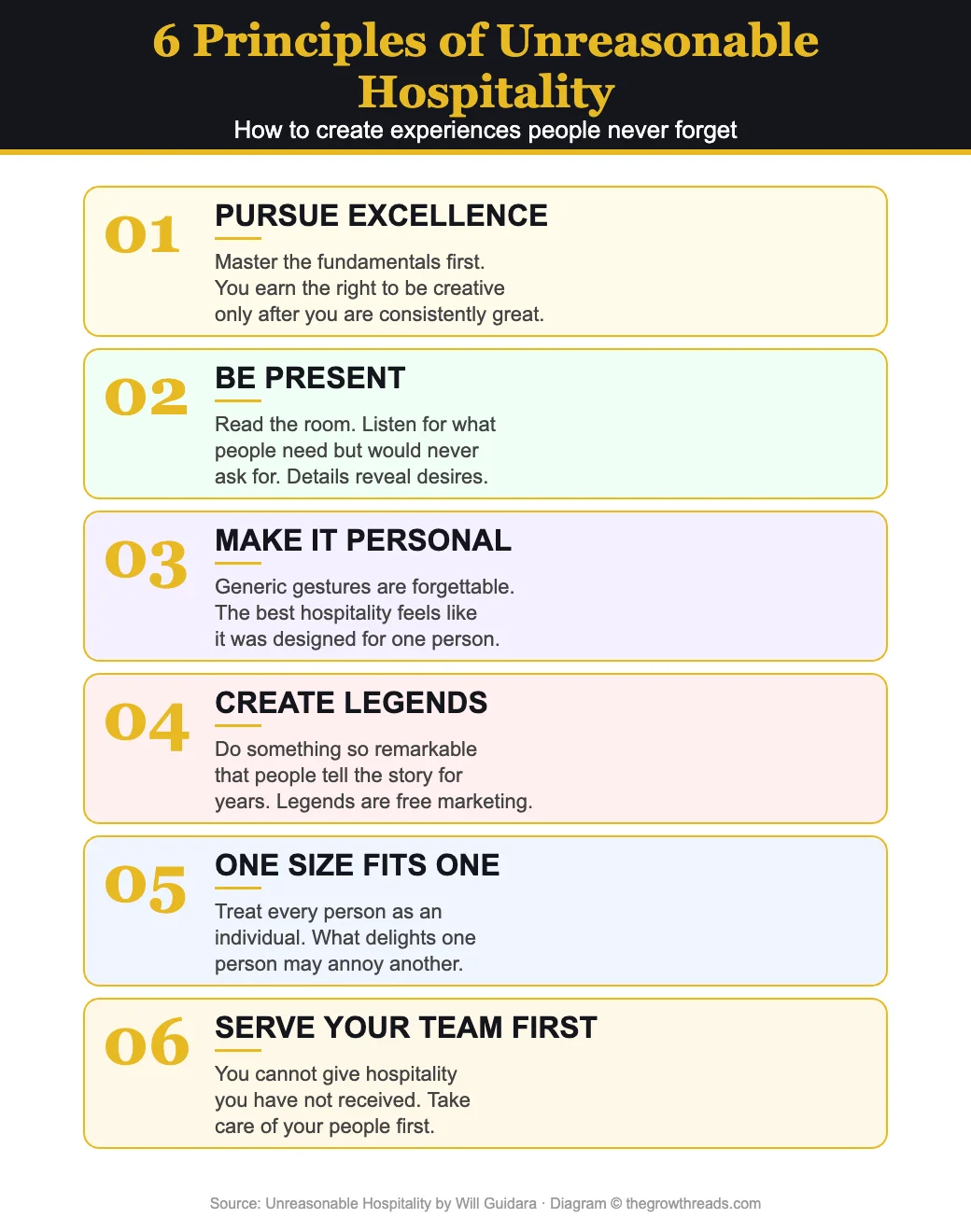
- Hospitality is a skill, not a personality trait: You do not have to be naturally warm or extroverted. Hospitality is a set of systems and decisions that anyone can learn and teach.
- Excellence first, then creativity: You earn the right to do extraordinary things only after you are consistently great at the fundamentals. Creativity without competence is chaos.
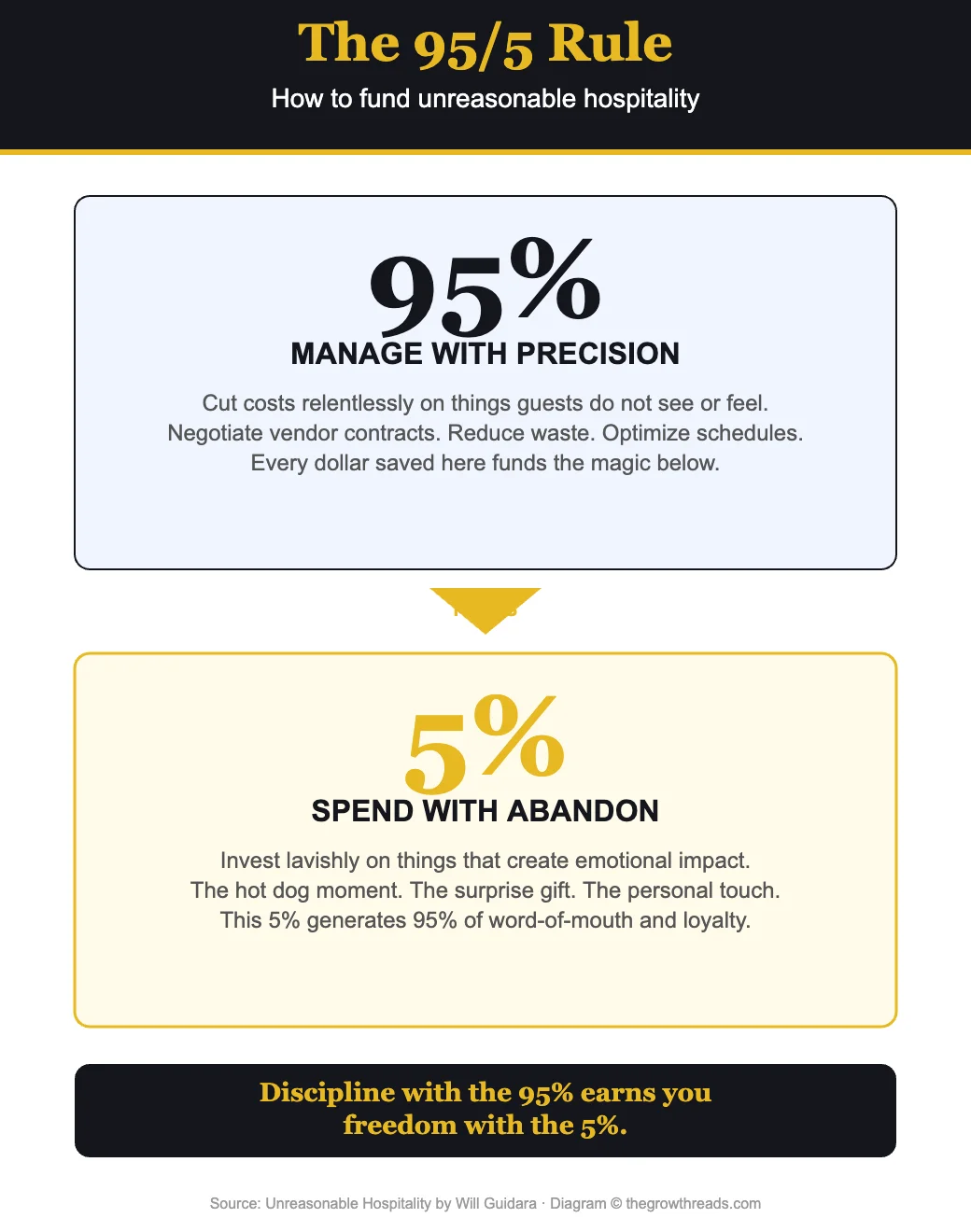
- The 95/5 rule: Manage 95% of your operation with fierce discipline so you can spend 5% on moments of unreasonable generosity. The 5% generates almost all your word-of-mouth.
- One size fits one: Generic hospitality is forgettable. The best experiences feel tailor-made because they are — you must read each person and customize accordingly.
- Create legends: Do something so remarkable that people tell the story forever. Legends are the most powerful and cheapest form of marketing that exists.
- Serve your team first: You cannot give hospitality you have not received. Take care of your people before asking them to take care of your customers.
- Read the room, not the script: The best hospitality comes from paying attention to what people actually need, not from following a checklist of “nice things to do.”
- Black-and-white vs. color decisions: Protect the non-negotiables (standards, safety, brand) absolutely, but give your team complete freedom on everything else.
- Pursue both excellence and hospitality: Most businesses choose one. The ones that win combine technical mastery with genuine human warmth.
- Being unreasonable is the point: The word “unreasonable” is intentional — reasonable hospitality is invisible. Only the unreasonable version creates emotional impact.
What is Unreasonable Hospitality about?
Unreasonable Hospitality is the story of how Will Guidara transformed Eleven Madison Park into the world’s best restaurant by prioritizing how guests feel over everything else. It provides a framework for building a culture of radical generosity — in restaurants, businesses, and daily life — through systems, leadership principles, and a philosophy of giving people more than they expect.
About the author
Will Guidara grew up in the restaurant industry — his father managed several New York City restaurants, and young Will spent his childhood watching front-of-house operations. After studying hospitality at Cornell, he took over as general manager of Eleven Madison Park at age 26, partnering with chef Daniel Humm. Over the next decade, Guidara and Humm transformed EMP from a two-star brasserie into a four-star, three-Michelin-star restaurant that was named the number one restaurant in the world in 2017. Guidara’s philosophy — that hospitality matters as much as the food — became the restaurant’s defining differentiator. He has since become one of the most sought-after speakers on leadership and service culture, working with companies across tech, finance, healthcare, and hospitality. Explore all Will Guidara book summaries →
Key concepts at a glance
| Concept | What it means | Use it when |
|---|---|---|
| Unreasonable Hospitality | Going so far beyond expectations that people tell the story forever | You want to differentiate on experience rather than product alone |
| The Dreamweaver | A dedicated team role for turning overheard comments into surprise moments | You want to systematize personalized gestures at scale |
| The 95/5 Rule | Manage 95% of costs with discipline; spend 5% on emotional impact | You need to fund generosity without blowing your budget |
| One Size Fits One | Customizing every interaction to the individual | Your service feels generic or scripted |
| Legends | Moments so remarkable they become stories people retell for years | You want organic word-of-mouth marketing |
| Black-and-White vs. Color | Non-negotiable standards vs. areas of creative freedom for the team | You need to empower people without losing quality control |
| Hospitality vs. Service | Service is technical delivery; hospitality is how it makes people feel | Your operations are excellent but emotionally forgettable |
| The Hot Dog Moment | An iconic example: serving a NYC street hot dog as a fine-dining course | You need to understand that unreasonable moments do not need to be expensive |
Part 1: The foundation — excellence before hospitality
Guidara opens with a critical distinction: hospitality without excellence is empty generosity, and excellence without hospitality is cold perfection. The first years at Eleven Madison Park were spent obsessively improving the basics — the food, the wine program, the pace of service, the cleanliness. Only after the restaurant achieved consistent technical excellence did Guidara begin layering on the extraordinary gestures that would eventually make EMP famous.
This sequencing matters because it establishes credibility. When a mediocre restaurant tries to create “wow moments,” guests see it as a distraction from the real problems. When a flawless restaurant adds a personal surprise, it feels like magic built on a foundation of trust. Guidara calls this “earning the right to be creative.” You cannot skip the fundamentals. Every legendary moment at EMP was possible only because the underlying operation was already running at the highest level.
The early chapters also introduce Guidara’s partnership with chef Daniel Humm and the tension between the kitchen (focused on the food) and the dining room (focused on the experience). Guidara’s breakthrough was convincing Humm — and eventually the entire team — that both mattered equally. A perfect dish served by an indifferent waiter is a missed opportunity. An imperfect dish served by someone who makes you feel like the most important person in the room might still create a memory you cherish.
Part 2: The Dreamweaver system — scaling the personal touch
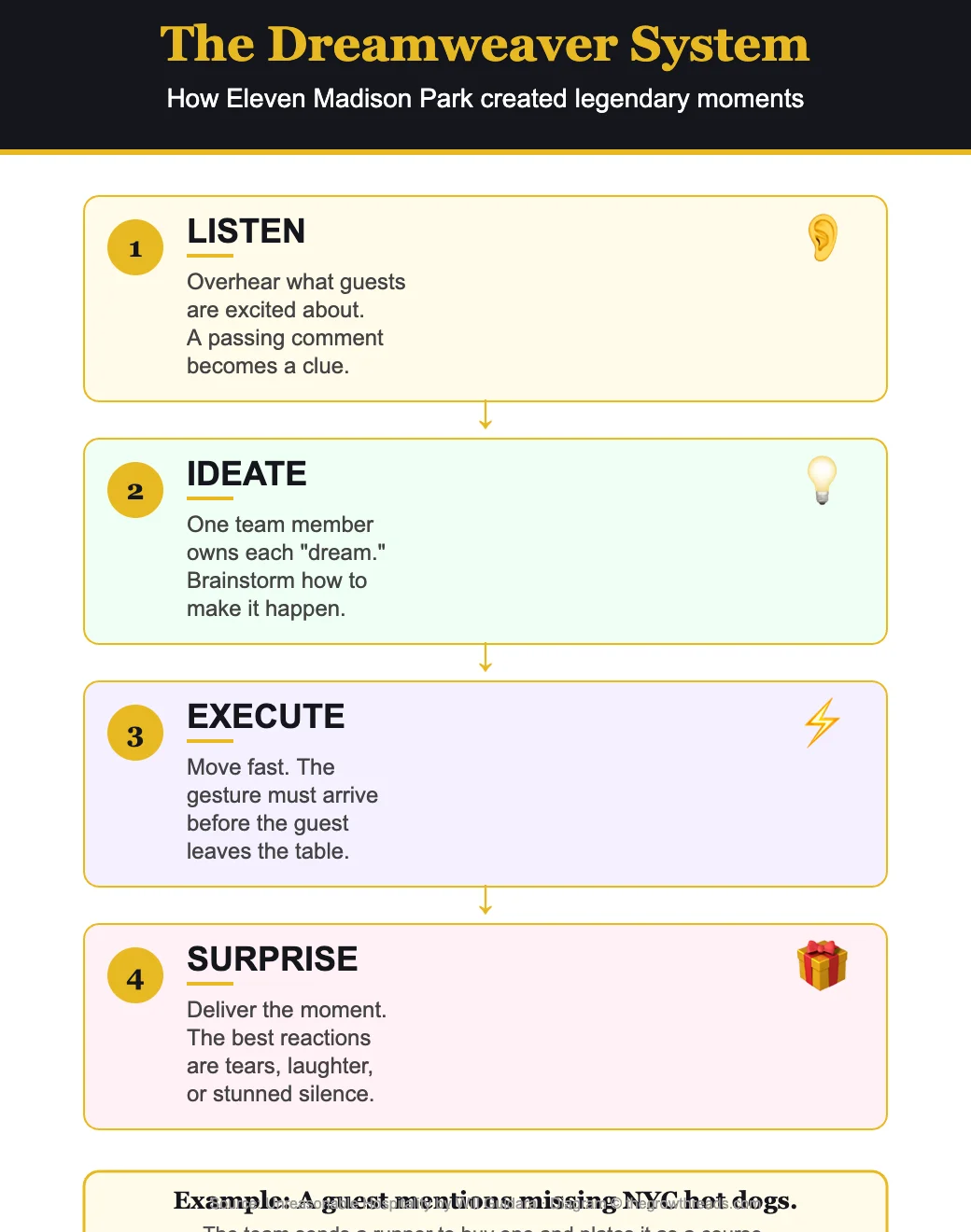
The book’s most innovative contribution is the Dreamweaver — a dedicated team member whose only job was to create personalized surprise moments for guests. The role emerged from a simple observation: guests constantly dropped clues about what would delight them. A couple mentioning it was their anniversary. A tourist saying they wished they could try a real NYC hot dog. A child excited about seeing snow for the first time. These moments usually evaporated because no one was responsible for acting on them.
The Dreamweaver changed that. The system worked in four steps: listen (servers and hosts were trained to overhear and report guest comments to the Dreamweaver), ideate (the Dreamweaver brainstormed a gesture that matched the guest’s specific comment), execute (the team made it happen before the guest left), and surprise (the gesture was delivered without explanation or expectation of reciprocity).
The most famous example became known as the hot dog moment. A family of tourists mentioned they had not tried a NYC street hot dog yet. The Dreamweaver sent a runner to buy one from a cart outside, plated it on fine china, and served it as an extra course at their four-star table. The gesture cost two dollars. The family told the story for years. That single hot dog generated more press coverage than any Michelin-starred dish on the menu.
What makes this system transferable to any business is that it does not require a restaurant or a large budget. It requires attention, creativity, and a willingness to deviate from the script. The investment is almost always small (a handwritten note, a remembered preference, an unexpected follow-up). The return is disproportionately large because people are so accustomed to transactional interactions that any genuine, personalized gesture feels extraordinary.
Part 3: The economics — how the 95/5 rule funds everything
Skeptics will ask: how do you pay for all this generosity? Guidara’s answer is the 95/5 rule. The principle is simple: manage 95% of your operation with ruthless financial discipline — negotiate better vendor contracts, reduce waste, optimize staffing, eliminate spending that does not directly impact the customer experience. Then take the savings and invest 5% of revenue in moments of unreasonable generosity, with zero expectation of direct return.
The math works because the 5% generates almost all of the restaurant’s word-of-mouth marketing, press coverage, and emotional loyalty. The hot dog cost two dollars. The press coverage it generated was worth thousands. A guest who experiences something extraordinary tells an average of seven people — and in the social media era, many tell thousands. This is marketing that money cannot buy, funded by operational discipline.
Guidara extends the 95/5 principle to leadership decisions more broadly. He uses the metaphor of “black-and-white” vs. “color” decisions. Black-and-white decisions are non-negotiable: food safety, cleanliness, core standards. These are protected absolutely and never compromised. Color decisions are everything else — how a table is set, how a guest is greeted, what gesture is appropriate. On color decisions, the team has complete creative freedom. This framework lets Guidara maintain quality control without killing his team’s autonomy or creativity.
Part 4: Leading the team — hospitality starts inside
The book’s final section focuses on the leadership principles that made the culture possible. Guidara’s most important insight here is deceptively simple: you cannot give hospitality you have not received. If your employees feel unseen, overworked, and undervalued, they will never — no matter how many training programs you run — make customers feel seen, valued, and cared for. Hospitality is an emotional state that transfers from leader to team to customer. The chain breaks wherever someone feels uncared for.
Guidara backed this up with specific practices. He held daily pre-service meetings that were as much about connection as about logistics. He learned every team member’s story. He gave public recognition for exceptional hospitality moments. He protected his team’s time off religiously. When a team member was going through a personal crisis, the restaurant rallied around them — not because it was policy, but because it was the culture.
He also describes the painful process of learning to give feedback with care. Early in his career, Guidara confused directness with coldness. He would deliver critical notes in front of the team, thinking transparency was the priority. Through trial and error, he developed what Kim Scott would recognize as Radical Candor — the ability to challenge directly while caring personally. The result was a team that could hear hard truths without feeling attacked, because they trusted that the feedback came from genuine investment in their growth.
Who is Unreasonable Hospitality best for — and who should read something else first?
This book is ideal for anyone in a leadership or service role — founders, managers, team leads, salespeople, teachers, healthcare workers — who wants to build a culture where people feel genuinely valued. It is equally useful as a business strategy book and a personal philosophy book. If you run any kind of team or interact with customers, the principles apply directly.
If you want a more data-driven approach to leadership, start with Good to Great by Jim Collins or Multipliers by Liz Wiseman. If you are specifically working on team culture, The Culture Code is a strong companion read. Guidara’s strength is in the emotional and practical dimension of leadership — the book will change how you treat people, not just how you manage them.
Questions to reflect on
- When was the last time a business or person made you feel genuinely special? What exactly did they do, and why did it stick with you?
- In your work, where are you settling for “good enough” hospitality when an unreasonable gesture could create a lasting memory?
- What would your version of the Dreamweaver look like — who on your team could own the role of creating surprise moments?
- Where in your 95% could you find savings to fund a 5% investment in emotional impact?
- How well are you taking care of your own team? Would they say they feel genuinely seen and valued?
🔥 Ready to give people more than they expect?
Unreasonable Hospitality will transform how you lead, serve, and connect with everyone around you.
How to apply Unreasonable Hospitality (7-day plan)
- Day 1 — Notice the clues: Spend the entire day listening for what the people around you — colleagues, family, customers — mention wanting or enjoying. Write down three clues in a notebook.
- Day 2 — Create one legend: Pick one clue from yesterday and act on it. Do something small but personal — a note, a small gift, a solved problem they did not ask you to solve. Make them feel seen.
- Day 3 — Audit your 95%: Review your team or personal budget for one area where you are spending money that does not directly impact the people you serve. Redirect that saving toward something that will.
- Day 4 — Serve your team: Do something unexpected and generous for a colleague or team member. Buy their coffee. Publicly recognize their work. Give them time off they did not ask for.
- Day 5 — Define your black-and-white: Write down the 3–5 non-negotiable standards in your work or life. Then explicitly free yourself (and your team) to be creative on everything else.
- Day 6 — Make one interaction personal: In your next meeting, call, or customer interaction, find one detail that shows you remembered something specific about that person. Reference it naturally.
- Day 7 — Assign a Dreamweaver: If you lead a team, designate one person (even part-time, even yourself) to be responsible for noticing opportunities to create unreasonable moments. Give them permission and a small budget.
Frequently asked questions
What is unreasonable hospitality?
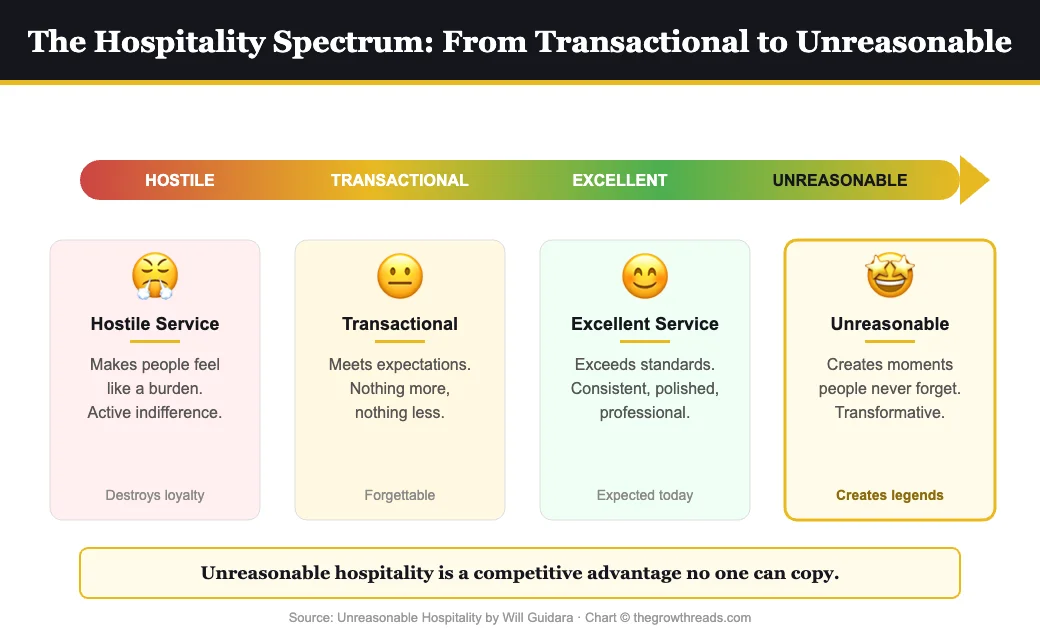
Unreasonable hospitality is the practice of going so far beyond what people expect that the experience becomes a story they tell for years. The word “unreasonable” is deliberate — reasonable hospitality (meeting expectations, being polite, delivering good service) is invisible because it is expected. Only when you cross the line into unreasonable territory — a personalized surprise, an absurdly generous gesture, a moment that feels designed just for one person — do you create emotional impact that people remember and share.
What is the hot dog story in Unreasonable Hospitality?
A family of tourists dining at Eleven Madison Park mentioned they had visited New York without trying a street hot dog. The Dreamweaver sent a runner to buy a two-dollar hot dog from a cart outside, plated it on fine china with proper garnishes, and served it as an extra course at their four-star table. The family was stunned and delighted. They told the story everywhere they went, generating more press than any dish on the menu. It became the signature example of how small, personal gestures create legendary experiences.
What is the 95/5 rule?
The 95/5 rule is Guidara’s financial framework for funding unreasonable hospitality. You manage 95% of your operation with strict financial discipline — cutting costs on things customers do not see or feel — and then invest the savings (roughly 5% of revenue) on moments of unreasonable generosity. The principle works because the emotional impact generated by the 5% creates word-of-mouth marketing and loyalty that far exceeds what traditional marketing spend could achieve.
Can you apply unreasonable hospitality outside restaurants?
Absolutely — and that is the book’s central argument. Guidara has consulted with companies in tech, healthcare, finance, education, and retail to apply these principles. The core framework (listen for clues, create personalized moments, serve your team first) works in any context where humans interact. A manager who remembers a team member’s child’s name and asks about their soccer game is practicing unreasonable hospitality. A doctor who follows up with a patient after hours is practicing it. The principles are universal.
What is the difference between service and hospitality?
Service is the technical delivery of a product or experience — accuracy, speed, consistency, quality. Hospitality is how the delivery makes people feel — seen, valued, cared for, special. You can have excellent service with zero hospitality (think of a flawlessly efficient but emotionally cold airline). You can also have warm hospitality with poor service (a friendly but incompetent waiter). Guidara argues that the businesses that win long-term combine both: technical excellence delivered with genuine human warmth.
How long does it take to read Unreasonable Hospitality?
The book is 304 pages and most readers finish it in about five hours. Guidara writes in a conversational, story-driven style with vivid restaurant anecdotes that make the pages fly. The audiobook, narrated by the author, runs about eight hours and is particularly engaging because Guidara’s natural warmth comes through in his narration. Many readers report finishing it in one or two sittings because the stories are so compelling.
What is the Dreamweaver role in Unreasonable Hospitality?
The Dreamweaver was a dedicated team member at Eleven Madison Park whose sole responsibility was creating personalized surprise moments for guests. The role was invented because Guidara noticed that guests constantly dropped clues about what would delight them, but no one was responsible for acting on those clues. The Dreamweaver would receive tips from servers, brainstorm a gesture, coordinate execution, and deliver the surprise before the guest left. The role proves that personalized hospitality can be systematized without losing its magic.
Related summaries
- The Culture Code Summary — Daniel Coyle on the signals that build high-performing, caring cultures.
- Radical Candor Summary — Kim Scott on giving honest feedback with genuine care.
- Leaders Eat Last Summary — Simon Sinek on why great leaders put their people first.
- Best Leadership Books — Our curated guide to the most impactful books on leading teams and organizations.
Related Leadership Summaries
Legacy Summary and Review
Principles Summary & Review: How to Make Better Decisions in Life and Work
Radical Candor Summary & Review: Be a Great Boss Without Losing Your Humanity
The 21 Irrefutable Laws of Leadership Summary & Review: The Complete Framework for Growing Your Influence
Wooden on Leadership Summary & Review: The Pyramid of Success Framework