

★★★★ 4.2/5 — a genuinely freeing two-word mindset tool for anyone who exhausts themselves managing other people. Simple, repetitive, but sticky.
Best for: people-pleasers, over-thinkers, and anyone drained by others’ opinions and drama · Reading time: ~6 hours (this guide: 14 min) · Difficulty to apply: Easy to grasp — the discipline is catching yourself in the moment
The Let Them Theory in one minute
So much of our stress comes from trying to control other people — and two words can set you free: “Let Them.” Mel Robbins builds an entire practical philosophy around the moment you stop fighting other people’s opinions, choices, and behavior and simply let them be who they are. When someone judges you, let them. When a friend pulls away, lets you down, or excludes you, let them. Trying to manage how others think and act, Robbins argues, is a losing battle that drains your energy and steals your peace. But the theory has a crucial second half that most people miss: after you “Let Them,” you must “Let Me” — take full responsibility for your own response, your boundaries, and what you do next. Together, these two moves hand you back the only power you ever actually had: control over yourself. It is a repackaging of ancient Stoic wisdom into a phrase you can use in real time.
Key takeaways
- “Let Them”: stop trying to control other people’s opinions, choices, and behavior; let them be who they are.
- “Let Me”: the essential second step — take ownership of your own response, energy, and actions.
- You only control yourself: almost all stress comes from trying to manage what was never yours to manage.
- Other people’s opinions are not your business: what others think of you is out of your control, so let them think it.
- Let people show you who they are: when someone reveals their character, believe them instead of fighting reality.
- Adult friendships change: let people drift; the right ones stay, and chasing the rest is exhausting.
- Stop managing others’ emotions: you are not responsible for how everyone else feels or reacts.
- Comparison is optional: let others have their wins; your energy belongs on your own path.
- Boundaries replace control: you can’t change people, but you can decide how you respond and what you allow.
- Peace is a practice: “Let Them, Let Me” only works when you catch yourself in the moment and repeat it.
What is The Let Them Theory about?
The Let Them Theory is a self-help book by Mel Robbins built around a simple mindset tool. It teaches you to stop wasting energy trying to control other people’s opinions and behavior by saying “Let Them,” and then to reclaim your power by saying “Let Me” — taking responsibility for your own response. The result, Robbins argues, is less stress and more freedom.
About the author
Mel Robbins is one of the most widely followed voices in modern self-improvement — a former criminal defense attorney turned motivational speaker, author, and host of the top-ranked Mel Robbins Podcast. She first broke through with The 5 Second Rule, another deceptively simple behavioral tool, and has built a large audience around practical, science-flavored advice delivered in a warm, direct voice. Published in late 2024 and co-authored with her daughter Sawyer Robbins, The Let Them Theory became an immediate blockbuster, one of the fastest-selling self-help books in years, after the phrase went viral online. Robbins is candid that she did not invent the two-word idea — versions of it have circulated widely — but she takes credit for turning it into a complete, usable framework, backed by relatable stories and references to psychology, that people can actually apply to friendships, family, work, and their own anxious minds. Explore all Mel Robbins book summaries →
Key concepts at a glance
| Concept | What it means | Use it when |
|---|---|---|
| Let Them | Release control over others | You’re upset by someone’s behavior |
| Let Me | Own your response and choices | Right after you “let them” |
| Locus of control | Focus only on what is yours | You feel powerless or anxious |
| Others’ opinions | Not your business to manage | You fear judgment |
| Adult friendship drift | Let relationships change naturally | A friend pulls away |
| Boundaries | Decide your response, not their behavior | Someone crosses a line |
Part 1: The two words that change everything — Let Them
Robbins tells the story that sparked the book: watching her son stress over friends at a prom, she instinctively wanted to intervene and fix the social dynamics, until her daughter told her to just “let them.” The relief was immediate. She realized how much of her mental energy she spent trying to control situations and people she had no power over, and how quickly that pressure vanished the moment she released it. That is the first move of the theory — when other people do things you dislike, disagree with, or find hurtful, you let them.
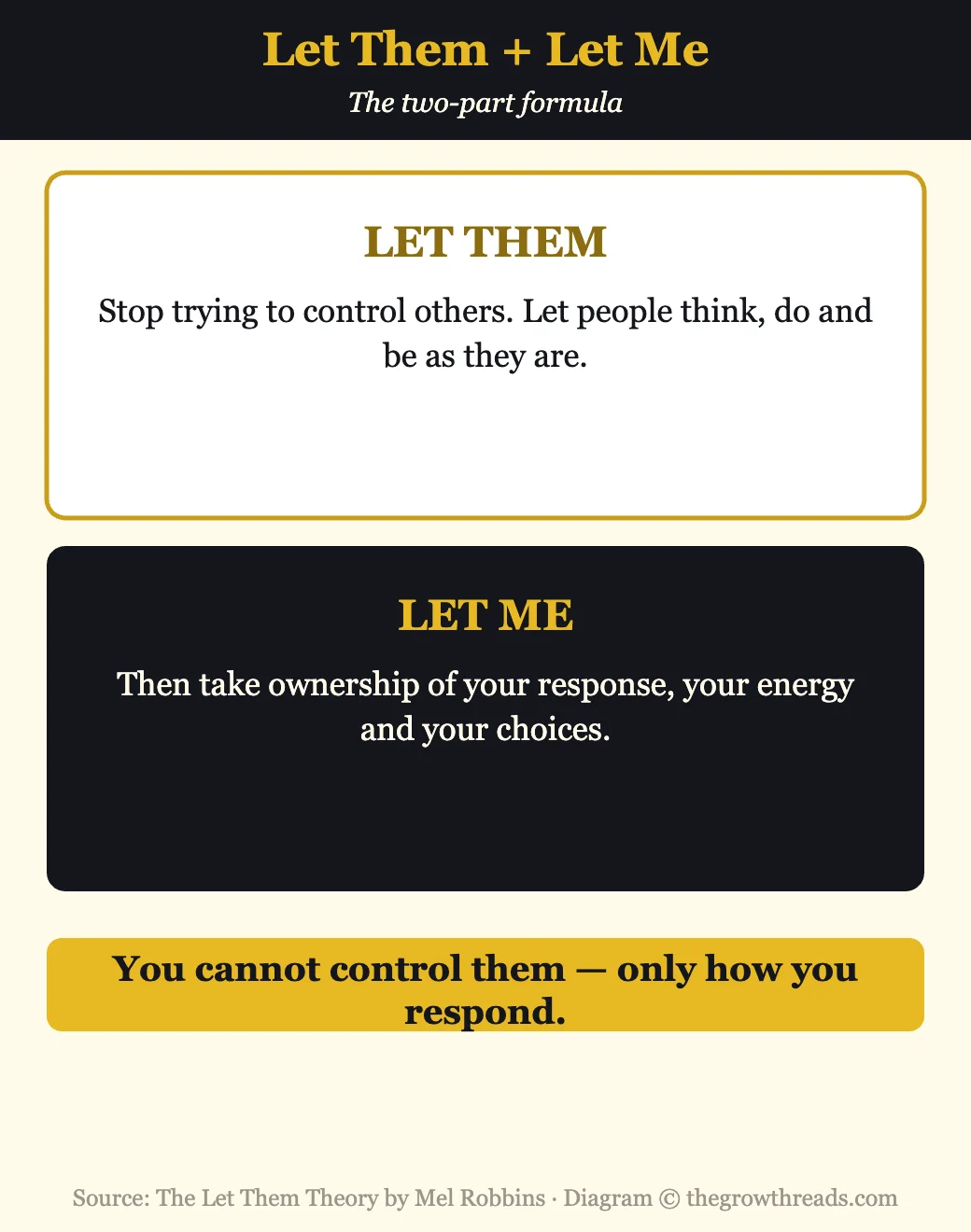
The power of “Let Them” is that it stops the exhausting, futile fight against reality. When someone judges you, criticizes you, or misunderstands you, your instinct is to defend, explain, or change their mind — but their opinion of you is fundamentally out of your control. Let them think it. When a friend cancels, a colleague takes credit, or a family member behaves badly, “Let Them” releases you from the resentment of expecting them to be different than they are. Robbins frames this as a form of acceptance, not defeat: you are not endorsing bad behavior, you are simply stopping the drain of trying to control the uncontrollable. The phrase works because it is short enough to say to yourself in the heat of the moment, interrupting the spiral before it takes hold.
Part 2: The half everyone forgets — Let Me
Robbins is emphatic that “Let Them” alone is incomplete, and even risks becoming passive resignation or an excuse to check out of relationships. The theory only works with its second half: “Let Me.” Once you have released your grip on the other person, you turn your attention to the one thing you can control — yourself.
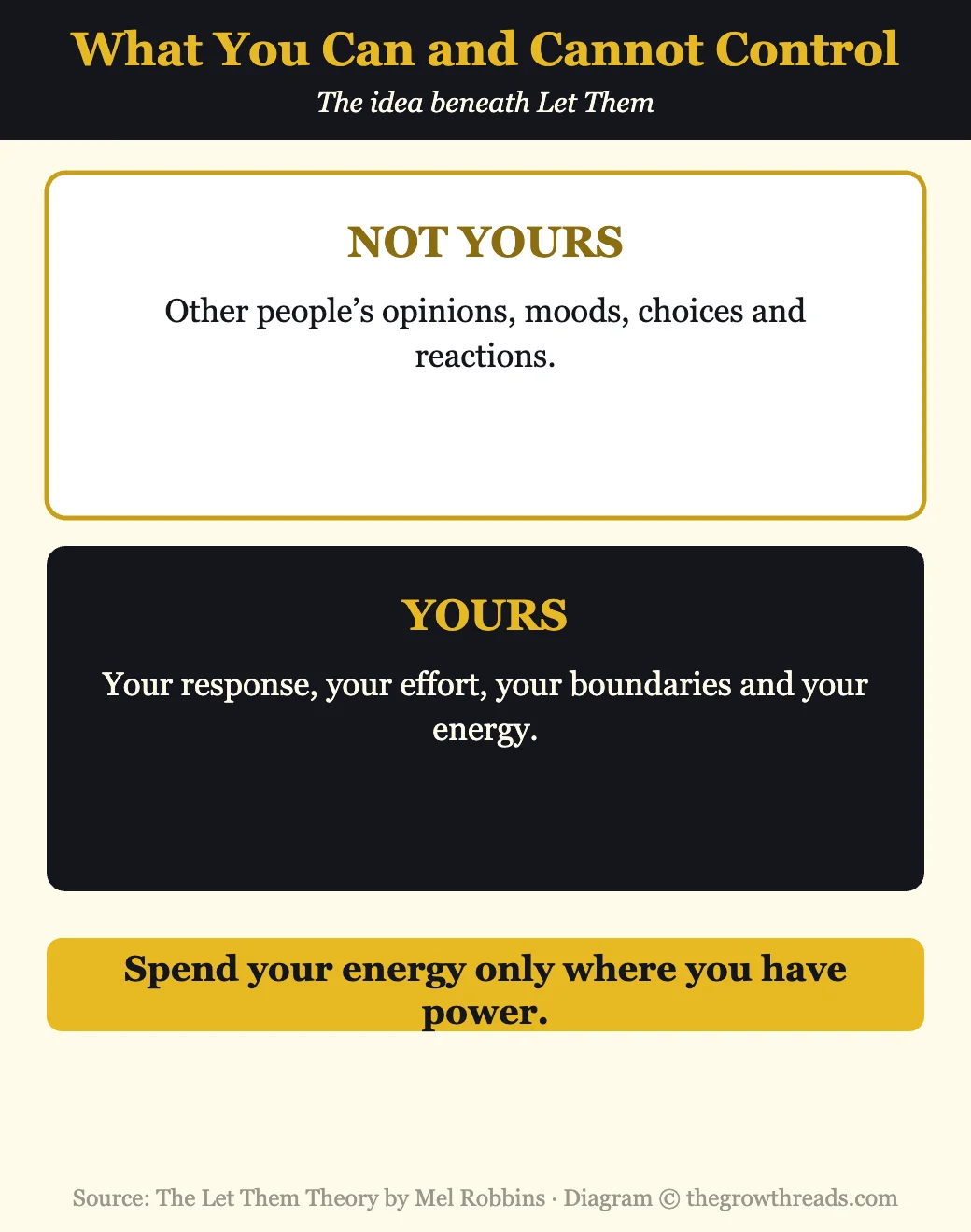
“Let Me” is about ownership. After you let someone be who they are, you ask: what will I do now? How will I respond? What boundary do I need? What do I actually want here? If a friend keeps letting you down, “Let Them” stops you stewing over their behavior, and “Let Me” prompts you to decide how much energy that friendship deserves going forward. If someone is rude, “Let Them” spares you the argument, and “Let Me” lets you choose your response and protect your peace. This second step is what separates the theory from mere avoidance — it transforms letting go from a passive shrug into an active reclaiming of your own agency. The distinction Robbins keeps returning to is the timeless one at the heart of Stoicism: you cannot control other people, but you have complete authority over your own thoughts, choices, and actions, and that is where all your energy should go.
TGR Note: The Let Them Theory is essentially Stoicism’s “dichotomy of control” rebranded for the group-chat era — and it lands in the same place as The Courage to Be Disliked, whose “separation of tasks” says other people’s opinions of you are their task, not yours. It also echoes the core of The Subtle Art of Not Giving a F*ck: reserve your limited care for what you can actually control.
Part 3: Applying Let Them — opinions, comparison, and friendships
Much of the book works through the specific situations where the theory earns its keep. The most common is other people’s opinions. Robbins argues that the fear of judgment secretly runs many people’s lives, and that “Let Them” is the cure: let them think you’re too much, too quiet, too ambitious, or not enough.
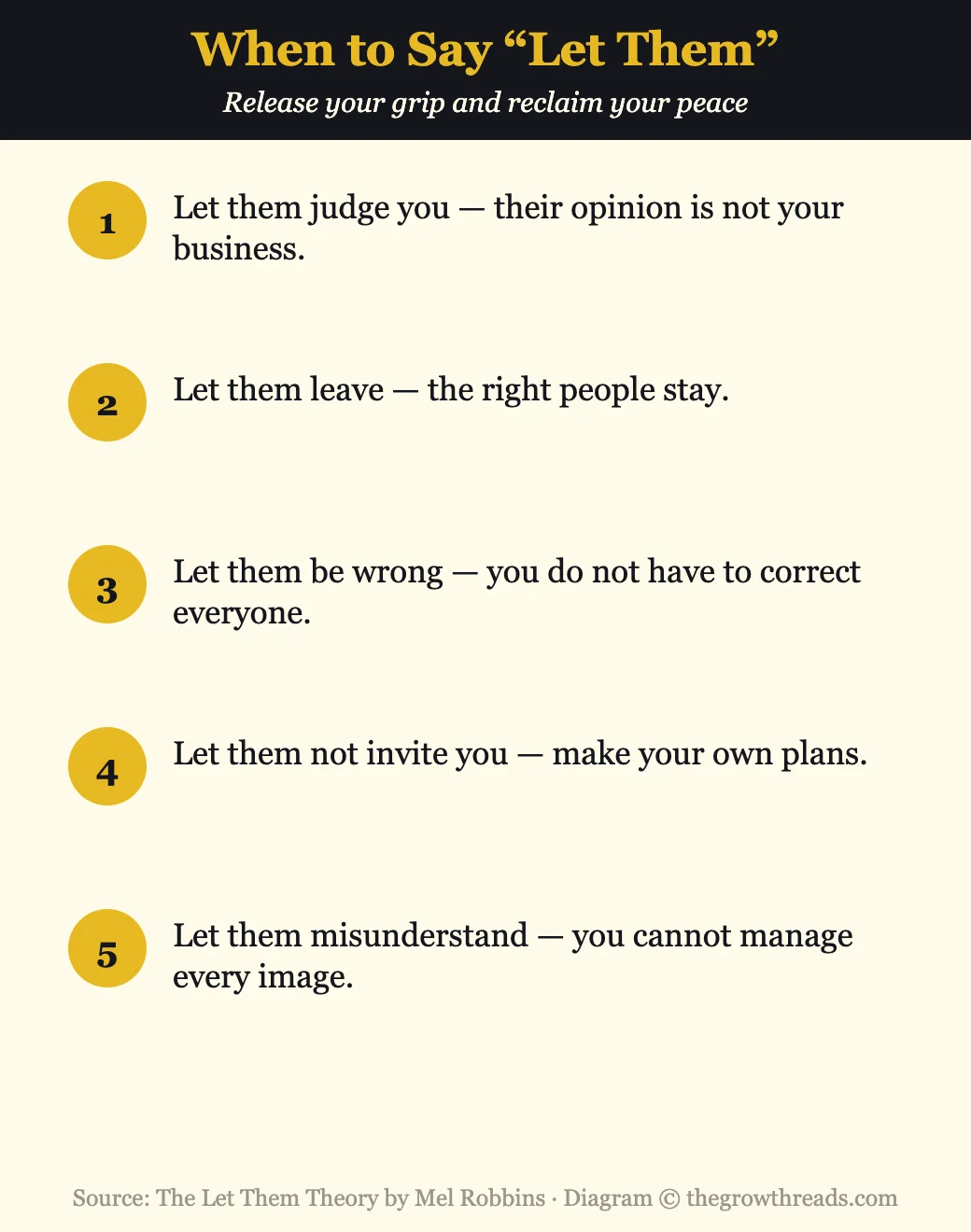
Because you can never fully control the story others tell about you, trying to is a trap; letting them judge frees enormous energy for your own life. She applies the same lens to comparison — let others have their highlight reels and wins, and keep your focus on your own path — and to the painful, universal experience of adult friendships changing. People grow apart, get busy, and sometimes exclude us, and Robbins counsels letting them, rather than clinging or keeping score. The friendships meant to last will; chasing the ones that are fading only prolongs the hurt. In each case the pattern is identical: “Let Them” removes the resentment, and “Let Me” points you back toward the plans, people, and choices that are actually yours to make.
Part 4: Let Them in relationships, family, and your own mind
The theory goes deeper into close relationships, where control is most tempting and most damaging. Robbins argues you cannot nag, manage, or love someone into changing; you can only let them be who they are and then decide, through “Let Me,” what you will accept and how you will show up. This extends to a liberating idea: you are not responsible for managing everyone else’s emotions. Many people, especially those raised to keep the peace, carry a constant background hum of anxiety about how others feel and whether everyone around them is okay. “Let Them” releases you from that impossible job — other adults are responsible for their own feelings — while “Let Me” keeps you responsible for treating people well and setting honest boundaries.
Finally, Robbins turns the tool inward, on your own anxious, controlling mind. Much of our suffering, she argues, comes from an internal insistence that things and people should be different than they are. “Let Them” can be applied to reality itself: let the traffic be slow, let the plan fall through, let the situation be what it is, and then use “Let Me” to choose your response. The book is repetitive by design — Robbins wants the phrase drilled in so it surfaces automatically in the moment you need it. The critique some readers make is fair: it is a very simple idea stretched across a long book, and the psychology is worn lightly. But the counter is that simplicity is the point. A tool you will actually remember and use under stress beats a sophisticated framework you forget, and many readers report that this particular two-word phrase genuinely stuck.
Who is The Let Them Theory best for — and who should read something else first?
This book is ideal for people-pleasers, over-thinkers, and anyone worn down by other people’s opinions, drama, and expectations. Its tool is easy to grasp and immediately usable, and the relationship examples are relatable. It is not for readers who want dense, heavily researched argument or who dislike repetitive, motivational-style writing — the idea is simple and stretched long. If you want the same liberation with a more rigorous psychological foundation, read The Courage to Be Disliked; for a punchier, funnier take on caring less, try The Subtle Art of Not Giving a F*ck.
Questions to reflect on
- Whose behavior are you exhausting yourself trying to control right now?
- Where are you letting the fear of someone’s opinion quietly run your decisions?
- After you “let them,” what would “let me” look like — what response is actually yours to choose?
- Which fading friendship are you clinging to that you could let drift?
- Whose emotions have you been managing that were never your responsibility?
🔥 Ready to let them — and reclaim your peace?
This guide is the map — Robbins’s stories are what make the two words actually stick in the moment.
How to apply The Let Them Theory (7-day plan)
- Day 1 — Learn the phrase. Practice saying “Let Them, Let Me” so it’s ready when stress hits.
- Day 2 — Let them judge. Notice one fear of someone’s opinion and consciously let them think it.
- Day 3 — Add “Let Me.” After letting go, choose one deliberate response that is actually yours.
- Day 4 — Release a friendship. Stop chasing one relationship that is fading and let it be.
- Day 5 — Drop the emotion-managing. Let one other adult own their feelings instead of fixing them.
- Day 6 — Set one boundary. Use “Let Me” to decide what you will and won’t accept.
- Day 7 — Let reality be. Apply “Let Them” to a frustration you can’t control, then choose your response.
Frequently asked questions
Is The Let Them Theory worth reading?
For the right reader, yes. If you tend to over-manage other people’s opinions and behavior, the “Let Them, Let Me” tool is genuinely freeing and easy to apply, and the relatable stories help it stick. The honest caveat is that it is a very simple idea stretched across a long book, and the psychology is presented lightly, so readers who want dense, rigorous argument may find it repetitive. Many people, though, say the two-word phrase is one of the few self-help tools they actually remember and use.
What is the Let Them Theory?
It is a two-part mindset tool. “Let Them” means to stop trying to control other people’s opinions, choices, and behavior, and instead let them be who they are — which frees you from the stress of fighting the uncontrollable. “Let Me” is the essential second step: once you release your grip on others, you take full responsibility for your own response, energy, boundaries, and choices. Together they focus your effort on the only thing you truly control — yourself.
What is the main message of The Let Them Theory?
That most of our stress comes from trying to control what other people think and do, and that peace comes from releasing that control and redirecting our energy inward. Robbins argues you cannot manage other people’s opinions, emotions, or behavior, so you should let them — and then take ownership of your own reactions and choices. It is a modern, everyday repackaging of the Stoic principle of focusing only on what is within your control.
Did Mel Robbins invent the Let Them idea?
Not exactly, and she says so. The two-word “Let Them” sentiment had circulated widely before the book, including in a well-known poem, and this has drawn some criticism online. Robbins’s contribution is turning the phrase into a complete, structured framework — especially the crucial “Let Me” second half — supported by stories and psychology so that people can actually apply it. Whether that reframing justifies a full book is a fair debate, but the practical tool it delivers is what most readers value.
How is The Let Them Theory different from just not caring?
The “Let Me” half is the key difference. “Let Them” on its own could look like apathy or checking out of relationships, but Robbins insists it is only step one. “Let Me” then requires you to take active responsibility — to choose your response, set boundaries, and decide what you want — which turns letting go from passive resignation into an intentional reclaiming of your agency. It is about redirecting energy toward what you control, not about ceasing to care.
How long does it take to read The Let Them Theory?
The book is around 320 pages and most readers finish it in about six hours, though because the core idea is simple and repeated, many read it quickly or skim. Our summary above captures the framework and its main applications in roughly 14 minutes, which for this particular book is often enough to start using the tool right away.
Is The Let Them Theory good for anxiety and people-pleasing?
It is especially aimed at exactly those tendencies. People-pleasers and anxious over-thinkers often exhaust themselves trying to control how others feel and what they think, and the “Let Them, Let Me” tool directly targets that pattern by releasing the impossible job of managing everyone else and returning focus to your own choices. It is not a substitute for therapy or treatment where those are needed, but as a simple, in-the-moment mindset shift, many readers find it calming and practical.
Related summaries
- The Courage to Be Disliked Summary — the deeper psychology of freedom from approval.
- The Subtle Art of Not Giving a F*ck Summary — caring less, but about the right things.
- The Power of Now Summary — accepting the present moment as it is.
- Browse all our best relationship books.
How we analyze books: We work from the full book — reconstructing its core arguments in our own words, adding commentary that connects it to related research and other books in our library, and pressure-testing the advice against how it plays out in real life. We never reproduce the text; we synthesize it. Read our full methodology.
Disclosure: The Growth Reads is reader-supported. When you buy through links on our site we may earn an affiliate commission at no extra cost to you. We only recommend books we believe are worth your time, and our summaries and opinions are written independently.
Related Relationships Summaries
Boundaries Summary & Review: When to Say Yes, How to Say No to Take Control of Your Life
Eight Dates Summary & Review: The Research-Backed Conversations That Transform Relationships
How to Talk So Kids Will Listen Summary & Review: 5 Skills That Transform Parenting
Why Marriages Succeed or Fail Summary & Review: The Science Behind Lasting Love
Why Won’t You Apologize Summary and Review