

★★★★½ 4.6/5 — The original research behind the “Four Horsemen” and the 5:1 ratio: dense in places, but genuinely diagnostic rather than generic.
Best for: Couples who want data-backed answers for what’s actually going wrong in an argument.
Reading time: Book ~6 hrs · This guide ~9 min
Difficulty to apply: Moderate — requires noticing patterns in real time during conflict.
Why Marriages Succeed or Fail in one minute
Most marriage advice tells couples to fight less. John Gottman’s research says something more useful: it’s not whether you fight, but how. After years of observing couples argue inside his “Love Lab” at the University of Washington, Gottman identified four specific behaviors that predict divorce with startling accuracy — and a simple ratio that predicts whether a marriage will last. This isn’t a book of gentle platitudes about listening more. It’s a diagnostic manual: name the pattern, then swap it for a teachable alternative. The result reads more like a field guide to your own arguments than a typical self-help book, and it’s the source material behind concepts — the Four Horsemen, the magic ratio, repair attempts — that have since become standard vocabulary in couples therapy.
Key takeaways
- Fighting isn’t the problem: three of the five marriage styles Gottman identified involve frequent, sometimes loud conflict — and all three can last a lifetime.
- Contempt is the single strongest predictor of divorce — stronger than criticism, defensiveness, or even chronic disagreement.
- The Four Horsemen arrive in a predictable sequence (criticism, contempt, defensiveness, stonewalling), and catching them early is far easier than reversing them once entrenched.
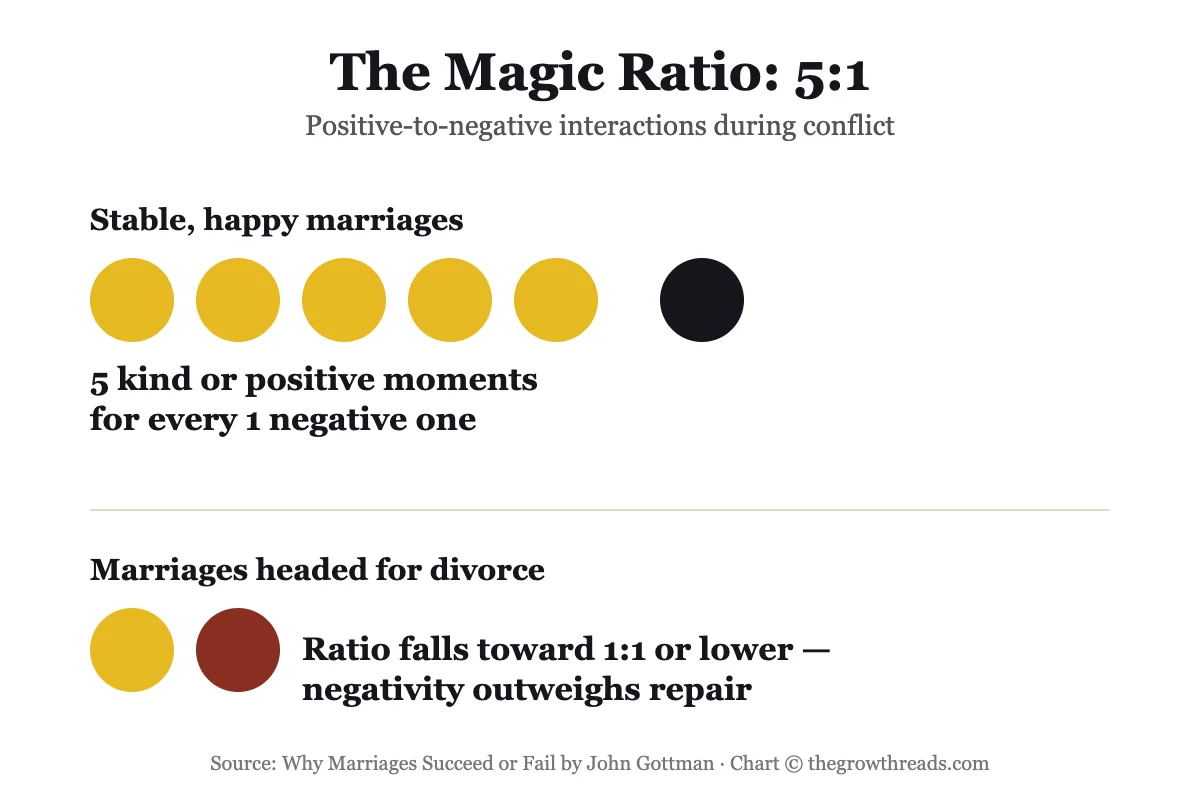
- Stable couples keep roughly five positive interactions for every negative one during conflict — the “magic ratio.”
- How you repair matters more than how the fight started. Couples who reconnect quickly stay together regardless of how loud the argument got.
- “Flooding” — the physiological overwhelm of a racing heart and tunnel vision — shuts down your ability to hear your partner, which makes a timeout a skill, not a cop-out.
- The Love Lab could predict divorce with over 90% accuracy after watching a couple discuss a disagreement for as little as 15 minutes.
- There is no single “correct” communication style. Validating, volatile, and conflict-avoiding couples all build lasting marriages in their own way.
- Small daily habits beat grand gestures — an accurate mental map of your partner’s current stresses and hopes matters more than one dramatic anniversary.
- The stories couples tell about their own history reveal where they’re headed — toward continued repair, or toward quietly rewriting the past in a negative light.
What is Why Marriages Succeed or Fail about?
Why Marriages Succeed or Fail is psychologist John Gottman’s account of his Love Lab research, which observed thousands of couples arguing to identify the specific behaviors — nicknamed the Four Horsemen — that predict divorce with over 90% accuracy, plus the ratio of positive to negative interactions that keeps a marriage stable.
About the author
John Gottman is an American psychologist and professor emeritus at the University of Washington, where he ran the “Love Lab” — an apartment-like research space where he and colleagues observed couples’ conversations frame by frame, coding facial expressions, physiology, and word choice. Beginning in the 1970s with fellow researcher Robert Levenson, Gottman followed married couples for years, sometimes decades, tracking who divorced and when. That longitudinal data became the foundation for this book’s central claims and, later, for the Gottman Method couples therapy he co-developed with his wife, psychologist Julie Schwartz Gottman, through The Gottman Institute. He has written or co-written more than a dozen books on relationships, and his research remains among the most frequently cited in the field. Explore all John Gottman book summaries →
Key concepts at a glance
| Concept | What it means | Use it when |
|---|---|---|
| Four Horsemen | Criticism, contempt, defensiveness, and stonewalling — the behaviors that predict divorce | A disagreement starts drifting past the specific issue |
| Magic Ratio (5:1) | Stable couples have roughly five positive interactions for every negative one during conflict | Gauging whether your day-to-day tone is sustainable |
| Repair Attempt | Any word or gesture that de-escalates tension mid-argument | Things start to overheat and you want an exit ramp |
| Flooding | Physiological overwhelm — racing heart, tunnel vision — that shuts down productive talk | You notice your body reacting before your mind does |
| The Love Lab | Gottman’s research space, where couples’ conversations were observed and coded in detail | Understanding where the data behind this book comes from |
| Marriage Styles | Validating, volatile, and conflict-avoiding couples all last; hostile styles don’t | Diagnosing whether your fighting style, not frequency, is the risk |
| Oral History Interview | A structured set of questions revealing how a couple narrates their shared past | Assessing the health of a relationship from the outside |
| Love Map | An up-to-date mental picture of your partner’s current stresses, hopes, and inner world | Checking whether you actually know what’s on your partner’s mind this week |
Part 1: How Gottman Learned to Predict Divorce
Gottman opens with a confession: therapists had been giving marriage advice for decades largely on intuition, because almost nobody had actually watched couples fight and tracked what happened to them afterward. So he built a lab for it. Working first with psychologist Robert Levenson at the University of Washington, Gottman recruited couples to sit in a room wired with sensors — heart rate, sweat response, blood pressure — and simply talk through a real disagreement for fifteen minutes while cameras recorded every expression.
Then he did the unglamorous part: he coded the tape, second by second, for specific behaviors — an eye-roll here, a defensive interruption there, a small joke that broke the tension. He and his team followed the same couples for years, in some cases decades, recording who divorced and when. That longitudinal design is what separates this book from ordinary relationship advice. Gottman wasn’t guessing at what healthy conflict looks like; he was pattern-matching against an actual outcome years later.
The headline result, and the one that made the book famous, is startling: after watching a couple discuss a single disagreement for as little as fifteen minutes, Gottman and his team could predict whether they would divorce with over 90% accuracy. Not by measuring how much they loved each other, and not by counting how often they fought — but by scoring the specific behaviors described in the chapters that follow.
TGR Note: This is Gottman’s original research book from 1994. If the Love Lab methodology interests you more than the diagnostics, his later book The Relationship Cure picks up where this one leaves off, expanding on the “bids for connection” that Love Maps are built from.
Part 2: The Four Horsemen of the Apocalypse
The most useful diagnostic in the book is also its most quoted: four communication patterns that, left unchecked, predict a relationship’s end. Gottman calls them the Four Horsemen, and they tend to arrive in order.
Criticism comes first — not a specific complaint (“you forgot to call the plumber”) but a character attack (“you never think about anyone but yourself”). The distinction matters because a complaint has an answer; a character attack only invites defense.
Contempt follows, and it is the horseman Gottman treats as the single strongest predictor of divorce in his data — stronger than criticism, stronger than open conflict itself. Contempt shows up as sarcasm, mockery, eye-rolling, or name-calling: any communication that signals disgust or superiority rather than disagreement. Where criticism attacks behavior, contempt attacks worth.
Defensiveness is the natural response to feeling attacked — playing the victim, making excuses, or answering a complaint with a counter-complaint of your own. It feels justified in the moment and almost always escalates the exchange instead of resolving it.
Stonewalling is the last horseman: one partner (statistically, more often men in Gottman’s data) simply shuts down, stops responding, and physically or emotionally withdraws. It often looks like calm, but it’s usually a sign of flooding — the partner is physiologically overwhelmed and has stopped being able to process what’s being said.
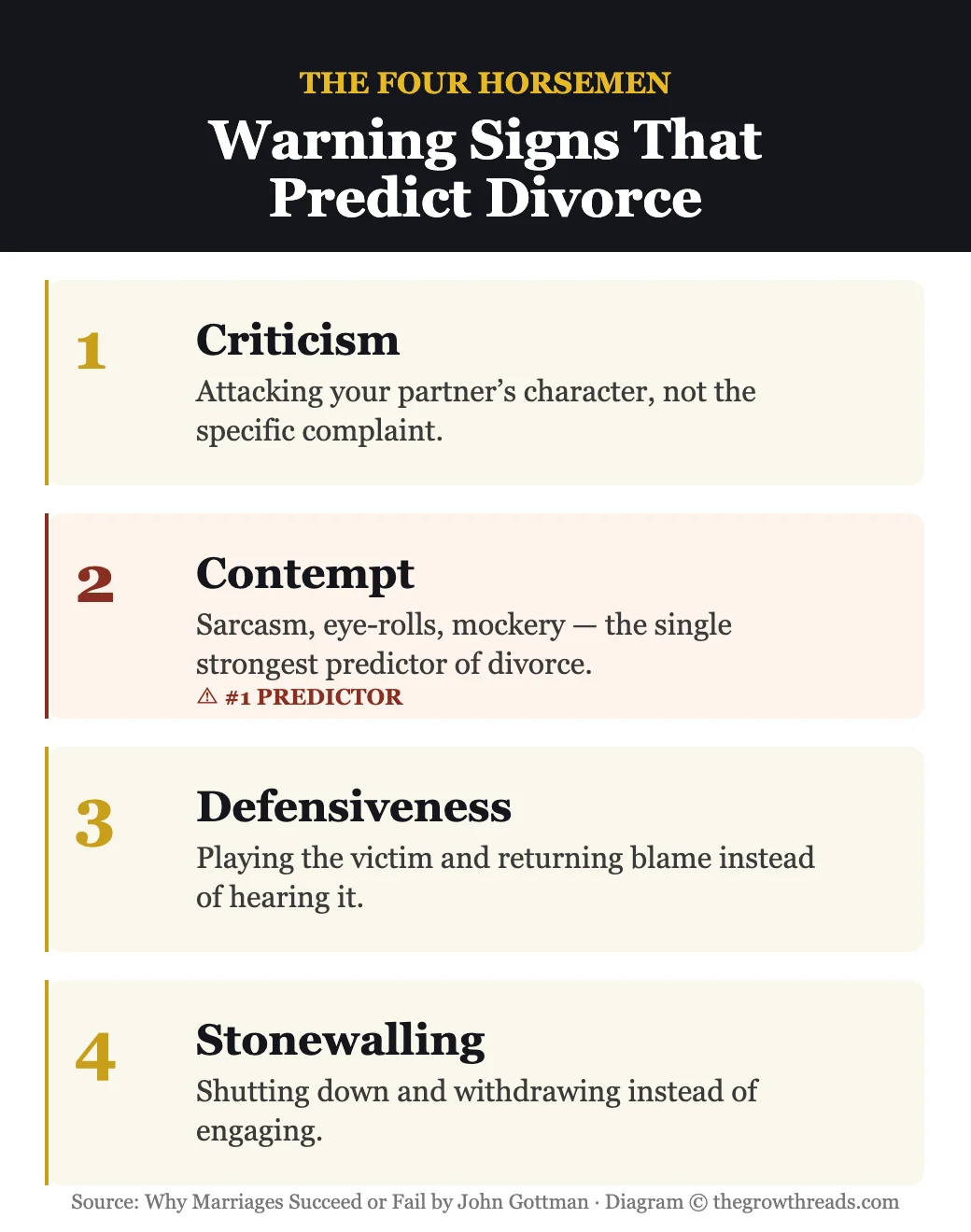
What makes the Four Horsemen useful isn’t just naming them — it’s that Gottman found they arrive in this predictable sequence over the course of a relationship, which means the earlier you can catch and name one, the less entrenched the pattern has to become before you address it.
Part 3: Repair Attempts and the Magic Ratio
If the Four Horsemen explain why marriages fail, this section explains why some marriages full of loud, frequent arguing still succeed. Gottman’s data showed that happy couples fight — sometimes often, sometimes intensely — but they consistently do one thing unhappy couples don’t: they repair the moment before it does lasting damage.
A repair attempt is any word, gesture, or joke that de-escalates tension mid-conflict. It can be as small as reaching for your partner’s hand, as verbal as “can we take that back and start over,” or as simple as genuine humor that breaks the mood. What matters isn’t how smooth the repair attempt is — Gottman found that even clumsy ones work, as long as the relationship has enough goodwill for the attempt to land.
That goodwill is what Gottman quantifies as the magic ratio: in his data, stable marriages maintained roughly five positive interactions — affection, humor, interest, validation — for every single negative one during a disagreement. Couples heading for divorce showed a ratio closer to 1:1, where negativity and positivity roughly cancel out, or worse, where negativity dominates.
Gottman also names the physiological reason repair so often fails once a fight escalates: flooding. When your heart rate crosses a certain threshold, your body shifts into a fight-or-flight state that makes it neurologically difficult to listen, empathize, or think clearly. This is why he recommends a genuine timeout — twenty minutes, no discussing the topic, just physiological recovery — rather than pushing through a conversation neither partner can productively have anymore.
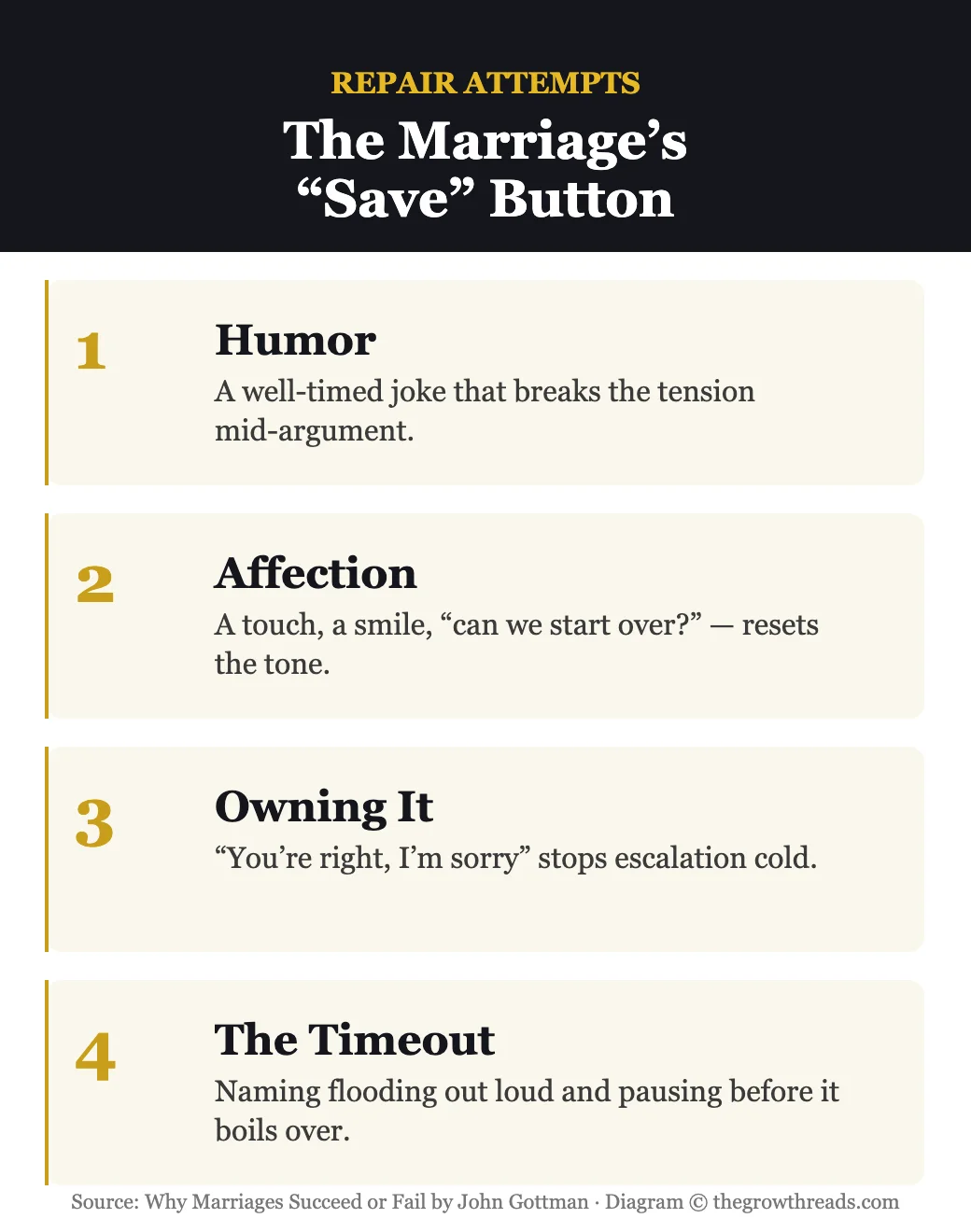
The practical implication is reassuring: you don’t need to eliminate conflict, and you don’t need to become a smoother communicator overnight. You need enough small positive deposits in the account that one negative withdrawal doesn’t bankrupt the relationship — and a habit of reaching for repair before flooding takes the option off the table.
TGR Note: Gottman turned this research into a step-by-step program in his later, more prescriptive book, The Seven Principles for Making Marriage Work. If you want the diagnosis, start here; if you want the workbook, that’s the natural next read.
Part 4: Marriage Styles — Why Some Couples Fight Loudly and Stay Together
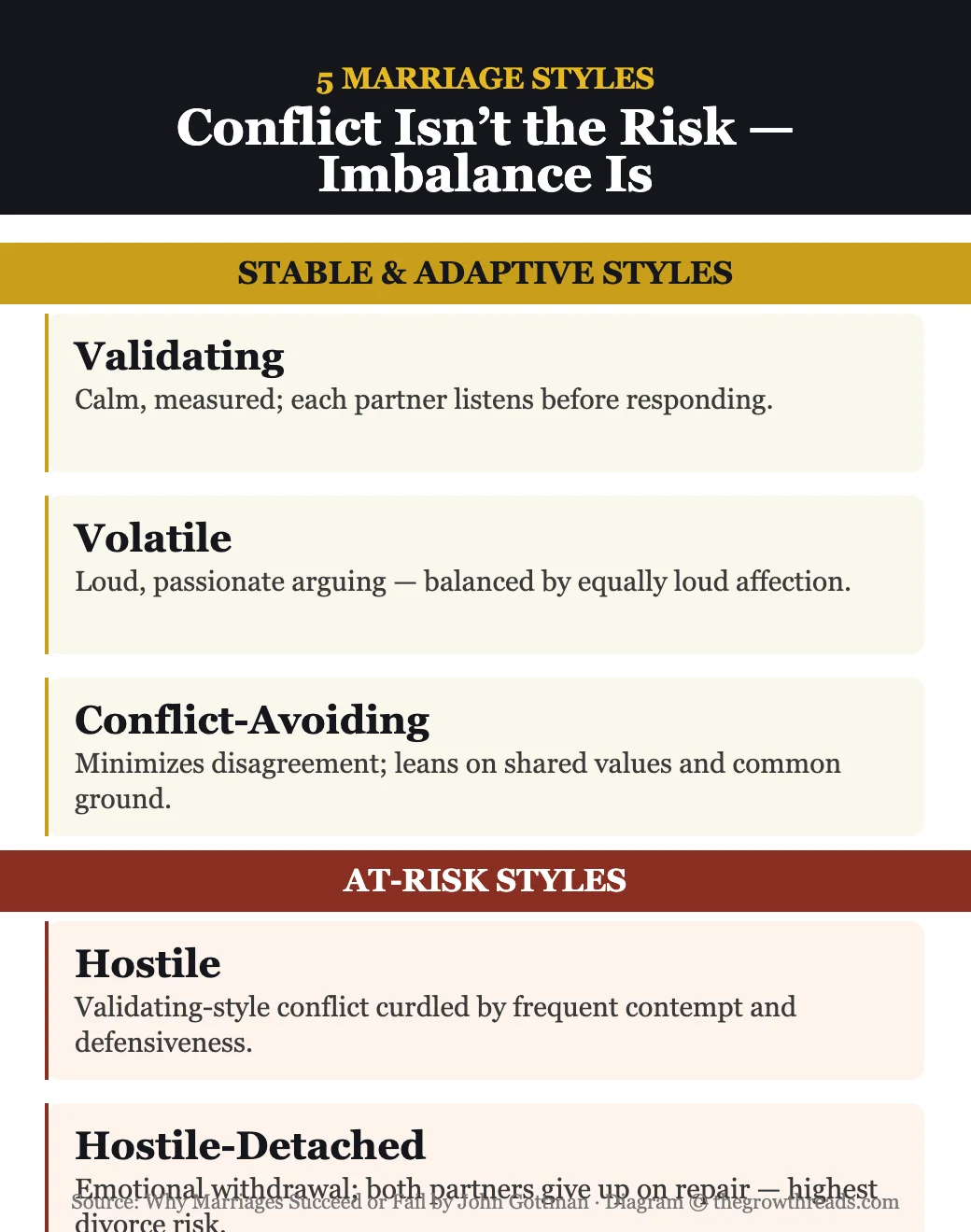
One of the more counter-intuitive findings in the book is that there is no single healthy way to argue. Gottman’s longitudinal data sorted couples into five recognizable styles, three of which last and two of which are at serious risk.
Validating couples argue calmly, listening and acknowledging each other’s point before responding. Volatile couples argue loudly and passionately — interrupting, raising their voices, laughing hard in between — and stay together because their affection and humor are just as intense as their conflict. Conflict-avoiding couples minimize disagreement altogether, leaning on shared values and common ground rather than debating differences. All three, Gottman found, produce equally stable, long marriages; they simply feel very different from the outside.
The two at-risk styles are hostile couples, whose validating- or volatile-style conflict has curdled into frequent contempt and defensiveness, and hostile-detached couples, where both partners have essentially given up on repair and coexist in a kind of resigned emotional distance. The second is the strongest predictor of divorce in the entire dataset — often a quieter, later divorce than the openly hostile pattern.
Gottman also introduces two diagnostic tools worth borrowing even outside the book: the Oral History Interview, a set of questions about how a couple met and how they narrate hard times, which reveals a surprising amount about a relationship’s trajectory; and the Love Map, a running mental inventory of your partner’s current stresses, friendships, and hopes. Couples with detailed, current Love Maps weathered conflict better — not because they fought less, but because they understood the person they were fighting with.
TGR Note: If you recognize your own relationship in the hostile-detached pattern, the attachment-styles lens in Attached is a useful companion — it explains why certain pairings drift toward withdrawal under stress in the first place.
TGR Note: For a gentler, emotion-focused alternative to naming the Four Horsemen mid-argument, Hold Me Tight reframes the same repair-attempt idea around identifying the underlying attachment fear driving the fight.
Who is Why Marriages Succeed or Fail best for — and who should read something else first?
This book suits couples and individuals who want a research-grounded diagnosis of what specifically goes wrong in arguments, rather than general encouragement to “communicate better.” It rewards readers who like data and are comfortable with a slightly academic tone in places.
If you want a more prescriptive, exercise-driven follow-up, go to The Seven Principles for Making Marriage Work instead. If your relationship struggles feel more rooted in early attachment patterns than in-the-moment communication habits, start with Attached. And if you’re earlier in a relationship and want a broader survey of love itself rather than conflict specifically, All About Love is a gentler entry point.
Questions to reflect on
- Which of the Four Horsemen shows up first in your typical disagreements — and which one do you reach for when you feel cornered?
- Think back to your last five arguments: on average, did repair happen within minutes, hours, or days — or not at all?
- Over an average week, does kindness, humor, and appreciation outnumber irritation and complaint by roughly five to one?
- Which marriage style — validating, volatile, or conflict-avoiding — best describes how you and your partner actually argue, versus how you think you “should”?
- What is one current stress or hope in your partner’s life this month that you could describe accurately right now?
🔥 Ready to decode your own arguments?
Read the original research behind the Four Horsemen and the 5:1 ratio in full.
How to apply Why Marriages Succeed or Fail (7-day plan)
- Day 1 — Notice your horseman. During your next small disagreement, silently note which of the Four Horsemen (if any) shows up first for you.
- Day 2 — Soften the start-up. Rewrite one recurring complaint as “I feel [X] about [situation], and I need [Y]” instead of a “you always” statement.
- Day 3 — Practice one repair attempt. After any small tension today, try a hand on the arm, a joke, or an honest “can we restart?”
- Day 4 — Run a mini oral history check-in. Ask your partner how they’d describe the story of how you met, or one hard time you got through together.
- Day 5 — Count your ratio. For one full day, notice whether kind, appreciative, or playful moments outnumber irritated ones at least five to one.
- Day 6 — Agree on a timeout signal. Identify your personal flooding signal (racing heart, urge to leave) and agree on a twenty-minute timeout cue before your next disagreement.
- Day 7 — Update one Love Map fact. Ask a question that fills in a gap in what you know about your partner’s current stresses, hopes, or worries — then write the answer down.
Frequently asked questions
What are the Four Horsemen of the Apocalypse in marriage?
They’re John Gottman’s term for four communication patterns that predict divorce: criticism (attacking character instead of raising a specific issue), contempt (sarcasm, mockery, or eye-rolling that signals disrespect), defensiveness (playing the victim or counter-blaming), and stonewalling (shutting down and withdrawing). Gottman found they tend to appear in this order as a relationship deteriorates, and contempt is the single strongest predictor of the four. Learning to notice one showing up in real time — rather than only recognizing it afterward — is the first practical skill the book teaches.
Is the 90% divorce prediction accuracy still considered reliable?
The original Love Lab studies reported prediction accuracy in that range, and the underlying behavioral patterns — the Four Horsemen, repair attempts, the positive-to-negative ratio — remain widely used in couples therapy and later replication work. Some researchers outside Gottman’s own lab have debated the precise statistical methods behind the headline percentage. The practical takeaway holds either way: these specific behaviors are consistently associated with relationship outcomes, even if the exact prediction number is debated.
What is the “magic ratio” and does it apply outside of arguments?
The magic ratio is Gottman’s finding that stable couples maintain roughly five positive interactions — affection, humor, interest, appreciation — for every negative one during conflict specifically. Later research and popular use have extended the same idea to day-to-day interactions generally, and many couples find it a useful informal gauge, but the book’s original data point is about conflict conversations rather than an all-day running tally.
Are volatile, loudly-fighting couples doomed?
No — this is one of the book’s more reassuring findings. Volatile couples, who argue passionately and often, showed the same long-term stability as calmer validating couples in Gottman’s data, as long as their affection and repair attempts were equally intense. What predicts trouble isn’t the volume of conflict but the presence of contempt, defensiveness, and stonewalling, and the absence of repair.
What’s the difference between this book and The Seven Principles for Making Marriage Work?
This book is Gottman’s earlier, research-first account — it explains the Love Lab studies and the diagnostic patterns (the Four Horsemen, the magic ratio, marriage styles) in depth. The Seven Principles for Making Marriage Work, published later, is more of a practical workbook built on the same research, with structured exercises for each principle. Readers who want the “why” often start here; readers who want a step-by-step program often prefer that one.
Can this book help if my partner won’t read it?
Yes, though it works best when both partners engage with it together. Many of the concepts — noticing your own horseman, offering a repair attempt, checking your Love Map — are things one partner can practice unilaterally and still shift the dynamic, since a repair attempt only requires one person to make it and one to accept it. That said, exercises like the Oral History Interview and open discussion of the marriage styles are more useful done together.
Is this book only for married couples?
The research was conducted on married couples, but the underlying patterns — the Four Horsemen, repair attempts, the positive-to-negative ratio, Love Maps — apply to any long-term committed relationship, dating or otherwise. Unmarried couples navigating recurring conflict will find the diagnostic framework equally useful; the book’s specific statistics and case studies, however, are drawn from married samples.
Related summaries
- The Relationship Cure — Gottman’s deeper dive into bids for connection and Love Maps.
- The Seven Principles for Making Marriage Work — the practical, exercise-driven follow-up to this research.
- Attached — how attachment styles shape the marriage styles described here.
- Hold Me Tight — an emotion-focused alternative approach to the same repair-attempt idea.
- See all 24 best relationship books →
How we analyze books: we read the full text, cross-reference the author’s original research and later interviews, and structure each summary around the book’s own framework rather than our opinion of it. Read our full methodology →
Related Relationships Summaries
Difficult Conversations Summary & Review: How to Discuss What Matters Most
Men Are from Mars, Women Are from Venus Summary & Review: Why You Keep Misunderstanding Each Other
The Mastery of Love Summary & Review: Build Relationships Without Fear
The Road Less Traveled Summary & Review: Why Growth Demands Embracing Difficulty
Untamed Summary & Review: Stop Pleasing and Start Living as Your Truest Self