

⭐⭐⭐⭐⭐ 4.5 / 5
One-liner: The definitive insider account of how Pixar built a culture where creativity thrives — and the leadership principles that kept it alive through decades of hit films.
Best for: Leaders, managers, and founders who need to build teams that produce original, high-quality work under real-world constraints.
Reading time: ~7 hours (368 pages)
Difficulty to apply: Moderate — the principles are clear, but building a candid culture takes sustained commitment.
Creativity, Inc. in one minute
Every Pixar movie started out terrible — and that is exactly the point. Ed Catmull, co-founder of Pixar and president of Pixar and Disney Animation, spent his career solving one problem: how do you build an organization where creative people do their best work? His answer is not a formula but a philosophy — protect new ideas from premature judgment, build feedback systems rooted in candor rather than authority, and accept that failure is not just tolerable but essential. This book is the operating manual for any leader who wants innovation without bureaucratic death.
Key takeaways
- People over ideas: Getting the right team is more important than having the right idea. Give a good idea to a mediocre team and they will find a way to fail; give a mediocre idea to a great team and they will fix it or come up with something better.
- Candor is the oxygen of creativity: The Braintrust — Pixar’s peer feedback group — works because it is candid without being authoritative. Directors hear hard truths but keep final decision-making power.
- All movies suck at first: Every Pixar film began as a mess. The difference between Pixar and other studios is not the absence of problems but the willingness to find and fix them through iterative feedback.
- Fear is the enemy: When people fear failure, they hide problems. Leaders must actively dismantle fear — not by saying “don’t be afraid” but by visibly rewarding honesty and responding well to bad news.
- The Hungry Beast vs. the Ugly Baby: The production machine (the Beast) demands constant feeding — sequels, safe bets. New ideas (Ugly Babies) are fragile and easily killed. Leaders must protect babies from the beast.
- Failure is investment, not waste: The cost of preventing all errors is greater than the cost of fixing the errors that actually occur. Let people experiment, fail cheaply, and learn fast.
- Mental models are incomplete: Our internal models of how the world works are always simplified. Good leaders know their map is not the territory and remain open to information that contradicts their model.
- Don’t confuse process with goal: Processes are tools, not sacred rituals. When a process stops serving the creative goal, change it — even if “we’ve always done it this way.”
- Notes Day works: Once a year, Pixar shut down production for a full day so every employee — from animators to accountants — could pitch ideas for improving the company. The best ideas came from unexpected places.
- The table matters: Catmull literally changed the conference table from a long rectangle (which created a hierarchy) to a square where everyone could see each other. Physical environment shapes creative dynamics.
What is Creativity, Inc. about?
Creativity, Inc. is a leadership book that chronicles how Pixar Animation Studios built and sustained a culture of creative excellence across 25 years of filmmaking. Ed Catmull shares the management principles, feedback systems, and organizational philosophies that enabled Pixar to produce an unbroken string of critically and commercially successful films, and reveals how those same principles were applied to revive Walt Disney Animation Studios.
About the author
Ed Catmull is a computer scientist, animator, and co-founder of Pixar Animation Studios. He earned his Ph.D. in computer science from the University of Utah, where he invented texture mapping and other foundational computer graphics techniques. After years of research at the New York Institute of Technology, he was recruited by George Lucas to lead the computer division of Lucasfilm, which Steve Jobs later purchased and transformed into Pixar. Catmull served as president of both Pixar and Walt Disney Animation Studios from 2006 until his retirement in 2019, overseeing films that won 16 Academy Awards and grossed over $14 billion worldwide. Explore all Ed Catmull book summaries →
Key concepts at a glance
| Concept | What it means | Use it when |
|---|---|---|
| The Braintrust | A peer feedback group that gives candid notes without authority over the director | Building feedback loops, creative reviews, product critiques |
| The Ugly Baby | Every new idea starts fragile and malformed — it needs protection, not judgment | Evaluating early-stage ideas, pitching concepts, innovation sprints |
| The Hungry Beast | The production machine that demands safe, proven output and resists novelty | Balancing innovation vs. delivery, portfolio management |
| Failure as Investment | Errors that produce learning are cheaper than the cost of preventing all risk | Setting team expectations, post-mortems, R&D budgets |
| Candor over Honesty | Candor is active and constructive; honesty can be passive or brutal | Performance reviews, design critiques, difficult conversations |
| The Hidden | Problems you cannot see are more dangerous than problems you can — build systems to surface them | Risk management, team health checks, retrospectives |
| Notes Day | Shutting down production so every employee can propose improvements | Annual planning, culture resets, morale boosts |
| Mental Models | Our internal maps of reality are always incomplete — stay open to disconfirming data | Strategic pivots, assumption audits, leadership self-reflection |
Part 1 — Getting started: from dream to Pixar
Catmull opens with a childhood dream: to make the first computer-animated feature film. That dream took 20 years to realize. The first section traces his journey from the University of Utah, where he invented foundational computer graphics techniques, through the New York Institute of Technology, then to George Lucas’s computer division, and finally to the founding of Pixar with Steve Jobs and John Lasseter.
The narrative is instructive because Catmull repeatedly discovers that achieving a goal creates a new problem. When Toy Story succeeded, he assumed the hard part was over. Instead, success created complacency, power struggles, and a growing distance between leadership and the creative teams doing the actual work. The lesson he draws is foundational: sustaining a creative culture is harder than building one, because success breeds the very forces — hierarchy, risk aversion, entitlement — that destroy creativity.
A critical early insight came from watching the table. Pixar’s original conference room had a long, narrow table. People gravitated to the center seats (power positions), while those at the ends felt sidelined. Catmull replaced it with a square table — a seemingly trivial change that transformed the dynamics of meetings. Everyone could see everyone. No seat was privileged. The physical environment, he realized, shapes creative outcomes in ways that organizational charts never capture.
Part 2 — Protecting the new: the Braintrust and candor
The Braintrust is the beating heart of Creativity, Inc. It is a group of senior creative leaders at Pixar who meet regularly to review films in progress. The rules are simple but strict: the Braintrust gives candid feedback. The director is not required to follow any of it. There is no authority in the room — only perspectives.
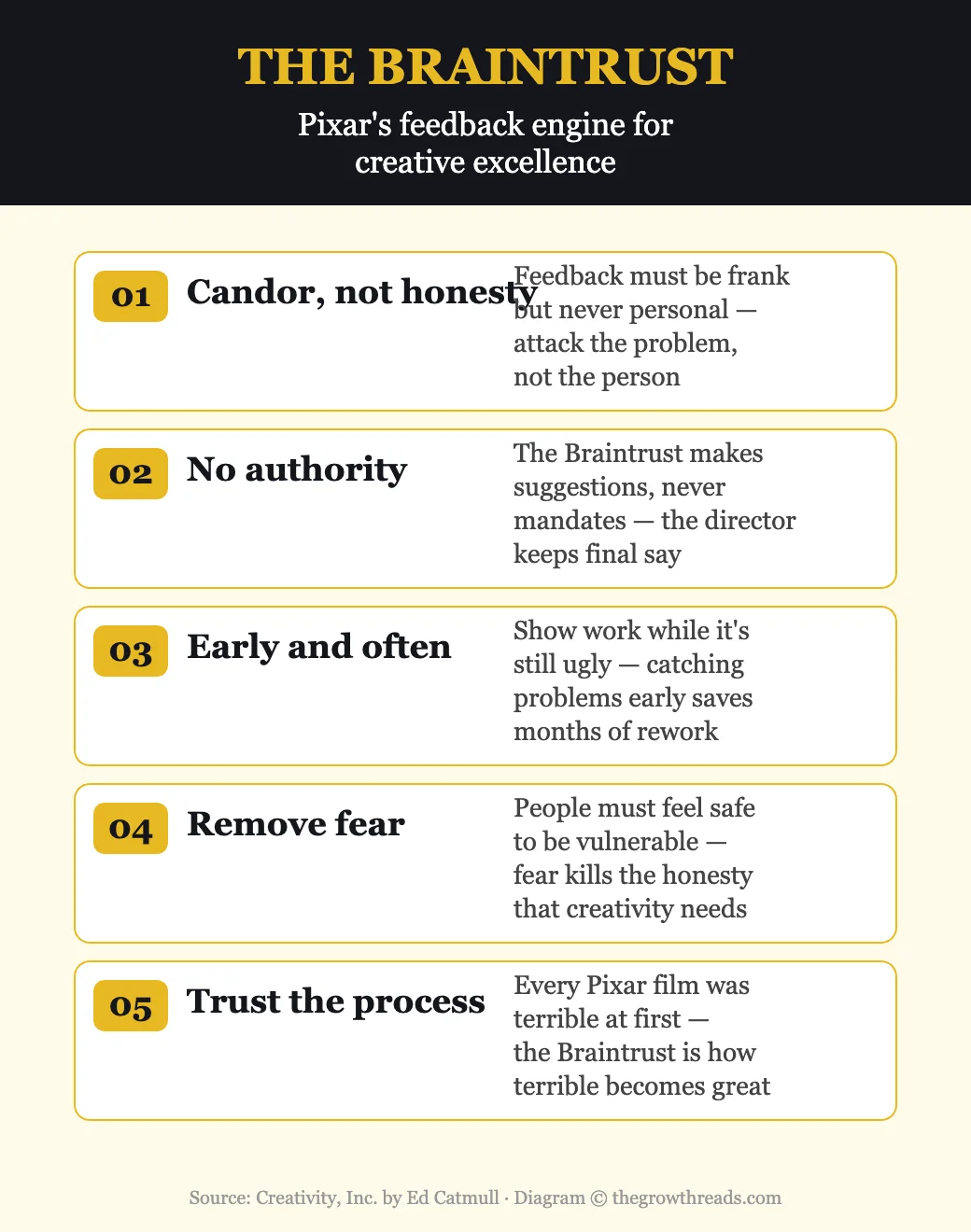
Catmull distinguishes between candor and honesty. Honesty implies a moral obligation — you should tell the truth. Candor is more active: it means volunteering your perspective even when it is uncomfortable, because you believe the work will improve. The Braintrust works because it replaces political feedback (telling people what they want to hear) with developmental feedback (telling people what the work needs).
The critical structural rule: the Braintrust has no authority. If the director ignores every note, that is their right. This removes the defensive posture that kills honest feedback in most organizations. When people know their suggestions are advisory, they give better ones — and when directors know they will not be overruled, they listen more openly.
Catmull addresses a common objection: does this not lead to chaos? No, because the Braintrust operates on trust, not consensus. Members are chosen for their ability to diagnose problems without prescribing solutions. The best Braintrust notes identify what is not working and why — they do not tell the director how to fix it. This preserves creative ownership while dramatically improving quality.
Part 3 — Building and sustaining: failure, fear, and the Beast
The middle section tackles the forces that erode creative culture over time. Catmull introduces two powerful metaphors: the Hungry Beast and the Ugly Baby.
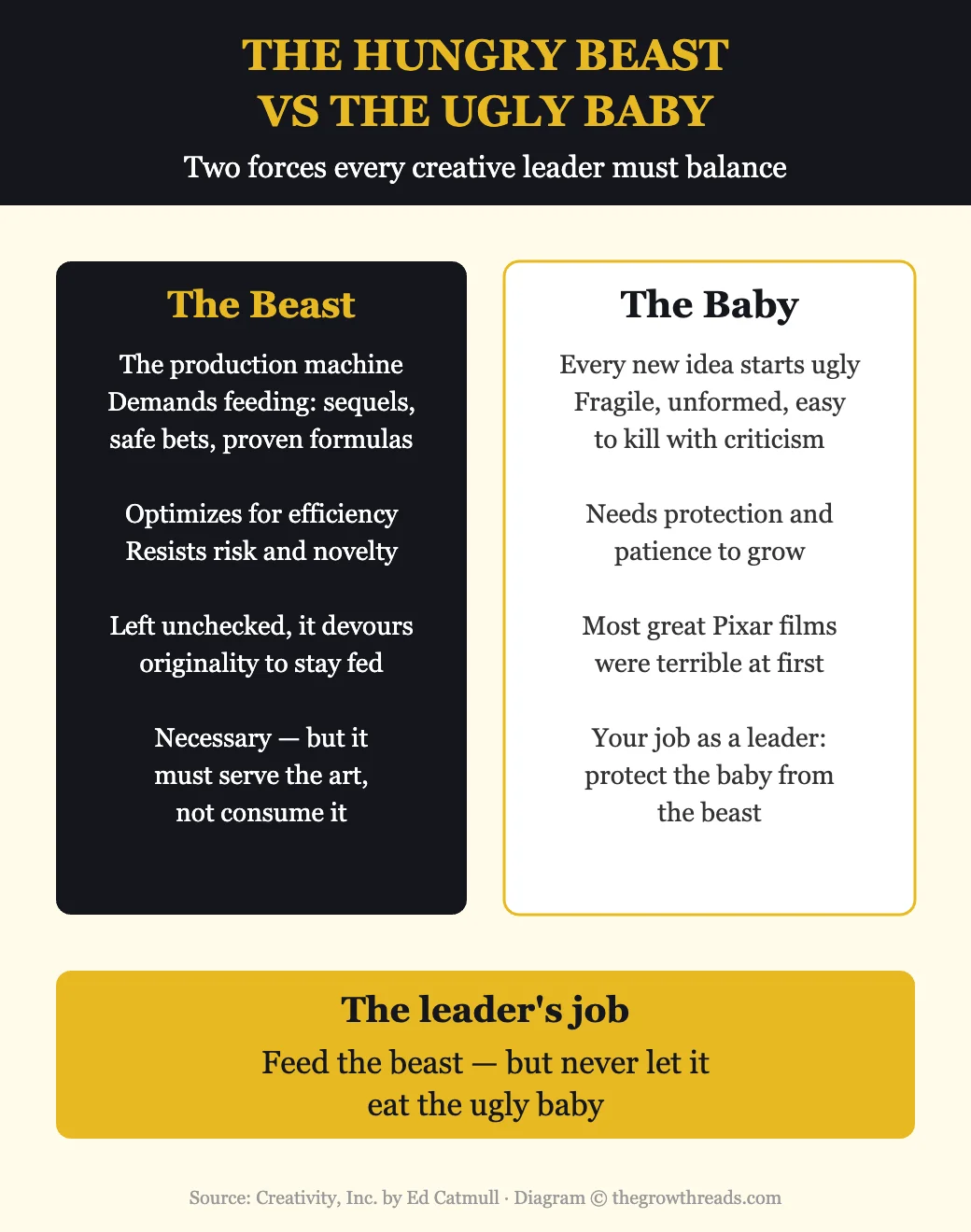
The Hungry Beast is the production machine. It needs to be fed — with sequels, with proven formulas, with output that satisfies investors and distribution pipelines. The Beast is necessary (without it, nothing ships), but left unchecked, it devours originality. Leaders who feed the Beast exclusively end up with a studio that is profitable but creatively dead.
The Ugly Baby is every new idea in its early, unformed state. New concepts look terrible because they are incomplete — characters are not developed, plots have holes, the animation is rough. Most organizations kill Ugly Babies through premature evaluation. Someone in a meeting says “that will never work,” and the idea dies before it has a chance to grow. Catmull’s rule: protect the Baby from the Beast. Give new ideas the time and resources to develop before subjecting them to the production machine’s efficiency demands.
On failure, Catmull is emphatic: it is not just tolerable but necessary. He recounts how the production of Toy Story 2 nearly collapsed — the film was so bad it almost went straight to video — before being rebuilt from scratch in nine months by an exhausted team. The lesson was not “avoid this situation” but “build the resilience and feedback systems to recover from it.” He argues that the cost of preventing all failure is greater than the cost of the failures themselves, because prevention requires bureaucracy that suffocates innovation.
Fear, he writes, is the real enemy of creativity. Not failure itself, but the fear of failure. When people fear consequences, they hide problems. Hidden problems compound. By the time leadership discovers them, they are catastrophically expensive to fix. Catmull’s solution: make it safe to surface problems early. Reward the messenger. Respond to bad news with curiosity, not blame.
Part 4 — Testing what we know: mental models and the unseen
The final section is the most philosophical. Catmull explores what he calls “the unseen” — the problems that exist but are invisible to leadership because information filters and power dynamics prevent them from surfacing. He argues that every leader operates with an incomplete mental model of their organization. The map is never the territory. The leaders who succeed are not the ones with the best models but the ones who know their models are wrong and actively seek disconfirming evidence.
He illustrates this with the story of Disney Animation’s turnaround. When Pixar acquired Disney Animation in 2006, Catmull found a culture paralyzed by fear and political maneuvering. Notes on films came with authority attached — if a senior executive suggested a change, it was a command, not a suggestion. The result: directors stopped taking creative risks, and the films suffered. Catmull’s first move was to remove mandatory notes — applying the Braintrust principle to Disney. Within a few years, Disney Animation produced Frozen, which became the highest-grossing animated film of all time.
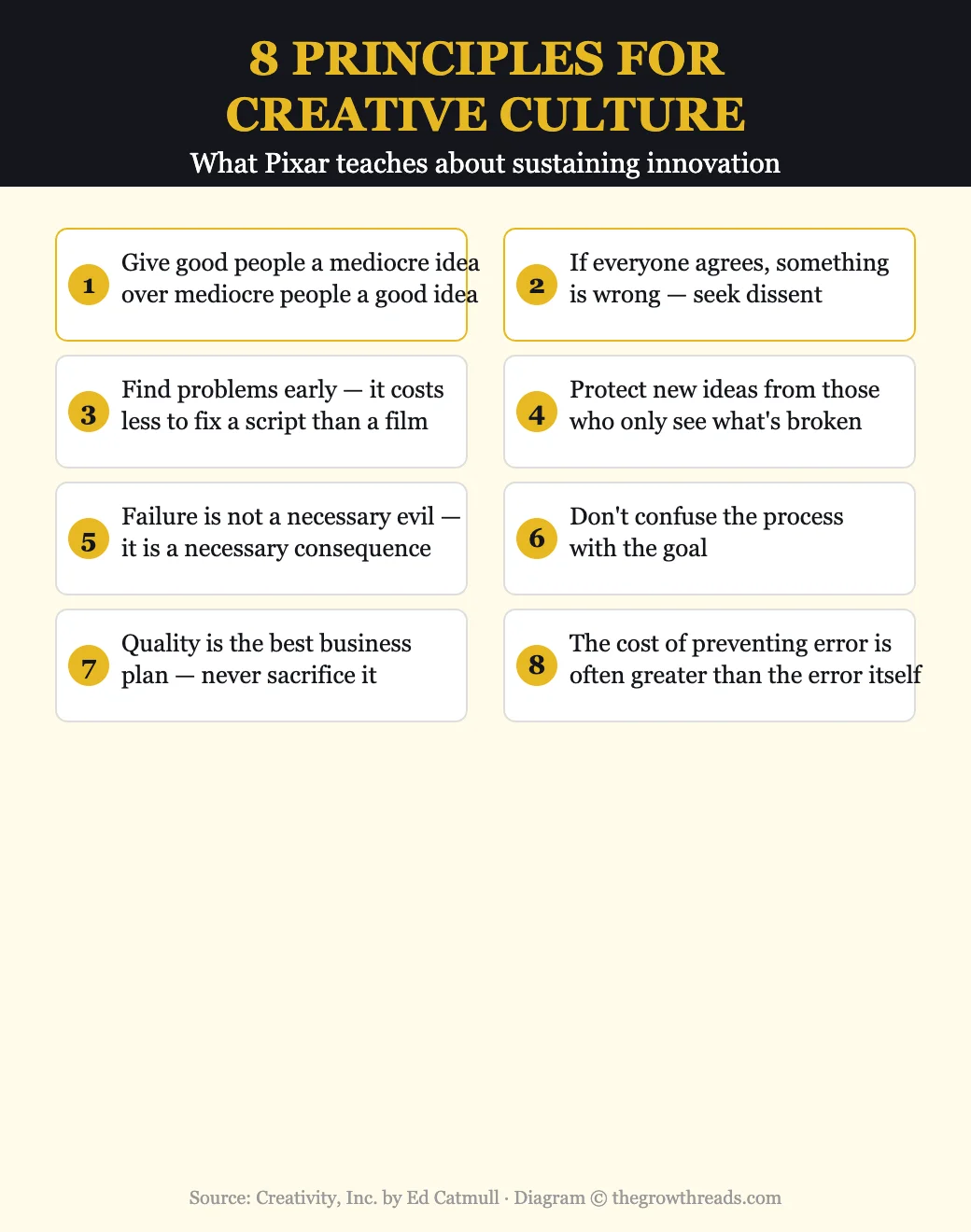
Catmull closes with “Notes Day” — a full-day shutdown of all production at Pixar where every employee, regardless of role, could propose ideas for improving the company. The experiment was radical (shutting down a studio costs hundreds of thousands of dollars per day) but the results were transformative. Solutions to long-standing problems came from unexpected sources — a production assistant suggested a scheduling fix that senior managers had missed for years. The lesson: the people closest to the work often see what leadership cannot.
Who is Creativity, Inc. best for — and who should read something else first?
This book is essential for anyone leading a team where the output must be original — product managers, creative directors, startup founders, R&D leaders, and agency heads. If your work depends on people doing their most creative thinking, the Braintrust model and the fear-management principles alone are worth the read.
If you are looking for a more tactical guide to giving feedback, start with Radical Candor by Kim Scott. If you want to understand what makes teams click at a neurological level, The Culture Code by Daniel Coyle is the better entry point. And if you need a framework for scaling a startup before you worry about creative culture, try The Lean Startup by Eric Ries.
Questions to reflect on
- Does your team have a Braintrust — a trusted group that gives candid, non-authoritative feedback? If not, what would it take to build one?
- Think of a recent idea that died early. Was it killed by legitimate concerns or by the Hungry Beast’s preference for safety?
- When someone brings you bad news, how do you respond? Would your team describe your reaction as curious or punishing?
- What “table” problem exists in your organization — a physical or structural setup that silently creates hierarchy and stifles input?
- If you held a Notes Day tomorrow and every employee could propose one change, what do you think the top suggestion would be?
🔥 Ready to build a culture where creativity thrives?
Learn Pixar’s leadership principles for sustained creative excellence.
How to apply Creativity, Inc. (7-day plan)
- Day 1 — Audit your table: Look at your team’s meeting setup. Does the physical arrangement create hierarchy? Experiment with a layout where everyone is equidistant and visible.
- Day 2 — Start a mini-Braintrust: Identify 3-4 trusted peers. Invite them to review a current project with one rule: candid feedback only, no authority to mandate changes.
- Day 3 — Protect an Ugly Baby: Find the newest, most fragile idea on your team. Instead of evaluating it, ask: what would this need to succeed? Give it one more week before any go/no-go decision.
- Day 4 — Reward a messenger: The next time someone brings you a problem or bad news, publicly thank them. Make it visible that surfacing issues is valued, not punished.
- Day 5 — Name the Beast: Identify the production demands that are crowding out experimentation on your team. Write them down. Decide which one you can defer to create space for a new initiative.
- Day 6 — Run a failure audit: List three recent failures or setbacks. For each one, ask: what did we learn, and did we learn it fast enough? Identify one process change that would catch similar problems earlier.
- Day 7 — Plan a Notes Day: Block two hours on the calendar for your team to propose improvements — no topic off-limits, no hierarchy. Commit to implementing at least one suggestion within two weeks.
Frequently asked questions
What is the main idea of Creativity, Inc.?
The central idea is that sustaining a creative culture is harder than building one, because success breeds forces — hierarchy, risk aversion, and complacency — that destroy creativity from within. Catmull argues that leaders must build systems for candid feedback (the Braintrust), protect fragile new ideas from premature judgment, and actively dismantle the fear that causes people to hide problems. Creative excellence is not about hiring brilliant individuals but about building an environment where brilliant people can do their best work.
What is the Braintrust in Creativity, Inc.?
The Braintrust is Pixar’s signature feedback mechanism — a group of senior creative leaders who regularly review films in progress and give candid notes. The two critical rules: feedback must be constructive and specific (identify what is not working and why), and the director retains full authority over whether to act on any note. This removes defensiveness and political maneuvering, creating a space where honest assessment of creative work is safe and productive.
Is Creativity, Inc. only relevant for creative industries?
No. While the examples come from animation, the principles apply to any organization that needs innovation. The Braintrust model works for product teams, design sprints, and strategic planning. The Beast-vs-Baby tension exists in every company that must balance efficiency with experimentation. Tech companies, consulting firms, healthcare organizations, and educational institutions have all adopted Catmull’s frameworks successfully. If your team produces any kind of original output, this book is directly applicable.
How does Creativity, Inc. compare to other leadership books?
Most leadership books prescribe frameworks from the outside. Creativity, Inc. is different because it is a first-person account from someone who built and led one of the most successful creative organizations in history. Where Good to Great is research-driven and The Lean Startup is methodology-driven, Creativity, Inc. is story-driven — you learn through Catmull’s successes and mistakes at Pixar and Disney. It pairs especially well with The Culture Code for the science behind why Catmull’s methods work.
What is the Hungry Beast vs. the Ugly Baby?
These are Catmull’s two central metaphors. The Hungry Beast is the production machine — it demands safe, proven output (sequels, established formulas) to keep the business running. The Ugly Baby is every new idea in its early, unformed state — fragile, incomplete, and easy to kill with premature criticism. The leader’s job is to feed the Beast enough to keep it alive while protecting the Baby until it grows strong enough to stand on its own. Organizations that only feed the Beast become creatively dead; those that only nurture Babies never ship.
What role did Steve Jobs play at Pixar?
Jobs purchased the computer graphics division from Lucasfilm in 1986 and funded Pixar through years of losses before Toy Story became a hit. Catmull describes Jobs as initially disruptive — his blunt communication style clashed with Pixar’s collaborative culture. Over time, Jobs learned to channel his intensity more constructively, becoming a crucial business strategist and protector of Pixar’s creative independence during the Disney distribution negotiations. Catmull credits Jobs with teaching him that quality is the best business plan.
What should I read after Creativity, Inc.?
For the science of team culture, read The Culture Code by Daniel Coyle. For a tactical feedback framework, try Radical Candor by Kim Scott. For scaling organizations while maintaining quality, Good to Great by Jim Collins is a natural companion. And for understanding how to motivate creative teams beyond money, Drive by Daniel Pink connects directly to Catmull’s social-norms approach to leadership.
Related summaries
- The Culture Code by Daniel Coyle — the science behind why Catmull’s culture-building methods work.
- Radical Candor by Kim Scott — a tactical framework for the kind of feedback the Braintrust delivers.
- Good to Great by Jim Collins — data-driven leadership principles that complement Catmull’s story-driven approach.
- Best Leadership Books — our complete guide to the most impactful leadership reads.