

★★★★☆ 4.3/5
One-liner: The definitive playbook for understanding what drives people — and yourself.
Best for: Anyone who wants to decode human behavior, navigate social dynamics, and develop deeper self-awareness.
Reading time: ~20 hours (624 pages)
Difficulty to apply: Moderate — concepts are deep but Greene provides concrete exercises and daily practices.
The Laws of Human Nature in one minute
Human behavior follows predictable patterns, and once you see them, you can never unsee them. Robert Greene distills thousands of years of wisdom from history, psychology, and philosophy into 18 laws that govern human nature. The book teaches you to master your own irrational tendencies, develop empathy as a strategic tool, see through the social masks people wear, and understand the deep motivations that drive every interaction. Rather than cynicism, Greene argues that understanding human nature leads to greater compassion — because you finally see people as they truly are, including yourself.
Key takeaways
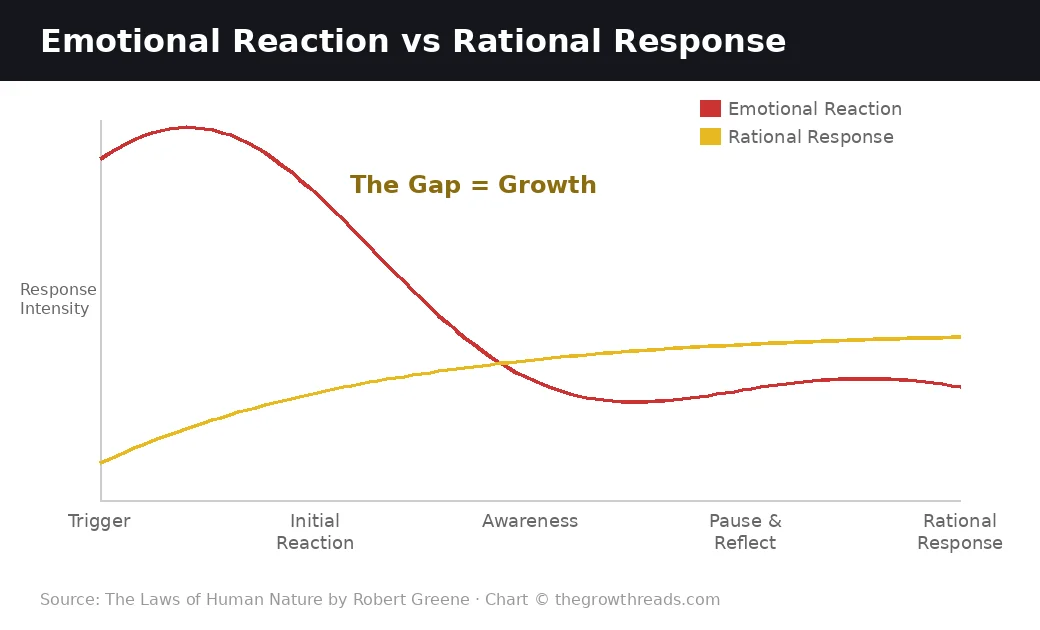
- Emotions rule first, rationality follows: Every decision begins with an emotional reaction. Recognizing this gap gives you space to respond rather than react.
- Narcissism exists on a spectrum: Healthy self-love fuels empathy. Deep narcissism destroys relationships. Learn to distinguish the two in yourself and others.
- Everyone wears masks: Social performance is universal and necessary. The skill lies in reading what is behind the performance without judgment.
- Character is destiny: A person’s repeated patterns of behavior reveal their true character far more reliably than any single action or statement.
- Envy is the most hidden emotion: People rarely admit to envy, making it one of the most dangerous forces in relationships and organizations.
- Your shadow self holds power: The traits you repress don’t disappear — they emerge sideways. Integrating your dark side makes you whole.
- Groups alter individual behavior: In crowds, people become more emotional, suggestible, and prone to conformity. Awareness is your shield.
- Authority requires purpose: True leadership emerges from having a clear sense of direction, not from manipulation or force.
- Generational patterns repeat: Each generation reacts against the previous one. Understanding this cycle helps you navigate cultural shifts.
- Mortality awareness sharpens focus: Confronting death eliminates trivial concerns and clarifies what genuinely matters to you.
What is The Laws of Human Nature about?
The Laws of Human Nature is Robert Greene’s comprehensive guide to understanding the hidden forces that drive human behavior. Drawing on historical examples from figures like Pericles, Queen Elizabeth I, and Martin Luther King Jr., Greene outlines 18 laws covering irrationality, narcissism, role-playing, envy, grandiosity, and more — teaching readers to master their own emotions, read people accurately, and navigate social dynamics with greater skill and self-awareness.
About the author
Robert Greene grew up in Los Angeles and studied classical languages at the University of California, Berkeley, before working over 50 different jobs — from Hollywood scriptwriting to translating in Paris. That eclectic experience gave him an unusual vantage point on power, strategy, and human behavior. His debut, The 48 Laws of Power, became an international phenomenon, and he has since written six bestsellers translated into over 40 languages. Greene’s work sits at the intersection of history, psychology, and practical strategy, earning him a devoted readership that spans entrepreneurs, athletes, musicians, and military leaders. He spent over six years researching The Laws of Human Nature, making it his most ambitious and deeply researched work. Explore all Robert Greene book summaries →
Key concepts at a glance
| Concept | What it means | Use it when |
|---|---|---|
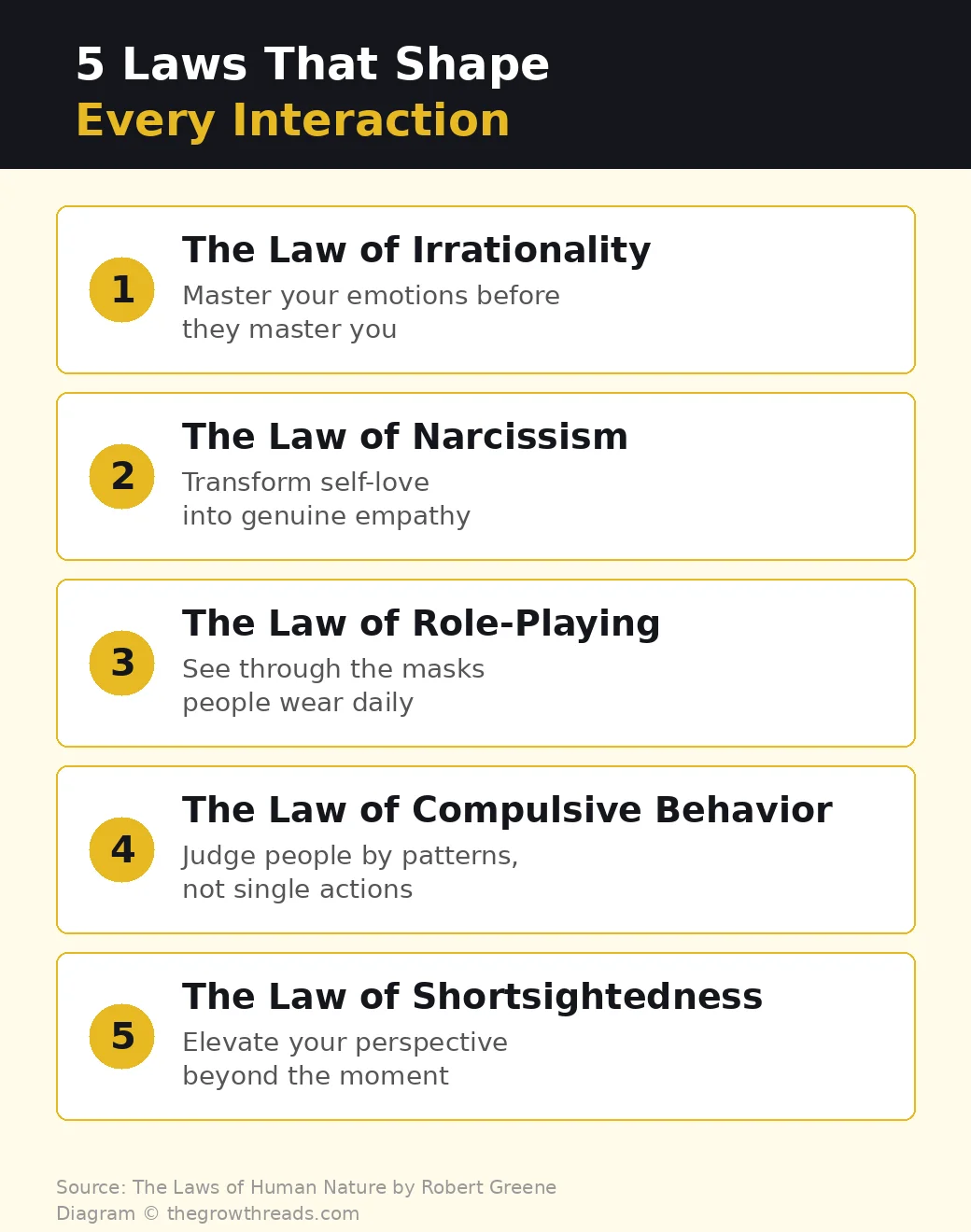
| The Law of Irrationality | Emotions distort your perception; recognize and master them | You feel a strong reaction and need to pause before deciding |
| The Law of Narcissism | Transform self-absorption into deep empathy | Someone’s behavior seems selfish or you catch yourself being self-centered |
| The Law of Role-Playing | People present curated versions of themselves | You want to understand someone’s real intentions behind their words |
| The Law of Compulsive Behavior | Character is revealed through repeated patterns, not one-offs | Deciding whether to trust someone in a high-stakes situation |
| The Law of Envy | Envy is the most concealed and destructive emotion | A friend or colleague seems subtly hostile after your success |
| The Law of Shortsightedness | Most people are trapped in immediate reactions | You need to plan beyond the current crisis |
| The Law of Defensiveness | Resistance hardens when you push; soften your approach | You want to persuade someone who is resistant to your ideas |
| The Law of Self-Sabotage | Your attitude shapes your reality more than circumstances | Nothing external has changed but everything feels stuck |
Part 1: Master your emotional self
Greene opens with arguably the book’s most foundational idea: humans are fundamentally irrational creatures who believe they are rational. He traces this through the story of Pericles, the Athenian statesman who transformed Athens by first mastering his own emotional reactions. While his contemporaries were swayed by fear, anger, and crowd emotions, Pericles cultivated what Greene calls “the rational self” — the ability to observe his own emotional reactions before acting on them.
The mechanism Greene describes is what modern psychologists call the “affect heuristic” — emotions arrive faster than thoughts, coloring every perception before the rational mind even engages. The key insight is not to suppress emotions (which Greene argues is impossible and counterproductive) but to create a gap between feeling and response. In that gap lives your freedom to choose wisely.
Greene extends this into a practical framework for emotional self-mastery: first recognize your emotional triggers, then develop the habit of stepping back during high-emotion moments, and finally train yourself to question your first reaction before committing to it.
Part 2: Decode other people
The middle section of the book is where Greene earns his reputation as a master observer of human behavior. He tackles the social masks everyone wears (the Law of Role-Playing), the way character reveals itself through repeated patterns rather than words (the Law of Compulsive Behavior), and how to develop genuine empathy as a tool for understanding rather than mere sympathy.
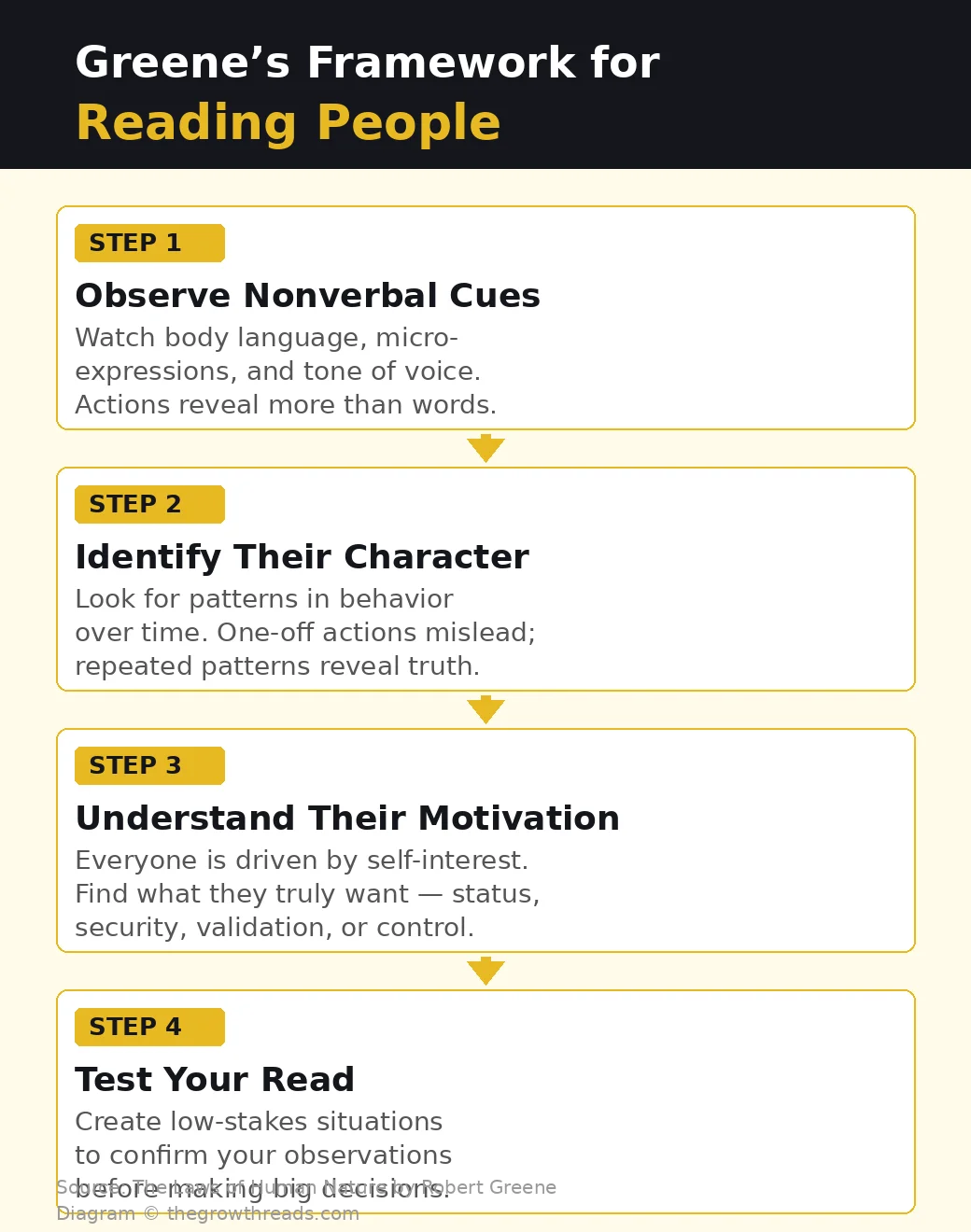
Greene uses the example of Milton Erickson, the legendary hypnotherapist who overcame polio and developed extraordinary skills in reading nonverbal behavior. Erickson learned to detect micro-expressions, shifts in posture, and vocal tone changes that revealed what patients truly felt versus what they claimed to feel. Greene argues this kind of perceptive attention is a learnable skill, not an innate gift.
The chapter on the Law of Compulsive Behavior is especially powerful. Greene distinguishes between strong and weak character not through moral judgment but through observable patterns: people with strong character can delay gratification, adapt their behavior to new situations, and accept responsibility. Those with weak character repeat the same mistakes across different contexts, blame others, and cannot tolerate frustration. The practical advice: judge character by patterns across time, never by a single impressive or disappointing moment.
Part 3: Confront your shadow
Greene draws heavily on Carl Jung’s concept of the shadow — the parts of ourselves we deny, repress, or project onto others. He argues that everyone carries a “dark side” of repressed desires, aggression, and selfishness, and that pretending this side does not exist makes it more dangerous, not less.
He illustrates this through the story of Richard Nixon, whose repressed insecurities and resentments eventually erupted in the Watergate scandal — a textbook case of the shadow taking control. Greene contrasts this with figures who integrated their darker impulses productively, channeling aggression into ambition and self-interest into strategic thinking.
The Law of Envy receives special attention. Greene considers envy the most concealed of all human emotions — people will admit to anger, fear, even greed before they acknowledge envy. He identifies the warning signs of envious friends and colleagues: excessive praise that feels hollow, subtle undermining disguised as “helpful feedback,” and a pattern of competitiveness that surfaces only when you succeed. The antidote is not to avoid triggering envy but to be aware of it and to manage how openly you display your advantages.
Part 4: Rise above human nature
The final section elevates the discussion from understanding others to mastering yourself at the deepest level. Greene covers the Law of Aimlessness (finding your life’s purpose), the Law of Conformity (resisting group pressure), the Law of Fickleness (earning genuine authority), the Law of Aggression (recognizing hidden aggressors), and culminates with the Law of Death Denial — the idea that meditating on your mortality is the ultimate key to living fully.
The chapter on conformity is especially relevant today. Greene describes how groups develop their own emotional atmosphere — what he calls the “group spirit” — that pulls individuals away from their independent judgment. Social media, he argues, has amplified this effect exponentially. The solution is not isolation but conscious awareness: you can participate in groups while maintaining an inner distance from their emotional currents.
Greene closes with the Law of Death Denial, drawing on the Stoic tradition and the example of Martin Luther King Jr., who lived with constant death threats yet found that confronting mortality gave him extraordinary clarity and courage. When you accept that your time is limited, trivial concerns fall away and your genuine priorities become unmistakable.
Who is The Laws of Human Nature best for — and who should read something else first?
This book is ideal for anyone navigating complex social environments — managers, entrepreneurs, negotiators, or anyone who has ever been blindsided by someone’s behavior. It is also excellent for people interested in self-awareness and personal development at a deeper level than typical self-help. If you enjoy understanding the “why” behind human actions, this book will feel like a revelation.
If you are looking for quick, simple advice, this is not the right starting point. At 624 pages, it demands serious commitment. Beginners to Greene might prefer starting with The 48 Laws of Power, which is more concise and action-oriented. If your primary interest is emotional intelligence in the workplace, Emotional Intelligence by Daniel Goleman offers a more focused treatment. And if you want the Jungian shadow work without the historical examples, 12 Rules for Life by Jordan Peterson covers similar ground more directly.
Questions to reflect on
- When was the last time an emotional reaction led you to a decision you later regretted — and what would the “rational response” have looked like?
- Which of your relationships are defined by genuine connection versus social performance — and are you comfortable with that ratio?
- What patterns of behavior do you repeat across different areas of your life, and what do those patterns reveal about your character?
- Which qualities in others trigger your strongest negative reactions — and could those be shadows of traits you have not accepted in yourself?
- If you fully accepted that your time is finite, what would you stop tolerating and what would you start pursuing immediately?
🔥 Ready to decode human behavior?
Master the hidden forces that drive every interaction — including your own.
How to apply The Laws of Human Nature (7-day plan)
- Day 1 — Track your emotional triggers: Carry a small notebook or use your phone’s notes app. Every time you feel a strong emotion today (anger, excitement, anxiety), write down the trigger and your initial impulse. Do not act on the impulse — just observe it.
- Day 2 — Practice the empathy exercise: In your next three conversations, focus entirely on understanding the other person’s perspective before responding. Ask yourself: what are they feeling right now, and why?
- Day 3 — Identify one mask you wear: Choose one social context (work, family, friends) and honestly examine the “role” you play. What would happen if you were 10% more authentic in that context?
- Day 4 — Assess character through patterns: Think of three people close to you. For each, identify one behavioral pattern they repeat across different situations. What does that pattern tell you about their character?
- Day 5 — Check for envy signals: Review your recent reactions to other people’s success. Were any of your responses tinged with comparison or resentment? Acknowledge it without judgment — awareness is the antidote.
- Day 6 — Resist one group pressure: Today, when you feel pulled toward a group opinion or behavior that does not align with your independent judgment, pause and choose your own position. Notice how it feels.
- Day 7 — The mortality meditation: Spend 10 quiet minutes imagining your life has only five years remaining. Write down the three things you would prioritize and one thing you would immediately stop doing.
Frequently asked questions
Is The Laws of Human Nature manipulative?
Greene explicitly addresses this concern in the book. He argues that understanding human nature is a neutral tool — like learning a language. You can use language to deceive or to connect deeply. Greene’s stated goal is greater compassion through understanding: when you see why people behave the way they do, you are less likely to take things personally and more likely to respond with empathy. The book devotes as much attention to self-understanding as it does to reading others, making it fundamentally a book about self-awareness rather than exploitation.
How is this different from The 48 Laws of Power?
The 48 Laws of Power is a tactical manual focused on navigating power dynamics in competitive environments. The Laws of Human Nature is broader and deeper — it is about understanding the fundamental drives that shape all human behavior, including your own. Where the 48 Laws tells you what to do in specific situations, The Laws of Human Nature helps you understand why people (and you) do what they do. Think of it as the theory that explains the practice.
Is the book too long at 624 pages?
The length is intentional. Greene uses extended historical narratives — Pericles, Queen Elizabeth I, Howard Hughes, Martin Luther King Jr. — to illustrate each law in depth. These stories are not filler; they provide the nuance that makes the concepts stick. That said, you do not need to read it straight through. Each of the 18 chapters stands alone, so you can read the laws most relevant to your current situation first and return to others later.
What are the most important laws to start with?
If you can only focus on a few, start with the Law of Irrationality (Chapter 1), the Law of Compulsive Behavior (Chapter 4), and the Law of Envy (Chapter 10). The first teaches emotional self-mastery, the second shows you how to assess character reliably, and the third warns you about the most hidden and dangerous human emotion. Together, these three laws give you a practical foundation for the rest of the book.
Can you really learn to read people from a book?
Greene would say that books provide the framework, but real skill comes from practice. He recommends treating daily interactions as a laboratory — observing body language, noting behavioral patterns, and testing your reads in low-stakes situations. The book gives you a vocabulary and mental models for what to look for; developing accurate perception requires applying those models consistently over months and years of attentive observation.
Is The Laws of Human Nature based on real science?
Greene draws on a mix of historical biography, evolutionary psychology, neuroscience, and Jungian analytical psychology. He references researchers like Daniel Kahneman, Paul Ekman, and Antonio Damasio alongside classical thinkers like Seneca and Machiavelli. While the book is not a scientific text, its core insights align with mainstream findings in behavioral psychology and cognitive science. Greene’s unique contribution is weaving these findings into vivid historical narratives that make the research memorable and applicable.
How does the book handle the topic of gender differences?
Chapter 12 (the Law of Gender Rigidity) discusses masculine and feminine qualities as existing within every individual, regardless of biological sex. Greene draws on Jung’s concept of the anima/animus and argues that repressing either dimension limits your potential. The chapter encourages readers to reconnect with their full range of qualities rather than conforming to rigid expectations. Some readers find this chapter’s framing outdated, though the underlying advice — be more flexible and less constrained by stereotypes — is widely applicable.
Related summaries
- The 48 Laws of Power by Robert Greene — Greene’s tactical classic on navigating power dynamics
- Thinking, Fast and Slow by Daniel Kahneman — The science behind rational vs. emotional thinking
- Influence by Robert Cialdini — The psychology of persuasion and how people are swayed
- 📚 Browse all Psychology book summaries
How we analyze books: We read each book cover-to-cover, cross-reference key claims with primary sources, and distill practical takeaways you can apply immediately. Our summaries are designed to complement the original — not replace it. Read our full methodology.