

★★★★☆
4.3 / 5 — A research-backed manual for building real expertise in any field.
Best for: Self-directed learners, coaches, parents, and anyone who wants to move beyond the “talent myth” and actually get better at something that matters to them.
Reading time: ~6 hours (336 pages) | Difficulty to apply: Medium — the principles are clear, but designing your own deliberate practice requires honest self-assessment and often a teacher.
Peak in one minute
Talent is overrated — the right kind of practice is what separates world-class performers from everyone else. Anders Ericsson spent three decades studying violinists, chess grandmasters, memory champions, surgeons, and athletes to answer a single question: what does it actually take to become great at something? His answer is deliberate practice — a specific, structured form of training that builds sophisticated mental representations, pushes you past comfort zones, and demands immediate feedback. Peak dismantles the myth that innate ability determines who reaches the top and replaces it with an actionable framework anyone can use. The catch: deliberate practice is hard, effortful, and often not fun. But the payoff is that extraordinary performance is far more available than most people believe.
Key takeaways
- There is no shortcut to expertise: World-class performers in every field studied have accumulated thousands of hours of a specific kind of practice — not just any practice, but deliberate practice with clear goals and feedback.
- Deliberate practice is not repetition: Simply doing something over and over does not lead to improvement. You must work on specific weaknesses, push beyond your comfort zone, and get corrective feedback.
- Mental representations are the engine of expertise: Experts develop rich internal models that let them plan ahead, spot patterns, self-correct, and process information faster than novices.
- Talent is a story we tell after the fact: When researchers trace the histories of “prodigies,” they consistently find earlier, more intensive practice — not genetic gifts.
- A good teacher changes everything: The best practice is designed by someone who already knows what expert performance looks like and can structure activities that target your weaknesses.
- Naive practice leads to plateaus: Once you reach “good enough,” performance flattens unless you deliberately target weak points with focused effort.
- Motivation is a system, not a feeling: Top performers sustain motivation through short-term goals, identity reinforcement, and social accountability — not willpower.
- The 10,000-hour rule is a simplification: Ericsson’s original research was more nuanced: it is the quality and structure of practice hours that matter, not simply the total.
- Expertise is domain-specific: Being an expert in chess does not make you an expert in music. Mental representations are built for specific domains.
- Adaptability is real: The human brain and body are far more adaptable than we assume — deliberate practice physically reshapes neural pathways and even body structures.
What is Peak about?
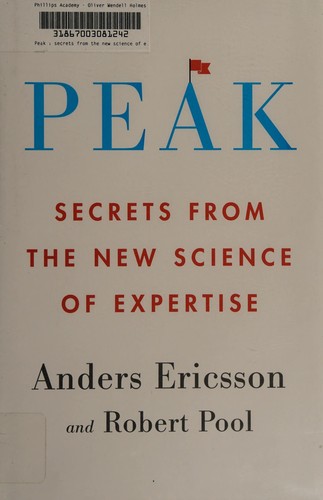
Peak is a science-backed argument that expertise is not born but built. Drawing on thirty years of research into how people develop exceptional abilities, Anders Ericsson explains the specific training method — deliberate practice — that separates world-class performers from everyone else, and shows how anyone can apply these principles to get dramatically better at almost anything.
About the author
K. Anders Ericsson (1947–2020) was a Swedish psychologist who spent his career at Florida State University studying the psychology of expertise and human performance. He is widely regarded as the world’s leading researcher on deliberate practice, and his landmark 1993 study of violinists at the Berlin Academy of Music became one of the most cited papers in performance science. His work was popularized (and somewhat oversimplified) by Malcolm Gladwell’s “10,000-hour rule” in Outliers. Peak, co-written with science writer Robert Pool, was Ericsson’s own attempt to set the record straight and give the public a complete, accurate picture of what his research actually found. Explore all K. Anders Ericsson book summaries →
Key concepts at a glance
| Concept | What it means | Use it when |
|---|---|---|
| Deliberate practice | Structured training designed by an expert to target specific weaknesses with immediate feedback | You want to improve past a plateau in any skill |
| Mental representations | Internal models that let experts process, plan, and self-correct faster than novices | You notice experts “see” things you miss |
| Purposeful practice | Practice with clear goals and focus, but without expert-designed structure | No teacher is available but you want structured improvement |
| Naive practice | Mindless repetition with no goals or feedback | You are stuck on a plateau and need to diagnose why |
| Adaptability | The brain and body physically restructure in response to sustained, focused demands | You doubt whether improvement is possible at your age or level |
| The talent myth | The mistaken belief that innate ability, not training quality, determines who becomes great | You catch yourself thinking “I am just not talented enough” |
| Homeostasis | The body’s tendency to return to equilibrium, which deliberate practice must continuously push against | You feel comfortable and progress has stalled |
Part 1: The power of purposeful practice
Ericsson opens with a striking study: Steve Faloon, an ordinary college student, trained his digit span from 7 digits (the human average) to 82 digits over two years of structured practice sessions. This was not because Steve was gifted — his IQ and memory were unremarkable. It was because he developed increasingly sophisticated mental strategies, chunking strings of numbers into meaningful patterns (running times, ages, dates) and building a retrieval structure to organize them.
This case sets up the book’s central argument: the human brain is far more adaptable than we think, but only when pushed in the right way. Ericsson distinguishes three tiers of practice. Naive practice is just doing an activity on repeat — playing tennis every weekend, running the same route, cooking the same meals — and hoping to get better. This works briefly, then plateaus. Purposeful practice adds specific goals (“today I will work only on my backhand return”), full concentration, feedback, and a willingness to leave the comfort zone. Deliberate practice goes further: it takes place in a field with established training methods, is guided by a qualified teacher, and targets the building of mental representations — the internal models that let experts think, plan, and self-correct at a higher level.
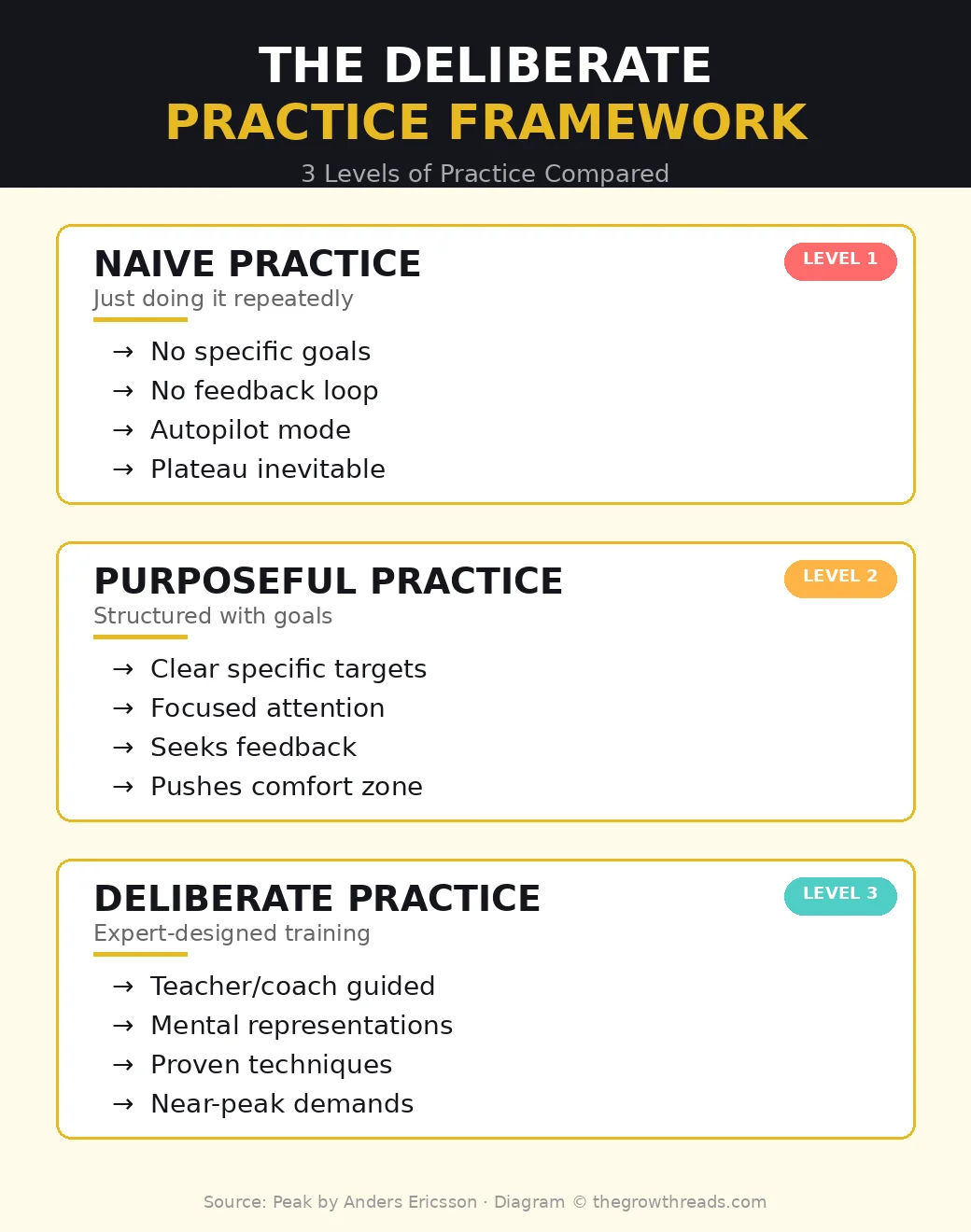
The key insight is that “getting better” is not a vague wish — it is an engineering problem. You identify the sub-skill that is weakest, design a drill that isolates it, get feedback, adjust, and repeat. Ericsson emphasizes that this process is rarely enjoyable in the moment. It requires sustained concentration, honest assessment of weaknesses, and the discipline to work on what is hard rather than what is fun.
Part 2: Mental representations — the engine of expertise
The concept that ties the entire book together is the mental representation. Ericsson defines these as pre-existing patterns of information — facts, images, rules, relationships — stored in long-term memory that experts use to process information quickly, plan ahead, and monitor their own performance. A chess grandmaster does not evaluate every possible move from scratch; they recognise board configurations they have seen thousands of times and immediately retrieve the strongest responses. A skilled doctor does not run through a checklist for every symptom; they pattern-match the clinical picture against thousands of cases stored in memory.
Ericsson provides a detailed breakdown of what mental representations do. First, they help experts absorb and process information. A music student with strong representations can hear a piece once and understand its structure; a novice hears a wall of sound. Second, they guide planning. A soccer midfielder with rich representations sees passing lanes before they open. Third — and most importantly for self-directed learners — they enable self-monitoring. An expert violinist hears when they are slightly sharp; a beginner cannot tell.
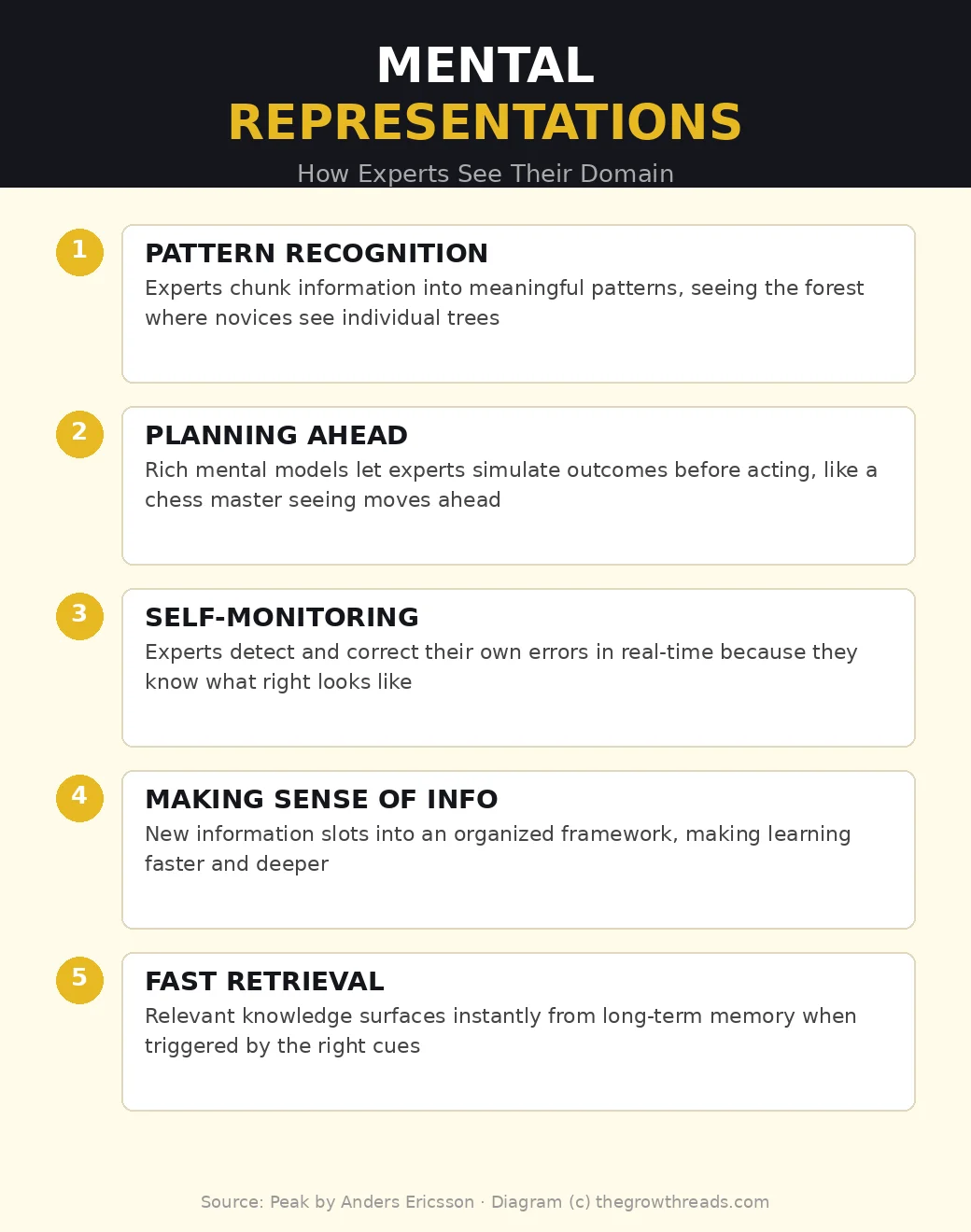
This creates a virtuous cycle: better mental representations make practice more effective, and more effective practice builds better mental representations. Ericsson argues this is the real mechanism behind expertise, and it explains why deliberate practice works while naive practice does not. Without the feedback loop of “what does expert performance look like?” there is nothing to compare your current performance against, and no way to identify what needs to change.
Part 3: Debunking the talent myth
Perhaps the most provocative section of Peak is Ericsson’s systematic dismantling of the “born talent” narrative. He examines case after case — Mozart, the Polgar sisters in chess, “perfect pitch” in musicians — and shows that in every instance, what looks like innate genius turns out to involve early, intensive, structured training.
Mozart is the signature example. Ericsson argues that Mozart’s father Leopold was one of Europe’s leading music educators, that Wolfgang began intensive training at age three or four, and that his earliest compositions — often cited as proof of prodigy — were in fact heavily edited by Leopold and considerably less impressive than what other composers produced at similar ages after similar training. The “miracle” was not Mozart’s genes but his father’s training programme and the sheer volume of structured practice hours he accumulated before anyone else his age had started.
Ericsson is careful to note that he is not claiming genetics play zero role. Physical size matters in basketball; body proportions affect swimming. But in the vast majority of cognitive and skill-based domains, he argues, the differences between top performers and average ones are explained by the quality and quantity of their practice, not by talent. He points to studies showing that practice accounts for the performance gap between expert and amateur musicians, between skilled and novice surgeons, and between champion and recreational athletes — even after controlling for variables like general intelligence.
Part 4: Applying deliberate practice to your life
In the final section, Ericsson addresses the practical question: how do you apply deliberate practice when you are not a concert pianist or Olympic athlete with a world-class coach? His answer is more nuanced than critics give him credit for.
First, find a teacher — or at least a model of expert performance. In fields with well-established training methods (music, chess, sports, medicine), the path is clear: work with a qualified instructor who can identify your weaknesses and design targeted drills. In fields without established methods (business, writing, parenting), Ericsson suggests identifying top performers, studying what they do differently, and designing your own practice activities that isolate specific sub-skills.
Second, stay focused and engaged. The single most common failure mode is going on autopilot — doing the activity but not actively working to improve. Ericsson is blunt: if your mind wanders during practice, you are not practising deliberately. Shorter, more intense sessions beat longer, unfocused ones.
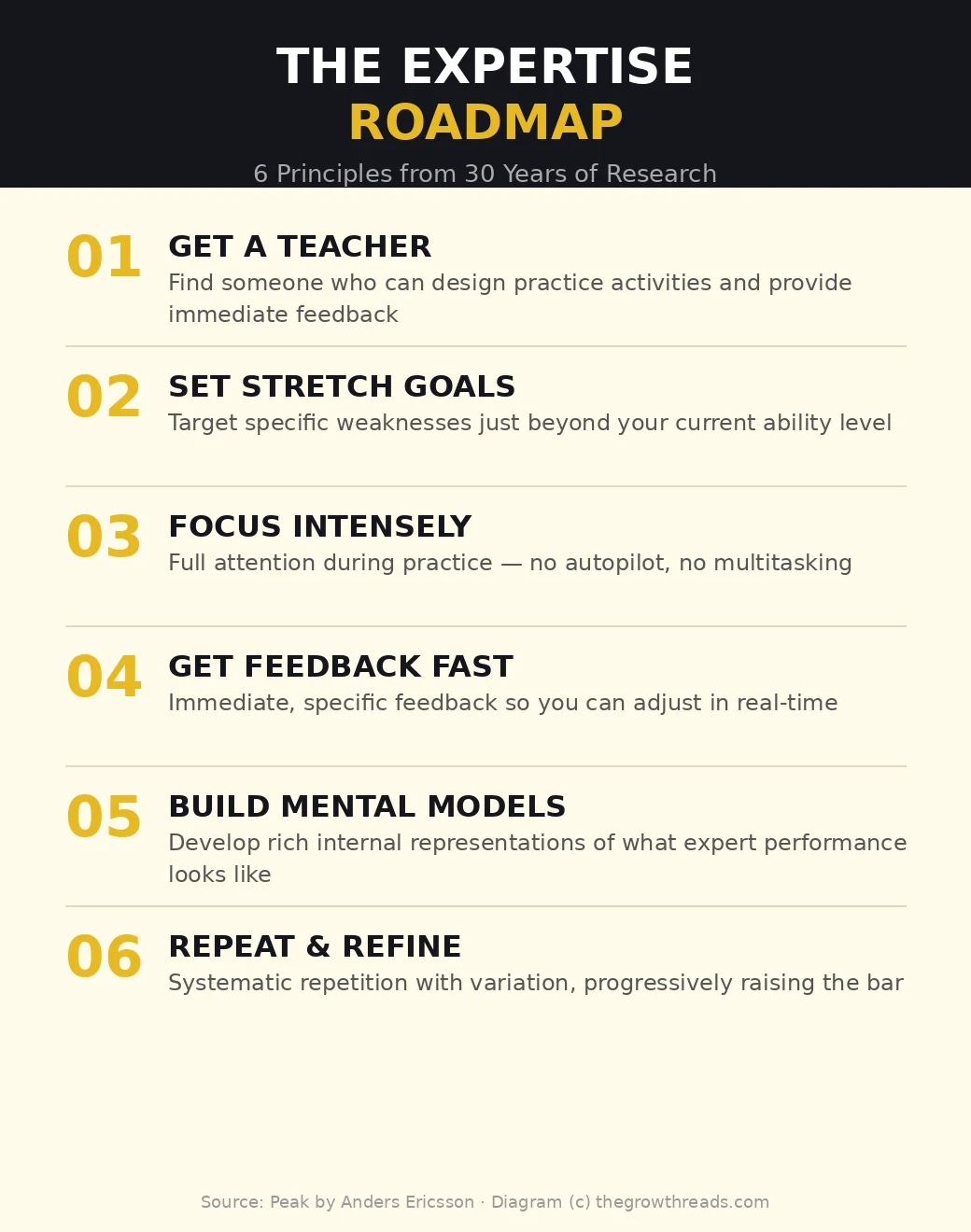
Third, build feedback loops. Without feedback, you cannot build accurate mental representations, and without mental representations, you will plateau. This might mean recording yourself and watching the playback, keeping detailed performance logs, or working with a peer who can give you honest assessments.
Ericsson also addresses motivation, which he frames as a practical problem rather than a personality trait. He recommends keeping practice sessions short enough to maintain full concentration (typically 60–90 minutes), setting clear short-term goals, building social accountability structures, and strengthening your identity as someone who practises. He notes that top performers do not enjoy practice more than anyone else — they have simply built stronger reasons and systems to keep doing it.
Who is Peak best for — and who should read something else first?
Peak is ideal for self-directed learners who want a research-backed framework for getting better at a specific skill, coaches and teachers designing training programmes, and parents who want to support their children’s development without falling for talent myths. It is also essential reading for anyone who has hit a plateau and cannot figure out why.
If you are looking for a broader perspective on skill development that includes the value of generalism, start with Range by David Epstein. If you want the habit-building foundation that makes daily practice possible, Atomic Habits by James Clear is the better first read. And if you want the deep-focus operating system that deliberate practice demands, pair Peak with Deep Work by Cal Newport.
Questions to reflect on
- In your most important skill, are you currently practising naively, purposefully, or deliberately — and what would it take to move up one level?
- What does expert performance actually look like in your field, and how precisely can you describe the gap between that standard and your current level?
- When did you last work on a specific weakness rather than repeating what you already do well?
- Who could serve as a teacher or feedback source for the skill you most want to improve — and what is stopping you from asking them?
- If talent is not the main factor, what story have you been telling yourself about your own potential that might be holding you back?
🔥 Ready to unlock your next level of performance?
Peak gives you the research-backed blueprint for building genuine expertise in any field.
How to apply Peak (7-day plan)
- Day 1 — Choose one skill. Pick the single skill that would make the biggest difference in your work or life right now. Write it down along with your honest current level on a 1–10 scale.
- Day 2 — Study an expert. Find someone who performs this skill at a level you admire. Watch, read, or listen to them for 30 minutes and write down three specific things they do differently from you.
- Day 3 — Identify your weakest sub-skill. Break your chosen skill into 3–5 component sub-skills. Rank them by weakness. The worst one is your first deliberate practice target.
- Day 4 — Design one drill. Create a 20-minute exercise that isolates your weakest sub-skill and includes a way to measure or get feedback on your performance.
- Day 5 — Do the drill with full focus. Set a timer, eliminate distractions, and complete the drill. Record or log your results so you can track progress.
- Day 6 — Get feedback. Show your work to someone more skilled, review your recording, or compare your output against an expert benchmark. Note one specific adjustment.
- Day 7 — Refine and schedule. Adjust your drill based on yesterday’s feedback. Block 20–30 minutes of deliberate practice into your calendar for the next two weeks. Consistency matters more than duration.
Frequently asked questions
What is the main message of Peak by Anders Ericsson?
The central message is that expertise is not a product of innate talent but of a specific kind of training called deliberate practice. Ericsson draws on thirty years of research across music, sports, medicine, and chess to show that top performers in every field became great through structured, effortful practice — not genetic gifts. Anyone willing to invest the time, find the right guidance, and push beyond their comfort zone can develop abilities far beyond what they currently think possible.
What is the difference between deliberate practice and regular practice?
Regular (naive) practice means repeating an activity on autopilot without targeting weaknesses. Deliberate practice is structured, goal-directed training designed by a knowledgeable teacher that targets specific areas for improvement, demands full concentration, includes immediate feedback, and continuously pushes you outside your comfort zone. The crucial difference is intentionality: deliberate practice forces the brain to build new and better mental representations rather than reinforcing existing ones.
Does Anders Ericsson support the 10,000-hour rule?
Not exactly. The 10,000-hour figure was popularised by Malcolm Gladwell in Outliers, based on Ericsson’s 1993 study of violinists. Ericsson himself says Gladwell oversimplified the research. In Peak, he clarifies that 10,000 was an average, not a universal threshold, and that the quality and structure of practice hours matter far more than the total count. Some people reach expertise faster; others never do, regardless of hours invested, because they practise naively rather than deliberately.
Can you use deliberate practice without a teacher?
Yes, though it is harder. Ericsson recommends what he calls purposeful practice for situations where no expert teacher is available. This means setting specific goals, maintaining intense focus, building your own feedback mechanisms (like recording yourself or keeping detailed logs), and studying what top performers do differently. The key is to avoid autopilot: always have a clear target, a way to measure progress, and a willingness to work on your weaknesses rather than your strengths.
What are mental representations in Peak?
Mental representations are internal models — patterns of information stored in long-term memory — that experts use to process information quickly, plan ahead, and monitor their own performance in real time. A chess grandmaster recognises board patterns instantly; a skilled doctor pattern-matches symptoms against thousands of stored cases. Building better mental representations is the core mechanism of deliberate practice: each focused session refines your internal model, which in turn makes future practice more effective.
How long should a deliberate practice session be?
Ericsson’s research suggests that most people can sustain genuine deliberate practice for about 60 to 90 minutes before concentration drops. Even top performers — concert pianists, Olympic athletes — rarely exceed four to five hours of truly focused practice per day, broken into sessions with rest in between. Quality matters far more than quantity. A focused 30-minute session where you target a specific weakness will produce more improvement than three hours of unfocused repetition.
Is it too late to start deliberate practice as an adult?
No. While Ericsson acknowledges that starting earlier provides advantages in certain physical domains, he emphasises that the brain remains adaptable throughout life. Adults can and do develop expertise in new fields — learning instruments, mastering languages, building professional skills — through deliberate practice. The principles are the same at any age: target weaknesses, get feedback, build mental representations, and push beyond comfort zones. The main barrier for adults is typically not biology but finding time and maintaining motivation.
Related summaries
If you found Peak valuable, these summaries explore complementary ideas about skill-building, focus, and performance:
- Deep Work by Cal Newport — The focus operating system that deliberate practice demands.
- Atomic Habits by James Clear — How to make daily practice automatic through habit design.
- Range by David Epstein — The counterpoint: when breadth and sampling beat early specialisation.
- So Good They Can’t Ignore You by Cal Newport — Why building rare skills (via deliberate practice) is the real path to a fulfilling career.
Explore our full collection of productivity book summaries on the best productivity books pillar page.