

★★★★½ 4.5 / 5
One-liner: A sex educator dismantles everything you thought you knew about desire, arousal, and sexual response — replacing shame and myths with neuroscience, compassion, and practical tools for a more fulfilling intimate life.
Best for: Anyone who has ever felt “broken” sexually, couples navigating desire differences, and readers who want the science of sexual wellbeing without judgment.
Reading time: ~7 hrs (guide: 26 min)
Difficulty to apply: Moderate (requires honest self-assessment and partner communication)
Come As You Are in one minute
You are not broken — you are just working with different wiring than culture told you to expect. Emily Nagoski, a sex educator with a PhD in health behaviour, wrote Come As You Are to address the single most common issue she encountered in her classes: women (and many men) who believed something was wrong with them because their desire did not look like what movies, media, and partners told them it should. The book introduces two transformative concepts: the dual control model (your sexual response has an accelerator that responds to sexually relevant stimuli AND brakes that respond to threats and stressors — low desire is usually too much brake, not too little gas) and the distinction between spontaneous and responsive desire (desire that appears “out of nowhere” versus desire that emerges in response to pleasure already happening — both are normal). The overarching message: there is no “right” way to experience desire, and once you understand your own unique wiring, you can create the conditions that work for you.
Key takeaways
- The dual control model: Sexual response has two systems — the Sexual Excitation System (accelerator) that notices turn-ons, and the Sexual Inhibition System (brakes) that notices turn-offs. Low desire is almost always a brakes problem, not an accelerator problem.
- Spontaneous desire is not the only normal: About 75% of men and 15% of women experience primarily spontaneous desire (it appears unprompted). About 30% of women experience primarily responsive desire (arousal comes first, then wanting). About 50% experience a mix. All are equally valid.
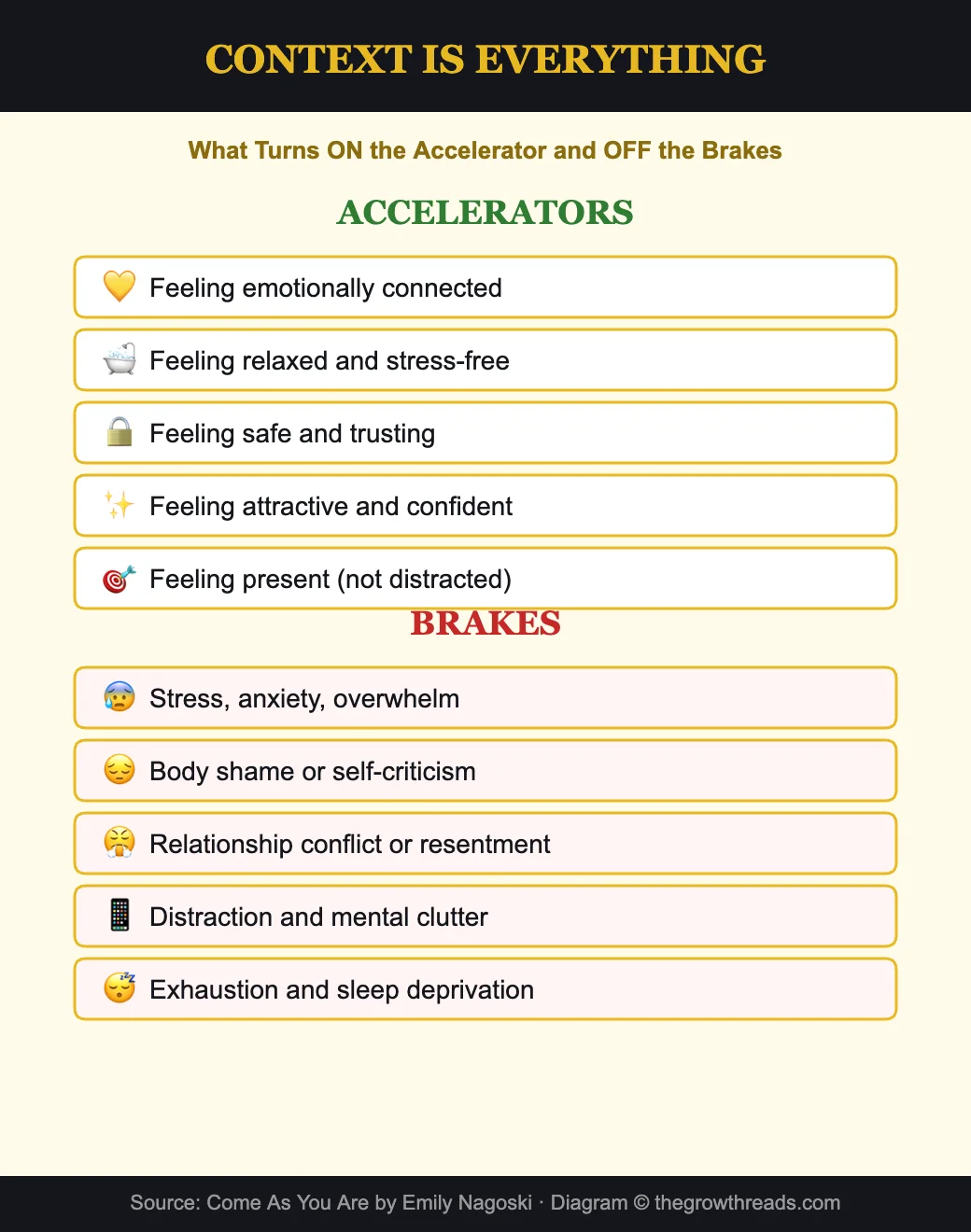
- Context determines everything: The same touch can feel arousing or annoying depending on context — your stress level, emotional connection, body image, relationship state, and physical environment. Desire is not a drive; it is a response to context.
- Stress is the #1 desire killer: The brakes system responds powerfully to stress. When your body is in threat-response mode, it suppresses sexual interest as a survival mechanism. Managing stress is not a bonus; it is a prerequisite for desire.
- Body image shame hits the brakes hard: Self-criticism about your body during intimacy activates the inhibition system. Learning to be present in your body rather than monitoring it from the outside is one of the most powerful desire unlocks.
- Arousal non-concordance is normal: Physical arousal (genital response) and subjective arousal (feeling turned on) do not always match. You can be physically aroused without wanting sex, or wanting sex without physical response. This is normal biology, not dysfunction.
- Desire is not a drive like hunger: You will not die without sex. Desire is an incentive motivation system — it responds to context and cues, not to deprivation. This reframing removes the pressure of “should” from sexual frequency.
- Emotional context matters as much as physical: Feeling emotionally safe, connected, and valued is as important for desire as physical stimulation — sometimes more so, particularly for people with responsive desire.
- Your sexual response is unique — and normal: There is enormous variation in how people experience arousal, desire, orgasm, and pleasure. The problem is not variation — it is the cultural myth that there is one “correct” sexual response pattern.
- Pleasure is the measure, not performance: Nagoski redefines “good sex” not as frequency, duration, or technique, but as sex that feels pleasurable and connecting for both partners — whatever form that takes.
What is Come As You Are about?
Come As You Are uses neuroscience and sexual health research to explain how desire, arousal, and pleasure actually work — replacing cultural myths with evidence. Emily Nagoski introduces the dual control model, the distinction between spontaneous and responsive desire, and the central role of context in sexual wellbeing.
About the author
Emily Nagoski, PhD, is a sex educator, researcher, and author who earned her doctorate in health behaviour from Indiana University, home to the Kinsey Institute. She spent years teaching human sexuality courses at Smith College, where the overwhelming response from students (“I thought I was broken”) inspired the book. Come As You Are became a New York Times bestseller and has been translated into over 30 languages. Nagoski combines academic rigour with warmth and humour, making complex neuroscience accessible without oversimplifying. Her follow-up, Burnout: The Secret to Unlocking the Stress Cycle (co-authored with her twin sister Amelia Nagoski), extends the stress-management science to broader wellbeing. Explore all Emily Nagoski book summaries →
Key concepts at a glance
| Concept | What it means | Use it when |
|---|---|---|
| Dual control model | Sexual response has an accelerator (SES) and brakes (SIS) that operate simultaneously | You want to understand why desire fluctuates |
| Spontaneous desire | Desire that appears “out of nowhere” without external cues | You assume this is the only normal type |
| Responsive desire | Desire that emerges in response to pleasure already happening | You feel desire only after intimacy begins |
| Context | The external and internal circumstances that determine whether a stimulus is perceived as arousing | The same touch feels different at different times |
| Arousal non-concordance | Physical genital response and subjective feeling of being turned on do not always match | Your body responds but you do not feel aroused, or vice versa |
| Stress cycle | The physiological arc from stress activation to completion — incomplete cycles suppress desire | You are too stressed for intimacy |
Part 1 — The dual control model
Nagoski opens with the metaphor that structures the entire book: your sexual response system is like a car with both an accelerator and brakes, and they operate simultaneously. The Sexual Excitation System (SES) scans your environment for sexually relevant cues — touch, visual stimuli, emotional connection, novelty — and sends “turn on” signals. The Sexual Inhibition System (SIS) scans for reasons NOT to be aroused — stress, danger, social consequences, relationship tension, body shame — and sends “turn off” signals.
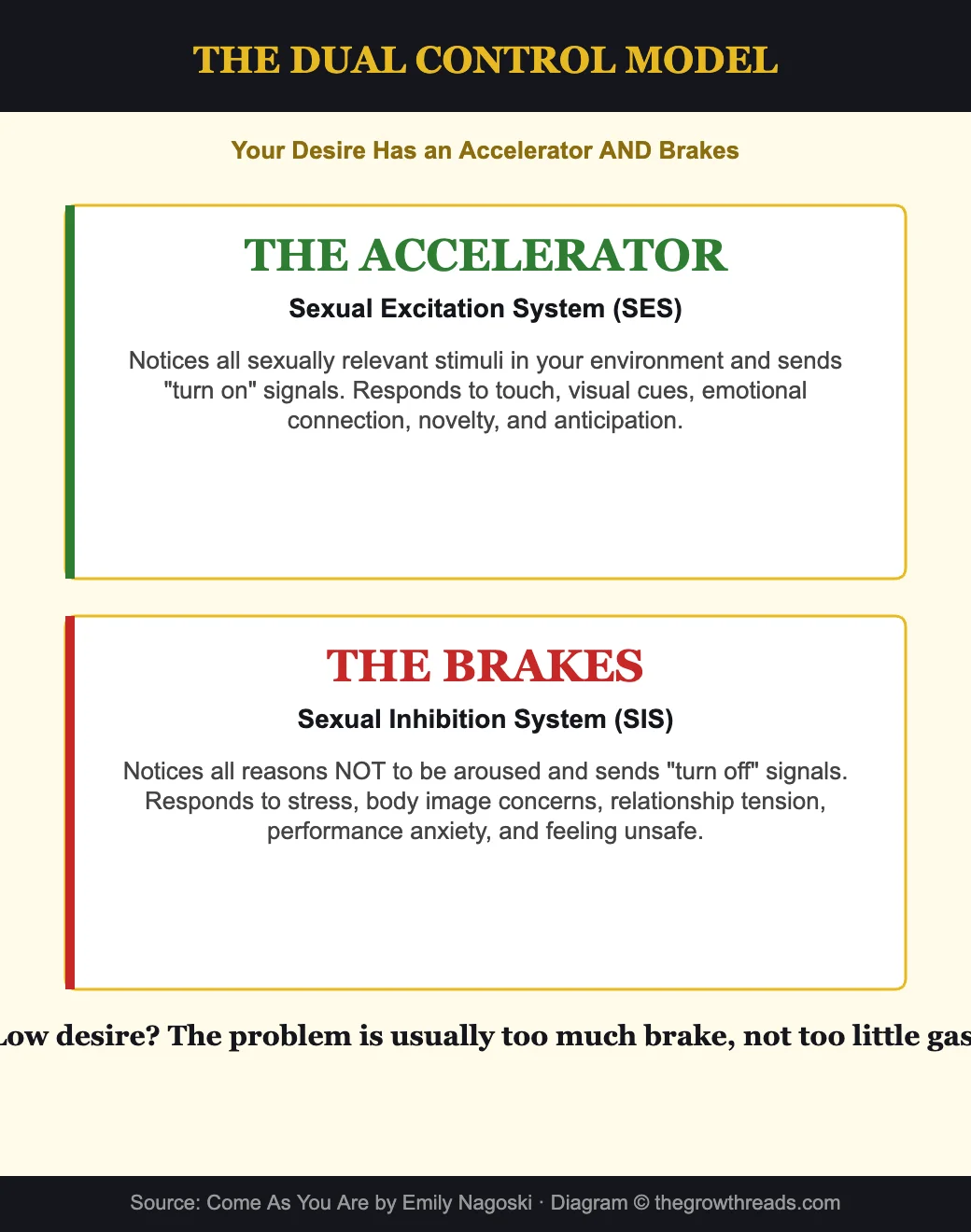
The critical insight: when someone experiences low desire, the conventional assumption is that their accelerator is weak — they just do not have much “sex drive.” Nagoski shows that in most cases, the accelerator is working fine; the problem is that the brakes are pressed too hard. Stress, body image concerns, relationship resentment, exhaustion, and distraction all activate the inhibition system. The solution is not to rev the engine harder (more stimulation, more pressure) but to release the brakes (reduce stress, create safety, address body shame, resolve relationship tension).
This reframing is the book’s most liberating contribution. It shifts the conversation from “what is wrong with you?” to “what is activating your brakes?” — a question that leads to actionable answers rather than shame. Every person has a different sensitivity on both pedals: some people have sensitive accelerators and quiet brakes (they get aroused easily in many contexts), while others have sensitive brakes and quieter accelerators (they need very specific conditions to feel desire). Neither configuration is better or worse — they are simply different wiring that requires different contexts.
Part 2 — Spontaneous vs responsive desire
The second major framework is the distinction between spontaneous and responsive desire — a concept that Nagoski says has “changed more lives than any other single idea” in her teaching career. Spontaneous desire is the type most people think of as “normal”: it appears unprompted, like hunger. You are going about your day and suddenly you want sex. This is the dominant portrayal in media, and it describes the experience of roughly 75% of men and 15% of women.
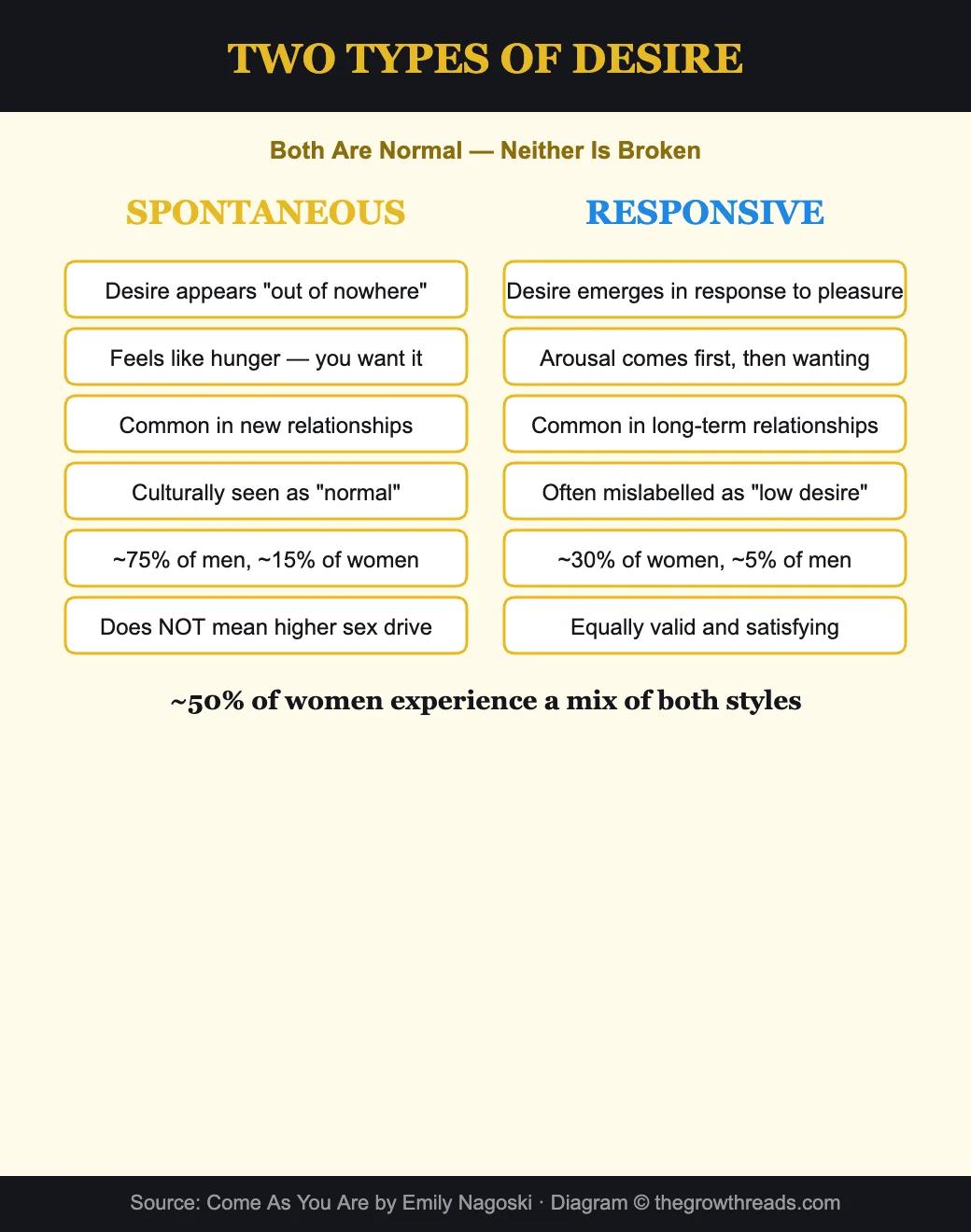
Responsive desire works differently: it does not appear until something pleasurable is already happening. You might not feel desire before intimacy begins, but once touching, kissing, or connecting starts, the desire emerges — arousal comes first, wanting follows. About 30% of women experience primarily responsive desire, and about 50% experience a mix of both styles. Responsive desire is not low desire — it is a different sequence of the same components. It produces equally satisfying, equally passionate sexual experiences. The problem is that culture frames it as “broken” because it does not match the spontaneous model.
The practical implication is enormous. If you have responsive desire, you do not wait around for wanting to strike; you create conditions where pleasure can begin and desire can follow. This might mean scheduling intimacy (not romantic, but effective), starting with non-sexual touch and allowing arousal to build, or simply giving yourself permission to say “I’m not in the mood yet, but I’m willing to begin and see.” For partners of responsive-desire people, it means understanding that the absence of spontaneous initiation is not rejection — it is a different operating system.
Part 3 — Context, stress, and the path forward
The final section ties the framework together with context — the meta-concept that governs everything. The same touch, the same partner, the same bed can produce arousal one night and irritation the next. The difference is not the stimulus but the context in which it is received. Nagoski identifies the key contextual factors: stress levels, emotional connection with the partner, body image state, physical environment, and relationship trust. When the context is right, the brakes release and the accelerator responds. When the context is wrong, no amount of technique compensates.
Stress receives extended treatment because it is the most common brake and the most modifiable. Nagoski explains the stress cycle — the physiological arc from activation (threat detected) to completion (the body processes the stress and returns to baseline). The problem in modern life is not stress itself but incomplete stress cycles: you feel the activation (a difficult email, a parenting crisis, a financial worry) but never physically complete the cycle. The stress hormones remain in your body, the brakes stay pressed, and desire has no chance. Solutions include physical exercise (the most reliable cycle-completer), crying, creative expression, social connection, and laughter — anything that tells the body the threat is over.
The body image chapter may be the most emotionally impactful in the book. Nagoski presents research showing that how a person feels about their body during intimacy is a stronger predictor of sexual satisfaction than any physical characteristic. Self-objectification — monitoring your body from the outside (“how do I look?”) rather than experiencing it from the inside (“how do I feel?”) — is the most powerful brake most people do not know they are pressing. The shift from spectating to inhabiting your body is, for many readers, the single most transformative takeaway.
Who is Come As You Are best for — and who should read something else first?
This book is for anyone who has ever felt that their sexual response is “wrong,” “broken,” or “not enough.” It is especially powerful for women, though men with responsive desire or sensitive brakes will find it equally revelatory. Couples navigating desire discrepancies will benefit enormously from the shared vocabulary it provides. Nagoski writes with warmth, humour, and zero judgment — making difficult topics feel safe to explore.
If your primary challenge is relational rather than sexual, start with Attached or Hold Me Tight — the emotional foundation needs to be solid before the desire work can take hold. If the desire paradox in long-term relationships is your focus, Mating in Captivity provides the complementary perspective. And if body image is the primary brake, this book addresses it directly and compassionately.
Questions to reflect on
- What are your top three brakes — the things that most consistently suppress your desire — and what would change if you addressed even one of them?
- Do you experience primarily spontaneous or responsive desire — and has misunderstanding your type caused unnecessary shame or conflict?
- How much of your energy during intimacy is spent monitoring how you look rather than experiencing how you feel?
- What context — emotional, physical, relational — would need to be true for your desire to emerge naturally?
- If “good sex” is defined by pleasure and connection rather than frequency or performance, how would you evaluate your intimate life?
🔥 Ready to understand your own desire?
Learn the science of sexual response — and discover that you are not broken, just different.
How to apply Come As You Are (7-day plan)
- Day 1 — Map your accelerator and brakes: List your top 5 turn-ons (accelerator: what contexts make desire more likely) and top 5 turn-offs (brakes: what contexts suppress desire). This is your personal sexual wiring map.
- Day 2 — Identify your desire style: Reflect: do you typically experience desire spontaneously (it appears unprompted) or responsively (it emerges once intimacy begins)? Neither is better. Knowing yours changes everything.
- Day 3 — Complete one stress cycle: Do 20 minutes of vigorous physical activity, have a long cry, laugh hard, or connect deeply with a friend. You are completing the physiological stress cycle that keeps the brakes pressed.
- Day 4 — Practice embodiment: During any physical activity today (showering, stretching, walking), focus entirely on sensation rather than appearance. Notice temperature, pressure, movement. You are training the shift from spectating to inhabiting your body.
- Day 5 — Release one brake: Identify your most persistent brake (stress, body shame, relationship tension, distraction) and take one concrete action to reduce its pressure: delegate a task, have a repair conversation, set a phone curfew.
- Day 6 — Communicate with your partner: Share your accelerator/brakes map with your partner. Ask them to share theirs. Discuss: what context would we need to create for desire to emerge naturally? This is not a demand — it is an invitation to co-create.
- Day 7 — Redefine good sex: Write your own definition of satisfying intimacy — not based on frequency, duration, or media portrayals, but on what actually feels pleasurable and connecting for you. Let this be your new measure.
Frequently asked questions
Is this book only for women?
Nagoski wrote it primarily for women, and the examples centre female experience. However, the core concepts — the dual control model, responsive desire, the role of context and stress — apply to all genders. Men with sensitive brakes, responsive desire, or desire discrepancies in their relationships will find the framework equally illuminating. Partners of any gender who want to understand their partner’s desire style will also benefit significantly.
What is responsive desire and is it really normal?
Responsive desire means your wanting emerges in response to pleasure that is already happening — arousal comes first, then desire follows. It is experienced by approximately 30% of women as their primary style, with another 50% experiencing a mix of responsive and spontaneous. It is completely normal, produces equally satisfying intimate experiences, and is well-documented in sexual health research. The reason it feels “abnormal” is that culture, media, and many partners expect spontaneous desire as the default.
Can this book help with desire discrepancies in a couple?
Yes — this is one of its strongest applications. When one partner has spontaneous desire and the other has responsive desire, both often feel frustrated and confused. The spontaneous partner feels rejected when the other does not initiate; the responsive partner feels pressured and inadequate. Understanding that these are different but equally valid wiring patterns — not a mismatch in love or attraction — transforms the conversation from blame to collaboration.
What is arousal non-concordance?
Arousal non-concordance means that physical genital response (blood flow, lubrication, erection) and subjective experience of being turned on do not always match. You can have a physical response without wanting sex, or want sex without a physical response. Research shows only about 10-25% concordance in women and 50% in men. This is normal biology, not dysfunction, and it has important implications: physical response alone does not indicate desire or consent, and lack of physical response does not indicate absence of desire.
How does stress affect desire?
Stress activates the brakes system powerfully. When your body is in threat-response mode (elevated cortisol, activated sympathetic nervous system), it suppresses sexual interest as a survival mechanism — your body prioritises escaping danger over reproduction. The issue in modern life is that stress rarely completes its cycle: the threat response activates but the body never gets the signal that it is safe. Solutions include physical activity, social connection, crying, laughter, and creative expression — all of which complete the stress cycle and release the brakes.
Is the science in this book reliable?
Yes. Nagoski draws primarily on the dual control model developed by Erick Janssen and John Bancroft at the Kinsey Institute, which is well-established in sexology research. The responsive/spontaneous desire distinction is supported by the work of Rosemary Basson and others. The stress-cycle concept draws on established psychophysiology. Nagoski cites peer-reviewed research throughout and clearly distinguishes between established science and emerging findings. Her PhD is in health behaviour from Indiana University, home to the Kinsey Institute, giving her direct access to the research community.
How does this compare to Mating in Captivity?
Complementary but different. Perel focuses on the relational and cultural dynamics that suppress desire in long-term partnerships — domesticity, over-togetherness, the loss of mystery. Nagoski focuses on the individual neurological and psychological mechanisms — the accelerator/brakes model, stress, body image, desire styles. Perel answers “why does desire fade between us?” Nagoski answers “why does desire work this way inside me?” Read Nagoski first for the individual science, then Perel for the relational framework.
Related summaries
- Mating in Captivity by Esther Perel — The relational dynamics that suppress desire in committed partnerships.
- Attached by Amir Levine — How attachment styles shape the emotional foundation that desire requires.
- Getting the Love You Want by Harville Hendrix — The imago theory of partner selection and conscious relationship.
- The Body Keeps the Score by Bessel van der Kolk — How the nervous system stores stress and trauma that affect intimacy.
- See all Relationships book summaries on our Best Relationship Books pillar page.