

★★★★½ 4.4 / 5
One-liner: A National Geographic explorer distils decades of fieldwork in five longevity hotspots into nine simple, evidence-backed habits that add years to your life — no biohacking required.
Best for: Anyone who wants to live longer and healthier without extreme diets or expensive supplements — especially readers who respond to real-world stories over lab data.
Reading time: ~6 hrs (guide: 25 min)
Difficulty to apply: Low–Moderate (lifestyle shifts, not protocols)
The Blue Zones in one minute
The longest-lived people on Earth do not count calories, run marathons, or take supplements — they live in environments that make healthy choices the default. Dan Buettner spent over a decade studying five communities where people regularly live past 100: Okinawa (Japan), Sardinia (Italy), Nicoya (Costa Rica), Ikaria (Greece), and Loma Linda (California). He found that despite vast cultural differences, these populations share nine common lifestyle habits — the “Power 9” — spanning natural movement, plant-heavy eating, social connection, purpose, and stress management. The book’s thesis is radical in its simplicity: longevity is not about willpower or genetics but about designing your surroundings so that the healthy choice is the easy choice.
Key takeaways
- Environment beats willpower: Blue Zone centenarians do not rely on discipline — their homes, social circles, and daily routines are structured so that healthy behaviour happens automatically.
- Natural movement outperforms the gym: The longest-lived people walk, garden, cook, and do manual chores throughout the day rather than exercising in concentrated bursts.
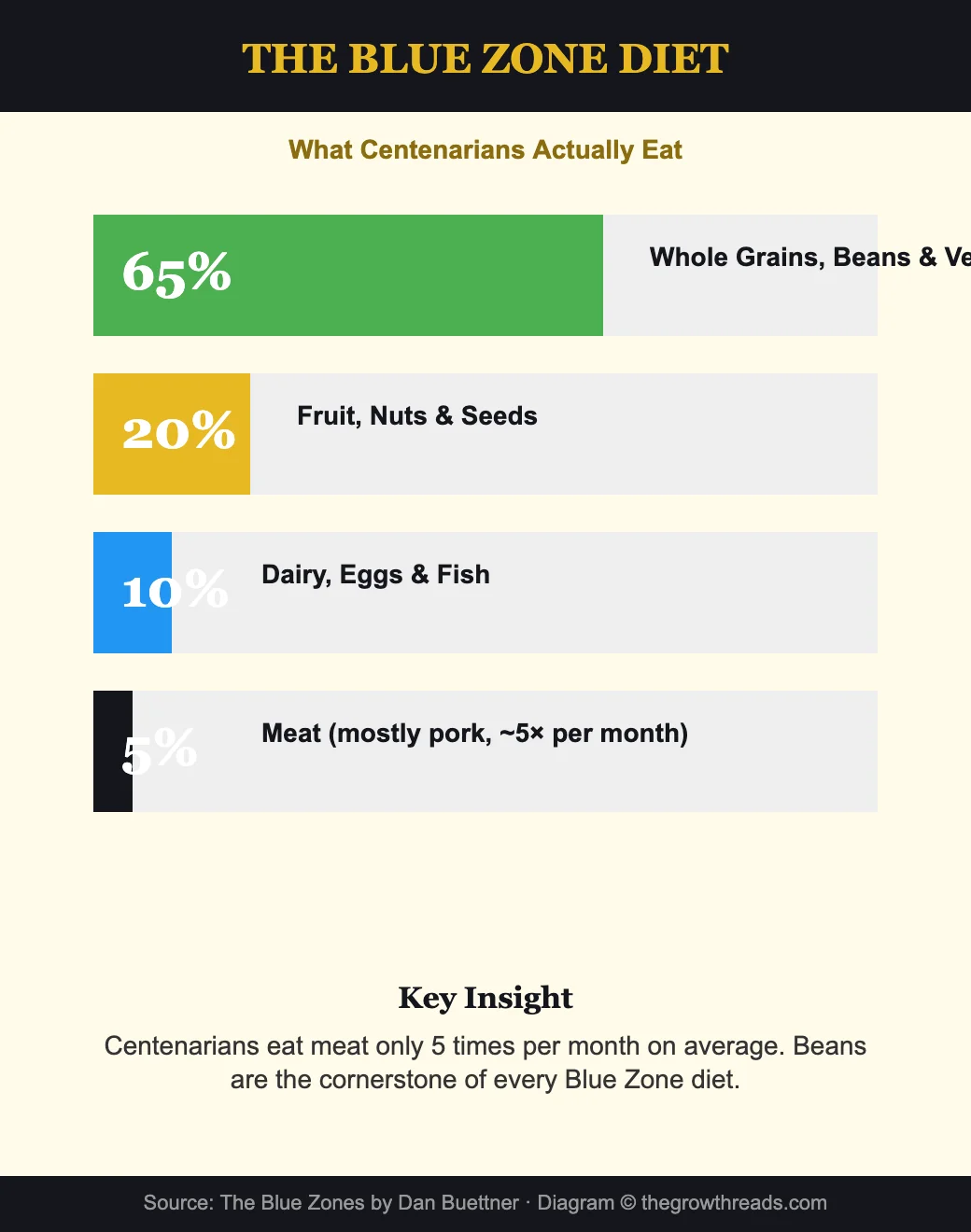
- Plant-heavy diets are the common thread: Across all five zones, beans, whole grains, and vegetables form the dietary foundation; meat is consumed sparingly — about five times per month on average.
- The 80% rule prevents overeating: Okinawans say “hara hachi bu” before meals — a reminder to stop eating when 80% full, reducing daily caloric intake by roughly 20% without conscious dieting.
- Purpose adds measurable years: Knowing why you wake up each morning is associated with up to seven extra years of life expectancy in Okinawan and Nicoyan populations.
- Stress management is non-negotiable: Every Blue Zone has built-in routines for shedding stress — prayer, napping, happy hour, or ancestor remembrance rituals.
- Moderate alcohol with meals extends life: Moderate, regular wine consumption (1–2 glasses daily) with food and friends is common in four of five Blue Zones.
- Faith communities add 4–14 years: Belonging to a faith-based community — regardless of denomination — correlates with significantly longer life spans.
- Family comes first: Centenarians invest in close family relationships, keep aging parents nearby, and commit to life partners — all of which correlate with lower disease and mortality rates.
- Your social circle shapes your health: Okinawans form “moais” — groups of five friends who commit to each other for life. Research shows that health behaviours spread through social networks.
What is The Blue Zones about?
The Blue Zones documents the lifestyle habits of the world’s longest-lived populations across five geographic regions. Dan Buettner identifies nine shared practices — the Power 9 — that explain their exceptional longevity, then shows readers how to redesign their own environments to make those habits effortless.
About the author
Dan Buettner is a National Geographic Fellow, explorer, and New York Times bestselling author who holds three Guinness World Records for endurance cycling. His Blue Zones research began in 2004 as a National Geographic cover story and expanded into a franchise that includes five books, a Netflix documentary series, and the Blue Zones Project — a community well-being initiative that has been adopted by dozens of US cities. Buettner’s work bridges academic longevity research and popular health journalism, making epidemiological findings accessible to general readers through narrative storytelling and practical application. Explore all Dan Buettner book summaries →
Key concepts at a glance
| Concept | What it means | Use it when |
|---|---|---|
| Blue Zones | Five geographic regions with statistically exceptional longevity | You want to study real-world longevity instead of lab models |
| Power 9 | Nine shared lifestyle habits found across all five Blue Zones | You want a simple checklist for healthier living |
| Hara hachi bu | Okinawan practice of eating until only 80% full | You struggle with portion control |
| Moai | Okinawan social support group of lifelong friends | You want to build a health-supportive social circle |
| Plant slant | Diet centred on beans, grains, and vegetables with minimal meat | You want to shift your diet without going fully vegetarian |
| Ikigai / Plan de vida | A personal sense of purpose or reason to live | You feel directionless or want to clarify your motivation |
| Downshift | Daily stress-reversal practices embedded in routine | You experience chronic stress without a recovery ritual |
| Right tribe | Surrounding yourself with people who practise healthy habits | Your current social circle enables unhealthy behaviour |
Part 1 — The five longevity hotspots
Buettner opens with the detective story of how these five regions were identified. Working with demographers Gianni Pes and Michel Poulain, who originally coined the term “Blue Zone” after circling Sardinian villages with blue ink on a map, Buettner validated exceptional longevity clusters using birth certificates, death records, and census data. The scientific rigour matters: these are not cherry-picked anecdotes but statistically verified populations with significantly higher rates of people reaching 100.
In Sardinia’s Barbagia region, male centenarians appear at roughly ten times the rate found in the United States. Buettner attributes this partly to the mountainous terrain — shepherds walk five or more miles daily over steep ground — and partly to the social structure: tight-knit villages where men maintain active social roles well into old age. In Okinawa, women have the longest disability-free life expectancy of any population ever studied. Their diet — centred on sweet potatoes, tofu, bitter melon, and green tea — is calorie-sparse but nutrient-dense, and the cultural practice of hara hachi bu ensures they never overeat.
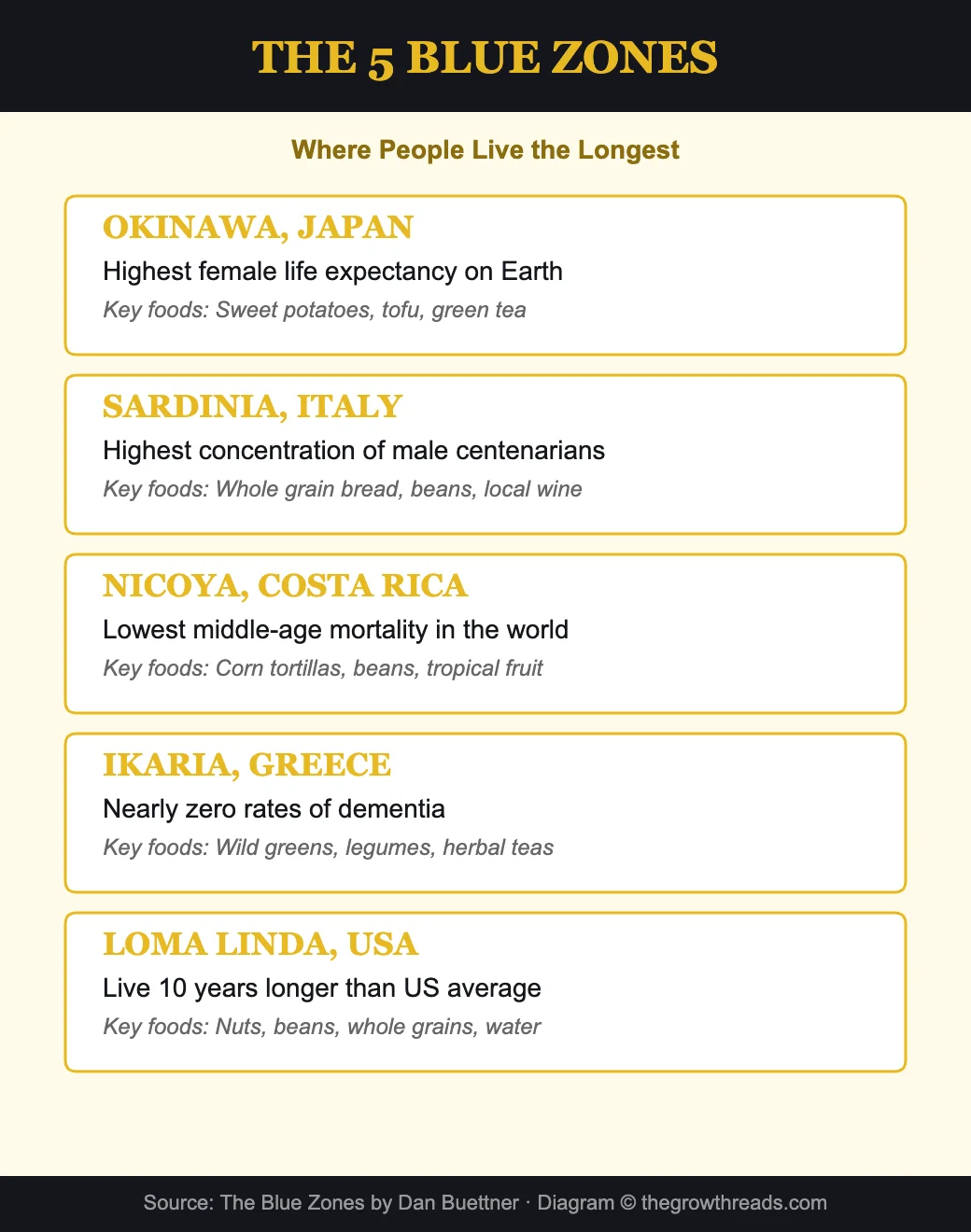
Nicoya Peninsula in Costa Rica stands out for having the lowest rate of middle-age mortality in the world. The Nicoyan diet of corn tortillas, beans, and tropical fruit delivers a high-fibre, high-antioxidant diet at very low cost. The water is unusually high in calcium and magnesium, which may support bone and heart health. Ikaria, a Greek island in the Aegean, has rates of dementia that are a fraction of the Western average. Ikarians eat wild greens, drink herbal teas with anti-inflammatory properties, and nap daily. And Loma Linda, a Seventh-day Adventist community in California, provides the control case: a modern American population that lives 10 years longer than their neighbours by following biblical health principles — plant-based diet, Sabbath rest, and community belonging.
Part 2 — The Power 9
After documenting the five zones individually, Buettner distils the nine habits that appear in every single one — despite the populations having no contact with each other. This cross-cultural consistency is the book’s strongest evidence, because it rules out genetic or geographic flukes. If the same behaviour produces the same outcome in five unrelated populations, the signal is strong.
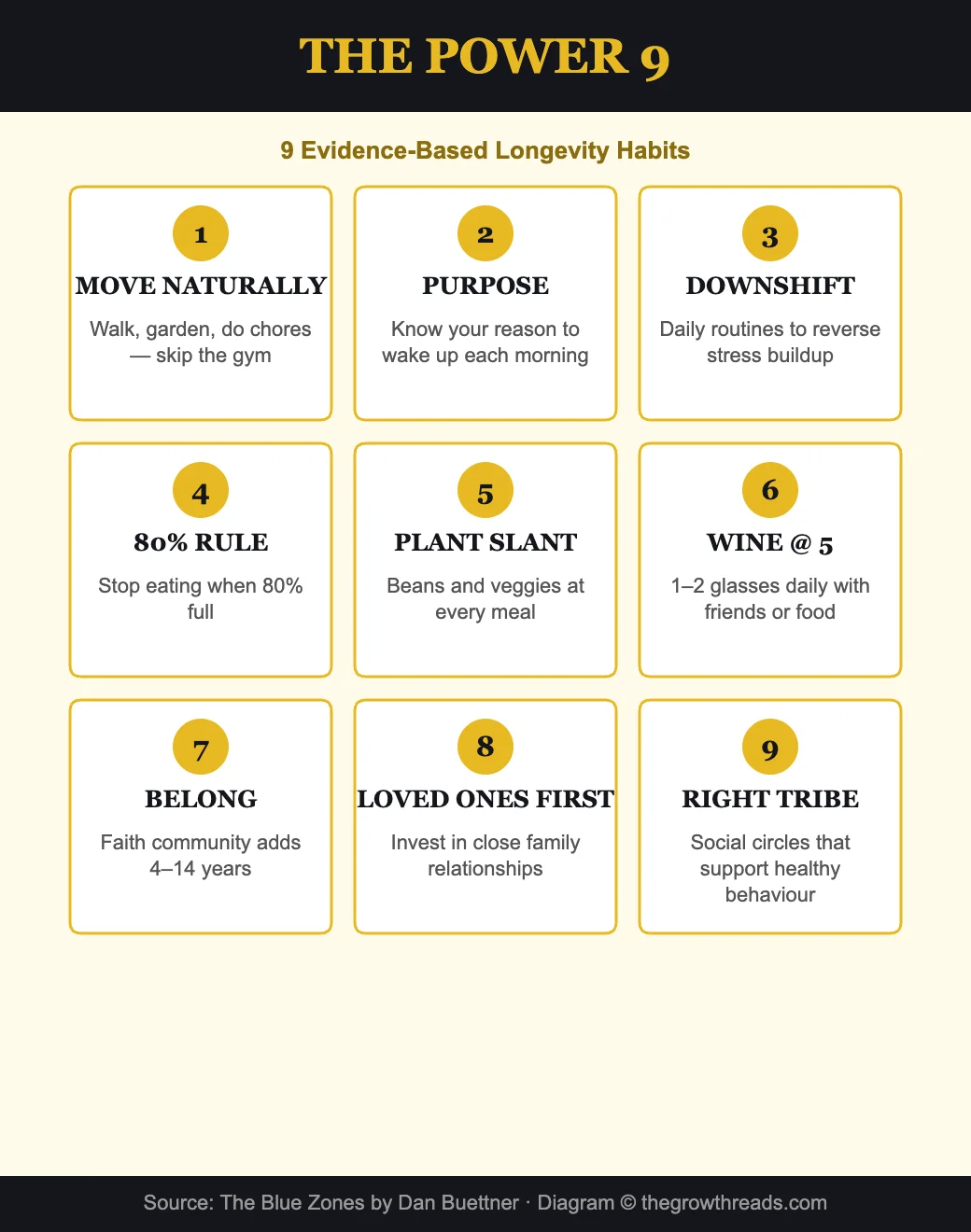
Move Naturally is the first principle, and it is perhaps the most counterintuitive to Western fitness culture. Centenarians do not “work out” — they walk to the store, knead bread by hand, tend gardens, and climb hills as part of daily life. The Sardinian shepherds who walk five miles a day over rough terrain have among the lowest cardiovascular disease rates in the world. The lesson is not that gyms are bad, but that structured exercise is a poor substitute for a life that requires constant low-intensity movement.
Purpose emerges as a surprisingly powerful predictor of longevity. The Okinawans call it “ikigai” and the Nicoyans call it “plan de vida” — both translate roughly to “reason to wake up in the morning.” A National Institutes of Health study found that people with a clear sense of purpose live up to seven years longer than those without one. Purpose need not be grand; for many centenarians, it is as simple as tending a garden, caring for grandchildren, or contributing to a weekly community meal.
The dietary pattern — Plant Slant and the 80% Rule — is remarkably consistent. Across all five zones, beans are eaten daily or almost daily. Meat is consumed in small portions, typically as a side dish or celebration food, roughly five times per month. The Adventists in Loma Linda who eat a fully plant-based diet live an additional two years beyond their meat-eating peers, who themselves already outlive the US average by a decade. The 80% Rule simply builds a caloric deficit into every meal without counting or tracking anything — a stark contrast to modern diet culture.
Part 3 — The social architecture of longevity
The final third of the book focuses on the social and psychological dimensions of the Power 9 — and this is where Buettner’s work departs most sharply from the individual-focused wellness industry. The data consistently shows that social connection is not a nice-to-have; it is a survival factor with effect sizes comparable to quitting smoking.
The Okinawan moai system is the most studied example. Groups of five children are paired together at age five and commit to supporting each other for life. These are not casual friendships — members share financial resources during hardship, provide emotional support during grief, and hold each other accountable for health behaviours. Framingham Heart Study data, which Buettner cites, confirms that obesity, smoking, and happiness all spread through social networks: if your three best friends are overweight, your own risk of obesity rises by 57%.
Faith-based community membership appears in every Blue Zone. Denomination does not matter — Adventist Christians, Catholic Sardinians, Greek Orthodox Ikarians, and Buddhist-influenced Okinawans all show the same longevity benefit, suggesting it is the practice of weekly belonging, shared ritual, and meaning-making that drives the effect rather than any specific doctrine. Studies suggest this adds 4–14 years of life expectancy.
Finally, Downshift — the daily practice of stress reversal — takes different forms in each zone but serves the same biological function. Sardinians have a daily happy hour. Adventists observe a 24-hour Sabbath from sunset Friday to sunset Saturday. Ikarians nap. Okinawans pause to remember ancestors. Each of these practices interrupts the cortisol-inflammation cycle that, left unchecked, accelerates aging and chronic disease. The mechanism is well understood: chronic inflammation damages telomeres, impairs immune function, and promotes the metabolic dysfunction underlying heart disease, diabetes, and cancer.
Who is The Blue Zones best for — and who should read something else first?
This book is perfect for readers who are tired of fad diets and biohacking trends and want a grounded, evidence-based approach to living longer. It is especially powerful for people in their 30s–50s who are designing the lifestyle habits that will carry them into old age. The narrative style — rich with travel writing and personal stories — makes it accessible even if you have no background in health science.
If you want deep clinical protocols rather than lifestyle principles, start with Outlive by Peter Attia. If you are specifically focused on nutrition science rather than the full lifestyle picture, How Not to Die goes deeper on the dietary evidence. And if sleep is your primary concern, Why We Sleep is more specialised.
Questions to reflect on
- How much of your daily movement comes from structured exercise versus natural activity built into your routine?
- Can you articulate your “ikigai” — your reason to wake up each morning — in a single sentence?
- If you applied the 80% rule to your next five meals, what would change?
- Who are the five people you spend the most time with, and do their health habits support or undermine yours?
- What is your daily “downshift” ritual — and if you do not have one, what could you adopt from the Blue Zone examples?
🔥 Ready to design your life for longevity?
Learn the nine habits that add years to your life from the world’s longest-lived communities.
How to apply The Blue Zones (7-day plan)
- Day 1 — Add natural movement: Replace one motorised trip with walking. Park farther from the store, take the stairs, or walk to a nearby errand. Track your step count as a baseline.
- Day 2 — Write your ikigai: Spend 15 minutes writing your personal “reason to wake up.” It does not need to be profound — “raising kind children” or “mastering woodworking” counts. Post it where you see it each morning.
- Day 3 — Try the 80% rule: At every meal today, pause when you feel 80% full and stop. Use a smaller plate if that helps. Notice how you feel 20 minutes later.
- Day 4 — Add beans to two meals: Replace one meat-based meal with a bean-based alternative. Try black beans with rice, lentil soup, or hummus with vegetables. Aim for at least half a cup daily.
- Day 5 — Build a downshift ritual: Choose one stress-reversal practice and do it at the same time today: a 20-minute nap, 10 minutes of prayer or meditation, or a slow walk without your phone.
- Day 6 — Invest in your moai: Reach out to one close friend or family member you have not connected with recently. Schedule an in-person meal, walk, or activity. Longevity is a team sport.
- Day 7 — Audit your environment: Walk through your home and identify one change that makes the healthy choice easier: move fruit to eye level, put walking shoes by the door, or set a “wine at 5” happy hour with a friend. Design your default.
Frequently asked questions
What are the five Blue Zones?
The five Blue Zones are Okinawa (Japan), Sardinia (Italy), Nicoya Peninsula (Costa Rica), Ikaria (Greece), and Loma Linda (California, USA). Each region was identified through demographic research showing statistically exceptional concentrations of centenarians. Despite being spread across four continents with no cultural contact, these populations share nine common lifestyle habits that contribute to their extraordinary longevity.
Do I need to go vegetarian to follow the Blue Zone diet?
No. Blue Zone populations are not vegetarian — they eat meat, but sparingly. The average centenarian consumes meat about five times per month, typically in small portions as a side dish rather than the centrepiece of a meal. The Loma Linda Adventists who eat fully plant-based do live the longest, but even the meat-eating residents of other Blue Zones significantly outlive Western averages. The key is making plants — especially beans — the foundation of your diet, not eliminating meat entirely.
How much of longevity is genetic versus lifestyle?
Buettner cites Danish twin studies suggesting that genes account for only about 20–25% of longevity, with the remaining 75–80% determined by lifestyle and environment. This is one of the book’s most empowering findings: the choices you make daily — what you eat, how you move, who you spend time with, and how you manage stress — have far more influence on your lifespan than the DNA you inherited. The Blue Zones demonstrate this at scale.
What is a moai and how do I create one?
A moai is an Okinawan tradition where a small group of friends (typically five) commit to supporting each other for life — emotionally, socially, and sometimes financially. To create a modern moai, identify 3–5 friends who share your values and health goals. Commit to meeting regularly (weekly or biweekly), establish mutual accountability around health behaviours, and agree to show up during difficult times. The key is consistency and genuine commitment, not casual socialising.
Is the Blue Zones research scientifically rigorous?
The demographic identification of the five zones used rigorous methods — birth certificates, death records, and census validation — and was published in peer-reviewed journals. The Power 9 framework is a synthesis of observational data, which means it identifies strong correlations rather than proving causation through controlled experiments. However, many individual findings (the health effects of plant-based diets, social connection, purpose, and stress management) are independently supported by large-scale clinical studies from Harvard, NIH, and the Framingham Heart Study.
Can I apply Blue Zone principles in a modern city?
Yes, and Buettner has tested this through the Blue Zones Project, which has been implemented in dozens of US cities. The approach focuses on environmental design: making walking easier, creating community gardens, establishing workplace wellness policies, and building social infrastructure. At the individual level, you can apply the principles by choosing to walk more, cooking with beans and vegetables, joining a community group, establishing a daily stress-relief ritual, and curating a social circle that supports healthy habits.
How does The Blue Zones compare to Outlive by Peter Attia?
The two books complement each other well. The Blue Zones takes a population-level, lifestyle-focused approach — observing what the longest-lived communities do naturally and extracting principles anyone can follow. Outlive takes a clinical, individual-focused approach — using biomarkers, advanced diagnostics, and targeted exercise protocols to optimise longevity. Blue Zones is the better starting point for most people because its recommendations are simpler to implement. Outlive is the next step for readers who want precision medicine and data-driven optimisation.
Related summaries
- Outlive by Peter Attia — A clinical approach to longevity through exercise, nutrition, sleep, and emotional health.
- How Not to Die by Michael Greger — The evidence for whole-food, plant-based eating to prevent the leading causes of death.
- In Defense of Food by Michael Pollan — “Eat food. Not too much. Mostly plants” — the simplest dietary principle ever written.
- Why We Sleep by Matthew Walker — The science of sleep as the foundation of health and longevity.
- See all Health book summaries on our Best Health Books pillar page.