

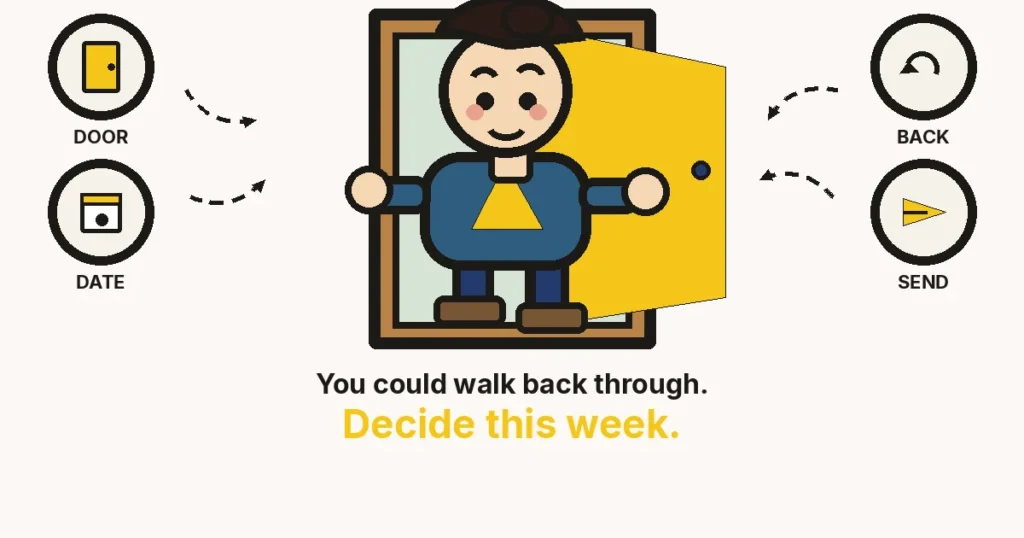
A decision you could undo is still waiting when you run a heavy process on a door you could walk back through. Jeff Bezos’s 2015 shareholder letter calls that a two-way door and says most decisions are that kind. Name the door, and the way back, before you wait.
Key takeaways
- A decision you could undo is still waiting when a heavy process sits on a door you could walk back through.
- Jeff Bezos, in the 2015 shareholder letter, calls consequential and irreversible decisions one-way doors, and he says those are made slowly, with deliberation and consultation.
- In that same 2015 letter, Bezos says most decisions are changeable two-way doors, and that a large organization tends to use the heavy process on those too.
- Bezos, in the 2016 letter published on 17 April 2017, says most decisions should probably be made with somewhere around 70 percent of the information you wish you had, and that waiting for 90 percent is probably slow.
- The door note and the sentences are an application for a solo founder or a new manager. The print book was not opened, and no sentence is taken from a numbered page.
What a decision you could undo is
A decision you could undo is still waiting when the choice is reversible and the process you are using assumes it is not. You are a solo founder. The next three proposals have not gone out. You could try a higher price on those three, and you could return to the old price the following Monday if the calls go badly. Instead you have a page of competitor numbers, a half-written explanation, and a note to yourself that says you will sleep on it. You are a new manager. The standup is a status round, and you want to try a different shape for two weeks. You could put the old agenda back on the third Monday. You have asked two more people what they think, and the trial still has no date.
The decision is one choice. The door is whether you can get back to where you were. A price on proposals you have not sent is a door you can reopen, if you say so. A standup you can restore is a door you can reopen, if the old agenda is still written down. A price you already promised in a signed note is not that door. A title you already announced to a client is not that door. The waiting is the heavy process: another document, another opinion, another night, while the reversible choice sits still.
This page starts before the trial has a sentence. The direction never gets written is the decision that was already spoken in a hallway and never put on a page. Here the trial has not started. Monday has no priority is which three items you will touch. Here the item is chosen, and the start is what you will not say. A problem you do not have yet is work for a future you are not in. The decision on this page is about work you already have.
What the letters say
Bezos’s 2015 letter says that a one-size-fits-all decision process is a pitfall, because most decisions are reversible and a heavy process on those decisions makes the company slow. The copy read on 20 November 2026 is the PDF named 2015-Letter-to-Shareholders on Amazon’s investor site, in full, including the 1997 letter attached at the end. The decision passage sits under the heading “Invention Machine.” The PDF states no study and no page number of a book.
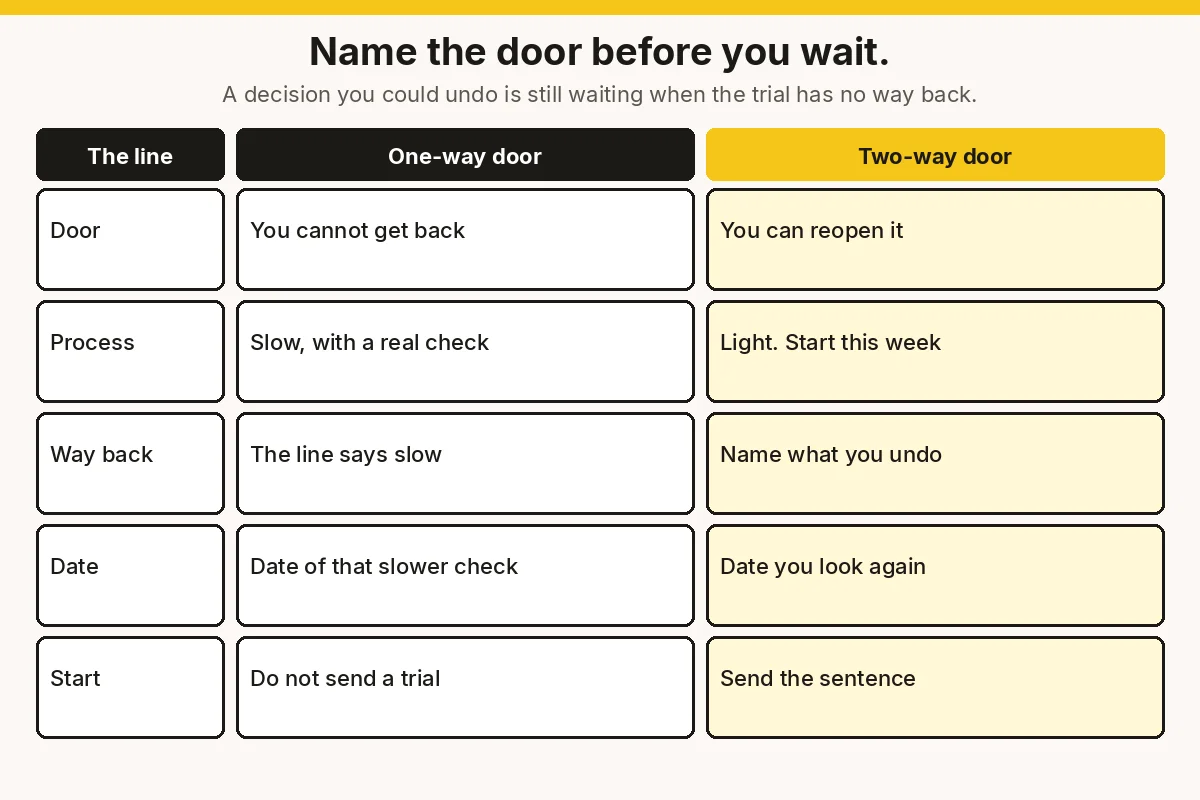
He separates two kinds. Some decisions are consequential and irreversible or nearly irreversible. He calls them one-way doors. If you walk through and do not like what you see on the other side, you cannot get back to where you were before. He calls these Type 1 decisions, and he says they must be made methodically, carefully, slowly, with great deliberation and consultation. Most decisions, he writes, are not like that. They are changeable and reversible. He calls them two-way doors. If you have made a suboptimal Type 2 decision, you do not have to live with the consequences for that long. You can reopen the door and go back through. Type 2 decisions, he says, can and should be made quickly by high judgment individuals or small groups.
He then names the tendency he is worried about. As organizations get larger, they use the heavy-weight Type 1 process on most decisions, including many Type 2 decisions. He says the end result is slowness, unthoughtful risk aversion, failure to experiment sufficiently, and consequently diminished invention. A footnote on that paragraph says the opposite situation is less interesting and that there is undoubtedly some survivorship bias. Any companies that habitually use the light-weight Type 2 process to make Type 1 decisions, he writes, go extinct before they get large. That footnote is his judgment. It names no count of companies, and it is not a study.
The 2016 letter, published on aboutamazon.com on 17 April 2017 and read in full the same day, points back to that passage. The page’s byline says the piece was written by Amazon Staff. The letter itself is signed Jeffrey P. Bezos, Founder and Chief Executive Officer. Under “High-Velocity Decision Making” he says never to use a one-size-fits-all decision-making process. Many decisions are reversible, two-way doors, and those can use a light-weight process. For those, he asks, so what if you are wrong? He says he wrote about this in more detail in last year’s letter.
His second point in that section is the line people turn into a rule. Most decisions should probably be made with somewhere around 70 percent of the information you wish you had. If you wait for 90 percent, in most cases, you are probably being slow. Either way, he says, you need to be good at quickly recognizing and correcting bad decisions. If you are good at course correcting, being wrong may be less costly than you think, whereas being slow is going to be expensive for sure. He does not define 70 percent as a score, a survey, or a worksheet. He does not say the line applies to a one-way door.
| What he separates | His words for the process | What this page will not borrow |
|---|---|---|
| One-way door, Type 1. Consequential, and irreversible or nearly irreversible. | Methodically, carefully, slowly, with great deliberation and consultation. | A reason to run that process on a trial you could undo. |
| Two-way door, Type 2. Changeable and reversible. You can reopen the door. | Quickly, by high judgment individuals or small groups. A light-weight process. | A reason to move quickly on a firing, a signed promise, or money you cannot recall. |
| Most decisions, in the 2016 letter. | Somewhere around 70 percent of the information you wish you had. Waiting for 90 percent is probably slow. | A score. He does not say how to measure the percent, and he does not put the line on a one-way door. |
| Real disagreement, in the 2016 letter. | The phrase “disagree and commit.” He says if you are the boss, you should do this too. | A way to end a one-way decision because you are tired of the argument. |
The door note
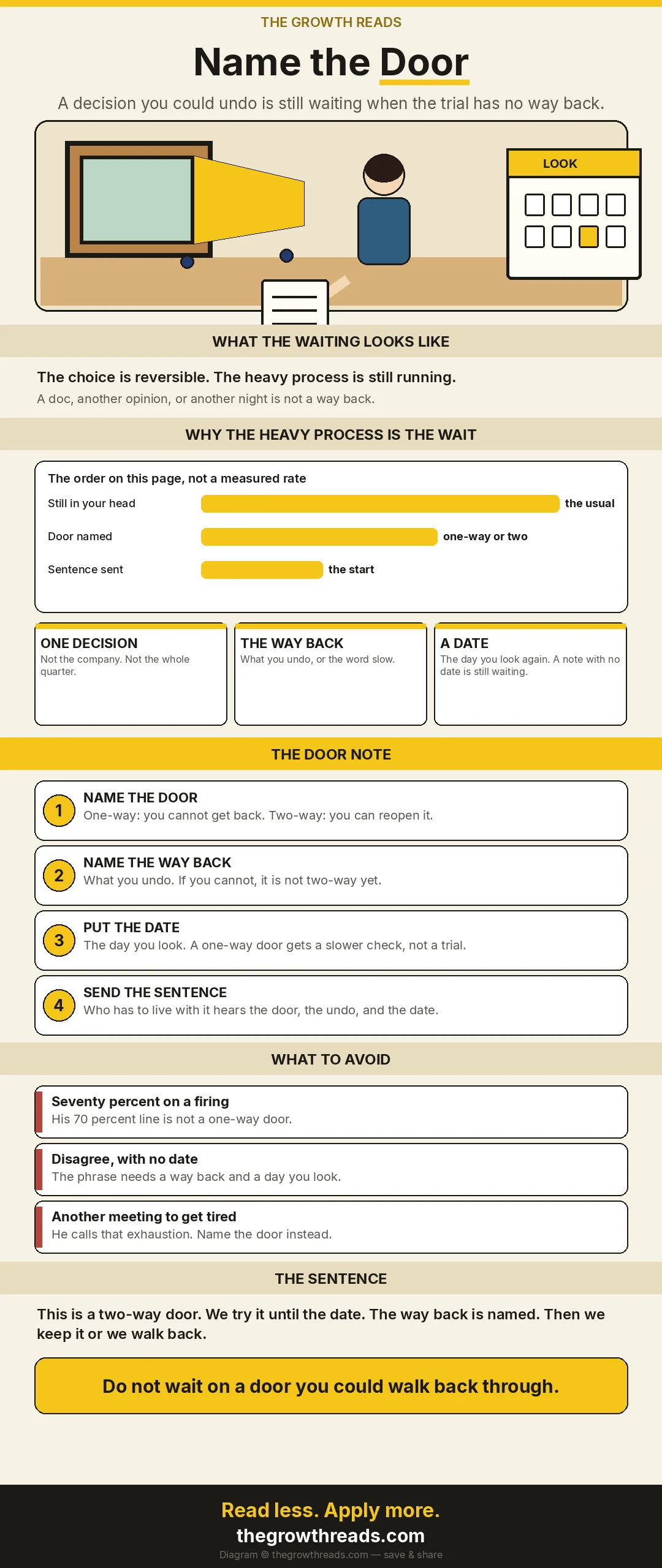
The door note is four lines for one decision: the door, the way back, the date, and the sentence that starts it. It is this page’s application. It is not a form in either letter. Write it for one choice you could make this week. If the choice is actually three choices, split it. A note that covers the quarter is the heavy process again.
1. The decision. One sentence. “Try the higher price on the next three proposals” is a decision. “Fix how we charge” is a theme. “Try a two-week standup that ends in one owner” is a decision. “Make the team more strategic” is a theme.
2. The door. One word: one-way or two-way. One-way means you cannot get back to where you were. Two-way means you can reopen the door. If you cannot say which, you are not ready for the light process, and you are also not ready to call the wait diligence.
3. The way back. If the door is two-way, name what you undo. The old price, the old agenda, the old owner of that inbox, the tool you cancel. If you cannot name the undo, it is not a two-way door yet. If the door is one-way, this line says “slow,” and the trial does not start.
4. The date. The day you look again. On a two-way door, that is the day you keep the trial or walk back. On a one-way door, that is the day of the slower check, not a start date. A note with no date is the decision still waiting.
Bezos says Type 2 decisions can be made quickly by high judgment individuals or small groups. He does not name the group for a two-person company. On this page the small group is the people who have to live with the trial. A founder alone can be that group. A new manager and the person whose week will change can be that group. A channel of twelve people asked for “thoughts” is the heavy process with an audience.
The sentence you send
The sentence names the door, the trial, the way back, and the date, and it goes to every person who has to live with it. Until that sentence exists, the decision is still in your head. A document of research is not the sentence. A meeting that ends with “let’s keep talking” is not the sentence.
Two-way. “This is a two-way door. We try [the trial] until [the date]. The way back is [the undo]. On that date we keep it or we walk back.”
One-way. “This is a one-way door. I am not starting a trial. The next step is [the slower check], and the date for that check is [the date].”
When you disagree, and the door is two-way. “I disagree and commit. We try your version until [the date]. The way back is [the undo].”
The third sentence uses his phrase, and it keeps the date and the undo that the phrase by itself does not include. In the 2016 letter he offers the words, “Look, I know we disagree on this but will you gamble with me on it? Disagree and commit?” He says that by that point no one can know the answer for sure. He also says this is not one way. If you are the boss, you should do it too. His example is an Amazon Studios original. He told the team his view, they wanted to go ahead, and he wrote back right away that he disagreed and committed. He says the example is not him thinking the argument was not worth chasing. It is a genuine disagreement, a candid view, a chance for the team to weigh it, and a quick commitment to go their way. The letter also gives a count of that team’s awards. This page does not use the count, and it does not treat a studio bet as a model for your price or your standup.
He has a fourth point, and it is the warning against waiting until someone is tired. Sometimes teams have different objectives and fundamentally different views. No amount of discussion, and no number of meetings, will resolve that deep misalignment. Without escalation, he says, the default is exhaustion. Whoever has more stamina carries the decision. “You’ve worn me down” is an awful decision-making process. It is slow and de-energizing. His scene for that is Amazon’s choice to let third-party sellers compete on its own product pages, which then set up hundreds of smaller decisions. A solo founder does not have that structure. The application on this page is smaller and labeled as ours: if you and one other person want different outcomes, another meeting is not a door. Say which objective is in force, or take it to the person who can decide. If that person is you, the sentence above is the escalation.
When you are the only person
You can be the heavy process by yourself, and a two-way door still needs a date you will actually open. There is no committee to blame. The consultation he describes for a one-way door becomes three friends, a rewritten page, and a feeling that you are being careful. If you can walk back, the small group is you. The speed is this week, not this quarter.
Write the four lines where you will see them on the date. A private note that you do not open is the same as a decision still in your head. Put the look-again date on the calendar before you send the sentence to yourself. On that date the only question is the one you wrote: keep it, or walk back. A new research question on that day is the heavy process returning.
The 70 percent line is the test for what you are waiting to learn, and only after the door is two-way. Write the one fact you wish you had. If that fact would not change the way back, you are in the slowness he calls expensive. If the fact is “can I undo this,” you do not have a two-way door yet, and the percent does not apply. He says you need to be good at recognizing and correcting a bad decision. The date is how this page holds that. It is not a claim that course correcting is free.
When the door is one-way
A one-way door stops the light process, including the 70 percent line and the disagree-and-commit sentence. His 2015 footnote is the reason. He says companies that habitually use the light-weight process on Type 1 decisions go extinct before they get large, and he calls that observation survivorship bias, not a tally you can copy. A solo founder is not those companies. The use here is the habit, not the scale: do not make a practice of treating a permanent choice as a quick trial.
On this page, these are one-way unless you can name a real undo. A price already sent. A signed scope. Money you cannot recall. A firing, or a title already told to a client. The seat no longer fits is the conversation for a person, and it is not a two-way door you close by stamina. A two-week trial of a different task can be two-way only if the person agrees and the old task is still theirs to take back. A surprise announcement is not that trial.
The build has no appetite is a time budget before the design grows. It does not tell you whether the decision to start is reversible. You are the bottleneck is the pile waiting on a decision you have not made. This page is for the one decision in that pile that you could undo, and that you are still decorating with a heavier process than the door requires.
Common mistakes
- Calling every nervous choice a one-way door, so the reversible trial never gets a date. The 2015 letter says most decisions are not like that.
- Calling every choice a two-way door because you want it started. If you cannot name the undo, the word two-way is a wish.
- Using “somewhere around 70 percent” on a firing, a signed promise, or money you cannot recall. He does not put that line on a one-way door.
- Saying “disagree and commit” with no date and no way back. His phrase saves time inside a reversible disagreement. It is not a closer for a permanent choice.
- Holding another meeting so the longer stamina wins. He calls “You’ve worn me down” an awful process. The meeting should have been a note when the sentence is the whole decision.
- Waiting for one more competitor’s price, one more opinion, or one more night when that fact would not change the undo. That is the wait for 90 percent, in his wording, and he says it is probably slow.
- Treating his letter’s company results, award counts, or the size of Amazon as a target. Those figures stay in the letters. They are not a bar for a two-person team.
What the source does and does not say
| In front of this page | What it supports | What it does not support |
|---|---|---|
| Jeff Bezos, the 2015 letter to shareholders, PDF read in full on 20 November 2026, including the attached 1997 letter. The 2016 letter, published 17 April 2017, read in full the same day. | One-way doors are slow and consulted. Two-way doors are reversible and can use a light process. Most decisions, in the later letter, should probably be made around 70 percent of the information you wish you had. Disagree and commit, including when you are the boss. Escalation beats exhaustion when objectives really differ. | A worksheet called 70 percent. A claim that the percent was measured. A count of extinct companies. Any instruction that a solo founder should copy Amazon’s studio bets, seller policy, or headcount. The door note and the three sentences, which are this page’s application. |
| Harvard Book Store’s page for ISBN 9781647820718, read on 20 November 2026. It lists Invent and Wander: The Collected Writings of Jeff Bezos, with an introduction by Walter Isaacson, Harvard Business Review Press, 17 November 2020, 288 pages, and describes the book as his shareholder letters plus speeches and interviews, co-published with PublicAffairs. | A real book that the store describes as collecting the shareholder letters. The letters checked above are the copy this page used. | Any ISBN confirmed on a copyright page. Any page number. Any claim that the printed wording matches the PDF or the web letter. The print book was not opened. Isaacson wrote the introduction in the store’s description. He is not the author of the letters. |
Frequently asked questions
What is a decision you could undo?
A decision you could undo is a choice you can walk back through. Jeff Bezos’s 2015 shareholder letter, read in full on 20 November 2026, calls that a two-way door: changeable, reversible, and not something you have to live with for long. You can reopen the door and go back through. The decision is still waiting when you already know the undo and you are still running a slow, consulted process as if the door were permanent. Name the door, the undo, and the date before you collect another opinion. The four-line note is this page’s application, not a form in the letter.
What does Bezos mean by a one-way door?
In the 2015 letter, a one-way door is a decision that is consequential and irreversible or nearly irreversible. If you walk through and do not like the other side, you cannot get back to where you were. He calls these Type 1 decisions and says they must be made methodically, carefully, slowly, with great deliberation and consultation. A signed promise, money you cannot recall, or a firing sits there unless you can name a real undo. His footnote calls the light process on these doors a path to extinction before a company gets large, and he names that survivorship bias, not a study.
Does the 70 percent line apply to every decision?
No. In the 2016 letter, published 17 April 2017, Bezos says most decisions should probably be made with somewhere around 70 percent of the information you wish you had. Waiting for 90 percent is probably slow. He does not define the percent, and he does not put it on a one-way door. Use the line only after the door is two-way. Write the one fact you are waiting for. If that fact would not change the way back, you are in the slowness he calls expensive. If the missing fact is the undo, you do not have a two-way door yet.
What sentence do you send on a two-way door?
Send one sentence to every person who has to live with the trial. “This is a two-way door. We try the trial until the date. The way back is the undo. On that date we keep it or we walk back.” A research page is not that sentence. A meeting that ends in another meeting is not that sentence. Bezos says a two-way door can use a light-weight process, and he asks, so what if you are wrong, because you can course-correct. The date is how you keep that correction real. He does not say the correction is free.
What if you are the only person in the company?
You can still be the heavy process. The consultation Bezos describes for a one-way door turns into extra drafts and another night when nobody else is in the room. If you can walk back, the small group he mentions can be you, and the speed is this week. Write the four lines where you will see them on the date, and put that date on a calendar you open. On the date, keep the trial or walk back. A new question on that day is the wait returning. A one-way door does not become light just because you have no colleague to consult.
Can you disagree and commit on a one-way door?
Not on this page. In the 2016 letter, “disagree and commit” is for a real disagreement where nobody can know the answer for sure, and he says the boss should be willing to use it too. His example is a studio decision he committed to in writing the same day. This page keeps the phrase for a two-way door that already has a date and a way back. Using it to close a firing, a signed promise, or an irreversible spend is the light process on a Type 1 decision, which his 2015 footnote warns against.
Is this the same problem as a direction that was never written?
No. A direction that was never written is a decision someone already spoke, usually in a hallway or a call, with no page the other person can start from. A decision you could undo is still waiting is earlier. The trial has not started, because you are treating a reversible choice as if walking back were impossible. If you already decided out loud, write the page that other article describes. If you have not started because you cannot name the undo, stay here and mark the door one-way. The two pages meet only at the sentence: a choice nobody else can read is still yours alone.
Did this page open Invent and Wander?
No. The text read on 20 November 2026 is the 2015 shareholder letter in the investor PDF, in full, including the attached 1997 letter, and the 2016 letter on aboutamazon.com, in full. The print book was not opened, so no page number is given. Harvard Book Store’s page for ISBN 9781647820718 lists Invent and Wander from Harvard Business Review Press on 17 November 2020, at 288 pages, and describes it as collecting the shareholder letters. That page count and that ISBN are the store’s listing. They were not checked on a copyright page. The door note and the sentences are an application, not a line in the letters.
Sources
- Jeff Bezos. 2015 Letter to Shareholders. Read in full on 20 November 2026 from the PDF named 2015-Letter-to-Shareholders at Amazon investor relations, including the 1997 letter attached in the same file. The decision passage is under “Invention Machine.” The file states no study and no book page. The door note is not in the letter.
- Jeff Bezos. 2016 Letter to Shareholders. Published 17 April 2017. Read in full on 20 November 2026 from aboutamazon.com/news/company-news/2016-letter-to-shareholders. The page byline says Amazon Staff. The letter is signed Jeffrey P. Bezos. It points to the prior year’s letter for the two-way door detail, and it contains the 70 percent line, “disagree and commit,” and the exhaustion warning.
- Harvard Book Store. Listing for ISBN 9781647820718, Invent and Wander: The Collected Writings of Jeff Bezos, with an introduction by Walter Isaacson. Read on 20 November 2026 from harvard.com/book/9781647820718. The page lists Harvard Business Review Press, 17 November 2020, 288 pages, and says the book collects his shareholder letters, speeches, and interviews, co-published with PublicAffairs. The print book was not opened. No sentence is taken from a numbered page.
Related reading on The Growth Reads
- The direction never gets written — the decision that was spoken and never put on a page
- Monday has no priority — three items, when the week is only a list
- A problem you do not have yet — the future problem you park, with a date to look again
- The build has no appetite — a time budget before the work grows
- You are the bottleneck — the pile that is waiting on a decision you have not made
- The seat no longer fits — a person, when the choice is not a two-week trial
- The meeting that should have been a note — when the sentence does not need another hour
- Productivity — the cluster this article sits in
- How we review — what a checked letter is, and what an unread page is not
How this was checked
Who it is for. A solo founder or a new manager who has one decision that could be undone, and who is still running a slow process on it.
What was read. Jeff Bezos, the 2015 letter to shareholders, in full, on 20 November 2026, from Amazon’s investor PDF, including the 1997 letter in the same file. His 2016 letter, in full, the same day, from the aboutamazon.com page dated 17 April 2017. Harvard Book Store’s listing for ISBN 9781647820718, the same day.
What was not read. The print edition of Invent and Wander. No page number, because the book was not opened. The store’s 288 pages and the ISBN are the listing, not a copyright page. No claim that the printed letters match the PDF or the web page. Walter Isaacson is the introduction in that listing, not the author of the letters.
Limit. The door note and the three sentences are our application. The 70 percent line is his “probably,” not a measured threshold, and it is not used here on a one-way door. The extinction footnote is his judgment about survivorship bias. It is not a count. His company results, award counts, and Amazon examples stay his. A person, a signed promise, and money you cannot recall do not become reversible because a letter about speed is useful somewhere else.
How we work: every article on The Growth Reads is built from books we have read and from primary accounts we can check, and it is date-stamped when those sources change. Read our methodology.